
电子

Search documents
——转债月报20260302:转债审批在加速,今年发行预测怎么看?-20260302
Huachuang Securities· 2026-03-02 04:06
1. Report Industry Investment Rating The provided text does not mention the industry investment rating. 2. Core Viewpoints of the Report - The implementation of the "Package of Measures to Optimize Refinancing" on February 9, 2026, by the Shanghai, Shenzhen, and Beijing Stock Exchanges may accelerate the issuance of convertible bonds in relevant sectors. Assuming the approval speed returns to the level before 2023, the expected issuance scale of convertible bonds in 2026 is 9.166 billion yuan [1][2][8]. - In March, the volatility of the equity market may increase, and defensive sectors may have short - term trading opportunities. The technology growth sector remains the main focus this year. The convertible bond market is currently at a historical high in terms of valuation, and the trading strategy should focus on capturing structural opportunities in the equity market, with a more cautious and neutral position [3]. - In February, the convertible bond market strengthened with small - cap styles leading, and the overall valuation increased by 2.01 pct. New bond issuance continued to be light, and the pace of new bond issuance plans slowed down [4]. 3. Summary According to the Directory 3.1 Convertible Bond Approval is Accelerating. How to Forecast This Year's Issuance? - The "Package of Measures to Optimize Refinancing" aims to guide capital market resources to gather towards technological innovation and new - quality productivity, which may accelerate the issuance of convertible bonds in relevant sectors. Since the fourth quarter of 2025, a non - seasonal recovery in convertible bond issuance scale has been observed [1][8][9]. - By analyzing the average time taken for each stage of convertible bond issuance, except for the relatively stable time from approval for registration to listing, the time taken for other stages increased significantly in 2024 and 2025 and began to recover significantly in the second half of 2025 [1][9]. - Assuming the approval speed returns to the level before 2023, the probabilities of completing the board proposal, shareholders' meeting approval, exchange acceptance, listing committee approval, and approval for registration within 2026 are 39.5%, 69.7%, 80.4%, 98.3%, and 99.3% respectively. After considering the probability of suspension of implementation, the expected issuance scale of convertible bonds in 2026 is 9.166 billion yuan [2][24][25]. 3.2 Key Convertible Bonds to Focus on in March - From January 30 to February 27, 2026, the convertible bond portfolio rose by 2.81%, outperforming the benchmark index by 3.66 pct. Huachen, Xingqiu, and Huayi in the portfolio had significant increases [30]. - In March, the "Huachuang Convertible Bond" focus portfolio was adjusted to include Xingqiu, Sanxia 2, Yirui, Huachen, Huayi, Yifeng, Bengang, Peiti, Ziyin, Qingnong, Chongyin, and Xingye [32]. 3.3 Strategy Outlook: Valuation Digestion is Underway, Returning to Prudent Neutrality - In March, due to global geopolitical instability and the Two Sessions, the volatility of the equity market may increase. Defensive sectors such as pharmaceutical consumption and transportation and public utilities with low valuations can be appropriately focused on. The technology growth sector, including AI, commercial aerospace, and humanoid robots, remains the main focus this year. With the unexpected recovery of PPI, attention should be paid to the price increases in chemicals, non - ferrous metals, energy, and electronic components [3][37]. - The convertible bond market's valuation is still at a historical high of 39%. The trading strategy for convertible bonds should focus on capturing structural opportunities in the equity market, and the overall position should return to a prudent and neutral level. It is recommended to avoid newly - issued convertible bonds with high valuations and double - high convertible bonds with unclear call expectations [3][42][43]. 3.4 Market Review: Convertible Bonds and Underlying Stocks Continued to be Strong, and Valuation Fluctuated Upward 3.4.1 Market Performance: Broad - based Indexes Generally Rose, and the Cyclical Sector Shined - In February, the convertible bond market strengthened, with small - cap styles leading. As of February 27, the Wind All - A Index rose by 2.34%, and the CSI Convertible Bond Index rose by 0.89%. The overall valuation increased by 2.01 pct month - on - month. Small - cap stocks were generally strong, with the CSI 300 rising by 0.09%, the CSI 500 rising by 3.44%, the CSI 1000 rising by 3.71%, and the CSI 2000 rising by 4.80% [49]. - The equity market remained active in February. Before the Spring Festival, there may have been profit - taking and risk - aversion sentiment. After the festival, the relaxation of Shanghai's real - estate control and the emphasis on economic construction in important meetings, as well as the calendar effect between the Spring Festival and the Two Sessions, strengthened the market's expectations for a "good start" and performance verification, and the margin trading balance increased rapidly [52]. 3.4.2 Capital Performance: Trading Activity in the Equity and Convertible Bond Markets Cooled, and the Margin Trading Balance Increased Rapidly After the Festival - From February 1 to February 27, 2026, the average daily trading volume of the CSI Convertible Bond Index was 75.423 billion yuan, a decrease of 18.04% compared with January 2026. The average daily trading volume of the Wind All - A Index was 2,310.723 billion yuan, a decrease of 24.11% compared with January 2026 [53]. - The margin trading balance showed a differentiated performance in February, increasing rapidly after the festival. As of February 26, 2026, the total margin trading balance in Shanghai and Shenzhen was approximately 2.66 trillion yuan, a decrease of 48.013 billion yuan compared with the end of January, but with a significant rebound after the festival. Most industries experienced net selling of margin trading funds [56]. 3.4.3 Convertible Bond Valuation: Valuation Rose Overall, with Small - Cap and Technology Sectors Stronger - As of February 28, 2026, compared with the end of January, the conversion premium rates of many industries increased. From the perspective of major sectors, most sectors' valuations increased, with the financial sector showing a relatively obvious increase. The average conversion premium rates of home appliances, agriculture, electronics, automobiles, and non - ferrous metals increased by 14.37, 1.40, 1.34, 1.21, and 0.55 pct respectively [58]. - Most rated and sized convertible bonds' valuations increased. As of February 28, compared with the end of January, the fitted premium rates of high - rated convertible bonds represented by AAA/AA + increased by 1.59 pct, medium - rated AA/AA - increased by 2.11 pct, and low - rated A/A - increased by 3.92 pct. In terms of size, the fitted premium rates of convertible bonds over 5 billion yuan increased by 1.70 pct, those in the 2 - 5 billion yuan (including 5 billion yuan) range increased by 1.56 pct, those in the 1 - 2 billion yuan (including 2 billion yuan) range increased by 1.40 pct, those in the 0.3 - 1 billion yuan (including 1 billion yuan) range increased by 1.71 pct, and those below 0.3 billion yuan (including) increased by 2.75 pct [66]. 3.5 Supply and Demand Situation: New Bond Issuance Continued to be Light, and the Pace of New Bond Issuance Plans Slowed Down 3.5.1 In February, 1 Convertible Bond was Issued, and 3 New Convertible Bonds were Listed - In February, the issuance of convertible bonds continued to be light, with the scale decreasing month - on - month. Only Haitian Convertible Bond was issued, with a scale of 801 million yuan. Aiwei, Longjian, and Shangtai Convertible Bonds were listed, with a total scale of 4.635 billion yuan [67]. - The online subscription for new convertible bonds decreased in February. The average effective subscription amount was 8.79 trillion yuan, a month - on - month decrease of 81.38%. The online winning rate was 0.0009%, a month - on - month decrease of 0.0018 pct [73]. - As of February 28, 2026, the total scale of convertible bonds to be issued was approximately 138.375 billion yuan. Five listed companies obtained approval for convertible bond issuance, with a planned issuance scale of 4.387 billion yuan. Seven convertible bond issuances had passed the review committee and were waiting for approval, with a total scale of 6.966 billion yuan. In February, five new board proposals were added, with a total scale of 12.42 billion yuan [74]. - In March 2026, the number and scale of convertible bonds to be delisted increased. As of February 27, the total balance was 16.459 billion yuan, and 14 convertible bonds would be delisted [81]. - Four convertible bonds' boards proposed downward revisions, and four convertible bonds announced the results of downward revisions. In February, 10 convertible bonds announced no downward revisions, and 15 convertible bonds announced expected downward revisions [84][85]. - In February, 12 convertible bonds announced early redemptions, many convertible bonds announced no early redemptions, and some convertible bonds announced that they were expected to meet the redemption conditions [88]. 3.5.2 In January, Holders on the Shanghai and Shenzhen Stock Exchanges Continued to Reduce Holdings, and Public Funds Performed Relatively Actively - The total scale of convertible bonds held by various entities on the Shanghai and Shenzhen Stock Exchanges further decreased, with a significant reduction on the Shenzhen Stock Exchange. In January, the total face value of convertible bonds held by the two exchanges was 558.832 billion yuan, a decrease of 8.06 billion yuan compared with the end of January, a decline of 1.46% [92]. - Public funds' holdings of convertible bonds increased, but their relative proportion decreased. In January, the total face value of convertible bonds held by public funds on the two exchanges was 240.076 billion yuan, a month - on - month increase of 6.88%, and the proportion was 44.08%, a month - on - month increase of 3.44 pct [94]. - Enterprise annuities' holdings of convertible bonds on the two exchanges decreased. In January, the total face value of convertible bonds held by enterprise annuities on the two exchanges was 83.843 billion yuan, a month - on - month decrease of 4.64%, and the proportion was 15.39%, a month - on - month decrease of 0.51 pct [94]. - Securities companies' holdings of convertible bonds on the two exchanges decreased. On the Shanghai Stock Exchange, the face value of convertible bonds held by securities companies' proprietary trading decreased by 0.07% compared with the end of January, and the proportion increased by 0.07 pct month - on - month. The face value of convertible bonds held by securities companies' asset management decreased by 6.74% compared with the end of January, and the proportion decreased by 0.24 pct month - on - month. On the Shenzhen Stock Exchange, the face value of convertible bonds held by securities companies' proprietary trading decreased by 1.16% compared with the end of January, and the proportion increased by 0.03 pct month - on - month. The face value of convertible bonds held by securities companies' collective asset management decreased by 5.20% compared with the end of January, and the proportion decreased by 0.09 pct month - on - month [95].
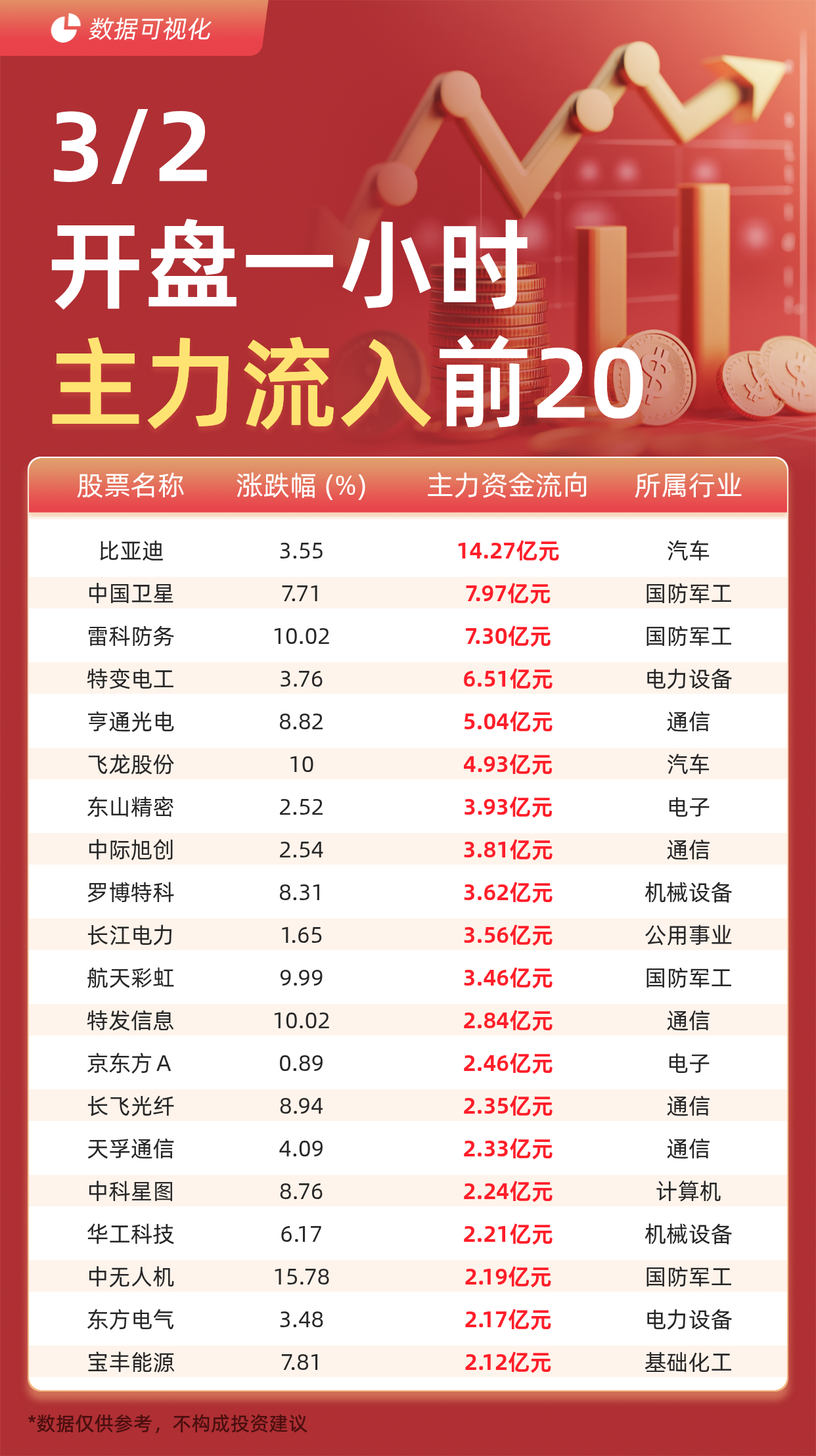
主力资金流入前20:比亚迪流入14.27亿元、中国卫星流入7.97亿元
Jin Rong Jie· 2026-03-02 02:59
Core Insights - The main focus of the news is the significant inflow of capital into various stocks, indicating strong investor interest in specific sectors and companies. Group 1: Stock Performance and Capital Inflow - BYD saw a capital inflow of 1.427 billion, with a price increase of 3.55% [1][2] - China Satellite experienced a capital inflow of 0.797 billion, with a price increase of 7.71% [1][2] - Aerospace Rainbow had a capital inflow of 0.346 billion, with a price increase of 9.99% [1][2] - The stock with the highest capital inflow was BYD, followed by China Satellite and Raytheon Defense [1][2] Group 2: Sector Analysis - The automotive sector, represented by BYD and Feilong Co., showed strong performance with inflows of 1.427 billion and 0.493 billion respectively [1][2] - The defense sector, including China Satellite and Raytheon Defense, also attracted significant capital, with inflows of 0.797 billion and 0.730 billion respectively [1][2] - The communication sector, represented by companies like Hengtong Optic-Electric and Tianfu Communication, saw inflows of 0.504 billion and 0.233 billion respectively [1][2][3]







2026年3月策略观点:春归-20260302
EBSCN· 2026-03-02 02:46
Group 1 - The report indicates a transition from a volatile fourth quarter to a spring market rally, with February showing initial fluctuations followed by a recovery, attributed to pre-holiday trading slowdown and short-term policy impacts [3][5][11] - The spring market is expected to continue, with increased trading activity post-Chinese New Year, supported by upcoming economic data releases and the National People's Congress in March, which will set the policy tone for the year [3][46][50] - The report suggests focusing on growth and cyclical sectors, with small-cap stocks likely to outperform due to increased risk appetite and the influx of retail investors, highlighting sectors such as humanoid robots, computing, and AI as key areas of interest [3][88][90] Group 2 - The report emphasizes the importance of monitoring external uncertainties, particularly geopolitical tensions in the Middle East, which could impact market sentiment and performance [3][76][78] - It notes that historical patterns show small-cap stocks tend to perform better during spring rallies, with a significant focus on growth and cyclical sectors based on past performance trends [3][88][90] - The report outlines specific policy measures in Shanghai aimed at stabilizing the real estate market, which may influence investor sentiment and market dynamics [67]
中国权益策略周报:稳定是如今中国股市的底色
GUOTAI HAITONG SECURITIES· 2026-03-02 02:35
Market Stability - Stability is the current backdrop of the Chinese stock market, with the Shanghai Composite Index recently stabilizing and recovering[7] - The geopolitical situation in the Middle East has limited impact on the index, and the market is expected to show a positive trend[7] - The Chinese government's increasing strength in national power, military, and governance contributes to the current stability of the economy and stock market[7] Economic Outlook - The upcoming National People's Congress is expected to lead to better-than-expected arrangements for deficit rates and local government special bonds, which will stabilize the real estate market[11] - In January and February 2026, the issuance of new special bonds reached CNY 0.83 trillion, a year-on-year increase of 39.6%, which is expected to boost economic activity[11] - The construction resumption rate and funding availability have increased by 1.5% and 3.7% year-on-year, respectively, indicating a positive trend in economic recovery[11] Sector Recommendations - The financial sector, particularly banks and non-bank financial institutions, is recommended for investment due to its stabilizing role in the market[22] - Emerging technologies, especially in AI and autonomous control, are highlighted as key investment areas, with recommendations for sectors like machinery, electronics, and defense[22] - Value sectors such as materials, oil transportation, and chemicals are expected to benefit from the domestic investment recovery and improving physical workload[22] Risk Factors - Potential risks include an unexpected global economic recession and uncertainties in global geopolitical situations[4]
另类投资策略周度跟踪:长期继续看多黄金,短期关注原油和铜-20260302
Huafu Securities· 2026-03-02 00:57
Core Insights - The report maintains a long-term bullish outlook on gold while suggesting short-term attention on oil and copper [2] - A-shares sentiment index is rising, while Hong Kong stocks sentiment index is declining, leading to a bullish position on A-shares and a neutral stance on Hong Kong stocks [2] - Current institutional focus is on basic chemicals and the automotive industry, with a decrease in attention towards non-bank financial sectors [2] A-shares and Hong Kong Stocks Sentiment Tracking - The A-shares sentiment index has increased, and the VIX for the Shanghai 50, CSI 300, CSI 500, and CSI 1000 has decreased, indicating a bullish timing strategy for A-shares [2][5] - The Hong Kong stocks sentiment index has decreased, leading to a neutral timing strategy for the Hang Seng Index [2][14] Institutional Research and Crowding Indicators - Current institutional focus is on the electric power and public utilities and automotive sectors, while attention towards retail and non-bank financial sectors has decreased [26] - Recent increases in institutional attention have been noted in coal, electric power and public utilities, banking, non-bank financials, and media sectors [27] - Several industries, including oil and petrochemicals, non-ferrous metals, steel, basic chemicals, and building materials, are at the threshold of crowding indicators [36][37] A-shares Style and Sector Allocation - The current allocation based on the A-shares industry and style rotation index favors media, electronics, automotive, and agriculture, forestry, animal husbandry, and fishery sectors [42] Commodities - The VIX for gold and silver has decreased from high levels, while copper and oil are experiencing high volatility [44] - The report maintains a long-term bullish outlook on gold due to declining U.S. real interest rates, increased market volatility, rising geopolitical risks, and growing demand for gold [50]
A股2月收官,沪指月线斩获3连阳
Dongguan Securities· 2026-03-01 23:32
Market Overview - The A-share market closed February with the Shanghai Composite Index achieving three consecutive monthly gains, closing at 4162.88, up 0.39% [1] - The Shenzhen Component Index and the ChiNext Index showed slight declines, with the former down 0.06% and the latter down 1.04% [1] Sector Performance - The top five performing sectors included Steel (up 3.37%), Coal (up 3.20%), and Non-ferrous Metals (up 3.10%), while the worst performers were Building Materials (down 1.45%) and Communication (down 1.38%) [2] - Notable concept indices that performed well included Lead Metal, Zinc Metal, and Cobalt Metal, while sectors like National Big Fund Holdings and PCB Concepts lagged [2] Future Outlook - The market showed mixed performance with significant trading volume, reaching 2.5 trillion, indicating a slight decrease but maintaining above 2 trillion for four consecutive days [5] - Technical analysis suggests a strong overall market sentiment, with the Shanghai Composite Index stabilizing above short-term moving averages and MACD in a bullish zone [5] - The upcoming Two Sessions are expected to positively influence the market, supported by policy expectations and improving corporate earnings, particularly in cyclical sectors and technology [5]
观点全追踪(3月第1期):晨会精选-20260302
GF SECURITIES· 2026-03-01 23:30
Core Insights - The report highlights the evolution of power PCBs from a single substrate role to a "functional carrier board," with high-density integration being a core trend. The demand for high integration and verticalization in onboard power is driving revolutionary changes in PCBs [3]. Industry Analysis - The report discusses the transition of power PCBs towards high-density, passive component embedding, with examples such as Zhongfu Circuit integrating 14-18 layers within a 17x23mm size, requiring advanced PCB technologies to support over 800W power transmission [3]. - It emphasizes the embedding of power modules into PCBs to achieve Integrated Voltage Regulation (IVR) functionality, moving from traditional dispersed power management components to highly integrated solutions within a single chip or package [3]. - The report notes that the future of power PCBs will involve adopting mSAP technology for finer line widths and spacing to facilitate the packaging and embedding of IVR functions, indicating a shift towards more multifunctional roles for power PCBs [3].
3月是涨价窗口,重视电子通胀链、油链、顺周期品种
SINOLINK SECURITIES· 2026-03-01 12:57
Investment Rating - The report suggests a positive outlook for the electronic inflation chain and oil chain sectors, indicating potential price increases and strong demand in various materials [1][2][3]. Core Insights - The electronic inflation chain is expected to see price increases in multiple products such as electronic cloth and copper foil due to strong demand from AI materials and new product launches [1][12]. - The oil chain is impacted by rising oil prices, leading to cost adjustments in products like asphalt, with companies like Dongfang Yuhong announcing price hikes of 5%-10% [2][13]. - Companies like Keda, Huaxin, and Leshushi are well-positioned for international expansion into regions like Africa and South America, with significant projects underway [3][14]. Summary by Sections Electronic Inflation Chain - March is anticipated to witness price increases in electronic materials due to strong demand from both AI and non-AI sectors, with successful price transmission expected [1][12]. - The report highlights the ongoing trend of AI displacing traditional production capacities in various segments, including copper foil and electronic cloth [1][12]. Oil Chain - The report outlines two main impacts of rising oil prices: direct cost adjustments in products linked to oil prices and the economic viability of coal chemical alternatives [2][13]. - Companies are advised to monitor price adjustments and capital expenditures in the coal chemical sector as they may provide business growth opportunities [2][13]. International Expansion - The report emphasizes the importance of local manufacturing and demand resonance in international markets, particularly in Africa, where companies are establishing production facilities to meet local needs [3][14]. - Leshushi's inclusion in the Hang Seng Composite Index is noted as a significant milestone, with implications for its market visibility and liquidity [3][14]. Market Performance - The report provides insights into the performance of various construction materials, with cement prices averaging 339 RMB/ton, showing a year-on-year decrease of 52 RMB/ton [4][15]. - The glass market is experiencing price fluctuations, with the average price of float glass at 1164.62 RMB/ton, reflecting a slight increase [4][15]. Price Changes - Cement prices have seen a slight decline due to seasonal factors, while the glass market is characterized by mixed performance across different regions [4][15][26]. - The report indicates that the overall construction material index has shown a positive trend, outperforming the broader market indices [18][22].


北交所策略周报(20260223-20260301):广信科技等调入北证50指数,美伊局势升温加强通胀交易线-20260301
Shenwan Hongyuan Securities· 2026-03-01 12:51
Group 1 - The core viewpoint of the report indicates that the North Exchange 50 Index has increased by 0.48%, but the average daily trading volume has decreased by 3.3% after the Spring Festival, suggesting a weak trading atmosphere [6][10][11] - The report highlights that the main trading theme in the A-share market is "real asset re-inflation," with a focus on cyclical and military-related stocks, particularly in light of the escalating US-Iran tensions [7][10] - The North Exchange 50 Index will undergo a new adjustment, with companies such as Guangxin Technology being added, effective from March 16 [7][10] Group 2 - The report notes that the North Exchange's trading volume for the week was 2.917 billion shares, a decrease of 18.41% compared to the previous week, and the trading amount was 71.825 billion yuan, down 22.66% [14][15] - The report states that 193 stocks on the North Exchange rose, while 96 fell, resulting in a rise-to-fall ratio of 2.01, with *ST Yunchuang and Keli Co., Ltd. leading the gains [26][34] - The report mentions that the average PE (TTM) for the North Exchange is 94.68 times, with a median of 46.13 times, indicating a slight increase [12][17] Group 3 - The report details that one new stock, Tongbao Optoelectronics, was listed this week, with a first-day price increase of 70.01% and a trading volume of 5.54 billion yuan [19][33] - The report indicates that three companies were newly listed on the New Third Board, while seven were delisted, with no new financing planned or completed during the week [36][38] - The report highlights that the strong stock proportion on the North Exchange has risen to 38% [13]
北交所策略周报:广信科技等调入北证50指数,美伊局势升温加强通胀交易线-20260301
Shenwan Hongyuan Securities· 2026-03-01 12:15
Group 1 - The core viewpoint of the report indicates that the North Exchange 50 index rose by 0.48% during the week, but the average daily trading volume decreased by 3.3%, suggesting a weak trading atmosphere post the Spring Festival [8][12]. - The report highlights that the main trading theme in the A-share market is "real asset re-inflation," with a focus on cyclical and military-related stocks, especially in light of the escalating US-Iran tensions which are expected to boost commodity prices [9][12]. - The North Exchange 50 index will undergo a new adjustment, with Guangxin Technology, Tiangong Co., and Jikang Technology being added, effective from March 16 [9][12]. Group 2 - The report notes that 193 stocks on the North Exchange rose, while 96 fell, resulting in a rise-to-fall ratio of 2.01, with *ST Yunchuang and Keli Co. leading the gains [28]. - The average PE (TTM) for the North Exchange is reported at 94.68 times, with a median of 46.13 times, indicating a relatively high valuation compared to other exchanges [14][19]. - The trading volume for the North Exchange was 2.917 billion shares, a decrease of 18.41% week-on-week, with a total trading value of 71.825 billion yuan, down 22.66% [16][17]. Group 3 - This week, one new stock, Tongbao Optoelectronics, was listed on the North Exchange, with a first-day price increase of 70.01% [21]. - The report mentions that three companies were newly listed on the New Third Board, while seven were delisted, with no new financing planned or completed during the week [39][41]. - The report emphasizes the importance of monitoring stocks such as Litong Technology, Zhongyu Technology, and others in the cyclical and military sectors due to the current market conditions [9][12].