
TMT

Search documents
【脱水研报】对比历史上成长板块上行波段,探讨当前科技行情位置和节奏
申万宏源研究· 2025-09-06 12:04
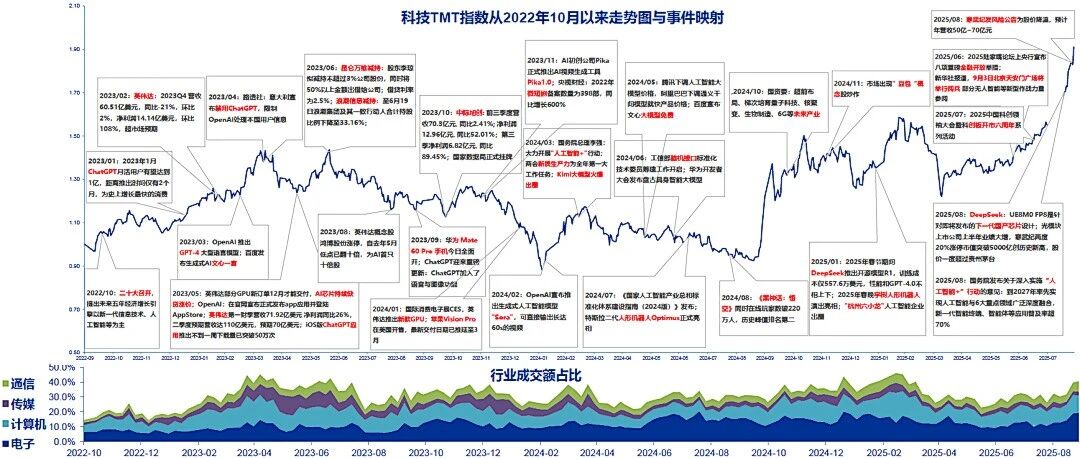
Core Conclusion - The current technology market is experiencing a fourth wave, which has reached a point of crowding risk, and after a period of consolidation, a fifth wave is anticipated [2][3]. Historical Comparison - The technology index has risen nearly 60% over approximately 100 trading days since the adjustment in April 2025, which is comparable to previous growth phases [4]. - Historical data shows that previous growth phases in the technology sector typically lasted around 70 trading days with similar average gains of about 60% [4]. - Adjustments before the initiation of the next wave typically take 30-40 trading days, with pullbacks ranging from 15% to 30% [4]. Market Sentiment and Trading Activity - As of the end of August, the technology sector accounted for 40.7% of total trading volume, surpassing the previous high of 38.5% in October 2024 [8]. - The average turnover rate for TMT stocks in August was 6.3%, close to the levels seen in early 2019 and 2020 [8]. - The financing balance for the technology sector reached 28.1% by the end of August, exceeding the previous high of 27.9% at the beginning of the year [8]. Future Outlook - The current AI market has seen significant growth since the low point on April 9, with sector gains ranging from 50% to 100% [11]. - There is an expectation for a consolidation phase before the emergence of the fifth wave, with a focus on technology applications such as smart driving, fintech, and robotics [11].

德邦证券程强:“强国叙事”支撑A股慢牛,大量宽基指数估值仍不算高
券商中国· 2025-09-06 10:44
Core Viewpoint - The recent performance of the Chinese stock market is driven by the unfolding of the "strong country narrative," which has enhanced market risk appetite and led to a reassessment of Chinese assets [1][3]. Group 1: Market Valuation and Investment Opportunities - A-shares and Hong Kong stocks have emerged from low valuation levels, but many broad-based indices still have room for growth, indicating that the Chinese capital market remains a value trap compared to global markets [2][5]. - The long-term outlook is positive for sectors such as technology, high-end manufacturing, and new consumption, which align with China's economic transformation [2][4]. - As of September 4, 2025, the dynamic price-to-earnings (PE) ratio for major A-share indices ranges from 12 to 39 times, with the Shanghai Composite Index at a relatively low PE of 11.8 times [5]. Group 2: Sector Performance and Economic Transition - The Chinese economy is transitioning from an investment and export-driven model to one focused on consumption, particularly in areas that enhance the quality of life for citizens [4]. - Despite an overall slowdown in profit growth, structural opportunities exist in high-growth sectors such as TMT (Technology, Media, and Telecommunications) and high-end manufacturing, which are seen as key drivers of the "manufacturing powerhouse" initiative [6][7]. Group 3: Policy Impact and Market Dynamics - The "anti-involution" policy aims to improve competition in manufacturing sectors like automotive and photovoltaic industries, potentially benefiting from a more favorable competitive landscape [8][10]. - The "anti-involution" initiative is viewed as a long-term strategic design rather than a temporary measure, with expectations of a "Davis double hit" for midstream manufacturing firms as the policy effects materialize [10][11].

中金研究 | 本周精选:地缘经济论、策略
中金点睛· 2025-09-06 01:09
Group 1 - The concept of geoeconomics has evolved from an academic idea to a significant topic in global economic and policy discussions, highlighting the shift from cooperation to competition in the international economic order [6] - Geoeconomic competition emphasizes the importance of economies of scale in international trade and global supply chains, with technology becoming a core area of competition among nations [6] - The zero-sum nature of geoeconomic competition suggests that one party's gain often comes at the expense of another, increasing the significance of absolute economic size [6] Group 2 - Since the implementation of "reciprocal tariffs" in early April, concerns regarding U.S. inflation, stock market prospects, and Federal Reserve interest rate cuts have persisted, yet the U.S. stock market continues to reach new highs [8] - The mainstream view has misjudged the impact of tariffs on U.S. stocks and inflation by focusing too much on the end effects of tariffs rather than the transmission process and the allocation of tariff revenues [8] Group 3 - The upward trend since September 2024 continues, with the U.S. Federal Reserve in a rate-cutting cycle and increasing downward pressure on U.S. demand [10] - The current turnover rate of over 5% indicates potential short-term volatility, but historical trends suggest that such periods do not typically alter mid-term market performance [10] Group 4 - Rapid increases in trading volume often indicate a quick rise in investor risk appetite, leading to short-term adjustments without changing the mid-term trend [12] - Historical data shows that after adjustment periods, indices tend to exhibit a pattern of oscillating upward, surpassing previous highs [12] Group 5 - In the first half of 2025, A-share companies reported a 2.8% year-on-year increase in profits, with the non-financial sector seeing a slight 1.5% growth [14] - Key sectors such as TMT, non-ferrous metals, and certain midstream areas performed well, contributing positively to index performance [14] - Financial metrics indicate stable performance, with improvements in cash flow and capital expenditure, while the overall profitability still requires enhancement [14]
估值与业绩是否匹配?多家券商机构研判A股后期投资机会
Huan Qiu Wang· 2025-09-06 00:34
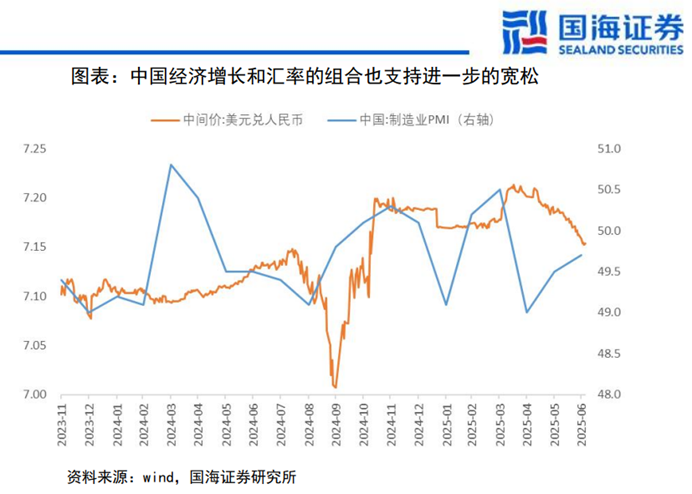
Group 1 - The core viewpoint of the articles indicates that the A-share market is experiencing a rebound, particularly in the new energy sector, with lithium batteries, energy storage, and CPO concepts leading the gains [1] - According to Galaxy Securities, the current valuation levels of A-shares are generally aligned with overall performance, but there are significant differences across industries. The overall market valuation remains within a reasonable range, with some industries being overvalued while others are undervalued but showing clear profit improvements [1] - Guohai Securities emphasizes the importance of monitoring the potential for index breakthroughs and upward shifts in the second half of the year, driven by liquidity and valuation. A global monetary and fiscal easing is anticipated, with growth expected to outperform value, leading to a potential global economic recovery next year [1] Group 2 - Investment recommendations from Guohai Securities highlight the need to focus on technology growth while also considering "anti-involution" investment opportunities. The report points out that "China's advantages" and reform dividends are becoming evident, with numerous opportunities in new productive forces [3] - The sectors suggested for attention include TMT (Technology, Media, and Telecommunications), military industry, and pharmaceuticals, with thematic focus on stablecoins, nuclear fusion, robotics, and solid-state batteries. The financial sector is also deemed worthy of attention during the index breakthrough period [3] - The push for "anti-involution" is expected to boost the performance of upstream resource sectors and enhance the overall quality dividend success rate, suggesting investment opportunities in dividend expansion [3]
近期调整属于“牛回头”,慢牛主基调仍在
HUAXI Securities· 2025-09-05 09:08
Core Viewpoints - The recent adjustment in the A-share market is seen as a "bull market pullback," with the underlying trend of a slow bull market remaining intact [2][4] - The A-share market has experienced a significant rise over the past five months, leading to profit-taking among investors, which is a common occurrence after substantial gains [2][3] - The acceleration of the market in August, driven by concentrated capital in the computing power sector, has increased volatility, with a notable rise in financing activities [3][4] Summary by Sections Recent Market Adjustment - From September 2 to September 4, the A-share market saw considerable fluctuations, with the Shanghai Composite Index dropping by 2.83% and the Wind All A Index falling by 4.62%, while trading volume decreased to below 3 trillion yuan [1] - The major indices, including the Sci-Tech 50 Index and the ChiNext Index, led the declines, with only the banking index showing an increase [1] Reasons for Market Adjustment - The A-share market has been on an upward trend for five months, with a cumulative increase of 32.17% from April 8 to September 1, leading to profit-taking as investors sought to realize gains [2] - The market's rise in August was characterized by a concentration of funds in leading stocks from the Sci-Tech and ChiNext boards, resulting in a record net inflow of financing funds amounting to 274.4 billion yuan [3] Market Outlook and Investment Strategy - The current pullback is viewed as a short-term correction within a broader bull market, supported by strong policy backing and a stable influx of long-term capital from insurance and pension funds [4] - The report suggests that the "slow bull" market still has ample space and opportunities, with sectors aligned with national strategies, such as innovative pharmaceuticals, solid-state batteries, energy storage, and robotics, expected to benefit from valuation premiums [4]
宝盈人工智能股票A:2025年上半年利润4172.68万元 净值增长率9.05%
Sou Hu Cai Jing· 2025-09-04 13:49
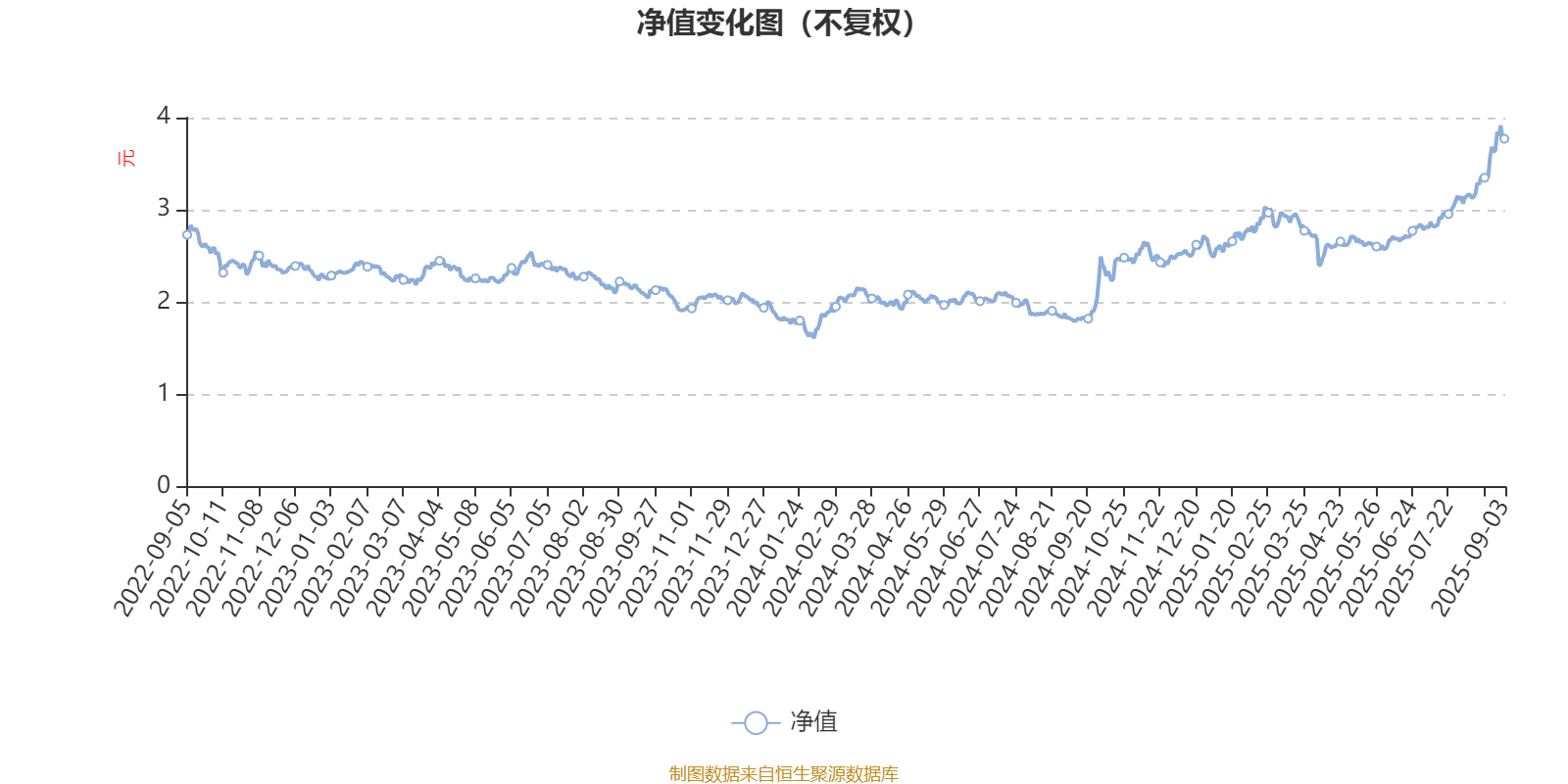
AI基金宝盈人工智能股票A(005962)披露2025年半年报,上半年基金利润4172.68万元,加权平均基金份额本期利润0.1911元。报告期内,基金净值增长率 为9.05%,截至上半年末,基金规模为6.11亿元。 该基金属于标准股票型基金,长期投资于TMT股票。截至9月3日,单位净值为3.771元。基金经理是张天闻,目前管理的4只基金近一年均为正收益。其中, 截至9月3日,宝盈人工智能股票A近一年复权单位净值增长率最高,达105.4%;宝盈智慧生活混合A最低,为72.36%。 基金管理人在中期报告中表示,从中长期角度进行后续展望,我们认为科技板块投资机会仍会持续。CHATGPT 的出现和Deepseek 的发展,使得 AI 在应用 端进一步落地,极大强化了市场对于科技的投资热情。本基金主要投资于人工智能相关的行业及公司,我们认为人工智能在各行业应用落地将带动整体 TMT 四大行业(电子、通讯、计算机和传媒互联网)的新一轮发展,我们会进一步增加人工智能相关的持仓。 截至9月3日,宝盈人工智能股票A近三个月复权单位净值增长率为46.41%,位于同类可比基金23/62;近半年复权单位净值增长率为34.16%,位 ...
波动加大,莫慌!下一波机遇在这里!
格隆汇APP· 2025-09-04 10:25
Group 1 - The current valuation of the Shanghai Composite Index is approximately 15.2 times P/E, which is at the 88th percentile level since 2010, indicating that only 12% of the time in the past 15 years has the valuation been higher than now [2] - The equity risk premium for the Shanghai Composite Index is about 0.5 percentage points, which is at the 50th percentile level since 2010, suggesting that current stock investments are neither particularly cheap nor expensive compared to government bonds [3] - The contradiction of "high valuation but not extreme premium" is fundamentally due to the changes in the interest rate environment, which has led to a reconfiguration of the valuation system [4] Group 2 - Industry valuations show significant differentiation, with many sectors not reaching historical extremes despite high overall index valuations [6] - The TMT sector has a P/E of approximately 45.2 times, which is at the 75th percentile since 2010, and is significantly lower than its peak of 90 times in 2021 [7] - The semiconductor sector has a P/E of 42.5 times, still below its peak of 70 times in 2020, indicating room for growth [7] Group 3 - The total margin financing balance reached a historical high of 230.56 billion yuan on September 1, but the proportion of margin financing to the total A-share market capitalization is only 2.45%, indicating that leverage is not excessively high [10] - The trading volume of margin financing accounts for 11.8% of total market transactions, which is lower than the peak of 15% in 2015, suggesting that leverage trading activity remains within a reasonable range [13] - The consensus is that the mid-2025 earnings report may represent the low point for the year, with subsequent quarters expected to show improvement [16] Group 4 - The TMT sector is expected to lead the market in September, supported by policy, technology, and funding catalysts [19][22] - The government has set a target for the digital economy to account for over 10% of GDP by 2025, indicating strong policy support for the sector [23] - Recent advancements in AI technology are driving exponential growth in computing power demand, further supporting the TMT sector's growth potential [24]

市场回调下,前期弱势行业展韧性
Nan Hua Qi Huo· 2025-09-04 08:57
Report Industry Investment Rating - Not provided Core View - The decline in the stock market today has widened, which generally aligns with the idea of a fall in sentiment and a rise in risk - aversion mentioned yesterday. Banks, consumer - related industries, public utilities, and transportation, which had relatively small increases since June 20, showed resilience, while TMT continued to lead the decline. Although the trading volume of the two markets has fallen from the high of three trillion, it remains at an active level. After three consecutive negative days in the stock market, sentiment is expected to be cautious, and there is significant pressure for a short - term rebound. However, the short - selling power is not strong, as indicated by the long lower shadow of the stock index. With no strong negative factors, after a rapid and substantial short - term correction, the stock market is expected to return to a volatile state [4]. Market Review - The stock index declined with increased trading volume today. Taking the CSI 300 index as an example, it closed down 2.12%. The trading volume of the two markets increased by 180.171 billion yuan. In the futures index market, all varieties declined with increased volume [2]. Important Information - The Ministry of Industry and Information Technology and the State Administration for Market Regulation issued a notice on printing and distributing the "Action Plan for Stable Growth of the Electronic Information Manufacturing Industry from 2025 - 2026" [3]. Strategy Recommendation Futures Index Market Observation | | IF | IH | IC | IM | | --- | --- | --- | --- | --- | | Main contract intraday change (%) | -1.88 | -1.51 | -2.42 | -2.21 | | Trading volume (10,000 lots) | 21.4783 | 10.143 | 19.4079 | 38.3239 | | Trading volume change (10,000 lots) | 1.8541 | 1.5325 | 2.7933 | 4.4942 | | Open interest (10,000 lots) | 29.8905 | 11.1522 | 26.1202 | 40.4746 | | Open interest change (10,000 lots) | 1.2436 | 0.8984 | 1.6332 | 0.5496 | [5] Spot Market Observation | Name | Value | | --- | --- | | Shanghai Composite Index change (%) | -1.25 | | Shenzhen Component Index change (%) | -2.83 | | Ratio of rising to falling stocks | 0.72 | | Trading volume of the two markets (100 million yuan) | 25442.57 | | Trading volume change (100 million yuan) | 1801.71 | [6]
【机构策略】短期A股市场或进入震荡整理期
Zheng Quan Shi Bao Wang· 2025-09-04 01:13
Group 1 - The A-share market is currently in a favorable environment with intertwined domestic and foreign policy benefits and ample liquidity, as indicated by the significant improvement in market funding conditions and continuous trading volume exceeding 2 trillion yuan [1][2] - The TMT sector is expected to maintain high growth in earnings due to the dual drivers of the AI wave and domestic substitution, which will likely lead to increased industry performance [1][2] - The market is experiencing a mixed performance with various sectors showing different trends, where gaming, photovoltaic equipment, electronic chemicals, and batteries performed well, while aerospace, shipbuilding, and small metals lagged [1] Group 2 - The market is anticipated to enter a phase of consolidation after rapid rotation, but the medium-term positive trend remains unchanged, driven by liquidity [2] - There is an expectation for continued balance-seeking between technology growth and defensive sectors, indicating a significant structural market characteristic [2] - The Federal Reserve's signals for potential interest rate cuts provide space for subsequent monetary policy adjustments, which may accelerate the recovery of the economic fundamentals [1][2]
策略 25年中报业绩分析
2025-09-03 14:46
Summary of Key Points from the Conference Call Industry Overview - The overall profitability of A-shares has turned positive for the first time after years of negative growth, with a net profit growth of 11% in Q1 2025, but a decline in Q2 [1][2] - The Sci-Tech Innovation Board, financial, oil, and petrochemical sectors have negatively impacted overall profitability, while the ChiNext Board has played a positive role [2] Financial Performance - Non-financial and non-oil A-shares showed a slight improvement in operating cash flow year-on-year, but the absolute scale remains low compared to the past three years, indicating unstable cash generation capabilities [1][5] - Capital expenditure has been negative for five consecutive quarters, but the decline has narrowed, with contract liabilities showing a year-on-year growth rate decline, reflecting insufficient recovery in terminal demand [1][6] Leverage and Financial Ratios - The ratio of interest-bearing debt to shareholder equity has slowly increased to a new high since 2022, while financial expenses as a percentage of total revenue have reached a historical low, indicating effective transmission of monetary easing policies to enterprises [1][7] - The return on equity (ROE) for non-financial and non-oil A-shares was 6.44% in Q2, showing signs of stabilization, but total asset turnover has declined, indicating weakened ability to convert assets into revenue [1][8] Sector Performance - Industries with better year-on-year profit changes include agriculture, forestry, animal husbandry, steel, building materials, electronics, and computers [3][9] - The TMT sector, including electronics and computers, performed relatively well on a quarter-on-quarter basis, while cyclical sectors experienced fluctuations due to the transition of old and new driving forces [3][10] Emerging Sectors - The AI sector has shown the best performance among new tracks, with high growth rates in optical modules and copper-clad laminates, while semiconductor equipment has seen negative growth [11] - In the pharmaceutical sector, innovative drugs and medical services have improved significantly, but medical device revenues and profits have declined [12] Investment Opportunities and Risks - The financial sector shows a stable overall performance, with city commercial banks and rural commercial banks leading the growth with 6.7% and 4.4% respectively, making them more attractive compared to large state-owned banks [18][19] - The insurance industry has shown stable performance with double growth in revenue and profit, indicating a positive outlook [20] Cash Flow and Capital Expenditure - Industries with good cash flow and stable growth include education publishing, kitchen appliances, and construction, while sectors like pre-processed food and liquor need to be monitored for cash flow deterioration [21] - The current capital expenditure remains in negative growth, but the decline is narrowing, indicating potential recovery in the future [14] Market Dynamics - Large and mid-cap stocks have performed better than small-cap stocks, with mid-cap stocks showing stronger growth in both revenue and profit [22] - Different scales of enterprises show significant performance disparities, with large enterprises generally outperforming small ones in technology and manufacturing sectors [23][24] This summary encapsulates the key insights from the conference call, highlighting the performance of various sectors, financial metrics, and potential investment opportunities and risks.