石油业

Search documents
美联储,降息预期生变
Zheng Quan Shi Bao· 2025-11-16 22:56
Group 1 - Global stock markets faced a significant downturn, referred to as "Black Friday," influenced by hawkish signals from Federal Reserve officials and concerns over the performance "bubble" of AI companies [1] - The Middle East stock market was the first major market to open for trading this week, showing varied performance across different countries [1] Group 2 - The Egyptian stock market surged over 2.5%, reaching a record closing high, while Saudi Arabia and Qatar indices fell by 1%, indicating a stark contrast in market performance [2] - The Saudi stock exchange index closed down 1.12% at 11,052.61 points, with Saudi Aramco shares dropping 1.08% to 25.58 Saudi Riyals [3] - The Albilad Southern East MSCI Hong Kong China Stock ETF listed in Saudi Arabia fell by 0.63% to 12.54 Saudi Riyals, while the Egyptian EGX 30 index rose by 2.54% to 41,211.27 points, surpassing its previous record [4] Group 3 - The probability of a Federal Reserve rate cut in December has dropped below 50%, now at 44.4%, with the likelihood of maintaining current rates rising to 55.6% [5] - Market analysts predict that the Federal Reserve will likely remain on hold in December, contrasting with a month ago when the probability of a rate cut was as high as 95% [6] Group 4 - A-shares are expected to be influenced by external factors, with short-term liquidity likely remaining loose, but overseas rate cut expectations declining [7] - Analysts suggest that the market is currently in a phase of searching for a main theme, with popular sectors like AI computing and semiconductors showing weak sustainability [7]
股指期货将震荡整理,白银期货再创上市以来新高,黄金、锡期货将震荡偏强,铜、铝期货将偏强震荡,原油、燃料油期货将震荡偏弱
Guo Tai Jun An Qi Huo· 2025-11-13 05:14
Report Industry Investment Rating No relevant content provided. Core Viewpoints - Through macro - fundamental and technical analysis, the report predicts the price trends and key support and resistance levels of various futures contracts on November 13, 2025 [2][3][4]. Summary by Directory 1. Macro News and Trading Alerts - China - Spain leaders met and witnessed the signing of 10 cooperation documents in economic, technological, and educational fields [7]. - Chinese and US economic officials emphasized the importance of economic and trade cooperation [7]. - Chinese officials welcomed foreign retail enterprises to invest in China [7]. - Seven Chinese government departments jointly issued an opinion to strengthen science and technology education in primary and secondary schools [7]. - The US House of Representatives will vote on a temporary appropriation bill, potentially ending the 43 - day government shutdown [8]. - The US Treasury Secretary announced upcoming "substantial" tariff news and a "tariff dividend" plan [8]. - Different Fed officials have different views on interest rate cuts [8]. 2. Commodity Futures - related Information - On November 12, US and Brent crude oil futures prices fell, with OPEC lowering its global oil demand forecast [9]. - On November 12, international precious metal futures generally rose, driven by factors such as the approaching end of the US government shutdown and geopolitical risks [9]. - On November 12, most London base metals rose [10]. - The EIA adjusted its 2025 and 2026 crude oil price forecasts [10]. - The IEA believes that global oil and gas demand may continue to grow until 2050 [11]. - OPEC expects the oil market to achieve supply - demand balance in 2026 [11]. - The Simandou iron ore project officially started production, with proven reserves of 4.4 billion tons [11]. - On November 12, the on - shore RMB against the US dollar and the RMB central parity rate both rose [11]. - On November 12, the US dollar index fell slightly, and non - US currencies showed mixed performance [12]. 3. Futures Market Analysis and Forecast 3.1 Stock Index Futures - On November 12, the main contracts of stock index futures showed different trends, with overall weak rebounds [12][13][14]. - A - share markets were volatile on November 12, with some sectors rising and others falling [14]. - The Shanghai Stock Exchange International Investors Conference was held, with officials announcing measures to optimize the capital market [15][16]. - Overseas investors' holdings of A - shares have increased, and institutions are generally optimistic about A - shares in 2026 [15][16]. - On November 12, the Hong Kong stock market rose, with different performances among sectors [16]. - On November 12, US and European stock markets showed different trends, and institutions are cautious about the future performance of US stocks [17]. - It is expected that stock index futures will oscillate and consolidate on November 13, 2025, and will have wide - range oscillations in November [18]. 3.2 Treasury Bond Futures - On November 12, the main contracts of ten - year and thirty - year treasury bond futures rose slightly, with weak rebounds [33][39]. - On November 12, the central bank conducted 195.5 billion yuan of reverse repurchase operations, with a net investment of 130 billion yuan [34]. - On November 12, short - term Shibor rates declined [34]. - It is expected that the main contracts of ten - year and thirty - year treasury bond futures will have wide - range oscillations on November 13, 2025 [36][40]. 3.3 Precious Metal Futures - On November 12, the main contract of gold futures had a slight decline, with weakening upward momentum [40]. - On November 12, the main contract of silver futures rose significantly, hitting a record high [48]. - It is expected that in November 2025, the main continuous contracts of gold and silver futures will have strong wide - range oscillations, and the silver futures will hit a record high. On November 13, 2025, both are expected to oscillate strongly [40][41][49][50]. 3.4 Base Metal Futures - On November 12, the main contracts of copper, aluminum, and tin futures rose slightly, with varying degrees of upward momentum [53][57][61]. - It is expected that in November 2025, the main continuous contracts of copper, aluminum, and tin futures will have strong wide - range oscillations. On November 13, 2025, they are expected to oscillate strongly [53][57][61]. 3.5 Other Commodity Futures - On November 12, the main contracts of polysilicon, lithium carbonate, rebar, hot - rolled coil, iron ore, coking coal, crude oil, fuel oil, and PTA futures showed different trends [65][66][72][75][77][84][89][94][96]. - It is expected that on November 13, 2025, polysilicon and lithium carbonate futures will have wide - range oscillations; rebar, hot - rolled coil, iron ore, coking coal, and PTA futures will oscillate weakly; crude oil and fuel oil futures will oscillate weakly [66][73][75][77][85][89][94][96].
海外高频 | 美国政府结束关门,ADP就业强于预期(申万宏观·赵伟团队)
Xin Lang Cai Jing· 2025-11-12 16:16
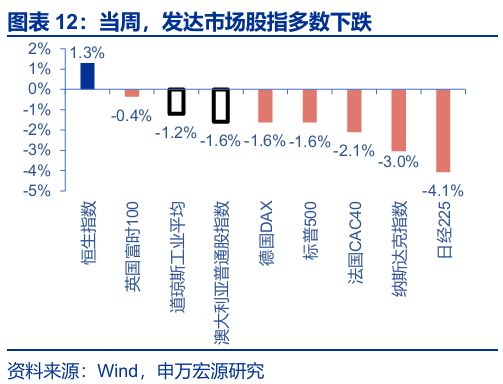
Group 1 - The U.S. government has ended its shutdown after a bipartisan agreement was reached, impacting 670,000 federal employees who were on unpaid leave, while 1.52 million continued to work and receive pay, representing 52% of federal civilian employees [48][46][69] - The October ADP employment report showed an increase of 42,000 jobs, surpassing the market expectation of 30,000, alleviating concerns about a weakening U.S. economy [60][57][69] - The ISM manufacturing PMI for October fell to 48.7, indicating contraction, while the services PMI rose to 52.4, suggesting stability in the job market [57][69] Group 2 - Global stock indices mostly declined, with the S&P 500 down 1.6% and the Nasdaq down 3.0%, while the Hang Seng Index rose by 1.3% [1][8] - In the U.S. stock market, sectors such as energy, healthcare, and real estate saw increases of 1.5%, 1.3%, and 1.0% respectively, while information technology and consumer discretionary sectors fell by 4.2% and 1.5% [5][8] - Emerging market indices also experienced declines, with the Korean Composite Index down 3.7% and the Indian SENSEX30 down 0.9% [1][8] Group 3 - The U.S. 10-year Treasury yield remained stable at 4.11%, while yields in other developed countries increased, with France's yield rising to 3.46% and Germany's to 2.75% [12][17] - The dollar index decreased by 0.2% to 99.55, while most major currencies appreciated against the dollar, including the euro and yen [21][28] - Commodity prices mostly fell, with WTI crude oil down 2.0% to $59.8 per barrel and COMEX gold remaining flat at $3995.2 per ounce [32][38]

资产配置年终观点:迷雾中航行:在全球分化与数据真空下的资产抉择-20251109
Guoxin Securities· 2025-11-09 12:58
Core Insights - By the end of 2025, the market will continue to be overshadowed by the "data vacuum" and "policy divergence" in the US. The relatively certain macro trends before the end of the year are: 1) The Federal Reserve has shifted to a loose monetary policy, benefiting US Treasuries and gold; 2) The oil market is facing oversupply, negatively impacting oil prices; 3) China's policy remains stable, favoring the bond market and providing thematic opportunities for A-shares; 4) Europe and Japan lack endogenous growth momentum, with Japan's "high market trading" peaking and Europe's economy stagnating [3][5]. Stock Market - Increasing Divergence, Seeking Structural Oases - A-shares are currently in a phase of negotiation between policy expectations and economic realities, with market performance highly dependent on signals from the upcoming Central Economic Work Conference. The focus is shifting from "monetary easing" to "fiscal expectations," with expectations for a shift towards greater fiscal stimulus aimed at expanding domestic demand and building a modern industrial system [6]. - The US stock market's strong performance is primarily driven by a few tech stocks, contrasting with the deteriorating data vacuum and macroeconomic realities, facing significant correction pressure before the end of the year. The Federal Reserve's recent dovish actions have increased policy uncertainty, negatively affecting risk asset valuations [8][14]. - The Japanese stock market, driven by new Prime Minister's fiscal policies, has shown signs of fatigue, with recent profit-taking leading to a decline. The market is returning to fundamentals, and any global risk aversion, especially in the AI sector, could lead to significant volatility [16]. - European stock markets are lacking upward catalysts due to economic stagnation and a neutral central bank stance, with core economies like Germany and France facing growth challenges [21]. Bond Market - Turning Interest Rate Cycle, Seeking Balance of Safety and Yield - The US Treasury market is entering a rate-cutting cycle, with the yield curve showing a "non-typical" steepening, highlighting the value of long-term bonds. The Federal Reserve's recent dovish shift signals a significant opportunity for long-term US Treasuries [31][32]. - In the domestic bond market, the People's Bank of China is maintaining a "moderately loose" monetary policy, providing stable support for the bond market. The low correlation of Chinese bonds with global indices makes them a valuable safe haven amid geopolitical risks [37]. Commodity Market - The Game of Hedging and Oversupply - Gold prices are expected to recover after a healthy correction following a record high, with the long-term bullish logic remaining intact due to declining real interest rates and ongoing central bank purchases [41][43]. - The oil market is under pressure from oversupply, with prices expected to remain weak. The increase in production from OPEC+ and non-OPEC countries has led to a significant oversupply, overshadowing geopolitical risks [47][49]. Overall Asset Allocation Summary - The report suggests prioritizing assets that benefit from the clearest macro trends, such as US Treasuries and gold, while avoiding assets affected by uncertainties like the US data vacuum and AI bubble. The recommended allocation order is: 1) Safe assets benefiting from Fed easing (US Treasuries, gold); 2) Structurally independent opportunities (domestic bonds, Indian stocks); 3) Markets awaiting catalysts (Vietnam); 4) Risk assets facing stagnation or bubble peaks (US, Japanese, European stocks); 5) Cyclical commodities under supply pressure (oil) [52][53].
商务部:若中国加入CPTPP将对维护多边主义发挥更大作用
Zheng Quan Shi Bao· 2025-11-06 17:58
Core Viewpoint - The Chinese government is actively promoting its accession to the Comprehensive and Progressive Agreement for Trans-Pacific Partnership (CPTPP), emphasizing its potential to enhance multilateralism and free trade amid rising unilateralism and protectionism [1][2] Economic Impact - Research from the Development Research Center of the State Council and the Chinese Academy of Social Sciences indicates that China's accession to the CPTPP could generate economic benefits for member countries, regional cooperation, and the global economy [1] - The Chinese market's large scale is expected to provide significant growth opportunities for CPTPP members, enhancing the agreement's global influence [1] - The Chinese Academy of Social Sciences estimates that China's membership could increase member GDP by 0.2% to 1.1% and exports by 2.5% to 11.8% [1] - The Development Research Center projects that global real GDP could grow by 0.2% and trade volume by 2.8% as a result of China's accession [1] Regional Cooperation - China's entry into the CPTPP is anticipated to foster a more extensive and closely-knit production and supply chain system within the region, enhancing the breadth, depth, and convenience of industrial cooperation [1] - Key sectors such as oil, agriculture, and educational services are expected to gain new growth opportunities from this enhanced cooperation [1]
商务部答封面新闻:我国加入CPTPP将拉动全球贸易额增长2.8%
Sou Hu Cai Jing· 2025-11-06 10:40
Core Viewpoint - The Chinese government is actively pursuing membership in the Comprehensive and Progressive Agreement for Trans-Pacific Partnership (CPTPP), which is expected to positively impact global economic growth and trade [1][3]. Economic Impact - China's accession to the CPTPP is projected to increase global real GDP by 0.2% and trade volume by 2.8% [1]. - Research from two Chinese institutions indicates that China's membership could lead to GDP growth among CPTPP members ranging from 0.2% to 1.1% and export growth between 2.5% and 11.8% [3]. Regional Cooperation - Joining the CPTPP is anticipated to enhance the formation of larger and more integrated supply chains within the region, benefiting industries such as oil, agriculture, and educational services [3]. Commitment to Open Economy - The Chinese government emphasizes its commitment to expanding high-level foreign trade and hopes that CPTPP members will recognize the positive significance of China's membership [5].
宝城期货资讯早班车-20251104
Bao Cheng Qi Huo· 2025-11-04 01:53
1. Macroeconomic Data Overview - GDP growth rate at constant prices in Q3 2025 was 4.8% year-on-year, down from 5.2% in the previous quarter but up from 4.6% in the same period last year [1] - Manufacturing PMI in October 2025 was 49.0%, down from 49.8% in the previous month and 50.1% in the same period last year [1] - Non-manufacturing PMI for business activities in October 2025 was 50.1%, up slightly from 50.0% in the previous month but down from 50.2% in the same period last year [1] 2. Commodity Investment Reference 2.1 Comprehensive - China's S&P Manufacturing PMI in October was 50.6, down from 51.2 in the previous month, with the expansion trend slowing [2] - In the first three quarters, the added value of large-scale electronic information manufacturing increased by 10.9% year-on-year, outperforming the overall industry and high-tech manufacturing [2] - China and the EU held export control dialogue consultations in Brussels, aiming to promote the stability and smoothness of the industrial and supply chains [2] 2.2 Metals - Industrial and Commercial Bank of China suspended and then resumed its gold accumulation business on November 3 [5] - Lithium carbonate prices have been rising recently, driven by unexpected demand and accelerated inventory depletion [6] - The three-month zinc futures on the London Metal Exchange reached $3,097 per ton, a new high since December 2024 [6] 2.3 Coal, Coke, Steel, and Minerals - Baosteel adjusted its production capacity target to "over 80 million tons", focusing on synergy and value creation [8] - Global iron ore shipments from October 27 to November 2 decreased by 174.5 tons compared to the previous period [8] 2.4 Energy and Chemicals - On November 3, the main contract of US crude oil closed higher after OPEC+ decided to suspend the planned production increase in Q1 2026 [9] - BP's CEO expects electricity demand to grow from 1% to 10% of the global economy in the next 5 - 10 years, driven by AI [9] 2.5 Agricultural Products - As of last Thursday, the planting progress of Brazil's 2025/26 soybean crop reached 47% of the expected area [11] - India's soybean oil imports in the 2024/25 fiscal year soared by 61.6% year-on-year to a record 5.56 million tons [11] 3. Financial News Compilation 3.1 Open Market - On November 3, the central bank conducted 783 billion yuan of 7-day reverse repurchase operations, resulting in a net withdrawal of 259 billion yuan [12] 3.2 Key News - China's S&P Manufacturing PMI expansion slowed in October, but upcoming policies may support the index [13] - Goldman Sachs raised its forecasts for China's export growth and real GDP growth [15] - The 8th China International Import Expo will be held from November 5 - 10 in Shanghai [15] 3.3 Bond Market Summary - China's bond market showed narrow fluctuations, with long-term bonds performing slightly better [19] - The main contracts of treasury bond futures mostly declined, and the 30-year main contract fell 0.11% [19] 3.4 Foreign Exchange Market - The onshore RMB closed at 7.1225 against the US dollar on November 3, down 90 points from the previous trading day [24] - The US dollar index rose 0.15% to 99.87 in New York trading [24] 3.5 Research Report Highlights - Xingzheng Fixed Income believes that the bond market will likely remain range-bound, and investors should focus on medium-term, high-coupon credit bonds [25] - Yangtze River Fixed Income expects the bond market to recover in Q4, with the yield of the 10-year treasury bond (tax-exempt) potentially falling to 1.65% - 1.7% [25] 4. Stock Market Key News - A shares rebounded after hitting a low, with Hainan Free Trade Zone and AI application themes leading the gains [30] - The Shanghai Composite Index rose 0.55% to 3,976.52 points, and the total turnover of A shares was 2.13 trillion yuan [30] - The Hang Seng Index rose 0.97% to 26,158.36 points, and southbound funds had a net purchase of HK$5.472 billion [30]
【广发宏观陈礼清】如何量化“叙事”对资产定价的影响
郭磊宏观茶座· 2025-11-03 03:35
Core Viewpoint - The article discusses the impact of "narrative trading" on asset pricing, emphasizing that asset pricing is influenced not only by fundamentals but also by popular narratives such as the restructuring of the dollar credit system and the new technological revolution [1][12]. Group 1: Narrative Economics - The influence of narratives on economic phenomena consists of a series of elements: a popular, easily spread story, public behavior, and an epidemiological model for macro-level dissemination [2][16]. - The concept of "herding behavior" is used to illustrate how narratives affect micro-level decision-making, with varying strengths across different phases of narrative development [2][18]. Group 2: Herding Effect in Asset Allocation - Traditional studies of herding behavior focus on individual stocks and short-term market sentiment, but the current narrative-driven environment poses challenges for asset allocation due to the breakdown of continuity in global fiscal, monetary, and trade environments [3][20]. - The article suggests that the herding effect can be quantified and applied to investment portfolio optimization and asset timing strategies [3][20]. Group 3: Measurement of Herding Effect - Four common indicators of herding behavior are identified: Cross-Sectional Absolute Deviation (CSAD), the quadratic coefficient of return dispersion, standard deviation of beta coefficients, and cross-correlation [4][23]. - The CSAD index, which measures the deviation of asset returns from the average, indicates the presence of herding behavior when returns cluster around a certain average level [4][23]. Group 4: Current State of Herding Effect - The CSAD index for major asset classes shows a right-skewed distribution, indicating a tendency for extreme herding behavior, with a mean-reverting characteristic suggesting that extreme trends are difficult to maintain [5][28]. - Since May 2025, the CSAD has decreased significantly, indicating a rapid herding effect, but has started to rebound slightly, suggesting a potential shift towards more balanced asset performance [5][28]. Group 5: Strategy Integration - The article proposes integrating the herding factor into a macro risk parity framework, which has shown superior annualized returns compared to traditional models [6][34]. - The new framework suggests increasing allocations to equities and commodities while reducing bond exposure, indicating a shift in investment strategy based on herding behavior [6][34]. Group 6: Domestic Equity Market Analysis - The herding effect in the domestic equity market, as measured by the CSAD, has shown a decline in right-skewness, indicating lower dispersion compared to historical levels [7][40]. - The herding effect has gone through phases of fermentation, intensification, and now a slight loosening, suggesting a gradual return to individual rationality among investors [7][40].

国际金融市场早知道:10月28日
Xin Hua Cai Jing· 2025-10-28 00:45
Group 1 - The IMF projects that the U.S. government debt will exceed 143.4% of GDP by 2030, increasing by over 20 percentage points from current levels [1] - U.S. Treasury Secretary Yellen praised Japan's expansionary fiscal policy during a meeting with Japan's Finance Minister, although no discussions on monetary policy details took place [1] - The negotiations between South Korea and the U.S. regarding a $350 billion investment project are currently stalled, with key issues such as investment methods, amounts, and timelines still under dispute [2] Group 2 - Argentina's ruling coalition led by President Milei won the midterm elections, alleviating investor concerns about potential stagnation in economic reforms [2] - The German business climate index rose from 87.7 to 88.4 in October, indicating improvements in manufacturing, services, and trade, despite a decline in business satisfaction for the third consecutive month [2] Group 3 - The Dow Jones Industrial Average increased by 0.71% to 47,544.59 points, while the S&P 500 rose by 1.23% to 6,875.16 points, and the Nasdaq Composite climbed by 1.86% to 23,637.46 points, all reaching new historical highs [3] - COMEX gold futures fell by 3.40% to $3,997.00 per ounce, and silver futures dropped by 3.61% to $46.83 per ounce [4] Group 4 - U.S. oil futures rose by 0.08% to $61.55 per barrel, while Brent crude futures decreased by 0.09% to $65.14 per barrel [5] - The 2-year U.S. Treasury yield fell by 0.64 basis points to 3.482%, with similar declines observed across other maturities [5] Group 5 - The U.S. dollar index decreased by 0.12% to 98.82, while the euro and British pound appreciated against the dollar [6]
热点思考 | 早苗经济学:安倍经济学2.0?(申万宏观·赵伟团队)
赵伟宏观探索· 2025-10-26 16:03
Group 1 - The core viewpoint of the article is that "Sanae Economics" proposed by newly elected Prime Minister Sanae Takaichi is not equivalent to "Abenomics 2.0" due to differing political and economic environments, with a focus on responsible fiscal policy rather than aggressive monetary easing [1][2][9] - Takaichi's economic policy emphasizes proactive fiscal measures, contrasting with Abenomics which prioritized monetary easing to combat deflation. The new approach aims to address inflation while maintaining financial stability [6][17] - Takaichi's government faces significant political constraints, including a lower parliamentary majority and lower public support compared to Abe, which may hinder the implementation of her policies [9][17] Group 2 - Japan's fiscal deficit is projected to rise from 1.3% in FY2025 to around 2.0% in FY2026, indicating a more expansionary fiscal stance compared to other developed economies [20][21] - The expected economic growth rate for Japan is forecasted to slightly increase to 0.9% in FY2026, driven by fiscal stimulus measures, with the supplementary budget potentially exceeding last year's 13.9 trillion yen [27][21] - The Bank of Japan is anticipated to lag in raising interest rates, with market expectations for a 50 basis point increase in 2026, influenced by inflation and currency depreciation pressures [45][47] Group 3 - Takaichi's government plans to implement a comprehensive stimulus package, including energy subsidies and tax relief measures, to support households and businesses amid rising costs [20][21] - The fiscal measures are expected to have a modest impact on GDP growth, with an estimated contribution of around 0.25% from the supplementary budget [27][21] - Japan's debt situation remains manageable, with a high debt-to-GDP ratio but low interest payment pressures due to a long debt duration and low foreign debt exposure [36][21]