服务业

Search documents
-3.2万!小非农意外“暴雷” 黄金短线急涨又急跌,新一轮涨势蓄势待发?
Sou Hu Cai Jing· 2025-12-04 02:14
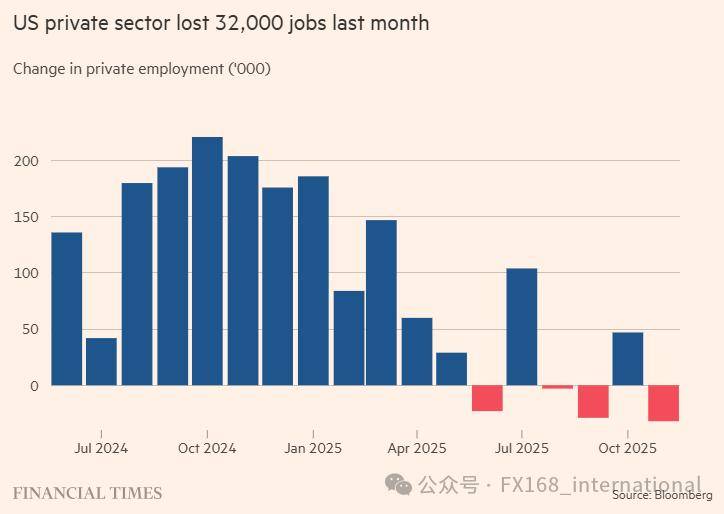
周三(12月3日),美国就业市场再度释放急剧降温信号,ADP报告意外录得大幅负增长,强化市场对 美联储下周降息的押注,同时推动金价延续反弹。与此同时,美国服务业活动虽有所改善,但就业依旧 处于收缩区间,进一步凸显经济动能的不均衡性。 ADP就业意外大幅下滑私营部门流失3.2万个岗位 美国私人部门11月就业状况大幅恶化。ADP 周三公布的数据显示,企业本月意外削减 32,000 个岗位, 远不及市场此前预期,为就业市场近期"波动与乏力"趋势再添证据。 (来源:彭博社,金融时报) ADP 首席经济学家 Nela Richardson 指出:"随着消费者趋于谨慎、宏观环境不确定性上升,企业招聘持 续呈现明显的反复表现。11月的放缓呈现广泛性,其中小企业的萎缩最为明显。" 由于美国政府此前发生 长达 43天的停摆,官方的非农就业报告本月将不会发布,使得市场对 ADP数据 的依赖程度显著提升。 报告还显示,薪资增速继续走弱:留任员工工资年增幅降至4.4%(10月为 4.5%);跳槽员工薪资增幅 降至6.3%(10月为 6.7%)。 多个行业招聘放缓,包括制造业、专业与商业服务、信息技术以及建筑业。 技术上,FX Emp ...

政策协同显身手 经济活力持续释放
Zhong Guo Zheng Quan Bao· 2025-12-03 20:28
Economic Recovery Indicators - In November, the manufacturing PMI rose to 49.2%, indicating an improvement in economic conditions [1] - The new export orders index increased by 1.7 percentage points to 47.6%, reflecting strong resilience in foreign trade [1] Consumer Market Dynamics - The consumption upgrade policy has driven sales exceeding 2.4 trillion yuan, benefiting over 360 million people in the first ten months of the year [2] - Retail sales of new energy passenger vehicles reached 10.15 million units, a year-on-year increase of 21.9% [2] Logistics and Delivery Growth - The express delivery business volume surpassed 180 billion pieces for the first time, indicating robust consumer activity [3] - The average monthly express delivery volume since 2025 has exceeded 16 billion pieces, showcasing a new growth trajectory in consumption [3] Policy Support for Economic Growth - The government has allocated 500 billion yuan for local government debt to enhance financial capacity and stimulate effective investment [4] - New policy financial tools have been implemented to support over 2,300 projects with a total investment of approximately 7 trillion yuan, focusing on digital economy and AI [4] Future Economic Outlook - The upcoming Central Economic Work Conference is expected to set a proactive macroeconomic policy for 2026, emphasizing domestic demand and technological self-reliance [5] - Fiscal and monetary policies are anticipated to remain supportive, with potential for further reductions in reserve requirements and interest rates [5]
智利经济增速超预期
Shang Wu Bu Wang Zhan· 2025-12-03 16:38
Core Viewpoint - The Chilean economy is experiencing a moderate recovery, with the October economic activity index (Imacec) showing a year-on-year growth of 2.2%, surpassing market expectations and aligning closely with the government's annual growth target of 2.5% [1] Economic Growth - The economic growth is primarily driven by the service sector and commercial activities, with commercial activity showing a significant year-on-year increase of 8.1% [1] - The service sector also contributed to growth, with a year-on-year increase of 2.5% [1] Sector Performance - In contrast, the goods production sector experienced a year-on-year decline of 0.2%, primarily due to reduced copper extraction and a decrease in electricity value added [1]
行业景气观察:11月制造业PMI环比上行,化工品价格多数上涨
CMS· 2025-12-03 13:05
Core Insights - The manufacturing PMI for November increased to 49.2%, up by 0.2 percentage points, remaining below the threshold for eight consecutive months, while the non-manufacturing PMI decreased to 49.5%, marking the first contraction since 2024 [12][14][21] - The report highlights improvements in the resource, consumer services, and information technology sectors, with notable price increases in industrial and precious metals, as well as in the new energy supply chain [1][21] - Recommendations are made for sectors with high or improving sentiment, including non-ferrous metals, steel, chemicals, batteries, traditional Chinese medicine, film, and semiconductors [1][21] Industry Overview Manufacturing Sector - The manufacturing sector shows a slight recovery with a production index at 50.0%, and new orders index at 49.2%, indicating a marginal improvement in demand despite remaining in contraction territory [14][15] - The purchasing price index rose to 53.6%, driven by increases in coal, metals, and new energy materials, reflecting a rebound in prices due to supportive policies and improved supply [14][15][21] Information Technology - The Philadelphia Semiconductor Index and Taiwan Semiconductor Industry Index both increased, with the Philadelphia index rising by 6.48% to 7149.47 points [24] - Prices for DDR4 and DDR5 DRAM memory increased, with 8GB DDR4 prices rising by 13.66% to $16.51 and 16GB DDR5 prices up by 3.95% to $27.20 [27][28] Consumer Services - The film industry saw a significant increase in box office revenue, with a ten-day average up by 250.53%, while ticket prices decreased slightly [19][21] - The price index for traditional Chinese medicine increased, indicating a positive trend in this sector [19][21] Resource Sector - Industrial metal prices generally increased, with copper, zinc, and nickel prices rising, while coal prices showed mixed trends with some declines in specific regions [23] - The national cement price index decreased, while glass prices increased, reflecting varied trends across different materials [23] Financial and Real Estate Sector - The real estate market showed signs of improvement with an increase in land transaction premium rates and total area sold, despite a decline in the number of second-hand homes listed for sale [23] - The monetary market experienced a net withdrawal, with a decrease in A-share turnover rates and daily transaction volumes [23] Public Utilities - Natural gas prices in China decreased, while electricity generation from key power plants showed a widening year-on-year decline [23]
最新发布!刚刚,重磅利好来袭!
Zheng Quan Shi Bao Wang· 2025-12-03 10:26
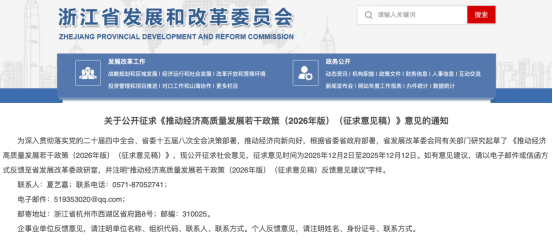
Core Viewpoint - Zhejiang's draft policy for promoting high-quality economic development outlines 42 specific measures across eight areas, aiming to enhance innovation, manufacturing, and service sectors while supporting consumption upgrades [2][4]. Group 1: Innovation and Technology - The draft emphasizes the importance of original innovation and tackling key core technologies, proposing a collaborative mechanism involving enterprises, government, and platforms [4]. - It plans to implement over 400 major technology projects and achieve more than 100 significant technological outcomes, with at least 80% participation from enterprises [4]. - The policy includes a target of establishing a computing power scale of 200 EFlops in the province and allocating approximately 500 million yuan for artificial intelligence support [5]. Group 2: Advanced Manufacturing - The draft aims to enhance the competitiveness of new quality productivity industries, offering up to 500,000 yuan in subsidies for individual projects [6]. - It proposes to support over 5,000 key industrial technology transformation projects and aims for an increase of over 1.1 trillion yuan in medium to long-term loans for manufacturing [7]. - The policy encourages the establishment of 20 future factories and 200 smart factories, along with the creation of 20 provincial industrial data sets [8]. Group 3: Service Sector and Consumption - The draft seeks to promote consumption upgrades by fostering new consumption models and issuing consumption vouchers to stimulate spending [9]. - It aims to support the transformation of over 50 professional markets and enhance the influence of the "Delicious Zhejiang" brand through various events [9]. - The policy includes measures to support the growth of service industry platforms and the establishment of around 200 leading service enterprises [10]. Group 4: Aviation and Low-altitude Economy - The draft supports the construction and operation of A-class general airports and the opening of over five new international routes and 100 drone routes [10].
日本PMI显示经济温和扩张 服务业连续五个月成为增长主要动力
Sou Hu Cai Jing· 2025-12-03 03:37
日本采购经理人指数数据显示,私营部门产出继续适度扩张,这再次由服务业活动所驱动。标准普尔全 球市场情报公司的Annabel Fiddes表示,该行业已连续过去五个月推动了增长。监测前景乐观情绪和员 工招聘的11月份指标达到2025年初以来的最高水平。新订单增长加速,企业表示有信心订单和商业活动 将在明年继续增加。对未来活动的乐观情绪攀升至1月份以来的最高点,企业预期需求将更加坚挺。 Fiddes表示,在接下来的几个月里,关键在于观察政府的新经济刺激方案是否会转化为需求的进一步改 善和产出的增长。 ...
西部证券晨会纪要-20251203
Western Securities· 2025-12-03 02:34
Group 1: Fixed Income - The manufacturing PMI for November shows a slowdown in contraction, with the index rising to 49.2%, an increase of 0.2 percentage points from the previous month, indicating a slight improvement in production and demand [7][8] - The non-manufacturing business activity index fell to 49.5%, a decrease of 0.6 percentage points, suggesting that the service sector has entered a contraction phase [7][11] - The construction industry has remained below the growth line for four consecutive months, necessitating further economic stabilization policies [7][11] Group 2: Real Estate - The sales revenue of the top 100 real estate companies in November decreased by 36.8% year-on-year and 11.7% month-on-month, indicating a significant decline as the market enters a sales lull [14][15] - The sales area for the top 100 companies also saw a year-on-year decline of 35.8%, although the rate of decline has lessened compared to previous months [14][15] - There is an increasing expectation for policy easing as the market shows signs of weakness, suggesting potential investment opportunities in the sector [14][16] Group 3: Pharmaceutical and Biotechnology - The company Huaren Sanjiu (000999.SZ) reported a revenue of 21.986 billion yuan for the first three quarters, a year-on-year increase of 11.38%, with a net profit of 2.353 billion yuan, reflecting a decline of 20.51% [18][19] - The company is focusing on both internal and external growth strategies, particularly in the consumer health sector, and is expected to achieve net profits of 3.295 billion yuan, 3.843 billion yuan, and 4.268 billion yuan for 2025, 2026, and 2027 respectively [19][20] - The company has a strong brand value and advantages in traditional Chinese medicine, which supports its growth potential [19][20] Group 4: Beauty and Personal Care - Huaxi Biological (688363.SH) reported a revenue of 3.163 billion yuan for the first three quarters, a year-on-year decrease of 18.36%, primarily due to a strategic contraction in its skin science innovation business [21][22] - The company is optimizing its business structure, with a focus on high-margin pharmaceutical-grade raw materials, which has led to an overall gross margin of 70.68% [22][23] - The company is expected to see a recovery in its skin science business and growth in its raw materials segment, driven by new synthetic biological materials [23]
日本加息对全球市场有何影响?
2025-12-03 02:12
日本加息对全球市场有何影响?20251202 摘要 日本央行加息预期引发市场波动,与此前预期新首相上台后延续宽松政 策不同,当前预期基于日本最新数据和通胀指标,显示宽松政策难以为 继,导致市场调整并转向加息预期。 PMI 数据显示企业主动去库存,11 月外需回升但生产端偏弱,企业为避 免亏损缩减生产和采购,用现有库存满足需求。此举短期增加经济压力, 但中长期有助于重启库存周期,或在明年下半年改善供需关系并推动 PPI 回升。 2025 年 A 股流动性充裕,企业存款活化显著,活期存款占比提升。财 政发债增加企业现金流,反内卷和贸易战导致制造业投资下滑,资金流 入股市,风险偏好上升亦促使企业资金入市,预计该趋势在 2026 年上 半年持续。 当前债券市场表现不佳,但央行关注价格而非数量,下半年利率区间维 持在 1.3%-1.5%。降息可能要等到 2026 年,目前不宜看空债券市场, 关注中央经济工作会议是否带来超预期政策调整。 Q&A 日本央行加息预期对全球市场产生了哪些影响? 日本央行加息预期对全球市场产生了显著影响。首先,日元套息交易的反转导 致投资者卖出高息资产,回流日元,这直接推动了全球债券市场利率上行 ...
利好来了!刚刚,浙江重磅发布!
券商中国· 2025-12-03 01:26
Core Viewpoint - The article discusses the "15th Five-Year Plan" for Zhejiang Province, emphasizing high-quality development and the establishment of a common prosperity demonstration zone, aiming for significant progress by 2030 in economic strength, technological capability, and overall competitiveness [1][2]. Group 1: Economic and Technological Development - The plan aims for major breakthroughs in innovation, establishing a modern industrial system, and enhancing global competitiveness in sectors like advanced manufacturing and artificial intelligence [2][3]. - By 2030, the per capita GDP of Zhejiang is expected to approach that of developed economies, with a focus on reducing urban-rural income disparities and improving residents' quality of life [1][2]. Group 2: Artificial Intelligence and Digital Economy - The plan includes the creation of an artificial intelligence innovation hub, promoting the integration of AI with various sectors, including manufacturing and social governance [3][4]. - It emphasizes the importance of a robust data infrastructure and the establishment of a new computing power system to support AI development [3]. Group 3: Emerging Industries and Investment - The plan highlights the development of emerging industries such as AI, new materials, and biomedicine, with a focus on creating future industry pilot zones [4][6]. - It aims to improve investment quality and efficiency, particularly in high-tech and strategic emerging industries, while enhancing the participation of private enterprises in major projects [6][7]. Group 4: Consumer Market and Domestic Demand - The strategy focuses on expanding domestic demand and enhancing consumer capabilities through various initiatives, including the promotion of new consumption models and the development of service industries [5][6]. - It aims to create a favorable consumption environment and support cities like Hangzhou and Ningbo in becoming international consumption centers [5]. Group 5: Marine Economy - The plan includes initiatives to strengthen the marine economy, focusing on modern marine industry systems and the sustainable development of marine resources [7]. - It aims to enhance marine ecological protection while participating in global marine governance [7].

欧元区11月CPI回升至2.2%,服务业价格顽固,欧央行12月降息“几无可能”
Hua Er Jie Jian Wen· 2025-12-02 12:03
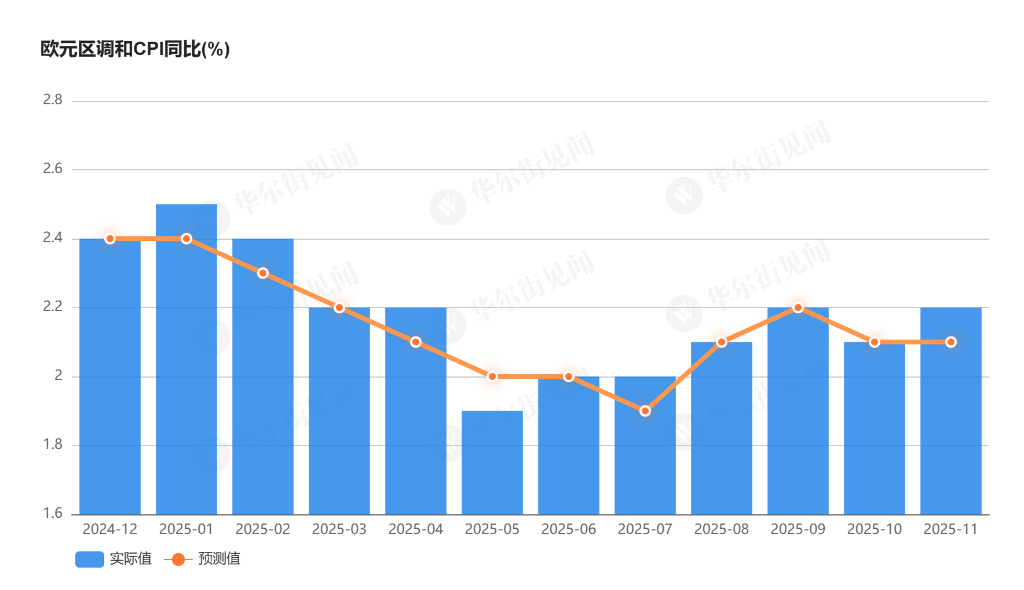
Group 1 - Eurozone inflation unexpectedly rose slightly in November, reinforcing market expectations that the European Central Bank (ECB) will not cut interest rates again in the short term [1][4] - The harmonized Consumer Price Index (CPI) in the Eurozone increased from 2.1% in the previous month to 2.2% year-on-year in November, remaining close to the ECB's target of 2% [1][4] - Core inflation, excluding volatile food and energy prices, remained stable at 2.4%, driven by rapid growth in service prices, while durable goods prices grew at a more moderate pace [4][5] Group 2 - Price pressures within the Eurozone, particularly in the service sector, continue to support inflation, with service inflation at 3.5% and unprocessed food prices up by 3.3% in November [5] - Energy prices have decreased significantly, with natural gas prices down over 40% year-on-year and crude oil prices down more than 10%, indicating ongoing deflationary pressures in the energy sector [5] - The ECB has maintained a wait-and-see approach after cutting rates by 2 percentage points over the past year, with officials indicating they can tolerate slight deviations from the inflation target as long as underlying trends align with it [6][7] Group 3 - Market pricing reflects the expectation that the ECB is unlikely to adjust its 2% deposit rate at the upcoming meeting on December 18 [7] - Economic indicators suggest a robust expansion close to potential growth rates of about 1% to 1.5%, supported by a relatively tight labor market [7] - The Eurozone unemployment rate slightly increased to 6.4% in October, indicating ongoing labor market dynamics [7]