
非银金融

Search documents
主力资金动向 69.61亿元潜入非银金融业
Zheng Quan Shi Bao Wang· 2026-01-06 11:14
Core Insights - The non-banking financial sector experienced the highest net inflow of funds today, amounting to 6.961 billion yuan, with a price change of 3.73% and a turnover rate of 2.12% [1][2] - The communication sector faced the largest net outflow of funds, totaling -10.507 billion yuan, with a price change of -0.77% and a turnover rate of 2.47% [1][2] Industry Summary - **Non-banking Financial**: - Trading volume: 8.892 billion shares - Change in trading volume: +80.24% - Price change: +3.73% - Net inflow: 6.961 billion yuan [1] - **Communication**: - Trading volume: 4.331 billion shares - Change in trading volume: +13.24% - Price change: -0.77% - Net outflow: -10.507 billion yuan [2] - **Other Notable Sectors**: - **Non-ferrous Metals**: - Net inflow: 5.885 billion yuan, price change: +4.26% [1] - **Automobile**: - Net inflow: 2.469 billion yuan, price change: +1.43% [1] - **Computer**: - Net inflow: 1.971 billion yuan, price change: +2.19% [1] - **Petroleum and Chemical**: - Net inflow: 1.111 billion yuan, price change: +2.82% [1] - **Pharmaceuticals**: - Net outflow: -6.276 billion yuan, price change: -22.60% [2] - **Machinery**: - Net outflow: -11.764 billion yuan, price change: -35.65% [2]
58.85亿元主力资金今日抢筹有色金属板块
Zheng Quan Shi Bao Wang· 2026-01-06 09:15
Core Viewpoint - The metal industry experienced a significant increase, with a rise of 4.26% on January 6, driven by substantial capital inflow, while the communication sector faced a decline of 0.77% [1] Group 1: Market Performance - The Shanghai Composite Index rose by 1.50% on January 6, with 30 out of 31 sectors showing gains, led by the metal and non-banking financial sectors, which increased by 4.26% and 3.73% respectively [1] - The non-banking financial sector saw a net capital inflow of 69.61 billion yuan, while the metal sector followed with an inflow of 58.85 billion yuan [1] Group 2: Capital Flow in the Metal Industry - The metal industry had 138 stocks, with 128 stocks rising and 5 hitting the daily limit, while 9 stocks declined [2] - Notable stocks with significant capital inflow included Zijin Mining, which received 1.029 billion yuan, followed by Huayou Cobalt and Tianqi Lithium with inflows of 549 million yuan and 439 million yuan respectively [2] Group 3: Capital Outflow in the Metal Industry - The metal industry also experienced capital outflows, with 6 stocks seeing outflows exceeding 100 million yuan, led by Baiyin Nonferrous with an outflow of 311.89 million yuan [3] - Other notable outflow stocks included Chifeng Jilong Gold and Tianshan Aluminum, with outflows of 224.87 million yuan and 183.85 million yuan respectively [3]



主力动向:1月6日特大单净流入142.42亿元
Zheng Quan Shi Bao Wang· 2026-01-06 09:15
Market Overview - The net inflow of large orders in the two markets reached 14.242 billion yuan, with 73 stocks seeing net inflows exceeding 200 million yuan, led by Dongfang Caifu with a net inflow of 2.943 billion yuan [1] - The Shanghai Composite Index closed up by 1.50%, with a total of 2,371 stocks experiencing net inflows and 2,538 stocks seeing net outflows [1] Industry Performance - Among the 20 industries with net inflows, the non-bank financial sector had the highest net inflow of 6.437 billion yuan, with its index rising by 3.73% [1] - The non-ferrous metals sector followed with a net inflow of 3.663 billion yuan and a rise of 4.26% [1] - Other notable sectors with significant inflows included computer and electronics [1] Individual Stock Performance - A total of 73 stocks had net inflows exceeding 200 million yuan, with Dongfang Caifu leading at 2.943 billion yuan, followed by Shanzhi Gaoke at 1.766 billion yuan [2] - The average increase for stocks with net inflows over 200 million yuan was 9.44%, outperforming the Shanghai Composite Index [2] - Specific stocks that saw significant gains included Lianjian Guangdian and Tianli Technology, which closed at their daily limit [2] Top Stocks by Net Inflow - The top stocks by net inflow included: - Dongfang Caifu: 2.943 billion yuan, up 5.73% [2] - Shanzhi Gaoke: 1.766 billion yuan, up 10.12% [2] - Aerospace Electronics: 1.530 billion yuan, up 10.02% [2] - TCL Technology: 1.421 billion yuan, up 8.35% [2] - Tonghuashun: 1.002 billion yuan, up 12.01% [2] Top Stocks by Net Outflow - The stocks with the highest net outflows included: - Zhongji Xuchuang: -2.292 billion yuan, down 2.93% [4] - Xinyi Sheng: -2.198 billion yuan, down 2.13% [4] - China Satellite Communications: -994 million yuan, up 10.00% [4] - BlueFocus: -943 million yuan, down 1.16% [4] - Yongding Co.: -762 million yuan, down 1.58% [4]



大盘放量逼空,享受流动溢价红利
Jin Rong Jie· 2026-01-06 08:26
Market Overview - The Shanghai Composite Index reached a new high of 4083.67 points, with a daily increase of 1.5% [1] - The total trading volume for the day was 2.81 trillion, an increase of 263.5 billion compared to the previous trading day [1] - The number of advancing stocks was 4,107, while 1,222 stocks declined, with 391 stocks rising over 5% and 28 stocks falling over 5% [1] Market Sentiment - The market is currently in a strong upward trend, with continuous inflow of new capital, indicating no immediate concerns about the current rally [1] - There is an acknowledgment of potential selling pressure and the need for adjustments, but this does not warrant a bearish outlook or reduction in positions [1] Sector Performance - The brain-computer interface sector saw a significant increase of 7.11%, continuing its momentum from the previous day [2] - The non-ferrous metals and chemical sectors experienced notable price increases, with titanium dioxide up 5.85%, copper up 4.11%, and other metals showing similar gains [3] - The non-bank financial sector also performed well, with insurance stocks rising by 4.22% and brokerage firms by 3.53% [3][4] Investment Strategy - Investors are advised to focus on individual stock performance rather than index movements, and to maintain a diversified approach [1] - The current market environment requires a higher tolerance for volatility, as increased trading volume leads to greater fluctuations in individual stocks [1] - The commercial aerospace sector is expected to remain strong, with upcoming satellite launches serving as a significant catalyst for growth [4]
粤开市场日报-20260106
Yuekai Securities· 2026-01-06 07:45
Market Overview - The A-share market showed a general upward trend today, with the Shanghai Composite Index rising by 1.50% to close at 4083.67 points, and the Shenzhen Component Index increasing by 1.40% to 14022.55 points [1] - The ChiNext Index rose by 0.75% to 3319.29 points, while the Sci-Tech 50 Index saw a gain of 1.84%, closing at 1429.3 points [1] - Overall, 4101 stocks rose while 1218 stocks fell, with a total trading volume of 28065 billion yuan, an increase of 2602 billion yuan compared to the previous trading day [1] Industry Performance - Among the Shenwan first-level industries, non-ferrous metals, non-bank financials, basic chemicals, defense and military industry, and comprehensive sectors led the gains, with increases of 4.26%, 3.73%, 3.12%, 3.08%, and 2.89% respectively [1] - The only sector that experienced a decline was the telecommunications industry, which fell by 0.77% [1] Concept Sector Performance - The top-performing concept sectors included stock trading software, rare metals selection, chemical raw materials selection, cobalt mines, satellite internet, satellite navigation, phosphorus chemicals, small metals, brain-computer interfaces, vanadium batteries, insurance selection, aircraft carriers, nickel mines, aluminum industry, and industrial metals selection [2] - Conversely, sectors such as optical modules (CPO), optical communication, copper-clad laminates, and central enterprise banks experienced a pullback [2]
今日沪指涨1.14% 有色金属行业涨幅最大
Zheng Quan Shi Bao Wang· 2026-01-06 04:43
相关ETF (原标题:今日沪指涨1.14% 有色金属行业涨幅最大) 证券时报•数据宝统计,截至上午收盘,今日沪指涨1.14%,A股成交量1037.56亿股,成交金额17961.97亿元,比上一个交易日增加9.00%。个股方 面,3696只个股上涨,其中涨停107只,1590只个股下跌,其中跌停2只。从申万行业来看,有色金属、非银金融、综合等涨幅最大,涨幅分别为 3.91%、3.31%、2.79%;通信、美容护理、银行等跌幅最大,跌幅分别为1.45%、0.12%、0.12%。(数据宝) 今日各行业表现(截至上午收盘) | 申万行业 | 行业 成交额 | | 比上日 | | 涨跌幅 | | --- | --- | --- | --- | --- | --- | | | 涨跌 (亿元) | | (%) | 领涨(跌)股 | (%) | | | (%) | | | | | | 有色金属 | 3.91 1282.80 26.40 | | | 天力复合 | 16.75 | | 非银金融 | 3.31 | 812.46 81.00 | | 华林证券 | 9.99 | | 综合 | 2.79 | 31.79 31.90 | ...

突破前期高点!沪指,十年新高
Zhong Guo Zheng Quan Bao· 2026-01-06 03:35
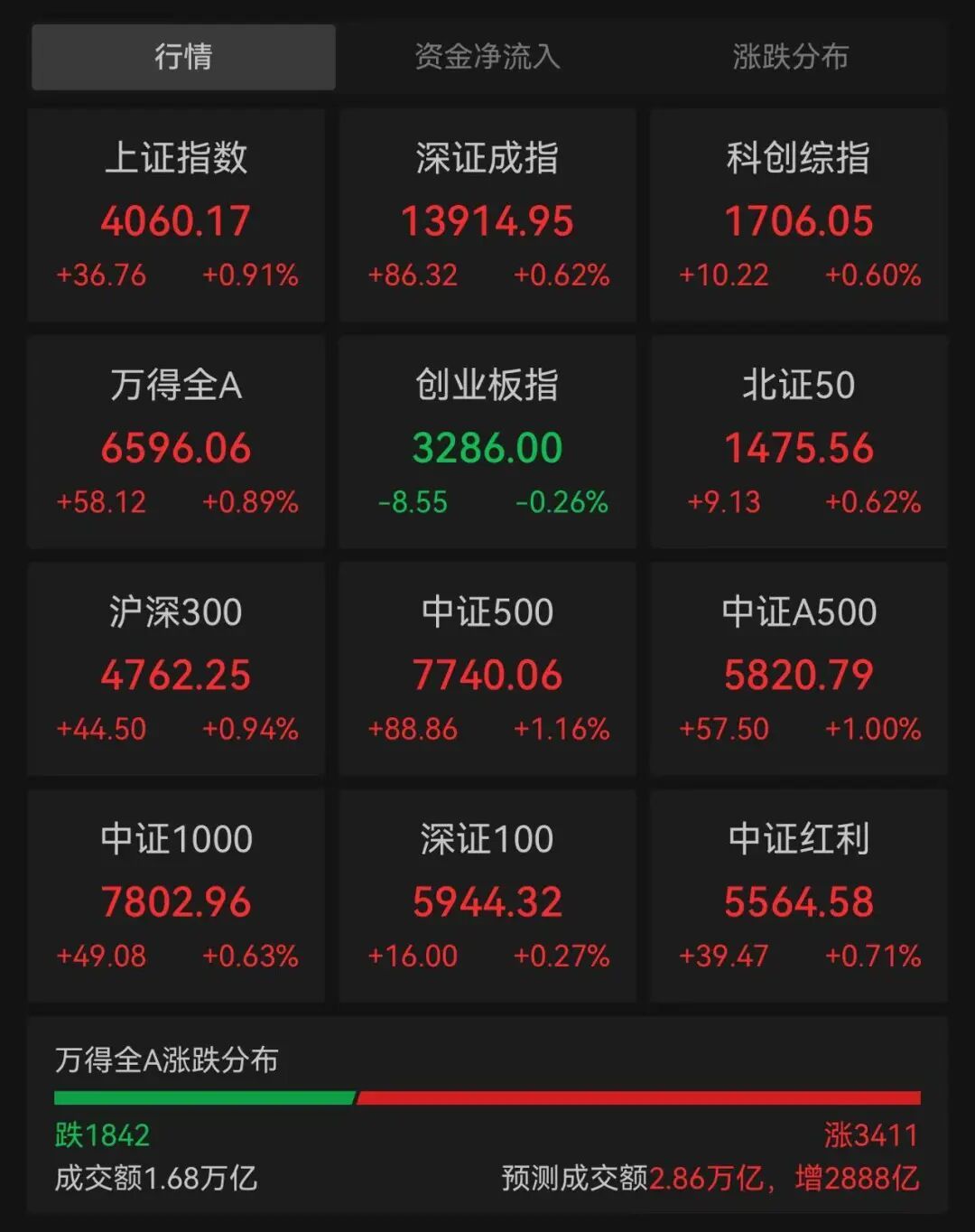
Group 1 - The A-share market showed strength on January 6, with the Shanghai Composite Index and Shenzhen Component Index rising by 0.91% and 0.62% respectively, reaching 4060.17 points, a ten-year high [1][2] - Over 3400 stocks in the A-share market experienced gains, indicating broad market participation [1] - Key sectors performing well included stock trading software, titanium dioxide, and brain-computer interfaces, with non-ferrous metals, non-bank financials, and oil and petrochemicals leading the gains among primary industries [1] Group 2 - The trading volume reached 1.68 trillion yuan, with a predicted increase to 2.86 trillion yuan, reflecting a rise of 288.8 billion yuan [2] - The performance of major indices included the CSI 300 rising by 0.94% to 4762.25 points, while the ChiNext Index fell by 0.26% to 3286.00 points [2] - The market's upward trend is anticipated to continue into the spring, with consumption and growth expected to be the main themes driving this rally [1]
【盘中播报】90只A股封板 有色金属行业涨幅最大
Zheng Quan Shi Bao Wang· 2026-01-06 03:35
Market Overview - The Shanghai Composite Index increased by 0.82% as of 10:27 AM, with a trading volume of 740.89 million shares and a transaction value of 12,880.17 billion yuan, representing a decrease of 1.00% compared to the previous trading day [1] Industry Performance - The top-performing sectors included: - Non-ferrous metals: up 3.90% with a transaction value of 921.96 billion yuan, led by Haotong Technology, which rose by 12.38% [1] - Non-bank financials: up 3.12% with a transaction value of 573.24 billion yuan, led by Hualin Securities, which increased by 9.99% [1] - Comprehensive: up 1.99% with a transaction value of 20.93 billion yuan, led by Tianchen Co., which rose by 9.98% [1] - The sectors with the largest declines included: - Communication: down 2.00% with a transaction value of 757.37 billion yuan, led by Hengdong Light, which fell by 8.88% [2] - Banking: down 0.53% with a transaction value of 108.31 billion yuan, led by Shanghai Bank, which decreased by 2.48% [2] - Food and beverage: down 0.11% with a transaction value of 108.59 billion yuan, led by Babi Food, which fell by 1.13% [2] Notable Stocks - Haotong Technology in the non-ferrous metals sector saw a significant increase of 12.38% [1] - Hualin Securities in the non-bank financials sector increased by 9.99% [1] - Tianchen Co. in the comprehensive sector rose by 9.98% [1] - Hengdong Light in the communication sector experienced a decline of 8.88% [2] - Shanghai Bank in the banking sector decreased by 2.48% [2] - Babi Food in the food and beverage sector fell by 1.13% [2]
突破前期高点!上证指数,十年新高
Zhong Guo Zheng Quan Bao· 2026-01-06 03:29
光大证券表示,2025年12月下旬的上涨或许就是本轮春季行情的起点,消费与成长有望成为春季行情的 两条主线。 1月6日早盘,A股市场走强。数据显示,截至11:10,上证指数、深证成指分别上涨0.91%、0.62%。上 证指数突破2025年11月14日的阶段高点——4034.08点,创逾十年新高,最新报4060.17点。A股市场超 3400只股票上涨。 从盘面上来看,炒股软件、钛白粉、脑机接口等板块表现活跃。申万一级行业中,有色金属、非银金 融、石油石化行业领涨。 ...
63股获融资客大手笔净买入
Zheng Quan Shi Bao Wang· 2026-01-06 01:53
1月5日融资客净买入金额排名 | 代码 | 简称 | 1月5日涨跌幅 | 融资净买入额 | 最新融资余额 | 占流通市值比例 | 所属行 | | --- | --- | --- | --- | --- | --- | --- | | | | (%) | (万元) | (万元) | (%) | 业 | | 300476 | 胜宏科 技 | 7.80 | 69363.31 | 1756919.88 | 6.63 | 电子 | | 002131 | 利欧股 份 | 9.93 | 52245.71 | 226514.25 | 6.25 | 机械设 备 | | 688012 | 中微公 司 | 14.16 | 49525.20 | 393398.56 | 2.02 | 电子 | | 000792 | 盐湖股 份 | 10.01 | 40611.02 | 432150.60 | 2.64 | 基础化 工 | | 600343 | 航天动 | -6.70 | 34281.30 | 172535.42 | 5.92 | 机械设 | | | 力 | | | | | 备 | | 300136 | 信维通 信 | 5.82 | 3 ...



