机械

Search documents
德国连续四年衰退,彻底被中国击败?英媒:都是特朗普关税的错
Sou Hu Cai Jing· 2025-11-24 10:18
Core Insights - The article discusses the significant economic decline of Germany, attributing it to a combination of long-term structural issues and external pressures, particularly from the trade policies initiated during Trump's administration [1][3][20] - Germany's industrial output has reverted to levels not seen in 20 years, indicating a severe downturn in its manufacturing sector [3][19] - The shift from trade surplus to trade deficit with China by 2025 raises concerns about Germany's economic standing globally [5][19] Economic Decline - Germany's GDP has been in decline since 2022, marking four consecutive years of negative growth, which is indicative of deeper economic issues rather than short-term fluctuations [3][20] - The industrial production level has fallen back to 2005 standards, highlighting a significant regression in Germany's manufacturing capabilities [3][19] Trade Dynamics - Germany has transitioned from a trade surplus with China to a trade deficit by 2025, which poses challenges to its economic stability and raises questions about its global economic position [5][19] - The rising costs of logistics and energy have further exacerbated the situation, leading to increased industrial costs and reduced profits for German companies [10][19] Competitive Pressures - The slow pace of industrial upgrades in Germany has allowed Chinese manufacturing to catch up rapidly, with significant price advantages and improving product quality [6][15] - German companies are facing increased competition from Chinese firms, which have demonstrated faster innovation cycles and adaptability in emerging sectors like renewable energy and smart manufacturing [11][13][15] Policy Impact - Trump's tariffs have disrupted global supply chains, particularly affecting German manufacturers who rely heavily on international sourcing for materials and components [8][10] - The combination of external trade barriers and internal policy pressures has constrained the operational space for German businesses, especially small and medium-sized enterprises [11][13] Future Outlook - The article suggests that Germany must adapt its industrial and policy strategies to regain its competitive edge, as the global economic focus shifts eastward [22] - Without significant changes in approach, Germany risks falling further behind in the next industrial revolution, highlighting the urgency for transformation in its economic model [22]


一周观点及重点报告概览-20251124
EBSCN· 2025-11-24 08:05
| 总量研究 2 | | --- | | 上周观点 2 | | 重点报告 2 | | 行业研究 4 | | 上周观点 4 | | 重点报告 5 | | 公司研究 6 | | 重点报告 6 | | 重点报告摘要 7 | | 总量研究 7 | | 行业研究 9 | | 公司研究 11 | 一周观点 总量研究 上周观点 | 领域 | 一周观点 | 分析师 | | --- | --- | --- | | | 市场大方向或仍处在牛市中,不过短期或进入宽幅震荡阶段。与往年牛市相比,当前指数仍然 | | | 策略 | 有相当大的上涨空间,但是在国家对于"慢牛"的政策指引之下,牛市持续的时间或许要比涨 | 张宇生 | | | 幅更加重要。不过短期来看,市场可能缺乏强力催化,叠加年末部分投资者在行为上可能趋于 | | | | 稳健,股市短期或以震荡蓄势为主。 | | | | 上周黄金价格上涨,国内权益市场指数集体回调,医药主题基金表现占优,TMT 主题基金回撤 | | | 金工 | 明显。不同投资范围的 ETF 资金均呈现流入,TMT、科创主题 ETF 受被动资金加仓,以恒生 | 祁嫣然 | | | 互联网 ETF 为代表的港 ...
20251124标普红利ETF(562060):稀缺的小盘红利攻守利器
Sou Hu Cai Jing· 2025-11-24 02:12
Core Insights - The article emphasizes the importance of dividend strategies in the current volatile investment environment, highlighting their role in providing stable cash flow and long-term compounding potential [1][3]. Summary by Categories Investment Strategy - Dividend strategies focus on high-dividend, cash flow-stable quality companies, serving as a foundational asset for wealth building [1]. - The S&P Dividend ETF (562060) exemplifies this strategy with its unique characteristics of "dividend + small-cap + industry diversification," making it stand out in uncertain markets [1][3]. Performance Metrics - The S&P Dividend ETF boasts a leading dividend yield of 5.18% among mainstream dividend indices, with a year-to-date increase of 14.95%, ranking first in performance [1][3]. - The ETF's median market capitalization is 21 billion, providing growth elasticity, while its industry diversification (top three sectors: banking 16.58%, machinery 11.02%, light industry manufacturing 8.68%) enhances its defensive qualities [1][3]. Cash Flow and Risk Management - The ETF's linked funds (Class A: 501029; Class C: 005125) have consistently paid dividends for four consecutive quarters, averaging approximately 1.25% per quarter, ensuring predictable cash flow [1]. - This combination of features allows the S&P Dividend ETF to withstand downside risks while being poised for rapid gains during market recoveries, making it a strong choice for investors seeking a balanced approach [1][3].

建议择机入场
HTSC· 2025-11-23 13:24
Quantitative Models and Construction A-Share Market Timing Model - **Model Name**: A-Share Multi-Dimensional Timing Model [10] - **Construction Idea**: The model integrates valuation, sentiment, capital, and technical dimensions to assess the directional outlook of the A-share market [10][12][16] - **Construction Process**: - Signals are generated daily for each dimension, with values of 0, ±1 representing neutral, bullish, and bearish views respectively [10] - **Valuation Dimension**: Uses equity risk premium (ERP) to capture mean-reversion characteristics [12][16] - **Sentiment Dimension**: Includes option put-call ratio, implied volatility, and futures member position ratio to reflect market sentiment [12][16] - **Capital Dimension**: Tracks financing purchase amounts to identify market trends [12][16] - **Technical Dimension**: Employs Bollinger Bands and individual stock turnover ratio differences to capture trend continuation [12][16] - The final market view is determined by the sum of scores across all dimensions [10] - **Evaluation**: The model effectively combines mean-reversion and trend-following strategies, balancing risk avoidance and opportunity capture [10] Style Timing Model - **Model Name**: Dividend Style Timing Model [18] - **Construction Idea**: Targets the relative performance of the CSI Dividend Index against the CSI All Index using trend-based indicators [18][22] - **Construction Process**: - Three indicators are used to generate daily signals (0, ±1 for neutral, bullish, bearish views) [18] - **Relative Momentum**: Positive indicator for dividend style [22] - **10Y-1Y Term Spread**: Negative indicator for dividend style, as wider spreads favor growth assets [22] - **Interbank Repo Volume**: Positive indicator for dividend style, reflecting asset scarcity [22] - Signals are aggregated to determine the overall view on dividend style [18] - **Evaluation**: The model captures dividend style trends effectively, leveraging macroeconomic and liquidity factors [18] - **Model Name**: Large-Cap vs Small-Cap Style Timing Model [23] - **Construction Idea**: Differentiates between macro-driven trends in low congestion and fund-driven reversals in high congestion [23][25] - **Construction Process**: - **Momentum Difference**: Calculates the difference in momentum between the Wind Micro-Cap Index and CSI 300 Index across multiple windows, averaging the top/bottom results for small/large-cap scores [27] - **Turnover Ratio**: Similar calculation for turnover ratio differences across windows, averaged for small/large-cap scores [27] - **Congestion Score**: Combines momentum and turnover scores to determine congestion levels (high congestion >90% for small-cap, <10% for large-cap) [27] - **Trend Model**: Uses small/large parameter double moving average models based on congestion levels [25] - **Evaluation**: The model adapts to market conditions, balancing long-term trends and short-term reversals [23][25] Sector Rotation Model - **Model Name**: Genetic Programming Sector Rotation Model [30] - **Construction Idea**: Directly mines factors from sector index data using genetic programming without relying on predefined scoring rules [30][33] - **Construction Process**: - **Factor Mining**: Utilizes NSGA-II algorithm to optimize for monotonicity and top-group performance simultaneously [33][34] - **Factor Combination**: Combines factors with weak collinearity using greedy strategy and variance inflation coefficient [34] - **Weekly Rebalancing**: Selects top five sectors based on multi-factor scores for equal-weight allocation [30] - **Example Factor**: Calculates covariance between standardized weekly low prices and monthly open prices over 25 days, adjusted by standardized weekly high prices over 15 days [38] - **Evaluation**: The model enhances factor diversity and reduces overfitting risks, achieving robust sector rotation performance [33][34] All-Weather Enhanced Portfolio - **Model Name**: China All-Weather Enhanced Portfolio [39] - **Construction Idea**: Implements macro factor risk parity to diversify risks across underlying macro drivers rather than assets [39][42] - **Construction Process**: - **Macro Quadrant Division**: Divides growth and inflation dimensions into four quadrants based on whether they exceed or fall short of expectations [42] - **Quadrant Portfolio Construction**: Constructs sub-portfolios within each quadrant, focusing on downside risk [42] - **Risk Budgeting**: Adjusts quadrant weights monthly based on macro momentum indicators combining buy-side and sell-side expectations [42] - **Evaluation**: The strategy demonstrates strong defensive attributes during market downturns while maintaining consistent returns [40][43] --- Backtesting Results A-Share Market Timing Model - **Annualized Return**: 24.94% [15] - **Maximum Drawdown**: -28.46% [15] - **Sharpe Ratio**: 1.16 [15] - **Calmar Ratio**: 0.88 [15] - **YTD Return**: 43.84% [15] - **Weekly Return**: 5.28% [15] Dividend Style Timing Model - **Annualized Return**: 15.67% [21] - **Maximum Drawdown**: -25.52% [21] - **Sharpe Ratio**: -0.26 [21] - **Calmar Ratio**: 0.85 [21] - **YTD Return**: 20.86% [21] - **Weekly Return**: -3.63% [21] Large-Cap vs Small-Cap Style Timing Model - **Annualized Return**: 27.04% [28] - **Maximum Drawdown**: -32.05% [28] - **Sharpe Ratio**: 1.13 [28] - **Calmar Ratio**: 0.84 [28] - **YTD Return**: 71.14% [28] - **Weekly Return**: -7.80% [28] Sector Rotation Model - **Annualized Return**: 30.83% [33] - **Annualized Volatility**: 17.74% [33] - **Sharpe Ratio**: 1.74 [33] - **Maximum Drawdown**: -19.63% [33] - **Calmar Ratio**: 1.57 [33] - **YTD Return**: 35.44% [33] - **Weekly Return**: -4.39% [33] All-Weather Enhanced Portfolio - **Annualized Return**: 11.51% [43] - **Annualized Volatility**: 6.18% [43] - **Sharpe Ratio**: 1.86 [43] - **Maximum Drawdown**: -6.30% [43] - **Calmar Ratio**: 1.83 [43] - **YTD Return**: 10.75% [43] - **Weekly Return**: -1.53% [43]

美关税彻底打疼德国!财长急访华求稀土,中国重夺最大伙伴地位!
Sou Hu Cai Jing· 2025-11-23 11:45
Group 1 - Germany's economy is facing challenges due to U.S. tariffs, leading to a shift in trade relationships, with China becoming its largest trading partner, surpassing the U.S. [3][4] - In the first three quarters of the year, Germany's trade with China grew by 0.6% to €185.9 billion, while trade with the U.S. decreased by 3.9% [3][4]. - The visit of German Finance Minister Christian Lindner to China was aimed at securing commitments for rare earth and key material supplies, which are crucial for Germany's industrial sector [3][6]. Group 2 - The shift in trade dynamics is attributed to the aggressive U.S. trade policies under Trump, which have negatively impacted German exports, particularly in the automotive and machinery sectors [4][6]. - Germany's dependency on China has increased significantly, with over 50% reliance in critical sectors such as chemicals, computers, and solar energy [6]. - China's willingness to provide rare earth materials to Germany is seen as a strategic move, emphasizing mutual benefits in the context of geopolitical tensions [8][10]. Group 3 - The evolving relationship between Germany and China reflects a pragmatic approach, moving away from ideological conflicts towards business and supply chain cooperation [6][12]. - Germany's previous disdain for Chinese products has shifted to a recognition of their importance, as they represent a vital market and supply source [10][12]. - Future relations between Germany and China are expected to be characterized by ongoing friction, but with a growing economic interdependence as Germany seeks stability amid U.S. pressures [12].

——金融工程市场跟踪周报20251123:短线关注超跌反弹机会-20251123
EBSCN· 2025-11-23 09:38
- The report discusses the "Volume Timing Signal" model, which indicates a cautious view for all indices as of November 21, 2025[24][25] - The "Number of Rising Stocks in the CSI 300 Index" sentiment indicator is used to gauge market sentiment by calculating the proportion of stocks with positive returns over a certain period[25][26] - The "Number of Rising Stocks in the CSI 300 Index" timing tracking involves smoothing the indicator over two different periods to capture its trend, with a bullish view when the short-term line is above the long-term line[27][28][29] - The "Moving Average Sentiment Indicator" uses the eight moving averages system to assess the trend state of the CSI 300 Index, assigning values based on the position of the moving average range[33][34][35] - The "Moving Average Sentiment Indicator" shows that the CSI 300 Index is currently in a non-prosperous sentiment range as of November 21, 2025[33][36][37] Model Backtest Results - Volume Timing Signal: All indices show a cautious view as of November 21, 2025[24][25] - Number of Rising Stocks in the CSI 300 Index: The indicator has recently declined, with the proportion of rising stocks slightly above 50%, indicating cooling market sentiment[25][26] - Number of Rising Stocks in the CSI 300 Index Timing Tracking: Both the fast and slow lines are declining, with the fast line below the slow line, indicating a cautious view for the near future[27][28][29] - Moving Average Sentiment Indicator: The CSI 300 Index is in a non-prosperous sentiment range as of November 21, 2025[33][36][37] Factor Construction and Evaluation - Cross-sectional volatility: The recent week saw a decline in cross-sectional volatility for CSI 300 and CSI 500 index constituents, indicating a deteriorating short-term alpha environment, while the CSI 1000 index constituents saw an increase, indicating an improving short-term alpha environment[2][38] - Time-series volatility: The recent week saw a decline in time-series volatility for CSI 300 index constituents, indicating a deteriorating alpha environment, while the CSI 500 and CSI 1000 index constituents saw an increase, indicating an improving alpha environment[2][39][40] Factor Backtest Results - Cross-sectional volatility: - CSI 300: 2.28% (recent quarter average), 83.44% (recent quarter average as a percentile of the past two years) - CSI 500: 2.44% (recent quarter average), 78.57% (recent quarter average as a percentile of the past two years) - CSI 1000: 2.60% (recent quarter average), 83.67% (recent quarter average as a percentile of the past two years)[39] - Time-series volatility: - CSI 300: 0.73% (recent quarter average), 77.23% (recent quarter average as a percentile of the past two years) - CSI 500: 0.53% (recent quarter average), 80.16% (recent quarter average as a percentile of the past two years) - CSI 1000: 0.27% (recent quarter average), 82.07% (recent quarter average as a percentile of the past two years)[42]


兴业证券:中国资产有望迎来修复
智通财经网· 2025-11-23 08:32
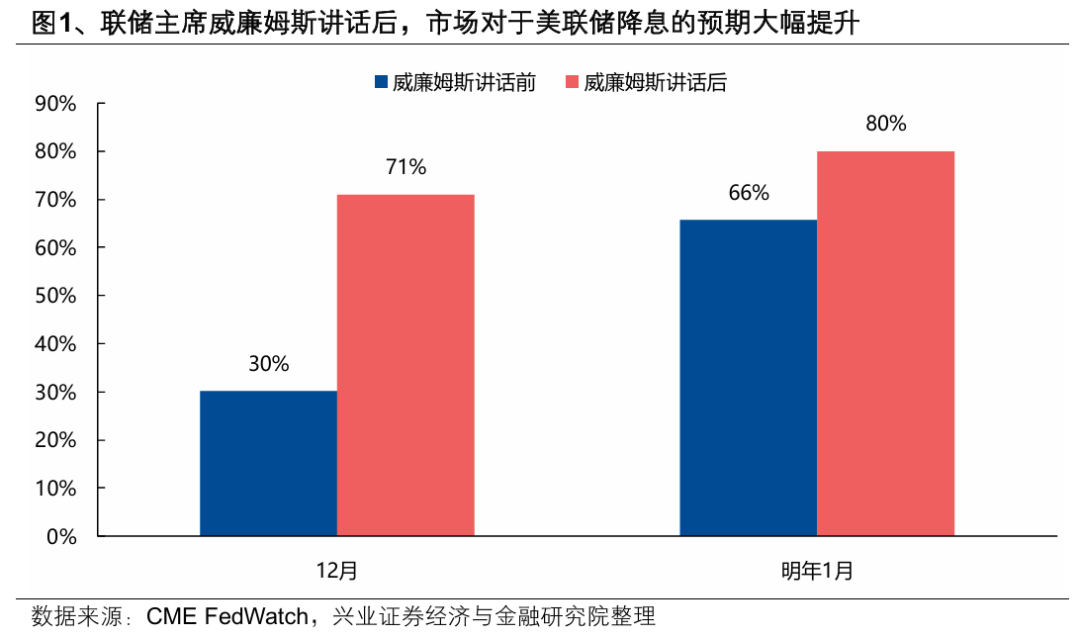
Group 1 - The core viewpoint is that Chinese assets are expected to recover due to their adjusted cost-effectiveness amidst global market fluctuations and the release of overseas risks [1][5][8] - The recent dovish comments from the Federal Reserve Chairman have led to a significant increase in the market's expectations for a rate cut in December, rising from 30% to 71%, which is easing the pressure on global risk appetite [2][5] - The concerns regarding the "AI bubble" are likely to ease as liquidity expectations improve and major tech companies continue to invest in AI applications, which are translating into actual productivity [5][8] Group 2 - The current market conditions indicate that the Hong Kong stock market, which has experienced earlier and deeper declines, presents a favorable entry point due to its high short-selling ratio and the valuation of the Hang Seng Tech Index returning to levels seen during "equal tariffs" [1][6][8] - Historical data shows that when the entire A-share market falls below the 60-day moving average, the subsequent recovery is often limited, suggesting that the market is likely to rebound after a short-term digestion period [5][6] - The independent logic supporting the recovery of Chinese assets includes enhanced national competitiveness, the release of new economic drivers, clear policy direction, and stable economic fundamentals, which are not affected by external disturbances [8][9] Group 3 - The focus for the year-end market layout should be on sectors with high growth expectations for the next year, particularly those that have adjusted to cost-effectiveness due to overseas shocks [9][10] - Key sectors identified for potential growth include AI industry trends, advantageous manufacturing, "anti-involution" sectors, and structural recovery in domestic demand [9][10][11] - For technology growth sectors, opportunities are seen in narrative shifts and internal "high-cut-low" strategies, particularly in AI applications, innovative pharmaceuticals, and military industries [14][18]

投顾晨报:防守策略生效,布局窗口将现-20251123
Orient Securities· 2025-11-23 06:42
Core Insights - The report emphasizes a defensive strategy in the current market environment, suggesting that investors should consider gradual positioning in sectors benefiting from marginal improvements in economic conditions in 2025 [2][3] - A significant rebalancing has occurred in global stock markets, with funds shifting from previously high-performing technology sectors to relatively undervalued sectors such as resources, consumption, and manufacturing [2][3] - The report highlights the positive outlook for mid-cap blue-chip companies in the machinery sector, driven by both policy support and fundamental improvements [5] Market Strategy - The current market is characterized by a "stable internal and external" dynamic, with technology assets experiencing a pullback due to concerns over an "AI bubble" [2][3] - Investors are advised to focus on mid-cap blue-chip companies in sectors like non-bank financials, steel, basic chemicals, and machinery, which have shown improved capital returns in Q3 [2][3] - Suggested ETFs for investment include the Consumer ETF (159928) and Infrastructure 50 ETF (516970/159635) [2][3] Industry Strategy - The machinery industry is expected to benefit from a dual drive of policy and fundamental support, with a focus on nurturing quality enterprises and specialized industrial clusters [5] - The forklift industry saw a 14.2% year-on-year increase in sales from January to October 2025, with exports rising by 15.5%, indicating a recovery in both domestic and international demand [5] - The "14th Five-Year Plan" emphasizes technological self-reliance, providing opportunities for companies with advantages in hydraulic components and five-axis machine tools to capture both traditional equipment upgrades and emerging market opportunities [5] Theme Strategy - The report discusses the launch of Nano2, which introduces a reasoning-driven visual generation capability, marking a shift from diffusion-based generation to a more intelligent image generation paradigm [6] - Companies with a comprehensive AI pathway, integrating hardware, research, models, and application scenarios, are expected to benefit significantly from advancements in AI applications [6] - Relevant ETFs for this theme include the Media ETF (512980/159805) and the China Concept Internet ETF (513220/159605) [6]
从宏观预期到权益配置思路:普林格周期资产配置的拓展
Huafu Securities· 2025-11-23 06:41
- **Pring Cycle and its construction** - **Model Name**: Pring Cycle - **Construction Idea**: The Pring Cycle divides the economy and market into six stages based on the rotation performance of stocks, bonds, and commodities, helping investors adapt to different economic environments [13][16][17] - **Construction Process**: 1. **Stage Division**: - Stage 1: Recovery Early Phase - Bonds perform best, stocks slightly rise, commodities remain flat - Stage 2: Recovery Acceleration - Stocks lead, bonds weaken - Stage 3: Expansion Peak - Commodities start rising, stock growth slows, bonds decline - Stage 4: Overheat Phase - Commodities perform best, stocks decline, bonds remain flat or slightly drop - Stage 5: Growth Slowdown - Bonds improve, stocks and commodities weaken - Stage 6: Recession Phase - Bonds perform best, stocks rebound slightly, commodities perform worst [16][17][18] 2. Historical validation of Pring Cycle stages and their corresponding market performances [18] - **Evaluation**: Pring Cycle provides forward-looking insights by extracting "implied economic expectations" from market variables like prices, interest rates, and commodities, reflecting the broad economic direction [47] - **Macro Trend Signal (TS) and its construction** - **Factor Name**: Trend Score (TS) - **Construction Idea**: TS is built using monthly macroeconomic data to reflect real economic activities, corporate profits, and liquidity trends, offering a stable and cross-industry consistent confirmation signal [47] - **Construction Process**: 1. **Factor Selection**: Core macro factors include PMI New Orders, PPI YoY/MoM, M1 YoY, and M2 YoY, representing demand, profitability, and liquidity [26][29][30] 2. **Standardization**: Apply 12-month rolling Z-score to each factor for comparability [33] 3. **Weighted Aggregation**: Combine Z-scores using normalized weights to derive monthly raw TS [33] 4. **EWMA Smoothing**: Apply EWMA (α=0.5) to stabilize TS and clarify trend segments [33] 5. **Anti-Jump Rule**: Use 60-period rolling distribution with dual thresholds (35/65 outer, 45/55 inner) to classify TS into "Cautious/Neutral/Positive" states, ensuring stable macro state transitions [34] 6. **Practical Application**: Extend monthly TS to daily frequency with a 15-day lag for real-time use [33] - **Evaluation**: TS complements Pring Cycle by providing confirmation signals from the fundamental side, enhancing reliability and cross-industry consistency [47] - **Backtesting Results for Models and Factors** - **Pring Cycle**: Historical validation shows that recovery and positive macro signals yield the strongest positive returns across industries, with recovery > overheat > recession in certainty [45][47] - **Macro Trend Signal (TS)**: Positive TS signals outperform cautious and neutral states, with clear positive effects on market returns [45][47] - **Combined Strategy**: The Pring Cycle and TS framework consistently outperform benchmarks like CSI 300 in most years, with stable long-term excess returns and controlled drawdowns [56][59] - **Performance Metrics for Macro States** - **CSI 300**: - Cautious: Recovery 2.24%, Recession -0.08%, Overheat 0.50% - Neutral: Recovery 0.23%, Recession -2.50%, Overheat 6.21% - Positive: Recovery 2.74%, Recession 0.34%, Overheat 1.29% [41] - **CSI 2000**: - Cautious: Recovery 4.42%, Recession -1.06%, Overheat -0.16% - Neutral: Recovery 2.85%, Recession -0.54%, Overheat -3.76% - Positive: Recovery 3.14%, Recession 0.37%, Overheat 1.77% [42] - **Growth Enterprise Index**: - Cautious: Recovery 3.69%, Recession -0.67%, Overheat -2.90% - Neutral: Recovery -0.97%, Recession -1.64%, Overheat 1.62% - Positive: Recovery 4.31%, Recession 2.95%, Overheat 0.51% [43] - **Low Volatility Dividend Index**: - Cautious: Recovery 2.13%, Recession 0.76%, Overheat 0.60% - Neutral: Recovery -0.69%, Recession -3.12%, Overheat 8.05% - Positive: Recovery 1.51%, Recession 1.42%, Overheat 1.86% [44] - **Sector Performance under Macro States** - **Positive-Recovery**: Sectors like New Energy, Basic Chemicals, Consumer Services, and Growth Enterprise Index show strong returns [60][62] - **Positive-Overheat**: Sectors like Electronics, Basic Chemicals, Electric Equipment, and Nonferrous Metals exhibit sustained performance, shifting towards cyclical sectors [63][64] - **Risk-Adjusted Returns**: Manufacturing chains (e.g., Chemicals, Nonferrous Metals) maintain mid-to-high rankings across all macro states, while defensive sectors (e.g., Food & Beverage, Banks) dominate during downturns [64][66] - **Strategy Effectiveness** - The combined Pring Cycle and TS framework systematically captures trends and filters noise, demonstrating long-term executability and adaptability to macroeconomic changes [56][59]
相差4倍!稀土独立失败,中方硬核逆袭反超德国,默茨彻底输了?
Sou Hu Cai Jing· 2025-11-22 12:40
Core Insights - The article analyzes how Chinese industry has surpassed Germany in areas where Germany traditionally excelled, leveraging advantages in price, quality, and speed, while Germany faces internal and external challenges [1][3][5] Group 1: German Industrial Decline - Germany, once a leader in manufacturing, is now experiencing economic stagnation, with industrial output stuck at 2005 levels for nearly two decades [3][5] - The once-proud advantages of German industry have turned into liabilities, leading to a significant decline in competitiveness [3][5] - In 2025, Germany experienced a historic trade deficit with China in capital goods for the first time since 2008, marking a critical shift in the industrial landscape [5][7] Group 2: Chinese Competitive Edge - Over the past six years, China's machinery exports to Europe have nearly doubled, with expectations to exceed €50 billion this year [7] - Chinese brands are increasingly dominating the automotive market in China, putting pressure on traditional German luxury brands like Audi and Porsche [7][9] - Chinese manufacturers are now competing directly in Germany's core sectors, offering products at significantly lower prices while maintaining comparable quality [9][11] Group 3: Challenges Facing German Industry - External pressures include trade barriers from the U.S. and rising energy costs, which have severely impacted German exports and profitability [13][15] - Internal challenges consist of high labor costs, bureaucratic inefficiencies, and a rigid innovation system that fails to adapt to new technologies [15][17] - Germany's attempts to reduce reliance on Chinese rare earth materials have been unsuccessful, further complicating its industrial recovery [17][19] Group 4: Future Outlook - The article suggests that Germany's industrial decline is not a temporary setback but a result of systemic issues that require urgent attention [19][21] - There is a call for Germany and Europe to reassess their industrial policies, increase innovation investments, and learn from China's competitive strategies [21][23] - The ongoing global competition emphasizes the need for continuous improvement and adaptation to avoid being left behind [23]