
有色

Search documents
新行业比较框架之五:从一维到二维,景气投资再解析
Bank of China Securities· 2025-12-17 13:36
Core Insights - The report introduces a new two-dimensional framework for analyzing industry prosperity, focusing on diffusion and dispersion metrics to provide a fresh perspective on investment strategies [1][2]. - It emphasizes the importance of absolute high prosperity over marginal high prosperity, indicating that long-term perspectives yield higher returns on earnings per share (EPS) [2][16]. - The report constructs a prosperity investment effectiveness index based on quarterly year-over-year (Q-YOY) data, which shows better performance than cumulative year-over-year (C-YOY) data [2][23]. Traditional One-Dimensional Prosperity Comparison - The report critiques the traditional one-dimensional approach that uses a single profitability growth rate for each industry, which simplifies market narratives to "who is accelerating and who is declining" [2][12]. - It raises questions about the importance of single-quarter versus cumulative profitability data, concluding that single-quarter data yields better investment outcomes [2][12][16]. - The report highlights that absolute high prosperity is more significant than marginal high prosperity, as evidenced by better net value performance in absolute high prosperity groups [2][16]. Two-Dimensional Prosperity Measurement - The report proposes measuring structural prosperity through two indicators: diffusion (measuring breadth) and dispersion (measuring structural strength) [2][2]. - It notes that the diffusion index influences "positioning," while the dispersion index affects "industry allocation bias" [2][2]. - The report suggests that the dispersion index is highly correlated with China's Producer Price Index (PPI), indicating that higher dispersion often coincides with rising PPI phases [2][14]. Application of the Two-Dimensional Framework - The report discusses the strategic value of diffusion and dispersion, asserting that they can better reflect the current market state than traditional methods [2][2]. - It emphasizes the need to analyze the composition of dispersion values to understand structural market trends, particularly in technology sectors [2][21]. - The report concludes that differentiation is the foundation of effective prosperity investment, with expectations for continued upward trends in diffusion and dispersion indices [2][24]. Conclusion and Outlook - The report anticipates that both diffusion and dispersion will likely trend upward, supporting the market's beta value [2][24]. - It recommends focusing on technology sectors such as computers, communications, and advanced manufacturing, as well as cyclical resource sectors like steel and chemicals [2][24].
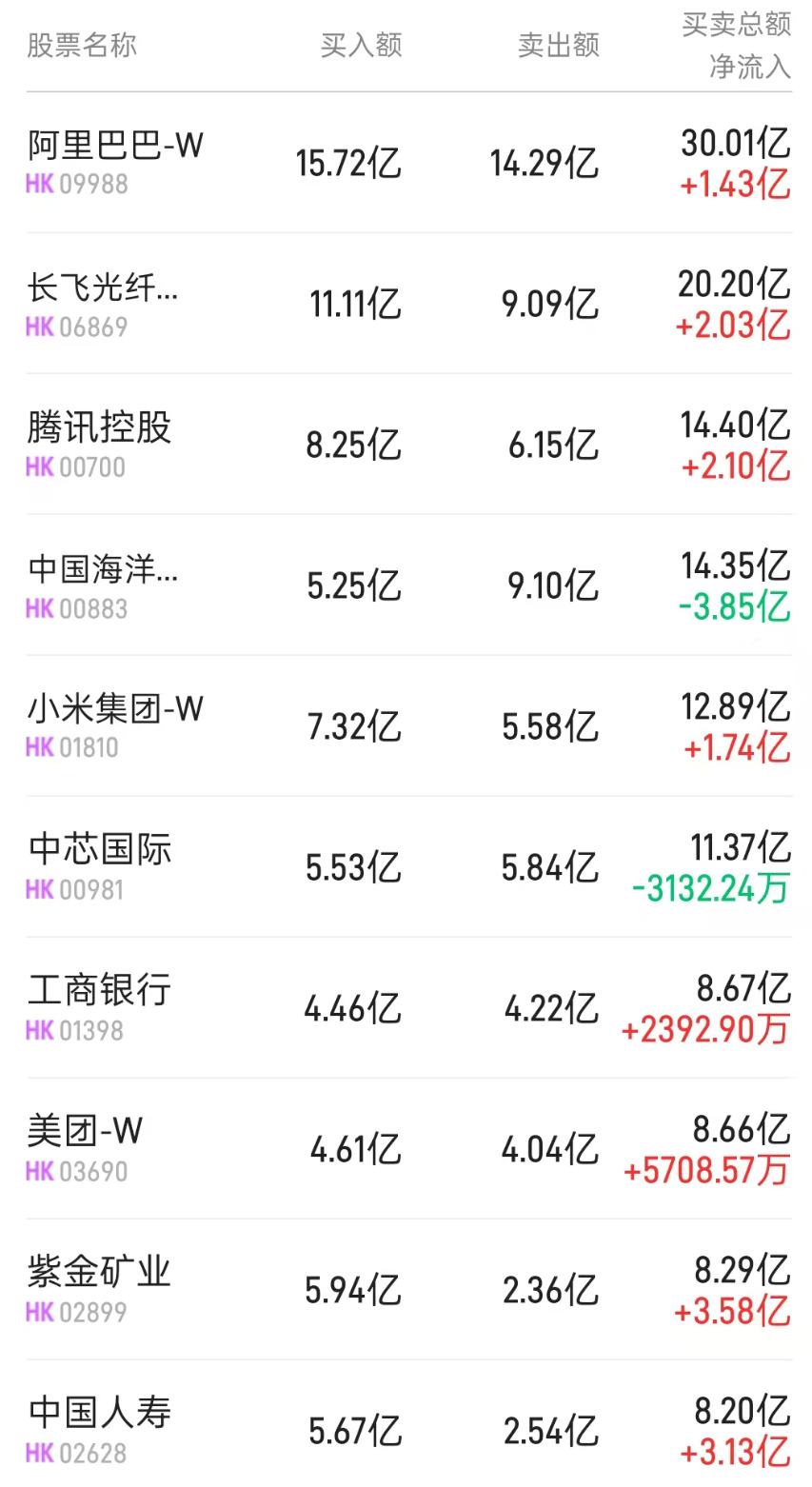
北水成交净买入79.09亿 内资全天抢筹科网股 加仓南方恒生科技超7亿港元
Zhi Tong Cai Jing· 2025-12-17 13:19
工商银行 中国人寿 紫金矿业 中国移动 中国海油 长飞光纤 分时图 日K线 周K线 月K线 7.81 0.02 0.26% 1.03% 0.64% 0.39% 0.00% 0.39% 0.64% 1.03% 7.71 7.74 7.76 7.79 7.82 7.84 7.87 09:30 10:30 11:30/13:00 14:00 15:00 0 195万 391万 586万 | 股票名称 | 买入额 | 卖出额 | 买卖总额 | | --- | --- | --- | --- | | | | | 净流入 | | 阿里巴巴-W | 15.72 乙 | 14.29 乙 | 30.01亿 | | HK 09988 | | | +1.43 乙 | | 长飞光纤 ... | 11.11亿 | 9.09亿 | 20.20亿 | | HK 06869 | | | +2.031Z+ | | 腾讯控股 | 8.25 亿 | 6.15 亿 | 14.40 乙 | | HK 00700 | | | +2.10 乙 | | :: | 5.25亿 | 9.10亿 | 14.35 乙 | | HK 00883 | | | -3.8 ...


午评:创业板指涨逾1%,半导体板块拉升,CPO概念等活跃
Zheng Quan Shi Bao Wang· 2025-12-17 04:35
Market Performance - The Shanghai Composite Index experienced a slight increase of 0.17%, closing at 3831.43 points, while the Shenzhen Component Index rose by 0.83% and the ChiNext Index surged by 1.21% [1] - The total trading volume in the Shanghai, Shenzhen, and North markets reached 10,403 billion [1] Sector Performance - Sectors such as liquor, agriculture, automotive, and real estate saw declines, while the semiconductor sector experienced a rise [1] - The tourism and catering, insurance, non-ferrous metals, and food and beverage sectors showed upward movement, with active performance in lithium mining, CPO concepts, and liquid cooling server concepts [1] Economic Outlook - Dongguan Securities indicated that ongoing domestic economic policies are expected to support economic growth within a reasonable range, providing a solid foundation for the capital market [1] - The gradual release of policy dividends is anticipated to boost market confidence, guiding various funds to actively allocate resources and promoting a gradual return to an upward market trend after consolidation [1] - Key sectors to watch include non-ferrous metals, banking, public utilities, transportation, and TMT (Technology, Media, and Telecommunications) [1]

创纪录!南向资金爆买!外资潜在回流 港股有望延续修复
Zheng Quan Shi Bao· 2025-12-16 13:03
今年以来,港股在全球主要股市中表现突出,恒生指数等年内涨幅超过20%。不过,自10月中旬以来, 港股市场进入调整阶段,波动有所加大,11月整体呈现震荡走势,12月以来的调整幅度有所加大。 港股作为典型的离岸市场,其流动性受海外环境影响显著,而基本面则与内地经济紧密相连。相比基本 面,流动性对港股行情的影响更为直接和迅速,其中科技类资产对利率变化更为敏感。 除了流动性,估值优势、资产质量提升与市场生态重塑多重因素,也将促使港股估值修复。多家券商机 构展望2026年港股行情时指出,随着港股基本面触底反弹,叠加其依旧显著的估值折价,港股市场在 2026年将迎来第二轮估值修复以及业绩进一步复苏的行情。 南向资金创纪录流入 中信证券也表示,考虑到理财和货基等产品收益率持续下滑,而今年以来中国资产的"赚钱效应"愈发显 著,居民"存款搬家"现象或将持续。特别考虑到港股的低配情况,预计南向资金将持续增配港股,尤其 散户资金有较大的增配空间。 回购热情升温 与南向资金涌入相呼应的是,港股市场回购热情出现升温。 数据显示,截至2025年12月15日,港股上市公司今年以来的回购金额为1693.45亿港元,相比2024年 2655. ...
创纪录!南向资金,爆买!
Zheng Quan Shi Bao· 2025-12-16 12:45
Group 1: Market Performance and Trends - The Hong Kong stock market has shown strong performance in 2025, with the Hang Seng Index rising over 20% year-to-date, but has entered a correction phase since mid-October, with increased volatility and a downward trend in December [1] - The market's liquidity is significantly influenced by the overseas environment, while its fundamentals are closely tied to the mainland economy, with liquidity having a more immediate impact on market performance [1] - Multiple factors, including valuation advantages and improved asset quality, are expected to drive valuation recovery in the Hong Kong market, with projections indicating a second round of valuation recovery and performance rebound by 2026 [1] Group 2: Southbound Capital Inflows - A notable feature of the Hong Kong market in 2025 is the record inflow of southbound capital, with a net buying amount reaching 1.39 trillion HKD by December 15, 2025, significantly surpassing the total for 2024 [2] - Southbound capital has provided substantial liquidity to the Hong Kong market, enhancing the pricing power of mainland investors, with the total market value of southbound holdings exceeding 6.3 trillion HKD, accounting for 12.7% of the total market capitalization [2] - The inflow of southbound capital is linked to a loose monetary policy environment, with a significant increase in trading volume, which reached a historical high of 57.5 trillion HKD in the first 11 months of 2025, a 94.5% increase year-on-year [2] Group 3: Future Projections for Southbound Capital - Future projections for southbound capital inflows suggest an increase of 600 billion HKD from public funds and insurance capital, with potential inflows from individual investors estimated between 2.5 billion HKD to 5 billion HKD over the next year [3] - The ongoing trend of "deposit migration" among residents, driven by declining yields on financial products, is expected to continue, with significant room for retail investors to increase their allocation to Hong Kong stocks [3] Group 4: Share Buyback Trends - The enthusiasm for share buybacks in the Hong Kong market has increased, with total buyback amounts reaching 169.35 billion HKD in 2025, although this is lower than the 265.51 billion HKD recorded in 2024 [4] - Monthly buyback amounts have surged since October, with 93.72 billion HKD in October, 117.42 billion HKD in November, and 115.24 billion HKD in the first half of December, indicating a strong upward trend [4][5] Group 5: External Capital Flows - In 2025, external capital flows into the Hong Kong market have turned positive, with inflows of 13.44 billion USD reported, and foreign cornerstone investors actively participating in IPOs [6] - The potential for further foreign capital inflows is contingent on domestic fundamentals and the RMB exchange rate, with expectations for a slight decrease in inflow scale compared to 2025 but still strong relative to southbound capital [6] Group 6: Market Recovery Outlook - The Hong Kong market is expected to benefit from a series of reforms and external economic policies, with projections for a rebound in 2026 driven by improved corporate earnings and continued inflows of southbound and foreign capital [7][8] - Key investment directions include technology sectors, healthcare, resource commodities, essential consumer goods, and industries benefiting from RMB appreciation [7]
创纪录!南向资金,爆买!
证券时报· 2025-12-16 12:42
Core Viewpoint - The Hong Kong stock market has shown strong performance in 2023, with the Hang Seng Index rising over 20% year-to-date, but has entered a correction phase since mid-October, with increased volatility and a significant adjustment in December [1] Group 1: Market Performance and Trends - The Hong Kong stock market is significantly influenced by overseas liquidity and closely tied to the mainland economy, with liquidity having a more immediate impact on market performance than fundamentals [1] - Multiple factors, including valuation advantages, improved asset quality, and market ecosystem restructuring, are expected to drive valuation recovery in the Hong Kong market [1] - Several brokerage firms predict that the Hong Kong market will experience a second round of valuation recovery and performance rebound by 2026, as fundamentals are expected to bottom out [1] Group 2: Southbound Capital Inflows - Southbound capital has been a key driver of the Hong Kong market's strong performance in 2025, with net inflows reaching a record 1.39 trillion HKD by December 15, 2025, significantly surpassing the total for 2024 [3] - The cumulative net inflow through the Stock Connect has reached 5.09 trillion HKD, nearing the 5.10 trillion HKD mark, providing substantial liquidity to the market and enhancing the pricing power of mainland investors [3] - The total trading volume in the Hong Kong market exceeded 57.5 trillion HKD in the first 11 months of 2025, marking a historical high and a 94.5% increase year-on-year [4] Group 3: Future Projections for Southbound Capital - Future inflows of southbound capital are expected to continue, with estimates suggesting an additional 600 billion HKD from public funds and insurance capital in 2026 [4] - If the proportion of Hong Kong stocks in new funds increases from 30.8% to 35%, there could be an additional inflow of 1 to 1.5 billion HKD [4] - Individual investors are projected to contribute significantly to the inflow, with potential purchases of 2.5 billion to 5 billion HKD in the coming year [5] Group 4: Share Buyback Trends - The enthusiasm for share buybacks in the Hong Kong market has increased, with total buyback amounts reaching 169.35 billion HKD in 2025, despite a decline from 2024 [8] - Monthly buyback amounts have surged since October, with 93.72 billion HKD in October, 117.42 billion HKD in November, and 115.24 billion HKD in the first half of December [8][10] - Major companies like Xiaomi and Tencent have contributed to the rising buyback trend, enhancing earnings per share and market confidence [9][10] Group 5: Foreign Capital Inflows - In 2025, foreign capital has stopped flowing out of the Hong Kong market, with inflows of 13.44 billion USD reported [12] - The demand for foreign capital in Chinese assets remains optimistic, driven by expectations of a stable or appreciating RMB and positive domestic fundamentals [12] - The inflow of foreign capital is expected to be slightly lower in 2026 compared to 2025, but remains strong compared to southbound capital inflows [12] Group 6: Outlook for 2026 - The Hong Kong market is anticipated to benefit from internal catalysts and external monetary easing policies, particularly from the US and Japan [14] - The market is expected to see a rebound in corporate earnings and continued inflows from southbound and foreign capital, driven by a "money-making effect" [15] - Key investment directions for 2026 include technology sectors, healthcare, resources benefiting from inflation, essential consumer goods, and industries benefiting from RMB appreciation [14][15]

长城基金汪立:布局春季行情,关注三大方向
Xin Lang Cai Jing· 2025-12-16 11:22
Group 1: Market Trends - The market continues to favor technology growth, while cyclical and consumer sectors are experiencing a pullback. AI-related optical modules and chips are gaining strength, alongside significant increases in controllable nuclear fusion and data center electricity, as well as heightened interest in smart grids and green energy consumption. Commercial aerospace remains highly active, while sectors like carbon black, phosphorus chemicals, methanol, real estate, and home textiles are lagging behind [1][6]. Group 2: Macroeconomic Analysis - The Central Economic Work Conference in China outlined five new understandings and eight key tasks to stabilize and promote economic growth. The focus is on a more proactive fiscal policy, leading investment recovery, and addressing real estate inventory issues. The conference emphasized the need for incremental policies based on changing circumstances [2][7]. - In November, China's core CPI rose to 0.7% year-on-year, while PPI fell to -2.2%. CPI was driven by food prices, consumer subsidies, and rising gold prices, while international oil price declines pressured PPI. The M1-M2 gap widened significantly, but M1 may stabilize marginally in the future. Exports in dollar terms grew by 5.9%, and imports increased by 1.9% [2][7]. Group 3: U.S. Federal Reserve Actions - The Federal Reserve announced a 25 basis point cut in the federal funds rate, bringing it to a target range of 3.50% to 3.75%. This decision aligns with expectations but reflects increasing internal divisions. The Fed's outlook on the U.S. economy and inflation has become more optimistic, and there may be further rate cuts anticipated due to a weakening labor market and upcoming leadership changes [3][8]. Group 4: Investment Strategy - A cross-year investment strategy is beginning, with expectations for policy adjustments to support market liquidity and activity. Historical patterns suggest that the spring market rally typically occurs from December to April, with large-cap stocks leading the way. Current market conditions may present a significant opportunity for positioning ahead of the spring rally [4][9]. - The investment outlook favors technology, financial services, and consumer sectors. Specific areas of interest include AI advancements, capital market reforms, and cyclical stocks that have seen valuation adjustments after three years of decline. Target sectors include internet, media, computing, and manufacturing with global competitive advantages, as well as low-priced consumer stocks and cyclical industries like non-ferrous metals and chemicals [5][10].
基本面没变、股价却崩了,你该抄底还是逃跑?
雪球· 2025-12-16 08:53
Group 1 - The article discusses the reliability of market predictions and the concept of "Mr. Market," suggesting that market prices often reflect emotional states rather than rational evaluations of fundamentals [4][5]. - It highlights examples from the A-share market where stock prices peaked before the actual revenue growth of leading companies, indicating a potential predictive nature of stock prices [6][8]. - The article argues against the belief that stock prices can foresee fundamental changes, emphasizing that historical examples often reflect narrative biases rather than true predictive capabilities [10][12]. Group 2 - The relationship between stock prices and fundamentals is explored through the "random walk theory," which posits that stock prices reflect fundamental changes only when informed investors act on new information [20][22]. - It is noted that only a small percentage of informed investors (10%) can accurately assess changes in fundamentals, leading to a disconnect for the majority of investors who may misinterpret market signals [19][21]. - The article concludes that while market movements may seem to predict fundamental changes, they often do not provide actionable insights for uninformed investors [33][35].

2025 年 11 月经济数据点评:分化延续,政策需加力
GUOTAI HAITONG SECURITIES· 2025-12-16 05:43
Economic Overview - The national economy in November 2025 showed characteristics of "stable production, differentiated consumption, and pressured investment" with industrial production recovering to normal levels after holiday disruptions[8] - The industrial added value in November grew by 4.8% year-on-year, a slight decrease of 0.1 percentage points from the previous month, indicating a marginal slowdown in growth[10] - Fixed asset investment from January to November decreased by 2.6% year-on-year, with November's monthly growth rate at -12.0%, although this was a slight improvement from the previous month[30] Production Insights - New industries continue to show resilience, with automotive manufacturing and transportation equipment leading in production growth, while traditional sectors face challenges[11] - The production index for services grew by 4.2% year-on-year in November, a decrease of 0.4 percentage points from October, reflecting seasonal adjustments post-holiday[14] Consumption Trends - Retail sales in November grew by only 1.3% year-on-year, marking the sixth consecutive month of decline, with large-scale retail sales dropping by 2.0%[20] - The promotional season's impact was limited, with online retail growth slowing from 8.1% to 5.4%, indicating weaker consumer demand[23] Investment Dynamics - Manufacturing investment showed signs of marginal improvement, particularly in high-tech sectors, despite an overall negative growth trend[31] - Real estate investment remains under pressure, with sales area and sales value down by 17.3% and 25.1% year-on-year, respectively, reflecting ongoing market adjustments[34] Risk Factors - External uncertainties are increasing, and domestic demand may decline more than expected, posing risks to economic stability[36]
午评:创业板指跌超2%,有色、军工等板块走低,零售板块逆市活跃
Sou Hu Cai Jing· 2025-12-16 04:20
Core Viewpoint - The A-share market experienced a decline across major indices, with the Shanghai Composite Index dropping over 1% while the North Stock 50 Index rose against the trend, indicating mixed market sentiment and sector performance [1] Market Performance - As of the midday close, the Shanghai Composite Index fell by 1.22% to 3820.85 points, the Shenzhen Component Index decreased by 1.88%, and the ChiNext Index dropped by 2.35%. In contrast, the North Stock 50 Index increased by 1.1% [1] - The total trading volume across the Shanghai, Shenzhen, and North Stock markets reached 1.1397 trillion yuan [1] Sector Analysis - Sectors such as non-ferrous metals, military industry, coal, oil, and pharmaceuticals all experienced declines, while retail and food & beverage sectors showed resilience with gains [1] - Concepts related to duty-free shopping and autonomous driving were notably active in the market [1] Policy Outlook - According to Everbright Securities, a new round of policy deployment is expected to support the A-share market's year-end performance, with domestic economic policies likely to continue to strengthen, maintaining economic growth within a reasonable range [1] - The release of policy dividends is anticipated to boost market confidence and attract various types of capital inflows [1] - Historically, the A-share market has performed well in the opening years of the 13th and 14th Five-Year Plans, suggesting a positive outlook for 2026 [1] Investment Strategy - Industry allocation should focus on TMT (Technology, Media, and Telecommunications) and advanced manufacturing sectors [1] - In the event of short-term market fluctuations due to external factors, defensive and consumer sectors may be worth monitoring [1]