金属

Search documents
工业金属板块8月11日跌0.11%,宏创控股领跌,主力资金净流入9347.45万元
Zheng Xing Xing Ye Ri Bao· 2025-08-11 08:33
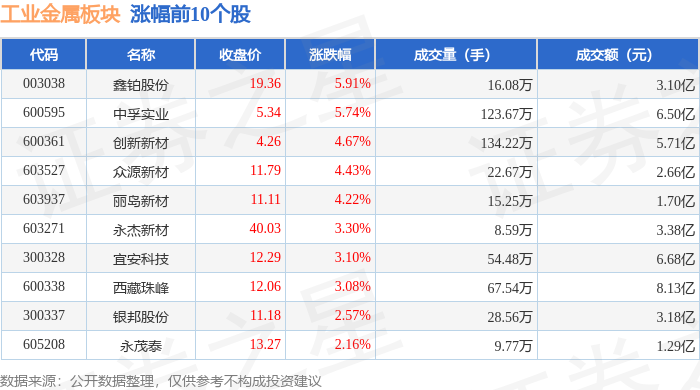
从资金流向上来看,当日工业金属板块主力资金净流入9347.45万元,游资资金净流入5613.05万元,散户 资金净流出1.5亿元。工业金属板块个股资金流向见下表: 证券之星消息,8月11日工业金属板块较上一交易日下跌0.11%,宏创控股领跌。当日上证指数报收于 3647.55,上涨0.34%。深证成指报收于11291.43,上涨1.46%。工业金属板块个股涨跌见下表: | 代码 | 名称 | 收盘价 | 涨跌幅 | 成交量(手) | 成交额(元) | | | --- | --- | --- | --- | --- | --- | --- | | 003038 | 整拍股份 | 19.36 | 5.91% | 16.08万 | | 3.10亿 | | 600595 | 一周五四 | 5.34 | 5.74% | 123.67万 | | 6.50亿 | | 600361 | 创新新材 | 4.26 | 4.67% | 134.22万 | | 5.71亿 | | 603527 | 众源新材 | 11.79 | 4.43% | 22.67万 | | 2.66亿 | | 603937 | 顾岛新材 | 11.11 | ...


新材料50ETF(159761)涨超1.3%,下游需求与国产替代成关注焦点
Mei Ri Jing Ji Xin Wen· 2025-08-11 06:14
Group 1 - The new materials industry is experiencing high downstream demand and opportunities for domestic substitution, with leading companies expected to enter a rapid growth phase due to high technical barriers [1] - The photovoltaic glass market is performing well, with inventory continuously decreasing and component companies actively stocking up; August order prices are expected to rise slightly [1] - The electronic yarn market is supported by stable demand, with high-end product supply tightening and overall demand performing relatively well [1] Group 2 - Glass fiber prices are at relatively low levels, and future demand from wind power and other sectors is expected to drive industry destocking and price increases [1] - New materials such as new-type glass and carbon fiber are benefiting from the high demand in the renewable energy sector, with growth potential expected to continue [1] - The New Materials 50 ETF (159761) tracks the New Materials Index (H30597), focusing on companies in advanced basic materials, key strategic materials, and cutting-edge new materials, reflecting the overall performance and market trends of related listed companies [1]
股指期货将偏强震荡,碳酸锂期货将震荡偏强,铜、工业硅、多晶硅、铁矿石、原油、烧碱、天然橡胶期货将偏强震荡
Guo Tai Jun An Qi Huo· 2025-08-11 03:52
Report Summary 1. Report Industry Investment Rating No investment rating information is provided in the report. 2. Core Viewpoints - Through macro - fundamental and technical analysis, the report predicts the trend of various futures contracts on August 11, 2025, including股指期货, 国债期货, 黄金期货, and other commodity futures [2][3]. - It also presents the expected trend of these futures contracts in August 2025, along with their resistance and support levels [26][52]. - The report includes macro - news and trading tips, such as international phone calls between leaders, economic data releases, and policy announcements [8]. 3. Summary by Related Catalogs 3.1 Futures Market Overview - In the first half of 2025, the whole futures market added 410,000 new customers, a 2.5% year - on - year increase. By the end of June, the total number of effective customers reached 2.61 million, a 12% year - on - year increase. The number of institutional customers increased by 43% compared to the same period in 2022, and the number of overseas customers increased by 63%, with traders from 39 countries or regions participating [14]. 3.2 Macroeconomic News - China - Russia and international relations: President Xi Jinping had a phone call with Russian President Putin, expressing support for the improvement of Russia - US relations and the political settlement of the Ukraine crisis. Regarding the possible secondary tariffs on China by the US, the Chinese Foreign Ministry stated that China's normal economic and trade cooperation with Russia is legitimate [8]. - Domestic economic policies: The Supreme People's Court issued guidelines to support the private economy, and the National Immigration Administration reported a significant increase in the number of foreign entries and exits in the first half of the year [8][11]. - Economic data: In July, CPI环比 increased by 0.4% from a 0.1% decline last month, and was flat year - on - year. Core CPI increased by 0.8% year - on - year. PPI环比 decreased by 0.2%, with the decline narrowing by 0.2 percentage points, and decreased by 3.6% year - on - year [9]. 3.3 Futures Market Performance on August 8 - Domestic commodity futures night session: Chemicals generally rose, non - metallic building materials were mixed, black series were mixed, agricultural products were mixed, and energy products generally fell [15]. - International futures market: International precious metals generally rose, international oil prices continued to fall due to OPEC's production increase plan, and London base metals were mixed [17][18]. 3.4 Futures Market Forecast - **Stock Index Futures**: On August 11, 2025, it is expected to be strongly oscillating. In August 2025, the IF, IH, IC, and IM contracts are also expected to be strongly oscillating or oscillating strongly [26]. - **Treasury Bond Futures**: On August 11, the ten - year T2509 is expected to be strongly oscillating, and the thirty - year TL2509 is expected to be oscillating and consolidating [47][51]. - **Precious Metal Futures**: On August 11, gold AU2510 and silver AG2510 are expected to be oscillating and consolidating. In August 2025, gold and silver continuous contracts are expected to be strongly and widely oscillating [52][58]. - **Base Metal Futures**: On August 11, copper CU2509 and zinc ZN2509 are expected to be strongly oscillating, while aluminum AL2509 and alumina AO2509 are expected to be weakly oscillating [63][69]. - **Industrial and Energy Futures**: On August 11, industrial silicon SI2511, polysilicon PS2511, lithium carbonate LC2511, iron ore I2601, crude oil SC2509, PTA TA509, caustic soda SH509, and natural rubber RU2601 are expected to be strongly oscillating. Coke JM2601, hot - rolled coil HC2510, and rebar RB2510 are expected to be weakly oscillating, and glass FG509, soda ash SA601, and PVC V2509 are expected to be widely oscillating [80][98].
百利好早盘分析:金价调整待变 关注美国通胀
Sou Hu Cai Jing· 2025-08-11 01:53
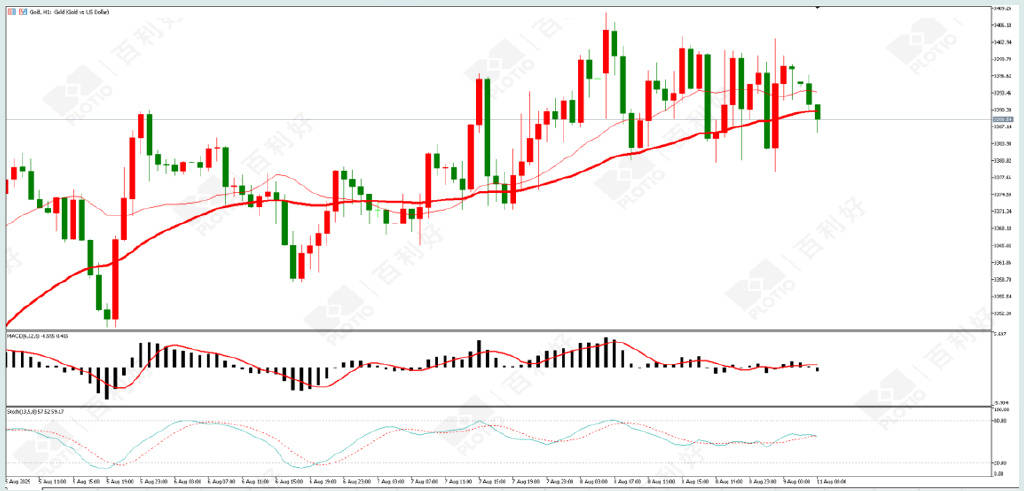
Group 1: Gold Market - The meeting between US President Trump and Russian President Putin on the 15th of this month in Alaska is expected to discuss the Ukraine crisis, with market expectations being neutral to optimistic, potentially putting pressure on gold prices [1] - Federal Reserve Governor Bowman indicated that recent US employment growth data has been significantly revised downward, suggesting a weak labor market that outweighs future inflation risks, leading to considerations for interest rate cuts, which could support higher gold prices [1] - Current market trading is primarily focused on the expectation of Federal Reserve rate cuts, with a greater likelihood of gold prices maintaining an upward trend [1] Group 2: Oil Market - Oil prices are expected to remain weak due to an anticipated increase in production from oil-producing countries, which is likely to hinder price increases [3] - Although the US is currently in its demand peak season, it is nearing the end of this period, coupled with risks of an economic recession, which could negatively impact oil demand [3] - Recent geopolitical tensions, particularly Iran's arrest of alleged Israeli intelligence agents, may influence oil prices, necessitating close monitoring of Middle Eastern developments [3] Group 3: Copper Market - The copper market is currently experiencing low-level fluctuations, with expectations of continued adjustment in the short term [5] - A recent rebound tested the 62-day moving average but failed to break through, indicating potential short-term downward risks [5] Group 4: Nikkei 225 Index - The Nikkei 225 index showed a significant increase in the previous trading day, closing with a bullish signal, suggesting a strong short-term outlook [6] - The index previously tested the 62-day moving average as support before rising, indicating a higher likelihood of further gains [6]
冠通期货资讯早间报-20250811
Guan Tong Qi Huo· 2025-08-11 01:31
Report Industry Investment Rating No relevant content provided. Core Viewpoints of the Report - International precious metal futures generally closed higher, while oil prices declined due to OPEC's production increase. Base metals showed mixed performance. The financial market had various developments including corporate dividends, fund self - purchases, and investment strategies. Industries such as real estate, agriculture, and manufacturing also had significant events [2][27][34] - The report suggests focusing on five strong industrial trend industries in asset allocation and avoiding unclear capital relay trading [29] Summary by Related Catalogs Overnight Night - Market Trends - COMEX gold futures rose 0.13% to $3458.2 per ounce, with a weekly increase of 1.72%. COMEX silver futures rose 0.56% to $38.51 per ounce, with a weekly increase of 4.28%. The rise was due to policy concerns and increased market uncertainty [2] - U.S. oil and Brent crude oil futures declined. U.S. oil fell 0.83% to $63.35 per barrel, with a weekly decline of 5.91%. Brent crude fell 0.17% to $66.32 per barrel, with a weekly decline of 4.81%, affected by OPEC+ production increase [2] - London base metals showed mixed performance. LME copper, zinc, and aluminum rose, while nickel, lead, and tin declined slightly. The market was significantly affected by Fed policies and tariffs [2] Important Information Macroeconomic Information - The 8th - 2025 China (Zhengzhou) International Futures Forum will be held from August 19th to 20th [4] - Five futures exchanges issued程序化交易 management measures to strengthen supervision [4] - In July, national passenger car retail sales were 1.826 million, a year - on - year increase of 6.3%. The cumulative retail sales this year were 12.728 million, a year - on - year increase of 10.1% [5] - As of August 8th, the Shanghai Export Container Freight Index and the China Export Container Freight Index declined [5] - In July, the national CPI was flat year - on - year. The average CPI from January to July decreased by 0.1% compared to the same period last year [7] - Fed Governor Bowman supports interest rate cuts in the remaining three meetings this year [7] Energy and Chemical Futures - As of August 7th, PVC social inventory increased 7.49% month - on - month to 776,300 tons, a year - on - year decrease of 17.52% [9] - As of August 7th, the weekly output of Chinese styrene factories was 359,200 tons, a decrease of 0.64%. The capacity utilization rate was 77.73%, a decrease of 1.19% [9] Metal Futures - The Guangzhou Futures Exchange added two new registered brands for polysilicon futures [11] - Last week, the nickel ore inventory at 14 Chinese ports increased by 389,800 wet tons to 10.3334 million wet tons, an increase of 3.92% [13] - Last week, copper, zinc, nickel, and tin inventories at the Shanghai Futures Exchange increased, while aluminum and lead inventories decreased [14] - The mining end of Ningde Times' Jiaxiaowo Mine will stop production starting from August 10th with no short - term resumption plan [14] Black - Series Futures - Due to rainfall, 12 out of 21 Inner Mongolia power coal mines reduced production or stopped production, with a total capacity of 67.5 million tons. Nine open - pit mines will resume production on the evening of August 8th [16] - Last week, the capacity utilization rate of independent coke enterprises increased by 0.34% to 74.03%. Coke daily output increased, inventory decreased, and coking coal inventory decreased [16] - On August 8th, the blast furnace operating rate of 247 steel mills was 83.75%, a week - on - week increase of 0.29 percentage points. The profitability of steel mills increased by 3.03 percentage points [16] - The inventory of imported iron ore at 45 and 47 Chinese ports increased, and the daily handling volume increased [18] - Coke started the sixth round of price increase, with an increase of 50 - 55 yuan [18] - Last week, the inventory of 60 independent ferrosilicon enterprises increased by 9.42% to 71,700 tons, while the inventory of 63 independent ferromanganese enterprises decreased by 2,500 tons [19] Agricultural Futures - As of August 8th, the self - breeding and self - raising pig farming profit was 45.13 yuan per head, and the profit from purchasing piglets for farming was a loss of 134.14 yuan per head [21] - Due to the anti - dumping investigation on Canadian rapeseed, the domestic far - month rapeseed procurement progress is slow, and the supply may be tight in the later stage [21] - From August 2nd to 8th, the actual soybean crushing volume of oil mills was 2.1775 million tons, with an operating rate of 61.21%, 35,500 tons lower than expected [22] - In July, the FAO Food Price Index rose 1.6% to 130.1 points, reaching a two - year high [24] - From August 1st to 10th, Malaysia's palm oil exports were expected to be 482,576 tons, a 23.3% increase from the same period last month [25] Financial Market Finance - Nearly 50 A - share companies have disclosed mid - term dividend plans, with some companies having high - value dividends and high dividend yields [27] - The Hong Kong Investment Management Limited has invested in over 100 projects, and more than 10 companies are applying for listing in Hong Kong [27] - Southern Fund self - purchased three equity - based ETFs worth 230 million yuan. This year, nearly 130 public funds have self - purchased over 5 billion yuan [27] - CITIC Securities suggests focusing on five strong industrial trend industries and avoiding unclear capital relay trading [29] - CITIC Construction Investment believes that the short - term A - share market has upward resistance but is in a bull - market relay, and suggests paying attention to new low - position sub - sectors [29] - Southbound funds have a cumulative net inflow of over HK$900.8 billion this year, and Hong Kong stocks are considered a more inclusive capital haven [29] Industry - Beijing Yizhuang issued policies to support the development of embodied intelligent robots [32] - The Hubei Brain - Computer Interface Industry Innovation Development Alliance was established, and the first medical service price standard for brain - computer interfaces was released [34] - From January to July, real estate companies had over 50 executive changes, with a focus on the marketing department. Some companies are introducing composite talents [34] - The Ministry of Agriculture and Rural Affairs will implement comprehensive regulation of pig production capacity and guide the reduction of about 1 million sows [34] - The first domestic shield/TBM big data mining community was established in Zhengzhou, and a vertical large - model was released [34] Overseas - U.S. Treasury Secretary believes Trump's tariff policy aims to bring manufacturing back to the U.S., and hopes the next Fed Chairman has "forward - looking thinking" [35] - The U.S. will stop providing tax credits for electric vehicles from September 30th. Electric vehicle sales may set a record in Q3 and decline in Q4 [35] - In 2024, Japan's population decreased by about 554,500, a decline of 0.44% [36] - The French government plans to save 4.2 billion euros from the national budget by canceling two public holidays in 2026 [36] International Stock Market - Jinglin Asset adjusted its U.S. stock holdings, adding technology stocks and clearing some positions [37] - The UK Competition and Markets Authority approved Boeing's acquisition of Spirit AeroSystems [37] Commodity - The gold futures price in the New York Mercantile Exchange hit a new high. "Interest - rate cut trading" and "Trump 2.0" will continue to catalyze the gold price [38] Bond - In the three months since the new policy on science and technology innovation bonds was implemented, the issuance scale reached 880.659 billion yuan, with a low average coupon rate [40] Foreign Exchange - Ten years after the "8·11 exchange - rate reform", the RMB exchange - rate marketization level has continuously improved, and two - way fluctuations have become the norm [41] Upcoming Economic Data and Events - Economic data such as Italy's July harmonized CPI annual rate final value, June trade balance, and Canada's national economic confidence index will be released [43] - There will be 54.48 billion yuan of reverse repurchase maturities in the Chinese central bank's open market. The revision plan of the Hang Seng Innovative Drug Index and related indices will be implemented [45] - The 2025 (Second) China Solid - State Battery Technology Industry Development Conference will be held from August 11th to 13th in Hangzhou. Hongyuan Co., Ltd. on the Beijing Stock Exchange will be available for subscription [45]
焦煤、碳酸锂领涨,政策支撑猪价企稳回升
2 1 Shi Ji Jing Ji Bao Dao· 2025-08-10 11:13
Group 1: Commodity Market Overview - Domestic commodity futures experienced mixed performance from August 4 to August 8, with coking coal and lithium carbonate leading gains, while fuel oil and crude oil saw declines [1] - Coking coal prices surged by 12.31%, breaking through the fluctuation range since June, driven by supply constraints and strong demand from steel mills [1][2] Group 2: Coking Coal Supply and Demand - Weekly coking coal production reached 5.2 million tons, a slight increase of 1.2% week-on-week but down 5% year-on-year due to ongoing production checks in Shanxi and Shaanxi [2] - Total coking coal inventory stood at 27.98 million tons, down 0.3% week-on-week, indicating a slight decrease in upstream stock [2] Group 3: Lithium Carbonate Market Dynamics - Lithium carbonate prices rose by 11.15% this week, influenced by supply concerns related to the Yichun lithium mine and ongoing market speculation [4][5] - The current market for lithium carbonate is characterized by a slight increase in supply and gradually recovering demand, with inventory levels exceeding 140,000 tons [5][6] Group 4: Economic Indicators - July CPI showed a month-on-month increase of 0.4%, while PPI decreased by 0.2%, indicating a narrowing decline [8] - The core CPI rose by 0.8% year-on-year, marking the highest level since March 2024, driven by price stability in household appliances and clothing [8] Group 5: Regulatory Developments - New regulations for algorithmic trading in the futures market will take effect on October 9, 2025, aimed at enhancing market order and fairness [9][10] - The regulations require a reporting system for algorithmic trading, with a six-month transition period for compliance [10]
2025年第一季度阿尔及利亚油气行业产量继续下降
Shang Wu Bu Wang Zhan· 2025-08-09 17:40
Group 1 - The Algerian oil and gas industry, a key pillar of the economy, experienced a year-on-year production decline of 3.3% in the first quarter of 2025 [1] - The production of liquefied natural gas, a critical product for Algeria's oil and gas sector, saw a significant drop of 17.5% in the first quarter of 2025 [1] - The refined oil production, after showing growth in the first and third quarters of 2024, began to decline by 2.2% in the first quarter of 2025 [1] Group 2 - Other industrial sectors also faced challenges, with mining and quarrying production decreasing by 3.7% in the first quarter of 2025 after a growth trend in 2023 and 2024 [1] - The steel, metals, machinery, electrical, and electronics industries experienced a dramatic overall decline of 41.7% in the first quarter of 2025, following a 25.1% increase in the fourth quarter of 2024 [1] - The chemical, food, and textile industries reported declines of 11.3%, 10.2%, and 4.9% respectively [1] Group 3 - Despite the overall industrial production downturn, the building materials sector showed a slight growth of 1.5% [1] - The wood and leather industries experienced significant growth, with increases of 19.6% and 13.1% respectively [1]
7月行业信息思考:“反内卷”对消费量、价、利润基本面的影响
SINOLINK SECURITIES· 2025-08-09 12:26
Group 1: Historical Insights - The previous supply-side reform period (2016-2017) saw significant pressure on consumption profits due to insufficient transmission of cost pressures from upstream resources and raw materials, leading to a general decline in profit growth across the consumption sector [1][12][21] - During the 2016-2017 period, despite strong demand-side policies, the ability of the consumption sector to pass on cost increases was limited, resulting in a divergence between revenue and profit growth [1][12][17] - Consumer confidence index rose from 103.7 in December 2015 to 122.6 in December 2017, indicating a strong demand environment during the previous reform [12][17] Group 2: Current "Anti-Internal Competition" Insights - The current "anti-internal competition" policy is expected to impose more stringent constraints on supply, particularly in sectors like automotive and express delivery, which may stabilize prices more quickly compared to the previous reform period [1][21] - The consumption sector is facing a more severe demand-side challenge now, with consumer confidence at low levels and growth relying more on "value-for-money" rather than brand premium pricing [1][21] - In July, the retail sales of passenger vehicles reached 1.826 million units, a year-on-year increase of 6.3%, but the growth rate significantly slowed from June's 13.3% [1][21] Group 3: Sector-Specific Observations - In the energy and resources sector, coal demand is expected to rise during peak seasons, with July's domestic raw coal production at 42.107 million tons, a year-on-year increase of 3.9% [22][23] - The real estate sector experienced a significant decline in transaction volume, with July's average daily transaction area for commercial housing in 30 major cities down 32.3% month-on-month and 18.6% year-on-year [35][37] - The manufacturing sector showed resilience, with strong performance in machinery and equipment exports, and heavy truck sales performing well [5][10]
智通港股解盘 | 结构问题引发调整 新藏铁路公司成立周期品再起
Zhi Tong Cai Jing· 2025-08-08 13:07
Market Overview - The Hong Kong stock market experienced a decline of 0.89%, attributed to internal structural issues despite positive market sentiment [1] - Concerns about "stagflation" in the US economy were highlighted, with initial jobless claims rising to 226,000, exceeding economists' expectations of 221,000 [1] - The US added 73,000 jobs in July, below the expected 100,000, while the personal consumption expenditure inflation rate rose to 2.6% year-on-year in June, higher than the anticipated 2.5% [1] Company Performance - Crocs projected a revenue decline of 9% to 11% for Q3, leading to a nearly 30% drop in its stock price, marking its lowest point in three years [1] - Semiconductor companies like SMIC and Hua Hong Semiconductor reported better-than-expected Q2 results, with SMIC's Q3 revenue guidance indicating a 5-7% increase and Hua Hong's a 11.3% increase [2] - AI application company Mingyuan Cloud turned a profit of 12.09 million to 15.41 million RMB, recovering from a loss of 115.37 million RMB last year, driven by product optimization and AI technology [3] Sector Insights - The pharmaceutical sector showed mixed results, with companies like Rongchang Bio and Junshi Biosciences seeing stock increases of over 6%, while Hutchison China MediTech's stock fell nearly 16% despite a significant profit increase due to asset sales [3] - The real estate sector in Hong Kong faced caution, with Wharf Holdings expressing a pessimistic outlook on retail rental prospects, resulting in an 8% stock drop [4] - Gold stocks remained strong, with companies like Zhaojin Mining and Shandong Gold benefiting from a weaker dollar [4] Infrastructure Developments - The establishment of the Xinjiang section of the New Tibet Railway, with a total investment of up to 350 billion RMB, is expected to boost related sectors, leading to stock increases in construction companies [4] - The MSCI announced the addition of 14 new stocks to its China index, including companies like 3SBio and Meituan, indicating potential investment opportunities [6] Emerging Technologies - The low Earth orbit satellite launch pace is accelerating, with multiple successful launches planned for the second half of the year, enhancing China's capabilities in satellite communications [7] - Companies like Interstellar Aerospace Technology are developing AI application satellites and aim to capture a significant market share in optical remote sensing satellites by 2028 [8] Individual Company Strategies - Smoore International is focusing on business transformation, with expectations of improved performance in HNB products following successful launches in Japan [9] - The company is diversifying into aerosol technology for beauty and medical applications, positioning 2025 as a critical year for growth [10]
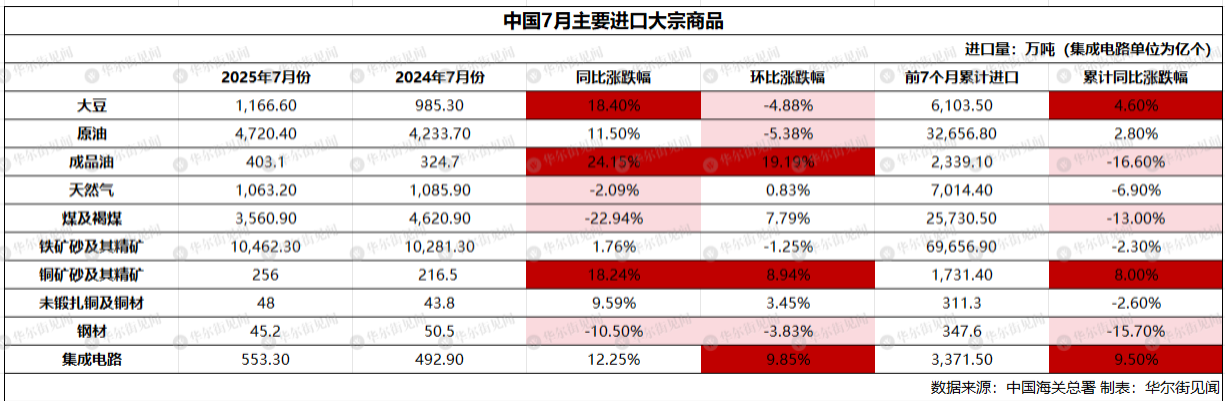
中国7月稀土出口环比跌23%,大豆进口创历史最高,铁矿石进口连续三个月保持在1亿吨上方
Hua Er Jie Jian Wen· 2025-08-07 06:34
Core Insights - China's rare earth exports fell by 23% month-on-month in July, ending a record high in June, while steel exports continued to rise, indicating mixed trends in the commodities market [1][2][3] Group 1: Rare Earth and Steel Exports - In July, China exported 5,994.3 tons of rare earth products, a decrease of 23% from June, but the total export volume for the first seven months of the year reached 38,563.6 tons, up 13% year-on-year [2] - Steel exports in July increased by 1.7% month-on-month to 9.84 million tons, marking the highest level since records began in 1990, with a total of 67.98 million tons exported in the first seven months of the year [3] Group 2: Soybean, Coal, and Oil Imports - China's soybean imports in July reached a historical high of 11.67 million tons, a year-on-year increase of 18.5%, driven by strong supply from Brazil [4] - Coal imports in July were 35.61 million tons, down 23% year-on-year but rebounding from a two-year low in June, supported by increased electricity demand due to high temperatures [5] - Crude oil imports in July totaled 47.2 million tons, averaging 11.12 million barrels per day, marking a 5.4% decrease from June but reflecting ongoing recovery in China's oil demand [6] Group 3: Overall Import Trends - In the first seven months of the year, imports of integrated circuits, copper ore and concentrates, and soybeans saw year-on-year increases of 9.5%, 8%, and 4.6% respectively, while imports of refined oil, coal, and steel declined [7][9] - The total coal import volume for the first seven months was 25.73 million tons, down 13% year-on-year, while crude oil imports totaled 32.66 million tons, reflecting a 2.8% increase [6][9]