
铜

Search documents
建信期货铜期货日报-20251014
Jian Xin Qi Huo· 2025-10-14 02:08
行业 铜期货日报 日期 2025 年 10 月 14 日 研究员:张平 021-60635734 zhangping@ccb.ccbfutures.com 期货从业资格号:F3015713 021-60635729 yufeifei@ccb.ccbfutures.com 期货从业资格号:F3025190 021-60635740 pengjinglin@ccb.ccbfutures.com 期货从业资格号:F3075681 有色金属研究团队 研究员:余菲菲 研究员:彭婧霖 请阅读正文后的声明 #summary# 每日报告 一、 行情回顾与操作建议 图1:沪铜走势及盘面价差 图2:伦铜走势及价差 宏观金融研究团队 021-60635739 有色金属研究团队 021-60635734 黑色金属研究团队 021-60635736 石油化工研究团队 021-60635738 农业产品研究团队 021-60635732 量化策略研究团队 021-60635726 数据来源:Wind,建信期货研究发展部 数据来源:Wind,建信期货研究发展部 沪铜冲高回落,主力最高涨至 88090,伦铜最高涨至 11000,均在前高附近 ...
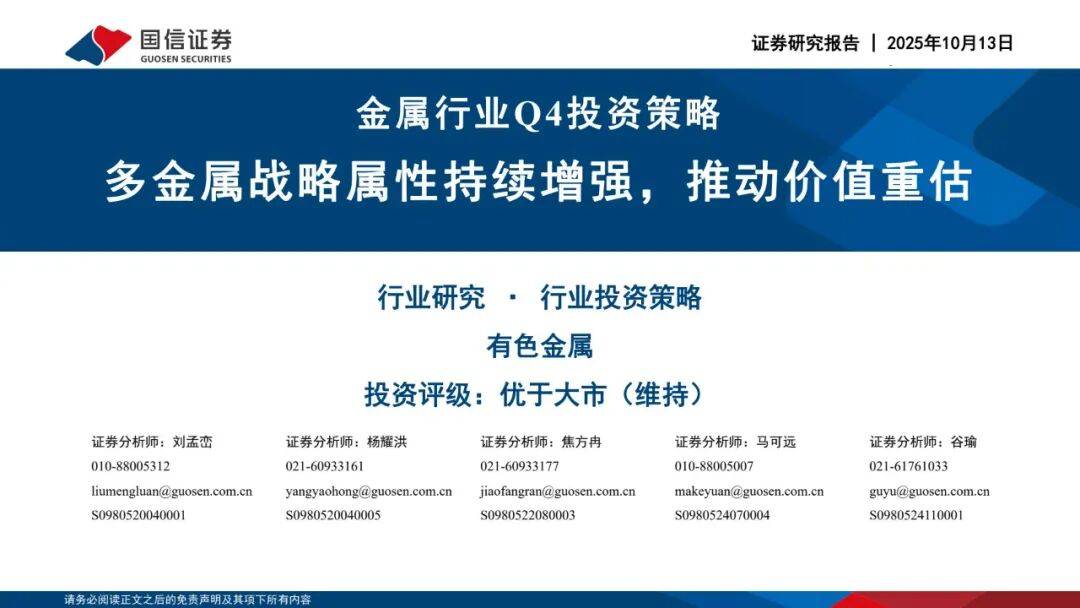
国信金属 | 金属行业Q4投资策略:多金属战略属性持续增强,推动价值重估
Sou Hu Cai Jing· 2025-10-13 14:57
Group 1: Industrial Metals - The copper market is experiencing upward price movement due to large copper mine production cuts, with the current phase being a Federal Reserve rate cut cycle. The supply disruptions in industrial metals are expected to lead to stable price increases, enhancing profits for listed companies in the industry. However, a rapid increase in copper prices may suppress downstream demand, leading to inventory accumulation during peak seasons, which is a signal of potential price peaks. Continuous monitoring of inventory changes is necessary [1][14][30] - The aluminum market is approaching a production peak in China, while foreign construction progress is slow. The next two years are expected to see peak production for China's electrolytic aluminum. The domestic aluminum supply-demand balance is fragile, and any increase in demand or supply disruptions could lead to shortages [1][32][38] Group 2: Precious Metals - Gold prices have reached new highs, driven by signals from Federal Reserve Chairman Powell's speech at the Jackson Hole global central bank conference, indicating rising employment risks and slowing GDP growth. The Fed's recent rate cut aligns with market expectations, and further cuts are anticipated. Global central banks are continuously increasing their gold reserves, suggesting a potential upward trend in gold prices through 2025 [3][11] Group 3: Energy Metals - The implementation of a quota system in the Democratic Republic of Congo is expected to create a significant shortage in the global cobalt market over the next two years, leading to a long-term price increase. The lithium market is currently in a state of relative balance, with supply disruptions not fully resolved but demand expectations rising [4][5][12] Group 4: Minor Metals - The strategic importance of minor metals is increasing, with export controls on rare earths tightening. The price of rare earth minerals has seen significant increases, with prices for certain products rising by 37% quarter-on-quarter. Tungsten prices are also expected to rise due to increased demand and supply constraints [6][13][15] Group 5: Tin - Global visible tin inventories have significantly decreased, with a peak of 22,763 tons in May 2024, followed by a reduction to below 9,000 tons by the end of 2022. This trend indicates a tightening supply situation in the tin market [2][41][52]

旺季大跌后,猪周期如何演绎?
2025-10-13 14:56
Summary of Conference Call Notes Industry Overview - The global ETF gold holdings have significantly increased, with a net inflow of 146 tons year-to-date, marking the largest single-month increase since March 2022. The North American market contributed the majority of this increase, reflecting concerns over U.S. economic risks, Federal Reserve policies, and geopolitical tensions [1][2] - The oil market is under pressure due to global risk asset sell-offs, despite OPEC's October meeting aligning with expectations for a slight reduction in production increases. Brent crude oil is expected to find support at around $60 per barrel [1][4] - The copper market is experiencing supply-side risks, particularly due to a Freeport incident leading to a supply-demand imbalance. Long-term fundamentals remain positive, with expectations of a copper shortage from 2025 to 2026 [1][6] Key Points on Specific Markets Gold Market - The rise in gold prices since September is primarily driven by safe-haven demand rather than expectations of interest rate cuts. The increase in ETF holdings in non-U.S. regions, especially Asia, is noteworthy [1][5] Oil Market - OPEC's recent actions included accelerating production cuts from April to September, with Saudi Arabia increasing production by approximately 1 million barrels. However, the market is expected to face downward pressure due to seasonal declines in downstream consumption and rising U.S. inventories [1][3][4] Pork Market - The pork market has seen a significant decline in prices, with a 15% drop in 2025 attributed to increased supply during peak seasons without a corresponding rise in demand. Future developments in the pork cycle will depend on supply-demand balance, policy adjustments, and breeding costs [1][7][8] - For October to November, pork prices are expected to continue declining, with planned slaughter volumes increasing by 5.5% and high slaughter weights maintained [1][9] - The medium-term outlook suggests that pork prices will not rebound significantly from Q4 2025 to H1 2026 due to ongoing supply pressures from increasing piglet numbers and policy measures affecting supply dynamics [1][10] - Long-term projections for H2 2026 indicate a target of 39 million breeding sows, with current losses in breeding profits accelerating the culling process. However, any significant capacity reduction in the near term may provide some price rebound opportunities [1][11] Additional Insights - The copper market is expected to remain in a state of shortage from 2025 to 2026, with favorable long-term fundamentals supporting price increases despite short-term market risk preferences [1][6] - The current futures market shows the 11 contract at a balanced state, indicating some supply pressure has been alleviated, while potential opportunities exist in the 09 contract due to deep losses in the 11 contract [1][12]
周期焦点直击 寻找黄金之外的“核心资产”
2025-10-13 14:56
Summary of Key Points from Conference Call Records Industry Overview - The focus is on the gold market and the broader context of precious and base metals, particularly in light of geopolitical tensions and economic conditions [1][2][4] Core Insights and Arguments - **Gold Market Dynamics**: - Gold has seen a significant price increase, nearly 10% in a week, driven by declining trust in government currencies and rising geopolitical tensions [2] - The price of gold is expected to stabilize after geopolitical tensions ease, but it remains a crucial asset in the precious metals sector [1][7] - The gold-to-silver ratio is currently around 80, expected to correct to below 60 as economic conditions stabilize [2][11] - **Base Metals Outlook**: - The outlook for base metals, particularly copper and aluminum, is optimistic due to supply disruptions from natural disasters and geopolitical events [1][8] - Copper is anticipated to remain in a supply shortage throughout the next year, driven by natural factors affecting production [9][10] - Electrolytic aluminum is highlighted as a strong investment opportunity due to its low valuation and cyclical nature [9] - **Impact of U.S.-China Trade Relations**: - Recent escalations in U.S.-China trade tensions have introduced market uncertainties but also present investment opportunities in scarce assets like base metals and renewable energy [5][6] - The potential for negotiations between the two nations may alleviate current tensions, impacting market dynamics positively [6] - **Phosphate Market**: - Phosphate prices have rebounded to near 2022 highs, driven by demand in agriculture and the renewable energy sector, particularly lithium iron phosphate [2][17] - A global supply gap of 4% is noted due to surging demand from China's renewable energy sector [18] Additional Important Insights - **Investment Strategies**: - Investors are advised to focus on base metals and renewable energy assets as key areas for potential growth amidst current market volatility [4][5] - The steel sector is suggested as a defensive strategy due to expected production declines [2][11] - **Geopolitical Factors**: - The rise of right-wing politics and global political polarization is contributing to a decline in trust in fiat currencies, further driving demand for safe-haven assets like gold and base metals [1][2] - **Market Valuation**: - Base metals are currently valued at historical lows compared to gold, indicating potential for price increases [8] - **Future Projections**: - The copper market is expected to see price increases in the upcoming quarters, driven by ongoing supply constraints and rising demand from new economic sectors [10] This summary encapsulates the critical insights and projections from the conference call, focusing on the gold and base metals markets, the implications of geopolitical tensions, and strategic investment opportunities.
黄金+铜+铝+锡+锑,贵金属领域最值得关注的龙头公司名单(附涨跌榜)
Sou Hu Cai Jing· 2025-10-13 12:32
Group 1: Core Insights - The report highlights the volatility in the non-ferrous metals sector due to dual factors of risk aversion and industrial uncertainty, with significant price increases in gold and copper driven by expectations of overseas monetary easing and supply changes [1][2]. - Key companies in the gold sector include Zhongjin Gold, Shandong Gold, Chifeng Gold, Shanjin International, and China National Gold International, which are recommended for investment focus [3]. - The report provides a detailed review of the market performance of five major sectors: precious metals, copper, aluminum, tin, and antimony, along with a summary of price changes, supply-demand structures, profitability, industry news, and a list of leading companies [1]. Group 2: Gold and Precious Metals - Gold prices rebounded quickly, reaching $3974.5 per ounce, a 2.29% increase since the beginning of the month, while silver prices rose to $50.76 per ounce, up 6.63% [2]. - The SPDR Gold ETF holdings increased by 70000 ounces to 32700000 ounces, indicating a rise in risk aversion among investors [2]. Group 3: Copper - Copper prices continued to rise, with LME copper closing at $10765 per ton, a 1.89% increase, and SHFE copper at 85900 yuan per ton, up 3.06% [4]. - LME copper inventory decreased by 1075 tons since the beginning of the month, indicating tightening supply [5]. - Key companies to watch in the copper sector include Zijin Mining, Luoyang Molybdenum, Jincheng Mining, Western Mining, Cangge Mining, and Minmetals Resources [8]. Group 4: Aluminum - Domestic electrolytic aluminum prices reached 21020 yuan per ton, with a slight increase of 290 yuan [9]. - The operating rate for aluminum profile enterprises is at 53.6%, indicating a slow recovery in downstream demand [9][10]. - Recommended companies in the aluminum sector include Shenhuo Co., Yun Aluminum, Tianshan Aluminum, and China Aluminum [10]. Group 5: Tin and Antimony - Tin prices surged by 5.16%, with domestic refined tin priced at 288830 yuan per ton, while supply remains tight due to lower-than-expected recovery from Myanmar's tin mines [11]. - Antimony prices continued to decline, with weak supply and demand dynamics [11][12]. - Companies to focus on in the tin sector include Xiyang Co., Huaxi Nonferrous, Xingye Silver Tin, and Hunan Gold [12]. Group 6: Investment Ratings and Strategies - The industry maintains a "recommended" rating, with gold, copper, aluminum, tin, and antimony sectors all showing investment value [13]. - Key variables affecting future market trends include Federal Reserve interest rate cuts, mining accidents, and downstream operating rates [13].
中美博弈或升温,关注避险需求与战略小金属
East Money Securities· 2025-10-13 12:30
Investment Rating - The report maintains an "Outperform" rating for the industry [2][9]. Core Insights - The report highlights the increasing geopolitical tensions between China and the U.S., which may elevate demand for safe-haven assets like gold and strategic metals such as rare earths and tungsten [5][9]. - The copper market is experiencing supply disruptions, with prices trending upward due to tight supply conditions [5]. - Aluminum demand is expected to continue, with potential opportunities for investment following market corrections [5]. - The strategic importance of rare earths and tungsten is emphasized due to recent export controls and geopolitical developments [5][9]. Summary by Sections Copper Sector - Supply disruptions are ongoing, with LME copper prices at $10,735 per ton, reflecting a week-on-week increase of 1.9% [5]. - The processing fee for imported copper concentrate is negative, indicating tight supply [5]. - Companies with rich copper reserves are recommended for investment [9]. Aluminum Sector - LME aluminum prices reached $2,800 per ton, up 3.6% week-on-week [5]. - The operating rate for aluminum processing enterprises has slightly decreased, but demand is expected to remain stable [5]. - Investment opportunities are suggested for companies in the aluminum sector following market corrections [9]. Gold Sector - Gold prices are rising, with SHFE gold at 901.6 RMB per gram, up 3.1% week-on-week [5]. - The report suggests that geopolitical tensions may enhance gold's strategic position as a safe-haven asset [5]. - Investment in gold-related companies is recommended due to their undervalued resource potential [9]. Rare Metals Sector - Rare earth prices remain stable, with praseodymium-neodymium oxide at 683,000 RMB per ton [5]. - Recent export controls on rare earths have heightened their strategic importance amid U.S.-China tensions [5][9]. - Investment opportunities are highlighted in companies involved in rare earth production [9]. Steel Sector - Steel prices are stable, with SHFE rebar at 3,103 RMB per ton, reflecting a week-on-week increase of 1.0% [6]. - The report notes frequent disruptions in iron ore supply negotiations, which may impact future prices [6]. - Companies with high self-sufficiency in iron ore are recommended for investment [9].




银河期货有色金属衍生品日报-20251013
Yin He Qi Huo· 2025-10-13 12:05
Group 1: Report Industry Investment Rating - No relevant content provided Group 2: Core Views of the Report - Copper prices are expected to have a long - term upward trend, with short - term adjustments. Alumina prices are likely to maintain a weak and volatile bottom - grinding market. Aluminum prices are expected to be weak in the short - term and strengthen in the medium - term. Nickel prices are expected to have increased volatility and a lower oscillation center. Stainless steel prices are expected to weaken. Tin prices will be in a short - term high - level oscillation. Industrial silicon prices may oscillate in the medium - term and be strong in the short - term. Polysilicon prices may have a limited short - term callback. Lithium carbonate prices are expected to continue to reduce inventory and support the price [6][14][20][46][53][60][64][71][76] Group 3: Summary by Related Catalogs Copper - **Market Review**: On October 13, the Shanghai Copper 2511 contract closed at 85,120 yuan/ton, down 2.06%, and the Shanghai Copper Index reduced positions by 12,125 lots to 566,100 lots. The spot market trading improved with price drops, and the premium in Shanghai rose [2] - **Important Information**: As of October 13, the national copper inventory increased by 0.57 million tons to 17.2 million tons. In September, China imported 2.587 million tons of copper ore and concentrates, and the cumulative import from January to September was 22.634 million tons, a year - on - year increase of 7.7%. The export of unwrought aluminum and aluminum products in September was 521,000 tons, and the cumulative export from January to September was 4.516 million tons, a year - on - year decrease of 8.1% [3][4] - **Logic Analysis**: Trump's tariff remarks and supply - side problems have affected copper prices. Mine supply tension has intensified, and consumption shows "not prosperous in the peak season", but there may be an increase in demand after price adjustments [6] - **Trading Strategy**: Adopt a long - on - dips strategy for single - side trading, continue to hold cross - market positive spreads, and arrange cross - period positive spreads after domestic inventory decline. Keep options on hold [7][8][9] Alumina - **Market Review**: On October 13, the Alumina 2601 contract decreased by 57 yuan to 2,820 yuan/ton. Spot prices in most regions declined [10] - **Related Information**: An aluminum plant in Xinjiang purchased 10,000 tons of alumina on October 13. As of last Friday, the national alumina production capacity was 114.62 million tons, with 98.55 million tons in operation. In September, the actual production of alumina was 8.06 million tons, the net export was about 80,000 tons, and the demand was 7.552 million tons [11][12] - **Logic Analysis**: Affected by market sentiment, alumina prices fell. Although the static surplus has been absorbed, the surplus trend remains. The price is expected to be weak and volatile [14] - **Trading Strategy**: Single - side trading shows a weak and volatile trend. Keep arbitrage and options on hold [15][16] Aluminum - **Market Review**: On October 13, the Shanghai Aluminum 2511 contract decreased by 205 yuan to 20,885 yuan/ton. Spot prices in various regions declined [17] - **Related Information**: Trump's tariff policy was upgraded. In September, the national electrolytic aluminum weighted average full - cost was 15,977 yuan/ton, and the theoretical profit was 4,798 yuan/ton. On October 13, the national aluminum ingot spot inventory was 642,000 tons, an increase of 80,000 tons [17] - **Trading Logic**: The tariff policy upgrade led to a decline in aluminum prices, but the medium - term upward trend remains. The market may have large - amplitude fluctuations [20] - **Trading Strategy**: Be on the sidelines in the short - term for single - side trading, and the medium - term trend is upward. Keep arbitrage and options on hold [21][22][23] Casting Aluminum Alloy - **Market Review**: On October 13, the Casting Aluminum Alloy 2511 contract decreased by 225 yuan to 20,335 yuan/ton. Spot prices in various regions declined [25] - **Related Information**: Trump's tariff policy was upgraded. On October 13, the social inventory of recycled aluminum alloy ingots in Foshan, Ningbo, and Wuxi decreased by 703 tons, and the casting aluminum alloy warehouse receipts increased by 2,503 tons [25][26] - **Trading Logic**: The tariff policy upgrade led to a decline in prices. Before the implementation of tariffs is clear, the negative impact of macro - sentiment on aluminum products is significant. The price will be weak, and scrap aluminum prices may support the spot price [27] - **Trading Strategy**: Pay attention to tariff policy developments for single - side trading. Keep arbitrage and options on hold [28][29][31] Zinc - **Market Review**: On October 13, Shanghai Zinc 2511 dropped 0.58% to 22,255 yuan/ton, and the Shanghai Zinc Index reduced positions by 2,771 lots to 212,600 lots. The spot market trading was light [32] - **Related Information**: As of October 13, the national zinc ingot inventory was 163,100 tons, an increase of 21,700 tons from September 29 [33] - **Logic Analysis**: In October, domestic zinc smelters increased production, and consumption did not improve significantly. The domestic price was under pressure, while the LME price was strong. The pattern of strong overseas and weak domestic may continue [34] - **Trading Strategy**: Close profitable short positions and wait for the export window to open to short again. Keep arbitrage on hold and close out the sold out - of - the - money call options [35][37] Lead - **Market Review**: On October 13, Shanghai Lead 2511 dropped 0.18% to 17,095 yuan/ton, and the Shanghai Lead Index increased positions by 5,004 lots to 82,700 lots. Part of the downstream replenished inventory, and the spot market had different purchasing attitudes [36] - **Related Information**: As of October 13, the national lead ingot social inventory was 36,000 tons, a decrease of 6,100 tons from September 29. The electric bicycle trade - in policy in Changsha and Shaoyang will be suspended on October 20 [39] - **Logic Analysis**: From September to mid - October, domestic lead production was relatively low. The inventory decreased during the National Day. The supply is weaker than demand currently, but the supply may increase in the second half of October, and the price may fall after rising [40] - **Trading Strategy**: The price may rise in the short - term but fall after rising. Keep arbitrage on hold and sell out - of - the - money call options [41] Nickel - **Market Review**: On October 13, the main contract of Shanghai Nickel NI2511 decreased by 2,080 yuan to 121,410 yuan/ton, and the index increased positions by 1,785 lots. Spot premiums changed [43] - **Related Information**: The Shanghai Futures Exchange adjusted the trading margin and daily price limit for nickel futures on October 14. Some Indonesian mining companies resumed production. Goldman Sachs predicted that nickel prices would drop by 6% by December 2026 [44][46] - **Logic Analysis**: Due to the lack of profit - taking and Trump's remarks, the decline was relatively mild. The "de - globalization" trend and the surplus pattern will lead to increased volatility and a lower center of oscillation [46] - **Trading Strategy**: Short a small amount of the main contract. Keep arbitrage and options on hold [47][48][49] Stainless Steel - **Market Review**: On October 13, the main contract of stainless steel SS2512 decreased by 205 yuan to 12,655 yuan/ton, and the index increased positions by 28,538 lots. The spot price range was given [51] - **Important Information**: Indonesia won the stainless - steel anti - dumping lawsuit against the EU, which is expected to boost exports. The national stainless - steel social inventory increased during the holiday [51][53] - **Logic Analysis**: The escalation of the Sino - US trade war affected external demand, and the inventory increased. The price was under pressure, and the market was waiting to see the inventory digestion this week [53] - **Trading Strategy**: The price will weaken. Keep arbitrage on hold [54][55] Tin - **Market Review**: On October 13, the main contract of Shanghai Tin 2511 closed at 282,110 yuan/ton, down 2.19%. The spot price dropped, and the trading was mainly for rigid demand [57] - **Related Information**: The US postponed the release of CPI data. As of October 10, the national tin ingot inventory decreased by 568 tons compared with September 26 [58][59] - **Logic Analysis**: Trump's tariff remarks led to a price drop. The supply of tin ore is still tight, and the demand is slowly recovering. Pay attention to Myanmar's resumption of production and electronic consumption recovery [60] - **Trading Strategy**: The price will oscillate at a high level in the short - term. Keep options on hold [61][62] Industrial Silicon - **Important Information**: The US cancelled a solar project and planned to impose tariffs on Chinese goods. The production capacity in Xinjiang decreased, and the production capacity in the east increased. The southwest may reduce production in November [63][64] - **Logic Analysis**: The production decreased in Xinjiang and increased in the east. The southwest will reduce production in November. The demand is strong in the short - term, and the price may oscillate in the medium - term and be strong in the short - term [64] - **Strategy Suggestion**: Hold long positions. There is no arbitrage and option strategy currently [67][68] Polysilicon - **Important Information**: The US cancelled a solar project and planned to impose tariffs on Chinese goods. The production increased in October, and the silicon wafer production decreased [70][71] - **Logic Analysis**: The supply increased and the demand decreased in October. The concentrated cancellation of warehouse receipts in November is the core driver of the price callback. The rumored state - purchase may limit the callback space [71] - **Strategy Suggestion**: Try to go long near the low point of the PS2512 contract in August. Hold the reverse arbitrage of 2511 and 2512 contracts. Buy both out - of - the - money call and put options [72] Lithium Carbonate - **Market Review**: On October 13, the Lithium Carbonate 2511 contract decreased by 780 yuan to 72,500 yuan/ton, and the index increased positions by 1,306 lots. The spot price dropped [74] - **Important Information**: A lithium project in Jiangxi had major changes. In September, the sales of new - energy vehicles and the production of ternary materials increased [76] - **Logic Analysis**: The supply growth rate is lower than the demand in October, and the inventory is expected to continue to decrease, supporting the price. Consider closing short positions and going long if the price falls below 70,000 yuan [76] - **Trading Strategy**: Short on rebounds and close short positions if the price falls below 70,000 yuan. Keep arbitrage and options on hold [77][78][79]
每日投行/机构观点梳理(2025-10-13)
Jin Shi Shu Ju· 2025-10-13 11:33
Group 1: Copper and Nickel Market Outlook - Goldman Sachs forecasts copper prices to remain in the range of $10,000 to $11,000 per ton in 2026/2027 [1] - Goldman Sachs predicts nickel prices will decline by 6% to $14,500 per ton by December 2026 due to the need for Indonesian nickel producers to lower profit margins to limit supply growth [1] Group 2: Gold Price Predictions - Canadian Imperial Bank of Commerce expects gold prices to rise to $4,500 per ounce in 2026 and 2027, before falling to $4,250 in 2028 and $4,000 in 2029, driven by long-term inflation concerns [1] - The recent surge in gold prices is attributed to fears of long-term inflation and wealth preservation, as the Federal Reserve's monetary policy has not adequately addressed these concerns [1] Group 3: Japanese Yen and Interest Rate Expectations - State Street Bank indicates that the delay in interest rate hikes has exacerbated the weakness of the Japanese yen, with market reactions expected if there is no consensus on the appointment of the new Prime Minister [2] Group 4: European Central Bank's Stance - Pantheon Macroeconomics suggests that the European Central Bank is unlikely to lower interest rates in the coming months despite a weak economic outlook, as they may view current economic weakness as temporary [3] Group 5: Chinese Market and Liquidity - China International Capital Corporation highlights October as a potential liquidity resonance window, suggesting that A-shares and Hong Kong stocks offer better value compared to U.S. stocks due to a shift towards a more accommodative monetary policy [4] - The report indicates that the recent escalation in U.S.-China trade tensions is expected to have a weaker impact on A-shares compared to previous events, with a focus on long-term asset revaluation in China [5] Group 6: Gold Market Dynamics - Guoxin Securities notes that the recent rise in gold prices is driven by expectations of Federal Reserve rate cuts, geopolitical risks, and increased investment demand, marking the beginning of a new strong cycle for gold [6] Group 7: Energy Storage and Lithium Battery Sector - CITIC Securities continues to recommend the energy storage sector, citing a turning point in domestic energy storage economics and a favorable outlook for the lithium battery industry [7] Group 8: Cobalt and Rare Earth Strategic Opportunities - CITIC Securities identifies strategic opportunities in cobalt and rare earths, with new export quotas from the Democratic Republic of Congo expected to lead to a market shift from surplus to shortage [8] Group 9: Market Volatility and Investment Strategy - Everbright Securities predicts that the market may enter a phase of wide fluctuations due to high valuations and cautious capital, while also noting potential support from upcoming policy expectations [9] Group 10: Long-term Outlook for Gold - Guoxin Securities maintains a positive long-term outlook for gold, suggesting that the third wave of opportunities may arise from shifts in capital flows due to the peak of the AI technology wave [10] Group 11: External Shocks and Chinese Market Opportunities - Guotai Junan Securities views external shocks as buying opportunities for the Chinese market, emphasizing the internal certainty of China's transformation and the demand for quality assets [11]
10月13日晚间重要公告一览
Xi Niu Cai Jing· 2025-10-13 10:13
Group 1 - Harbin Air Conditioning plans to transfer 40% equity of its subsidiary, Harbin Fushanchuan Biotechnology Development Co., Ltd. The subsidiary reported a net profit of -16.0963 million yuan for 2024, which is 218.83% of the previous year's net profit absolute value [1] - Xinhua Insurance expects a net profit of 29.986 billion to 34.122 billion yuan for the first three quarters of 2025, representing a year-on-year growth of 45% to 65% [1][2] - Gansu Energy anticipates a net profit of 1.55 billion to 1.6 billion yuan for the first three quarters of 2025, reflecting a year-on-year increase of 11.86% to 15.47% [2][3] Group 2 - Dongfang Tower forecasts a net profit of 750 million to 900 million yuan for the first three quarters of 2025, indicating a year-on-year growth of 60.83% to 93% [4] - Meili Eco announced that its subsidiary won a bid for an EPC project worth 2.375 billion yuan [6] - Bohai Chemical's wholly-owned subsidiary will undergo routine maintenance for its 600,000 tons/year PDH unit, expected to last about 30 days [8] Group 3 - Qin Port Co. reported a total throughput of 317.02 million tons for the first nine months of 2025, a year-on-year increase of 5.56% [10] - Jianglong Shipbuilding won a bid for a 72.99 million yuan fishery enforcement vessel project, accounting for 4.22% of its 2024 audited revenue [11] - Longyuan Technology expects a net profit of 35 million to 40 million yuan for the first three quarters of 2025, representing a year-on-year increase of 50.11% to 71.55% [12] Group 4 - Naipu Mining anticipates a net profit of 61 million to 66 million yuan for the first three quarters of 2025, reflecting a year-on-year decline of 45.16% to 49.32% [14] - Jinggong Steel Structure reported a cumulative contract amount of 17.98 billion yuan for the first nine months of 2025, a year-on-year increase of 4.8% [15][16] - Shenzhen Gas reported a net profit of 918 million yuan for the first three quarters of 2025, a year-on-year decrease of 13.08% [17] Group 5 - Yabao Pharmaceutical's subsidiary received a drug registration certificate for a new diabetes medication [18] - Shaanxi Coal's coal production in September was 14.56 million tons, a year-on-year increase of 5.34% [20] - Sifang New Materials reported a 15.94% year-on-year decline in concrete production for the first three quarters [22] Group 6 - Nanjing Foods reported a consolidated revenue of 276 million yuan in September, a slight increase of 0.0016% year-on-year [23] - Pulaike received a new veterinary drug registration certificate for a flea and tick treatment [24] - Zhucheng Technology received a cash dividend of 15 million yuan from its subsidiary [25] Group 7 - David Medical's subsidiary received a medical device registration certificate for a portable electronic endoscope image processor [26] - Zhongtong Bus reported a 36.88% year-on-year increase in sales in September, totaling 1,106 units [27] - Xiantan Co. reported a 11.95% year-on-year increase in chicken sales revenue in September [28] Group 8 - Bojun Technology expects a net profit of 552 million to 662 million yuan for the first three quarters of 2025, a year-on-year increase of 50% to 80% [30] - Haishi Pharmaceutical's innovative pain relief drug clinical trial application has been accepted [31] - Lingxiao Pump Industry used 80 million yuan of idle funds to purchase financial products [32] Group 9 - Qiangda Circuit's subsidiary completed business registration changes to expand its operational scope [33] - *ST Tianyu's controlling shareholder applied for bankruptcy liquidation due to severe financial difficulties [34] - Baolidi's shareholder plans to reduce holdings by up to 1 million shares [36] Group 10 - Zijin Mining completed the acquisition of Kazakhstan's Raygorodok gold mine, controlling 100% of its rights [44] - Zhonggang Luoyang's indirect controlling shareholder completed a capital increase, raising registered capital from approximately 26.666 billion yuan to 44.824 billion yuan [46] - Jinyu Jidong's director resigned due to work adjustments [47]




贵金属有色金属产业日报-20251013
Dong Ya Qi Huo· 2025-10-13 09:40
Report Industry Investment Rating No relevant content provided. Core Views of the Report - The continuous push of safe - haven demand, central bank gold - buying trends, and monetary policy easing expectations have strengthened the medium - to - long - term upward logic of precious metals prices [3]. - The copper price is caught between the strong expectation of supply shortage and the weak expectation of tariff policy, leading to short - term high - level fluctuations in futures prices [16]. - Macroeconomic policies are the core factors affecting the price of Shanghai Aluminum. The price has been affected by factors such as employment data, tariff announcements, and supply disruptions. Alumina is in an oversupply situation, while cast aluminum alloy has strong support [35]. - The fundamentals of zinc have not improved. Although the zinc price has risen, the domestic supply - strong and demand - weak pattern is obvious [56]. - The nickel price is mainly influenced by the situation of the Indonesian nickel ore market. The downstream of the new energy sector has a good demand, and the stainless steel market has some positive factors, but is also affected by tariff uncertainties [69]. - Due to increased macro - uncertainty, the tin price is expected to correct in the short term [85]. - Considering supply and demand factors, the lithium carbonate futures price is expected to show a weakening trend with fluctuations [98]. - The price of industrial silicon is expected to rise slightly with the arrival of the dry season, but the increase is limited by inventory. The trading of polysilicon is focused on the establishment of the storage platform and the cancellation of warehouse receipts, with high volatility and risk [109]. Summaries Based on Relevant Catalogs Precious Metals - **Price Influencing Factors**: Fed rate - cut expectations, global economic uncertainty, geopolitical risks, and central bank gold - buying trends are driving up precious metals prices. The gold ETF holdings have rebounded [3]. - **Price Charts**: Various price charts, including SHFE gold and silver futures prices, COMEX gold prices, and gold - related spreads, are provided [4][10][12] Copper - **Price Outlook**: The copper price is in a high - level fluctuation due to the tug - of - war between supply and policy expectations. Further upward breakthrough may require the support of rate - cut expectations and domestic policies [16]. - **Price and Inventory Data**: Current copper futures and spot prices, import and export profits, and inventory data are presented [17][22][33] Aluminum - **Price Influencing Factors**: Macroeconomic policies, employment data, tariff announcements, and supply disruptions are affecting the aluminum price. Alumina is in an oversupply situation [35]. - **Price and Inventory Data**: Current aluminum and alumina futures and spot prices, spreads, and inventory data are provided [36][44][50] Zinc - **Price Outlook**: The zinc price has risen, but the domestic supply - strong and demand - weak pattern persists. The import - export situation is also a factor [56]. - **Price and Inventory Data**: Current zinc futures and spot prices, spreads, and inventory data are presented [57][63][66] Nickel - **Price Influencing Factors**: The Indonesian nickel ore market, new energy demand, and stainless steel market trends are influencing the nickel price. Tariff uncertainties also have an impact [69]. - **Price and Inventory Data**: Current nickel and stainless steel futures prices, inventory data, and downstream profit data are provided [70][76][80] Tin - **Price Outlook**: Due to increased macro - uncertainty, the tin price is expected to correct in the short term [85]. - **Price and Inventory Data**: Current tin futures and spot prices, spreads, and inventory data are presented [85][88][93] Lithium Carbonate - **Price Outlook**: Considering supply and demand factors, the lithium carbonate futures price is expected to show a weakening trend with fluctuations [98]. - **Price and Inventory Data**: Current lithium carbonate futures and spot prices, raw material prices, and inventory data are provided [99][103][107] Silicon - **Price Outlook**: The price of industrial silicon is expected to rise slightly with the arrival of the dry season, but the increase is limited by inventory. The trading of polysilicon is focused on the establishment of the storage platform and the cancellation of warehouse receipts, with high volatility and risk [109]. - **Price and Inventory Data**: Current industrial silicon and polysilicon spot prices, production data, and inventory data are presented [110][116][123]