黑色金属

Search documents
中金-大宗商品2025下半年展望综述
中金· 2025-06-09 05:29
大宗商品展望 证券研究报告 2025.06.08 大宗商品 2025 下半年展望综述:一致 预期后的变局 郭朝辉 分析员 李林惠 分析员 王炙鹿 分析员 SAC 执证编号:S0080513070006 SFC CE Ref:BBU524 chaohui.guo@cicc.com.cn SAC 执证编号:S0080524060004 linhui.li@cicc.com.cn SAC 执证编号:S0080523030003 zhilu.wang@cicc.com.cn 关税冲击风险偏好,外部突变因素驱动商品价格共振 上半年,大宗商品市场频繁发生同涨同跌的共振行情,背后驱动却并非基本面的内生同频,而更多源于意外变量的外部 冲击。我们认为美国关税政策反复是商品市场共同面对的核心变数,从贸易政策不确定性驱动跨市套利交易、提振海外 金属价格,到"对等关税"超预期、商品市场迎来抛售。市场资金的剧烈流动中或已显示,本次美国关税政策对商品市 场风险偏好的冲击并不亚于 2020 年全球疫情和 2022 年俄乌冲突时期,我们认为一致预期的演绎和定价可能已经较为 充分。继特朗普政府在 4 月 23 日传递关税政策缓和信号1,再到 ...
宝城期货品种套利数据日报-20250609
Bao Cheng Qi Huo· 2025-06-09 02:59
1. Report Industry Investment Rating - No relevant content provided 2. Core Views of the Report - The report presents the basis, price ratio, and spread data of various commodities including thermal coal, energy chemicals, black metals, non - ferrous metals, agricultural products, and stock index futures on different dates in June 2025, which can help investors understand the market conditions and potential investment opportunities of these commodities [2][6][16][24][37][47] 3. Summary by Directory 3.1 Power Coal - Basis data from May 30, 2025, to June 6, 2025, are presented, and the basis is negative. The 5 - 1, 9 - 1, and 9 - 5 spreads are all 0 [2] 3.2 Energy Chemicals 3.2.1 Energy Commodities - Basis data of INE crude oil and fuel oil, and the price ratio of crude oil to asphalt from May 30, 2025, to June 6, 2025, are provided. The basis of INE crude oil is negative [6] 3.2.2 Chemical Commodities - Basis, inter - month spread, and inter - commodity spread data of various chemical commodities such as natural rubber, methanol, PTA, etc., from May 30, 2025, to June 6, 2025, are given [11] 3.3 Black Metals - Basis, inter - month spread, and inter - commodity data of black metals including rebar, iron ore, coke, and coking coal from May 30, 2025, to June 6, 2025, are presented [16] 3.4 Non - Ferrous Metals 3.4.1 Domestic Market - Domestic basis data of copper, aluminum, zinc, lead, nickel, and tin from May 30, 2025, to June 6, 2025, are provided [24] 3.4.2 London Market - LME price premium or discount, Shanghai - London price ratio, CIF price, domestic spot price, and import profit and loss data of copper, aluminum, zinc, lead, nickel, and tin on June 6, 2025, are given [30] 3.5 Agricultural Products - Basis, inter - month spread, and inter - commodity spread data of agricultural products such as soybeans, soybean meal, soybean oil, etc., from May 30, 2025, to June 6, 2025, are presented [37][39] 3.6 Stock Index Futures - Basis and inter - month spread data of CSI 300, SSE 50, CSI 500, and CSI 1000 index futures are provided [47]
中美双雄竞智,期市屏息敛声:申万期货早间评论-20250609
申银万国期货研究· 2025-06-09 00:46
Core Viewpoint - The article discusses the ongoing economic and trade negotiations between China and the United States, highlighting the impact of recent economic data and policy decisions on various markets, including precious metals, stock indices, and crude oil [1][2][4]. Group 1: Economic and Trade Developments - The first meeting of the China-US economic and trade consultation mechanism took place from June 8 to June 13, with China's Ministry of Commerce stating that export controls on rare earths align with international practices [1]. - The People's Bank of China has increased its gold reserves for the seventh consecutive month, adding 60,000 ounces, although the pace of accumulation has slowed [1]. - US non-farm payrolls for May increased by 139,000, surpassing market expectations but marking the lowest growth since February [1][4]. Group 2: Precious Metals Market - The US non-farm data exceeded expectations, leading to a divergence in gold and silver prices, with gold experiencing a pullback while silver continued to strengthen [2][15]. - Concerns arose regarding the potential spread of tariffs on precious metals following President Trump's announcement to raise tariffs on steel and aluminum from 25% to 50% [2][15]. - The market anticipates a period of consolidation for gold and silver, with long-term support remaining clear, while short-term fluctuations may arise from US debt issues or potential quantitative easing by the Federal Reserve [2][15]. Group 3: Stock Indices - US stock indices showed an upward trend, with low volatility observed in the previous trading day [3][8]. - As of June 5, the financing balance in China increased by 4.599 billion yuan, indicating a favorable environment for medium to long-term investments in the stock market [3][8]. - Current valuation levels of major indices in China remain low, suggesting a high cost-effectiveness for long-term capital allocation [3][8]. Group 4: Crude Oil Market - Crude oil prices rose by 1.71% in the night session, supported by a decrease in US commercial crude oil inventories by 4.304 million barrels [10]. - The market is currently influenced by seasonal demand peaks and geopolitical issues, although long-term production increases pose a downside risk to prices [10]. - The potential for US sanctions on Venezuela and Iran remains a critical factor to monitor in the crude oil market [10]. Group 5: Domestic and International News - Canadian Prime Minister expressed willingness to restore relations with China, indicating a potential for increased cooperation in trade and other sectors [5]. - The Shanghai Shipping Exchange reported an increase in the Shanghai Export Container Freight Index, reflecting a rise in shipping costs [7].


综合晨报:美国5月非农就业数据好于预期-20250609
Dong Zheng Qi Huo· 2025-06-09 00:43
1. Report Industry Investment Ratings - Gold: Short - term, pay attention to callback risks [16] - US Dollar Index: Short - term, maintain volatility [20] - US Stock Index Futures: Do not recommend chasing high, still in a volatile market [24] - Treasury Bond Futures: Adopt a bullish approach [26] - A - share Stock Index Futures: Suggest balanced allocation [30] - Palm Oil: Pay attention to the 9 - 1 positive spread opportunity, price expected to oscillate [34] - Soybean Oil: Place in the short - allocation position [34] - Coking Coal/Coke: Treat as a short - term rebound, be cautious about chasing high, recommend waiting and seeing [36] - Sugar: Zhengzhou sugar is expected to oscillate weakly [40] - Cotton: Hold a cautiously optimistic view with limited upside [44] - Soybean Meal: Futures short - term oscillate, greater probability of upward drive in the future; spot basis remains weak [48] - Corn Starch: CS07 - C07 may maintain low - level oscillation; CS09 - C09 has the expectation of repair [49] - Corn: Before the contract change, hold 07 long positions with low cost; for new contracts after 09, adopt a weakly bearish approach [50] - Rebar/Hot - rolled Coil: Spot should be hedged on rebounds [56] - Copper: Short - term, recommend waiting and seeing, price likely to oscillate at a high level [61] - Lithium Carbonate: Pay attention to short - selling opportunities on rebounds [62] - Polysilicon: Consider short - term short and long - term long, pay attention to position management when building positions on the left [65] - Industrial Silicon: Consider short - selling lightly after a rebound, expect low - level oscillation [67] - Lead: Short - term, wait and see; gradually pay attention to mid - line long opportunities [68] - Zinc: Short - term, pay attention to short - selling opportunities on rebounds; recommend long - term internal - external positive spread [71] - Nickel: Short - term, wait and see; consider selling put options on dips; mid - line, pay attention to short - selling opportunities on rebounds after Q3 [74] - Carbon Emissions: EU carbon price short - term oscillates [76] - Crude Oil: Market risk appetite supports oil price, but upside space may be limited [78] - Caustic Soda: The 09 contract's downside space is limited due to large discount [80] - Pulp: Expected to oscillate [82] - PVC: Expected to oscillate weakly [83] - Bottle Chip: Place long positions on the bottle chip processing fee on dips [86] - Soda Ash: Adopt a short - selling approach on rallies in the medium - term [87] - Float Glass: Spot price has downward adjustment space; short - term, the futures price is affected by market risk preference [89] 2. Core Views - The US May non - farm payroll data was better than expected, the labor market remained resilient, and the short - term US dollar index maintained volatility [2][19] - In the context of high necessity for stable growth and low constraints on stable exchange rates, there is a basis for further loosening of liquidity, and incremental monetary policies are expected to be introduced in Q3, so the bond market is starting to accumulate strength for a bull market [3][26] - A - share investors' bets on TACO trading were successful, but the mismatch between the slow change in domestic fundamentals and high market sentiment needs to be repaired [4][29] - The prices of coking coal and coke were affected by the macro environment, and their fundamentals did not change significantly in the short term [5][35] - The left - side long - position in industrial silicon faced risks, and short - selling lightly after a rebound could be considered [6][67] - The decline in US oil rig numbers supported the rebound of oil prices [7][77] 3. Summaries by Catalog 3.1 Financial News and Comments 3.1.1 Macro Strategy (Gold) - China's gold reserves increased slightly in May. The US May non - farm payroll report was better than expected, which supported the Fed to continue to wait and see, postponed the market's interest - rate cut expectation to September, and put pressure on gold. The wage growth in the non - farm data increased the inflation risk, and the employment market's weakening trend remained unchanged [13][15] 3.1.2 Macro Strategy (Foreign Exchange Futures - US Dollar Index) - Multiple events occurred in the US, including conflicts and Trump's call for interest - rate cuts. The US May non - farm data was better than expected, and the labor market remained resilient, so the short - term US dollar index maintained volatility [17][19] 3.1.3 Macro Strategy (US Stock Index Futures) - US consumer credit increased sharply in April, and the Fed official believed that it was difficult to cut interest rates before September. The US May non - farm data maintained a certain degree of resilience, but there were still concerns about stagflation in the US economy, and the US stock market was still in a volatile market [21][23] 3.1.4 Macro Strategy (Treasury Bond Futures) - The central bank conducted 1350 billion yuan of 7 - day reverse repurchase operations. Although there were uncertainties in short - term liquidity, in the long run, there was a basis for further loosening of liquidity, and the bond market was expected to strengthen [25][26] 3.1.5 Macro Strategy (Stock Index Futures) - High - level Sino - US economic and trade consultations were about to be held, and the Ministry of Commerce approved some rare - earth export license applications. A - share market sentiment was high, but the mismatch between fundamentals and sentiment needed to be repaired [27][29] 3.2 Commodity News and Comments 3.2.1 Agricultural Products (Soybean Oil/Rapeseed Oil/Palm Oil) - Malaysia's palm oil production increased in early June, and the domestic soybean oil press volume was expected to rise. Palm oil prices were expected to oscillate, and soybean oil was recommended to be placed in the short - allocation position [31][34] 3.2.2 Black Metals (Coking Coal/Coke) - The price of metallurgical coke in Lvliang was weak. The fundamentals of coking coal and coke did not change significantly in the short term, and attention should be paid to the impact of the macro environment [35][36] 3.2.3 Agricultural Products (Sugar) - The domestic sugar sales rate was high in May, but the import of raw sugar was expected to increase. The domestic sugar market was expected to be affected by external markets and imports, and Zhengzhou sugar was expected to oscillate weakly [39][40] 3.2.4 Agricultural Products (Cotton) - The demand for Pakistani yarn was limited, and Brazil's cotton export decline widened. The US cotton export sales were sluggish. The domestic cotton market was affected by multiple factors, and a cautiously optimistic view was held [41][44] 3.2.5 Agricultural Products (Soybean Meal) - Brazil's soybean sales rate was lower than previous years, and Argentina's soybean harvest was nearly completed. The domestic soybean press volume was expected to rise, and the soybean meal supply was increasing. The futures were expected to oscillate, and the spot basis was weak [45][48] 3.2.6 Agricultural Products (Corn Starch) - The theoretical profit of corn starch enterprises in some regions improved slightly. The starch market was expected to improve marginally, and the spread between CS07 - C07 and CS09 - C09 had different trends [49] 3.2.7 Agricultural Products (Corn) - The wheat market price was under pressure. The corn contract change was slow, and the price oscillated. The wheat price decline affected the corn market, and different strategies were recommended for different contracts [50] 3.2.8 Black Metals (Rebar/Hot - rolled Coil) - The average daily output of key steel enterprises' crude steel decreased in late May. The steel price rebounded slightly, but the long - term trend was still bearish due to weak external demand [51][55] 3.2.9 Non - ferrous Metals (Copper) - A Norwegian copper mine project obtained EU strategic status, and LME copper inventory fell to a two - year low. The short - term macro factors were favorable to copper prices, but the inventory trends at home and abroad were different, and the price was expected to oscillate at a high level [57][61] 3.2.10 Non - ferrous Metals (Lithium Carbonate) - A Bolivian lithium mining contract was suspended. The inventory pressure of lithium carbonate in June was relieved, and attention should be paid to short - selling opportunities on rebounds [62] 3.2.11 Non - ferrous Metals (Polysilicon) - A HJT battery and component project was about to be put into production. The silicon material market was in a stalemate, and the production schedule in June was increased. Consider short - term short and long - term long strategies [63][65] 3.2.12 Non - ferrous Metals (Industrial Silicon) - The production and start - up rates of industrial silicon in different regions changed. The demand was weak, and the price was at a low level. Short - selling lightly after a rebound could be considered [66][67] 3.2.13 Non - ferrous Metals (Lead) - The LME lead spread was in a discount state. The supply had marginal reduction, and the demand was at a low level. Short - term wait - and - see, and pay attention to mid - line long opportunities [68] 3.2.14 Non - ferrous Metals (Zinc) - The LME zinc spread was in a discount state. The zinc supply was expected to increase, and the demand was weak. Short - sell on rallies and consider long - term internal - external positive spread [69][71] 3.2.15 Non - ferrous Metals (Nickel) - There were environmental issues in an Indonesian nickel mine. The nickel price oscillated at a low level, and the supply and demand on the mine and nickel - iron sides had different trends [72][73] 3.2.16 Energy and Chemicals (Carbon Emissions) - The EU carbon price increased slightly. The natural gas market affected the carbon market, and the EU's climate target proposal would affect the carbon market's development [75] 3.2.17 Energy and Chemicals (Crude Oil) - The number of US oil rigs decreased significantly, which supported the rebound of oil prices [77] 3.2.18 Energy and Chemicals (Caustic Soda) - The trading of the caustic soda market in Shandong was stable. The supply was stable, and the demand was average. The 09 contract's downside space was limited [79][80] 3.2.19 Energy and Chemicals (Pulp) - The prices of imported wood pulp in the spot market fluctuated. The futures price oscillated, and the market was expected to oscillate [81][82] 3.2.20 Energy and Chemicals (PVC) - The spot price of PVC increased, but the downstream procurement was inactive. The PVC market was expected to oscillate weakly [83] 3.2.21 Energy and Chemicals (Bottle Chip) - The export quotes of bottle chip factories were mostly stable. The industry had high supply pressure, and the processing fee was at a low level. Consider building long positions on the processing fee on dips [84][86] 3.2.22 Energy and Chemicals (Soda Ash) - The price of soda ash in the Shahe area was stable. The supply was expected to increase, and the demand was average. Adopt a short - selling approach on rallies in the medium - term [87] 3.2.23 Energy and Chemicals (Float Glass) - The price of float glass in the Shahe market changed slightly. The market was affected by different factors in different regions. The spot price had downward adjustment space [88][89]
中金2025下半年展望 | 大宗商品综述:一致预期后的变局
中金点睛· 2025-06-08 23:57
点击小程序查看报告原文 Abstract 摘要 关税冲击风险偏好,外部突变因素驱动商品价格共振 关税冲击风险偏好,外部突变因素驱动商品价格共振 上半年,大宗商品市场频繁发生同涨同跌的共振行情,背后驱动却并非基本面的内生同频,而更多源于意外变量的外部冲击。我们认为美国关税政策反复 是商品市场共同面对的核心变数,从贸易政策不确定性驱动跨市套利交易、提振海外金属价格,到"对等关税"超预期、商品市场迎来抛售。市场资金的剧 烈流动中或已显示,本次美国关税政策对商品市场风险偏好的冲击并不亚于2020年全球疫情和2022年俄乌冲突时期,我们认为一致预期的演绎和定价可能 已经较为充分。继特朗普政府在4月23日传递关税政策缓和信号[1],再到5月12日中美日内瓦经贸会谈联合声明发布[2],关税不确定性似乎初步见顶,全 球经济衰退担忧缓和,商品价格和市场持仓的回补或均显示一致预期的修正进程已经开始。 一致预期后的变局可 能来自 于商品基本面的易变因素 展望下半年,贸易政策和地缘局势对商品市场的影响或将从预期到现实,而这本身也是不确定性从检验到修正的过程,不同商品基本面所面临的易变因素 可能带来预期差机会,成为一致预期后的市场变局 ...

黑色金属数据日报-20250606
Guo Mao Qi Huo· 2025-06-06 07:31
Report Summary 1. Report Industry Investment Ratings - Not provided in the given content. 2. Core Views of the Report - **Steel**: The risk appetite in the capital market has slightly improved, but the industrial contradictions have little impact. The market may enter a stage of intensified divergence, and there may be a band convergence of the basis. It is recommended to wait and see for single - side trading, choose hot - rolled coils with better liquidity for futures - spot operations, and pay attention to the pressure range after basis repair [4]. - **Coking Coal and Coke**: The third round of coke price cuts of 70 - 75 yuan is expected to be implemented soon. The market is mainly affected by macro uncertainties and industrial demand pressure. The short - term rebound is mainly due to short - covering, and the medium - term strategy is to short at high levels, with the short - term upper pressure around the coking coal warehouse receipt cost of 800 yuan [4]. - **Silicon Iron and Manganese Silicon**: The market sentiment fluctuates greatly, and the price elasticity at low levels increases. Both silicon iron and manganese silicon prices are expected to be under pressure due to factors such as supply - demand changes and cost decline [5]. - **Iron Ore**: The rebound is mainly due to short - covering, and the downward trend remains unchanged. Iron ore shipments are expected to rise, and the port inventory may shift from slight destocking to slight accumulation. The market needs to pay attention to the impact of steel mill profits on iron - water production and the stability of steel exports [5]. 3. Summary by Related Catalogs Futures Market - **Prices and Changes**: On June 5, for far - month contracts, RB2601 closed at 2951 yuan/ton, up 10 yuan (0.34%); HC2601 closed at 3075 yuan/ton, unchanged; I2601 closed at 665 yuan/ton, up 1 yuan (0.15%); J2601 closed at 1358.5 yuan/ton, up 6 yuan (0.44%); JM2601 closed at 773 yuan/ton, up 9 yuan (1.18%). For near - month contracts, RB2510 closed at 2959 yuan/ton, up 4 yuan (0.14%); HC2510 closed at 3077 yuan/ton, down 6 yuan (- 0.19%); I2509 closed at 701 yuan/ton, down 1 yuan (- 0.14%); J2509 closed at 1342 yuan/ton, up 7.5 yuan (0.56%); JM2509 closed at 757 yuan/ton, up 12.5 yuan (1.68%) [2]. - **Spreads**: The spreads between near - month and far - month contracts, such as RB2510 - 2601, HC2510 - 2601, etc., also had corresponding changes. The spreads, ratios, and profits of the main contracts, like the coil - to - rebar spread, rebar - to - ore ratio, etc., also showed different trends [2]. Spot Market - **Prices and Changes**: On June 5, the prices of various steel products in different regions, such as Shanghai rebar, Tianjin rebar, etc., had different degrees of decline. The prices of hot - rolled coils also decreased, and the prices of coking coal and coke had mixed trends. For example, Shanghai rebar was 3090 yuan/ton, down 30 yuan; Shanghai hot - rolled coil was 3170 yuan/ton, down 50 yuan; the price of coking coal at Ganqimao Port decreased, and the price of quasi - first - grade coke at Qingdao Port remained unchanged [2]. - **Basis**: The basis of HC, RB, I, J, and JM main contracts also changed. For example, the HC main contract basis was 93 yuan/ton on June 5, down 30 yuan; the RB main contract basis was 131 yuan/ton, down 15 yuan [2].
黑色商品日报-20250606
Guang Da Qi Huo· 2025-06-06 06:16
1. Report Industry Investment Rating No relevant content provided. 2. Core Views of the Report - Steel: The rebar futures contract 2510 closed at 2959 yuan/ton, down 0.5%. Spot prices fell slightly, and trading volume declined. Rebar production continued to fall, inventory decline narrowed, and apparent demand dropped. Considering the one - day less workweek, the data was neutral. With the entry into the consumption off - season, the market has a weak expectation for future supply and demand. However, the phone call between the leaders of China and the US may ease trade - war sentiment and boost market risk appetite. Short - term rebar futures are expected to trade in a narrow range [1]. - Iron Ore: The iron ore futures contract i2509 closed at 701 yuan/ton, down 0.5%. Port spot prices were mixed. Australian shipments decreased from a high level, Brazilian shipments increased significantly, and shipments from non - mainstream countries rebounded from a low level. Iron ore shipments globally increased. Iron - making output continued to decline. With 47 - port and steel - mill imported ore inventories decreasing, the price is expected to trade sideways [1]. - Coking Coal: The coking coal futures contract 2509 closed at 757 yuan/ton, down 1.43%. Spot prices in some areas decreased. Some coal mines had signs of shutdown and production restrictions due to safety incidents, and there was a slight increase in procurement in the spot trading link, but some coal mines still had high inventories. The coke market has a downward expectation, and steel mills' demand for coking coal is weak. Short - term coking coal futures are expected to trade sideways [1]. - Coke: The coke futures contract 2509 closed at 1342 yuan/ton, down 1.86%. Port spot prices fell. Steel mills initiated the third round of price cuts for coke. After two rounds of price cuts, coking enterprises faced production losses, and production enthusiasm weakened. Steel - mill demand for coke decreased as steel production declined. Short - term coke futures are expected to trade sideways [1]. - Manganese Silicon: On Thursday, the manganese silicon futures price fluctuated narrowly, with the main contract closing at 5482 yuan/ton, up 0.48%. The market price of 6517 manganese silicon was stable. The manganese silicon price was mainly affected by the overall black - commodity sector sentiment but lacked sustainable support. Terminal demand was weak, and supply reduction support was limited. It is expected to follow the black - commodity sector fluctuations [3]. - Ferrosilicon: On Thursday, the ferrosilicon futures price trended weaker, with the main contract closing at 5196 yuan/ton, down 0.65%. Spot prices were stable. Terminal demand was weak, market sentiment needed boosting, and cost support was weak. Although weekly production has dropped to a low level in recent years, it has not supported the price. It is expected to trade weakly in the short term [3]. 3. Summary by Directory 3.1 Research Views - **Steel**: The rebar futures price declined, and so did spot prices and trading volume. Production, inventory, and apparent demand all showed a downward trend. Market sentiment was affected by the consumption off - season and international trade relations [1]. - **Iron Ore**: Futures price dropped, and port spot prices were mixed. Supply increased, demand decreased, and inventory declined. The price is expected to be range - bound [1]. - **Coking Coal**: Futures price fell, and some spot prices decreased. Supply was affected by safety incidents, and demand was weak due to the coke market's downward expectation [1]. - **Coke**: Futures price declined, and port spot prices dropped. Steel mills' price cuts and weakening demand from the steel sector led to a production slowdown in coking enterprises [1]. - **Manganese Silicon**: Futures price fluctuated narrowly, and the market price was stable. It was mainly driven by sector sentiment, with weak terminal demand and limited supply - reduction support [3]. - **Ferrosilicon**: Futures price trended weaker, and spot prices were stable. Weak terminal demand, low market sentiment, and limited cost support led to a weak outlook [3]. 3.2 Daily Data Monitoring - **Contract Spreads**: For various black commodities, contract spreads such as 10 - 1 month, 1 - 5 month showed different changes, including increases and decreases [4]. - **Basis**: The basis of different contracts for each commodity also changed, with some increasing and some decreasing [4]. - **Spot Prices**: Spot prices of different regions and varieties of black commodities changed, including price drops and stability [4]. - **Profit and Spreads**: The profit of different steel - making processes (such as rebar) and cross - commodity spreads (e.g., roll - rebar spread) showed various changes [4]. 3.3 Chart Analysis - **Main Contract Prices**: Charts showed the historical closing prices of main contracts for rebar, hot - rolled coil, iron ore, coke, coking coal, manganese silicon, and ferrosilicon from 2020 to 2025 [6][8][10][11][13][16]. - **Main Contract Basis**: Charts presented the historical basis of main contracts for different black commodities [18][19][22][24]. - **Inter - period Contract Spreads**: Charts showed the historical spreads of different inter - period contracts for each black commodity [26][30][32][34][35][38]. - **Cross - commodity Contract Spreads**: Charts displayed the historical spreads of cross - commodity contracts such as roll - rebar spread, rebar - iron ore ratio, etc. [40][41][42][44]. - **Rebar Profit**: Charts showed the historical profits of rebar in different production processes (main - contract surface profit, long - process profit, short - process profit) [45][46][48]. 3.4 Black Research Team Members Introduction - Qiu Yuecheng: The assistant director of the Everbright Futures Research Institute and the director of black research, with nearly 20 years of experience in the steel industry [52]. - Zhang Xiaojin: The director of resource - product research at Everbright Futures Research Institute, with rich experience in the field of power coal research [52]. - Liu Xi: A black researcher at Everbright Futures Research Institute, good at fundamental supply - demand analysis based on industrial - chain data [52]. - Zhang Chunjie: A black researcher at Everbright Futures Research Institute, with experience in investment trading strategies and spot - futures trading [53].
黑色建材日报:宏观预期改善,黑色底部反弹-20250606
Hua Tai Qi Huo· 2025-06-06 03:04
1. Report Industry Investment Rating No information provided. 2. Core Views of the Report - The macro - expectation has improved, leading to a bottom - up rebound in the black commodity market. The steel market is in a situation where the off - season expectation and the real consumption resilience are in a game, and the price fluctuates at the bottom. Iron ore shows a relatively strong short - term price due to high demand and inventory reduction, but the long - term supply is expected to be loose. For coking coal and coke, the third round of price cuts for coke has started, and the overall supply - demand pressure of coking coal is large. The price increase of thermal coal is limited due to weak demand and high inventory, but the price decline slows down as the peak season approaches [1][3][5][6]. 3. Summary by Relevant Catalogs Steel Market Analysis - Futures and spot: Yesterday, rebar and hot - rolled coil futures rebounded from the bottom following the black commodity sector. In the spot market, national rebar production, consumption, and inventory all decreased; hot - rolled coil production increased, inventory rose month - on - month, and consumption declined. The production, sales, and inventory of the five major steel products all decreased month - on - month [1]. - Supply and demand and logic: Currently, the plate market maintains a pattern of strong supply and demand, while the production and sales of building materials are weakening. Steel inventory is continuously decreasing, and export resilience persists. The off - season expectation of steel and the real consumption resilience are in a game, and the price fluctuates at the bottom. Later, attention should be paid to the performance of finished product demand in the off - season, inventory accumulation, and cost support caused by macro - disturbances [1]. Strategy - Unilateral: Oscillation; Cross - period: None; Cross - variety: None; Futures - spot: None; Options: None [2]. Iron Ore Market Analysis - Futures and spot: Yesterday, the iron ore futures price oscillated. In the spot market, the prices of mainstream imported iron ore varieties fluctuated slightly. Traders' enthusiasm for quoting was average, and steel mills mainly replenished inventory on demand. There were no transactions in the market yesterday. The cumulative transaction volume of iron ore at major ports across the country was 962,000 tons, a month - on - month decrease of 9.76%; the cumulative transaction volume of forward - looking spot was 1.96 million tons, a month - on - month increase of 75.31%. According to Steel Union data, the average daily hot metal output of 247 steel mills this week was 2.418 million tons, a month - on - month decrease of 100,000 tons, and the profitability rate of steel mills remained unchanged [3]. - Supply and demand and logic: Iron ore demand remains at a high level, and inventory maintains a slight reduction without further accumulation in the short term, so the price is relatively strong. In the long run, the iron ore market still shows a pattern of relatively loose supply and demand, and steel mills have an expectation of further production cuts. However, when the reality turns to a loose situation depends on the weakening of future consumption. Later, attention should be paid to the impact of supply - side changes on the industrial chain [3]. Strategy - Unilateral: Oscillation; Cross - period: None; Cross - variety: None; Futures - spot: None; Options: None [4]. Coking Coal and Coke (Double - Coking) Market Analysis - Futures and spot: Yesterday, the double - coking futures continued to rise. In some areas, the third round of price cuts for coke started. The sentiment in the domestic market was dull. For imported Mongolian coal, the customs clearance of Mongolian coal has maintained around 700 vehicles recently, and the port transactions are cold. The current quotation of Mongolian No. 5 raw coal is about 715 - 740 yuan/ton. The double - coking inventory decreased month - on - month, and the inventory reduction of coking coal was considerable [5]. - Supply and demand and logic: For coke, the third round of price cuts in the spot market has started, the coking profit has shrunk, and the supply has decreased month - on - month due to production cuts. Based on the expectation of a decline in iron ore production, the short - term demand for coke is under pressure. For coking coal, as it enters the off - season of consumption, the market is worried about the later consumption intensity. The hot metal output continues to decline, and the market has a strong willingness to suppress raw material prices. The price rebounds after reaching the phased bottom. The full - caliber coking coal inventory continues to increase, some coal mines have top - bin pressure, the production reduction is less than expected, and the overall supply - demand pressure is still large. In June, the origin enters the safety month, and the supply disturbance in the origin increases [5][6]. Strategy - Coking coal: Oscillation; Coke: Oscillation; Cross - period: None; Cross - variety: None; Futures - spot: None; Options: None [6]. Thermal Coal Market Analysis - Futures and spot: In the origin, the coal prices in the main producing areas were slightly adjusted. June is the safety production month, and the safety inspection intensity in the origin is strict, resulting in a slight contraction in production. Downstream metallurgical and chemical industries replenished inventory in small quantities, and the number of coal - pulling trucks in operating coal mines increased, with an obvious willingness to support prices. At the port, as the shipping volume declined, the port inventory continued to decrease but was still at a high level in the same period. The daily consumption of power plants decreased compared with the previous period, the demand was weak, the purchase of market coal was small, and the driving force for price increase was insufficient [6]. - Supply and demand and logic: In the short term, the support for coal demand is limited, but as the peak season approaches, the price decline slows down. In the long - term, the pattern of loose supply remains unchanged. Attention should be paid to the consumption of non - power coal and the inventory replenishment for peak - summer power consumption [6]. Strategy No strategy information provided.
黑色产业数据每日监测-20250605
Jin Shi Qi Huo· 2025-06-05 10:31
| | 黑色产业数据每日监测(6.5) | | | | --- | --- | --- | --- | | 品种 | 主力合约收盘价 涨跌 涨跌幅 现货价格 | | 基差 | | 螺纹 | 2959 4 0.14% | 3120 | 161 | | 热卷 | 3077 -6 -0.19% | 3160 | 83 | | 铁矿 | 701 -1 -0.14% | 740 | 39 | | 焦煤 | 757 12.5 1.68% | 910 | 153 | | 焦炭 | 1342 7.5 0.56% 1307 -35 | | | | | 市场概况 | | | | | 今日黑色系商品期货整体整体企稳。螺纹收于2959元/吨,上涨0.14%;热卷 | | | | | 主力合约收于3077元/吨,下跌0.16%;铁矿今日主力合约收于701元/吨;双 | | | | | 焦今天收涨。 | | | | | 市场分析 | | | | | 产业链来看,传统季节性淡季来临,叠加全国中高考限制部分地区噪音作 | | | | | 业,使得终端需求持续走弱。本周五大钢材品种产量微降0.47万吨,库存微 | | | | | 降1.79万 ...
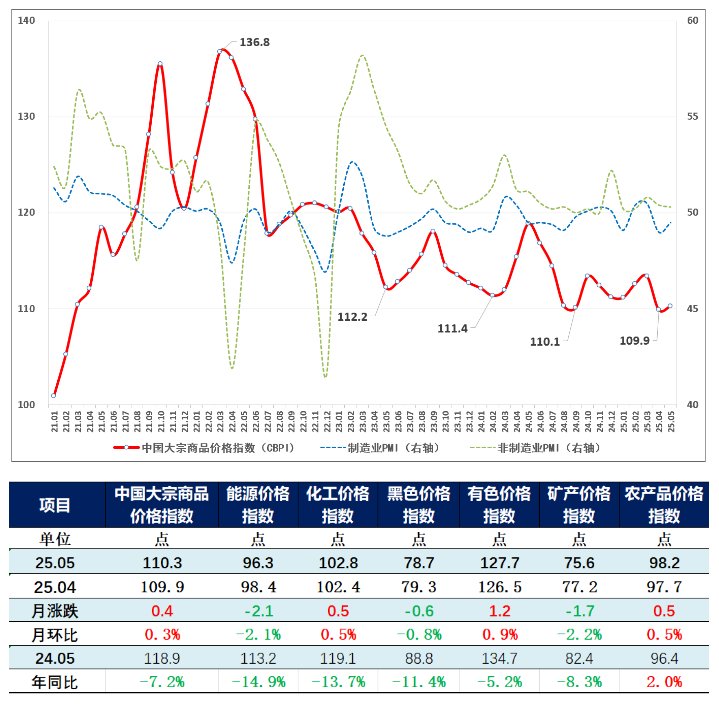
中物联大宗商品分会:2025年5月中国大宗商品价格指数(CBPI)为110.3点 环比上涨0.3%
智通财经网· 2025-06-05 05:46
Core Insights - The China Commodity Price Index (CBPI) for May 2025 is reported at 110.3 points, reflecting a month-on-month increase of 0.3% but a year-on-year decrease of 7.2% [1][3] - The index shows signs of stabilization and improvement due to a temporary easing of US-China trade tariffs, which has restored some market confidence [1][3] - Despite the recovery in global commodity prices, external uncertainties and insufficient effective demand remain significant challenges for various industries [1][3] Price Index Summary - The CBPI increased from 109.9 points in April to 110.3 points in May, with a month-on-month rise of 0.4 points [3] - The energy price index decreased to 96.3 points, down 2.1% month-on-month and down 14.9% year-on-year [3][4] - The chemical price index rebounded to 102.8 points, with a month-on-month increase of 0.5% but a year-on-year decline of 13.7% [3][4] - The black metal price index fell to 78.7 points, down 0.8% month-on-month and down 11.4% year-on-year [3][4] - The non-ferrous metal price index rose slightly to 127.7 points, up 0.9% month-on-month but down 5.2% year-on-year [3][4] - The agricultural product price index increased to 98.2 points, with a month-on-month rise of 0.5% and a year-on-year increase of 2% [3][4] Commodity Price Movements - Among 50 monitored commodities, 32 (64%) saw price declines while 17 (34%) experienced price increases in May [5] - The top three commodities with price increases were PTA (up 9.5%), ethylene glycol (up 4.6%), and corn (up 4.3%) [5] - The largest price declines were observed in industrial silicon (down 10.2%), lithium carbonate (down 10%), and soybean meal (down 9.9%) [5]