
基建

Search documents
专家揭秘中国经济破局密码:别再被这三大误区坑惨
Sou Hu Cai Jing· 2025-05-19 01:30
Infrastructure Investment - China's infrastructure development shows significant regional and structural differences, with the central and western regions needing to address gaps in transportation, energy, and new infrastructure like 5G and data centers, while eastern developed areas focus on upgrading traditional infrastructure [2] - The central government emphasizes "precise and effective investment" to avoid blind expansion, prioritizing major projects and new urbanization in the "14th Five-Year Plan" [2] Consumer Coupons - Consumer coupons have provided immediate boosts to specific sectors such as dining, retail, and tourism, alleviating pressure on small and medium enterprises, with notable sales recovery following their distribution in 2022 [4] - However, reliance on consumer coupons alone cannot address the fundamental issue of consumption decline, which is primarily driven by unstable income expectations [4] Industrial Innovation - Industrial innovation is crucial for China's economic transformation, particularly with the rise of the digital economy and emerging industries like AI, new energy, and biomedicine, which are key drivers of sustained economic growth [5] - The government is accelerating technological innovation through initiatives like "ranking and hanging banners," technology special funds, and industry-academia-research cooperation [6] Urbanization - As of 2023, China's urbanization rate is approximately 66.16%, transitioning from a "high-speed" to a "high-quality" development phase, focusing on coordinated development of urban clusters [8] - Despite claims of many cities becoming towns, data shows over 100 cities still possess strong development potential [8] Real Estate Market - The real estate market exhibits clear differentiation, with some third and fourth-tier cities experiencing price adjustments due to population outflow and inventory buildup, while first-tier and core second-tier cities maintain stable prices [11] - The central government adheres to the "housing is for living, not speculation" policy, promoting measures to support rigid and improved housing demand [11] Stock Market and Economy - The stock market reflects economic conditions, with long-term performance driven by economic fundamentals and corporate earnings, necessitating reforms to enhance market efficiency and direct funds towards innovation and green economy sectors [12] - To achieve sustainable growth similar to the US stock market, China must cultivate globally competitive enterprises, particularly in new energy and high-end manufacturing [12] Industry Upgrading - The growth of enterprises is a natural result of market competition rather than direct government intervention, which should focus on creating a fair competitive environment and supporting innovation [14] - Upgrading the manufacturing sector is essential, requiring technological innovation and digital transformation to increase added value, rather than over-reliance on short-term gains from real estate or financial markets [14]


解析跨地域基础设施项目中的融资与偿债机制
Sou Hu Cai Jing· 2025-05-18 23:48
Core Viewpoint - The article discusses the complexities and challenges in the financing and debt repayment mechanisms of cross-regional infrastructure projects in China, particularly focusing on the use of Public-Private Partnership (PPP) models and special bonds. Group 1: Project Funding and Debt Responsibility Complexity - Cross-regional infrastructure projects, especially in railways and highways, have complex funding structures involving local government fiscal funds, bank loans, and social capital. The debt and funding responsibilities are not always directly correlated [2]. - Local governments often incur debt corresponding to their funding responsibilities in projects, leading to fragmented debt representation across multiple sub-projects, particularly in PPP projects [2]. Group 2: Special Bonds and Debt Repayment Sources - Recent changes allow PPP projects to utilize special bond funds, which are linked to government funding responsibilities rather than direct project revenues. This indicates that government borrowing is influenced more by social benefits than by project profitability [3]. - In projects like toll roads and railways, the repayment of special bonds may not rely on operational income, leading to a significant asymmetry between project profitability and debt repayment sources [4]. Group 3: Measures and Practical Operations - Local governments and project companies are implementing measures to ensure the repayment of special bonds, such as requiring project companies to agree that revenues can be used for debt repayment [7]. - In cases where operational income is insufficient, local governments may resort to land transfer revenues as a repayment source, particularly in regions with active real estate development [7]. - Additional projects and revenue sources, such as advertising and parking fees along railway lines, are being considered to supplement income for special bond repayment [7]. Group 4: Conclusion - The financing and debt repayment mechanisms for cross-regional infrastructure projects face multiple challenges, particularly in the design of debt responsibilities and repayment sources in PPP projects. Factors like project profitability, shareholder dividend decisions, and local government fiscal burdens significantly impact the repayment of special bonds [6]. - With ongoing policy improvements and the application of special bonds in PPP projects, the future financing models for infrastructure are expected to become more diversified and flexible, supporting sustainable economic development in China [6].
宏观量化经济指数周报20250518:央行报表总规模因何连月缩减?-20250518
Soochow Securities· 2025-05-18 13:05
Economic Indicators - As of May 18, 2025, the weekly ECI supply index is 50.24%, down 0.01 percentage points from last week, while the demand index is 49.91%, down 0.02 percentage points[6] - The monthly ECI supply index for the first three weeks of May is 50.25%, down 0.10 percentage points from April, and the demand index is 49.93%, up 0.01 percentage points[7] - The ECI investment index is 49.95%, down 0.04 percentage points from last week, and the consumption index is 49.74%, down 0.01 percentage points[6] Central Bank and Monetary Policy - As of April 30, 2025, the central bank's total balance sheet is 45.52 trillion yuan, a decrease of 108.48 billion yuan from March 2025[13] - The central bank's holdings of government bonds decreased by 1823.5 billion yuan in April, bringing the total to 25.18 trillion yuan[14] - In April, the central bank increased support for the capital market by 3700 billion yuan, indicating a proactive stance to stabilize the market[14] Market Trends - The average daily sales of passenger cars from May 1 to May 11 increased by 34% compared to the same period last month[7] - The container shipping price index for exports to the U.S. has shown significant improvement, with rates for the West and East coasts rising by 23.2% and 21.5% respectively as of May 16[7] - The construction sector is expected to accelerate in Q2 2025, with the asphalt working rate showing a notable recovery compared to last year[7] Risks and Outlook - There is a potential for a "rush to export" phenomenon in the short term, which could impact market stability[46] - The effectiveness of policy measures may fall short of market expectations, particularly in the real estate sector[46] - The sustainability of improvements in the real estate market remains to be observed[46]
宏观周报:出口高频数据尚未大幅回升-20250518
KAIYUAN SECURITIES· 2025-05-18 12:15
Supply and Demand - Construction starts show a structural positive change, with infrastructure cement usage exceeding the same period in 2024[2] - Industrial production remains at a seasonally high level, with the chemical chain operating at historical highs[2] - Demand in construction is weak, while automotive and home appliance demand is improving, with rolling sales of passenger cars showing a year-on-year increase[3] Price Trends - International commodity prices show a mixed trend, with oil and gold prices declining while base metals are rising[4] - Domestic industrial products are experiencing a slight rebound, with rebar prices recovering and some chemical and building material prices showing signs of rebound[4] - Food prices are trending downward, with agricultural product prices fluctuating downwards and pork prices remaining stable[4] Real Estate and Liquidity - New housing transactions remain at historical lows, although first-tier cities show improvement, with transaction area in major cities up 2% week-on-week[5] - Second-hand housing transactions in Beijing and Shenzhen show a marginal year-on-year decline, while Shanghai's second-hand housing transactions continue at historical highs[5] - Liquidity is tightening, with funding rates declining; as of May 16, R007 was at 1.63% and DR007 at 1.64%[5] Export Performance - High-frequency export data has not significantly rebounded, with May exports expected to be around 0% year-on-year as of May 17[6] - Port throughput data indicates a potential decline in exports, with daily export transport data showing some resilience but not a substantial recovery[6] Risk Factors - Risks include unexpected fluctuations in commodity prices and potential changes in policy strength[6]
央企新兴产业故事:已出现供需失衡、增量不增效
经济观察报· 2025-05-17 12:41
Core Viewpoint - The article discusses the challenges faced by central enterprises in the new materials and new energy sectors, particularly the issues of "supply-demand imbalance" and "incremental growth without efficiency" as they expand their investments in strategic emerging industries [1][3][4]. Group 1: Supply-Demand Imbalance - Central enterprises in sectors like new materials and new energy are experiencing a mismatch between supply and demand, leading to overcapacity and underutilization of resources [3][4]. - The investment in strategic emerging industries has increased significantly, with a reported investment of 2.18 trillion yuan in 2023, marking a 32.1% year-on-year growth [12]. - Despite the push for expansion, many enterprises are struggling with low capacity utilization rates, with some reporting rates below 30% [9][22]. Group 2: Incremental Growth Challenges - Companies are facing difficulties in achieving expected returns on their investments, leading to a situation where increased production does not translate into proportional revenue growth [21][23]. - The carbonates industry, for example, saw a projected gross margin of less than 10% in 2024, significantly below the industry average, due to falling prices and excess inventory [22]. - The construction sector is also experiencing similar issues, with rapid capacity expansion in offshore wind projects leading to market saturation and reduced profit margins [24][25]. Group 3: Strategic Direction and Policy Alignment - The State-owned Assets Supervision and Administration Commission (SASAC) has set clear quantitative targets for central enterprises, aiming for 35% of their revenue to come from strategic emerging industries by 2025 [4][28]. - Enterprises are encouraged to balance policy directives with market realities, as they face challenges in aligning their operational capabilities with ambitious targets set by SASAC [27][29]. - There is a concern among enterprises about the potential risks of investing in new materials and technologies, particularly if market demand does not meet expectations [28][30].

央企新兴产业故事:已出现供需失衡、增量不增效
Jing Ji Guan Cha Wang· 2025-05-17 12:16
Core Insights - The article discusses the challenges faced by state-owned enterprises (SOEs) in the strategic emerging industries, particularly in new materials and renewable energy sectors, highlighting issues of supply-demand imbalance and ineffective growth despite increased investments [2][6][30]. Group 1: Industry Challenges - SOEs in the strategic emerging industries are experiencing a common issue of "supply-demand imbalance and ineffective growth," as noted by Liu Bing, a project leader in a new materials SOE [2]. - Many SOEs are still in the early stages of capital investment or output, with significant revenue opportunities yet to materialize [2]. - The National State-owned Assets Supervision and Administration Commission (SASAC) has set a target for SOEs to achieve a 35% revenue share from strategic emerging industries by 2025 [5][32]. Group 2: Investment and Market Dynamics - Since 2025, SASAC has focused on key industries such as new energy vehicles and new materials, which are crucial for the transformation and upgrading of China's manufacturing sector [3]. - In 2023, central enterprises invested 2.18 trillion yuan in strategic emerging industries, marking a 32.1% year-on-year increase [14]. - Despite the optimistic market outlook for carbonates, the industry faces significant challenges, including low capacity utilization rates and inconsistent product quality [10][25]. Group 3: Financial Implications - The rapid expansion of production capacity has not been matched by market demand, leading to a decline in product prices and a significant drop in profitability for enterprises [23][27]. - In 2024, the overall operating rate of the carbonate industry was less than 40%, with profit margins expected to fall below 10%, significantly lower than the industry average [21][25]. - To address inventory buildup, companies have resorted to price reductions, but this strategy has not yielded the desired results, further exacerbating the industry's profitability issues [28][29]. Group 4: Strategic Considerations - SOEs must balance policy directives with market realities, as highlighted by concerns over potential market demand shortfalls impacting investment returns [32][34]. - The SASAC's push for SOEs to enter emerging industries aims to align with national strategies, but companies face challenges in meeting ambitious targets while ensuring economic viability [32][34]. - Liu Bing's team emphasizes the need to focus on quality and effectiveness in addition to meeting quantitative targets set by SASAC [34].
近30份估值提升计划出炉 央企控股上市公司市值管理再出实招
Shang Hai Zheng Quan Bao· 2025-05-14 18:52
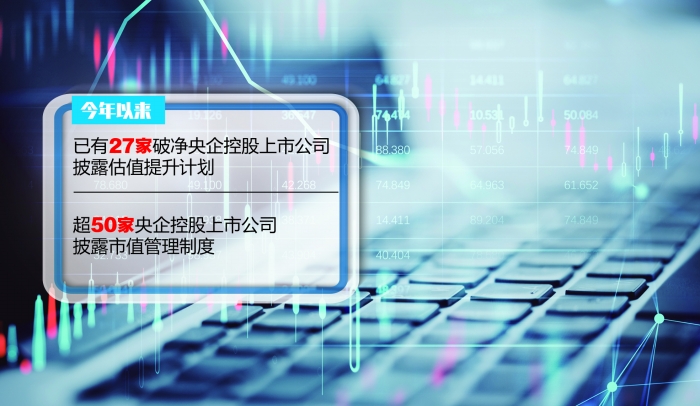
Core Viewpoint - Central state-owned enterprises (SOEs) are addressing the issue of stock prices falling below net asset value (known as "破净") by implementing valuation enhancement plans to boost company value and investor confidence [2][3] Group 1: Valuation Enhancement Plans - 27 central SOEs have disclosed targeted valuation enhancement plans this year, with over 50 SOEs revealing their market value management systems [2] - The State-owned Assets Supervision and Administration Commission (SASAC) emphasizes the importance of addressing the long-term "破净" issue as a key annual task [2] - Companies are focusing on improving core business operations as the primary task in their disclosed valuation enhancement plans [3] Group 2: Strategic Development Initiatives - China Electric Power Construction plans to develop strategic emerging industries such as offshore wind power, hydrogen energy, and artificial intelligence in engineering [3] - China State Construction Engineering is focusing on industrialization, digitalization, and green transformation to enhance its competitive edge [4] Group 3: Mergers and Acquisitions - High-quality mergers and acquisitions are seen as essential for optimizing business layout and expanding market share in the steel industry [5] - China Communications Construction Company is planning to integrate its subsidiaries to reduce costs and enhance efficiency [5][6] Group 4: Long-term Return Mechanisms - The "three-piece set" of dividends, share buybacks, and stock repurchases is crucial for enhancing investor returns and is a significant part of the market value management toolbox [7] - Daqin Railway plans to maintain a cash dividend ratio of at least 55% of net profit by 2025, while other companies like China Merchants Port and Shanghai Energy are also increasing their dividend payouts [7][8] Group 5: Market Stabilization Efforts - Since April, central SOEs have initiated share buybacks and repurchases exceeding 30 billion yuan to stabilize the capital market [8] - A rapid response mechanism has been established by many central SOEs to address market fluctuations effectively [8]





国泰海通|24年报和25年一季报总结(二)
国泰海通证券研究· 2025-05-13 13:11
Group 1: Mechanical Industry - The mechanical industry is expected to see a recovery in prosperity from 2024 to Q1 2025, with revenue and profit growth in semiconductor equipment, engineering machinery, and robotics [1][2] - In 2024, the mechanical industry is projected to achieve a revenue of 2.3 trillion yuan, a year-on-year increase of 4.9%, and a net profit of 123.24 billion yuan, a year-on-year decrease of 11.1% [1] - By Q1 2025, the total revenue is expected to reach 522.08 billion yuan, with a year-on-year increase of 8.8%, and a net profit of 38.33 billion yuan, a year-on-year increase of 20.1% [1] Group 2: Robotics and Semiconductor Equipment - The humanoid robot sector is anticipated to see significant profit growth, particularly in force sensors, bearings, and tendon drive components [2][3] - The transition from "multi-sensor fusion" to "body intelligence" in humanoid robots will create new demands for hardware and software technologies [3] - The semiconductor equipment sector is benefiting from domestic substitution and capital expenditure, with significant room for improvement in self-sufficiency due to geopolitical influences [3][4] Group 3: Engineering Machinery - The engineering machinery sector is expected to maintain high prosperity levels, driven by domestic demand and supportive fiscal policies [4] - Domestic sales of excavators are projected to continue increasing, despite some trade friction risks in exports [4] Group 4: Game Industry - The gaming industry is experiencing a recovery, with revenue growth starting from Q2 2024 and a significant increase in profits by Q1 2025 [6][8] - In 2024, the total revenue for the gaming industry reached 93.434 billion yuan, a year-on-year increase of 7.4%, while net profit decreased by 50% due to a drop in profit margins [7] - By Q1 2025, the gaming industry revenue is expected to reach 26.719 billion yuan, a year-on-year increase of 21.6%, with net profit reaching 3.482 billion yuan, reflecting a strong recovery [8] Group 5: Lithium Battery Industry - The lithium battery sector is seeing significant profit concentration among leading battery manufacturers, with overall revenue in 2024 reaching 1.755 trillion yuan, a year-on-year increase of 4.9% [11][12] - By Q1 2025, the lithium battery sector is projected to achieve a revenue of 414.084 billion yuan, a year-on-year increase of 22.75%, with net profit reaching 28.717 billion yuan, a year-on-year increase of 51.11% [13] Group 6: Home Appliance Industry - The home appliance sector is expected to show strong performance, with overall revenue and net profit in 2024 increasing by 6% and 9%, respectively [15] - By Q1 2025, revenue and net profit are projected to increase by 14% and 22%, respectively, driven by domestic demand and export opportunities [15][16] Group 7: Pharmaceutical Industry - The pharmaceutical sector is experiencing a divergence in performance, with innovative drugs driving growth in the pharmaceutical segment [19][20] - In 2024, the overall revenue for the pharmaceutical sector is expected to decline by 1.5%, while net profit is projected to decrease by 12.5% [20][21] Group 8: Real Estate Industry - The real estate sector is witnessing a decline in profitability, with gross margins reaching a historical low of 13.8% in 2024 [25][26] - The sector is expected to stabilize in 2025, with improvements in gross margins as land acquisition costs decrease [25][27] Group 9: Coal Industry - The coal sector is facing significant pressure, with prices expected to reach a turning point in May 2025 [32][34] - The average selling price of self-produced coal is projected to decline by 10.9% in Q1 2025 compared to 2024, impacting overall profitability [33] Group 10: ETF Holdings - Institutional investors have significantly increased their holdings in ETFs, with a 38.8% year-on-year growth, reaching 1.54 trillion yuan by the end of 2024 [36][37] - The proportion of state-owned funds in ETF holdings has also increased, indicating a shift in investment strategies [36][37]

新华全媒+|CPI环比由降转涨 部分工业行业价格稳中向好——透视4月份物价数据
Sou Hu Cai Jing· 2025-05-10 08:27
Group 1: CPI and Core CPI Trends - In April, the national Consumer Price Index (CPI) shifted from a decrease of 0.4% in the previous month to an increase of 0.1% [1] - The core CPI, excluding food and energy prices, rose by 0.5% year-on-year, indicating stable growth [1][4] - The increase in core CPI reflects the internal resilience of the economy, supported by ongoing macro policies [4] Group 2: Price Changes in Specific Sectors - Prices in the wearable smart device manufacturing sector increased by 3% year-on-year, while aircraft manufacturing prices rose by 1.3% [1][4] - Service prices showed a steady upward trend, with significant increases in travel-related services, such as airfares rising by 13.5% and hotel accommodation by 4.5% [2] - The prices of black metal smelting and non-metal mineral products saw a narrowing decline, indicating a recovery in demand due to infrastructure projects [5] Group 3: Energy Prices and Their Impact - International oil prices fell significantly due to production increases from countries like Saudi Arabia and Russia, leading to a 4.8% year-on-year decline in energy prices [3] - The drop in gasoline prices by 10.4% contributed approximately 0.38 percentage points to the year-on-year decline in CPI [2][3] Group 4: Policy Impacts on Consumption and Prices - Various policies aimed at boosting consumption and upgrading service quality have been implemented, contributing to the recovery of service consumption [2][5] - The ongoing promotion of trade diversification has led to price increases in certain export sectors, such as integrated circuit packaging, which rose by 2.7% year-on-year [5]
华泰期货宏观日报:关注基建行业相关投资项目开展-20250509
Hua Tai Qi Huo· 2025-05-09 07:28
宏观日报 | 2025-05-09 关注基建行业相关投资项目开展 中观事件总览 生产行业:关注运输、基建投资项目推进。 1)国家发改委副主任郑备在新闻发布会上表示,民企促进法全文贯 穿了平等对待、公平竞争、同等保护、共同发展的原则,国家发展改革委将重点从破壁垒、拓空间、优服务等方 面推动落实。今年还将在交通运输、能源、水利、新型基础设施、城市基础设施等重点领域,推出总投资规模约3 万亿元的优质项目。 服务行业:云服务业务稳步增长。 1)工信部数据显示,今年一季度,我国软件和信息技术服务业稳健增长,完 成业务收入31479亿元,同比增长10.6%。分领域看,信息技术服务收入保持两位数增长,达到20820亿元,占全行 业收入近七成。其中,云计算、大数据服务共实现收入3540亿元,同比增长11.1%。一季度软件业务利润总额也保 持了两位数增长,达到11.6%。一季度软件业务出口增速由负转正,出口达到131亿美元,同比增长2.4%。 数据来源:央视新闻,iFind,华泰期货研究院 行业总览 上游:1)能源:国际油价受关税影响持续回落。2)有色:锌、铝、铅受关税影响价格震荡。3)建材:水泥、建 材价格持续回落。4)农业 ...