有色

Search documents
权益商品反弹在即 :申万期货早间评论-20251125
申银万国期货研究· 2025-11-25 00:55
Group 1 - The core viewpoint of the article emphasizes the importance of maintaining stable and positive Sino-U.S. relations, highlighting mutual benefits and cooperation as essential for both nations' prosperity [1][7] - The article discusses the recent phone call between Chinese President Xi Jinping and U.S. President Trump, where they acknowledged the positive trajectory of bilateral relations since the Busan meeting [1][7] - Xi reiterated China's stance on Taiwan, asserting that its return is a crucial part of the post-war international order, and called for joint efforts to uphold the achievements of World War II [1][7] Group 2 - In the financial market, U.S. stock indices showed a significant rebound, with small-cap stocks recovering after a period of adjustment, while sectors like defense and media led the gains [2][10] - The article notes a decrease in financing balance by 29.2 billion yuan to 2.445 trillion yuan, indicating cautious market sentiment as the year-end approaches [2][10] - The article suggests that the technology sector remains a long-term focus, with expectations for a more balanced market style if overseas tech performance stabilizes [2][10] Group 3 - The article reports on the weak performance of coking coal and coke futures, with total positions remaining stable, and highlights a recovery in supply as coal imports from Mongolia increase [3][20] - It mentions that the demand side shows improvement, particularly in construction materials, with significant inventory reductions observed [3][20] - The article discusses the impact of U.S. sanctions on Russian oil companies, which could affect global oil supply dynamics, and notes ongoing diplomatic efforts regarding the Ukraine conflict [12][13] Group 4 - The People's Bank of China is set to conduct a 1 trillion yuan MLF operation, marking a net injection of 100 billion yuan for the month, continuing a trend of increased liquidity support [8] - The article highlights the ongoing cautious approach in the market, with expectations for supportive monetary policies amid economic pressures [11]


国泰海通 · 晨报1125|策略、固收
国泰海通证券研究· 2025-11-24 12:10
Group 1: Market Overview - The global risk appetite has decreased, with the VIX index and MOVE 5-day moving average rising significantly, leading to a synchronized decline in both stock and commodity markets [2] - Major global stock indices have generally retreated, with the technology sector experiencing notable declines, while gold, silver, copper, and oil also recorded drops [2][3] - The USD index has surpassed 100, and the Japanese yen has depreciated significantly, approaching the 160 mark against the dollar [2][5] Group 2: Equity Market Performance - The MSCI global index fell by 2.5%, with developed markets showing a pattern where declines in frontier markets were less severe than in developed and emerging markets [3] - In the U.S., major indices like the S&P 500 and Dow Jones dropped by 1.9%, while the Nasdaq fell by 2.7%, indicating increased scrutiny on the earnings quality of major tech firms [3] - Emerging markets saw significant declines in A-shares, with small-cap and tech boards dropping over 5.1%, while the Russian RTS index rose sharply by 9.1% [3] Group 3: Bond Market Dynamics - The Chinese bond market exhibited a "bear steepening" trend, with the yield curve shifting upward and the 10Y-2Y spread widening [4] - In contrast, U.S. Treasury yields showed a "bull steepening" pattern, with the yield curve moving downward, influenced by dovish comments from the New York Fed [4] - The Japanese government is expected to issue additional bonds to finance a fiscal stimulus plan, which may lead to increased long-term bond yields [4] Group 4: Commodity and Currency Trends - Commodity indices such as South China and CRB fell by 1.8% and 2.2%, respectively, with only three out of thirteen major commodity futures recording price increases [5] - The dollar index rose by 0.9%, while the yen depreciated by 1.2%, which may benefit Japanese exporters but also heighten inflationary pressures [5] - The Bank of Japan faces increased pressure to raise interest rates due to the combination of yen depreciation and inflation [5] Group 5: Fixed Income Issuance and Trading - Net financing in the bond market increased, with a total issuance of 3,846.4 billion yuan against 2,555.6 billion yuan maturing, resulting in a net increase of 1,290.8 billion yuan [9] - Secondary market trading volume decreased, with total transactions amounting to 7,783.28 billion yuan, down from 8,032.22 billion yuan the previous week [10] - The yield on 3-year AAA medium-term notes fell by 2.33 basis points to 1.86%, indicating a downward trend in short-term yields [10]

廖市无双:上证破趋势,大盘何去何从?
2025-11-24 01:46
廖市无双:上证破趋势,大盘何去何从?20251123 摘要 上证指数跌破 4 月 7 日以来的上升趋势线,确认五浪结构破位及日线 MACD 底背离,预示将进入 ABC 调整结构,需关注调整结构发展及各 指数表现。当前指数在 3,700-3,800 点区域具备较强支撑,包括 3,732 点、3,774 点和 3,702 点等关键点位。 创业板指数自 10 月 17 日以来创新高后随上证指数调整,形成 A 浪下跌。 科创 50 指数呈现 ABC 结构,C 段加速下跌。创业板风险相对较高,需 谨慎对待,而恒生科技和科创 50 指数调整较为充分,无需进一步杀跌。 本周无行业板块上涨,前期强势板块如电芯、基础化工、钢铁、医药、 有色等显著回调,锂矿链条跌幅接近 10%。银行和食品饮料等防御性板 块相对抗跌,银行因前期回调具备防御属性,食品饮料因涨幅小且风险 释放表现稳健。 美联储降息预期减弱导致全球流动性收紧,比特币价格大幅下跌,引发 以其为抵押的经营经理面临流动性紧张,负面影响传导至股票市场。英 伟达财报超预期但应收账款和存货增加引发质疑,可能影响国内科技股。 Q&A 上证指数和上证 50 的近期走势如何,未来可能会 ...
A股开盘速递 | 三大股指集体高开 CPO、光刻机、算力租赁等板块涨幅居前
智通财经网· 2025-11-24 01:44
A股三大股指集体高开,沪指涨0.36%,创业板指涨0.9%。盘面上,CPO、光刻机、算力租赁等板块涨 幅居前。 这种情况下,调仓的思路不是刻意回避AI叙事,而是尽量选择ROE底部向上趋势性抬升的品种,从这 个角度来看,适度增加对化工、有色、电新这样沉寂比较久且利润率和行业景气度在历史相对低点的行 业,是更优的选择。 另外,AI叙事只是影响了行情斜率而不是趋势。,如果未来AI叙事出现波动,的确可能会带来这些行 业剧烈的波动,但只要ROE能实现从底部开始向上的持续抬升,这种股价波动都只是短期的(相对于那 些ROE在历史高点的行业而言),不会威胁到本金安全。 招商证券:有色、钢铁、建材是当前可以考虑布局的顺周期选择 机构看后市 中信证券:适度增加化工、有色、电新的仓位,是更优的选择 10月以来市场波动加大,但择时成功率并不高,背后的原因是增量资金的底层结构在发生变化,稳健绝 对收益型资金持续入市在降低传统激进策略择时的有效性。当前真正重要的变量还是企业出海环境的稳 定性以及AI,涉及到的是中美关系以及AI基础设施的投建进程。当前不仅是TMT板块,连有色、化 工、电新的上涨直接或间接都受到AI叙事的影响,而这些板块占 ...
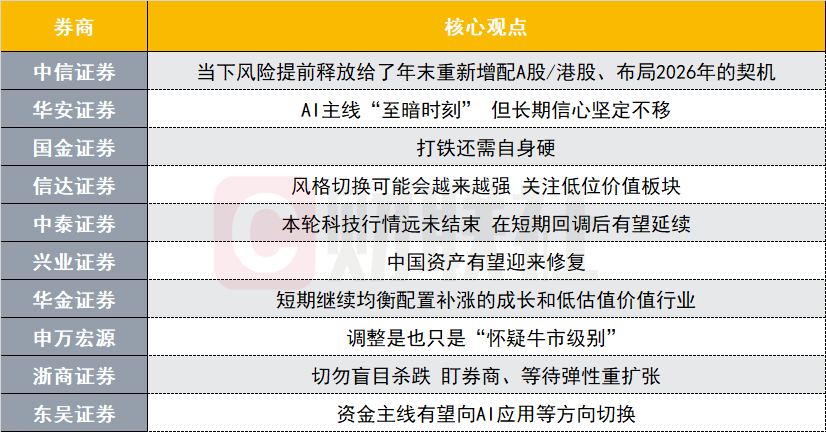
年末重新增配A股迎来契机?投资主线有哪些?十大券商策略来了
Feng Huang Wang· 2025-11-23 13:21
Core Viewpoints - Current risk release provides an opportunity for reallocating A-shares and Hong Kong stocks by year-end and planning for 2026 [2] - The AI sector is experiencing a "darkest hour," but long-term confidence remains unwavering [4] - The adjustment phase is merely a "doubtful bull market level" [11] Industry Insights - Focus on resource and traditional manufacturing opportunities, particularly in chemicals, non-ferrous metals, and new energy [3] - The AI industry is expected to continue its growth trajectory, with significant valuation growth potential for A-share companies [8] - The market is likely to experience a style switch, with increasing attention on low-valued sectors [6] Investment Recommendations - Emphasize sectors benefiting from physical asset consumption, such as upstream resources (copper, aluminum, lithium, oil, coal) and midstream industries [5] - Maintain a balanced allocation between growth sectors and undervalued value industries, particularly in the consumer sector as year-end approaches [10] - Focus on AI applications and sectors closely related to the "14th Five-Year Plan," such as hydrogen energy, nuclear energy, and quantum technology [14]



全球共振高位调整,耐心等待情绪企稳
HWABAO SECURITIES· 2025-11-23 12:34
Group 1 - The report indicates that the global market is experiencing a high-level adjustment, and investors should remain patient while waiting for market sentiment to stabilize [1][2] - The A-share market is currently oscillating around the 4000-point mark, with increased rotation among sectors, suggesting a need for cautious investment strategies [1][2] - The report highlights that the bond market is expected to maintain a volatile trend in the medium term, with the 10-year government bond yield projected to fluctuate between 1.75% and 1.85% [2][12] Group 2 - The report notes that the recent U.S. non-farm payroll data showed an unexpected increase of 119,000 jobs in September, which has led to a decline in expectations for a rate cut by the Federal Reserve [8][9] - The Chinese LPR rates remained unchanged, with the 5-year LPR at 3.5% and the 1-year LPR at 3%, indicating a stable monetary policy environment [9] - The report emphasizes that the A-share market has seen a significant decline, with the Shanghai Composite Index dropping by 3.90% during the week, reflecting weak market sentiment [10][12] Group 3 - The report suggests that the short-term outlook for the stock market remains weak, with a lack of upward momentum and major indices falling below their 60-day moving averages [12][13] - It is recommended to adopt a balanced investment approach, focusing on sectors such as banking and low-volatility dividend stocks to mitigate risks during this period of market adjustment [2][12] - The report also indicates that the domestic macro multi-asset model has achieved a year-to-date return of 12.08%, significantly outperforming its benchmark [21][22]
A股市场运行周报第68期:切勿盲目杀跌,盯券商、等待弹性重扩张-20251122
ZHESHANG SECURITIES· 2025-11-22 07:09
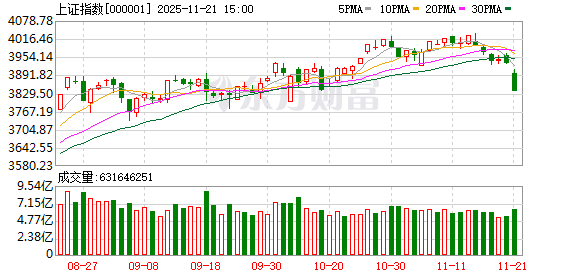
Core Insights - The report indicates that the A-share market has been affected by the weakened expectations of interest rate cuts by the Federal Reserve, leading to a significant decline in global stock markets, including A-shares [1][55] - It is suggested that the current market adjustment is necessary, and investors should not panic sell but rather wait for the market to stabilize, particularly focusing on the brokerage sector as a signal for potential recovery [1][5][57] - The report anticipates that the systemic "slow bull" market is not over and may enter a "second phase" after the current adjustments [1][4][56] Market Overview - Major indices in the A-share market experienced declines due to global market fluctuations, with the Shanghai Composite Index, Shanghai 50, and CSI 300 dropping by 3.90%, 2.72%, and 3.77% respectively [12][55] - The growth indices, such as the CSI 500 and CSI 1000, saw larger declines of 5.78% and 5.80%, while the ChiNext Index and STAR 50 fell by 6.15% and 5.54% respectively [12][55] - The Hong Kong market mirrored the A-share performance, with the Hang Seng Index and Hang Seng Tech Index declining by 5.09% and 7.18% [12][55] Sector Analysis - All major sectors in the market experienced declines, with the banking and food & beverage sectors showing relative resilience, falling only by 0.87% and 1.36% respectively [14][55] - Sectors that had previously performed well, such as electric new energy and basic chemicals, saw significant declines of 9.41% and 8.24% [14][55] - The report highlights that investors should differentiate between high and low-performing stocks, advising against holding onto recently broken high-position stocks while retaining positions in relatively low-position sectors like brokerage, consumption, and real estate [5][57] Market Sentiment - The average daily trading volume in the Shanghai and Shenzhen markets decreased to 1.85 trillion yuan, indicating a drop in market activity [23][55] - The main stock index futures contracts showed a negative basis, suggesting bearish sentiment among investors [23][55] Fund Flow - The margin trading balance slightly decreased to 2.48 trillion yuan, with a financing buy ratio of 10.11% [29][55] - The report notes that the medical ETF saw the highest net inflow of 2.8 billion yuan, while the banking ETF experienced the largest outflow of 13.9 billion yuan [29][55] Valuation Insights - The report indicates that the valuation levels of major indices have receded, with the current PE-TTM for the Shanghai Composite Index at 16.1, placing it at the 84.13 percentile [47][55] - The dynamic valuation model suggests that the current market indices are within a normal range, indicating potential for future recovery [50][55]
A股大跌!牛市根基仍在?投票预测下周一涨跌
Sou Hu Cai Jing· 2025-11-22 02:57
Market Overview - The A-share market experienced significant declines today, with the Shanghai Composite Index dropping by 2.45%, falling below 3900 points, and the Shenzhen Component Index down by 3.41%, while the ChiNext Index saw a decline of 4.02% [2] Reasons for the Decline - The sharp adjustment in the A-share market is attributed to a combination of overseas risk transmission and internal structural contradictions [2] - Concerns over an AI bubble have heightened global risk aversion, with Nvidia's better-than-expected earnings report failing to alleviate doubts about the sustainability of AI profits [3] - Expectations for a Federal Reserve interest rate cut have diminished, further disrupting the liquidity environment [4] - Mixed signals from U.S. non-farm payroll data and internal divisions within the Federal Reserve have reduced the probability of a rate cut in December, putting pressure on growth sector valuations [5] - Domestically, the market is in a policy and earnings vacuum, lacking new catalysts following the third-quarter report disclosures [6] Institutional Insights - Qianhai Kaiyuan Fund suggests that there may be further downside potential in the short term, possibly taking the form of a consolidation phase [7] - However, they maintain a long-term optimistic outlook, believing that the foundation for a new market high remains intact [8] - Yingda Securities echoes this sentiment, stating that while facing short-term adjustments and pressures, the logic for a mid-term positive outlook has not changed [9] - Caixin Securities shares a similar view, indicating that the recent market consolidation has been relatively sufficient, suggesting limited downside potential [10] Future Investment Opportunities - Bosera Fund recommends a balanced investment strategy, focusing on cyclical sectors benefiting from "anti-involution" policies and improved supply-demand dynamics, as well as quality tech growth stocks with sufficient valuation digestion [11][12] - They also emphasize the defensive value of dividend assets, suggesting that investors optimize their portfolio structure during market adjustments [13] - Guotai Fund highlights that technology growth will be the main driver, with new economies leading Chinese assets into a profit recovery cycle [14] - The acceleration of AI industrialization, the overseas expansion of advantageous industries, and "anti-involution" are identified as three key growth drivers [15] Recommendations for Ordinary Investors - Yongying Fund advises investors to remain calm and rational in the face of short-term volatility, avoiding overinterpretation of market adjustments [16][19] - It is recommended to adhere to a value investment philosophy, focusing on high-quality listed companies with long-term competitiveness and making investment decisions based on fundamental analysis [16] - For equity fund allocations, strategies such as diversified investments, regular contributions, and setting profit-taking and stop-loss targets are suggested to scientifically control risk exposure [17] - Investors should maintain a rational approach, adjusting asset allocation based on their circumstances and participating in the market with a long-term perspective [18]

A股大跌!火速解读
凤凰网财经· 2025-11-21 13:05
Core Viewpoint - The A-share market experienced a significant decline on November 21, with the Shanghai Composite Index dropping over 2%, attributed to multiple factors including external market pressures and internal structural contradictions [1][3][4]. Group 1: Factors Leading to A-share Adjustment - The decline in A-shares is influenced by both overseas risk transmission and internal structural issues, with concerns over the sustainability of AI profits and tightening liquidity impacting market sentiment [3][4]. - The market is currently in a policy and earnings vacuum, lacking new catalysts following the third-quarter report disclosures, leading to a shift in funds from high-growth sectors to lower-valued dividend assets [3][4]. - External market volatility, particularly from the U.S. stock market, has negatively impacted A-shares, with significant declines in major Asian indices following a drop in U.S. stocks [3][4]. Group 2: Long-term Market Outlook - Despite short-term fluctuations, the long-term outlook for A-shares remains optimistic, with expectations for new highs driven by stable domestic liquidity and confirmed earnings bottoms for listed companies [5][6]. - The fundamentals supporting a bull market have not changed, including improved confidence in handling U.S.-China risks and a shift in economic governance towards "anti-involution" strategies [6][7]. - The potential for a clearer path for U.S. interest rate cuts could alleviate external pressures on the market [5][6]. Group 3: Investment Strategy and Sector Focus - A balanced investment strategy is recommended, focusing on sectors benefiting from "anti-involution" policies, improving supply-demand dynamics, and high-quality tech growth stocks [7]. - The technology sector, particularly AI hardware, may require a period of consolidation due to high cumulative gains, while new economic drivers are expected to lead China into a profit recovery cycle [7][8]. - Investors are advised to maintain a rational approach to short-term volatility, emphasizing value investment in companies with long-term competitive advantages [6][7].

A股大跌 公募研判后市:“牛市的基础没有发生改变!”
Zhong Guo Ji Jin Bao· 2025-11-21 11:35
Core Viewpoint - A-shares experienced a significant decline on November 21, with the Shanghai Composite Index dropping over 2% and closing at a loss of 2.45% [2][3] Market Performance - The Shanghai Composite Index fell by 2.45%, the Shenzhen Component Index by 3.41%, and the ChiNext Index by 4.02% [2] - Sectors such as internet and media entertainment saw gains, while materials, chemicals, semiconductors, and electrical equipment faced declines [2] Causes of Decline - Multiple factors contributed to the adjustment in A-shares, including external risks and internal structural contradictions [3] - Concerns over an AI bubble and the impact of U.S. Federal Reserve interest rate expectations led to a decrease in global risk appetite [3][4] - The market is currently in a policy and earnings vacuum, lacking new catalysts following the third-quarter report disclosures [3] - The recent performance of the U.S. stock market, particularly the drop in major indices, negatively affected investor sentiment in the Asia-Pacific region, including A-shares [4] Future Outlook - Short-term market movements may continue to be volatile, but there is a long-term optimistic view on the potential for new highs in indices [5][6] - The domestic liquidity environment remains reasonably ample, and corporate earnings are gradually confirming a bottom [6] - The potential for a clearer path to interest rate cuts by the U.S. Federal Reserve could alleviate external pressures [6] Investment Strategy - A balanced investment strategy is recommended, focusing on sectors benefiting from "anti-involution," AI, and overseas expansion concepts [8] - Investors are advised to maintain a rational perspective on short-term fluctuations and adhere to value investment principles [7] - Emphasis on diversifying investments and setting stop-loss targets to manage risk exposure effectively [7]