
债券

Search documents
欧洲债市:PMI数据拖累英国国债走低 市场关注周三的通胀数据
Xin Lang Cai Jing· 2025-12-16 17:01
Group 1 - UK government bonds underperformed compared to US and European counterparts, following a brighter economic outlook indicated by December PMI data [1][4] - UK bond prices narrowed their intraday losses but ultimately closed lower, with the yield curve rising by 1-2 basis points; traders are now focused on the upcoming UK inflation data [1][4] - German government bond yields fell by 1 basis point, following the trend of US bonds, after the US unemployment rate reached its highest level in four years [2][4] Group 2 - Current market data shows German government bond yields stable at 2.85% [3][5] - German government bond futures dropped by 3 points to 127.55% [3][5] - Italian 10-year government bond yields increased by 2 basis points to 3.55%, with the Italy-Germany bond spread widening by 2 basis points to 70 basis points [3][5] - French 10-year government bond yields decreased by 2 basis points to 3.55% [3][5] - The 10-year UK government bond yield rose by 2 basis points to 4.52% [3][5]
【笔记财经晨会】2025.12.16 星期二
债券笔记· 2025-12-16 15:36
Macroeconomic Insights - China's industrial added value in November increased by 4.8% year-on-year, below the expected 5% and previous value of 4.9% [5] - Fixed asset investment (excluding rural households) in China decreased by 2.6% year-on-year from January to November, compared to a decline of 1.7% previously [5] - Retail sales of consumer goods in November grew by 1.3% year-on-year, falling short of the expected 2.9% and previous value of 2.9% [5] - The economic data for November indicates a significant decline in consumption and investment, with a notable increase in the decline of real estate investment, highlighting persistent issues of insufficient domestic demand [5] Equity Market Analysis - A-shares exhibited a shrinking adjustment trend due to key technical levels and a convergence of short-term risk appetite, with the ChiNext index showing a relative weakness, down by 1.77% [6] - The trading volume in the two markets significantly decreased, with a reduction of over 300 billion yuan in a single day [6] - The three major indices are currently operating below the 5-day moving average, indicating that the market remains in a phase of consolidation [6] - Despite overall pressure on indices, structural opportunities within the market remain active, particularly in the commercial aerospace sector and consumer sectors, which have attracted capital attention [6] Consumer Sector Insights - The core investment logic behind the notice on enhancing business and financial collaboration to boost consumption lies in the understanding that "new supply creates new demand" [6] - Investment opportunities are found in innovations on the supply side that leverage new technologies, create new scenarios, and meet new consumer sentiments [6] - The introduction of policies is expected to further optimize the development environment for new consumption, significantly impacting market confidence, stimulating corporate innovation, and unleashing economic growth potential [6] Alcohol Industry Focus - Kweichow Moutai's recent volume control policy is viewed as a short-term price defense and confidence restoration strategy, aimed at gaining time for deeper structural reforms [7] - In the long term, this policy represents a proactive shift in the industry from relying on "volume and price increases" for growth to a more refined management approach focusing on "brand resilience," "channel health," and "real consumption foundation" [7]


【笔记20251216— 大A:实实在在,没有水分了】
债券笔记· 2025-12-16 15:36
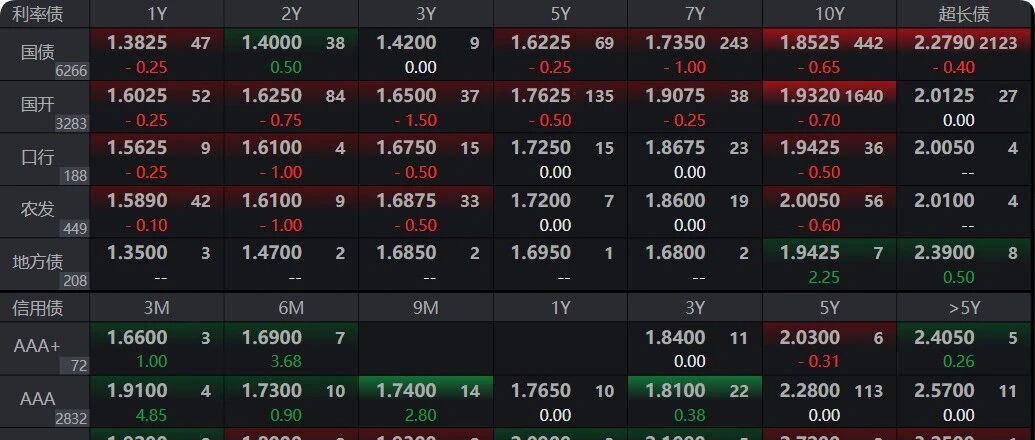
Core Viewpoint - The article discusses the current state of the financial market, highlighting a significant decline in the stock market and the ongoing net redemption of bond funds, while also noting a balanced and slightly loose liquidity environment [3][5][6]. Group 1: Market Conditions - The stock market is experiencing a unilateral decline, with bond funds continuing to see net redemptions, indicating a lack of investor confidence [5][6]. - The liquidity in the market is described as balanced and slightly loose, with the central bank conducting a 135.3 billion yuan reverse repurchase operation, resulting in a net injection of 18 billion yuan [3][5]. - The interest rates for various financial instruments are showing slight declines, with the 10-year government bond yield fluctuating around 1.8525% [5][6]. Group 2: Interest Rates and Transactions - The weighted average rates for interbank funding show stability, with R001 at 1.34% and R007 at 1.50%, indicating a steady funding environment [4]. - The trading volume for R001 is reported at 75,164 million yuan, reflecting a slight increase, while R007 shows a decrease in trading volume [4]. - The article notes that the bond market dynamics have shifted, where previously abundant liquidity led to declining rates, but now the presence of short positions in government bond futures is causing upward pressure on rates [6].
债市在恐慌什么?超长债大幅深跌后反弹
第一财经· 2025-12-16 10:18
Core Viewpoint - The bond market is experiencing significant volatility, with long-term bonds facing sharp declines despite positive macroeconomic signals, leading to a sense of panic among traders [3][5]. Market Performance - As of the latest close, all government bond futures fell, with the 30-year main contract down 0.99% to 111.53 yuan, marking a new low since November 18, 2024. The 10-year and 5-year contracts also saw declines [3]. - In the interbank market, yields on most interest rate bonds rose, with the 30-year government bond yield increasing by 3.6 basis points to over 2.28%, and the 10-year bond yield approaching 1.86%, both reaching new highs since the end of September [3][6]. Economic Indicators - Recent macroeconomic data indicates a mixed outlook, with November's industrial output growth at 4.8%, a slight decline from October, and retail sales growth slowing to 1.3%, marking six consecutive months of deceleration [6]. - Housing prices in first-tier cities showed a mixed trend, with new home prices declining in most cities except Shanghai, which saw a 5.1% increase year-on-year [5][6]. Market Sentiment and Expectations - Analysts suggest that the current bond market situation cannot be fully explained by fundamentals, as panic selling may overshadow positive macroeconomic expectations. There is an increased market anticipation for expansionary policies in the coming year [5][6]. - The sentiment in the bond market remains weak, with institutions showing a tendency to sell off long-term bonds, particularly as year-end approaches and redemption pressures mount [11][12]. Institutional Behavior - The bond market has seen a negative feedback loop, with institutions opting to secure profits amid declining prices, particularly affecting long-term bonds [10]. - Analysts note that the recent sell-off in long-term bonds is influenced by both trading and allocation pressures, with banks facing constraints related to duration risk and a shift in investment focus towards equities [11][12].

施罗德基金资产配置观点
2 1 Shi Ji Jing Ji Bao Dao· 2025-12-16 09:08
Economic Outlook - Global GDP growth from 2025 to 2027 is expected to exceed market consensus, with liquidity already released and fiscal support in place, reducing the probability of a deep economic recession [1] - The implementation of the Inflation Reduction Act is anticipated to have a significant positive impact on the economy [1] - US retail and employment data remain robust, indicating sustained consumer momentum [1] Bond Market - The ten-year government bond yield is fluctuating between 1.65% and 1.90%, with significant adjustments observed from July to September, followed by a slight bullish trend [2] - The market predominantly holds bullish and neutral views, with year-end rush potentially leading to limited downward space for interest rates [2] - Central bank bond purchases and weaker-than-expected real estate and infrastructure volumes provide downward protection for the bond market [2] Real Estate and Infrastructure - Real estate and infrastructure data continue to decline, with significant drops in investment and a surge in second-hand housing listings [3] - Fiscal revenues related to real estate have seen a double-digit decline, and overall fiscal deficits are projected to be around 8.3 trillion yuan for the year [3] - The demand for credit bonds is supported by the increase in bank wealth management products, which have surpassed 32 trillion yuan [3] Stock Market - Cyclical - Demand-side performance remains lackluster, with price increases primarily driven by supply constraints and energy storage [4] - Precious metals, particularly gold, maintain resilience, while industrial metals like copper and aluminum are expected to face supply challenges [4] - Chemical products are experiencing price rebounds due to industry-wide production cuts [4] Stock Market - Manufacturing - The industrial sector's overall rating remains unchanged, with significant price increases in lithium battery materials [5] - The automotive sector shows mixed signals, with wholesale data growing by 6-7%, primarily driven by exports [5] - Valuations in the photovoltaic and lithium battery sectors have returned to above-average levels, while the automotive supply chain remains undervalued [5] Stock Market - Consumer - High-end consumer goods outperform mass-market products, with travel and pet sectors maintaining high growth [6] - The recovery in travel-related prices is notable, with airlines and hotels showing positive year-on-year growth [6] - The pork market is experiencing price declines, with expectations of a weak market in the first half of 2026 [6] Stock Market - Technology - The technology sector remains promising, driven by AI advancements and increasing chip computing power [8] - The semiconductor equipment market is expected to double by 2025, with rising storage prices contributing to this growth [8] - Short-term cash flow concerns in AI applications are present, but new opportunities may arise with future chip iterations [8]
债市在恐慌什么?超长债大幅深跌后反弹
Di Yi Cai Jing· 2025-12-16 08:23
Group 1 - The bond market is experiencing significant volatility, with long-term bonds facing a sharp decline despite positive macroeconomic signals, leading to a lack of buying power among traders [1][2][3] - On Monday, the yield on 30-year government bonds rose by 3.6 basis points to over 2.28%, marking a total increase of 7.5 basis points over two trading days, while the 10-year bond yield approached 1.86%, both reaching new highs since the end of September [1][2] - The market sentiment is influenced by fears of panic selling, as traders react to the uncertainty surrounding the repayment prospects of Vanke's bonds, which has led to increased selling pressure on government bonds [3][4] Group 2 - Recent economic data indicates a slowdown in several macroeconomic indicators, with industrial output growth at 4.8% year-on-year, a slight decline from the previous month, and retail sales growth dropping to 1.3%, marking six consecutive months of decline [3] - The bond market's liquidity remains relatively loose, with the overnight repo rate staying below 1.3%, and the central bank has shown a clear intention to support liquidity through operations like reverse repos [3][5] - The widening yield spread between long-term and short-term bonds reflects ongoing selling pressure, particularly on long-term bonds, as institutions adjust their portfolios in response to year-end considerations and changing market conditions [5][6][7]

【财经分析】规模稳增显韧性 政策支持启新程——2025年中国绿债市场发展全景透视
Xin Hua Cai Jing· 2025-12-16 08:16
新华财经上海12月16日电(记者杨溢仁)在双碳目标持续深化推进的背景下,绿色债券作为衔接绿色产 业与金融资源的核心工具,2025年在中国市场实现了规模与影响力的双重突破。 可以看到,截至11月末,中国绿债市场不仅在全球市场中占据了核心地位,更呈现出从"增量扩 张"向"提质增效"转型的鲜明特征。政策体系的不断完善为市场发展注入了强劲动力,但发行主体覆盖 不足、中外标准衔接不畅等短板仍待攻克。 规模领跑全球两大特征凸显 同时,政策层面还在积极推动国内标准与国际接轨,中欧《可持续金融共同分类目录》及其升级版《多 边可持续金融共同分类目录》的落地,就通过建立中欧认可的绿色经济活动清单,逐步消除了中外绿色 标准差异带来的市场障碍。 就市场规模来看,中国已稳居全球绿债发行的第一梯队。根据券商测算,截至2025年11月末,中国境内 市场贴标绿色债券的累计发行规模达5.16万亿元,存量规模突破2.41万亿元。其中,11月单月的一级市 场发行规模达1720.90亿元,二级市场交易规模为1525.64亿元,展现出了强劲的市场流动性。 此外,就年度发行情况来看,来自联合资信的数据显示,截至2025年10月末,国内绿债的发行规模为 ...
国债与企业债有哪些核心区别?
Sou Hu Cai Jing· 2025-12-16 08:10
Group 1 - The core difference between government bonds and corporate bonds lies in the issuing entities, with government bonds issued by the central government and corporate bonds by legally established corporations [1] - Government bonds are considered low-risk investments due to their reliance on national credit, while corporate bonds carry varying levels of credit risk based on the issuing company's financial stability [1] - Typically, government bonds offer lower yields compared to corporate bonds, as investors in corporate bonds must accept higher credit risks, leading issuers to provide higher returns [1] Group 2 - Government bonds generally have higher liquidity in the secondary market, allowing for easier trading, whereas corporate bonds' liquidity is influenced by factors such as issuance scale and credit ratings [2] - The primary purpose of issuing government bonds is to cover fiscal deficits and fund national projects, while corporate bonds are mainly issued to meet operational needs like capacity expansion and debt repayment [2]
政策助力下,中长期有望“稳中有进”
Datong Securities· 2025-12-16 07:55
Group 1 - The overall asset performance indicates that various asset classes have entered a period of fluctuation, with the equity market experiencing a high-level consolidation phase, primarily driven by the technology sector, while consumer and cyclical sectors remain weak [1][6]. - The Federal Reserve's recent interest rate cut was weaker than expected, limiting its positive impact on the U.S. and global economies, which in turn affects the capital markets [1][6]. - The Central Economic Work Conference in China reiterated a stable growth approach, with a focus on expanding domestic demand and improving investment, although the implementation of these policies may take time to materialize [2][10]. Group 2 - The A-share market is currently in a high-level consolidation phase, with limited substantial positive news and a preference for stability as the new year approaches [2][10]. - The report suggests a "barbell strategy" for asset allocation, recommending maintaining positions in the technology sector while cautiously considering opportunities in the consumer sector due to recent positive macro data [2][11]. - The technology sector is expected to remain a core driver of market performance, with significant opportunities arising from national competition and domestic innovation [10][11]. Group 3 - The bond market is following the trends of the equity market, showing a clear negative correlation, and is expected to remain under pressure without significant positive catalysts [3][32]. - The bond market's configuration suggests limited upward potential in the short term, but it may serve as a stabilizing option against equity market volatility [32]. Group 4 - The commodity market is experiencing a return to a fluctuating trend, with precious metals like silver supporting the upward movement of the precious metals index, while energy and chemical commodities are underperforming [4][41]. - The report anticipates that gold may continue to rise in the long term, driven by a decoupling from the U.S. dollar, although the overall strength of the commodity market will depend on the performance of metals and agricultural products [41][45].
政府债周报(12/14):下周新增债披露发行352亿-20251216
Changjiang Securities· 2025-12-16 05:47
Report Investment Rating - No investment rating information provided in the report Core Viewpoints - From December 15 - 21, local government bonds are scheduled to be issued worth 400.4 billion yuan, including 352.2 billion yuan of new bonds (59.6 billion yuan of new general bonds and 292.6 billion yuan of new special bonds) and 48.2 billion yuan of refinancing bonds (39.2 billion yuan of refinancing general bonds and 9.0 billion yuan of refinancing special bonds) [1][5] - From December 8 - 14, local government bonds worth 1069.6 billion yuan were issued, including 710.5 billion yuan of new bonds (210.0 billion yuan of new general bonds and 500.5 billion yuan of new special bonds) and 359.0 billion yuan of refinancing bonds (187.4 billion yuan of refinancing general bonds and 171.6 billion yuan of refinancing special bonds) [1][5] - As of December 14, the fifth - round second - batch special refinancing bonds totaled 20,000.00 billion yuan, the sixth - round totaled 2881.00 billion yuan, and no new disclosure was made this week. The top three provinces or municipalities with separately - planned status in the fifth - round second - batch disclosure were Jiangsu (2511.00 billion yuan), Hunan (1288.00 billion yuan), and Henan (1227.00 billion yuan) [5] - As of December 14, the special new special bonds in 2025 totaled 13656.08 billion yuan, and since 2023, a total of 25534.72 billion yuan has been disclosed. The top three in terms of disclosure scale are Jiangsu (2440.35 billion yuan), Hubei (1377.69 billion yuan), and Henan (1325.34 billion yuan). The top three provinces or municipalities with separately - planned status in 2025 disclosure are Jiangsu (1289.00 billion yuan), Guangdong (1239.28 billion yuan), and Henan (759.60 billion yuan) [6] Summary by Directory Local Bond Actual Issuance and Forecast Issuance - Actual Issuance and Pre - issuance Disclosure: From December 8 - 14, the net supply of local government bonds was 623 billion yuan; from December 15 - 21, the forecast net supply of local government bonds is 281 billion yuan [12] - Comparison of Planned and Actual Issuance: Data shows the comparison between planned and actual issuance of local government bonds in November and December, as well as the comparison of monthly issuance and net financing in recent months [15][18][21] Local Bond Net Supply - New Bond Issuance Progress: As of December 14, the issuance progress of new general bonds was 95.06%, and that of new special bonds was 99.32%. The calculation denominator of the issuance progress includes the 200 billion yuan of used carry - over quota, so there is a certain difference in the caliber compared with the previous progress (before November) [25] - Refinancing Bond Net Supply: As of December 14, the cumulative scale of refinancing bonds minus local government bond maturities for the year is shown in the figure, and the statistical caliber includes both issued and disclosed but not yet issued bonds [27][28] Special Bond Issuance Details - Special Refinancing Bond Issuance Statistics: As of December 14, the special refinancing bond statistics are presented in the figure, including different rounds of issuance in various regions, and the statistical caliber includes both issued and disclosed but not yet issued bonds [31][32] - Special New Special Bond Issuance Statistics: As of December 14, the special new special bond statistics are presented in the figure, showing the issuance in 2023, 2024, and 2025 in various regions, and the statistical caliber includes both issued and disclosed but not yet issued bonds [34][35] Local Bond Investment and Trading - Primary - Secondary Spread: The primary and secondary spreads of local government bonds are presented in the figure, showing the spreads of different maturities on December 7 and December 14, 2025, and the changes [38] - Regional Secondary Spread: The regional secondary spreads of local government bonds from September 5, 2025, to December 12, 2025, in different regions are presented in the figure [39] New Special Bond Investment Directions - Project Investment Direction Monthly Statistics: The latest month's statistics only consider the investment directions of issued new bonds, and do not consider the pre - issuance disclosure of new bond investment directions [41]