
金属冶炼

Search documents
日度策略参考-20260120
Guo Mao Qi Huo· 2026-01-20 03:19
Report Industry Investment Ratings No information provided in the report. Core Views of the Report - The policy aims for a slow - bull trend in the stock index market, with short - term shock adjustment space expected to be limited, and long - term bulls can choose opportunities to lay out [1]. - Asset shortage and weak economy are beneficial to bond futures, but the central bank has reminded of interest rate risks in the short term, and attention should be paid to the Bank of Japan's interest rate decision [1]. - Most commodities are in a state of shock, with different influencing factors such as policy, supply - demand relationship, and macro - sentiment [1]. Summary by Related Catalogs Stock Index - The stock index was strong in the first half of the week, then adjusted with policy "cooling" of speculative sentiment. The policy advocates a slow - bull trend, and long - term bulls can choose opportunities to lay out [1]. Treasury Bonds - Asset shortage and weak economy are beneficial to bond futures, but the central bank has reminded of interest rate risks in the short term, and attention should be paid to the Bank of Japan's interest rate decision [1]. Non - ferrous Metals - **Copper**: With the US suspension of key mineral taxation, short - term copper price concerns ease, and it tends to run in high - level shock [1]. - **Aluminum**: With weak macro - and industrial - driven factors, aluminum prices have fallen from high levels [1]. - **Alumina**: With strong supply and weak demand in the domestic market, the price is under pressure but is near the cost line, expected to run in shock [1]. - **Zinc**: With a stable cost center and inventory pressure, zinc prices fluctuate in a range under repeated macro - sentiment [1]. - **Nickel**: Despite a 2026 RKAB target of about 260 million wet tons in Indonesia, the supply remains tight. Global inventory accumulation may restrict price increases. Short - term prices are in high - level shock, and short - term long - positions on dips are recommended [1]. Black Metals - **Iron Ore**: There is obvious upward pressure, and chasing long positions is not recommended [1]. - **Manganese Silicon and Ferrosilicon**: There is a situation of weak reality and strong expectation, with energy - consumption control and anti - involution possibly disturbing supply [1]. - **Glass and Soda Ash**: The short - term market sentiment is warming, but the medium - term supply is in surplus, and prices are under pressure [1]. - **Coking Coal and Coke**: If the "capacity - reduction" expectation continues to ferment, there may be room for price increases, but the actual increase is hard to judge, and fluctuations intensify after a large increase [1]. Agricultural Products - **Palm Oil**: Affected by the rumor of Indonesia not implementing B50, it is expected to enter shock consolidation, waiting for positive drivers [1]. - **Soybean Oil**: With a strong fundamental situation, it is recommended to be overweighted in the oil sector, and consider a long - Y and short - P spread [1]. - **Rapeseed Oil**: With improved supply expectations and a global bumper harvest in the new season, its fundamental situation in the oil sector is relatively weak [1]. - **Cotton**: The market is currently in a situation of "having support but no driver", and future policies, planting intentions, and demand should be monitored [1]. - **Sugar**: There is a consensus on short - positions due to global surplus and increased domestic supply. If the price continues to fall, there is cost support, but short - term fundamentals lack continuous drivers [1]. - **Corn**: With a fast selling progress in the Northeast and low port inventories, the short - term spot is firm, and the futures are expected to fluctuate in a range [1]. - **Soybeans**: With Brazil's harvest progress, the selling pressure of a bumper harvest is expected, and attention should be paid to Argentina's weather [1]. Energy and Chemicals - **Crude Oil**: Affected by OPEC+ production suspension, the uncertainty of the Russia - Ukraine peace agreement, and US sanctions on Venezuela [1]. - **Fuel Oil**: Follows the trend of crude oil in the short term, with no prominent supply - demand contradiction [1]. - **Asphalt**: With high profit and sufficient supply of raw materials, the "14th Five - Year Plan" construction demand may be falsified [1]. - **Natural Rubber**: With strong cost support and an increase in mid - stream inventory, it is recommended to be long on dips [1]. - **BR Rubber**: After a phased correction, the cost of butadiene has strong support, and the market is expected to return to fundamental - driven [1]. - **PTA**: The PX market has risen rapidly, and the PTA market is expected to be tight in 2026, with high domestic operating rates [1]. - **MEG**: After a continuous decline, it rebounded due to supply - side news, and downstream demand is better than expected [1]. - **Styrene**: With improved supply - demand fundamentals, inventory has decreased, and the price has rebounded [1]. - **Urea**: With limited upward space due to weak domestic demand and support from anti - involution and cost [1]. - **PVC**: With less global production in 2026, but poor fundamentals, there may be a rush for exports [1]. - **Caustic Soda**: With weak fundamentals and low prices, the market is expected to trade on fundamentals again [1]. - **LPG**: With rising import costs, inventory reduction, and high domestic PDH operating rates, the heating market is expected to start [1]. Shipping - **Container Shipping on the European Route**: Expected to reach a peak in mid - January, with cautious resumption of flights by airlines and pre - holiday replenishment demand [1].
现货白银刷新历史高点:申万期货早间评论-20260120
申银万国期货研究· 2026-01-20 00:45
首席点 评: 现货白银刷新历史高点 德国总理默茨当地时间 19日对联邦内阁通报了与英法等国就美国总统特朗普针对格陵兰岛问题欲加征 关税一事的协商情况,具体细节并未公开。默茨表示,事态很严重,但他不想让事态进一步升级;在被 问及关税相关问题时默茨表示,他不希望加征关税,但如果必要,欧盟成员国将采取此类措施。默茨还 表示,将在21日与特朗普在瑞士达沃斯会面做进一步讨论,德国已经撤回了此前派驻格陵兰岛参加军事 行动的德方士兵。周一(1月19日)纽约尾盘,COMEX黄金期货涨1.77%,最终报4676.70美元/盎司, 亚太盘初急剧拉升,北京时间07:32达到4698美元——时隔数日再创盘中历史新高,日内绝大部分时间 持续高位窄幅震荡。COMEX白银期货涨6.49%,最终94.280美元/盎司,亚太盘初显著拉升,01:45涨至 94.705美元,时隔数日也再创历史新高。COMEX铜期货涨1.28%,报5.9055美元/磅,此前连续两个交易 日下挫。现货铂金涨1.55%,报2377.09美元/盎司;现货钯金涨2.13%,报1841.80美元/盎司。 重点品种:贵金属、 碳酸锂 、原油 碳酸锂 : 碳酸锂主力合约波动较大 ...


投资铜条1公斤280元!再也不敢叫“破铜烂铁”…
新浪财经· 2026-01-19 10:59
Group 1 - The article highlights the rising interest in investment copper bars amidst a surge in precious metal prices, particularly gold and silver, which have become popular investment choices [2][3] - In Shenzhen's Shui Bei, the largest gold and jewelry distribution center in China, merchants have started to offer pure copper 999.9 investment bars, with 1000g bars priced between 180 to 280 yuan [3] - However, most merchants do not have copper bars in stock and require pre-orders, with a waiting time of 3 to 7 days, leading to skepticism about the future resale value of these copper bars [4] Group 2 - In Hangzhou, some investors are also beginning to show interest in investment copper bars, although there is a general perception that copper is inexpensive and lacks significant appreciation potential [7] - The price of copper has seen a substantial increase, with a year-on-year rise of over 30%, and the price of copper futures has exceeded 100,000 yuan per ton [10] - The article notes that copper does not possess the same safe-haven and monetary attributes as gold and silver, making it less suitable for personal investment [11] Group 3 - Industry experts predict that potential U.S. tariffs on refined copper could significantly impact copper prices, with a proposed 15% tariff starting in 2027 and a 30% tariff in 2028 [13] - There is a divergence in market outlooks, with UBS warning of a structural shortage in the copper concentrate market, while Goldman Sachs and Citigroup express concerns about a potential price correction in the latter half of the year [15] - Goldman Sachs has adjusted its copper price forecast for the first half of 2026 upward, while Citigroup suggests that current price increases may have already priced in most potential benefits [15]

1月16日LME金属库存及注销仓单数据
Wen Hua Cai Jing· 2026-01-19 09:56
Group 1: Copper Inventory Changes - Copper inventory increased by 3,850 tons, reaching a total of 147,425 tons, reflecting a rise of 2.68% [1] - Registered warehouse receipts for copper are at 98,875 tons, with a decrease of 2.07% in canceled receipts [2] - The total copper inventory across all locations is 485,000 tons, showing a slight increase of 1.27% [2] Group 2: Zinc Inventory Changes - Zinc inventory decreased by 1,475 tons, bringing the total to 105,050 tons, a decline of 1.38% [1] - Registered warehouse receipts for zinc are at 96,525 tons, with a significant drop of 11.20% in canceled receipts [2] - The overall zinc inventory across all locations is 106,525 tons, indicating a slight decrease [9] Group 3: Aluminum Inventory Changes - Aluminum inventory decreased by 2,850 tons, resulting in a total of 203,500 tons, a decline of 1.38% [1] - Registered warehouse receipts for aluminum are at 162,675 tons, with canceled receipts at 40,825 tons, representing 20.06% of the total [5] - The total aluminum inventory across all locations is 485,000 tons, reflecting a decrease of 0.61% [1] Group 4: Tin Inventory Changes - Tin inventory increased by 505 tons, reaching a total of 6,440 tons, an increase of 8.51% [1] - Registered warehouse receipts for tin are at 6,225 tons, with canceled receipts at 215 tons, representing 3.34% of the total [11] - The overall tin inventory across all locations is 6,440 tons, showing a positive trend [11] Group 5: General Inventory Trends - The overall trend in metal inventories shows fluctuations, with copper and tin experiencing increases while zinc and aluminum face declines [1][2] - The registered and canceled receipts across various metals indicate varying levels of market activity and demand [2][5]
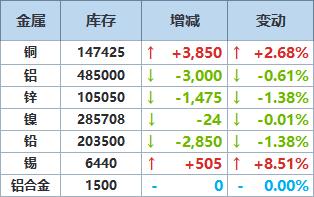
突发重挫!锡镍价格为何同步“跳水”?反弹曙光何在?
Xin Lang Cai Jing· 2026-01-19 09:56
Core Viewpoint - The recent sharp decline in tin and nickel prices in the Yangtze spot market is attributed to a combination of macroeconomic factors, supply-demand dynamics, and regulatory actions, leading to increased market divergence regarding future trends [1] Macroeconomic Pressure - The US dollar index remains strong around 99.40, nearing a six-week high, which is a key factor suppressing non-ferrous metal prices [2] - Market expectations for the Federal Reserve's interest rate policy have solidified, with a 95% probability of maintaining rates in January and a 78.4% probability in March, pushing back rate cut expectations to mid-year [2] Supply and Demand Logic - Tin prices are pressured by increased supply expectations from Myanmar and Indonesia, with imports from Myanmar reaching 7,190 tons in November, alleviating previous supply tightness [3] - Demand for tin is weakening as the "export window" for photovoltaic solder approaches its end, and speculative demand in AI and semiconductor sectors is also declining [3] - Nickel prices are affected by high inventory levels, with LME nickel stocks rising to 285,732 tons, and weak demand from the electric vehicle sector, which saw a 38% year-on-year drop in retail sales in early January [3] Industry Chain Impact - Global visible tin inventories are at approximately 12,000 tons, down over 70% from historical highs, but supply improvements are evident with increased mining quotas expected from Indonesia [4] - The nickel industry faces challenges with overcapacity in smelting and weak demand from the stainless steel and electric vehicle sectors, leading to significant operational pressures across the supply chain [5] Corporate Dynamics - Leading companies like Yunnan Tin Company reported a 35.99% year-on-year increase in net profit for the first three quarters of 2025, but current price declines may impact short-term profitability [6] - The second-largest tin producer, Xinyi Silver Tin, is expanding its capacity and plans to increase tin concentrate production to 20,000 tons per year through acquisitions [6] - Nickel industry leader Tsingshan Group is well-positioned due to its extensive operations in Indonesia, with ongoing projects in high-grade nickel and battery-grade nickel expected to benefit from future demand recovery [6] Outlook and Strategy - Analysts predict that tin and nickel prices will maintain a weak and volatile trend in the short term, with tin prices likely oscillating between 370,000 and 400,000 yuan per ton [7] - Nickel prices are expected to remain under pressure, with key support around 141,000 yuan per ton, and potential declines to 140,000 yuan if demand does not improve [7] - Investors are advised to lower leverage and control positions, focusing on leading companies with resource advantages and cost benefits while avoiding speculative trades [8]

欧盟碳边境调节机制正式落地 对我国影响几何
Xin Lang Cai Jing· 2026-01-19 02:05
Core Viewpoint - The implementation of the EU Carbon Border Adjustment Mechanism (CBAM) starting January 1 will significantly impact China's high-carbon industries, particularly steel and aluminum exports to the EU, which account for approximately 3.5% of China's total exports to the EU [1][10]. Group 1: Short-term Impact - The short-term pressure on Chinese exporters due to CBAM is manageable, as the initial carbon cost is set at a low base of 2.5% [3][12]. - Companies that have not undertaken energy-saving and carbon reduction measures will face the most significant challenges under CBAM [1][11]. - The default emission values set by the EU for Chinese products are generally higher than the global average, creating an unfair disadvantage for Chinese exporters [3][12]. Group 2: Compliance and Adaptation - Exporting companies need to shift from relying on default values for carbon reporting to establishing their own carbon monitoring and reporting systems [4][13]. - The implementation of CBAM will require strict compliance with carbon data reporting across the supply chain, affecting not only manufacturers but also upstream suppliers [14]. - Engaging with third-party certification bodies to obtain independent verification reports can enhance the credibility and compliance of carbon data [14]. Group 3: Long-term Strategy - Companies must focus on long-term low-carbon transformation strategies to remain competitive in international markets [16]. - The expansion of CBAM to include 180 downstream products by 2028 will broaden the scope of carbon cost calculations, necessitating a comprehensive approach to carbon footprint management [16]. - Collaboration with partners who have established low-carbon transition plans and transparent carbon data will be crucial for maintaining competitiveness [16]. Group 4: Policy and Market Dynamics - The Chinese government is advocating for fair trade practices and is prepared to take necessary measures against any unfair trade restrictions imposed by the EU [17]. - The establishment of a domestic carbon market and potential introduction of auction mechanisms could help alleviate carbon cost pressures on companies [16]. - Financial institutions may introduce green finance policies to support companies in their transition to low-carbon operations [16].
以优质服务让企业找到归“蜀”感
Xin Hua Ri Bao· 2026-01-18 21:25
Group 1 - Jiangsu Tiangong Technology Co., Ltd. is advancing its project to build a production line for 3,000 tons of high-end titanium and titanium alloy rods and wires, with the third EB furnace expected to enter mass production after the Spring Festival [1] - The project includes three core processes: titanium alloy powder preparation, high-end titanium and titanium alloy smelting, and rolling, targeting high-end markets such as consumer electronics, 3D printing, aerospace, and medical devices [1] - The project has progressed rapidly since its launch in February last year, with two EB furnaces already in mass production and the entire project expected to be completed by the end of this year [1] Group 2 - Jiangsu Youyuan New Materials Technology Co., Ltd. has built a new factory with eight EPS forming machines in the first phase, with plans for an additional eight machines in the second phase, targeting a production value of 30 million yuan in the first year [2] - The project aims to achieve an annual production capacity of 10 million sets of packaging separators, primarily for the photovoltaic equipment, automotive parts, and home appliance sectors [2] - The local government has provided significant support throughout the project, ensuring efficient processing of necessary procedures without delays [2] Group 3 - Jiangsu Lingdong Intelligent Technology Co., Ltd. focuses on inspection robots in the optoelectronic field and electromechanical integration systems, with a team primarily composed of university members [3] - The company chose to establish itself in Xiashu Town due to its proximity to educational institutions and the local government's strong support [3] - The local government is committed to high-quality development and enhancing service efficiency to ensure a conducive environment for startups and business growth [3]
贵金属“涨”声一片 带动工业金属囤货潮
Xin Lang Cai Jing· 2026-01-18 18:28
跟着"元素周期表"投资 在社交平台上,铜条投资的热度已然显现。来自浙江的花女士发布工厂生产视频,喊话"Cu99.9 1000克 铜条加班加点生产中,需要提前预约"。在她的帖子留言区,有近百条留言询问价格与购买方式,市场 投资热度可见一斑。 王少忠试水"投资铜条",受到意想不到的热捧。受访者供图 近期,黄金、白银价格连创新高,带动不少工业金属表现亮眼。受此影响,市场投资热情正悄然从传统 贵金属蔓延至工业金属。 近期,锑、锗、钨、铟等工业金属成为社交媒体上的"香饽饽":有人宣称囤数十公斤铟锭坐等升值,有 人买钾条号称涨幅150%,还有商家随手打造的"投资铜条"更是一日内收获超30人咨询。这场火爆的"元 素周期表投资热"背后,暗藏着怎样的投资心理与潜在风险?华西都市报、封面新闻记者采访了相关领 域专家。 商家试水投资铜条一天超30人咨询 2025年,全球贵金属市场迎来一波牛市,黄金年内涨幅突 破 70% ,白 银 飙 升 超170%。"最初大家还 等着价格回调,结果越等越高。"王少忠是深圳水贝片区的贵金属行业资深从业者,其公司长期主营贵 金属来料加工与投资性银条售卖。 受国际形势波动与金银铂价格暴涨启发,王少忠灵光 ...

每日核心期货品种分析-20260116
Guan Tong Qi Huo· 2026-01-16 13:06
Report Summary 1. Report Industry Investment Rating No relevant information provided. 2. Core Viewpoints - As of the close on January 16, domestic futures main contracts mostly declined. Polysilicon and rapeseed oil rose over 2%, while lithium carbonate and container shipping to Europe routes dropped over 8%, and tin and nickel futures also fell significantly. Different futures varieties showed distinct trends due to various factors such as supply - demand fundamentals, geopolitical events, and policy changes [5][6]. 3. Summary by Directory 3.1 Commodity Performance - As of January 16, domestic futures main contracts showed a pattern of more declines than increases. Polysilicon and rapeseed oil rose over 2%, glass rose over 1%; lithium carbonate and container shipping to Europe routes dropped over 8%, tin dropped over 6%, nickel, butadiene rubber, fuel oil, caustic soda, and SC crude oil dropped over 3%, and apples, liquefied petroleum gas (LPG), and copper dropped over 2%. In the stock index futures, the CSI 300 futures (IF) main contract dropped 0.29%, the SSE 50 futures (IH) main contract dropped 0.64%, the CSI 500 futures (IC) main contract rose 0.40%, and the CSI 1000 futures (IM) main contract rose 0.25%. In the bond futures, the 2 - year Treasury bond futures (TS) main contract rose 0.03%, the 5 - year Treasury bond futures (TF) main contract rose 0.05%, the 10 - year Treasury bond futures (T) main contract rose 0.01%, and the 30 - year Treasury bond futures (TL) main contract dropped 0.09%. In terms of capital flow, hot - rolled coil 2605, rebar 2605, and rapeseed oil 2605 had capital inflows, while lithium carbonate 2605, silver 2604, and gold 2602 had capital outflows [5][6]. 3.2 Market Analysis - **Copper (Cu)**: Copper futures opened low and moved lower. Supply - side issues included difficulties for smelters to profit from long - term contracts, and by - products like sulfuric acid and gold becoming major profit sources. The refined copper output was expected to decline in January. The merger negotiation between Rio Tinto and Glencore might affect the global copper supply. Demand from end - users was strong, but the copper products sector was cautious. Copper inventory increased significantly. Although the market's expectation of copper being included in the tariff scope weakened, copper futures were still prone to rise due to tight supply [8]. - **Lithium Carbonate**: It opened high and hit the daily limit down. In December 2025, the output was 99,000 tons, a 3.0% month - on - month increase. The weekly inventory decreased slightly. The demand from energy - storage batteries remained strong, but the market was pressured by the expected increase in supply from the recycling end. The government's adjustment of the export tax - rebate policy for batteries might impact the market. The strong situation of lithium carbonate remained unchanged, but the market was volatile [10]. - **Crude Oil**: OPEC+ decided to maintain the production plan in February and March 2026. The EIA data showed an unexpected increase in US crude and gasoline inventories. US crude production decreased slightly but remained near the historical high. Geopolitical factors such as the situation in Iran and the US - India - Russia oil trade relationship affected the market. The market was worried about demand, and the supply was in an oversupply situation. The price was expected to fluctuate and consolidate [11][13]. - **Asphalt**: The asphalt production rate increased slightly this week, but the expected production in January 2026 decreased compared to the previous month and the same period last year. The downstream construction was restricted by funds and weather. The inventory rate of asphalt refineries continued to rise. The geopolitical situation in Venezuela affected the supply of raw materials for domestic asphalt production. The price was expected to fluctuate, and an inverse spread strategy was recommended [14][16]. - **PP**: After the New Year's Day holiday, the downstream PP operating rate decreased slightly. The PP enterprise operating rate remained stable at a relatively low level. The cost decreased due to the easing of the Iran situation. The supply increased with new capacity coming on - stream. The downstream demand was limited before the Spring Festival. The market was expected to fluctuate within a range, and the L - PP spread was expected to narrow [17]. - **Plastic**: The plastic operating rate decreased slightly. The downstream PE operating rate decreased, and the demand from the agricultural film sector continued to decline. The cost decreased with the easing of the Iran situation. The supply increased with new capacity coming on - stream. The market was expected to fluctuate within a range, and the L - PP spread was expected to narrow [18][19]. - **PVC**: The upstream calcium carbide price was stable. The PVC operating rate was basically stable, but the downstream operating rate decreased. The export orders decreased, and the social inventory continued to increase. The cancellation of the export tax - rebate policy might stimulate a rush - to - export phenomenon. The 03 - 05 contracts were expected to fluctuate strongly [20]. - **Coking Coal**: Coking coal opened low and moved higher but declined during the day. The coking coal options were listed on the Dalian Commodity Exchange. The supply from imported coal decreased, while domestic production increased. The inventory transferred from upstream to downstream. The demand from steel mills and coking enterprises was expected to increase during the winter storage period, but the upward momentum was limited due to weak macro - sentiment. The price was expected to fluctuate widely [22]. - **Urea**: Urea opened low and moved higher but declined during the day. The market trading was not active, and the downstream was resistant to high prices. The daily output was expected to remain above 200,000 tons. The agricultural demand increased, and the industrial demand from compound fertilizer and melamine factories also rose. The inventory decreased. The price was expected to adjust at a high level in the short term [23].
日度策略参考-20260116
Guo Mao Qi Huo· 2026-01-16 06:01
1. Report Industry Investment Ratings - No clear overall industry investment ratings are provided in the report. However, specific ratings for some individual industries are as follows: - Industrial silicon is rated "bearish" [1] -沪胶 is rated "bullish" [1] 2. Core Views of the Report - The stock index is expected to continue rising after a period of shock adjustment. The bond market is favored by the asset shortage and weak economy, but short - term interest rate risks are prompted by the central bank. The prices of various commodities show different trends due to factors such as macro - policies, supply - demand relationships, and geopolitical situations [1] 3. Summary by Related Catalogs Macro - financial - **Stock index**: After the policy of lowering the margin trading leverage, the market speculative sentiment declined. The central bank's measures of lowering interest rates and increasing loan quotas are expected to further loosen the capital side. The stock index is expected to continue rising after shock adjustment [1] - **Treasury bonds**: The asset shortage and weak economy are beneficial for bond futures, but the central bank's short - term interest rate risk prompt and the Japanese central bank's interest rate decision need attention [1] Non - ferrous metals - **Copper**: The downstream demand is relatively pressured. With the cooling of market sentiment, copper prices have fallen from high levels and are currently in a volatile trend [1] - **Aluminum**: Due to limited industrial drivers and weakening macro - sentiment, aluminum prices have fallen from high levels and are expected to fluctuate [1] - **Alumina**: The alumina production capacity has a large release space, and the industrial side exerts downward pressure on prices. However, the current price is close to the cost line, so it is expected to fluctuate [1] - **Zinc**: The cost center of zinc fundamentals is stabilizing, but there is inventory pressure. Although zinc prices have made up for losses due to good macro - sentiment recently, the upside space is cautiously viewed [1] - **Nickel**: The 2026 RKAB target of Indonesian nickel mines is about 260 million wet tons, but the supply shortage pattern is difficult to change. Nickel prices are expected to be strongly volatile in the short term, and attention should be paid to Indonesian policies, macro - sentiment, and futures positions [1] - **Stainless steel**: The price has risen sharply due to the supply shortage of nickel ore. The price of raw material nickel - iron has been rising, the social inventory of stainless steel has slightly decreased, and steel mills' production in January has increased. The stainless steel futures are expected to be strongly volatile [1] - **Tin**: Due to good macro - sentiment and continuous supply disturbances, tin prices have continued to rise. The exchange's margin - increasing action on the 15th has had a short - term impact on tin prices [1] Precious metals and new energy - **Precious metals**: With the easing of geopolitical tensions and Trump's decision to postpone the tariff on key minerals, the upward momentum of precious metal prices has slowed down. Gold and silver prices are expected to fluctuate widely at high levels in the short term. Platinum and palladium prices are expected to fluctuate widely in the short term. In the long term, due to the supply - demand gap of platinum and the relatively loose supply of palladium, platinum can be allocated at a low price or a [long - platinum, short - palladium] arbitrage strategy can be adopted [1] - **Lithium carbonate**: It is in the traditional peak season of new energy vehicles, with strong demand for energy storage and increased supply from restarts. It is expected to be strongly volatile, but the spot market is weak, and the upward momentum is insufficient [1] Black metals - **Rebar and hot - rolled coil**: High output and high inventory suppress the price increase space. The transmission from futures price increases to the spot market is not smooth. Unilateral long positions should be closed and observed, and cash - and - carry arbitrage positions can be participated in [1] - **Iron ore**: There is obvious upward pressure, and it is not recommended to chase long positions at the current position [1] - **Coking coal and coke**: If the "capacity - reduction" expectation continues to ferment and there is pre - holiday stockpiling in the spot market, coking coal may still have room to rise. However, since the "capacity - reduction" expectation mainly comes from online rumors, the actual upward space is difficult to judge, and the volatility increases after a sharp rise [1] - **Glass and soda ash**: The short - term market sentiment has warmed up, and supply and demand are supportive. However, in the medium term, supply and demand will continue to be in surplus, and prices will be under pressure. Soda ash mainly follows the trend of glass, and its supply - demand situation is more relaxed in the medium term, so the price is under pressure [1] Agricultural products - **Palm oil**: The rumor that Indonesia will not implement B50 has put pressure on the market. It is expected to enter a shock - consolidation phase in the short term, waiting for positive driving factors such as Indian stockpiling and inventory reduction in the producing areas [1] - **Soybean oil**: It has a strong fundamental situation, and it is recommended to allocate more in the oil market. Consider a long - soybean - oil, short - palm - oil spread strategy [1] - **Rapeseed oil**: The expectation of improved Sino - Canadian trade and the Australian commercial crushing are expected to improve the tight domestic supply situation. Coupled with the global rapeseed harvest in the new season, the fundamentals of rapeseed oil are relatively weak in the oil market [1] - **Cotton**: There is support from the new - crop purchase price, and the downstream has rigid replenishment demand. However, there is currently no clear driving factor. Future attention should be paid to the central government's No.1 Document in the first quarter of next year, planting intentions, weather during the planting period, and the peak - season demand in March and April [1] - **Sugar**: The global sugar market has a surplus, and the domestic new - crop supply has increased. There is a strong consensus on short positions. If the futures price continues to fall, there will be strong cost support below, but there is a lack of continuous fundamental drivers in the short term [1] - **Corn**: The grain - selling progress has slowed down but is still faster than the same period last year. The port inventory is low, and there is a certain pre - holiday replenishment demand from the middle and lower reaches. The spot price is still firm in the short term, and the futures price is expected to fluctuate at a high level [1] - **Soybeans**: The USDA report is bearish. The expected harvest pressure in South America is gradually reflected in the Brazilian CNF premium. The domestic futures market is expected to be weakly volatile. In the first quarter, the concentrated ownership of imported soybeans may lead to structural problems, which may support the pre - holiday spot price, but the domestic auction policy is uncertain [1] Energy and chemicals - **Crude oil**: OPEC+ has suspended production increases until the end of 2026, the uncertainty of the Russia - Ukraine peace agreement, and US sanctions on Venezuelan oil exports have an impact on the market [1] - **Fuel oil**: It follows the trend of crude oil in the short term. The probability of the "14th Five - Year Plan" rush - work demand is falsified, and the supply of Venezuelan crude oil is not short [1] - **Asphalt**: The raw material cost provides strong support, the futures - spot price difference has rebounded significantly, and the mid - stream inventory has increased significantly [1] - **BR rubber**: The futures position has declined, the new warehouse receipts have increased, and the short - term upward momentum has slowed down. The spot price has led the recovery of the basis, and attention should be paid to the upward momentum above 12,000. The processing profit of butadiene rubber has narrowed, and the overseas cracking device capacity has been cleared, which is beneficial for the long - term domestic butadiene export [1] - **PTA**: The PX market has experienced a sharp rise, which is not due to fundamental changes. The PX fundamentals are supported, and the market is expected to be tight in 2026. Domestic PTA maintains high - level operation, and the high gasoline spread supports aromatics [1] - **Ethylene glycol**: Two MEG plants in Taiwan, China, with a total capacity of 720,000 tons/year, plan to shut down next month. Ethylene glycol has rebounded rapidly due to supply - side news. The current polyester downstream operating rate is maintained above 90%, and the demand performance slightly exceeds expectations [1] - **Styrene**: The Asian styrene market is generally stable. Suppliers are reluctant to lower prices due to continuous losses, while buyers insist on pressing prices due to weak downstream polymer demand and profit compression. Although the downstream demand is weak, the domestic market has a strong bullish sentiment due to export support. The market is in a weak - equilibrium state, and the short - term upward momentum depends on the overseas market [1] - **Hydrogen**: The upward space is limited due to weak domestic demand, but there is support from anti - involution and the cost side [1] - **PE**: The supply pressure is relatively large due to high operating load and less maintenance. The downstream improvement is less than expected, and the price has returned to a reasonable range. Geopolitical conflicts may lead to a rise in crude oil prices [1] - **PVC**: There is less global production in 2026, and the future expectation is optimistic. The cancellation of export tax rebates may lead to a rush - export phenomenon. The implementation of differential electricity prices in the northwest region may force the elimination of PVC production capacity [1] - **LPG**: The January CP has risen unexpectedly, providing strong support for the import cost. The escalation of the Middle East geopolitical conflict has increased the short - term risk premium. The EIA weekly C3 inventory accumulation trend has slowed down and is expected to turn into inventory reduction, and the domestic port inventory has also decreased. Domestic PDH maintains high - level operation but is deeply in deficit [1] Others - **Container shipping**: It is expected to reach the peak in mid - January. Airlines are still cautious about trial resumption of flights. The pre - holiday replenishment demand still exists [1] - **Paper pulp**: Affected by the decline of the commodity macro - market, paper pulp has fallen but has not broken through the shock range. The short - term commodity sentiment fluctuates greatly, and it is recommended to observe cautiously [1] - **Log**: The spot price of logs has shown signs of bottom - rebounding recently, and the further decline space of the futures price is limited. However, the January overseas offer has still declined slightly, and the log futures and spot markets lack upward driving factors, and it is expected to fluctuate in the range of 760 - 790 yuan/m³ [1] - **Live pigs**: The spot price has gradually stabilized recently. Supported by demand and with the unsold slaughter weight, the production capacity still needs to be further released [1]