消费

Search documents
基金高点买入必亏?这才是最大的投资误区!
Sou Hu Cai Jing· 2025-09-02 21:49
Core Insights - The article addresses the misconception that high points in fund performance equate to losses, emphasizing the complexity of market dynamics and the importance of a rational investment framework. Group 1: Industry Fundamentals - The long-term potential of a fund is determined by the underlying industry or company, with examples like the renewable energy sector showing significant growth despite short-term fluctuations [2][4] - Key factors influencing industry performance include policy incentives, technological advancements, and sustained market demand [4] Group 2: Fund Management - Skilled fund managers can mitigate high-point risks through strategic adjustments, with active management outperforming index funds by an average of 12 percentage points over the past five years [6] - Regular investment strategies, such as dollar-cost averaging, can transform high-point risks into long-term gains, evidenced by a case where a monthly investment yielded an 18% return compared to a mere 3% for a lump-sum investment [6] Group 3: Asset Allocation - A balanced approach combining equities and bonds can create a "resilient" portfolio, with a classic allocation of 60% equity funds and 40% bond funds [8][9] - Dynamic adjustments based on market valuations can help manage risk exposure effectively, as shown by the performance differences between pure equity funds and balanced portfolios during downturns [9] Group 4: Investment Traps - Investors often mistakenly equate historical high points with future peaks, necessitating a dynamic perspective on market valuations [12] - The impact of fund fees on long-term returns is significant, with lower management fees leading to substantially higher returns over time [13] - Short-term thinking can undermine the benefits of compounding, highlighting the importance of sustained investment over longer periods [14]


南向资金年内净买入近万亿港元,机构看好港股,这些板块将受益
Mei Ri Jing Ji Xin Wen· 2025-09-02 02:49
Group 1 - Southbound funds have continuously bought into Hong Kong stocks, with a cumulative net purchase amount exceeding 990 billion HKD as of September 1, indicating strong investor confidence in the Hong Kong market [1] - Key sectors attracting significant capital include pharmaceuticals, technology, internet, and consumer markets, reflecting a focused investment strategy [1] - Both the Hong Kong and A-share markets are experiencing a notable recovery in investor confidence, supported by resilient fundamentals and ongoing policy benefits, which may drive positive market trends [1] Group 2 - The overall liquidity environment is favorable due to expectations of interest rate cuts by the Federal Reserve, which may further enhance capital inflows into the Hong Kong stock market [1] - Technology, pharmaceuticals, and internet sectors, which are more sensitive to liquidity changes, are expected to benefit from this influx of capital [1] Group 3 - Relevant ETFs include the Hang Seng Technology Index ETF (513180), focusing on technology leaders and new energy vehicles, the Hang Seng Internet ETF (513330), which targets leading internet companies in Hong Kong, and the Hang Seng Pharmaceutical ETF (159892), concentrating on innovative drugs and contract research organizations [2]
中金公司9月A股行业配置建议:成长风格延续 关注景气细分领域
Mei Ri Jing Ji Xin Wen· 2025-09-02 00:53
Group 1 - The report from China International Capital Corporation (CICC) suggests a focus on sectors with solid industrial logic, such as communication equipment, semiconductors, electronic hardware, solid-state batteries, innovative pharmaceuticals, national defense and military industry, and robotics, due to favorable liquidity expectations [1] - The advantages of Chinese manufacturing are highlighted, with a recommendation to pay attention to white goods, construction machinery, and power grid equipment that have established overseas production capacity and are benefiting from trade growth with non-US economies [1] - The recovery in capital market sentiment is expected to boost financial performance, leading to a focus on insurance and brokerage firms [1] Group 2 - The "anti-involution" trend is guiding supply contraction in various industries, with policy efforts expected to stabilize demand, particularly in the photovoltaic sector [1] - There may be differentiation within dividend sectors, with an emphasis on high-quality cash flow, volatility, and dividend certainty, suggesting investments in leading consumer stocks, cyclical leaders, and telecommunications [1]

港股科技板块走强,恒生科技ETF易方达(513010)等产品成交活跃,机构称港股估值具备充分吸引力
Mei Ri Jing Ji Xin Wen· 2025-09-01 13:00
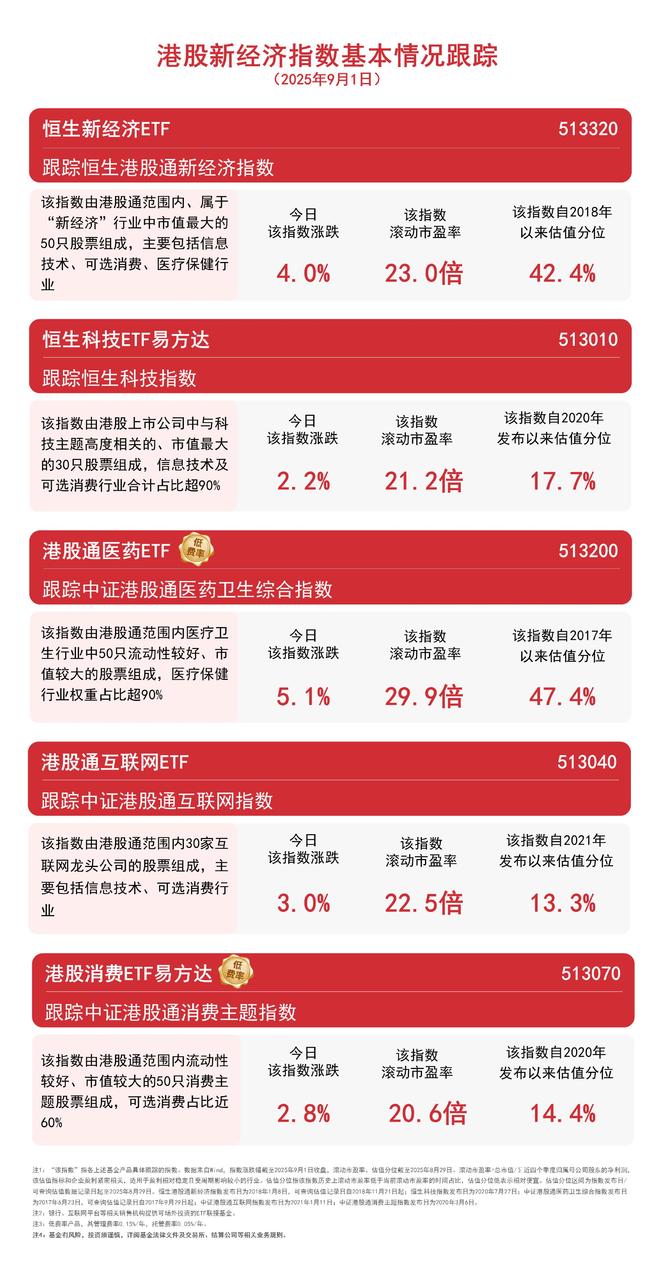
Group 1 - The core viewpoint of the articles indicates a positive outlook for Hong Kong stocks, with significant increases in various indices, suggesting strong market performance and potential for future growth [1] - The CSI Hong Kong Stock Connect Healthcare Index rose by 5.1%, while the Hang Seng New Economy Index increased by 4%, indicating robust investor interest in these sectors [1] - The report from Founder Securities highlights the attractiveness of Hong Kong stocks in terms of valuation, particularly in sectors like artificial intelligence and innovative pharmaceuticals, which are expected to attract continued inflows from southbound and foreign capital [1] Group 2 - The Hang Seng New Economy ETF tracks the Hang Seng Stock Connect New Economy Index, which consists of 50 large-cap stocks in the new economy sector, showing a rolling P/E ratio of 23.0 times and a valuation percentile of 42.4% since 2018 [2] - The Hang Seng Technology ETF, which tracks the Hang Seng Technology Index, comprises 30 major tech-related stocks, with a rolling P/E ratio of 21.2 times and a valuation percentile of 17.7% since its inception in 2020 [2] - The CSI Hong Kong Stock Connect Healthcare Index, which includes 50 liquid and large-cap healthcare stocks, has a rolling P/E ratio of 29.9 times and a valuation percentile of 47.4% since 2017 [3] - The CSI Hong Kong Stock Connect Internet Index consists of 30 leading internet companies, with a rolling P/E ratio of 22.5 times and a valuation percentile of 13.3% since its launch in 2021 [3] - The CSI Hong Kong Stock Connect Consumption Theme Index includes 50 large-cap consumer stocks, with a rolling P/E ratio of 20.6 times and a valuation percentile of 14.4% since its inception in 2020 [3]
中信建投证券:短期指数大概率横盘震荡,消费、周期等方向更具性价比
Xin Hua Cai Jing· 2025-09-01 05:58
Group 1 - The Shanghai Composite Index has shown a four consecutive month increase, reaching a peak of 3888 points, but short-term fluctuations around 3800 points are expected due to strong support at 3766 [1] - The weakening of the US dollar and the decoupling of US Treasury yields have increased the attractiveness of emerging markets, supported by continuous inflows from margin trading, household deposits, and northbound capital [1] - The current market sentiment is entering an overheated phase, with a noticeable tendency for crowding in certain sectors, particularly in TMT, which is approaching a warning line, indicating a need to pay attention to deteriorating trading structures [1] Group 2 - The mid-year report indicates a clear turning point in profitability for 2025, with revenue and net profit expected to turn positive, signaling a mild recovery phase for companies [2] - There is a notable improvement in cash flow and expense ratios, enhancing corporate resilience, while ROE stabilizes at the bottom but shows structural differentiation due to insufficient demand affecting asset efficiency [2] - The technology manufacturing sector is performing well, while the cyclical sector shows internal differentiation, and the consumer sector is awaiting revenue benefits to translate into profits [2]

四大变化,折射发展新动能
Xin Hua Ri Bao· 2025-09-01 02:09
Group 1: Company Performance - Jiangsu's 713 A-share listed companies achieved a total revenue of over 1.68 trillion yuan and a net profit of nearly 148.2 billion yuan in the first half of 2025, with 429 companies reporting revenue growth [1] - 573 companies reported profitability, with 193 companies having a net profit exceeding 100 million yuan [1] - Over 40% of companies reported revenue exceeding 1 billion yuan, and 45 companies had revenue growth exceeding 50% [1] Group 2: AI Integration - More than half of the listed companies in Jiangsu mentioned "AI" or "artificial intelligence" in their semi-annual reports, indicating deep integration of AI tools with core business operations [2] - AI is reshaping drug development processes, as seen in Heng Rui Medicine's use of AI for early development strategies, enhancing clinical conversion efficiency [2] - Traditional industries are also benefiting from AI, with companies like Taihu Snow combining human creativity with AI for product design and optimization [2] Group 3: Cost Reduction and Innovation - AI applications are leading to cost reduction and efficiency improvements across various industries, such as a 20% reduction in R&D costs and a 30% decrease in R&D cycles in the steel industry [3] - Companies like Jingyuan Environmental are utilizing AI to provide comprehensive intelligent services, promoting industry upgrades [3] - The focus of AI applications is shifting towards vertical industries, allowing companies to address specific industry pain points effectively [3][4] Group 4: Industry Self-Regulation and Quality Improvement - The "anti-involution" trend is gaining traction in industries like photovoltaics, steel, cement, and chemicals, with companies actively addressing industry challenges through self-regulation and strategic adjustments [5] - Companies are focusing on differentiated competition and green transformation to achieve sustainable competitive advantages [5][6] Group 5: Overseas Expansion - 440 listed companies in Jiangsu reported a total overseas revenue of 290.6 billion yuan, with many adjusting their overseas production strategies to enhance global market adaptability [8] - Companies like Zhongxin Bo are establishing multiple production bases globally to respond quickly to international delivery demands [8] - Tianhe Energy has expanded its global service network, enhancing its international operational capabilities [9] Group 6: Mid-Year Dividend Distribution - Over 120 A-share listed companies in Jiangsu have announced mid-year dividend plans, with total distributions exceeding 10 billion yuan, reflecting improved corporate profitability and investor return awareness [11][12] - Companies are increasingly adopting clear mid- to long-term dividend plans, with some committing to a cash dividend ratio of no less than 30% of net profit [12][13] - The rise in mid-year dividends is seen as a positive signal for market stability and investor confidence [13]
上海财大滴水湖高金教授陈欣:银行股估值修复后空间有限,消费股有望进入良性轨道|财富领航征程
Xin Lang Cai Jing· 2025-09-01 01:35
专题:财富领航征程丨金融新启航 中央金融工作会议指出,要做好科技金融、绿色金融、普惠金融、养老金融、数字金融 " 五 篇大文章 " ,为推进金融高质量发展指明了方向。鉴于此,新浪财经年度策划《金融新启 航》特别推出《财富领航征程》系列访谈栏目,深度对话金融机构高管、专家学者,共谋行 业发展之道。 作为金融市场的重要组成部分,牛市是投资者实现财富跃升的黄金窗口, 随着指数持续上行,市场对 牛市是否真正启动的讨论愈发热烈。当前背景下,如何在牛市抓住财富风口?如何搭建科学的全球资产 配置?本期《财富领航征程》对话上海财经大学滴水湖高级金融学院教授、资本市场研究中心主任陈 欣。 中国股市是全球最重要的金融市场之一,虽然近年经历了较大的波动和变化,但在陈欣看来,随着我国 经济的持续发展和资本市场的不断完善,国内股市正在逐渐走向成熟,未来波动率有望进一步减弱。 陈欣表示,银行股逆袭的背后是对"过度悲观"预期的修复;估值修复后,当前银行股持续获得显著超额 收益的空间并不大。与以往相比,目前消费类股票的估值水平并不高,仍有修复空间。股市中,不少投 资者热衷于追逐热门股,但需注意的是,其中可能存在"过度估值"陷阱,其底层风险难 ...
“基金专业买手”公募FOF加仓稀土、创新药
Sou Hu Cai Jing· 2025-09-01 00:39
Core Insights - Publicly offered funds (FOFs) have shown a clear adjustment strategy in their semi-annual reports, indicating a continued recognition of the attractiveness of equity assets and structural market characteristics in the first half of the year [1] - High-performing FOF products remain optimistic about sectors such as rare earths, innovative pharmaceuticals, technology, and gold, maintaining significant holdings in these areas [1] - Some fund managers are implementing rebalancing strategies for sectors that have seen excessive short-term gains, while others are beginning to position themselves on the left side of the consumption sector to strategically "capture" industry turning points [1]
A股结构性牛市,该如何应对?|第404期直播回放
银行螺丝钉· 2025-08-29 13:58
Core Viewpoint - The article discusses the structural bull market in A-shares, highlighting the rotation between growth and value styles, and how investors can navigate these changes to optimize returns [1][57]. Group 1: Market Performance - Since the beginning of 2025, the growth style has significantly outperformed, with the ChiNext Index rising by 38.82%, while the Hong Kong-Shenzhen Dividend Low Volatility Index only increased by 13.52% [3][5]. - Historical performance shows that from 2016 to 2018, value style was strong, followed by growth style dominance from 2019 to 2020, and then a resurgence of value style from 2021 to 2024 [5][29]. Group 2: Style Rotation Characteristics - A-shares exhibit a characteristic of style rotation, where different styles do not move in tandem but rather alternate in performance [5][33]. - Structural bull markets are common in A-shares, where certain sectors rise significantly while others lag behind or even decline [6][34]. Group 3: Investment Strategies - Investors are advised to diversify their portfolios across different styles to benefit from whichever style performs well [47]. - A balanced approach with regular rebalancing can lead to higher returns and lower volatility compared to a single-style investment [50][52]. Group 4: Valuation Insights - The article provides insights into current valuations of various indices, indicating that many value and growth indices are still at relatively attractive levels [11][12]. - The valuation table includes key metrics such as earnings yield, price-to-earnings ratio, and dividend yield for different indices, aiding investors in making informed decisions [13][14].

[8月29日]指数估值数据(A股港股继续上涨;A股港股谁涨的多;港股指数估值表更新;抽奖福利)
银行螺丝钉· 2025-08-29 13:58
Core Viewpoint - The article discusses the recent performance of A-shares and Hong Kong stocks, highlighting the rapid style switching in the market and the potential for A-shares to catch up with Hong Kong stocks in terms of returns [11][12][40]. Market Performance - The overall market showed a slight increase, remaining at 4.3 stars, close to 4.2 stars [1]. - Large, medium, and small-cap stocks all experienced gains, with large-cap stocks rising slightly more [2]. - Both growth and value styles saw increases [3]. - There was significant divergence in performance among different stocks [4]. - The STAR Market 50 index declined, while the ChiNext index saw substantial gains [5]. - Recently lagging sectors like consumer stocks experienced significant rebounds [6]. - Hong Kong stocks also rose overall, with small-cap and dividend stocks leading the gains [7]. Market Trends - The speed of style switching in the market has been very rapid, occurring almost daily [8]. - Each category of undervalued stocks tends to have its performance phase [9]. - Investors are advised to remain patient and avoid chasing trends or frequent trading [10]. A-shares vs. Hong Kong Stocks - A-shares and Hong Kong stocks have historically similar long-term returns, but their phases of increase and decrease differ [11]. - Recently, A-shares have begun to catch up after previously lagging behind Hong Kong stocks [12]. - Both markets were at low valuation levels around September last year, coinciding with the Federal Reserve's first rate cut [13][14]. - The decline in USD interest rates has increased global market liquidity, benefiting non-USD assets [15]. Characteristics of Bull Markets - The bull markets in A-shares and Hong Kong stocks share several characteristics: - Rarely slow bull markets, mostly characterized by rapid increases [17]. - Predominantly structural bull markets, with growth style stocks leading the way [20][21]. - Bull markets often experience intermittent pullbacks, typically following a pattern of "advance three, retreat one" [23]. Recent Performance Analysis - In the past year, A-shares experienced two major upward waves, one in late September last year and another in July-August this year [25]. - After a significant rise at the end of September last year, A-shares remained in a sideways trend for nearly half a year before gradually rising after June this year [25][26]. - Hong Kong stocks exhibited a similar pattern but had an additional upward phase [27]. - As of August 28 this year, the Hang Seng Index had risen 24%, while the CSI 300 Index for A-shares had increased by 13% [29]. - Since the low point in September last year, the Hang Seng Index has surged by 69%, compared to a 43% increase for the CSI 300 Index [30]. Valuation Insights - The article provides a summary of the valuation of various Hong Kong stock indices, indicating that most indices have moved out of undervaluation, with only a few value styles remaining undervalued [34]. - The article also mentions that the valuation table for Hong Kong indices is updated daily in a mini-program for easy access [36]. Conclusion - The article emphasizes the importance of understanding market dynamics and the potential for A-shares to align more closely with the performance of Hong Kong stocks, suggesting a favorable outlook for investors who remain patient and strategic in their approach [40].