石油石化

Search documents
权重股,集体异动!
Zheng Quan Shi Bao Wang· 2025-12-15 05:16
Group 1 - A-shares experienced a collective decline in major indices, with the Shanghai Composite Index dropping nearly 1% at one point, but the losses narrowed towards the end of the trading session [2] - Notable stocks such as Pudong Development Bank, Agricultural Bank of China, Industrial and Commercial Bank of China, Bank of China, China Petroleum, China Petrochemical, Kweichow Moutai, and China Life Insurance saw a sudden collective surge during the auction period [2] Group 2 - The North Securities 50 Index surged significantly in the afternoon, rising over 6% at one point and closing up 3.84% [3] - Individual stocks like Tianli Composite hit a 30% limit up, while Fujida and Xingtum Measurement Control rose over 13%, and Tianma New Materials increased by over 9% [4] - The North Securities Index sample stocks and reserve list will undergo regular adjustments, effective December 15, including companies like Five New Tunnel Equipment, Better Ray, Airo Technology, Shuguang Digital Innovation, Anda Technology, and Jinbo Biological [4] Group 3 - The ultra-high voltage concept stocks showed strong performance, with Tongguang Cable hitting a 20% limit up, while Zhongchao Holdings and Hualing Cable also reached their limit up, and Caneng Electric rose nearly 8% [5] - Institutions believe that 2026, as the start of the "14th Five-Year Plan," will present dual opportunities for the power equipment industry due to domestic demand expectations and external demand recovery [5] - CITIC Securities projects that investment in the power grid will maintain stable growth during the "14th Five-Year Plan," with an estimated total investment of approximately 3.8 trillion yuan from 2026 to 2030, corresponding to an average annual investment of about 750 billion yuan [5]
化工标的有望兼具高弹性和高股息的优势,石化ETF(159731)布局价值凸显
Sou Hu Cai Jing· 2025-12-15 02:20
Core Viewpoint - The China petrochemical industry index showed a significant upward trend, with key stocks like Tongcheng New Materials rising over 6%, indicating a positive market sentiment and potential investment opportunities in the sector [1]. Group 1: Market Performance - On December 15, the China petrochemical industry index opened low but quickly rose, currently up approximately 0.85% [1]. - The petrochemical ETF (159731) followed the index's upward movement, highlighting the value in the sector [1]. Group 2: Industry Outlook - Guohai Securities suggests that the trend of "anti-involution" may lead to a revaluation of the Chinese chemical industry, with future measures likely to significantly slow global chemical industry capacity expansion [1]. - The Chinese chemical industry is characterized by abundant net operating cash flow, which could lead to a substantial increase in potential dividend yields as capacity expansion slows [1]. - Changes on the supply side are expected to halt the decline in industry prosperity, with chemical stocks likely to exhibit both high elasticity and high dividend advantages [1]. Group 3: Investment Focus - Key areas of focus include petrochemicals, coal chemicals, organic silicon, phosphate chemicals, and glyphosate [1]. - The petrochemical ETF (159731) and its linked funds (017855/017856) closely track the China petrochemical industry index, with the basic chemical industry accounting for 60.39% and the petroleum and petrochemical industry for 32.71% of the index, positioning them to benefit from policies aimed at anti-involution, structural adjustments, and the elimination of outdated capacity [1].
国际油价、蛋氨酸价格下跌,TDI价格上涨 | 投研报告
Zhong Guo Neng Yuan Wang· 2025-12-15 02:01
Core Insights - The chemical industry report indicates a mixed performance in chemical product prices, with 42 products increasing in price, 37 decreasing, and 21 remaining stable during the week of December 8-14 [1][2] - The report suggests focusing on undervalued leading companies, the impact of "anti-involution" on supply in related sub-industries, and the importance of self-sufficiency in electronic materials and certain new energy materials amid price increases [1][6] Industry Dynamics - In the week of December 8-14, 47% of tracked chemical products saw a month-on-month price increase, while 44% experienced a decrease, and 9% remained unchanged [2] - The top price increases were noted in nitric acid, sulfuric acid, raw salt, bisphenol A, and TDI, while the largest declines were in PVA, LLDPE, trichloroethylene, and NYMEX natural gas [2] Oil Market Overview - International oil prices fell, with WTI crude oil futures closing at $57.44 per barrel (down 2.45%) and Brent crude at $61.12 per barrel (down 2.19%) [3] - The U.S. oil production averaged 13.853 million barrels per day, an increase of 38,000 barrels from the previous week and 222,000 barrels from the same period last year [3] - U.S. oil demand rose to an average of 21.082 million barrels per day, with gasoline demand increasing to 8.456 million barrels per day [3] TDI Market Analysis - TDI prices increased to an average of 14,713 yuan/ton, up 2.49% week-on-week and 5.51% month-on-month [4] - TDI production decreased, with an overall operating rate of approximately 58.55%, and various factories experiencing operational issues [4] - Average costs for TDI were 11,819 yuan/ton, down 0.92% week-on-week, while average gross profit rose by 31.79% week-on-week [4] Methionine Market Analysis - Methionine prices decreased to an average of 17,900 yuan/ton, down 2.45% week-on-week and 9.14% month-on-month [5] - The production remained stable at 18,350 tons, with an operating rate of 89.42% [5] - The cost of methionine was 13,853.73 yuan/ton, with a gross profit margin of 23.67% [5] Valuation Metrics - As of December 12, the TTM price-to-earnings ratio for the SW basic chemical sector was 24.14, and the price-to-book ratio was 2.19 [6] - The SW oil and petrochemical sector had a TTM price-to-earnings ratio of 12.85 and a price-to-book ratio of 1.24 [6] Investment Recommendations - The report recommends focusing on undervalued leading companies, sectors benefiting from policy support, and emerging fields such as semiconductor materials and new energy materials [6] - Specific companies highlighted for investment include Wanhua Chemical, Hualu Hengsheng, and others [6][7]





跨年行情即将启动,如何提前布局?十大券商最新研判!
Ge Long Hui· 2025-12-15 00:33
3. 中信建投:跨年行情蓄势待发 A股上涨的底层逻辑并未改变,目前市场已经基本完成调整,跨年有望迎来新一波行情。中期行业配置 方面,重点关注具有一定景气催化的有色金属和AI算力板块;主题投资方面,商业航天为主线,可控核 聚变和人形机器人也可适当关注。此外,港股市场中的潜在热点主要集中在互联网巨头、创新药两大方 向。 上周A股市场风格分化,成长风格整体走强。主要指数中,沪指累跌0.34%,深证成指累涨0.84%,创业 板指累涨2.74%。通信、军工、电子、机械设备领涨;煤炭、石油石化、钢铁、房地产板块下跌。 后市市场将如何演绎?且看最新十大券商策略汇总。 1. 中信证券:内外兼顾,寻求交集 从中央经济工作会议内容来看,做大内循环仍是重心,定位和去年相似。但对于股票市场而言,内需品 种和外需品种的预期和定价与去年存在巨大差异:去年底投资者对外需普遍谨慎,对内需充满期待,但 最终外需的表现大超预期;今年是重仓布局外需敞口品种,预期相对充分,但对内需品种欠缺信心;实际 上,明年外需继续超预期的难度在加大,但内需可期待的因素在增多。从这些角度来看,海外敞口品种 业绩兑现力强,但估值继续提升难度大;内需敞口品种景气度一般 ...
行业行深业度周报告:伊拉克恢复油田产量,原油供应过剩担忧较大-20251214
Ping An Securities· 2025-12-14 14:09
Investment Rating - The report maintains a "Strong Buy" rating for the oil and petrochemical sector [1]. Core Viewpoints - Iraq has restored production at the West Qurna 2 oil field, raising concerns about oversupply in the crude oil market. WTI crude futures fell by 4.33% and Brent crude futures by 4.13% during the specified period [6]. - Geopolitical tensions continue, particularly regarding the Russia-Ukraine situation and U.S.-Venezuela relations, which may impact oil prices [6]. - The U.S. Federal Reserve has lowered the federal funds rate target range by 25 basis points to between 3.50% and 3.75%, marking the third rate cut of the year [6]. - In the fluorochemical sector, the 2026 refrigerant quotas are expected to increase, with downstream demand in home appliances likely to continue due to government subsidies [6]. Summary by Sections Oil and Petrochemicals - Iraq's oil production has returned to approximately 460,000 barrels per day, and U.S. refinery utilization rates have increased following seasonal maintenance [6][7]. - The report suggests that domestic oil companies are diversifying their oil and gas sources to mitigate sensitivity to international oil price fluctuations [7]. Fluorochemicals - The 2026 HFC production quota has been announced, totaling 797,845 tons, which is an increase of 5,963 tons from the previous year. Notable increases include HFC-134a by 3,242 tons and HFC-245fa by 2,918 tons [6]. - The demand for refrigerants is expected to grow, supported by government policies and subsidies, particularly in the automotive sector [6][7]. Investment Recommendations - The report recommends focusing on the oil and petrochemical, fluorochemical, and semiconductor materials sectors. It highlights the resilience of major oil companies in the face of price volatility and suggests monitoring companies like China National Petroleum, Sinopec, and CNOOC [7]. - In the fluorochemical sector, companies leading in third-generation refrigerants and upstream fluorite resources are recommended for investment [7]. - The semiconductor materials sector is also highlighted for its upward cycle and potential for domestic substitution, with specific companies suggested for consideration [7].
下周科技板块最受看好!
Xin Lang Cai Jing· 2025-12-14 12:38
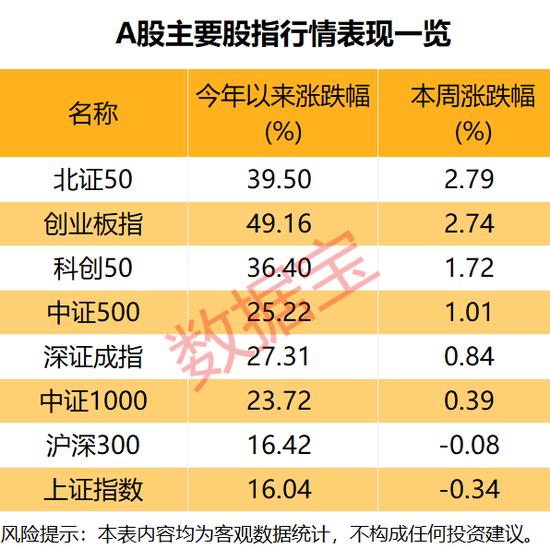
Market Overview - The A-share market experienced mixed performance from December 8 to 12, with a trading volume maintained above 1.7 trillion yuan. The Shanghai Composite Index fell by 0.34% to close at 3889.35 points, while the Shenzhen Component Index rose by 0.84%, the ChiNext Index increased by 2.74%, and the Northern Stock 50 Index saw the highest weekly gain of 2.79% among major A-share indices [1][12]. Year-to-Date and Weekly Performance - Year-to-date performance shows the Northern Stock 50 Index up by 39.50%, the ChiNext Index up by 49.16%, and the Sci-Tech 50 Index up by 36.40%. In contrast, the Shanghai Composite Index has increased by 16.04% this year but fell by 0.34% this week [2][13]. Sector Performance - In the Shenwan first-level industry indices, the communication index led with a gain of 6.27%, followed by defense and military, and electronics indices, which rose by 2.8% and 2.63%, respectively. Conversely, coal and oil & petrochemical indices dropped by over 3%, while steel, real estate, textile and apparel, and basic chemicals sectors collectively fell by over 2% [4][13]. Fund Flow Analysis - The A-share market saw a net outflow of approximately 120.52 billion yuan in main funds this week. The electronic, computer, and communication sectors experienced net outflows exceeding 10 billion yuan, with the highest outflow from electronics at 17.97 billion yuan. In contrast, the banking and steel sectors saw net inflows of over 1 billion yuan [4][13]. Investor Sentiment and Positioning - A survey indicated that 22% of respondents increased their positions, while 20% reduced theirs. The overall positioning trend showed a decrease in full-margin and full positions, with a rise in those holding 50% or less of their positions [5][14]. Profitability and Market Outlook - More than half of the surveyed investors reported profitability, with 45% indicating profits within 10%. Looking ahead, 50% of respondents expect the A-share market to remain in a sideways trend, unable to reach 4000 points, while 31% are optimistic about surpassing that level [7][16][18]. Risk Assessment - Among respondents, 59% perceive the A-share market as having medium risk, while 15% view it as high risk and 17% as low risk. This indicates a general consensus of moderate risk in the current market environment [10][19]. Sector Preferences - The technology sector remains the most favored, with 55% of respondents expressing optimism. The renewable energy sector saw a 4% increase in favorable sentiment, now at 8%, while the large financial sector's positive outlook decreased to 4% [11][19][20]. Policy Implications - The Central Economic Work Conference emphasized "innovation-driven development" and the importance of "artificial intelligence+" as a strategic focus for the upcoming year, indicating a commitment to enhancing technological integration and industry competitiveness [12][21].

量化择时周报:市场处于上行趋势信号边缘位置-20251214
ZHONGTAI SECURITIES· 2025-12-14 12:10
- The report indicates that the market is on the edge of an upward trend signal, with the core observation indicator being whether the profitability effect is positive. The current trend line of the WIND All A Index is around 6262 points, and the closing price is at 6264 points, just on the verge of turning positive[2][5][7] - The timing system signal shows that the distance between the moving averages is 4.03%, significantly greater than the absolute value of 3%, indicating that the market has returned to an upward trend pattern[2][5][6] - The industry trend allocation model shows that the mid-term distress reversal expectation model signals attention to liquor and real estate; the TWO BETA model continues to recommend the technology sector, focusing on consumer electronics and domestic computing power. The industry trend model shows that the engineering machinery/industrial metals/energy storage sectors continue their upward trend[2][5][7] - From the valuation indicators, the PE of the WIND All A Index is around the 80th percentile, which is a medium level, and the PB is around the 50th percentile, which is a relatively low level. Based on the short-term trend judgment and the position management model, it is recommended that absolute return products with the WIND All A as the main stock allocation should have a position of 60%[5][7][12]
——策略周专题(2025年12月第2期):新一轮政策部署护航,A股跨年行情可期
EBSCN· 2025-12-14 08:49
Group 1 - The A-share market is expected to experience a cross-year rally supported by new policy deployments, with a focus on maintaining economic growth within a reasonable range and enhancing market confidence through policy incentives [4][22][26] - Major A-share indices mostly rose this week, with the ChiNext Index, Sci-Tech 50, and CSI 500 leading in gains, while the Shanghai Composite Index, SSE 50, and CSI 300 saw declines [1][13][15] - The current valuation levels of indices such as Sci-Tech 50 and Wind All A are relatively high, with their PE (TTM) percentile ranks exceeding 80% as of December 12, 2025 [1][14][27] Group 2 - The central economic work conference emphasized a stable yet progressive approach, continuing with a more proactive fiscal policy and moderately loose monetary policy, which is expected to support domestic economic growth [2][42][26] - Economic data shows that the social financing scale increased by 8.5% year-on-year as of the end of November, indicating reasonable growth in financial totals, while the CPI rose by 0.7% year-on-year [43][44] - The TMT (Technology, Media, and Telecommunications) and advanced manufacturing sectors are highlighted as key areas for investment, with TMT likely to lead in a liquidity-driven market, while advanced manufacturing may take precedence in a fundamentals-driven market [32][38][4] Group 3 - The report indicates a significant divergence in industry performance, with sectors such as telecommunications, defense, and electronics showing strong gains, while coal, oil and petrochemicals, and real estate faced declines [15][54] - The market is currently experiencing notable volatility due to a combination of domestic and international events, including the Federal Reserve's interest rate decisions and the release of key economic data [3][18][45] - Historical patterns suggest that the A-share market tends to perform well in the opening years of the 13th and 14th Five-Year Plans, indicating a potential for positive performance in 2026 as well [26][28]
渤海证券:政策基调初步明晰 A股市场延续震荡特征
Xin Lang Cai Jing· 2025-12-14 06:58
Market Review - Major indices showed mixed performance in the past five trading days (December 5 - December 11), with the Shanghai Composite Index slightly down by 0.06% and the ChiNext Index up by 3.14% [1][5] - The CSI 300 Index rose by 0.12%, while the CSI 500 Index increased by 1.00% [1][5] - Trading volume increased, with a total of 9.30 trillion yuan traded, averaging 1.86 trillion yuan per day, an increase of 205.98 billion yuan compared to the previous five trading days [1][5] - Among the Shenwan first-level industries, telecommunications, comprehensive, and defense industries saw the highest gains, while coal, oil and petrochemicals, and steel industries experienced the largest declines [1][5] Economic Data - November exports increased by 5.9% year-on-year, significantly rebounding from October, influenced by multiple factors including a lower base, stable external demand, and the end of holiday disruptions [1][5] - Exports to the US saw a larger year-on-year decline, while exports to Japan, South Korea, and the EU experienced substantial rebounds, indicating a continued optimization of export structure [1][5] - The Consumer Price Index (CPI) rose by 0.7% year-on-year and fell by 0.1% month-on-month, primarily driven by food prices, particularly fresh vegetables, due to a lower base and supply-side disruptions [1][5] - The Producer Price Index (PPI) decreased by 2.2% year-on-year and increased by 0.1% month-on-month, with the year-on-year decline mainly influenced by a higher base [1][5] Policy Outlook - The Central Political Bureau of the Communist Party held a meeting to analyze and study economic work for 2026, maintaining a tone of "more proactive and effective" macro policies as emphasized in the 2024 Central Economic Work Conference [2][6] - Fiscal and monetary policies will continue to emphasize "more proactive" and "moderately loose" measures, with a focus on integrating existing and new policies [2][6] - The economic work for 2026 will focus on building a strong domestic market and cultivating new growth drivers among eight key areas, with more detailed plans to be revealed in the Central Economic Work Conference [2][6] Investment Strategy - The A-share market continues to exhibit a volatile characteristic, with positive signals from the Political Bureau meeting and confirmation of overseas liquidity easing due to the Federal Reserve's interest rate cuts [3][7] - The market is expected to regain strength driven by policy support and liquidity expectations, although some funds may delay allocation as the year-end approaches [3][7] - Investors are advised to remain patient and refine their strategies around policy and technology themes while waiting for sentiment to improve [3][7] - Investment opportunities are identified in the following sectors: 1. TMT sector and robotics, driven by ongoing capital expansion from domestic and international cloud vendors, accelerated domestic substitution of computing power, and potential application-driven growth [3][7] 2. Power equipment and non-ferrous metals sectors, benefiting from high global demand for energy storage and ongoing solid-state battery industrialization [3][7] 3. Social services and resource products, with policy focus on structural adjustments and "anti-involution" creating competitive opportunities [3][7] - Additionally, the banking sector presents allocation opportunities due to a low interest rate environment and a shift in public fund holdings towards performance benchmarks [3][7]
中国银河策略:如何看待政策对A股跨年行情的牵引?
Xin Lang Cai Jing· 2025-12-14 06:53
Market Overview - The A-share market experienced a fluctuating and differentiated trend from December 8 to December 12, with the overall index rising by 0.26% [1][31] - The North Star 50 and ChiNext indices led the gains, increasing by 2.79% and 2.74% respectively, while the Shanghai Composite Index, Shanghai 50, and CSI 300 saw slight declines [1][31] - Small-cap stocks outperformed, with the CSI 1000 index rising by 0.39%, compared to a decline of 0.08% for the CSI 300 [1][31] - Among sectors, telecommunications, defense, and electronics were the top gainers, with increases of 6.27%, 2.80%, and 2.63% respectively, while coal, oil and petrochemicals, and steel faced significant declines [1][31][39] Fund Flow - The trading activity in the A-share market showed signs of recovery, with an average daily turnover of 19,530 billion yuan, up by 2,568.66 billion yuan from the previous week [2][32] - Northbound capital saw an average daily turnover of 2,324.71 billion yuan, an increase of 397.27 billion yuan compared to the previous week [2][32] - The total margin trading balance reached 25,079.69 billion yuan, up by 263.01 billion yuan from the previous week [2][32] - A total of 23 new funds were established this week, with a total issuance of 18.218 billion units, of which equity funds accounted for 13, with an issuance of 6.690 billion units, a decrease of 4.526 billion units from the previous week [2][32][47] Valuation Changes - As of December 12, the PE (TTM) ratio for the overall A-share index decreased by 0.24% to 21.73 times, placing it at the 85.10 percentile since 2010 [2][23] - The PB (LF) ratio fell by 0.1% to 1.79 times, situated at the 47.62 percentile since 2010 [2][23] - The bond yield spread for the A-shares was 2.7613%, near the three-year rolling average of 3.3405% and at the 52.16 percentile since 2010 [2][23][51] Investment Outlook - Recent significant events include the Federal Reserve's decision to cut interest rates by 25 basis points, aligning with market expectations, although internal divisions have widened [3][33] - The Central Political Bureau and Central Economic Work Conference held this week provided direction for economic work in 2026, emphasizing "seeking progress while maintaining stability and improving quality and efficiency" [3][33] - The focus on domestic demand as a primary task reflects the urgent need to address "insufficient effective demand," highlighting the importance of technological innovation under the drive for innovation [3][33] - The capital market's role is expected to be further strengthened, with a clear commitment to "continuously deepen the comprehensive reform of capital market investment and financing" [3][33] Configuration Opportunities - Main Line 1: The unprecedented global changes are accelerating, with a shift in domestic economic logic towards new productive forces, highlighting key areas such as artificial intelligence, embodied intelligence, new energy, controllable nuclear fusion, quantum technology, and aerospace [4][34] - Main Line 2: The moderate advancement of anti-involution policies, combined with supply-demand structure optimization and price recovery expectations, indicates a clear path for profit recovery in manufacturing and resource sectors [4][34] - Auxiliary Line 1: The policy direction to expand domestic demand presents a window for investment in the consumer sector [4][34] - Auxiliary Line 2: The trend of going global is expected to further open up profit space for enterprises [4][34]