
贵金属

Search documents
黄金白银深夜大跳水背后,特朗普不打了?第一批受害者已出现
Sou Hu Cai Jing· 2026-02-03 03:11
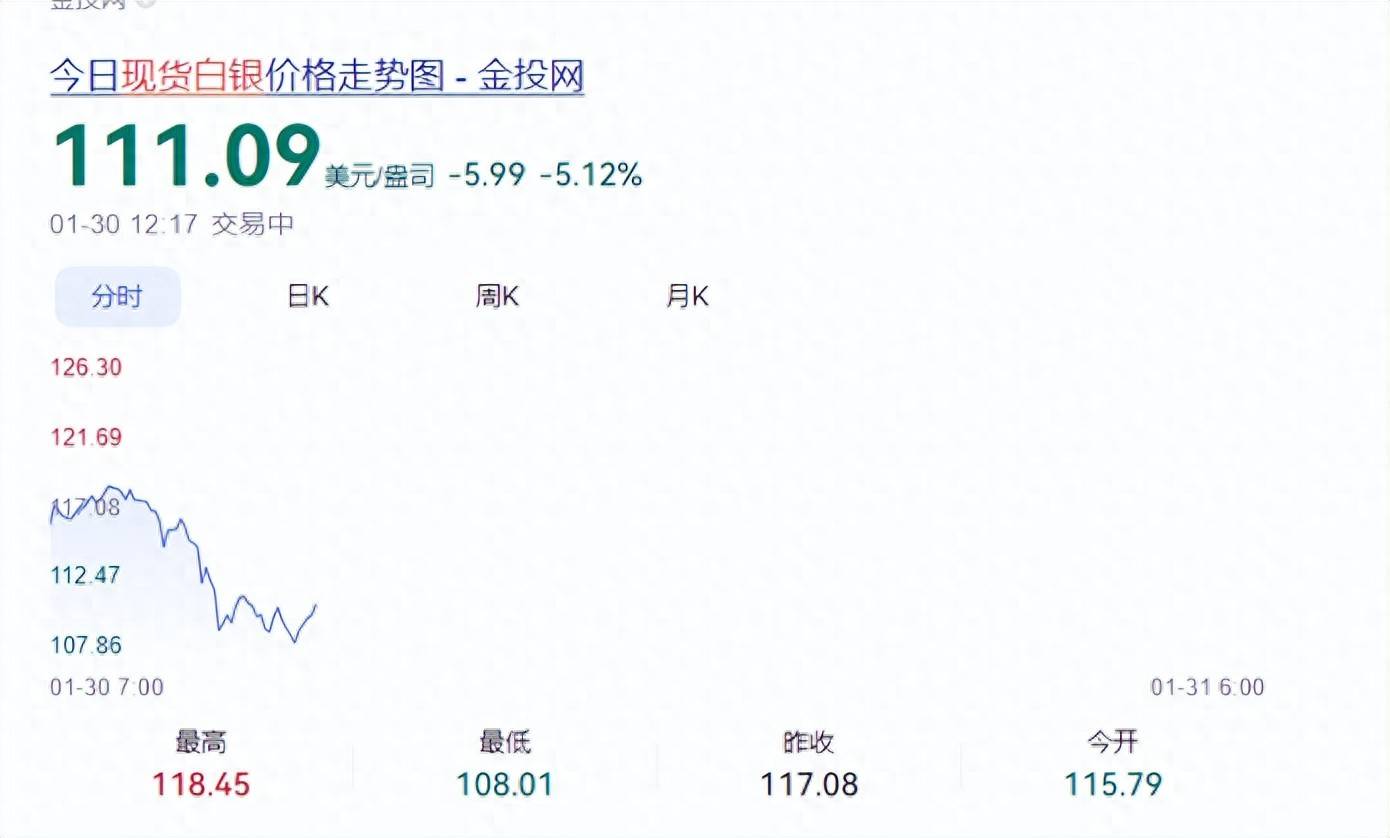
Core Viewpoint - The sudden crash in gold and silver prices on January 29 and 30 was driven by a combination of retail investor behavior, liquidity issues, and geopolitical tensions, leading to significant market volatility and panic selling [1][3][4]. Group 1: Market Reactions - On January 29, gold prices plummeted from a high of 5600 to 5200, while silver dropped from 121 to 106 [1]. - The morning of January 30 saw a broader market decline, with the A-share Shanghai Composite Index falling by 40 points, gold dropping to 5152.94 USD/oz (a 4% decline), and silver falling by 5.12% to 111.09 USD/oz [1][3]. Group 2: Causes of Price Decline - The surge in gold prices was primarily driven by retail investors, whose enthusiasm often leads to volatile market conditions. When retail interest peaks, it signals an impending correction [4]. - A wave of selling began as some investors opted to secure profits at high prices, triggering automated stop-loss orders and leading to a panic sell-off [6]. - The overall decline in asset prices, including stocks and cryptocurrencies, indicates a liquidity crisis, exacerbated by the Federal Reserve's decision to maintain interest rates and rising long-term bond yields [6]. Group 3: Geopolitical Factors - The current international environment suggests that gold prices are influenced more by "deterrent demand" rather than traditional "safe-haven demand," as countries react to perceived instability in U.S. policies under the Trump administration [8][10]. - Countries like Poland and Germany are increasing their gold reserves, indicating a shift away from reliance on the U.S. dollar and a collective effort to counteract U.S. monetary dominance [10][12]. Group 4: Central Bank Actions - Global central banks have significantly increased their gold reserves, with a tenfold increase over the past two years, reflecting a strategic move to counter the weakening of the dollar's dominance [12]. - Central banks are actively purchasing gold as a defensive measure against the potential collapse of the dollar's hegemony, with gold now comprising 28.9% of official reserves [12][14]. Group 5: Investor Sentiment - Many retail investors have expressed frustration and losses due to the sudden price drop, highlighting the risks associated with speculative trading in precious metals [18][20][22]. - Industry experts warn that this decline is not merely a minor correction, and investors holding long positions should implement strict risk management strategies to mitigate further losses [22].


光大期货金融期货日报-20260203
Guang Da Qi Huo· 2026-02-03 03:11
Report Industry Investment Rating - The investment rating for stock index futures is "volatile" [1] - The investment rating for treasury bond futures is "relatively strong" [1] Core View - The A-share market is experiencing high valuations in hot sectors, with the dynamic PE of the CSI 500 index exceeding twice the standard deviation of the past 5 years. The "stock-bond seesaw effect" is evident, and regulatory authorities are emphasizing market stability. High-valuation sectors may face capital outflow pressure, and volatility is expected to increase around the Spring Festival [1] - Treasury bond futures show mixed performance, and the bond market lacks strong upward momentum under the backdrop of continuous policy support. Interest rates are expected to remain range-bound [1][2] Summary by Directory Research View - **Stock Index Futures**: The market adjusted with all three major indices down over 2%, and nearly 4,700 stocks falling. High valuations, regulatory emphasis on stability, and measures to cool the market may lead to capital outflows from high-valuation sectors and increased volatility [1] - **Treasury Bond Futures**: The 30-year contract rose 0.18%, while the 10-year and 5-year contracts declined slightly. The central bank conducted 750 billion yuan of 7-day reverse repurchases, resulting in a net withdrawal of 755 billion yuan. The bond market lacks strong upward momentum, and interest rates are range-bound [1][2] Price Changes - **Stock Index Futures**: IH, IF, IC, and IM all declined, with IC dropping 5.49% and IM down 4.71% from January 30 to February 2, 2026 [3] - **Stock Indices**: All major indices, including the Shanghai Composite 50, CSI 300, CSI 500, and CSI 1000, decreased, with the CSI 500 falling 3.98% [3] - **Treasury Bond Futures**: TS remained flat, TF and T declined slightly, and TL rose 0.13% [3] Market News - **Overall Trend**: The market adjusted throughout the day, with all three major indices down over 2%. Nearly 4,700 stocks fell, and trading volume reached 2.61 trillion yuan [1][5] - **Industry Sectors**: Only the power grid equipment and brewing sectors rose, while precious metals, non-ferrous metals, oil and gas, and semiconductor chips led the decline [5] - **Hot Concepts**: Power grid equipment stocks and liquor stocks rose, while precious metals, oil and gas, and semiconductor chip stocks declined significantly [5] Chart Analysis - **Stock Index Futures**: Charts show the historical price trends and basis trends of IH, IF, IC, and IM [7][8][9] - **Treasury Bond Futures**: Charts display the price trends, basis trends, inter - period spreads, and cross - variety spreads of treasury bond futures, as well as the yields of treasury bonds and the capital interest rates [14][15][16] - **Exchange Rates**: Charts present the exchange rate trends between the US dollar, euro, pound, yen, and the RMB, including spot and forward exchange rates [22][23][24] Member Introduction - Zhu Jintao, a master's degree holder from Jilin University, serves as the director of macro - financial research at Everbright Futures Research Institute [29] - Wang Dongying, an index analyst with a master's degree from Columbia University, focuses on stock index futures, including macro fundamentals, key industry sectors, index financial reports, and market capital tracking [29]
宏观金融数据日报-20260203
Guo Mao Qi Huo· 2026-02-03 03:06
1. Report Industry Investment Rating - Not mentioned in the provided content 2. Core View of the Report - In the context of expected tightening of overseas liquidity, the US dollar index rebounded significantly. Yesterday, all non - ferrous varieties in the domestic commodity market hit the daily limit down, triggering an overall adjustment of risk assets. The stock index dropped significantly due to the linkage between commodities and the stock market and concerns about overseas liquidity tightening [6]. - The current A - share market is dominated by capital and policy. About 70 billion yuan flowed out of broad - based ETFs from January 15th to 27th, presumably due to Central Huijin's reduction to cool the market. The redemption of broad - based ETFs weakened last Thursday and Friday. In the short term, the policy is expected to take flexible measures to support the market. In the long run, the medium - to - long - term upward trend of the stock index is not expected to end [6]. 3. Summary by Relevant Catalogs 3.1 Macro Financial Data - **Interest Rates**: DR001 closed at 1.36 with a 3.65bp increase; DR007 at 1.49 with a - 10.20bp change; GC001 at 1.78 with a 17.50bp increase; GC007 at 1.64 with a 3.00bp increase; SHBOR 3M at 1.59 with a - 0.01bp change; LPR 5 - year at 3.50 with no change; 1 - year treasury at 1.30 with a 0.50bp increase; 5 - year treasury at 1.57 with a - 0.10bp change; 10 - year treasury at 1.81 with a 0.10bp increase; 10 - year US treasury at 4.26 with a 2.00bp increase [3]. - **Central Bank Operations**: The central bank conducted 75 billion yuan of 7 - day reverse repurchase operations yesterday at an operating rate of 1.40%. With 150.5 billion yuan of reverse repurchases maturing, the net withdrawal was 75.5 billion yuan. This week, 1.7615 trillion yuan of reverse repurchases are due to mature, and 700 billion yuan of 91 - day repurchase - style reverse repurchases will mature on Wednesday [3][4]. 3.2 Stock Index Market - **Index Performance**: The Shanghai Composite Index fell to 4016, the CSI 300 dropped 2.13% to 4606, the SSE 50 declined 2.07% to 3003, the CSI 500 decreased 3.98% to 8037, and the CSI 1000 fell 3.39% to 7975. The decline of stock index futures was greater than that of the underlying indexes, and the discount widened, indicating a rapid cooling of market sentiment. The trading volume of the three major stock exchanges in Shanghai, Shenzhen, and Beijing was 2.6069 trillion yuan, a decrease of 255.8 billion yuan from the previous trading day. Most industry sectors fell, with only power grid equipment and the brewing industry rising [5]. - **Futures Performance**: The trading volume of IF increased by 6.8% to 191,408, and the open interest decreased by 5.6% to 313,881; IH trading volume rose 15.9% to 89,283, and open interest decreased by 2.5% to 119,304; IC trading volume increased 16.4% to 289,004, and open interest decreased by 5.9% to 328,769; IM trading volume rose 11.3% to 307,100, and open interest increased by 1.3% to 414,250 [5]. - **Premium and Discount**: The report provides the premium and discount rates for different contracts of IF, IH, IC, and IM [7].
金价、银价早盘反弹,黄金概念股继续下挫
Bei Ke Cai Jing· 2026-02-03 03:05
Group 1 - Gold prices experienced a significant rebound after a sharp correction, with spot gold reaching a maximum increase of over 4%, touching $4,856 per ounce, and currently reported at $4,780.5 per ounce, up 2.6% [1] - COMEX gold also saw an increase, reported at $4,816.8 per ounce, up 3.5% [1] - Silver prices surged, with spot silver reaching a maximum increase of over 8%, touching $85 per ounce, and currently reported at $82.5 per ounce, up 4.4% [2] Group 2 - A-share precious metal LOFs opened high, with Jiashi Gold LOF (160719) rising over 5%, Gold LOF (164701) up over 4%, and Gold Theme LOF (161116) increasing over 3% [3] - However, A-share gold and silver concept stocks continued to decline, with companies like Sichuan Gold, Zhaojin Gold, and Hunan Silver hitting the daily limit down [3]
市场风偏下降叠加负伽马效应,贵金属波动率大幅放大
Soochow Securities· 2026-02-03 03:01
Investment Rating - The report maintains an "Overweight" rating for the non-ferrous metals sector [1]. Core Views - The non-ferrous metals sector saw a weekly increase of 3.37%, ranking it among the top performers across all primary industries. The precious metals segment surged by 18.02%, while small metals, energy metals, and new materials declined [1][14]. - The market is experiencing increased volatility in precious metals due to a decline in market risk appetite and negative gamma effects, leading to significant fluctuations in prices [1][4]. Summary by Sections Market Review - The Shanghai Composite Index fell by 0.44%, while the non-ferrous metals sector outperformed with a 3.37% increase, surpassing the index by 3.81 percentage points [14]. - Among the sub-sectors, precious metals rose by 18.02%, while small metals, energy metals, and new materials saw declines of 1.09%, 8.17%, and 5.12%, respectively [14]. Industrial Metals - **Copper**: The demand from downstream sectors is declining due to the Spring Festival effect, leading to a rise in global copper inventories. As of January 30, LME copper was priced at $13,071 per ton, down 0.44% week-on-week, while SHFE copper rose to 103,680 CNY per ton, up 2.31% [2][30]. - **Aluminum**: Prices fluctuated due to rising overseas natural gas prices. As of January 30, LME aluminum was priced at $3,136 per ton, down 1.20%, while SHFE aluminum was at 24,560 CNY per ton, up 1.11% [3][35]. - **Zinc**: Zinc prices increased, with LME zinc at $3,370 per ton, up 3.09%, and SHFE zinc at 25,835 CNY per ton, up 5.08% [38]. - **Tin**: Tin prices fell, with LME tin at $50,600 per ton, down 10.61%, and SHFE tin at 409,000 CNY per ton, down 4.79% [42]. Precious Metals - The report notes that precious metals are under pressure due to rising inflation data and the Federal Reserve's decision to maintain interest rates. As of January 30, COMEX gold was priced at $4,907.50 per ounce, down 1.52%, while SHFE gold was at 1,161.42 CNY per gram, up 4.10% [4][45]. - The nomination of Kevin Warsh as the new Federal Reserve Chairman has led to a decline in market risk appetite, exacerbating the volatility in precious metals [4][46]. Inventory Changes - Copper inventories have reached their highest levels since May 2025, with LME copper stocks at 175,000 tons, up 1.91% week-on-week [31]. - Aluminum inventories increased, with SHFE stocks rising by 10.01% to 216,800 tons [35]. - Zinc inventories decreased, with LME stocks at 110,000 tons, down 1.35% [38].
首席点评:贵金属继续调整
Shen Yin Wan Guo Qi Huo· 2026-02-03 02:45
报告日期:2026 年 2 月 3 日 申银万国期货研究所 首席点评:贵金属继续调整 2026 年春节将迎来 9 天假期,为繁荣节日市场、丰富群众文化生活、激发假期 消费活力,日前,商务部等 9 单位发布关于印发《2026"乐购新春"春节特别活 动方案》的通知。《方案》紧扣年俗文化、家庭团圆、购物出行等核心需求,扩 大优质商品和服务供给,丰富多元化消费场景,激发实体商业活力。中共中央、 国务院批复同意《现代化首都都市圈空间协同规划(2023-2035 年)》,要求建 成以首都为核心的世界一流都市圈、先行示范中国式现代化的首善之区,支撑京 津冀世界一流城市群建设。国内商品期货夜盘收盘,原油主力合约下跌 4.8%报 450 元/桶;贵金属方面,沪金主力合约下跌 3.86%报 1045 元/克,沪银主力合约 下跌 20%报 20600 元/千克。 重点品种:贵金属、原油、股指 贵金属:白银:夜盘沪银期货再度跌停。此次贵金属巨震主要受两方面因素影响: 一是因为 1 月 30 日特朗普宣布提名凯文·沃什为下一任联储主席,沃什的传统 鹰派立场,带动美元指数明显回升,市场对美联储独立性担忧有所缓解。二是此 前贵金属短期内快 ...
黄金续跌创逾两周新低 多重利空共振触发千点回调
Jin Tou Wang· 2026-02-03 02:14
此轮跌势的直接导火索,源于美国总统特朗普对美联储人事的"鹰派"提名。上周五特朗普宣布,提名前 美联储理事凯文.沃什接替鲍威尔出任下一届美联储主席(任期2026年5月开启)。由于沃什素以鹰派立场 著称,其提名被市场解读为美联储未来政策可能转向更紧缩的方向——这一预期直接挫败了投资者 对"进一步降息"的押注。受此推动,美元指数自低位大幅反弹,前期积累大量多头的黄金市场随即触发 获利了结潮,成为金价下行的核心推力。 除货币政策预期生变外,地缘局势的阶段性缓和进一步削弱了黄金的避险吸引力。最新消息显示,美国 方面已释放与伊朗谈判的积极信号,伊朗外长回应称双方接触"取得成效",并认为达成公平协议"存在 可能",甚至有望在短期内落地。与此同时,乌克兰总统泽连斯基也表示准备就相关议题展开"实质 性"讨论,下一届三方会议计划于2月4-5日在阿布扎比举行。地缘紧张氛围的降温,使得黄金作为"避险 锚"的配置需求短期回落。 不过,黄金市场的深层支撑逻辑尚未完全瓦解。一方面,地缘局势的不确定性仍未彻底消除——中东局 势的复杂性、俄乌问题的长期化特征,均可能随时引发新的避险情绪升温;另一方面,全球"去美元 化"浪潮持续推进,各国央行对 ...
流动性风险下的商品市场
2026-02-03 02:05
Summary of Conference Call on Commodity Market Dynamics Industry Overview - The conference call discusses the recent dynamics in the commodity market, particularly focusing on the significant price declines observed since January 30, 2026, with silver futures being the primary commodity affected [1][2]. Key Points and Arguments Commodity Price Movements - A notable price drop in commodities has been observed, with silver futures leading the decline, followed by tin, platinum, palladium, nickel, copper, aluminum, and eventually impacting crude oil and lithium carbonate [3][4]. - The price of domestic silver futures remains 30% higher than the London Metal Exchange (LME) spot price, indicating a significant premium [5]. Market Dynamics and Liquidity Risks - The liquidity risk in the market is primarily concentrated in silver, with over 90,000 short positions unable to be cleared, triggering margin calls and subsequent sell-offs [4][6]. - The gold market is relatively stable, with a fair pricing mechanism, and is less affected by liquidity risks compared to silver [6]. Future Market Outlook - Historical patterns suggest that severe commodity price fluctuations often follow similar transmission chains, necessitating close monitoring of domestic and international price premiums [7]. - There is potential for recovery in certain commodities that may have been oversold, particularly in the non-ferrous metals sector, with aluminum identified as a key focus [8][9]. Investment Opportunities - The call highlights three main investment themes for 2026: non-ferrous metals (with a focus on aluminum), renewable energy materials, and critical raw materials in high-tech industries [8]. - The basic and fine chemical sectors are also recommended for investment, as they may experience a rebound due to inventory replenishment and capacity restructuring after a prolonged period of destocking [10]. Gold as an Investment - Gold continues to be viewed as a valuable investment, with central banks maintaining a trend of purchasing gold, which is expected to persist despite recent market volatility [11]. Monitoring Silver Futures - Silver futures are considered a critical indicator for assessing market sentiment and liquidity. A recovery in silver futures could signal a stabilization in the broader commodity market [12]. Additional Important Insights - The A-share market's volatility is largely driven by emotional transmission rather than fundamental deterioration, with significant correlations observed with U.S. stock market movements [13][14]. - The current market fluctuations are primarily liquidity-driven, with expectations of stabilization in the precious metals matrix in the near term [15]. - Several sectors are highlighted for potential investment, including commercial aerospace, AI applications, and semiconductor equipment, which are expected to attract attention in the upcoming market cycles [16][17]. Investment Strategy Recommendations - Investors are advised to manage their positions and timing carefully, focusing on growth sectors while being adaptable to rapid market rotations, especially around the Chinese New Year [18].
资产价格演绎与新Fed主席是两个不同的路径
2026-02-03 02:05
近期黄金市场波动较大,您对黄金的短期和中期走势有何看法? 黄金的长期上涨逻辑没有改变,短期内由于技术性超买出现了一定回调。根据 1978 年至今的数据,黄金在创下历史新高后单日下跌超过 5%的情况下,一周 和一个月的中位收益分别为-0.6%和-0.7%。但拉长至一年维度,收益分化明 显,例如 1979 年涨幅达 71%,而 1980 年和 2011 年分别亏损 28%和 8%。 我们认为在 2026 年的一二季度黄金依然有上行趋势,中期配置可考虑在十周 线(约 4,567 点)进行布局,如果继续下跌则可在 20 周线(约 4,292 点)进 行配置。 对于白银市场近期的剧烈波动,有什么具体原因及未来预判? 白银近期的剧烈波动主要是由于市场操纵行为以及基本面因素。11 月份白银逼 空行情缺乏基本面支持,其上涨更多是价格驱动导致投资者跟风。国外矿商减 美国经济前景光明,受益于 AI 发展,预计将与中国形成两极化格局。短 期内,美国仍面临高债务和通胀粘性问题,政策操作空间受限。沃什的 政策立场偏中性,长期利好消费股和中小企业。 中国高端制造业发展提升企业 ROE,长期利好股市和汇率。但短期内存 在结构性风险,如垃圾 ...
金银铜-贵金属与铜-在物流逻辑中重寻坐标
2026-02-03 02:05
Summary of Key Points from Conference Call Industry Overview - The conference call discusses the precious metals and copper markets, highlighting the differences in pricing mechanisms and demand drivers between precious metals and industrial metals [1][4]. Precious Metals Market Core Insights - The precious metals market is experiencing a phase of supply-demand contradictions, with gold demand driven by investment, physical, central bank, and industrial needs. The first three are critical for marginal flows [1]. - Since 2022, central bank gold purchases have surged due to geopolitical risks, particularly from countries like China and Russia. If developing countries increase their gold holdings from below 5% to 5%-10%, it could significantly boost demand [1][7]. - The market is expected to see a positive premium in the first half of 2025 driven by domestic funds, while the second half will be influenced by European and American funds, leading to a negative premium [1][10]. - The volatility in the silver market is high, with strong bullish sentiment and speculative leverage. The willingness to hold physical silver in marginal markets like China and India is noteworthy [1][16]. Additional Insights - The demand for gold is categorized into four segments: investment, physical, central bank, and industrial, with the first three being the most impactful on market trends [5]. - The current wave of central bank gold purchases began in 2022, driven by geopolitical tensions, particularly after the freezing of Russian assets [6]. - ETF investments play a significant role in the precious metals market, with the U.S. and Europe dominating net inflows, while Asian ETFs are still developing [8][9]. Copper Market Core Insights - The copper market faces contradictions in logistics and fundamentals, with U.S. copper premiums rising due to investigations and low inventories in non-U.S. regions [3][18]. - An estimated 600,000 tons of new copper supply is expected in 2026, but actual increases may fall short due to the lifecycle stage of many mines [20]. - The domestic smelting industry is currently in a challenging position, balancing production increases with profitability issues, exacerbated by competition from Southeast Asian countries [21]. Additional Insights - Future copper demand is expected to decline in the home appliance and power generation sectors, while the electric grid remains optimistic. AI computing demand is projected to add limited copper usage [22]. - Current copper prices are expected to stabilize around 99,000 yuan per ton, with a positive outlook for the first half of 2026, potentially rising to 120,000-140,000 yuan per ton [23][26]. - The U.S. inventory situation is critical, with an expected consumption of 600,000 tons by Q3 2026, which will primarily be absorbed domestically [24][25]. Conclusion - The precious metals market is poised for growth driven by central bank purchases and ETF inflows, while the copper market faces logistical challenges and fluctuating demand across sectors. The overall sentiment remains cautiously optimistic for both markets, with specific attention to geopolitical risks and inventory dynamics.