
医药生物等

Search documents
防御主线持续霸屏,A股下一个风口藏在哪?丨智氪
36氪· 2025-06-22 10:09
Core Viewpoint - The A-share market is experiencing limited upward elasticity, and investors need to remain cautious due to internal and external pressures leading to short-term adjustments [3][11]. Market Performance - During the week of June 16-20, the A-share market showed a slight decline, with the Shanghai Composite Index down by 0.51% to close at 3360 points, and the Wind All A Index down by 1.07% [4]. - Among the 31 primary industries, only the banking and telecommunications sectors saw gains, while sectors like beauty care, textiles, pharmaceuticals, non-ferrous metals, and social services faced significant declines [5]. - The Hong Kong market mirrored the A-share performance, with the Hang Seng Index down 1.52% and the Hang Seng Technology Index down 2.03% [5]. Economic Data and Trends - Recent macroeconomic data indicates a decline in fiscal revenue and expenditure for the first five months of the year, attributed to factors such as falling PPI and a slowdown in land sales [7][9]. - Manufacturing investment grew by 8.5%, while infrastructure investment was at 5.6%, contrasting with a 10.7% decline in real estate investment [9]. - Retail sales for the same period increased by 6.4%, driven by initiatives like trade-in programs and tourism [10]. External Influences - Ongoing international issues, including U.S.-China trade negotiations and geopolitical tensions in the Middle East, are affecting investor sentiment and market performance [10]. - The upcoming policy window in July is critical, with expectations for potential tariff adjustments and trade discussions [10]. Future Outlook - Despite concerns over domestic demand resilience, there is a high expectation for policies to stabilize the capital market, suggesting that while short-term adjustments may occur, significant declines are unlikely [11]. - The combination of monetary and fiscal policies is essential for economic strength, with a potential fiscal stimulus expected post-August [13]. - In the current market environment, defensive stocks, particularly those with solid fundamentals in the new consumption sector, are favored, while technology stocks with performance metrics are also seen as attractive [15].


周度金融市场跟踪:本周避险情绪延续,A股继续回调,债市收益率震荡下行-20250622
Bank of China Securities· 2025-06-22 08:17
宏观经济 | 证券研究报告 — 总量周报 2025 年 6 月 22 日 周度金融市场跟踪 股票方面,本周 A 股整体下跌,小盘股走势弱于大盘股。全周累计看,沪深 300 本 周下跌 0.5%,中证1000 下跌 1.7%,中证 2000 下跌 2.2%。恒生指数本周下跌 1.5%, 恒生科技指数下跌 2.0%。行业方面,银行、通信和电子领涨。值得注意的是在市场 整体走弱的背景下,本周银行指数大幅上涨 2.6%,申万银行指数收盘至历史最高水 平。前期上涨较多的美容护理、纺织服装和医药生物领跌(图表 9),医药生物在连 续多周上涨后本周大幅下跌 4.4%。风格上,本周高估值风格(高市盈率和高市净率 指数)与低估值风格(低市盈率和低市净率指数)连续第二周走势相反(高估值下跌, 低估值上涨)。高估值资产的整体下跌体现了当前市场的避险情绪。周内看,周一(6 月 16 日)市场整体上涨,上午统计局发布经济数据,5 月份国民经济运行总体平稳、 稳中有进,全天超 3500 只股票上涨。周二(6 月 17 日)市场震荡。周三(6 月 18 日)上午陆家嘴论坛"一行两局一会"领导分别发言并发布了一系列政策举措,其中 证监会推出 ...
股指早报:陆家嘴金融论坛开幕,关注政策层面消息-20250618
Chuang Yuan Qi Huo· 2025-06-18 08:14
Report Industry Investment Rating - Not provided in the document Core Viewpoints - Overseas data shows the cooling of the US economy, but it's not enough to change the Fed's stance. The Middle - East geopolitical instability has raised market risk - aversion. Domestic A - shares are in a state of stock game, with expectations of index repair and attention to policies from the Lujiazui Financial Forum and foreign capital inflows [1][2][11] Summary by Directory 1.行情观点 1.1 Overseas Overnight - The US May retail sales monthly rate was - 0.9%, lower than expected and the previous value, the largest decline since March 2023, mainly due to the drop in car purchases. The May industrial output monthly rate was - 0.2%, also lower than expected and the previous value. The Fed is more concerned about labor - market data and is delaying interest - rate cuts due to internal contradictions. Overnight, the US dollar index rose, US bond yields increased, gold slightly rose, crude oil rose, US stock indexes fell, and the Nasdaq Golden Dragon China Index dropped, with the offshore RMB exchange rate depreciating. Middle - East geopolitical fluctuations increased market risk - aversion [1][4] 1.2 Domestic Market Review - On Tuesday, the Shanghai Composite Index fell 0.4%, the Shenzhen Component Index fell 0.12%, and the ChiNext Index fell 0.36%. The market showed a volatile correction. Although the index decline was limited, individual - stock declines widened. The market was mainly affected by news and in a state of stock game with sector rotation. Coal, public utilities, etc. rose, while pharmaceutical biology, beauty care, etc. fell. The Lujiazui Forum is being held, and policy news is to be focused on [2][5] 1.3 Important News - The US Senate passed a stablecoin bill. Trump mentioned upcoming drug tariffs. 95% of central banks expect gold reserves to rise in the next 12 months. The "Fed whisperer" said the Fed would have been ready to cut interest rates this week without tariff risks. There are ongoing developments in the Israel - Iran conflict, and China announced evacuating citizens from Iran and Israel. China's new - generation manned spacecraft had a successful test [6][7][9] 1.4 Today's Strategy - Pay attention to whether the US will directly attack Iran and the intensification of great - power games. Domestic A - shares are in a stock game. With the expectation of policies from the Lujiazui Financial Forum, the index is expected to repair. Focus on policy news' impact on index trading volume and foreign capital inflows when gold prices are high [11] 2. Futures Market Tracking - The document presents the performance, trading volume, and positions of futures contracts for the Shanghai 50, CSI 300, CSI 500, and CSI 1000 indexes, including data such as closing prices, settlement prices, trading volume changes, and position changes [13][14] 3. Spot Market Tracking - It shows the current points, daily, weekly, monthly, and annual changes, trading volume, and valuation of major stock indexes and sectors. Market - style contributions to the Shanghai 50, CSI 300, CSI 500, and CSI 1000 indexes are also presented, along with charts on market trading volume, turnover rate, and other indicators [36][37][38] 4. Liquidity Tracking - Charts on central - bank open - market operations and Shibor interest - rate levels are provided [53]
投资者微观行为洞察手册:6月第2期:融资资金流入扩大,外资流入中国资产
GUOTAI HAITONG SECURITIES· 2025-06-16 09:06
Market Pricing Status - The overall trading heat in the market has significantly increased, with the average daily trading volume of the entire A-share market rising from 12.2 trillion to 13.8 trillion yuan, and the turnover rate of the Shanghai Composite Index increasing to 82% [1][12][11] - The number of daily limit-up stocks has decreased to 66, with the maximum consecutive limit-up stocks being 7 [1][12] A-Share Liquidity Tracking - Foreign capital has turned to inflow, with a net inflow of 0.3 million USD into the A-share market [4][47] - The net inflow of financing funds reached 125.8 billion yuan, with the total margin balance increasing to 1.8 trillion yuan [4][30] - The issuance scale of new equity funds has decreased to 12.2 billion yuan [4][30] Industry Allocation Tracking - Financing funds have shown divergence in the pharmaceutical sector, with net inflows of 22.5 billion yuan in pharmaceuticals and 17.2 billion yuan in electronics, while there were net outflows of 15.6 billion yuan in agriculture and 2.8 billion yuan in power equipment [4][30] - Foreign capital has primarily flowed into the real estate sector, while food and beverage and power equipment sectors experienced net outflows [4][30] - The top three industries on the trading leaderboard were pharmaceuticals, machinery, and environmental protection [4][30] Global Fund Flow Tracking - Southbound funds have increased, with a net inflow of 154.6 billion yuan, placing it in the 62nd percentile since 2022 [3][4] - Major global markets have shown mixed performance, with the South Korean index leading with a 2.9% increase [3][4]
山东上市公司4月传播影响力指数均值微涨,谁被挤出TOP10?
Sou Hu Cai Jing· 2025-06-11 06:38
Core Insights - The overall brand communication effectiveness of Shandong listed companies showed improvement in April 2025, with an average INC index of 588.49, reflecting a 0.43% increase from March [1][3] - The company with the highest increase in ranking was Zhongchuang Logistics Co., Ltd., which rose by 156 positions, while Zhiyang Innovation Technology Co., Ltd. experienced the largest drop, falling by 132 positions [1] INC Index Overview - The INC index, or Internet Communication Influence Index, serves as a quantitative evaluation system for brand communication effectiveness in the digital age [2] - The index evaluates dimensions such as communication breadth, heat, online attention, and official website presentation [2] Industry Level Analysis - The average INC index of 588.49 indicates that most brands in the industry are maturing and gaining more attention, with both brand voice and social concern on the rise [3] - The skewness coefficient of the INC index is 0.77, indicating a moderate right-skewed distribution, where a few units exhibit outstanding communication influence, enhancing the overall industry INC level [3] Communication Breadth Analysis - The average communication breadth index for April was 2.73, categorized as "standard level" [5] - Eight companies achieved the highest level (5), including Qingdao Beer Co., Ltd. and Haier Smart Home Co., Ltd. [5] - A total of 68 companies reached level 4 ("upgraded level"), while 212 companies were at level 3 ("standard level") [5] Communication Heat Analysis - The average communication heat index was 2.36, also at the "standard level" [6] - Five companies reached the highest level (5), including Qingdao Beer Co., Ltd. and Haier Smart Home Co., Ltd. [7] - A total of 50 companies achieved level 4, indicating strong activity and high information engagement [7][8] Online Attention Analysis - The average online attention index was 1.6, categorized as "regional attention" [9] - 107 companies reached level 3 or above ("national attention"), including Qingdao Beer Co., Ltd. and Haier Smart Home Co., Ltd. [10] - 114 companies were at the lowest level ("sporadic attention"), indicating low brand awareness [10] Official Website Presentation Analysis - The average official website presentation index was 1.08, below the "standard level" [11] - Two companies achieved the highest level (5), including Haier Smart Home Co., Ltd. [12] - A total of 176 companies were at the lowest level ("deep water level"), indicating poor website visibility [12]




A股,这一类案例激增!啥情况
Zheng Quan Shi Bao Wang· 2025-06-09 13:11
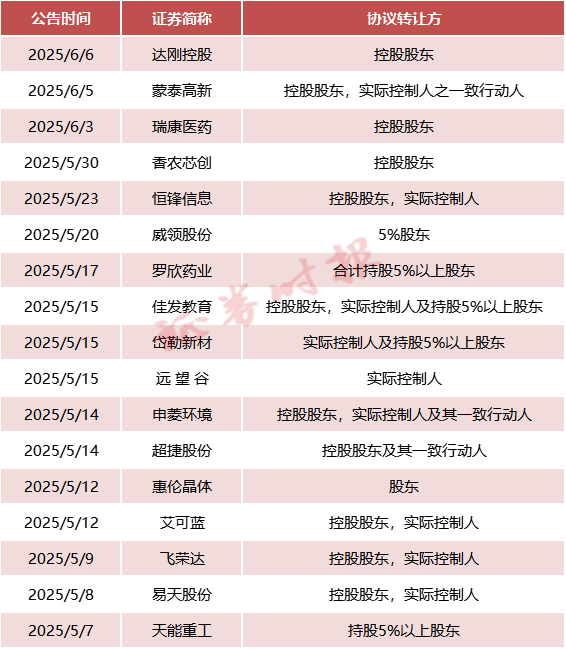
Core Viewpoint - The number of terminated share transfer agreements in the A-share market has significantly increased since the implementation of new reduction regulations in May 2024, with 30 companies announcing terminations this year, surpassing the total for 2024 [1][2]. Summary by Relevant Sections Termination of Agreements - As of June 6, 2025, 30 listed companies have announced the termination of share transfer agreements, with 17 of these occurring since May 2025, indicating a notable rise in such cases [1][2][3]. - The majority of these agreements were signed after the new reduction regulations were enacted, with many originating in the fourth quarter of the previous year [3]. Factors Influencing Termination - The increase in terminated agreements may be attributed to stricter regulatory scrutiny following the new reduction rules, particularly concerning actual controllers and major shareholders [4][5]. - Market volatility since September 24, 2024, has led to significant fluctuations in stock prices, which can result in disagreements over transfer prices between parties [4]. - Financial constraints faced by buyers, especially smaller private equity funds, can hinder the execution of agreements, leading to terminations [4]. Regulatory Challenges - The lack of transparency regarding the financial status and funding sources of buyers complicates the regulatory review process for share transfers [6]. - Issues such as private agreements and cross-regional regulatory inefficiencies further complicate the oversight of these transactions [6]. Recommendations for Improvement - Experts suggest enhancing the transparency of private equity funds by requiring disclosure of ultimate beneficiaries and implementing ongoing monitoring of agreements post-transfer [7]. - Strengthening penalties for violations of reduction restrictions could deter non-compliance and improve market integrity [7]. Market Implications - The recent increase in terminated agreements may help standardize market practices, reducing insider trading and conflicts of interest, thereby enhancing long-term investment value [8]. - However, this trend could also lead to fluctuations in stock prices as market expectations regarding share transfers shift [8].

2025年夏季行业比较投资展望:PB-ROE双低反转策略
Shenwan Hongyuan Securities· 2025-06-09 12:47
Investment Rating - The report suggests a focus on industries with low PB-ROE ratios, particularly financials, computing, defense, pharmaceuticals, and electrical equipment, indicating a potential for undervalued reversals [4][5]. Core Insights - Since April 2025, global trade tariff conflicts have led to significant volatility in capital markets, with markets in Japan, Germany, and the US rising by 5-10% compared to pre-tariff levels, while Chinese asset prices have slightly declined [3][4]. - The report emphasizes the importance of performance benchmarks for public funds, highlighting that financials, dividends, and computing are major underweight sectors [3][4]. - The report identifies a calendar effect where certain sectors like electronics and military are expected to yield higher absolute returns in June and July [3][4]. Summary by Sections Industry Rotation Review and Outlook - Consumer, pharmaceutical, banking, and dividend assets have shown superior performance [12]. Fund Analysis - New regulations for public funds stress the significance of performance benchmarks, with financials, dividends, and computing being the main underweight sectors [3][4]. Market Trading Characteristics - Assets that have seen declines for four consecutive years, such as pharmaceuticals and certain consumer goods, are beginning to stabilize, while real estate and liquor sectors have yet to show improvement [3][4]. Economic Conditions, Valuation, and Capital Chips - The current PB-ROE framework favors industries poised for undervalued reversals, including financials, computing, defense, pharmaceuticals, and electrical equipment [4][5]. Industry Policies - The report discusses ongoing policies aimed at stabilizing capital markets, boosting consumption, and addressing internal competition, with a focus on new productivity [4][5]. 2025 Industry Allocation - The report provides a detailed allocation table for the second half of 2025, indicating sectors with potential for absolute returns [12].

FICC日报:海外宏观环境改善,股指反弹-20250530
Hua Tai Qi Huo· 2025-05-30 05:13
Report Industry Investment Rating - Not provided in the content Core View - The adjustment expectation of the US tariff policy boosts market sentiment and drives the synchronous rebound of domestic and overseas stock indices. Although the US economic growth rate in Q1 is higher than the initial value, the overall situation is still in a contraction state, limiting the rebound of US stocks. The overseas macro - environment shows marginal improvement, and capital sentiment is repaired. However, there is still great uncertainty in the potential policy direction of the Trump administration. It is recommended to maintain an interval operation strategy in the short term [3] Summary by Directory 1. Market Analysis - **Domestic Situation**: The Ministry of Commerce responded to the new trends in China - US economic and trade consultations. Since the Geneva economic and trade talks, both sides have maintained communication at multiple levels. China has repeatedly negotiated with the US regarding its abuse of export control measures in the semiconductor field. China will closely monitor the EU's subsequent actions on the anti - dumping investigation against Chinese tire products and safeguard the legitimate rights and interests of Chinese enterprises [1] - **Overseas Situation**: The US Q1 GDP revised value shrank by 0.2% annually, slightly higher than the initial value of 0.3%. Consumption expenditure growth slowed down significantly, reaching the weakest growth in nearly two years. Corporate profits plunged 2.9%, the largest decline since 2020. The core PCE was slightly adjusted down to 3.4% [1] 2. Stock Index Rebound - **Spot Market**: A - share indices opened higher and closed higher. The Shanghai Composite Index rose 0.7% to 3363.45 points, and the ChiNext Index rose 1.37%. Most sector indices increased, with the computer, pharmaceutical, electronics, and national defense and military industries leading the gains. Only the beauty care, banking, food and beverage, and petroleum and petrochemical industries declined. The trading volume of the Shanghai and Shenzhen stock markets reached 1.2 trillion yuan. In overseas markets, the US Federal Appellate Court suspended a ruling blocking Trump's global tariff collection, and is considering whether to extend the suspension period. The US three major stock indices all rose slightly, with the Nasdaq rising 0.39% to 19175.87 points [2] - **Futures Market**: The basis of stock index futures rebounded, especially for IC and IM. The trading volume and open interest of stock index futures increased simultaneously [2] 3. Strategy - The adjustment expectation of the US tariff policy boosts market sentiment, driving the synchronous rebound of domestic and overseas stock indices. Although the US economic growth rate in Q1 is higher than the initial value, the overall contraction limits the rebound of US stocks. With marginal improvement in the overseas macro - environment and repaired capital sentiment, considering the uncertainty of the Trump administration's policy, it is recommended to maintain an interval operation strategy in the short term [3] 4. Macro - economic Charts - Include charts showing the relationship between the US dollar index and A - share trends, US Treasury yields and A - share trends, RMB exchange rate and A - share trends, and US Treasury yields and A - share style trends [6][7][9] 5. Spot Market Tracking Charts - **Stock Index Performance**: On May 29, 2025, the Shanghai Composite Index rose 0.70% to 3363.45, the Shenzhen Component Index rose 1.24% to 10127.20, the ChiNext Index rose 1.37% to 2012.55, the CSI 300 Index rose 0.59% to 3858.70, the SSE 50 Index fell 0.08% to 2690.89, the CSI 500 Index rose 1.47% to 5719.91, and the CSI 1000 Index rose 1.76% to 6089.58 [12] - Also include charts of the trading volume of the Shanghai and Shenzhen stock markets and margin trading balance [13] 6. Stock Index Futures Tracking Charts - **Trading Volume and Open Interest**: The trading volume and open interest of IF, IH, IC, and IM all increased. For example, the trading volume of IF increased by 36676 to 102154, and the open interest increased by 15516 to 247352 [14][15] - **Basis**: The basis of stock index futures rebounded. For instance, the basis of the current - month IF contract increased by 5.34 to - 25.90 [32] - **Inter - period Spread**: There are data on inter - period spreads such as the spread between the next - month and current - month contracts, the next - season and current - month contracts, etc., with corresponding changes in values [39][40][44]
A股市场大势研判:沪指走出三连阳
Dongguan Securities· 2025-05-21 23:31
Market Performance - The Shanghai Composite Index closed at 3387.57, with a slight increase of 0.21% or 7.10 points [2] - The Shenzhen Component Index rose by 0.44%, closing at 10294.22, gaining 45.05 points [2] - The CSI 300 Index increased by 0.47%, closing at 3916.38, with a gain of 18.21 points [2] - The ChiNext Index saw a rise of 0.83%, closing at 2065.39, up by 16.93 points [2] - The STAR 50 Index decreased by 0.22%, closing at 995.49, down by 2.19 points [2] - The Beijing Stock Exchange 50 Index increased by 0.39%, closing at 1479.81, gaining 5.82 points [2] Sector Performance - The top-performing sectors included coal (2.55%), non-ferrous metals (2.05%), and electric power equipment (1.11%) [3] - The bottom-performing sectors included beauty care (-1.09%), electronics (-0.93%), and media (-0.87%) [3] - Concept sectors that performed well included graphite electrodes (2.57%), recombinant proteins (2.52%), and gold concepts (2.06%) [3] - Underperforming concept sectors included PEEK materials (-1.79%), camping economy (-1.56%), and WiFi 6 (-1.55%) [3] Market Outlook - The report indicates that the A-share market shows strong resilience and strategic determination, with the potential for further upward movement despite significant selling pressure above [5] - The report suggests a focus on sectors such as finance, public utilities, retail, food and beverage, non-ferrous metals, and TMT for investment opportunities [5] - The completion of the China-ASEAN Free Trade Area 3.0 negotiations is expected to enhance regional economic integration and supply chain connectivity [4]
资金透视:资金共识仍待凝聚
HTSC· 2025-05-20 03:19
Core Insights - The market consensus remains fragmented despite the easing of US-China tariffs, with various funds showing interest in different sectors such as dividends, themes, large-cap growth, and export chains [1][2] - Active foreign capital has seen a net outflow, while passive foreign capital continues to flow into the A-share market, indicating a structural divergence in foreign investment [3][56] - Industrial capital is providing support to the A-share market, with significant increases in share buybacks compared to the previous year [4][65] Group 1: Fund Allocation and Market Dynamics - Retail investors have shown a preference for defensive dividend stocks, with net inflows into banking and transportation sectors, while experiencing outflows from electronics and machinery [2][11] - Financing funds are focusing on industries with improving fundamentals and thematic catalysts, such as defense and military [2][19] - Private equity funds are concentrating their research on large-cap growth sectors like pharmaceuticals and electronics [2][50] Group 2: Foreign Investment Trends - In the recent period, foreign capital saw a net inflow of 21.8 billion yuan, with active foreign capital experiencing a net outflow of 7.2 billion yuan, while passive foreign capital recorded a net inflow of 29 billion yuan [3][56] - Regional and global allocation-type foreign funds have increased their positions in A-shares, with Asian allocation funds reaching 89% of their levels since 2020 [3][56] Group 3: Industrial Capital and Market Support - The A-share market has faced four consecutive weeks of net outflows from ETFs, totaling 263 billion yuan, with significant support from industrial capital through share buybacks [4][41] - The average weekly buyback amount in 2025 has risen to 68 billion yuan, compared to 43 billion yuan in 2024, indicating a strong trend in corporate buybacks [4][71] Group 4: Fundraising and Market Activity - The number of new equity funds launched has decreased, with only 48 billion yuan in new equity fund shares issued last week, reflecting a decline in fundraising activity [32][33] - The net reduction of significant shareholders in the secondary market amounted to 43 billion yuan, with a weekly unlock market value of 306 billion yuan [65][74]