有色

Search documents
创业板指震荡调整 全市场超3200股飘绿
Mei Ri Shang Bao· 2026-02-11 22:19
Market Overview - The Shanghai Composite Index experienced a slight increase of 0.09%, closing at 4131.98 points, while the Shenzhen Component Index fell by 0.35% and the ChiNext Index dropped by 1.08% [1] - A total trading volume of approximately 2 trillion yuan was recorded, a decrease of over 120 billion yuan compared to the previous day [1] - Over 3200 stocks in the A-share market closed in the red, with sectors like short drama games and film stocks facing significant declines [1] Glass Fiber Industry - The glass fiber manufacturing sector saw a remarkable surge, with nearly all stocks hitting the daily limit up [2] - Major companies like International Composites and Changhai Co. experienced significant price increases, with International Composites reaching a 20% limit up shortly after market open [2] - Recent price hikes in electronic cloth by leading companies indicate a tightening supply, driven by increased demand from AI chip production [2][3] - The expected net profits for International Composites and Honghe Technology in 2025 are projected to be between 260 million to 350 million yuan and 193 million to 226 million yuan, respectively, reflecting a rise in glass fiber product prices [3] Nonferrous Metals and Steel - The nonferrous metals sector, particularly tungsten stocks, showed strong performance, with companies like Zhongtung High-tech and Xianglu Tungsten hitting the daily limit up [4] - Tungsten prices have seen significant increases, with black tungsten concentrate prices rising by 48.9% since the beginning of the year [4] - The steel sector also performed well, with companies like Baodi Mining and Dazhong Mining showing notable gains [5] - The National Market Supervision Administration is focusing on optimizing traditional industries, which may positively impact the steel and nonferrous metals sectors [5] Media Sector - The media sector, particularly film stocks, experienced a downturn, with companies like Huanxi Media and Huace Film falling over 10% [6] - Huanxi Media issued a risk warning regarding its stock price, which had surged over 100% in the previous 10 trading days, indicating potential market overheating [6] - The company has invested in several films for the upcoming Spring Festival, but the market performance remains uncertain due to low investment ratios and the nascent stage of its AI short drama business [6]


资源行情接棒 资金借道ETF参与热门板块
Zhong Guo Zheng Quan Bao· 2026-02-11 20:57
Group 1 - The resource sector has strengthened again, with multiple rare metal-themed ETFs rising over 3%, and mining, non-ferrous, gold, rare earth, and chemical ETFs generally increasing over 2% [1] - After significant gains, the film, media, and online consumption ETFs experienced a collective pullback, with the film ETF (159855) dropping nearly 6% [1] - AI application-related sectors saw a surge, with over 1.3 billion yuan net inflow into ETFs tracking the film and media indices on February 10 [1] Group 2 - Huatai Fund suggests gradually shifting focus to post-holiday market trends, emphasizing three main lines: AI hardware driven by overseas influences, high-end manufacturing in new energy and innovative pharmaceuticals, and domestic price increase chains in chemicals, building materials, and steel [2] - Fuguo Fund recommends focusing on sectors with high elasticity and growth potential, such as electronics, computers, and communications, which are sensitive to liquidity improvements and rising risk appetite [2]
中国银河证券杨超:2026年A股行情将围绕两大主线展开
Zhong Guo Zheng Quan Bao· 2026-02-11 20:23
Group 1 - The A-share market is currently experiencing a clear risk-averse sentiment and structural differentiation, with funds favoring high-dividend, low-valuation, and defensive consumption sectors, while technology and cyclical sectors continue to adjust [1][2] - The market is showing significant structural differentiation, with defensive sectors acting as a "safe haven" for funds, leading to a notable decline in trading activity and a shift of capital from high-valuation technology and cyclical sectors to more stable assets [1][2] - The upcoming Chinese New Year is expected to influence market behavior, with historical trends indicating a preference for high-dividend and defensive sectors before the holiday, while post-holiday, the market may favor small-cap and growth styles [2][3] Group 2 - The current industry structure is transitioning from a traditional factor-driven growth model to a new productivity development model centered on technological innovation [2] - Investors are weighing the strategies of "holding stocks during the holiday" versus "holding cash for safety," with the former focusing on potential policy catalysts and liquidity, while the latter aims to avoid short-term volatility [3] - Post-holiday, the market is expected to shift focus back to growth sectors with industry catalysts and earnings certainty, driven by policy catalysts in February and earnings disclosures in March [3][4] Group 3 - Earnings forecasts indicate a shift in the logic of A-share market growth for 2026, with profitability expected to take precedence over valuation, highlighting structural opportunities in technology manufacturing and cyclical industries benefiting from price increases [4] - Two main investment themes are suggested: one focusing on the improvement of supply-demand dynamics and industry profitability, and the other on new productivity areas such as semiconductors, artificial intelligence, and renewable energy [4] - The overall market tone for 2026 is expected to remain bullish, with a focus on technological innovation and profitability recovery, supported by domestic consumption and overseas expansion as auxiliary themes [4]

资金借道ETF参与热门板块
Zhong Guo Zheng Quan Bao· 2026-02-11 20:23
● 本报记者 王鹤静 2月11日,资源板块再度走强,多只稀有金属主题ETF涨超3%,矿业、有色、黄金股、稀土、化工等主 题ETF普遍涨超2%。 影视、传媒、线上消费等主题ETF历经大涨后,2月11日迎来集体回调,前一日涨停的影视ETF (159855)下跌近6%。 此前,AI应用相关板块大涨。2月10日,跟踪中证影视指数的ETF净流入超13亿元,跟踪中证传媒指数 的ETF也净流入超6亿元。此外,旅游ETF(159766)已连续17个交易日维持资金净流入态势,基金份 额一路增长,目前已突破110亿份,规模突破94亿元。 宽基ETF在近期轮动行情下遭遇资金流出。2月10日,沪深300、中证A500主题ETF均净流出20亿元以 上,中证500、科创50主题ETF净流出均超10亿元。 临近春节假期,汇添富基金表示,随着宏观数据陆续披露、产业催化密集落地,叠加假期后风险偏好回 升、增量资金入场的日历效应,市场环境有望转向积极,持股过节具备较高胜率与赔率。 汇添富基金建议,可逐步转向布局节后行情,重点关注三条主线:一是受海外映射带动的AI硬件(北 美算力链、半导体产业链);二是高端制造中的新能源(电池储能、电网、光伏)与 ...
多家公募机构看好持股过节
Zheng Quan Ri Bao· 2026-02-11 16:17
Group 1 - The core viewpoint of the article emphasizes the debate among investors regarding whether to hold stocks or cash during the upcoming Spring Festival, with many public fund institutions advocating for holding stocks based on historical data and current macroeconomic conditions [1][2]. - Historical data from FuGuo Fund indicates that the A-share market tends to perform weakly before the Spring Festival but shows significant strength afterward, with average returns of -2.20% in the second week before the festival and 2.03%, 0.86%, and 0.83% in the first, second, and third weeks after the festival, respectively [1]. - Public fund managers suggest that the current macro environment supports holding stocks, citing improved liquidity conditions and a stable external environment as key reasons [2]. Group 2 - Fund managers recommend focusing on two main investment directions: technology and domestic demand value, with specific sectors such as food, retail, tourism, and resources being highlighted for their potential benefits from the Spring Festival consumption [3]. - The expectation of a "red envelope market" post-festival is noted, with anticipated strong consumption data and increased market activity due to concentrated capital inflow and positive policy expectations [3]. - Investment strategies should be tailored to individual risk preferences, with higher-risk investors encouraged to maintain higher positions, while lower-risk investors may consider reducing exposure to mitigate potential volatility during the holiday period [3].
PPI上行验证,继续重视涨价链
Ge Long Hui· 2026-02-11 14:09
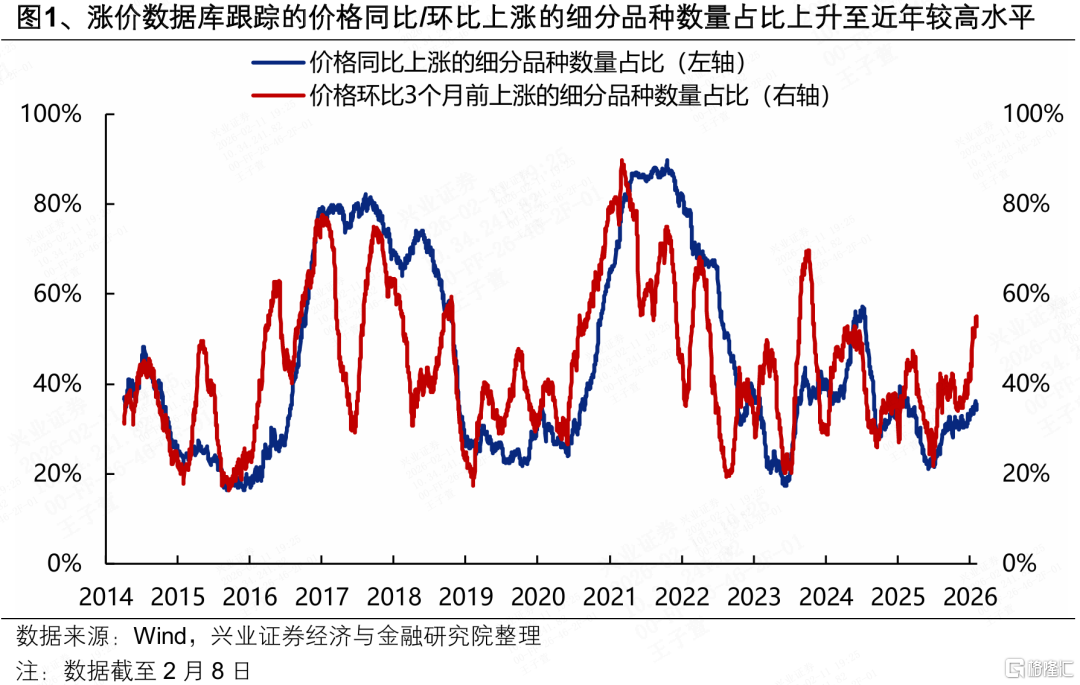
Core Viewpoint - The recovery of prices is identified as the most critical logic supporting corporate profit improvement in 2026, which may also influence market styles [1]. Price Trends and Data Analysis - The first inflation data of the year validates the momentum of price improvement, with the Producer Price Index (PPI) reaching a year-on-year high not seen since August 2024 and a month-on-month high since October 2023 [1]. - The proportion of price-increasing subcategories in the comprehensive price database has risen to a relatively high level, indicating a strong correlation with the month-on-month PPI trends [1]. - Recent price increases are characterized by a broader range and richer clues, driven by international commodity price transmission, favorable policies, and trends in the technology industry [4]. Sector-Specific Insights - The sectors with significant month-on-month PPI increases in January include non-ferrous metals, non-metallic mineral products (such as building materials), black metals, technology manufacturing, chemical fibers, and agricultural processing [4]. - The price increases in these sectors correspond with the high-frequency tracked price subcategories, indicating a robust link between input inflation and domestic price recovery [4]. Price Increase Clues - The proportion of subcategories with price increases over the past three months is at its second-highest level since 2016, only surpassed by the supply-side reform period in 2017 and the significant inflation period in 2021 [4]. - A detailed table shows various subcategories with significant price increases in January, such as oxygen pressure (62.5%), lithium concentrate (52.3%), and DRAM index (35.7%), indicating strong upward price trends across multiple sectors [6][7]. Future Outlook - The post-holiday period is seen as a critical window for validating price increases, with expectations for further price clues to emerge as the spring construction season begins and policies are implemented after the March meetings [9]. - Historical data suggests that the first quarter is typically a key period for PPI acceleration during inflation cycles, indicating a potential for sustained price increases [9]. Sector Performance Expectations - The relative performance of sectors such as TMT (Technology, Media, and Telecommunications), advanced manufacturing, and resource & infrastructure chains is expected to be strong post-Spring Festival, with higher win rates anticipated [10]. - A statistical analysis shows that industries with a positive correlation to PPI include chemicals, steel, building materials, transportation, petrochemicals, non-ferrous metals, and coal, among others [14].

春节持股VS持币抉择:近十年节后首日6涨4跌,机构建议持股过节
Di Yi Cai Jing· 2026-02-11 12:02
Core Viewpoint - The strategy of "holding light positions during the holiday" is considered a prudent and historically reasonable approach in the current A-share market context, balancing the risks of market fluctuations before the holiday and the opportunities for participation in the post-holiday spring rally [1][8]. Market Performance Analysis - Over the past decade, the A-share market has shown mixed performance on the first trading day after the Spring Festival, with the Shanghai Composite Index rising 6 times and falling 4 times [2][3]. - The Shanghai Composite Index experienced a 2.89% increase from February 3 to February 11, while the Shenzhen Component Index rose by 2.43% during the same period [2]. - The A-share market is currently in a state of consolidation, with the four major indices showing varied performance on February 11, 2023 [2]. Historical Data Insights - Historical data indicates that the average increase for the Wind All A index in the 10 trading days following the Spring Festival is 3.3%, while the average decline in the 10 trading days before is -1.3% [4]. - The TMT sector has shown a high success rate in the post-holiday period, with a 100% success rate in the first 10 trading days after the Spring Festival [4][9]. Fund Flow and Market Sentiment - Historical trends suggest that market activity tends to contract before the holiday due to uncertainties and cash withdrawal demands, while funds typically flow back into the market post-holiday, indicating a recovery in risk appetite [5]. - Analysts suggest that the current market conditions, including government policies focusing on domestic demand and the potential for improved economic outlook, support a "hold positions" strategy during the holiday [6]. Sector Recommendations - Analysts recommend focusing on sectors that are expected to benefit from policy shifts and economic recovery, such as materials, financials, and technology, particularly in light of the upcoming political and economic events [8]. - The strategy includes maintaining positions in cyclical industries and sectors with improving profitability, such as non-ferrous metals, basic chemicals, and construction materials [8].
历史的“春节后”
Guotou Securities· 2026-02-11 10:42
Group 1 - The report highlights a high probability of style switching in A-shares around the Spring Festival, with a historical tendency for value and large-cap stocks to dominate before the festival, while growth and small-cap stocks tend to perform better afterward [1][8][23] - From 2010 to 2025, there were only two years (2020 and 2022) without a clear switch between growth and value styles, indicating a strong historical pattern of style rotation [8][18] - The report identifies that in 62.5% of the years analyzed, there was a significant switch from large-cap to small-cap stocks after the Spring Festival, suggesting a high likelihood of this trend continuing [1][8] Group 2 - Historical analysis shows that the sectors leading in performance before the Spring Festival often do not repeat their success in the following month, indicating a high probability of sector rotation [2][8] - The report notes that in years where value stocks led after the Spring Festival (2011, 2016, 2021), there were common factors such as liquidity tightening or unexpected risk events that suppressed growth stocks [2][23] - The macro environment in 2015 and 2019, characterized by ample liquidity and weak fundamentals, is compared to the upcoming 2026 Spring Festival, suggesting potential for similar market dynamics [2][3] Group 3 - The report assesses that the current market style is shifting towards value before the 2026 Spring Festival, with technology and growth stocks receding [3][4] - It suggests that if the value style continues post-festival, it will be driven by expectations of domestic economic recovery and policy support, although there are concerns regarding inflation metrics [3][4] - The analysis indicates that the performance of small-cap stocks is expected to rebound significantly after the Spring Festival, driven by liquidity recovery and risk appetite [18][19]
收评:创业板指跌超1%,传媒板块下挫,有色、石油等板块拉升
Sou Hu Cai Jing· 2026-02-11 07:35
Market Overview - The Shanghai Composite Index experienced a slight increase of 0.09%, closing at 4131.98 points, while the Shenzhen Component Index fell by 0.35% and the ChiNext Index dropped by 1.08% [1] - The total trading volume across the Shanghai, Shenzhen, and North markets reached approximately 2 trillion yuan [1] Sector Performance - The media sector saw a significant decline, while tourism, catering, insurance, retail, and semiconductor sectors also faced downward pressure [1] - Conversely, sectors such as non-ferrous metals, chemical fiber, oil, coal, steel, and chemicals showed upward movement, with the fiberglass concept experiencing a surge and lithium, rare earth, and gold concepts being active [1] Market Sentiment and Predictions - Dongguan Securities indicated that with the upcoming long holiday, market fluctuations are expected to stabilize, leading to a general trend of consolidation [1] - The market may have completed a phase of capital digestion, and regulatory bodies are emphasizing the maintenance of stability before the holiday [1] - There is an optimistic outlook for the market in the medium to long term, supported by expected consumer boosts during the Spring Festival and a generally warm policy environment [1] Investment Recommendations - Investors are advised to remain rational, avoiding impulsive trading behaviors, and to focus on long-term strategies while managing their positions carefully [1] - Emphasis should be placed on high-quality assets with stable fundamentals and high profit certainty, particularly in sectors related to consumer recovery, technological self-sufficiency, and high-end manufacturing [1] - Attention should also be given to the potential risks of overheating in specific themes that could lead to adjustments [1]
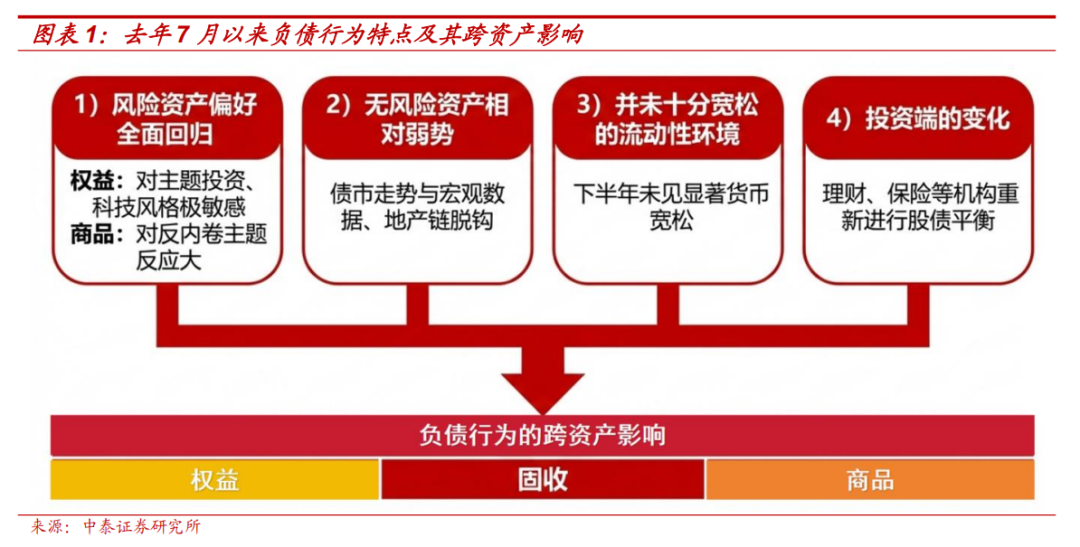
发明“负债行为框架”
Xin Lang Cai Jing· 2026-02-11 07:01
(来源:品债论市) 我们从去年7月以来,一直强调负债行为对当下权益、固收类乃至于商品的跨资产影响,当时是看到了几点趋势: 在2025年8月24日《如何做专业的"负债端"研究——A 股为什么会涨?》中提出:要重视负债行为的研究,负债端驱动资金趋势性重返A股市场,形成了 比资产端更强的上行力量。 元旦以来,我们明显能看到,A股正在经历这三个因子的叠加共振: 1)负债行为进一步变化:分红险热卖、理财产品结构趋向含权理财,引起各类资管机构投资行为的变化,而在负债流入相对后置的机构,能明显感到"恐 高"; 2)资产端催化的科技三大方向共振:从11月蓄力的商业航天,12月底以来海外内存涨价带动的存储、算力链,1月份以来的AI应用等,与商品共振上行 的有色。这些板块的上涨,不能单纯地从业绩、市场空间的资产定价方式出发,而简单的归结于"情绪",描述颗粒度又过于粗糙; 我们在2025年7月10日的中期策略报告《资金驱动,科技进攻》中旗帜鲜明指出负债端驱动保险增配权益,机构的增量资金驱动市场上涨,科技是最确定 的弹性方向。 3)本应该属于债券的"开门红"季节性行情,很大程度上"转移"给了权益,延续了2024年3月份后债券季节性全 ...