
家用电器

Search documents
同比增长5.2%!肇庆交出2025年上半年经济“成绩单”
Nan Fang Du Shi Bao· 2025-07-21 14:50
Economic Overview - The GDP of Zhaoqing City reached 135.8 billion yuan in the first half of 2025, with a year-on-year growth of 5.2% at constant prices [2] - The primary industry added value was 17.5 billion yuan, growing by 4.8%; the secondary industry added value was 53.6 billion yuan, growing by 4.9%; and the tertiary industry added value was 64.6 billion yuan, growing by 5.6% [2] Agricultural Performance - The agricultural, forestry, animal husbandry, and fishery sectors achieved a total output value of 30.9 billion yuan, with a year-on-year increase of 5.5% [2] - Specific growth rates included planting (4.2%), forestry (6.5%), animal husbandry (4.8%), fishery (6.4%), and auxiliary activities (10.9%) [2] - Vegetable production reached 1.446 million tons, increasing by 3.1%; live pig output was 1.746 million heads, up by 7.1%; and total aquatic products amounted to 270,400 tons, growing by 4.4% [2] Industrial Growth - The industrial added value above designated size grew by 4.5% year-on-year [3] - Manufacturing and electricity, heat, gas, and water production and supply industries both grew by 4.6%, while mining decreased by 19.0% [3] - Notable growth in specific manufacturing sectors included electrical machinery (21.8%), automotive (20.2%), and computer and electronic equipment (15.6%) [3] - Newly established industrial enterprises showed remarkable performance with a 116.9% increase in added value, contributing 2.0 percentage points to overall industrial growth [3] - Advanced manufacturing increased by 17.6%, accounting for 39.0% of the industrial added value [3] Consumer Market - The total retail sales of consumer goods reached 60.9 billion yuan, with a year-on-year growth of 2.8% [4] - Retail sales of goods were 57.3 billion yuan, growing by 2.8%, while catering revenue was 3.52 billion yuan, increasing by 2.0% [4] - Urban retail sales were 48.0 billion yuan, up by 2.8%, and rural retail sales were 12.8 billion yuan, also growing by 2.8% [4] - The "old-for-new" policy significantly boosted sales in home appliances and cultural office supplies, with increases of 152.6% and 77.3% respectively [4] - Online retail sales through public networks reached 12.3 billion yuan, growing by 10.9% [4] Investment Trends - Fixed asset investment decreased by 8.8% year-on-year [4] - Infrastructure investment, however, grew by 10.0%, while construction and industrial investments fell by 1.2% and 11.8% respectively [4] - Real estate development investment saw a significant decline of 39.2%, with commercial housing sales area dropping by 37.9% [5] Financial Sector - By the end of June, the total balance of deposits was 411.4 billion yuan, increasing by 8.3% year-on-year, while the total balance of loans was 361.6 billion yuan, growing by 7.6% [5] - The Consumer Price Index (CPI) showed a slight decrease of 0.3% year-on-year, with food prices down by 0.5% and non-food prices down by 0.8% [5]


大消费行业周报(7月第3周):“谷子经济”赛道延续高景气度-20250721
Century Securities· 2025-07-21 00:41
Investment Rating - The report indicates a positive outlook for the "Guzi Economy" sector, suggesting it will maintain high prosperity [3][5]. Core Insights - The "Guzi Economy" is expected to continue its high growth trajectory, with a projected market size of 1,689 billion yuan in 2024 and an anticipated increase to 3,089 billion yuan by 2029, reflecting a compound annual growth rate of approximately 13% [5]. - The report highlights that the consumer sector, excluding beauty and personal care, saw an overall increase in stock prices, with notable gains in home appliances, social services, food and beverage, textiles and apparel, and retail [5]. - The report notes a decline in retail sales growth in June, attributed to preemptive consumption ahead of major sales events, indicating a potential impact on future consumer spending [5]. Summary by Sections Market Weekly Review - The consumer sector experienced a rise in stock prices, with home appliances up by 1.86%, social services by 1.05%, and food and beverage by 0.68% [5]. - Key stocks that led the gains included Huangshi Group (+15.53%), Yitian Intelligent (+24.99%), and Lianfa Co. (+29.61%) [5]. Industry News and Key Company Announcements - The report mentions that the "Guzi Economy" is entering a high growth phase, with companies like Pop Mart forecasting a revenue increase of no less than 200% year-on-year for the first half of 2025 [5][17]. - The report also discusses the impact of government policies aimed at boosting consumption and domestic demand, which are expected to support the consumer sector in the second half of the year [5].

转债周度专题:转债新高怎么看?-20250721
Tianfeng Securities· 2025-07-21 00:14
1. Report Industry Investment Rating No information provided in the text. 2. Core Views of the Report - The Convertible Bond Index reached a new high this week, with a cumulative increase of 9.48% since the beginning of the year. The valuation of convertible bonds has entered a high - level range and is shifting from following the underlying stock to an active upward - adjustment phase. It is recommended to focus on convertible bonds with low option valuations and those with elastic advantages in structure, such as those with a par value between 80 - 100 yuan [1][10]. - During the interim report period, attention should be paid to industries with improving performance expectations. It is advisable to focus on convertible bonds of industries with stable demand and high performance certainty, as well as those with performance recovery expectations under the "anti - involution" trend, while avoiding some high - price and high - premium targets that deviate from fundamentals [2][19]. - Considering the impact of refinancing policies, there is certain support on the demand side under the shrinking supply of convertible bonds. With the low long - term yield of pure bonds, the opportunity cost of convertible bonds is relatively low. However, the current overall valuation of convertible bonds is at a relatively high level, so be vigilant against callback risks. In terms of clauses, continue to focus on the game space of downward revisions, beware of forced redemption risks, and appropriately pay attention to short - term game opportunities of near - maturity convertible bonds [23]. 3. Summary According to Relevant Catalogs 3.1. Convertible Bond Weekly Special and Outlook 3.1.1. How to View the New High of Convertible Bonds - As of Friday, the Convertible Bond Index continued to rise, reaching a new high in recent years. The valuation of convertible bonds has entered a high - level range, and the valuation is gradually shifting from following the underlying stock to an active upward - adjustment phase. Analogy to early 2022 suggests a potential overheating risk after the active upward adjustment of convertible bond valuations. It is recommended to focus on individual convertible bonds with relatively low option valuations [1][10]. - In terms of convertible bond elasticity, focus on convertible bonds with elastic advantages in structure, such as those with a par value between 80 - 100 yuan. During the short - term valuation upward period, the elastic asymmetry advantage of convertible bonds is more significant in medium - and low - par value convertible bonds, especially those in the 70 - 100 yuan par value group, which have better offensive - defensive properties [12]. - During the interim report period, 123 convertible bond issuers have disclosed their semi - annual performance forecasts for 2025. Industries such as electronics and non - ferrous metals have relatively more issuers with pre - increased or slightly increased performance. It is recommended to focus on convertible bonds of industries with stable demand and high performance certainty, as well as those with performance recovery expectations under the "anti - involution" trend, and avoid some high - price and high - premium targets that deviate from fundamentals [2][19]. 3.1.2. Weekly Review and Market Outlook - The market showed mixed daily gains and losses this week but rose overall. The A - share market had different trends each day, with changes in trading volume and sector performance. For example, on Monday, the trading volume of the Shanghai, Shenzhen, and Beijing stock markets was 1480.9 billion yuan, a decrease of 255.7 billion yuan from the previous day, and the humanoid robot and reducer concepts led the gains [22]. - It is believed that the current A - shares still present good allocation value. The rebound in export orders has led to a narrow improvement in the PMI in June, and measures such as large - scale equipment updates and consumer goods trade - ins are expected to boost domestic demand. At the convertible bond level, there is support on the demand side under the shrinking supply, but be vigilant against callback risks. In terms of industries, focus on popular themes, domestic demand - oriented sectors, and high - dividend sectors under the Chinese - characteristic valuation system [23]. 3.2. Weekly Tracking of the Convertible Bond Market 3.2.1. The Equity Market Closed Higher - This week, major equity market indices closed higher. The Wind All - A Index rose 1.40%, the Shanghai Composite Index rose 0.69%, the Shenzhen Component Index rose 2.04%, and the ChiNext Index rose 3.17%. The market style was more inclined to small - cap value [27]. - Among the Shenwan industry indices, 19 industries rose and 12 fell. The communication, pharmaceutical biology, and automobile industries led the gains, with increases of 7.56%, 4.00%, and 3.28% respectively, while the media, real estate, and public utilities industries were among the top losers [30]. 3.2.2. The Convertible Bond Market Closed Higher, and the Hundred - Yuan Premium Rate Rose - This week, the convertible bond market closed higher. The CSI Convertible Bond Index rose 0.67%, the Shanghai Convertible Bond Index rose 0.52%, and the Shenzhen Convertible Bond Index rose 0.92%. The average daily trading volume of convertible bonds increased, with an average daily trading volume of 70.669 billion yuan, an increase of 2.554 billion yuan from last week, and a total weekly trading volume of 353.346 billion yuan [3][32]. - At the industry level, 22 convertible bond industries rose and 7 fell. The household appliances, media, and computer industries were the top three gainers, with increases of 3.21%, 2.49%, and 2.20% respectively. At the corresponding underlying stock level, 18 industries rose and 11 fell, with the household appliances, computer, and pharmaceutical biology industries leading the gains [38]. - Most individual convertible bonds rose (341 out of 466). After excluding the closing data of newly - listed convertible bonds this week, the top five weekly gainers were Borui Convertible Bond (pharmaceutical biology, 36.83%), Bohui Convertible Bond (petroleum and petrochemical, 33.80%), Julong Convertible Bond (basic chemicals, 24.43%), Yitian Convertible Bond (household appliances, 24.41%), and Hongfeng Convertible Bond (power equipment, 23.14%). The top five weekly losers were Seli Convertible Bond (pharmaceutical biology, - 9.74%), Guangda Convertible Bond (power equipment, - 8.86%), Huachen Convertible Bond (power equipment, - 8.71%), Punai Convertible Bond (building materials, - 8.32%), and Liande Convertible Bond (electronics, - 7.44%). The top five in terms of weekly trading volume were Seli Convertible Bond (pharmaceutical biology, 22.08 billion yuan), Bohui Convertible Bond (petroleum and petrochemical, 14.263 billion yuan), Outong Convertible Bond (power equipment, 11.195 billion yuan), Borui Convertible Bond (pharmaceutical biology, 11.061 billion yuan), and Huicheng Convertible Bond (environmental protection, 10.133 billion yuan) [40]. - The weighted conversion value of the entire market increased, and the premium rate rose. The weighted average conversion value at the end of this week was 95.31 yuan, an increase of 0.45 yuan from the end of last week. The weighted conversion premium rate of the entire market was 44.37%, an increase of 0.39 percentage points from last week. The hundred - yuan par value premium rate was 23.38%, an increase of 0.80 percentage points from last week. The median implied volatility of the entire market's convertible bonds was 32.71%, an increase of 0.79 percentage points from last week, and the pure - bond premium rate of debt - biased convertible bonds was 8.28%, an increase of 0.21 percentage points from last week [47]. 3.2.3. High - Frequency Tracking of Different Types of Convertible Bonds 3.2.3.1. Classification Valuation Changes - This week, the valuations of convertible bonds with a par value below 80 yuan increased significantly, while those with a par value between 80 - 90 yuan decreased, and the valuations of other par - value convertible bonds increased. The valuations of AAA, AA +, and AA - rated convertible bonds increased, while those of other ratings decreased. The valuation of large - cap convertible bonds increased, while those of other size - segmented convertible bonds decreased [53]. - Since the beginning of 2024, the conversion premium rates of equity - biased and balanced convertible bonds have rebounded from the bottom. As of Friday, the conversion premium rate of equity - biased convertible bonds was around the 35th percentile since 2017, and that of balanced convertible bonds was below the 50th percentile since 2017 [53]. 3.2.3.2. Market Index Performance - This week, AAA - rated convertible bonds fell by 0.06%, while other rated convertible bonds rose. Since 2023, AAA - rated convertible bonds have recorded an 18.83% return, AA + - rated convertible bonds 6.65%, AA - rated convertible bonds 10.00%, AA - - rated convertible bonds 18.17%, A + - rated convertible bonds 20.64%, and A and below - rated convertible bonds 26.82%. Historically, high - rated AAA convertible bonds have shown stable performance, while low - rated convertible bonds have shown weaker downside resistance and greater rebound strength [69][71]. - This week, convertible bonds of all sizes rose. Small - cap convertible bonds rose 2.23%, small - and medium - cap convertible bonds 0.67%, medium - cap convertible bonds 0.74%, and large - cap convertible bonds 0.22%. Since 2023, small - cap convertible bonds have recorded a 21.20% return, small - and medium - cap convertible bonds 18.87%, medium - cap convertible bonds 15.00%, and large - cap convertible bonds 14.77% [71]. 3.3. Convertible Bond Supply and Clause Tracking 3.3.1. This Week's Primary Plan Issuance - Two new convertible bonds were listed this week (Yongxi Convertible Bond and Xizhen Convertible Bond), and three have been issued but not yet listed (Libo Convertible Bond, Bo 25 Convertible Bond, and Guanghe Convertible Bond). There were six primary approvals this week (from July 14 to July 18, 2025). Jindawen (1.801 billion yuan) and Weidao Nano (1.17 billion yuan) were approved by the CSRC [75]. - Since the beginning of 2023 to July 18, 2025, there have been a total of 86 planned convertible bonds, with a total scale of 138.41 billion yuan. Among them, 11 convertible bonds have passed the board of directors' resolution, with a total scale of 15.878 billion yuan; 40 have passed the general meeting of shareholders, with a total scale of 67.022 billion yuan; 29 have been accepted by the exchange, with a total scale of 48.781 billion yuan; 2 have passed the listing committee, with a total scale of 1.45 billion yuan; and 4 have been approved by the CSRC, with a total scale of 5.28 billion yuan [76]. 3.3.2. Downward Revision & Redemption Clauses - This week, 12 convertible bonds announced that they were expected to trigger a downward revision, 4 announced that they would not make a downward revision, 1 proposed a downward revision, and 1 announced the result of a downward revision [79]. - This week, 8 convertible bonds announced that they were expected to trigger redemption, 3 announced that they would not redeem in advance, and 5 announced early redemption [81][82]. - As of the end of this week, there were 5 convertible bonds still in the put - option declaration period and 23 in the company's capital - reduction repayment declaration period. It is recommended to continuously monitor the price changes of convertible bonds and the marginal changes in the company's tendency for downward revisions [84].
机构研究周报:平衡港A配比,适宜适度的股债同多策略
Wind万得· 2025-07-20 22:28
Economic Overview - China's GDP for the first half of 2025 grew by 5.3% year-on-year, with fixed asset investment increasing by 2.8%, while real estate development investment fell by 11.2% [3] - The second quarter's growth was supported by "old-for-new" subsidies and stable export growth, but challenges remain in real estate and consumption, necessitating ongoing policy support [3] Equity Market Insights - CITIC Securities suggests that the current market conditions present an opportunity to increase allocations to Hong Kong stocks, particularly in low-priced manufacturing sectors, as the "anti-involution" narrative continues [5] - Guolian Minsheng notes that the current macro environment differs significantly from 2015, with a lack of substantial stable capital inflow, suggesting a weaker market performance compared to previous years [6] - Galaxy Securities anticipates a preference for large-cap stocks in the second half of 2025, with value stocks gaining favor due to stable returns and support from traditional industries [8] Industry Research - In the humanoid robot sector, Invesco Great Wall Fund highlights a significant breakthrough with a 124 million yuan order, indicating a shift towards large-scale commercialization, with the global market expected to reach $20 billion by 2030 [13] - Tianhong Fund emphasizes the improving fundamentals of the military industry, with a focus on upcoming military parades showcasing new equipment, suggesting a favorable investment environment [14] - Galaxy Fund points to the expansion of AI computing power driving demand in the communications sector, with a positive outlook for related electronic components [15] Macro and Fixed Income - Galaxy Fund indicates that long-term interest rates may have room to decline due to economic pressures, recommending attention to key negotiation points between China and the U.S. [21] - Morgan Fund predicts a volatile downward trend in the bond market for the second half of 2025, advising on optimizing investment portfolios in a low-interest environment [22] - 富国基金 suggests a stable yet changing bond market, with expectations of a prolonged low-interest rate environment impacting future investment strategies [23] Asset Allocation Strategies - E Fund recommends a balanced approach to equity and bond investments, highlighting the importance of flexibility in response to market volatility and strong consensus expectations [25][26]

精准施策扩内需:释放服务消费潜能,扩大服务业有效投资
Zhong Guo Xin Wen Wang· 2025-07-20 03:02
Group 1 - Domestic demand is the main driver of economic growth in the first half of the year, contributing 68.8% to economic growth, with a significant increase to 77% in the second quarter [1][3] - Final consumption expenditure contributed 52% to economic growth, with retail sales of home appliances and cultural office supplies increasing over 25% year-on-year [1][2] - The service consumption growth rate was 4.9% year-on-year, with strong demand in cultural entertainment and tourism sectors [1][3] Group 2 - Capital formation contributed 16.8% to economic growth, with equipment investment increasing by 17.3% and infrastructure investment by 4.6% [2][4] - Investment in high-tech sectors such as aerospace and computer manufacturing grew by 26.3% and 21.5% respectively, indicating a shift towards new economic drivers [2][4] - High-tech service industry investment increased by 8.6%, with information services growing by 37.4% [2][4] Group 3 - The domestic market's size and potential for consumption and investment are highlighted as unique advantages for the economy, with a population of over 1.4 billion and a per capita GDP exceeding $13,000 [3][4] - There is significant potential for growth in service consumption and investment, with a focus on improving income and leisure time for consumers [4][5] - Strategies to enhance service quality and support innovation in consumption scenarios are emphasized to stimulate further growth [4][5]
极端酷暑改变欧洲“空调观念”
Jing Ji Ri Bao· 2025-07-18 22:03
Group 1 - The demand for air conditioning and cooling products in Europe is rising due to extreme heat waves, with temperatures reaching as high as 46 degrees Celsius in southern Spain [1] - Despite the increasing temperatures, the penetration rate of air conditioning in Europe remains low compared to other major economies, with only about 20% of households in Europe having cooling devices, and as low as 3% in Germany [2][3] - The traditional perception of air conditioning as a luxury item is changing, as many households now consider it a necessity due to frequent high temperatures and health concerns [1][3] Group 2 - The high cost of air conditioning units and installation, along with bureaucratic hurdles for renters, poses significant barriers to widespread adoption [2] - The lack of pre-installed air conditioning infrastructure in many older European buildings complicates the situation, as historical preservation laws often restrict the installation of outdoor units [2] - The discussion around "climate equity" is gaining traction, highlighting the disparity between wealthier individuals who can afford cooling solutions and lower-income populations who struggle to cope with heat [3]
【盘中播报】45只A股封板 有色金属行业涨幅最大
Zheng Quan Shi Bao Wang· 2025-07-18 07:06
Core Viewpoint - The A-share market shows a mixed performance with a slight increase in the Shanghai Composite Index, while the non-ferrous metals sector leads the gains among various industries [2] Industry Performance - The non-ferrous metals sector experienced the highest increase of 1.66%, with a transaction volume of 806.93 billion yuan, up by 82.56% from the previous trading day [2] - The steel industry rose by 0.98%, with a transaction volume of 114.66 billion yuan, an increase of 35.33% compared to the last trading day [2] - The coal industry saw a rise of 0.84%, with a transaction volume of 68.80 billion yuan, up by 83.14% from the previous day [2] - Other notable sectors include basic chemicals and defense industry, both increasing by 0.74% [2] Stock Highlights - Leading stocks in the non-ferrous metals sector include Haixing Co., which rose by 10.03% [2] - In the steel sector, Baogang Co. increased by 5.97% [2] - Yunmei Energy in the coal sector saw a rise of 10.05% [2] - Other significant gainers include Fumiao Technology in basic chemicals, which surged by 20.02% [2]
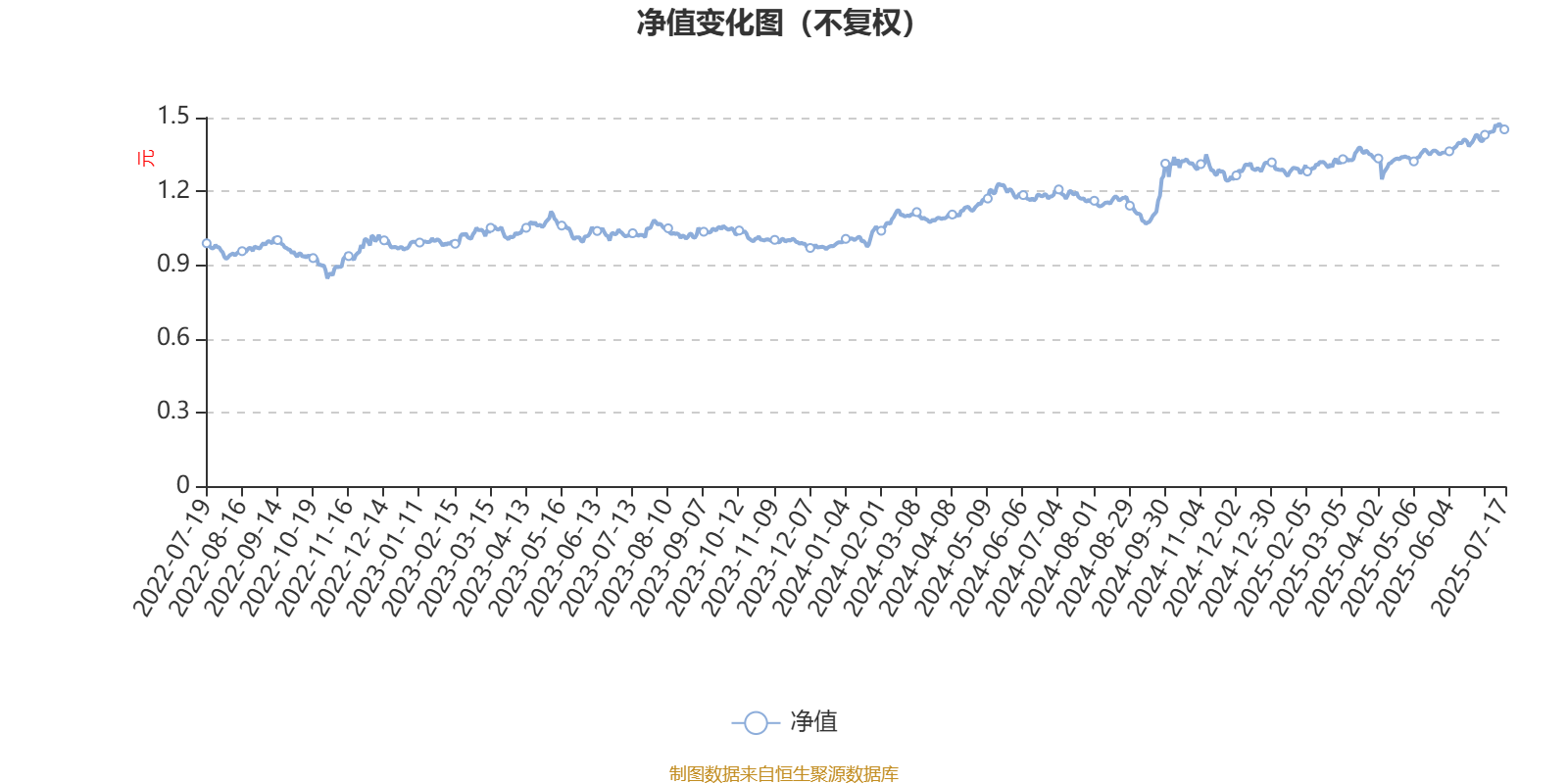
中泰红利价值一年持有混合发起:2025年第二季度利润3878.55万元 净值增长率5.38%
Sou Hu Cai Jing· 2025-07-18 02:46
Core Viewpoint - The AI Fund Zhongtai Hongli Value One-Year Holding Mixed Fund (014772) reported a profit of 38.7855 million yuan for Q2 2025, with a net asset value growth rate of 5.38% during the period [3][16]. Fund Performance - As of July 17, the fund's unit net value was 1.452 yuan, with a one-year cumulative net value growth rate of 22.12%, ranking 103 out of 256 comparable funds [3][4]. - The fund's three-month net value growth rate was 8.88%, and the six-month rate was 12.09%, ranking 152 out of 256 and 88 out of 256 respectively [4]. - Over the past three years, the fund achieved a net value growth rate of 49.39%, ranking 4 out of 239 comparable funds [4]. Risk and Return Metrics - The fund's Sharpe ratio over the past three years was 0.9271, placing it 5 out of 240 in its category [9]. - The maximum drawdown over the past three years was 16.43%, with the largest single-quarter drawdown occurring in Q3 2024 at 11.63% [12]. Investment Strategy - The fund maintained a high average stock position of 92.86% over the past three years, compared to a category average of 85.64% [15]. - The fund's top ten holdings have consistently accounted for over 60% of its portfolio for nearly two years, with major holdings including China State Construction, China Merchants Bank, and Gree Electric Appliances [19]. Fund Management - The fund is managed by Jiang Cheng and Wang Tao, who have both achieved positive returns across the two funds they manage over the past year [3]. - The fund's overall position slightly decreased in Q2 2025 as a result of assessing reinvestment risks and opportunity costs [3].
红利国企ETF(510720)昨日净流入超0.6亿,市场关注低利率下分红稳定性
Sou Hu Cai Jing· 2025-07-17 01:58
Group 1 - The core viewpoint is that in the context of asset scarcity, the value of dividend-paying industries is becoming more prominent, with the banking sector leading in dividend strategies by mid-2025 due to its stable dividend capability and sustainability [1] - Analysts suggest that in a low-interest-rate environment, it is essential to select industries with stable dividends, focusing on sectors with high dividend levels such as oil and petrochemicals, home appliances, and those with strong dividend intentions like banks and transportation [1] - The current market favors stocks that combine defensive attributes with dividend certainty, as evidenced by the strong performance of the banking sector [1] Group 2 - The Hongxin Securities Dividend ETF tracks the Shanghai Dividend Index, which focuses on high-quality companies listed on the Shanghai Stock Exchange with stable dividend records, covering representative enterprises in finance, energy, and consumer sectors [1] - The index aims to provide investors with a benchmark for measuring the performance of high-dividend stocks in the Chinese market by selecting state-owned enterprises with strong continuous dividend capabilities [1] - Investors without stock accounts can consider the Guotai Shanghai State-Owned Enterprise Dividend ETF Initiation Link A (021701) and Link C (021702) [1]
中证全指耐用消费品与服装指数报5909.85点,前十大权重包含九号公司等
Jin Rong Jie· 2025-07-16 08:43
Group 1 - The core index of the Consumer Durables and Apparel sector, represented by the CSI Consumer Durables and Apparel Index, opened at 5909.85 points and has shown a monthly increase of 3.56%, a quarterly increase of 5.62%, and a year-to-date increase of 2.47% [1] - The CSI Consumer Durables and Apparel Index is composed of listed companies that correspond to the durable consumer goods and apparel theme, reflecting the overall performance of these companies. The index was established on December 31, 2004, with a base point of 1000.0 [1] - The top ten weighted companies in the index include Gree Electric Appliances (10.52%), Midea Group (10.01%), Haier Smart Home (8.25%), and others, indicating a concentration in major players within the sector [1] Group 2 - The market composition of the CSI Consumer Durables and Apparel Index shows that the Shenzhen Stock Exchange accounts for 59.35% and the Shanghai Stock Exchange accounts for 40.65% [1] - In terms of industry composition, home appliances represent 66.41%, textiles and apparel 15.20%, home furnishings 8.48%, leisure equipment and supplies 5.21%, and jewelry and luxury goods 4.70% [2] - The index samples are adjusted biannually, with adjustments occurring on the next trading day after the second Friday of June and December each year. Weight factors are generally fixed until the next scheduled adjustment, with special circumstances allowing for temporary adjustments [2]




