
公用事业

Search documents
【10日资金路线图】两市主力资金净流出近930亿元 交通运输等行业实现净流入
证券时报· 2025-10-10 10:53
Market Overview - On October 10, the A-share market experienced an overall decline, with the Shanghai Composite Index closing at 3897.03 points, down 0.94%, the Shenzhen Component Index at 13355.42 points, down 2.7%, and the ChiNext Index at 3113.26 points, down 4.55% [2] - The total trading volume of both markets was 25156.14 billion yuan, a decrease of 1375.83 billion yuan compared to the previous trading day [2] Capital Flow - The net outflow of main funds from the two markets reached nearly 930 billion yuan, with an opening net outflow of 344.05 billion yuan and a closing net outflow of 150.74 billion yuan [3] - The net outflow of main funds from the CSI 300 was approximately 396 billion yuan, while the ChiNext saw a net outflow of 415.71 billion yuan [5] Sector Performance - The sectors with the highest net inflows included Transportation (17.90 billion yuan), Building Materials (13.59 billion yuan), and Oil & Gas (13.29 billion yuan) [7] - The sectors with the largest net outflows were Electronics (-465.95 billion yuan), Computers (-306.10 billion yuan), and Electric Equipment (-234.66 billion yuan) [7] Institutional Activity - The top stocks with institutional net purchases included Shen Technology (34.14 million yuan), Dawi Co. (6.07 million yuan), and Chuling Information (4.24 million yuan) [10] - Conversely, stocks with significant institutional net sales included Guo Xuan High-Tech (-722.41 million yuan), Blue丰 Biochemical (-1429.17 million yuan), and Hainan Huatie (-4225.76 million yuan) [10] Analyst Recommendations - Recent analyst ratings highlighted stocks such as Kaipu Cloud with a target price of 299.52 yuan, representing a potential upside of 33.27% from its latest closing price of 224.75 yuan [12] - Other notable recommendations included Tonglian Precision with a target price of 80.50 yuan, indicating a potential upside of 38.96% from its latest closing price of 57.93 yuan [12]


本周主力资金净流出1457.50亿元,电子净流出规模居首
Zheng Quan Shi Bao Wang· 2025-10-10 09:56
Market Overview - The Shanghai Composite Index increased by 0.37% this week, while the Shenzhen Component Index decreased by 1.26%, and the ChiNext Index fell by 3.86%. The CSI 300 Index declined by 0.51% [1] - Among the tradable A-shares, 2,963 stocks rose, accounting for 54.66%, while 2,379 stocks fell [1] Capital Flow - This week, the total net outflow of main funds was 145.75 billion yuan, with every trading day showing a net outflow. The ChiNext saw a net outflow of 50.69 billion yuan, the Sci-Tech Innovation Board had a net outflow of 22.16 billion yuan, and the CSI 300 components experienced a net outflow of 64.64 billion yuan [2][1] Industry Performance - Out of the 28 primary industries classified by Shenwan, 17 industries saw an increase this week. The top-performing sectors were non-ferrous metals and coal, with increases of 4.44% and 4.41%, respectively. The worst-performing sectors were media and electronics, with declines of 3.82% and 2.63% [2][1] - In terms of capital flow by industry, seven industries experienced net inflows, with the construction and decoration industry leading with a net inflow of 0.98 billion yuan and a rise of 2.84%. The public utilities sector followed with a net inflow of 0.97 billion yuan and a rise of 3.45% [2][3] Individual Stock Performance - A total of 1,962 stocks saw net inflows this week, with 138 stocks having net inflows exceeding 100 million yuan. The stock with the highest net inflow was ZTE Corporation, which rose by 13.94% with a net inflow of 4.05 billion yuan. Other notable stocks included Hikvision and Vision China, with net inflows of 0.965 billion yuan and 0.904 billion yuan, respectively [4][1] - Conversely, 375 stocks experienced net outflows exceeding 100 million yuan, with the largest outflows from SMIC, Sunshine Power, and Oriental Fortune, which saw net outflows of 4.525 billion yuan, 4.468 billion yuan, and 3.679 billion yuan, respectively [4][1]




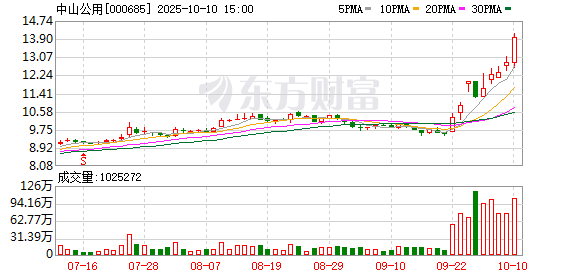
中山公用成交额创2014年12月10日以来新高
Zheng Quan Shi Bao Wang· 2025-10-10 07:20
Core Insights - Zhongshan Public Utility achieved a trading volume of 1.333 billion RMB, marking the highest level since December 10, 2014 [2] - The latest stock price increased by 8.17%, with a turnover rate of 7.86% [2] - The previous trading day recorded a total trading volume of 971 million RMB [2] Company Overview - Zhongshan Public Utility Group Co., Ltd. was established on December 26, 1992, with a registered capital of 1.475 billion RMB [2]

FICC日报:有色板块爆发,沪指站上3900点-20251010
Hua Tai Qi Huo· 2025-10-10 03:48
策略 FICC日报 | 2025-10-10 有色板块爆发,沪指站上3900点 市场分析 对稀土等出口管制。国内方面,我国域外管辖迈出坚实一步。商务部发布公告,宣布对境外相关稀土物项和稀土 相关技术实施出口管制,并将反无人机技术公司等14家外国实体列入不可靠实体清单。商务部还会同海关总署连 发4则公告,宣布对超硬材料、部分稀土设备和原辅料、部分中重稀土、锂电池和人造石墨负极材料等相关物项实 施出口管制。海外方面,哈马斯高级官员、首席谈判代表哈利勒·哈亚发表声明宣布达成停火协议,哈利勒·哈亚表 示,哈马斯已从包括美国在内的调解方那里获得了保证,"加沙战争已经结束"。美国方面,美国共和党提出的结 束美国政府停摆的法案未能在参议院获得足够票数,法案未获通过。 指数走强。现货市场,A股三大指数走强,沪指涨1.32%收于3933.97点,刷新十年高点创业板指涨0.73%。行业方 面,板块指数涨多跌少,有色金属板块爆发,钢铁、煤炭、公用事业行业领涨,传媒、房地产、社会服务、行业 跌幅居前。当日沪深两市成交金额约为2.6万亿元。海外方面,美国三大股指小幅收跌,道指跌0.52%报46358.42点。 期指增仓。期货市场,基差 ...
1009A股日评:上证指数站上3900,黄金与AI叙事持续强化-20251010
Changjiang Securities· 2025-10-10 03:22
Core Insights - The A-share market experienced a strong upward trend, with the Shanghai Composite Index breaking through 3900 points, indicating a recovery in market volume [2][5][13] - Key sectors leading the market include metals and mining (+6.96%), coal (+3.00%), public utilities (+2.65%), and electronics (+2.21%), while sectors such as social services (-1.67%) and media internet (-1.23%) saw declines [2][8][14] - The overall market performance showed the Shanghai Composite Index up by 1.32%, Shenzhen Component Index up by 1.47%, and the ChiNext Index up by 0.73%, with total market turnover around 2.67 trillion yuan [2][8][14] Market Analysis - The market sentiment is strong as it is the first trading day after the National Day holiday, with upstream cyclical sectors like non-ferrous metals, steel, and coal leading the gains [8][14] - The technology sector, including solid-state batteries, humanoid robots, and semiconductors, also showed overall growth, driven by breakthroughs in controllable nuclear fusion technology [8][14] - The report highlights that the market is expected to maintain a "slow bull" trend, supported by ample micro liquidity and the influx of long-term capital [13][14] Sector Performance - The report identifies that the AI and robotics sectors are at a critical commercialization window, while traditional sectors face supply surplus issues, necessitating policy support for recovery [14] - The focus on technology growth includes attention to the "Double Innovation" and Hang Seng Technology Index, as well as sectors like lithium batteries, military industry, and chemicals [14] - Value sectors showing improving conditions include metals, gaming, and Hong Kong internet, with a focus on industries with rising revenue growth and gross margins [14]
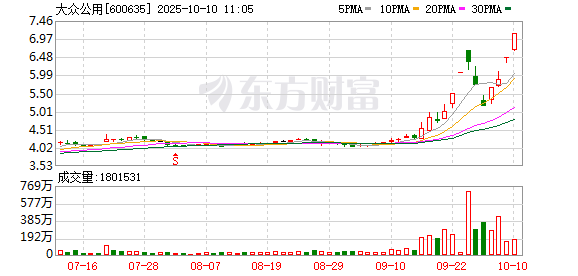
大众公用录得4天3板
Zheng Quan Shi Bao Wang· 2025-10-10 03:04
Core Insights - The stock of Shanghai Dazhong Public Utilities (Group) Co., Ltd. has experienced a significant increase, achieving three limit-up days within four trading days, with a cumulative rise of 38.06% and a turnover rate of 42.48% [2] - As of 9:36 AM, the stock's trading volume reached 151 million shares, with a transaction value of 1.047 billion yuan, resulting in a turnover rate of 6.23% [2] - The latest total market capitalization of the stock in the A-share market is 17.198 billion yuan [2] Trading Data Summary - The latest margin trading balance as of October 9 is 794 million yuan, with a financing balance of 790 million yuan, reflecting an increase of 24.17 million yuan or 3.16% compared to the previous trading day, but a cumulative decrease of 18.89 million yuan or 2.34% over the last four days [2] - The stock has appeared on the Dragon and Tiger list due to a cumulative deviation in the rise of 20% over three consecutive trading days and a daily deviation of 7% [2] - The net buying from the Shanghai Stock Connect reached 53.463 million yuan, while the total net buying from brokerage seats amounted to 47.459 million yuan [2] Recent Stock Performance - The stock's daily performance over the past few days is as follows: - October 9: +10.05% with a turnover rate of 6.59% and a net inflow of 176.53 million yuan [2] - September 30: +3.53% with a turnover rate of 18.14% and a net outflow of 146.82 million yuan [2] - September 29: +10.10% with a turnover rate of 11.52% and a net inflow of 411.03 million yuan [2] - September 26: -9.97% with a turnover rate of 15.05% and a net outflow of 173.84 million yuan [2] - September 25: -9.92% with a turnover rate of 12.19% and a net outflow of 237.08 million yuan [2] - September 24: +4.79% with a turnover rate of 29.54% and a net outflow of 720.48 million yuan [2] - September 23: +9.98% with a turnover rate of 1.57% and a net inflow of 83.50 million yuan [2] - September 22: +9.98% with a turnover rate of 9.82% and a net inflow of 145.98 million yuan [2] - September 19: +5.92% with a turnover rate of 11.87% and a net inflow of 279.46 million yuan [2] - September 18: -2.47% with a turnover rate of 8.16% and a net inflow of 0.76 million yuan [2]

港股异动 | 大众公用(01635)涨超8% 公司指经营活动正常 此前表示参股深创投
Zhi Tong Cai Jing· 2025-10-10 01:55
Core Viewpoint - Dazhong Public Utilities (01635) experienced a significant stock price increase of over 8%, reaching HKD 4.5 with a trading volume of HKD 335 million, following an announcement regarding unusual trading activity [1] Company Summary - Dazhong Public Utilities reported that its stock price had deviated by more than 20% over three consecutive trading days (September 29, September 30, and October 9), indicating abnormal trading fluctuations [1] - The company confirmed that its production and operational activities are normal, and there have been no significant changes in disclosed operational conditions or external environments that could impact stock price fluctuations [1] Investment and Holdings - Dazhong Public Utilities is an investment holding company driven by both public utilities and financial venture capital [1] - The company has a stake in Shenzhen Capital Group, which holds shares in Yushu Technology [1] - Shenzhen Capital Group is also an investor in the well-known GPU company Moore Threads, which has recently passed the listing committee review for its IPO on the Sci-Tech Innovation Board [1]
创业板公司前三季业绩抢先看 11家预增
Zheng Quan Shi Bao Wang· 2025-10-10 01:52
Core Viewpoint - The article highlights that 11 companies listed on the ChiNext board have announced positive earnings forecasts for the first three quarters of the year, indicating a strong performance trend in this segment of the market [1] Group 1: Earnings Forecasts - A total of 11 companies are expected to report increased earnings, with the median expected net profit growth ranging from 2.48% to 168% [1] - The company with the highest expected net profit growth is Jinli (金力), projected at 168% [1] - Other notable companies include Changchuan Technology (长川科技) with a 138.39% increase and Taotao Automotive (涛涛车业) with a 99.10% increase [1] Group 2: Stock Performance - The latest closing prices of these companies vary, with Jinli at 39.49 yuan and Taotao at 211.51 yuan [1] - Year-to-date stock performance shows significant fluctuations, with some companies like Jianda (建发) experiencing a decline of 23% [1] - The electronic sector appears to have multiple companies with strong earnings forecasts, including Changchuan Technology and C Yunhan (C云汉) [1] Group 3: Industry Insights - The companies span various industries, including electronics, automotive, public utilities, and pharmaceuticals, indicating diverse growth opportunities within the ChiNext board [1] - The automotive sector shows promising growth with companies like Taotao and United Power (联合动力) both forecasting substantial profit increases [1] - The electronic industry is particularly highlighted, with several companies such as C Yunhan and Dinglong (鼎龙) showing strong earnings projections [1]





大众公用涨超8% 公司指经营活动正常 此前表示参股深创投
Zhi Tong Cai Jing· 2025-10-10 01:48
Core Viewpoint - Dazhong Public (600635) shares surged over 8%, reaching HKD 4.5 with a trading volume of HKD 335 million, attributed to an announcement regarding unusual stock price fluctuations [1] Group 1: Stock Performance - Dazhong Public's stock price increased by 8.43% as of the report, indicating significant market interest [1] - The stock experienced a cumulative price deviation of over 20% across three consecutive trading days: September 29, September 30, and October 9 [1] Group 2: Company Operations - The company conducted a self-examination and confirmed that its production and operational activities are normal [1] - There have been no significant changes in the disclosed operational conditions or external environment that would impact stock price fluctuations [1] Group 3: Investment and Holdings - Dazhong Public is an investment holding company driven by public utilities and financial venture capital [1] - The company has a stake in Shenzhen Capital Group, which holds shares in Yushu Technology [1] - Shenzhen Capital Group is also an investor in the well-known GPU company Moore Threads, which has recently passed the listing committee review for its IPO on the Sci-Tech Innovation Board [1]
A股市场大势研判:沪指时隔10年重返3900点
Dongguan Securities· 2025-10-09 23:30
Market Overview - The A-share market has seen the Shanghai Composite Index return to 3900 points for the first time in 10 years, closing at 3933.97 with a gain of 1.32% [1][6] - The Shenzhen Component Index and the ChiNext Index also experienced increases of 1.47% and 0.73% respectively, indicating a positive market sentiment [2][4] Sector Performance - The top-performing sectors included non-ferrous metals (7.60%), steel (3.38%), and coal (3.00%), while the weakest sectors were media (-1.43%), real estate (-1.39%), and social services (-1.03%) [3][4] - Concept indices such as controllable nuclear fusion (6.97%) and lead metals (6.14%) showed strong performance, while sectors like duty-free shops (-1.82%) and ice and snow industry (-1.59%) lagged [3][4] Future Outlook - The report suggests that the recent export controls on rare earth technologies by the Ministry of Commerce will enhance the value and pricing of rare earth products, recommending a focus on companies with export qualifications in rare earth and magnetic materials [5] - The overall market sentiment remains optimistic, with expectations of further upward movement in the indices, particularly in sectors like non-ferrous metals, technology growth, new energy, and machinery [6]