Hua Er Jie Jian Wen

Search documents
中国12月CPI环比由降转涨,同比涨幅继续扩大,核心CPI上涨1.2%
Hua Er Jie Jian Wen· 2026-01-09 01:35
Group 1: CPI Analysis - In December, the Consumer Price Index (CPI) increased by 0.8% year-on-year, up from 0.7% in the previous month, marking the highest level since March 2023 [1][4] - The core CPI, excluding food and energy, rose by 1.2% year-on-year, maintaining above 1% for four consecutive months [4] - The increase in CPI was primarily driven by a rise in food prices, which increased by 1.1%, with fresh vegetables and fruits seeing significant price hikes of 18.2% and 4.4% respectively [4][3] Group 2: PPI Analysis - The Producer Price Index (PPI) rose by 0.2% month-on-month, marking the third consecutive month of increase, with the growth rate expanding by 0.1 percentage points from the previous month [5][7] - Year-on-year, the PPI decreased by 1.9%, but the decline was narrower by 0.3 percentage points compared to the previous month, indicating some positive changes in certain industries [7] - Key industries such as coal mining and lithium-ion battery manufacturing saw price increases, reflecting improvements in supply-demand dynamics and ongoing policy effects [5][6]
恒指高开0.47%,MiniMax港股上市首日涨超42%。阿里巴巴、京东集团涨超3%,哔哩哔哩、腾讯音乐涨超2%
Hua Er Jie Jian Wen· 2026-01-09 01:23
Group 1 - The Hang Seng Index opened up by 0.47% [1] - MiniMax's first day of trading in Hong Kong saw a rise of over 42% [1] - Alibaba and JD.com both increased by over 3% [1] - Bilibili and Tencent Music both rose by over 2% [1]
或在周六,美国232关税调查结果将出!白银、铂金和钯金将面临“重大不确定性”
Hua Er Jie Jian Wen· 2026-01-09 01:14
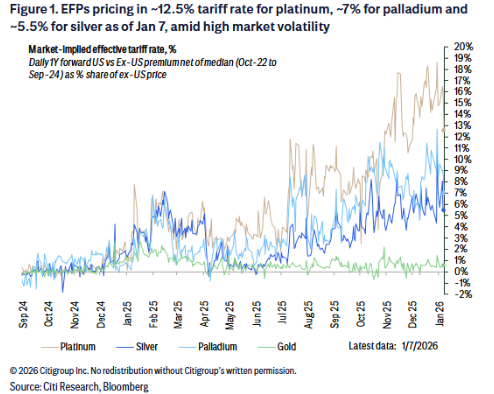
Core Viewpoint - The results of the U.S. Section 232 tariff investigation on critical minerals are expected to be announced on January 10, which will significantly impact the prices of Comex silver and platinum group metals [1] Group 1: Tariff Implications - If tariffs are not imposed, metals are likely to flow out of the U.S. to other regions, alleviating current market tensions and lowering London spot prices [1] - In the event of tariffs, there will be a 15-day implementation window that may trigger a "rush to ship from the U.S." behavior, pushing U.S. benchmark pricing and exchange futures premiums (EFP) higher before imports decline [1] - The expected tariff rates are approximately 12.5% for platinum, 7% for palladium, and 5.5% for silver, reflecting market uncertainty [1][3] Group 2: Silver Market Dynamics - Citigroup's research team leans towards a scenario where silver will likely avoid tariffs, given the U.S.'s heavy reliance on imported silver [3] - In a no-tariff scenario, silver prices may face temporary downward pressure, as the absence of tariffs would encourage metal outflows from the U.S., easing global market tensions [4] - The timing of the tariff decision may coincide with the annual index rebalancing window, potentially leading to a $7 billion outflow of silver, which is about 12% of Comex holdings [7] Group 3: Palladium and Platinum Tax Outlook - Palladium is most likely to face high tariffs, with a potential rate of 50%, which could lead to a sharp increase in domestic prices and create a "dual market" between the U.S. and other regions [8] - The price premium in the U.S. would reflect the tariff costs and related logistics, making U.S. prices systematically higher than global pricing centers [8] - The outlook for platinum tariffs is uncertain, with the possibility of it being taxed alongside palladium, but the U.S. has a higher dependency on platinum imports, which may lower the likelihood of tariffs [10]

铜价涨幅远超预期!高盛上调上半年目标价,但仍然坚持“美国关税后回调”
Hua Er Jie Jian Wen· 2026-01-09 00:55
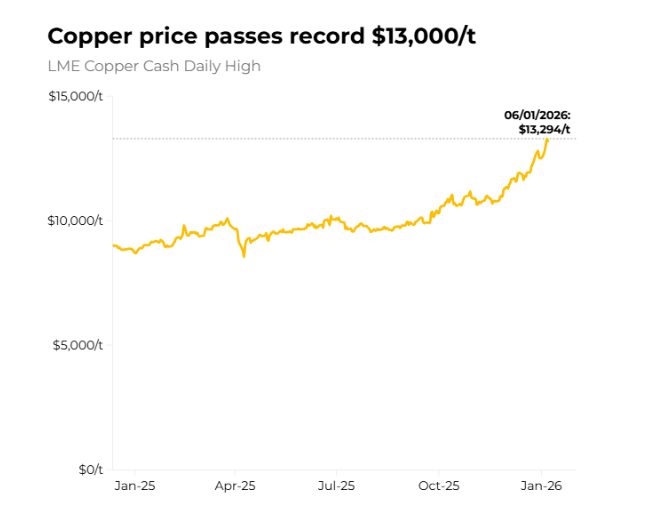
Core Viewpoint - Goldman Sachs has revised its short-term copper price forecast due to a significant price surge, but maintains that once U.S. tariffs are implemented, supply and demand fundamentals will regain influence [1][6]. Group 1: Price Movements and Predictions - Copper prices have experienced extreme volatility, rising from under $11,000 per ton at the end of November to a peak of $13,387 per ton on January 6, marking a 22% increase [1]. - Goldman Sachs has adjusted its 2026 mid-year LME copper price forecast from $11,525 per ton to $12,750 per ton [1]. - Despite the current price surge, Goldman Sachs does not expect prices above $13,000 to be sustainable and maintains a forecast of $11,200 per ton for Q4 2026 [1]. Group 2: Factors Driving Price Increase - Three main themes are driving the current copper price increase: 1. Tight signals in the spot market, evidenced by a surge in metal withdrawal requests from LME warehouses in early December, indicating supply tightness outside the U.S. [4]. 2. The AI and data center boom continues to attract significant investment into the copper market, despite some fluctuations in mid-December [4]. 3. The macro narrative of "running the economy hot" is fueling expectations of accelerated U.S. economic growth and a rebound in cyclical demand, positively impacting copper and broader risk assets [5]. Group 3: Tariff Implications - The anticipated U.S. tariff decision on refined copper is expected to be a turning point, potentially ending the current stockpiling behavior in the U.S. [6]. - The U.S. Commerce Department has suggested delaying the imposition of tariffs on refined copper, increasing the likelihood that these tariffs may not be implemented [6]. - If tariffs are postponed, it could negatively impact LME copper prices as the market would refocus on global supply abundance [7]. Group 4: Market Fundamentals and Risks - Despite the current price boom, the global copper market fundamentals appear weak, with a projected surplus of 600,000 tons in 2025, the largest since 2009 [8]. - The surplus expectation for 2026 has been revised from 160,000 tons to 300,000 tons, and U.S. stockpiling expectations have been reduced from 7.5 million tons to 6 million tons [8]. - Speculative positions in the market have reached historical highs, indicating a potential late-stage market phase, although prices may still find support until key economic pillars collapse [9].

“谷歌眼镜合作方”中国XReal募资1亿美元
Hua Er Jie Jian Wen· 2026-01-09 00:39
Core Viewpoint - XReal, a Chinese smart glasses manufacturer, has completed a $100 million funding round, achieving a valuation of over $1 billion, amidst increasing competition in the smart glasses market [1] Group 1: Funding and Valuation - XReal has successfully raised $100 million in a new funding round from supply chain partners and other undisclosed supporters [1] - The company's valuation has surpassed $1 billion following this funding round [1] Group 2: Product Development and Partnerships - XReal has announced the release of two new glasses products at the CES event, including an upgraded entry-level model [1] - The company is expanding its collaboration with Alphabet, Google's parent company, on the Android XR smart glasses project, which is progressing as planned [1][2] - The collaboration with Google is set to launch in 2026, focusing on combining XReal's expertise in optical modules and chips with Google's strengths in AI and operating systems [2] Group 3: Market Competition - XReal faces intense competition from tech giants, with Meta leading the market with its AI-enabled Ray-Ban glasses and Apple expected to launch its first smart glasses this year [4] - Meta has introduced a high-end model priced at $799, while Apple has shifted focus from its Vision Pro headset to developing AI glasses similar to Meta's offerings [4] - XReal's CEO has criticized the Vision Pro for its high price and weight, asserting that XReal can provide a similar experience at a more affordable price [4] Group 4: Industry Trends and Innovations - Analysts believe that the combination of edge AI and XR devices could lead to a significant industry breakthrough [3] - Various companies showcased different forms of smart wearable devices at CES, including Razer's concept headphones with built-in cameras and Motorola's camera-equipped pendant [5] - Razer's CEO suggested that headphones might appeal more to some consumers, but XReal's CEO remains confident that glasses are the optimal solution for this technology [5][6]
“减肥神药”停药后如何?两年内恢复原“胖”
Hua Er Jie Jian Wen· 2026-01-09 00:08
Core Insights - A recent study published in the British Medical Journal (BMJ) indicates that patients who stop using anti-obesity medications will regain their original weight within two years, losing the associated health benefits such as improved heart health, cholesterol levels, and blood pressure [1][2] - The analysis, which included data from over 9,000 participants, highlights the rapid weight rebound and deterioration of health indicators occurring even before full weight restoration [1][2] Group 1: Weight Rebound and Health Implications - The study analyzed 37 research studies and found that participants lost an average of 8.3 kg during treatment but would regain their original weight in less than 21 months after stopping the medication [2] - Beneficial effects on heart health, cholesterol, and blood pressure are expected to diminish within 18 months post-medication [2] - The research emphasizes that weight loss through medication is faster but leads to quicker rebound compared to behavioral weight loss programs [2] Group 2: Long-term Intervention Necessity - Experts stress the need for ongoing interventions to maintain weight loss results, especially as millions may stop using these medications in the coming years [3] - The study's findings align with emerging views on the limitations and advantages of such medications [2][3] Group 3: Nutritional Risks and Muscle Loss - A separate study published in Obesity Reviews indicates that users of weight loss medications may face nutritional deficiencies and muscle loss due to inadequate dietary guidance [4] - Up to 40% of the weight lost may consist of lean body mass, including muscle, highlighting the risks of unmonitored medication use [4] - The lack of nutritional support for users who purchase medications privately raises concerns about replacing one health issue with another [4]
油价因委内瑞拉局势及供应担忧大涨逾3%,创两周新高
Hua Er Jie Jian Wen· 2026-01-08 22:45
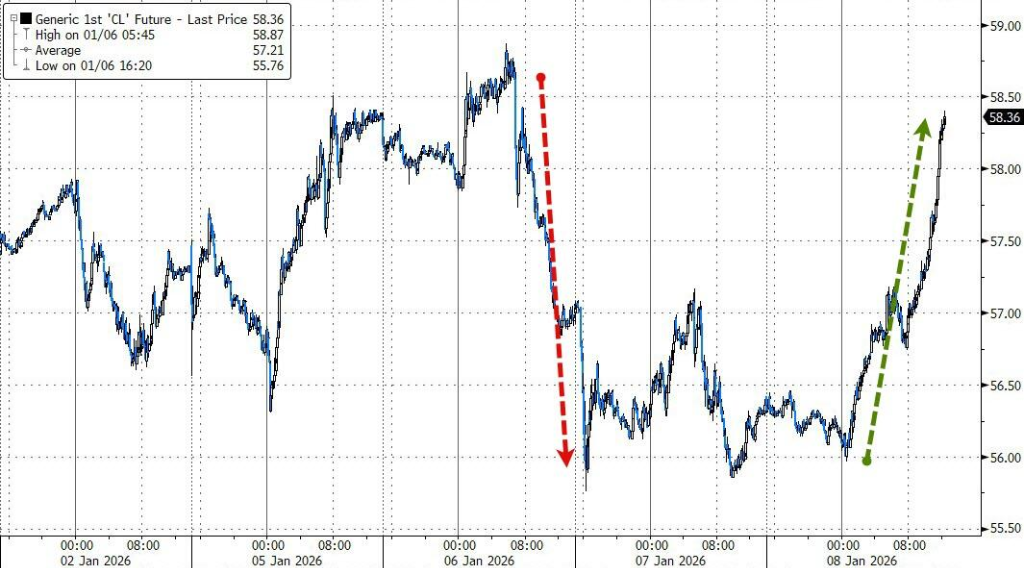
Core Viewpoint - International oil prices rebounded on Thursday, rising over 3% to a two-week high, driven by concerns over supply disruptions from Venezuela, Russia, Iraq, and Iran despite an increase in U.S. gasoline and distillate inventories [1]. Group 1: Oil Price Movement - Brent crude futures settled at $61.99 per barrel, up $2.03 or 3.4%, marking the highest closing price since December 24 of the previous year [3]. - WTI crude futures increased by $1.77 or 3.2%, reaching $57.76 per barrel [3]. Group 2: Supply Concerns - Investors are evaluating the situation in Venezuela, where the U.S. plans to sell up to 50 million barrels of Venezuelan oil to domestic refiners, which may take years to significantly impact the Gulf Coast [1]. - A drone attack on a tanker heading to Russia in the Black Sea and Iraq's move to nationalize the West Qurna 2 oil field due to U.S. sanctions on Lukoil are contributing to supply risk concerns [1]. - Iran is facing nationwide protests due to economic difficulties, leading to internet blackouts, further complicating the supply landscape [1].
特朗普创纪录1.5万亿军费要打“世界大战”?军工股大反弹,无人机厂商两位数高涨
Hua Er Jie Jian Wen· 2026-01-08 19:04
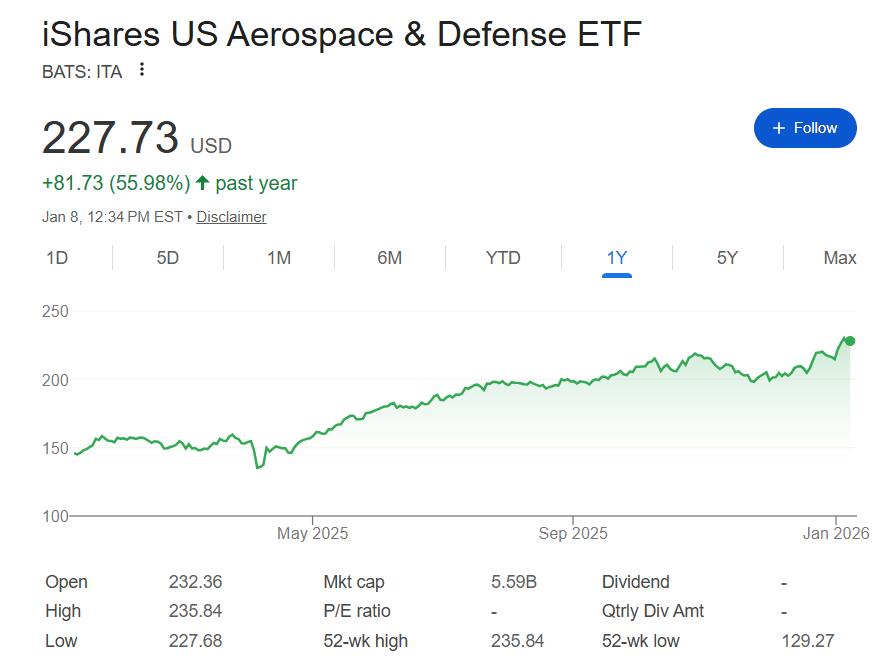
Core Viewpoint - President Trump's recent statements have caused significant volatility in the defense sector, with threats to limit dividends and stock buybacks for defense contractors leading to a sharp decline in military stocks, followed by a strong rebound after his proposal to increase military spending to $1.5 trillion for fiscal year 2027, a 50% increase from the current budget of $901 billion [1][2][10]. Group 1: Market Reactions - Following Trump's statements, defense stocks experienced a dramatic rebound, with major companies like Lockheed Martin (LMT) rising over 9%, Northrop Grumman (NOC) nearly 11%, and Raytheon Technologies (RTX) up nearly 6% [5][9]. - The iShares U.S. Aerospace & Defense ETF (ITA) has seen a cumulative increase of over 50% in the past 12 months, reflecting strong performance in the defense sector [2]. - Global defense stocks also rose, with European defense stocks increasing by up to 3.8% on the same day, and notable gains in companies like BAE Systems and Rheinmetall [9]. Group 2: Budget Proposal and Challenges - Trump's proposal to increase the defense budget by 50% is historically rare, with the last similar increase occurring during the Korean War in 1951 [10]. - The feasibility of this budget increase faces challenges, as the Congressional Budget Office (CBO) estimates a budget deficit of 5.5% of GDP for the current year, with projected tax revenues falling short of the anticipated defense spending growth [10][11]. - Political hurdles exist, as the proposed budget would require significant support in the Senate, and there are concerns about whether defense contractors can absorb such a large increase in spending [11]. Group 3: Analyst Perspectives - Analysts generally express cautious optimism regarding the direction of U.S. defense spending, with expectations for higher expenditures amid stricter scrutiny of companies [12][13]. - Some analysts suggest that limiting capital returns could free up billions for capacity expansion or acquisitions, indicating a potential shift in investment strategies within the defense sector [13]. - The geopolitical landscape is driving increased defense spending, with analysts noting that the world is becoming a more dangerous place, further justifying the proposed budget increase [13][14].




特朗普就美联储主席人选表示:“我心里已经有决定了”。(纽约时报)
Hua Er Jie Jian Wen· 2026-01-08 17:49
特朗普就美联储主席人选表示:"我心里已经有决定了"。(纽约时报) 风险提示及免责条款 市场有风险,投资需谨慎。本文不构成个人投资建议,也未考虑到个别用户特殊的投资目标、财务状况或需要。用户应考虑本文中的任何 意见、观点或结论是否符合其特定状况。据此投资,责任自负。 ...
就在明天!美最高法院关税意见日敲定,美股、美债市场迎来“大考”
Hua Er Jie Jian Wen· 2026-01-08 16:13
Core Viewpoint - The U.S. Supreme Court is set to make a final ruling on Trump's comprehensive tariff plan, which will significantly impact the U.S. stock and bond markets. Analysts expect that if the tariffs are deemed illegal, the stock market may benefit from improved corporate profit expectations, while the bond market could face selling pressure due to renewed concerns over fiscal deficits and a more complex policy path from the Federal Reserve [1]. Group 1: Stock Market Implications - If the Supreme Court rules to cancel the current tariffs, the impact will vary significantly across different sectors. Companies reliant on imported goods or global supply chains are expected to benefit directly, while domestic producers previously supported by trade protection may lag [2]. - The consumer goods sector, particularly in clothing, toys, and home goods, is likely to be the most clear-cut winner due to high reliance on overseas imports and elevated tariff rates, alleviating cost pressures and profit uncertainties [2]. - The industrial manufacturing and transportation sectors may also benefit from tariff refunds and potential economic stimulus effects. Large banks in the financial sector could see gains from improved overall consumer confidence, while more volatile fintech sub-sectors may experience significant fluctuations due to market sentiment changes [2]. Group 2: Bond Market Concerns - Bond traders are preparing for potential market volatility, although the expected impact is generally viewed as temporary. U.S. Treasury bonds recorded over 6% returns in 2025, marking the best annual performance since 2020, largely due to market bets on continued rate cuts by the Federal Reserve [3]. - The cancellation of tariffs could create a revenue gap for the government, reigniting concerns over the federal budget deficit. Analysts from JPMorgan highlight the risk of renewed fiscal worries, which could push up long-term yields and steepen the yield curve [3]. - Morgan Stanley emphasizes the need for investors to monitor the timing and scale of potential tariff refunds to importers, as this will directly affect Treasury issuance demand. They believe that initial selling in the bond market may be short-lived, with a potential for a "fact-based buy-in" to lower yields again [3].