
Qi Huo Ri Bao

Search documents
铁矿石 走势不容乐观
Qi Huo Ri Bao· 2025-11-18 01:23
Group 1 - The core viewpoint of the articles indicates that the iron ore futures market is facing a challenging outlook due to supply increases, weakening demand, and rising policy expectations, leading to a pessimistic mid-term price trend [1] Group 2 - The supply side has shifted from expectation to reality, with major mining companies signaling expansion in their third-quarter reports. BHP's West Pilbara project has increased capacity utilization to 110%, with daily shipments stabilizing at 1.8 million tons. Rio Tinto's Cape Lambert port expansion has raised its fourth-quarter shipment target by 5%. Vale's Capanema project has achieved 15 million tons of new capacity as of October. Notably, the Simandou iron ore project in Guinea has commenced production, with an annual capacity exceeding 30 million tons and an expected increase of 80 million tons by 2026 [2] - Shipment and inventory data further confirm a relaxed supply situation, with average daily shipments from Australia and Brazil reaching 3.12 million tons in November, a year-on-year increase of 4.2%. Domestic northern ports have seen continuous arrivals exceeding 24 million tons for four weeks, with total iron ore inventory at major ports rising to 158 million tons, a historical high for the same period. The inventory structure shows a decrease in daily port throughput from 3.2 million tons to 2.95 million tons, indicating weakened proactive replenishment demand, which may extend the accumulation cycle into the first quarter of next year [2] Group 3 - Steel mills are experiencing rapid declines in profitability, which is a core factor constraining iron ore demand. Current data shows that the profitability of blast furnaces has dropped to 39%. This suggests that the market should reconsider the traditional view of "steel mill production inertia," as the marginal reduction in steel production can significantly impact the iron ore supply-demand balance. There are differing interpretations regarding the reduction in pig iron production, with some believing it will help reduce steel inventory and support steel prices. However, from the perspective of iron ore fundamentals, the previous high valuation was primarily due to steel mills benefiting upstream through replenishment. With both steel mill profits and production declining, iron ore is likely to experience a negative feedback loop, gradually giving back previous excessive gains [3] - Additionally, weak real estate data continues to affect demand for construction steel. Data from the Steel Association indicates that national steel social inventory has accumulated for two consecutive weeks, with finished product inventory at steel mills rising to 14.5 million tons, further suppressing the willingness to procure iron ore [3] Group 4 - In the short term, the market is expected to operate within a range, with three core factors to monitor: the effectiveness of the support at 760 yuan/ton, which corresponds to previous lows and steel mill procurement cost lines; the central economic work conference at the end of November, which may release strong stimulus signals for real estate and infrastructure, potentially pushing prices to challenge resistance levels of 790-800 yuan/ton; and the shipment data from Australia and Brazil in early December, which, if it continues to show high growth, will reinforce long-term bearish logic [4]
集体涨停!一则消息“引爆”碳酸锂市场?
Qi Huo Ri Bao· 2025-11-18 01:20
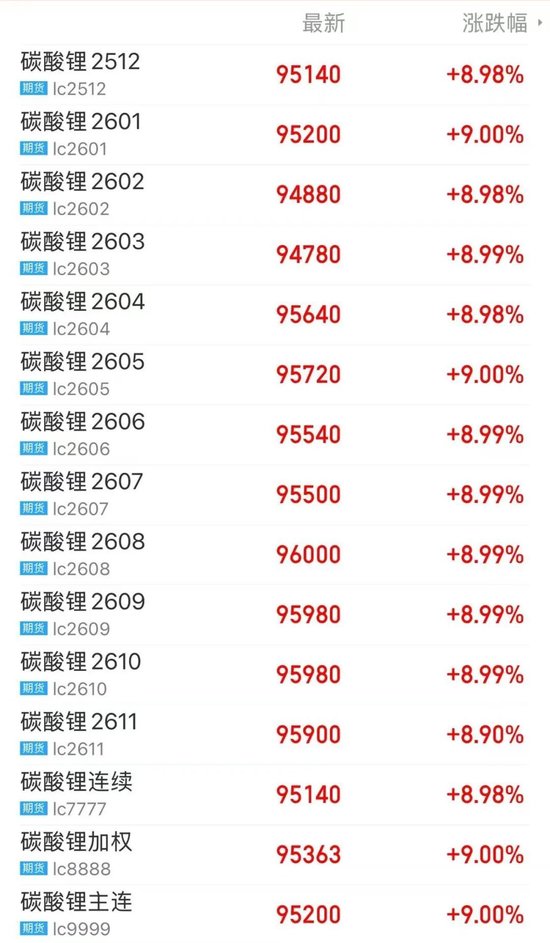
Core Viewpoint - The strong rise in lithium carbonate futures prices is attributed to a combination of favorable market sentiment and fundamental factors, with multiple contracts hitting the daily limit up on November 17 [1][2][4]. Price Movement - Lithium carbonate prices have seen significant increases, with the main contract reaching 95,140 yuan/ton, reflecting an 8.98% rise, while other contracts also showed similar upward trends, with some increasing by up to 9.00% [2]. Market Sentiment - Analysts indicate that the current market sentiment is positive, with expectations of increased demand for lithium carbonate in 2025 and 2026, driven by the anticipated growth in electric vehicle and energy storage sectors [4][5]. Demand Forecast - There is a consensus among industry experts that if demand growth exceeds 30% by 2026, the lithium carbonate market may face a supply-demand imbalance, potentially pushing prices beyond 150,000 yuan/ton, and possibly reaching 200,000 yuan/ton [3][4]. Supply and Demand Dynamics - The lithium carbonate market is currently characterized by strong supply and demand. Domestic production increased by 5.7% month-on-month in October, reaching 92,300 tons, while energy storage battery production surged by 55% year-on-year from January to October [4][5]. Inventory Levels - As of November 14, lithium carbonate weekly inventory stood at 120,500 tons, down by 3,481 tons from the previous week, indicating a rapid depletion of stock [5]. Future Outlook - Analysts suggest that while the current demand remains robust, attention should be paid to the sustainability of this demand and the pace of future supply releases. The market is expected to maintain a strong performance in the short term, but caution is advised regarding potential seasonal demand weaknesses [5].

铜价或重回上升通道
Qi Huo Ri Bao· 2025-11-18 01:00
Core Viewpoint - Copper prices have reached historical highs, with LME three-month copper prices exceeding $11,200 per ton and Shanghai copper prices surpassing 89,240 yuan per ton, indicating a strong market outlook for copper in the medium to long term due to supply constraints and increasing demand from energy transition and emerging markets [1][4]. Supply and Demand Dynamics - Global copper mine supply is expected to decline, with major mines like Kamoa-Kakula and El Teniente facing unexpected production cuts, leading to a projected decrease in global copper concentrate output by 220,000 tons in 2025 compared to 2024 [2]. - The International Copper Study Group (ICSG) has significantly lowered its forecast for global mine production growth in 2025 from 2.3% to 1.4% due to these supply disruptions [2]. Strategic Resource Attributes - Copper's strategic importance is highlighted by its essential role in various sectors, including electric vehicles, renewable energy, and digital infrastructure, with the International Energy Agency (IEA) predicting that copper usage in the renewable sector will exceed 30% by 2030 [4]. - Traditional demand from sectors like power infrastructure and construction remains robust, with a stable copper usage rate of 45%-48% in the power industry, while emerging markets are driving a growth rate of over 10% in construction-related copper demand [4]. Export and Demand Growth - China's copper exports have shown resilience, with a year-on-year growth of 5.3% from January to October 2025, despite concerns over trade policies and economic conditions [5]. - High-end manufacturing exports, including automobiles and integrated circuits, have significantly contributed to this growth, with notable increases in specific sectors such as automotive exports rising by 34% [5]. Challenges and Market Dynamics - High copper prices are creating challenges for downstream enterprises, particularly small and medium-sized businesses, which face increased material costs and potential operational cutbacks [6]. - The widening price gap between refined copper and recycled copper is prompting downstream companies to seek lower-cost alternatives, which may further impact refined copper demand [6]. - Despite short-term price fluctuations, the long-term outlook for copper remains strong due to structural supply constraints and disruptive demand growth, presenting potential investment opportunities [6].
监管升级!LME或永久限制近月大额持仓 分析人士:有望重塑金属交易逻辑
Qi Huo Ri Bao· 2025-11-18 00:35
Core Viewpoint - The London Metal Exchange (LME) is seeking to permanently limit large positions in near-month contracts to mitigate the risk of short squeezes in a low inventory environment, reflecting a systemic restructuring to adapt to changes in the global metal market [1][3]. Group 1: Risk Mitigation - The proposed permanent near-month lending rules aim to prevent short squeeze risks associated with low inventory levels and large positions, as evidenced by past incidents like the LME nickel squeeze in 2022 and the copper inventory transfer in 2023 [3]. - LME copper inventory dropped significantly from 270,900 tons in early February to approximately 95,900 tons by the end of June, a decline of over 60%, which contributed to substantial price volatility in LME copper futures [3]. Group 2: New Rules and Regulations - In June, LME introduced temporary regulations limiting the total long positions held by traders in delivery month contracts to the available inventory, requiring excess positions to be closed or converted to zero premium lending within 24 hours [4]. - The new rules proposed for late October focus on "position control" and "liquidity supply," with specific thresholds for lending premiums based on the percentage of total inventory held [4][5]. Group 3: Market Impact - Analysts suggest that the implementation of these new rules will have both short-term and long-term effects, stabilizing price volatility in the short term while potentially reshaping trading logic in the long term [7][9]. - The new regulations are expected to enhance market transparency and reduce the potential for manipulative practices, leading to a more effective price discovery mechanism [7][9]. Group 4: Strategic Considerations - LME's recent initiatives indicate a strategic focus on better serving the Chinese market, including establishing warehouses in Hong Kong and aligning offshore renminbi interest rates with other currencies [8]. - The LME is also optimizing its options market, including plans to convert American-style options to European-style options, which reflects ongoing efforts to enhance market efficiency [8]. Group 5: Regulatory Insights - The new rules from LME may serve as a regulatory reference for domestic futures markets in China, emphasizing the importance of proactive risk prevention measures [9]. - The public consultation period for the proposed rules will continue until November 21, with market participants keenly observing potential adjustments to the tiered thresholds [9].
集体涨停!一则消息“引爆”碳酸锂市场?
Qi Huo Ri Bao· 2025-11-17 23:35
Core Viewpoint - The lithium carbonate futures prices have surged strongly, with multiple contracts hitting the daily limit up, driven by both fundamental and news factors [2][4]. Price Movement - Lithium carbonate futures prices for various contracts have shown significant increases, with the main contract (c2601) reaching 95,200, reflecting a rise of 9.00% [3][4]. - The weighted average price of lithium carbonate is reported at 95,363, with a rise of 9.00% [4]. Market Sentiment - Analysts indicate that the current market sentiment is positive, contributing to the rise in lithium carbonate futures prices [5]. - The overall price trend for lithium carbonate is upward, with optimistic demand expectations for 2025 and 2026 [6]. Demand and Supply Dynamics - The demand for lithium carbonate is expected to remain strong, particularly in the electric vehicle sector, with projections indicating a penetration rate of around 60% for new energy vehicles by the end of the year [6]. - The supply side is also showing strength, with domestic lithium carbonate production increasing by 5.7% month-on-month in October, reaching 92,300 tons [6]. Inventory Levels - As of November 14, the weekly inventory of lithium carbonate was reported at 120,500 tons, a decrease of 3,481 tons from the previous week [8]. Future Outlook - Analysts expect strong demand for lithium carbonate to continue into late November and December, with a focus on the first quarter of the next year [7]. - Despite the strong market conditions, there are concerns about potential seasonal demand weakness and the need for careful monitoring of supply releases [8].

突然大涨,伯克希尔重仓买入!美联储,降息大消息→
Qi Huo Ri Bao· 2025-11-17 23:33
美联储,降息大消息 11月17日晚间,美联储副主席菲利普·杰斐逊表示,美联储在进一步降息时应谨慎行事,以免削弱其抗通胀的努力。他重申,随着利率接近中性水平,决 策者需要在行动上"缓步前行"。 杰斐逊说,在2025年迄今为止两次降息25个基点之后,美联储当前的政策立场"仍然具有一定限制性,但已经更接近中性水平"。 杰斐逊的观点具有一定的风向标意义,因为他的立场通常与美联储主席鲍威尔高(301251)度一致。 他指出,实现美联储2%的通胀目标的工作似乎已经停滞,这可能反映了关税的影响。 在谈到政策前景时,杰斐逊表示,他将以数据为指引,在每一次议息会议上逐次作出决定。 18日凌晨,美联储理事沃勒重申,美联储应该在12月会议上再次降息,理由是美国劳动力市场疲软以及货币政策在伤害中低收入消费者。 "由于基本通胀接近联邦公开市场委员会的目标且有证据显示劳动力市场疲软,我支持在12月会议上再次将政策利率降低25个基点。本周晚些时候的9月就 业报告或未来几周的任何其他数据,都不太可能改变我的观点。"沃勒说。 据CME"美联储观察",美联储12月降息25个基点的概率为42.9%,维持利率不变的概率为57.1%。 伯克希尔重仓买 ...

监管升级!LME或永久限制近月大额持仓,分析人士:有望重塑金属交易逻辑
Qi Huo Ri Bao· 2025-11-17 23:29
Core Viewpoint - The London Metal Exchange (LME) is seeking feedback on a proposal to permanently limit large positions in near-month contracts, aiming to mitigate the risk of short squeezes in a low inventory environment and adapt to changes in the global metal market landscape [1][2]. Group 1: Risk Mitigation - The LME's adjustment of lending rules is driven by significant market risks due to declining inventories over the past two years, highlighted by events such as the nickel squeeze in 2022 and the copper inventory transfer in 2023 [2]. - The proposed Front Month Lending Rules aim to prevent short squeeze risks by permanently limiting large positions in near-month contracts, addressing the issues arising from low inventory levels [2][3]. - LME copper inventory dropped over 60% from 270,900 tons in early February to approximately 95,900 tons by the end of June, leading to significant price volatility in LME copper futures [2]. Group 2: New Rules and Their Implications - The temporary rules introduced in June required traders holding long positions in delivery month contracts to limit their total holdings to the available inventory, with excess positions needing to be closed or converted to zero premium lending [3]. - The new rules focus on "position control" and "liquidity supply," with specific thresholds for lending premiums based on the percentage of total inventory held [3][4]. - Analysts suggest that the implementation of these new rules will stabilize price volatility in the short term and reshape trading logic in the long term, enhancing market transparency and reducing the potential for manipulative practices [5][6]. Group 3: Market Dynamics and Strategic Considerations - The LME's recent initiatives indicate a strategic focus on better serving the Chinese market, including establishing warehouses in Hong Kong and aligning offshore RMB collateral rates with other currencies [7]. - The LME's proposed changes are seen as a shift towards proactive regulation, moving from reactive measures to preventive strategies in global metal market oversight [8]. - The feedback period for the proposed rules will last until November 21, with market participants keenly observing potential adjustments to the tiered thresholds [8].

期债 短期维持箱体走势
Qi Huo Ri Bao· 2025-11-17 18:07
近期,债市呈箱体震荡走势,10年期国债收益率围绕1.8%小幅波动。短期来看,利空因素在于股市放 量上涨,风险偏好回升,对债市形成明显压制;利多因素在于宽松的资金面和刚刚公布的10月金融数据 偏弱。在风险偏好回暖与资金面宽松预期拉锯下,市场缺乏主线,短期震荡格局明显。 从国内经济基本面来看,10月CPI和PPI温和回升,但居民消费延续回落态势。与此同时,10月金融数据 转弱,一方面10月信贷季节性回落,另一方面财政对实体支持力度阶段性回落。"弱现实"仍在延续,对 债市形成支撑。 从潜在利空因素来看,一是部分经济数据表现具备韧性,降低了年末加码宽松的紧迫性。二是风险偏好 变化,国内权益市场走势偏强,通过股债"跷跷板"效应压制债市情绪。三是近期美元和美债收益率集体 上涨,在一定程度上限制了国内利率下行的空间。 从政策层面来看,市场对四季度降准降息的预期升温。央行在三季度货币政策报告中重提"跨周期调 节",预示政策视角更重长期。财政政策方面,5000亿元地方债务结存限额下达,后续基建投资可能形 成脉冲。宽松预期是当前债市核心支撑。另外,近期资金面仍偏宽松,短端利率保持低位,这也给债市 提供了支撑。 从海外市场环境来看 ...
西南期货联合国家级生猪大数据中心成功举办“健康发展 期现联动”饲料产业交流会
Qi Huo Ri Bao· 2025-11-17 05:59
Core Insights - The event "Healthy Development of Spot and Futures Linkage" was successfully held in Chongqing Rongchang, focusing on the integration of the feed industry with futures and options markets [1][2] - The Rongchang District government emphasizes the importance of high-quality development in the pig industry and aims to create a synergistic ecosystem combining data, finance, and industry [1] Group 1: Event Overview - The event was organized by Southwest Futures in collaboration with the National Pig Big Data Center, gathering government agencies and feed-related enterprises to discuss new pathways for the feed industry [1] - Rongchang District is recognized as a core area for the national pig industry, highlighting its commitment to optimizing the business environment for feed enterprises and farming entities [1] Group 2: Strategic Focus - The conference centered on practical empowerment and precise matching, focusing on the core functions of futures and options related to feed (corn, soybean meal) and their application in enterprises [2] - Southwest Futures and the National Pig Big Data Center plan to deepen strategic cooperation to build a specialized platform for industry-finance collaboration, aiming to create a risk hedging service system [2] Group 3: Goals and Objectives - The initiative aims to leverage digital tools to address industry pain points and utilize financial innovation to hedge market risks, thereby empowering the entire pig industry chain for high-quality development [2]
沪铝 警惕短线回调风险
Qi Huo Ri Bao· 2025-11-17 01:29
Core Viewpoint - The aluminum market is expected to experience upward price trends in the medium to long term due to strong demand and rigid supply, despite potential short-term price declines due to seasonal pressures in the consumption off-season [1][5]. Group 1: Macro Environment - The macroeconomic outlook has improved, with the Federal Reserve lowering interest rates in September and October, boosting sentiment in the non-ferrous metals market [1]. - The easing of trade tensions between China and the U.S. has alleviated concerns regarding aluminum product trade barriers, contributing to a more optimistic macro environment [1]. - Political uncertainties in the U.S. have decreased, and economic data has not been as pessimistic as expected, further strengthening the positive macro outlook [1]. Group 2: Supply Dynamics - Recent weather conditions in Guinea and reduced shipments from Australia have led to a significant decline in bauxite inventory at ports, but shipments are expected to return to previous levels after the rainy season [2]. - Domestic aluminum oxide production remains stable due to sufficient raw material inventory, with a capacity utilization rate of 84.05% as of October, despite a slight decline [2]. - Domestic electrolytic aluminum production capacity is nearly fully utilized at 97.46%, with limited room for future capacity growth [3]. - Global electrolytic aluminum production is estimated at 72 million tons for 2024, with China contributing about 60%, while overseas production faces constraints from energy costs and infrastructure issues [3]. Group 3: Demand Trends - Overall consumption of aluminum shows resilience, although the average operating rate for aluminum profiles is significantly lower than in previous years [4]. - Demand in traditional construction sectors is weak, but strong demand in sectors such as new energy vehicles, photovoltaics, and ultra-high voltage infrastructure supports consumption resilience [5]. Group 4: Price Outlook - The global aluminum market is characterized by a tight supply-demand balance, heavily reliant on China's nearly full production capacity [5]. - Short-term price pressures may arise as the market enters the traditional consumption off-season, following a recent surge in prices above 22,000 yuan/ton [5].