
Qi Huo Ri Bao

Search documents
纳指、标普500指数、金价再创历史新高!特朗普宣布:加征25%关税!国际油价涨势能否延续
Qi Huo Ri Bao· 2025-10-07 00:06
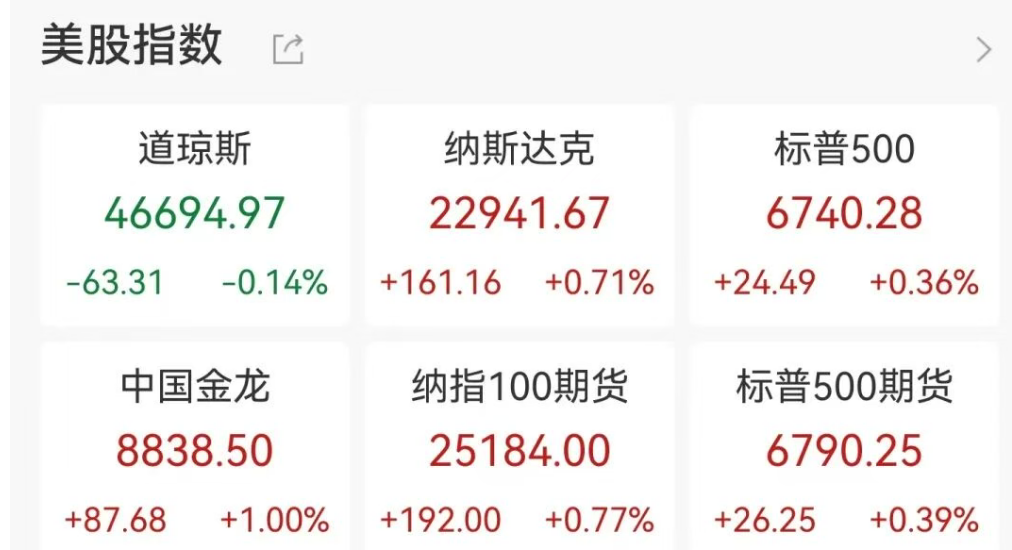
早上好,来看一些热点消息。 据央视报道,当地时间10月6日,美国国会参议院对民主党提出的旨在结束政府"关门"的拨款法案进行表决,最终以45票赞成、50票反对,法案 未获通过。随后,参议院将投票表决共和党版临时拨款法案。 纳指、标普500指数、金价再创历史新高 美国股市在周一迎来新一轮上涨潮,纳指与标普500指数双双创历史新高,市场情绪高涨。 截至收盘,道指跌0.14%,纳指涨0.71%,标普500指数涨0.36%。其中,AMD盘中一度涨37.6%,最终收涨23.71%。纳斯达克中国金龙指数收涨 1%,热门中概股多数上涨。 | 美股指数 | | | | --- | --- | --- | | 道琼斯 | 纳斯达克 | 标普500 | | 46694.97 | 22941.67 | 6740.28 | | -63.31 -0.14% +161.16 +0.71% | | +24.49 +0.36% | | 中国金龙 | 纳指100期货 | 标普500期货 | | 8838.50 | 25184.00 | 6790.25 | | +87.68 +1.00% +192.00 +0.77% +26.25 +0.39% ...

有色板块分化明显!分析人士:铜价有望继续领涨
Qi Huo Ri Bao· 2025-10-07 00:06
Core Viewpoint - The "Nonferrous Metal Industry Stabilization and Growth Work Plan (2025-2026)" issued by eight departments, including the Ministry of Industry and Information Technology, outlines a clear direction for the future development of the nonferrous metal industry, with expectations for growth amid macroeconomic changes and supply-side disturbances [1][2]. Macroeconomic Context - The Federal Reserve's recent 25 basis point interest rate cut and indications of two more cuts this year are expected to positively impact nonferrous metals, as historical trends show that such cuts typically lead to lower U.S. Treasury yields and a weaker dollar, benefiting metals with financial attributes [1][2]. - Domestic macroeconomic signals are also positive, with expectations for policy support increasing, particularly following the Central Committee's meeting on September 29, which discussed the 15th Five-Year Plan [1][2]. Industry Growth Projections - The plan sets a target for the nonferrous metal industry's value-added growth at approximately 5% annually and a 1.5% annual growth in the production of ten key nonferrous metals, including copper, aluminum, and lithium, with recycled metal production expected to exceed 20 million tons [2]. - Data from January to August 2025 shows a 7.7% year-on-year increase in the value-added of the nonferrous metal smelting and rolling industry, surpassing the national average industrial growth rate [2]. Supply and Demand Dynamics - The recent accident at Indonesia's Grasberg copper mine has intensified supply concerns, with the company reducing its 2026 copper production guidance by 35%, leading to expectations of a global copper supply deficit of 26.8 thousand tons in 2025 and 30.8 thousand tons in 2026 [3][4]. - Despite the strong performance of copper prices, other nonferrous metals are experiencing relatively flat price movements due to weak global economic data and subdued downstream demand, particularly in the real estate and automotive sectors [4]. Long-term Implications of the Plan - Key aspects of the plan include clarifying mining rights, promoting recycling and green transformation in the nonferrous metals sector, and recognizing the potential for new demand from AI and robotics [3]. - The industry is expected to undergo a transition towards green, low-carbon, and high-end development by 2026, necessitating close monitoring of policy implementation and downstream demand recovery [1][3].
重申产量压减!业内最新研判:钢价四季度不宜悲观
Qi Huo Ri Bao· 2025-10-06 00:47
Core Viewpoint - The Ministry of Industry and Information Technology and other departments have issued a plan for the steel industry aimed at stabilizing growth from 2025 to 2026, emphasizing capacity replacement, production reduction, and support for advanced enterprises while phasing out inefficient capacities [1][2]. Group 1: Policy Measures - The plan continues the trend of recent years in regulating the steel industry, focusing on dynamic balance between supply and demand, and promoting high-end product supply [1]. - It encourages the import of raw materials like coking coal and scrap steel while ensuring stable prices [1]. - The overall policy direction emphasizes industry self-discipline, avoiding vicious regional price competition, and enhancing cooperation along the supply chain [1]. Group 2: Market Conditions - Despite a downward trend in steel prices in the first half of the year, the overall profitability of steel mills has improved due to a larger decrease in raw material prices compared to steel prices [2]. - The third quarter has seen a strong trend in raw material prices, with iron ore prices rebounding to around $107 per ton due to inventory replenishment by steel mills and unstable overseas shipments [2]. - The steel market is currently characterized by high iron output, leading to an oversupply situation, while demand remains weak due to sluggish real estate and infrastructure sectors [3]. Group 3: Future Outlook - Industry experts have differing views on the fourth quarter; some believe that the steel industry will face challenges with profitability management, while others see potential for price stabilization due to production reduction intentions among steel mills [4]. - The plan also emphasizes the importance of carbon footprint accounting and digital carbon management centers, indicating a shift towards green and low-carbon upgrades in the industry [5][6]. - Looking ahead to 2026, there is cautious optimism regarding the steel industry, with expectations of improved demand in construction steel and favorable conditions for steel exports, despite potential adjustments in export regions and product types due to tariffs [6].

见证历史!现货金价首破3900美元/盎司!维持增产 原油开盘涨近1%!加沙地带谈判将举行
Qi Huo Ri Bao· 2025-10-06 00:18
Group 1: Negotiations and Political Developments - A Hamas delegation led by Khalil Hayya has arrived in Egypt for negotiations with Israel on October 6, focusing on a ceasefire "20-point plan" and the conditions for personnel exchange [2][4] - The Egyptian Foreign Ministry announced it will host talks between Israel and Hamas, with participation from U.S. Middle East envoy and other mediators [2][4] - Eight foreign ministers from Egypt, Jordan, UAE, Indonesia, Pakistan, Turkey, Saudi Arabia, and Qatar issued a joint statement supporting efforts to end the Gaza war and welcomed Hamas's readiness to transfer administrative control of Gaza to a transitional Palestinian authority [6][7] Group 2: Military Readiness and Operations - Israeli Defense Forces Chief of Staff, Herzi Halevi, stated that the military must be prepared to resume combat operations, indicating that the current pause is due to diplomatic efforts rather than a formal ceasefire [4][5] - The Israeli military conducted surprise drills simulating Hamas attacks during a recent inspection, highlighting ongoing military readiness [5] Group 3: Oil Production and Market Dynamics - Eight major oil-producing countries, including Saudi Arabia and Russia, decided to maintain an increase in oil production by 137,000 barrels per day in November, aiming for greater market share [9][10] - The decision to adjust production levels comes amid a relatively stable global economic outlook and low oil inventory levels [11] - The increase in production is a response to previous voluntary cuts, with the eight countries having extended their reduction measures until March 2025 [12] Group 4: Shipping and Freight Market Trends - The European shipping market has shown weak performance, with spot rates continuing to decline, and a significant number of scheduled voyages being canceled due to overcapacity and weak demand [19][20] - The Drewry World Container Index reported an 8% week-on-week drop in freight rates, reaching the lowest level since early 2024, indicating ongoing challenges in the shipping sector [19] - Analysts suggest that the shipping market may experience temporary tightness post-holidays, but overall conditions are expected to remain loose due to increased capacity compared to the previous year [20][21]
重申“产量压减”!业内最新研判:钢价四季度不宜过度悲观|观策论市
Qi Huo Ri Bao· 2025-10-05 23:59
Core Viewpoint - The Ministry of Industry and Information Technology and other departments have issued a plan for the steel industry aimed at stabilizing growth from 2025 to 2026, emphasizing capacity replacement, production reduction, and support for advanced enterprises while phasing out inefficient capacities [1][2]. Group 1: Policy Measures - The plan continues the trend of recent years in regulating the steel industry, focusing on increasing capacity replacement and implementing production reduction policies to maintain supply-demand balance [1]. - It promotes the classification and management of steel enterprises and aims to increase the supply of high-end products while ensuring stable prices and supply of raw materials [1][5]. Group 2: Market Dynamics - Despite a downward trend in steel prices in the first half of the year, the overall profitability of steel mills has improved due to a larger decrease in raw material prices compared to steel prices [2]. - The third quarter has seen a strong trend in raw material prices, with iron ore prices rebounding to around $107 per ton due to inventory replenishment by steel mills and unstable overseas shipments [2][3]. Group 3: Demand and Supply Outlook - The overall supply of steel remains abundant due to high iron water production, while demand is supported by shipbuilding, automotive, and strong exports, but is weakened by real estate and infrastructure sectors [3]. - The fourth quarter is expected to see a seasonal decline in construction steel demand, with limited potential for significant increases in rolled steel and exports [3]. Group 4: Industry Perspectives - Industry experts have differing views on the fourth-quarter steel market, with some indicating that the steel industry will face challenges in profitability management compared to the first half of the year [4]. - The plan emphasizes the need to implement annual crude steel production control tasks and achieve ultra-low emission transformation by the end of 2025, with a potential reduction space of around 10 million tons [4]. Group 5: Future Trends - The plan also highlights the importance of establishing a carbon footprint accounting standard system and promoting digital carbon management centers in anticipation of carbon trading market inclusion [5][6]. - Looking ahead to 2026, there is cautious optimism regarding the steel industry, with expectations of improved demand for construction steel and favorable conditions for steel exports, despite potential adjustments in export regions and product types due to tariffs [6].
石化化工市场机会在哪儿?分析人士:长期看这三大赛道|观策论市
Qi Huo Ri Bao· 2025-10-04 23:47
Core Viewpoint - The "Stabilizing Growth Work Plan for the Petrochemical Industry (2025-2026)" emphasizes a transformation direction of "stabilizing total volume and optimizing structure," avoiding a one-size-fits-all approach to capacity reduction [1][2] Policy Impact on Chemical Prices - The plan focuses on controlling new capacity and upgrading existing facilities rather than eliminating current capacity, indicating that supply will not significantly shrink in the short term [1][2] - The core contradiction in the chemical market remains high capacity investment with weak demand, leading to a pessimistic market outlook despite policy changes [2] Specific Chemical Products Analysis - The plan supports refining enterprises to "reduce oil and increase chemicals," which may increase the total supply of chemical products, particularly affecting prices of basic chemicals like synthetic resins and ethylene glycol [2][5] - PX is viewed positively by multiple institutions due to the peak of capacity expansion being over, with no new capacity expected from 2024 to 2025, leading to a favorable supply-demand balance [3][4] - Ethylene is still in a capacity expansion cycle, and while the policy may slow down supply growth, the basic market remains loose, with price fluctuations expected to be limited [4] Long-term Market Opportunities - The policy aims to curb blind capacity expansion and improve the supply-demand mismatch, potentially increasing industry profit margins by 3-5 percentage points by 2026 [3] - Long-term investment opportunities are identified in three areas: high-end fine chemicals, green transition sectors, and companies with integrated layouts and technological advantages [5] Short-term Trading Strategies - Short-term trading strategies should focus on "swing trading" to avoid blind chasing of price increases, with attention to short-term mismatches due to policy windows and facility maintenance [6] - Investors are advised to be cautious of the potential for policy expectations to be overvalued in the market, particularly in high-end products [6]
以色列与哈马斯代表团即将会谈!美联储10月降息概率96.2%!A股创纪录 分析人士:节后有望上行
Qi Huo Ri Bao· 2025-10-04 23:30
Group 1: Israel-Hamas Talks - The Israeli and Hamas delegations will hold talks in Egypt on October 6, focusing on a ceasefire plan proposed by President Trump [1] - The discussions will address the conditions for personnel exchanges and the details of the ceasefire [1] - The U.S. officials, including Middle East envoy Greenblatt and Jared Kushner, will participate in the talks [1] Group 2: Ukraine-Russia Sanctions - Ukrainian President Zelensky signed multiple new sanctions against Russia, targeting Russian entrepreneurs, military industry, and the oil sector [2] - Russia's maritime commission chairman emphasized the need to strengthen naval forces to deter strategic provocations from Western countries [2] Group 3: U.S. Federal Reserve Rate Decisions - The probability of a 25 basis point rate cut by the Federal Reserve in October is 96.2%, while the chance of maintaining the current rate is only 3.8% [3] - For December, the probability of maintaining the rate is 0.4%, with a cumulative 25 basis point cut at 13.3% and a cumulative 50 basis point cut at 86.3% [3] Group 4: A-Share Market Performance - In September, the A-share market saw significant index increases, with the ChiNext Index rising by 12.04% and the STAR 50 Index by 11.48% [4] - The total trading volume in September reached approximately 53.2 trillion yuan, setting a new monthly record [4] - Daily trading volume has exceeded 2 trillion yuan for 35 consecutive trading days since August 13 [4] Group 5: Hong Kong Stock Market Outlook - The Hong Kong stock market had a strong start in Q4, with the Hang Seng Index rising by 1.61% on October 2, reaching a nearly four-year high [5] - The strong performance is attributed to global liquidity preferences shifting towards a more accommodative stance due to the Fed's rate cut cycle [6] Group 6: Investor Sentiment and Market Trends - Unlike previous years, the last trading day before the National Day holiday saw collective index increases and active trading, indicating a shift in investor sentiment [7] - Increased financing balances and active financing funds suggest a strong willingness for new capital to enter the market [7] - The financial sector, particularly securities firms, is expected to perform well, supported by recent central bank policies [7] Group 7: Post-Holiday Market Expectations - The market is expected to trend upwards post-holiday due to several factors, including upcoming important political meetings and a favorable liquidity environment [8] - Historical trends indicate that trading volume and risk appetite typically increase after the National Day holiday [8]
石化化工市场机会在哪儿?分析人士:长期看这三大赛道
Qi Huo Ri Bao· 2025-10-04 23:27
Core Viewpoint - The "Stabilizing Growth Work Plan for the Petrochemical Industry (2025-2026)" emphasizes a transformation direction of "stabilizing total volume and optimizing structure," avoiding a one-size-fits-all approach to capacity reduction and focusing on controlling new capacity and upgrading existing facilities [1][3]. Policy Impact on Chemical Prices - The policy aims to control new capacity in traditional sectors like refining and ethylene while promoting upgrades of existing facilities, indicating that there will not be a significant contraction in supply in the short term [1][2]. - The core contradiction in the chemical market remains high capacity investment against weak demand, leading to a pessimistic market outlook despite policy changes [2]. Specific Chemical Products Analysis - The plan supports refining enterprises to "reduce oil and increase chemicals," which may increase the total supply of chemical products, particularly affecting prices of basic chemicals like synthetic resins and ethylene glycol negatively [2]. - PX is viewed positively by multiple institutions due to the peak of capacity expansion being over, with no new capacity expected from 2024 to 2025, leading to a more stable supply-demand balance [3][4]. - Ethylene is still in a capacity expansion cycle, and while the policy may slow down supply growth, the basic market conditions are unlikely to improve significantly in the short term [5]. Long-term Market Opportunities - The policy's long-term value lies in curbing blind capacity expansion and alleviating capacity mismatch issues, with potential profit margins in the industry expected to rise by 3-5 percentage points by 2026 if the policy is effectively implemented [3][6]. - Long-term investment opportunities are identified in three main areas: high-end fine chemicals, green transition sectors, and companies with integrated layouts and technological advantages [6]. Short-term Trading Strategies - For short-term trading from Q4 2025 to early 2026, a "swing trading" approach is recommended, focusing on short-term mismatches due to policy windows and maintenance schedules [7]. - Investors are advised to be cautious of the potential for policy expectations to be overvalued in the market, particularly in high-end products, and to wait for corrections before making new investments [7].

外盘铜价创年内新高
Qi Huo Ri Bao· 2025-10-04 02:38
Group 1 - The core point of the article is that copper prices have surged due to multiple factors, including supply disruptions, macroeconomic policies, and changes in supply-demand dynamics, with LME copper futures breaking the $10,500 per ton mark for the first time since May 2024 [1][2] - A significant accident at the Grasberg copper mine in Indonesia, the world's second-largest, has sharply tightened market supply expectations, leading to a downward revision of global copper mine supply forecasts for 2025-2026 [1][2] - Goldman Sachs has shifted its global copper market outlook from "oversupply" to "shortage," while JPMorgan forecasts an average LME copper price of $11,000 per ton in Q4, significantly higher than the July prediction of $9,350 per ton [1][2] Group 2 - Macroeconomic factors, particularly the Federal Reserve's interest rate cuts, are seen as an "invisible driver" of rising copper prices, with potential further rate cuts likely to boost market risk sentiment and support copper prices [2] - The tight copper supply has affected the smelting sector, with global copper concentrate production growth lagging behind refined copper, leading to low processing fees and losses for domestic smelters [2] - The domestic copper industry is entering a peak season, with increased operating rates in various sectors, including electrolytic copper rods and wire and cable production, driven by strong demand from the power and new energy vehicle sectors [2] Group 3 - Despite the U.S. government's tariff exemptions on copper concentrate and refined copper, the U.S. Geological Survey's classification of copper concentrate as a critical mineral may lead to increased competition for copper resources [3] - Analysts believe that copper prices still have the potential to rise further due to tight global copper concentrate supply, although high prices may dampen industry demand [3] - Factors supporting strong copper prices include the Federal Reserve's loose monetary policy, ongoing mine production cuts, and increased orders in the domestic power and new energy vehicle sectors, although caution is advised due to potential demand pressures and global trade risks [3]
刚刚,哈马斯回应“20点计划”,特朗普表态!美参院再度否决临时拨款法案,NNSA“告急”!外盘铜价创年内新高
Qi Huo Ri Bao· 2025-10-03 23:40
Group 1: Gaza Conflict Developments - Hamas has submitted a response to Trump's "20-point plan" and expressed willingness to negotiate through mediators for its implementation [1] - Hamas agrees to transfer governance of Gaza to an independent Palestinian authority and will participate in discussions regarding the future of Gaza and Palestinian rights [1] - Trump believes Hamas is ready for lasting peace based on their recent statement and calls for an immediate halt to Israeli bombings to ensure the safe rescue of hostages [1] Group 2: U.S. Government Funding Issues - The U.S. Senate voted against a temporary funding bill proposed by Democrats, resulting in a continued government shutdown [3] - The Republican proposal for a temporary funding bill also failed to pass, leading to potential operational disruptions in government agencies [3] - The U.S. Department of Energy indicated that it has enough funding to operate for only about eight more days before entering emergency shutdown procedures [3] Group 3: Copper Market Insights - LME copper prices have reached a new high of over $10,500 per ton, driven by supply disruptions and changes in macroeconomic policies [5] - The Grasberg copper mine in Indonesia experienced a significant accident, tightening market supply expectations and prompting analysts to revise global copper supply forecasts [5][6] - High copper prices are supported by a combination of reduced global supply, U.S. import behavior, and strong domestic demand in sectors like electric power and new energy vehicles [8] Group 4: Market Dynamics and Future Outlook - Analysts predict that copper prices may continue to rise due to ongoing supply tightness, but caution that high prices could lead to reduced demand from industries [7][8] - The domestic copper processing industry is facing challenges with high costs leading to potential production cuts, while demand remains robust in the "golden September and silver October" season [7][8] - Despite the bullish outlook, concerns about global trade tensions and cautious inventory management among end-users may temper expectations for sustained price increases [8]