
Qi Huo Ri Bao

Search documents
去年工业中长期贷款增长较为平稳
Qi Huo Ri Bao· 2026-01-27 16:17
本报讯中国人民银行27日发布的数据显示,2025年四季度末,金融机构人民币各项贷款余额271.91万亿 元,同比增长6.4%,全年人民币贷款增加16.27万亿元。 2025年四季度末,本外币服务业中长期贷款余额72.87万亿元,同比增长7.8%,增速比各项贷款高1.6个 百分点,全年增加5.24万亿元。不含房地产业的服务业中长期贷款余额同比增长9.4%;房地产业中长期 贷款余额同比增长1.8%。(齐宣) 2025年四季度末,本外币工业中长期贷款余额26.63万亿元,同比增长8.4%,增速比各项贷款高2.2个百 分点,全年增加2.11万亿元。其中,重工业中长期贷款余额22.6万亿元,同比增长7.8%;轻工业中长期 贷款余额4.04万亿元,同比增长11.8%。 ...
中基协建立公募基金业绩比较基准要素库
Qi Huo Ri Bao· 2026-01-27 16:11
本报讯1月27日,中基协发布公告称,为落实《推动公募基金高质量发展行动方案》部署,规范公开募 集证券投资基金业绩比较基准选取和使用,保护投资者的合法权益,根据《证券投资基金法》《公开募 集证券投资基金运作管理办法》《公开募集证券投资基金业绩比较基准指引》《公开募集证券投资基金 业绩比较基准操作细则》及其他有关法律法规,中期协建立了公募基金业绩比较基准要素库。经第一届 公募基金业绩比较基准要素库专家工作组第一次会议评议通过,予以发布。(齐宣) ...
再出手!18名客户被限制开仓和出金!交易所精准亮剑 守护市场“安全感”
Qi Huo Ri Bao· 2026-01-27 13:36
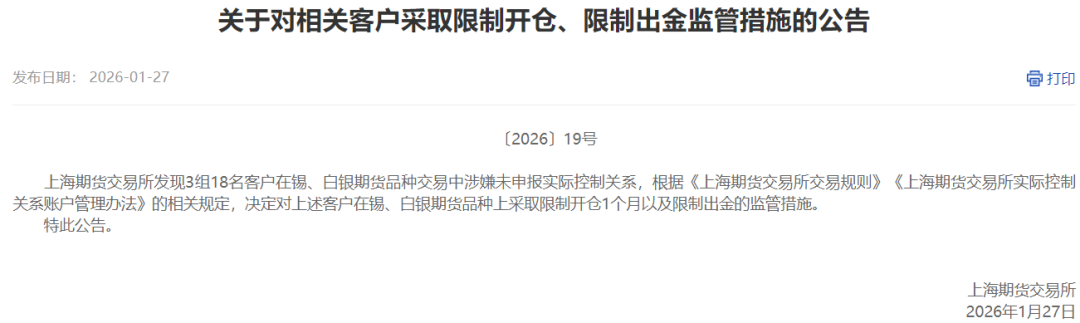
1月27日,上期所连发两则公告。公告显示,有9组实际控制关系账户在相关合约上账户组日内开仓交易量超限达到交易所处理标准,另有3组18名客户在 锡、白银期货品种交易中涉嫌未申报实际控制关系,交易所决定对相关客户采取限制开仓的监管措施,并对上述涉嫌未申报实际控制关系的18名客户采取 限制出金的监管措施。 出台多项风控措施。记者注意到,针对本轮贵金属、有色金属市场的高波动行情,上期所全面升级风控措施:一是调整交易保证金和交易手续费。目的是 提升交易门槛,抑制市场资金高杠杆和短线追涨行为,增强市场稳定性。二是调整涨跌停板幅度。其中,将白银涨跌停板幅度调整至16%、沪锡涨跌停板 幅度调整至11%、铜和铝涨跌停板幅度调整至9%。目的是避免极端行情影响,缓解价格剧烈波动。三是设定交易限额。其中,将白银日内开仓上限调整 为800手、锡日内开仓上限调整为200手等。目的是防止资金集中流入,引发短期异常价格波动,维护市场公平。 加强交易行为监管。2025年12月,上期所在异常交易行为管理方面,处理异常交易行为73起,其中自成交超限43起,频繁报撤单超限28起,日内开仓量超 限2起,均通过会员单位对上述达到异常交易处理标准的客户进 ...

60千克银锭变投资银条后被预订一空
Qi Huo Ri Bao· 2026-01-27 13:28
"说干就干。"让杨荣没想到的是,一次从期货市场采购银锭后制作成投资银条销售的尝试居然成功 了。"这次经历,我不仅见识了白银市场投资的狂热,也认识到看问题、做经营需要发散思维。更重要 的是,我深刻体会到,只有在做好风控的基础上,才能在宏观环境向好、经济发展前景乐观的宏观叙事 中实现人生目标。"她说。 "近日,随着白银期现货价格不断上涨,我从期货市场接下的60千克银锭成了抢手货,先前的担忧也随 之烟消云散。"来自河南省开封市的期货交易者杨荣告诉期货日报记者,自己制作的投资银条还没从深 圳的白银加工厂拿到店里,便已被打造银饰的匠人和喜爱金银收藏的亲友预订一空了。 记者注意到,近期,银价涨势迅猛,不少网友曝出买白银的经历,直呼"后悔卖早了"。杨荣也不例外。 1月27日,河南省郑州市、开封市的银锭销售价普遍在29元/克左右,比1月26日她卖出的价格涨了3元/ 克。 杨荣虽然开设有茶庄等企业,但也是一位资深期货交易者。本次从期货市场拿货,源于她细致入微的观 察。"2025年10月下旬以来,白银期现货价格持续上行,身边有众多打造银饰的匠人和喜爱金银收藏的 亲友为如何买到含银量足、价格适中的白银而发愁。"她告诉记者,思来想去 ...

再出手!18名客户被限制开仓和出金!交易所精准亮剑,守护市场“安全感”
Qi Huo Ri Bao· 2026-01-27 13:28
1月27日,上期所连发两则公告。公告显示,有9组实际控制关系账户在相关合约上账户组日内开仓交易量超限达到交易所处理标准,另有3组18名客户在 锡、白银期货品种交易中涉嫌未申报实际控制关系,交易所决定对相关客户采取限制开仓的监管措施,并对上述涉嫌未申报实际控制关系的18名客户采取 限制出金的监管措施。 自去年12月至今年1月,黄金、白银、铜、锡等品种价格相继刷新历史高位。沪金期货价格先后突破1000元/克、1100元/克整数关口,沪银期货价格先后 突破20000元/千克、30000元/千克整数关口。与此同时,沪铜期货价格站上100000元/吨,沪锡期货价格一度突破460000元/吨。 对此,市场人士认为,本轮贵金属、有色金属价格大涨,由宏观面和基本面利多因素共同推动,但短期价格快速拉升也令潜在风险上升,尤其是高杠杆资 金与非理性追涨行为可能会对市场稳健运行造成影响。 记者注意到,面对市场担忧,上期所打出风控和监管"组合拳",通过多轮风控措施,平抑市场过度波动,引导投资者理性交易,同时强化交易行为监管, 严厉打击违规交易行为,维护期货市场交易秩序。 发布风险提示,引导市场理性参与。上期所分别在2025年12月8日 ...
我国期货市场开放再升级:从“点状突破”迈向“产业链条系统性开放”
Qi Huo Ri Bao· 2026-01-27 12:12
Group 1 - The core viewpoint of the news is the expansion of China's futures market with the addition of 14 new futures options, including nickel, lithium carbonate, and paraxylene, marking a significant step in the gradual and structured opening of the market [1] - The opening of these new products reflects China's strategic focus on its competitive industries, such as being the largest consumer and importer of nickel, and the largest processor and consumer of lithium carbonate [1] - The inclusion of these products is expected to attract more foreign traders, enhance the international influence of "China prices," and improve global resource allocation capabilities, thereby increasing the resilience and competitiveness of the entire industry chain [1] Group 2 - Looking ahead, the market anticipates further reforms to deepen the opening of the futures market, such as extending trading hours for core products to cover major trading periods in Europe and the U.S. [2] - The steps taken in the opening of the futures market align closely with national strategies and serve the real economy, acting as a signal for China's deeper integration into the global economy and enhancing the pricing influence of key commodities [2] - A more open, transparent, and dynamic futures market is expected to provide stronger financial support for high-quality development and the construction of a modern industrial system [2]
三方面因素推动金银价格攀升
Qi Huo Ri Bao· 2026-01-27 03:21
1月26日,黄金和白银价格再创新高。伦敦现货黄金价格盘中一度突破5100美元/盎司,年内涨幅超 18%;伦敦现货白银价格盘中一度突破110美元/盎司,年内涨幅超50%。今年以来,贵金属价格震荡 走高,笔者认为,核心驱动来自贸易冲突、全球央行购金、地缘风险三方面。 最后,地缘风险上升使得贵金属获得了较高的风险溢价。美国年初对委内瑞拉发起大规模军事行动,强 行控制委内瑞拉总统马杜罗及其夫人并将他们带至美国,进一步强化了美国所谓"门罗主义"叙事,而争 夺关键矿产资源的目的也令贵金属直接受益。伊朗方面,美国官员表示,尽管已撤回对伊朗的打击计 划,但特朗普仍要求幕僚提供所谓的"决定性"军事选项。相关讨论正值美国向中东派遣航空母舰与喷气 式战斗机之际。这些部署可能标志着更大规模军事集结的开始,若特朗普决定对伊朗实施打击,此举将 为打击行动提供所需火力。美国官员透露,特朗普在描述希望美国行动对伊朗产生何种效果时,反复使 用了"决定性"一词。这一措辞促使美国五角大楼和白宫的幕僚细化了一系列供特朗普选择的方案,其中 一些方案旨在推动伊朗政权更迭。格陵兰岛方面,特朗普自去年上任以来曾多次扬言要得到格陵兰岛。 1月20日,美国总统 ...
沪铝 高位震荡
Qi Huo Ri Bao· 2026-01-27 01:32
Group 1 - The Trump administration's internal and foreign policy challenges have led to a significant weakening of the US dollar index [2] - The Guinea aluminum industry is set to resume production, with the AGB2A-GIC project expected to contribute approximately 40 million tons of bauxite supply by 2026 [2] - China's alumina production is projected to reach 92.45 million tons in 2026, with a net export volume of 2 million tons, indicating a loose global supply-demand situation for alumina [2] Group 2 - Global electrolytic aluminum production is expected to reach 76.58 million tons in 2026, with China's production at 45.44 million tons [3] - The demand for electrolytic aluminum in 2026 is projected to be 76.51 million tons globally, with China's demand at 47.33 million tons, suggesting a slightly loose supply-demand balance [3] - The recent increase in operational capacity for aluminum processing enterprises is attributed to seasonal demand growth, but the traditional consumption off-season may lead to a reduction in operational capacity [3] Group 3 - In the short term, the weakening of the US dollar index may suppress downstream demand, keeping aluminum prices stable [4] - In the medium to long term, expectations of Federal Reserve interest rate cuts, slow production ramp-up of new electrolytic aluminum capacity overseas, and domestic capacity nearing its limit may provide upward price potential for aluminum [4]
金银价格继续飙升 业内人士:静待美联储会议信号
Qi Huo Ri Bao· 2026-01-27 01:28
1月26日,金银价格继续飙升,录得新高。截至北京时间17:00,伦敦现货黄金价格最高升至5110.25美元 /盎司,伦敦现货白银价格最高触及110.06美元/盎司。受委内瑞拉、伊朗及格陵兰岛局势的扰动,市 场避险情绪升温,将金银价格推至新高。1月27日至28日,年内首场美联储议息会议将召开。美联储大 概率"按兵不动","何时具备降息条件"成为市场的关注焦点。 混沌天成期货宏观分析师周蜜儿向记者表示,近期金价上扬可归因于地缘局势变动、美元指数下跌以及 美债抛售预期。她认为,当前市场定价逻辑主要涵盖三个层面:一是委内瑞拉、伊朗及格陵兰岛等地缘 争端,二是美联储新任主席人选的预期,三是美国总统特朗普对欧洲的关税威胁。在这些不确定因素的 作用下,长期货币信用逻辑不断深化,机构对黄金的配置需求预期提升,引发了新一轮上涨行情。 值得注意的是,近期美元指数持续回落,1月26日盘中最低录得96.92点。金瑞期货贵金属研究员吴梓杰 认为,美元指数回落的原因有两方面: 一方面,与风险事件下"美国例外论"的暂时降温有关。本次地缘不确定性上升时,市场资金并未像以往 一样单向涌入美元资产,反而部分转向黄金、瑞士法郎等替代性避险资产,削 ...
宽松预期升温 债市交易情绪回暖
Qi Huo Ri Bao· 2026-01-27 01:23
近期,国债期货市场持续上行,尤其是长端债表现偏强,国债收益率曲线呈平坦化趋势。分析人士认 为,债市交易情绪回暖,主要受益于货币宽松预期升温以及权益市场"降温"带来的资金分流效应。央行 超预期投放中长期流动性,资金面无忧,近期公布的经济数据并未对债市造成太大影响,一季度债市回 暖行情有望延续。 ...