GEELY AUTO(00175)

Search documents
宇树科技回应“上市绿色通道被叫停”;苹果回应国行版AI上线;段永平再晒部分苹果持仓,累计收益率超16倍;巴菲特退休后最新发声丨邦早报
Sou Hu Cai Jing· 2026-01-05 00:33
Group 1 - Yushu Technology clarifies that it has not applied for the "green channel" for IPO and that its listing work is progressing normally [1] - Apple has initiated a gray test for its "Apple Smart and Siri" feature for certain domestic devices, but it has not officially launched yet [1] - Warren Buffett, after retiring, expressed confidence in the new CEO Greg Abel, stating he has full decision-making authority [1] - Investor Duan Yongping shared that his investment in Apple stock has yielded a return of over 1623.48%, amounting to approximately $34.26 million [1] Group 2 - Meituan has had 3.25 million RMB worth of equity frozen by a court, with the freeze lasting for three years [2] - The control struggle at Double Star Celebrity Group has intensified, with founder Wang Hai announcing a severance of ties with his son and daughter-in-law [2][3] Group 3 - Xiaopeng Motors' Vice President Chen Yonghai has left the company, with President Wang Fengying temporarily taking over his responsibilities [4] - Romaishi has initiated a restructuring plan called "Rebirth Plan," aiming to complete funding and restructuring by Q1 2026 [4] - GAC Honda has completed the acquisition of Dongfeng Honda Engine Company, changing its name to GAC Honda Engine Company [4] Group 4 - The French skincare brand Filorga announced the closure of its official flagship store due to strategic adjustments, with the store set to cease operations on January 31, 2026 [4] - Tesla's restaurant has seen a significant drop in customer traffic and the departure of its celebrity chef within six months of opening [4] Group 5 - The "Wawa Xiaozong" trademarks have been successfully registered, with rights valid until December 13, 2035 [7] - The facial cleansing brand "Washing Bear" has faced complaints of store closures, with the founder promising to address consumer rights [9] Group 6 - Burger King's online ordering system experienced significant failures, leading to multiple public apologies from the company [11] - Former Meta AI chief Yang Likun left the company, criticizing the focus on large language models as a dead end for achieving superintelligence [12] Group 7 - Cloud Leopard Intelligent has initiated its IPO process, aiming to become the first domestic DPU company listed [12] - Bole Technology has completed over 1 billion RMB in financing, marking the largest funding round in the unmanned mining vehicle sector [12] - Shurui Robotics has raised $100 million in its D round of financing [12] Group 8 - Geely has launched new PHEV models, with prices starting at 139,800 RMB, featuring advanced hybrid technology [13] - Grok has released a new version, optimizing video generation capabilities [15] Group 9 - During the 2026 New Year's holiday, 142 million domestic trips were made in China, with total spending reaching 84.79 billion RMB [18] - China's automobile exports to Venezuela increased by 130% in 2025, with significant growth in both passenger and commercial vehicle segments [18][19] - In November 2025, China's automobile exports reached 818,000 units, a year-on-year increase of 49.2% [19]






山海寻梦,不觉其远;前路迢迢,阔步而行 26家公司掌门人寄语2026
Shang Hai Zheng Quan Bao· 2026-01-04 20:55
Group 1 - Huawei's rotating chairman Meng Wanzhou emphasized the importance of resilience and professionalism in overcoming challenges and creating value, highlighting the long-term strategic opportunities presented by the wave of intelligent transformation [25] - Hengrui Medicine's chairman Sun Piaoyang announced plans to increase R&D investment, focusing on oncology, autoimmune, and metabolic diseases, while promoting international cooperation and accelerating overseas clinical trials [26] - Wanhua Chemical's chairman Liao Zengtai aims to enhance operational quality and focus on technological innovation, particularly in battery materials and high-end new materials [27] Group 2 - Muyuan Foods' chairman Qin Yinglin expressed commitment to smart pig farming and improving animal health, aiming to enhance the quality and safety of pork for consumers [28] - Gree Electric's chairman Dong Mingzhu plans to deepen the core business while accelerating in smart equipment and renewable energy sectors, emphasizing a commitment to green and digital transformation [29] - Geely Holding Group's chairman Li Shufu highlighted the importance of making bold decisions during critical moments, focusing on core values and sustainable development [30] Group 3 - SAIC Motor's chairman Wang Xiaoqiu stated the company will deepen reforms and focus on intelligent and electric vehicle development, aiming for high-quality growth [30] - Hengli Group's chairman Chen Jianhua emphasized the need for a proactive approach to overcome challenges and achieve breakthroughs in the coming years [31] - LONGi Green Energy's chairman Zhong Baoshen believes the photovoltaic industry is at a pivotal moment, with significant opportunities for innovation and growth [32] Group 4 - TCL's chairman Li Dongsheng stressed the importance of maintaining strategic focus and enhancing core capabilities to achieve high-quality development [33] - Inspur's acting chairman Li Jun highlighted the transformative impact of artificial intelligence on the economy and the need for open and collaborative innovation [35] - Trina Solar's co-chairman Gao Haichun mentioned the company's evolution from a product supplier to a solution provider, focusing on system-level product innovation [36] Group 5 - JinkoSolar's chairman Li Xian-de discussed the potential of space photovoltaic technology as a sustainable energy solution for future challenges [37] - LEO Technology's chairman Wang Xiangrong emphasized the importance of creating value beyond mere data growth, focusing on sustainable and collaborative progress [38] - Innovent Biologics' chairman Cui Jisong outlined the company's commitment to innovation and global expansion in the next decade [39] Group 6 - Fosun International's chairman Guo Guangchang highlighted the growing demand for health and wellness, emphasizing the need to leverage the company's strengths in various industries [40] - Obsidian Technology's chairman Huang Yuanhao expressed the importance of innovation in robotics and AI vision, aiming to lead in the upcoming technological revolution [41] - Volkswagen's chairman Yang Guoping emphasized the commitment to brand and innovation as the company embarks on a new journey in the "14th Five-Year Plan" [42]





比亚迪获全球纯电销冠!2026汽车国家补贴政策发布!特斯拉全球总产量突破900万辆!丨一周大事件
电动车公社· 2026-01-04 16:06
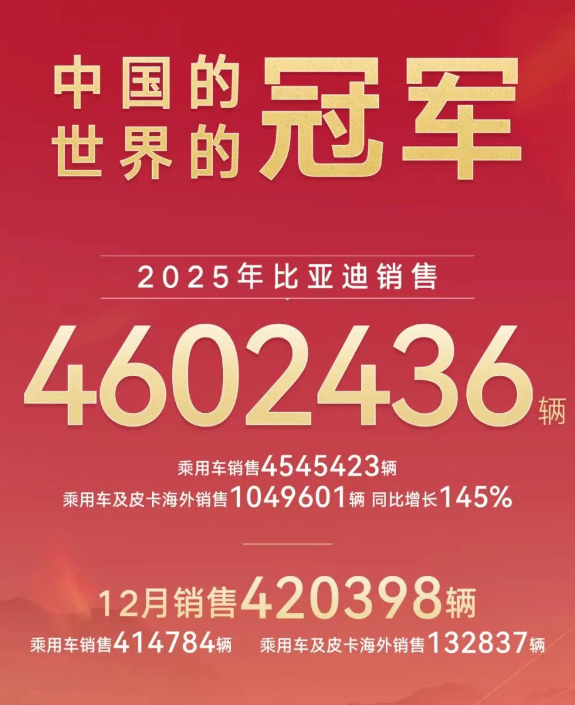
New Car Launches - The new GAC Trumpchi M8 has been launched with a price range of 309,900 to 359,900 yuan, offering three models [2][3] - The M8 features a 7-seat layout, a 140kW 2.0T engine, a 160kW electric motor, and a 44.5kWh lithium battery, providing a pure electric range of 248 km [6][8] Company Developments - FAW Group has officially acquired a 5% stake in Leap Motor for 3.744 billion yuan, marking a significant collaboration between a traditional automaker and a new energy vehicle brand [10][12] - Geely has completed the integration of its Qianli Intelligent Driving core business and technology system, focusing on advanced driving technologies [3][14] - Tesla's global production has surpassed 9 million vehicles, with the Shanghai Gigafactory contributing nearly half of the total deliveries [4][16] Industry News - The 2026 national subsidy policy for automobiles has been released, adjusting subsidies based on vehicle price to avoid excessive support for low-priced models [33][36] - CATL has established 1,325 battery swap stations, enhancing its service capabilities for both passenger and commercial vehicles [9][32] Sales Performance - BYD sold 414,784 passenger vehicles in December, with a total annual sales of 4,545,423 units, maintaining its leadership in the new energy vehicle market [37][40] - Geely's December new energy sales reached 154,264 units, contributing to an annual total of 3,024,567 units [41][42] - Changan Automobile reported total sales of 254,800 units in December, with over 1 million new energy vehicles sold throughout the year [45][50] - Leap Motor delivered 60,423 vehicles in December, achieving a total of 596,555 units for the year [17][62] - NIO delivered 48,135 vehicles in December, with a total of 326,028 units for the year, showing significant growth in the second half of the year [66][69]





汽车行业周报:2026年汽车以旧换新政策发布-20260104
GF SECURITIES· 2026-01-04 15:33
Investment Rating - The industry investment rating is "Buy" [6] Core Viewpoints - The report highlights the implementation of a large-scale equipment update and consumer goods replacement policy for 2026, which includes subsidies for scrapping and replacing vehicles. The policy is expected to significantly boost the sales of mid-to-high-end passenger cars [6][9][18]. - The report maintains a judgment of "price increase and stable volume" for domestic passenger car demand in 2026, indicating a positive outlook for the industry despite potential market fluctuations [18]. Summary by Sections 1. 2026 Vehicle Replacement Policy - The policy supports scrapping and replacing personal vehicles with subsidies of 12% (up to 20,000 CNY) for new energy vehicles and 10% (up to 15,000 CNY) for fuel vehicles with an engine size of 2.0 liters or less [9][10]. - It also includes support for scrapping old commercial vehicles and promoting the electrification of city buses [9][10]. 2. Market Share Tracking in PHEV Segment - The report focuses on the performance of PHEV market shares, particularly for BYD and Geely, as they adjust their market strategies and configurations [11]. - The analysis indicates significant variance in market shares due to increased supply and competitive strategies [11]. 3. Recent Report Insights - The continuation of the vehicle replacement policy aligns with expectations, and the report anticipates a rise in the proportion of mid-to-high-end passenger car sales due to the subsidy structure [18]. - The report reflects on the previous year's strategy of "emerging from deflation," which has proven to be correct, and emphasizes the importance of regulatory changes and strategic adjustments by leading companies [18]. 4. Investment Recommendations - The report suggests a "shelf-style" investment approach, recommending various companies across the passenger vehicle chain, including Geely, BYD, and others for potential growth [19]. - Specific companies are categorized into "right-side" and "left-side" targets based on their operational performance and market positioning [19].



车企2025年产销量放榜 突破多个“里程碑”
Zheng Quan Shi Bao Wang· 2026-01-04 14:38
Core Insights - Major automotive companies in China, including BYD, Changan Automobile, and Geely, reported significant sales growth for 2025, with a notable increase in overseas sales and milestones achieved by new energy vehicle manufacturers [1][2][5][7]. BYD - BYD's total sales for 2025 reached 4.6024 million units, a year-on-year increase of 7.73%, with pure electric vehicle sales growing nearly 28% and commercial vehicle sales increasing by approximately 162% [2]. - BYD's overseas exports of new energy vehicles totaled 133,200 units in December 2025, with annual overseas sales surpassing 1 million units, reflecting a 145% year-on-year growth [4]. - The total installed capacity of BYD's power batteries and energy storage batteries was approximately 285.634 GWh, marking a nearly 47% increase from the previous year [4]. Changan Automobile - Changan's total sales for 2025 reached 2.913 million units, a year-on-year growth of 8.54%, with self-owned brand sales increasing by 10.86% and new energy vehicle sales growing by about 50% [5]. BAIC Blue Valley - BAIC Blue Valley achieved significant production and sales growth, with total production reaching 206,300 units, a year-on-year increase of 127.17%, and total sales of 209,600 units, up 84.06% [6]. Geely Automobile - Geely's total vehicle sales for 2025 were 3.0246 million units, a 39% increase compared to the previous year, exceeding its annual sales target [7]. - Geely set a sales target of 3.45 million units for 2026, representing a growth of approximately 14% from 2025, with a new energy vehicle sales target of 2.22 million units, up 32% [7]. NIO - NIO reported a delivery of 48,100 units in December 2025, a year-on-year increase of 54.6%, with total deliveries for the year reaching 326,000 units, up 46.9% [8]. Li Auto - Li Auto delivered 44,200 new vehicles in December 2025, with a historical cumulative delivery surpassing 1.5 million units, expanding its market presence in Central Asia and Africa [9]. XPeng - XPeng delivered 37,500 smart electric vehicles in December 2025, with total annual deliveries of 429,400 units, reflecting a year-on-year growth of 126% [10]. - The company expanded its overseas market presence with 45,000 units delivered abroad, a 96% increase, and established 1,100 new charging stations, bringing the total to 3,000 [10].

车企2025“年终考”成绩单出炉
Mei Ri Jing Ji Xin Wen· 2026-01-04 14:21
Core Insights - The 2025 Chinese automotive market showcased a "stronger getting stronger, increasing differentiation" trend amid deepening new energy transitions and intense industry competition [1] Group 1: Performance of Leading Companies - BYD achieved sales of 4.6024 million vehicles in 2025, with overseas sales surpassing 1 million for the first time, marking a 145% year-on-year increase in passenger and pickup truck sales [2] - BYD's pure electric vehicle sales reached 2.2567 million units, a nearly 28% increase, surpassing Tesla's 1.636 million units, making BYD the global leader in annual electric vehicle sales [2] - Geely also exceeded its annual sales target, achieving 3.0246 million units sold, a 39% year-on-year increase, with new energy vehicle sales reaching 1.6878 million units, up 90% [2] Group 2: Performance of Other Companies - Dongfeng Motor achieved its dual target of over 1 million new energy vehicles and 1.5 million total vehicle sales, with new energy vehicle sales reaching 1.04 million, a 21% increase [3] - Changan Automobile reported sales of 2.913 million vehicles, a growth of 8.5%, with new energy vehicle sales of 1.109 million, up 51% [5] - Chery Group sold 2.8064 million vehicles, a 7.8% increase, with new energy vehicle sales reaching 903,800 units, a 54.9% increase [5] Group 3: Underperformance of Certain Companies - China FAW achieved a total vehicle sales of 3.302 million, a 3.2% increase, but fell short of its target of 3.45 million [4] - Great Wall Motors reported sales of 1.3237 million vehicles, a 7.33% increase, but only achieved 33.09% of its 4 million target [5][6] - New energy vehicle sales for Great Wall reached 403,700 units, a 25.44% increase, but the overall performance was below expectations [5][6] Group 4: New Forces in the Market - Among new forces, Leap Motor, Xiaomi, and Xpeng all exceeded their annual sales targets, with Leap Motor achieving 596,600 units sold, marking a 119.3% target completion rate [7] - Xiaomi's vehicle deliveries surpassed 50,000 in December 2025, exceeding its annual target of 350,000 [7] - NIO and Li Auto, however, did not meet their targets, with NIO selling 326,000 units and Li Auto selling 406,300 units, both falling short of their respective goals [8][9]

我们该怎样记住2025年的中国汽车?
Xin Lang Cai Jing· 2026-01-04 11:30
Core Insights - The Chinese automotive industry has undergone a significant transition in 2025, moving towards the popularization of electrification and the acceptance of safety and responsibility in intelligent driving, while the focus has shifted from expansion to efficiency, governance, and organizational capability [2][69]. Group 1: Industry Competition and Regulation - The Chinese automotive sector has seen a comprehensive intervention from the government to restore competitive order, addressing issues like price wars and production consistency [4][70]. - The intervention marks a shift from merely addressing price control to tackling the root cause of competition, which is the high degree of product and capability homogeneity among companies [6][73]. - The need for differentiation in competition is emphasized, suggesting that true market differentiation must be established to eliminate the cycle of homogeneous competition [9][75]. Group 2: State-Owned Enterprise Reform - The establishment of a new state-owned enterprise, Changan Automobile, marks a significant reform in the state-owned automotive sector, indicating a shift from scale and form to mechanisms and efficiency [10][14]. - The reform aims to enhance the capabilities of state-owned enterprises, focusing on creating irreplaceable advantages in key areas [12][14]. - The changes in state-owned enterprises reflect a broader trend towards efficiency and capability building in the face of new industry challenges [15][64]. Group 3: Intelligent Driving and Safety - The rapid adoption of intelligent driving technologies has led to a shift in focus from technical capabilities to safety and responsibility, with companies facing increased scrutiny over their marketing practices [16][18]. - A significant traffic accident in March 2025 highlighted the urgent need for clear definitions of responsibility and safety standards in intelligent driving [18][21]. - Companies like Geely are taking proactive steps to enhance safety standards, indicating a broader industry trend towards building safety as a core competency [21][23]. Group 4: Globalization and Market Dynamics - The Chinese automotive industry is increasingly viewed as a key player in global market dynamics, with companies recognizing the need for localized manufacturing and long-term partnerships abroad [44][46]. - The shift from merely exporting products to establishing a presence in foreign markets reflects a deeper understanding of the complexities of global trade [44][46]. - The evolving landscape of international relations, particularly between China and the West, is reshaping how Chinese automotive companies approach global expansion [43][48]. Group 5: Capital Market Engagement - The surge of Chinese automotive companies seeking IPOs in Hong Kong indicates a strategic reassessment of capital and risk in light of global market changes [56][58]. - The focus on stable cash flow and clear profit models is becoming essential as the industry transitions into a phase of stock competition and technological differentiation [56][58]. - The choice of Hong Kong for IPOs reflects a desire for regulatory stability and alignment with global standards, enhancing transparency and governance [58][61]. Group 6: Industry Consolidation and Efficiency - A trend of strategic consolidation is emerging, with companies prioritizing resource concentration and efficiency over brand proliferation [66][66]. - Major global automakers are also reducing operations and focusing on core competencies, indicating a broader industry recognition that scale alone may not ensure safety in a volatile market [66][66]. - The end of the expansion phase in the automotive industry signals the beginning of a more competitive environment that tests endurance, efficiency, and organizational capabilities [66][66].

盘点自主五强的2025,哪家增长最有含金量?
Xin Lang Cai Jing· 2026-01-04 11:29
尖子生就要比学赶超! 编辑:梅梅 回顾2025年,自主五强销量均有增长。 比亚迪460万辆,吉利302万辆,长安超290万辆,奇瑞280万辆,长城132万辆——哪家的增长最有含金量? 比亚迪继续稳坐NO.1宝座,拿下三冠王:中国汽车市场车企销量冠军、中国汽车市场品牌销量冠军、全球新能源车市场销量冠军。值得关注的是,比亚 迪2025年海外出口已超百万台,同比增长145%,直追"出口一哥"奇瑞。2025年,奇瑞出口销量为134.4万辆。 超额完成2025全年任务后,吉利已放出2026年目标:全年销量冲击345万辆,新能源目标为222万辆。过去两年,吉利集团都在年中宣布上调销量目标—— 有理由相信,345万辆只是吉利2026的保底? 作为自主五强中的唯一央企,长安汽车2025销量创九年新高,总销量超290万辆,同比增长8.5%,连续6年实现同比正增长。长城汽车整体销量虽不及前 面四强,但132万辆仍创下历史新高。 头部的较量,犹如尖子生的"比学赶超",没一个孬的! 2026年,你觉得自主五强中,哪家更有后劲呢? 尖子生就要比学赶超! 编辑:梅梅 回顾2025年,自主五强销量均有增长。 比亚迪460万辆,吉利302万 ...

跨越302万辆销量里程碑:吉利汽车正以硬核技术重塑全球竞争位势
Huan Qiu Wang· 2026-01-04 11:15
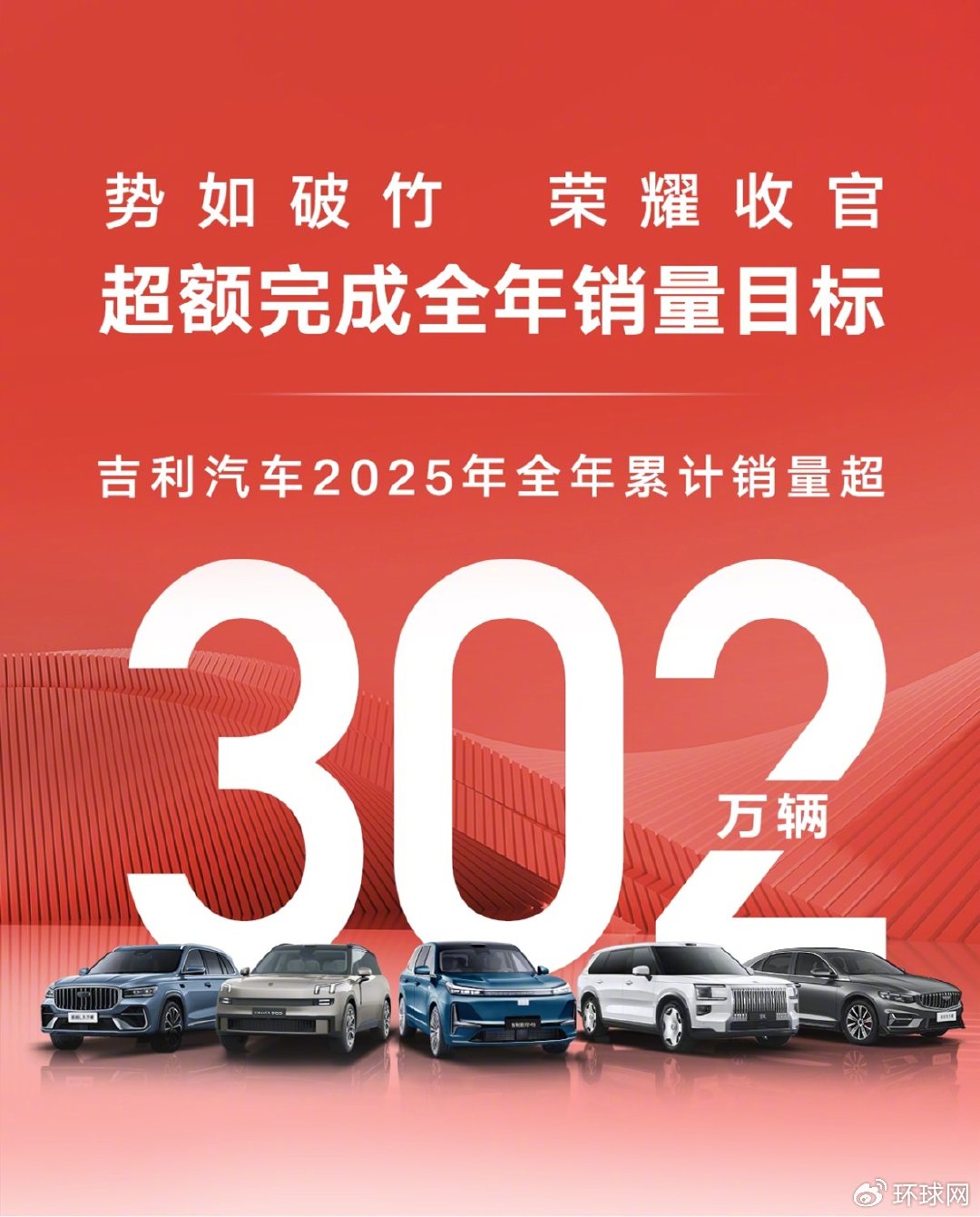
Core Viewpoint - Geely Auto has achieved a significant milestone with a total annual sales of 3,024,567 vehicles in 2025, marking its emergence as a key player in the global automotive industry, particularly in the electric vehicle (EV) segment [1][4]. Group 1: Sales Growth and Market Position - Geely's sales increased by 39% year-on-year, surpassing its adjusted target of 3 million vehicles for the year [4]. - The company’s EV sales reached 1,687,767 units, representing a remarkable 90% year-on-year growth, solidifying its position in the first tier of the EV market [4]. - Geely's Galaxy brand became the fastest domestic EV brand to exceed annual sales of 1 million units, achieving 1.24 million units sold in 2025, a 150% increase [6]. Group 2: Product and Technology Development - Geely has made substantial investments in technology, safety, and quality, culminating in the successful execution of its "Smart Geely 2025" strategy [8]. - The company launched the industry's first "full-domain AI" technology system, enhancing its competitive edge in smart vehicle technology [11]. - Geely's safety initiatives are highlighted by its leading position in safety patents and the establishment of a global safety center, achieving multiple five-star ratings in Euro NCAP tests [12]. Group 3: Global Expansion and Strategic Initiatives - Geely's overseas sales reached 420,000 units in 2025, with over 120,000 units being EVs, indicating a shift from mere trade exports to a more advanced "system export" model [13][14]. - The company has implemented a "Five-Five" global strategy, establishing multiple design and engineering centers worldwide to enhance its global resource allocation capabilities [15]. - Geely is advancing its local production capabilities in various regions, including the establishment of CKD factories in Egypt and Indonesia, and partnerships for local production in Brazil [17]. Group 4: Future Outlook - Geely has set an ambitious sales target of 3.45 million vehicles for 2026, with a focus on achieving 2.22 million EV sales [19]. - The company plans to launch approximately 10 new models and expand its high-value vehicle offerings globally, furthering its dual fuel strategy [19]. - Geely aims to enhance its AI technology integration across all vehicle models, promoting smart mobility solutions in everyday life [20].
12月国内销量跟踪
数说新能源· 2026-01-04 03:59
Sales Performance - BYD sold 420,398 vehicles, a year-on-year decrease of 18.3% and a month-on-month decrease of 11.5% [1] - NIO delivered 48,135 vehicles, a year-on-year increase of 54.6% and a month-on-month increase of 32.7% [1] - Li Auto delivered 44,246 vehicles, a year-on-year decrease of 24.4% but a month-on-month increase of 33.3% [1] - Xpeng delivered 37,508 vehicles, a year-on-year increase of 2.2% and a month-on-month increase of 2.1% [1] - Leap Motor delivered 60,423 vehicles, a year-on-year increase of 42.1% but a month-on-month decrease of 14.1% [1] - Lantu delivered 15,954 vehicles, a year-on-year increase of 31.5% but a month-on-month decrease of 20.2% [1] - Seres sold 57,000 vehicles, a year-on-year increase of 88.7% and a month-on-month increase of 4.9% [1] - Avita delivered 10,470 vehicles, a year-on-year decrease of 5.4% and a month-on-month decrease of 25.5% [1] - Geely sold 154,264 vehicles, a year-on-year increase of 38.7% but a month-on-month decrease of 17.9% [1] - SAIC-GM sold 11,307 vehicles, a year-on-year increase of 89.9% and a month-on-month increase of 6% [1] - Wuling sold 122,838 vehicles, a year-on-year increase of 31.2% and a month-on-month increase of 11.2% [1] - It is expected that 1.92 million electric vehicles (including commercial vehicles) will be sold in December in China, a year-on-year increase of 20.3% and a month-on-month increase of 5.32% [1] Industry Trends - The procurement of battery cells by manufacturers is focusing on balancing performance and cost [5] - BYD is expanding its presence in Southeast Asia [5] - CATL indicates that the growth in the energy storage market is outpacing that of the power market [9]