CNRE(600111)

Search documents
重视锂权益配置,电力短缺铝供给逻辑强化
Changjiang Securities· 2025-11-10 08:13
Investment Rating - The report maintains a "Positive" investment rating for the industry [7] Core Views - The overall industrial metal prices have experienced a decline, particularly in the overseas market, primarily due to liquidity issues in the US banking system. The government shutdown has led to a tightening of cash balances, impacting global risk assets. Concerns over power shortages in North America due to data center developments have raised fears of production halts in high-energy-consuming sectors like aluminum and zinc, resulting in relatively strong prices for these commodities. The lithium industry has seen a turnaround, with improving supply-demand fundamentals. The uncertainty in overseas resource development and weak profitability due to low lithium prices have peaked capital expenditures in the industry by 2024-2025, with a confirmed trend of declining supply growth from 2026 to 2028. By 2026, equity values are expected to outperform commodity prices, potentially leading the market out of a downturn [2][4][5]. Summary by Sections Precious Metals - The ongoing US government shutdown has heightened risk aversion, which is expected to drive gold prices higher in the short term. The report emphasizes that gold prices are currently stabilizing rather than indicating a trend reversal. Historically, gold prices tend to peak early in a rate-cutting cycle, and the current macroeconomic environment suggests that gold may not have reached its peak yet. The report maintains a positive outlook for gold, suggesting that the market is entering a phase of systematic re-evaluation [4]. Industrial Metals - The report highlights a long-term positive outlook for copper and aluminum. Recent price adjustments in these metals are attributed to liquidity issues in the US. The report notes that copper inventories have increased by 4.68% week-on-week and 25.01% year-on-year, while aluminum inventories have decreased by 0.49% week-on-week and 13.31% year-on-year. The report suggests that despite short-term fluctuations, the long-term economic outlook and supply-demand structure will favor a strong cycle for copper and aluminum [4][5]. Energy and Minor Metals - The lithium sector is expected to see a supply inflection point and a new demand cycle. The report indicates that the darkest period for the lithium industry has passed, with a clear trend of improving supply-demand fundamentals. The demand for lithium is projected to grow significantly due to stable domestic power needs and the acceleration of solid-state battery industrialization. The report also highlights the strategic importance of rare earths and tungsten, with expectations of a new upward trend in prices due to supply constraints and increased demand [5][24]. Supply Dynamics - The report discusses the high concentration of supply in cobalt and nickel, with specific attention to the Democratic Republic of Congo's cobalt quotas and Indonesia's tightening supply policies for nickel. These factors are expected to support long-term price increases for both cobalt and nickel, benefiting resource-oriented companies [5][24].




行业周报:有色金属周报:全球缺电行情持续,看好电解铝后续走势-20251109
SINOLINK SECURITIES· 2025-11-09 12:46
Investment Ratings - The report maintains a positive outlook on copper, aluminum, and precious metals, indicating high market activity and potential for investment [12][34][62] Core Insights - Copper prices have shown a slight decline, but the overall market remains robust with increasing demand and production recovery [13][14] - Aluminum market is experiencing a turning point with supply constraints and stable demand, leading to potential price increases [14] - Precious metals, particularly gold, are stabilizing amidst geopolitical tensions and economic uncertainties, suggesting a favorable investment environment [15] Summary by Sections Copper - LME copper price decreased by 1.80% to $10,695.00 per ton, while domestic prices fell by 1.23% to 86,000 yuan per ton [13] - Domestic copper inventory increased to 203,300 tons, marking a three-year high, with a notable rise in production rates among major cable manufacturers [13][14] - The demand for copper is recovering as prices decline, leading to improved order volumes and production rates [13] Aluminum - LME aluminum price decreased by 0.90% to $2,862.00 per ton, while domestic prices increased by 1.53% to 21,600 yuan per ton [14] - Domestic electrolytic aluminum inventory reached 622,000 tons, with a slight increase in production rates among downstream processing enterprises [14] - The aluminum market is facing challenges due to environmental regulations and seasonal demand fluctuations, but there is potential for recovery in specific sectors [14] Precious Metals - COMEX gold price decreased by 0.15% to $4,007.80 per ounce, with SPDR gold holdings increasing to 1,042.06 tons [15] - The gold market is influenced by ongoing U.S. government shutdowns and geopolitical risks, maintaining a strong but volatile trading environment [15] - The overall sentiment in the precious metals market remains positive, with expectations of price stabilization and potential upward movement [15] Rare Earths - Prices for praseodymium and neodymium oxide increased by 4.23%, driven by heightened demand expectations following the suspension of export control measures [34] - The rare earth sector is expected to see significant price increases due to supply constraints and strategic importance in various industries [34] Antimony - Antimony prices decreased by 6.89%, but the market outlook is improving due to potential recovery in export demand and stable domestic consumption [36] - The report suggests that resource scarcity and reduced global supply could lead to upward price adjustments in the future [36] Tin - Tin prices slightly decreased by 0.12%, but the market is expected to remain resilient due to ongoing supply chain disruptions and stable demand [37] - The report highlights the impact of regulatory actions in Indonesia aimed at curbing illegal mining, which may support future price stability [37] Lithium - Lithium carbonate prices increased by 2.14% to 80,600 yuan per ton, with production levels showing a slight rise [62] - The lithium market is experiencing strong demand growth, particularly in the energy storage and electric vehicle sectors, which is expected to support prices [62]



2025年12月沪深300、上证50和科创50等指数调整名单预测
Shenwan Hongyuan Securities· 2025-11-08 12:42
- The report predicts adjustments to the constituent stocks of major indices, including CSI 300, CSI 500, CSI 1000, CSI 2000, SSE 50, and STAR 50, based on publicly available index compilation rules and data [5][10][16][18][20] - CSI 300 Index is constructed by selecting the top 50% stocks based on average daily trading volume over the past year, followed by the top 300 stocks ranked by average daily market capitalization, while adhering to a 10% adjustment limit, priority for old samples, and a 20% buffer zone rule [5] - The adjustment prediction for CSI 300 Index involves calculating the average daily market capitalization and trading volume of A-shares over the past year, excluding stocks with suspension, violations, or financial reporting issues [5] - The report defines a "shock coefficient" to measure the price impact and duration caused by passive index fund rebalancing, calculated as: $ Shock Coefficient = (Passive Buy Amount - Passive Sell Amount) / Average Daily Trading Volume $ This coefficient is applied to assess the impact of adjustments on stocks [6][9] - CSI 500 Index is constructed by excluding CSI 300 constituent stocks and the top 300 stocks by average daily market capitalization over the past year, followed by removing the bottom 20% stocks by average daily trading volume, and selecting the top 500 stocks by market capitalization, adhering to a 10% adjustment limit, priority for old samples, and a 10% buffer zone rule [10] - CSI 1000 Index is constructed by excluding CSI 800 constituent stocks, the top 300 stocks by market capitalization, and stocks with insufficient liquidity (bottom 20% by trading volume), selecting the top 1000 stocks by market capitalization over the past year [16] - CSI 2000 Index is constructed by excluding CSI 800 and CSI 1000 constituent stocks, the top 1500 stocks by market capitalization, and selecting the top 2000 stocks by market capitalization over the past year [16] - SSE 50 Index is constructed by selecting the top 50 stocks by market capitalization and liquidity from the Shanghai Stock Exchange, adhering to adjustment rules similar to other indices [18] - STAR 50 Index is constructed by selecting the top 50 stocks by market capitalization from STAR Market, excluding stocks with delisting risks, major violations, or low liquidity (bottom 10% by trading volume) [20] - The report predicts adjustments to the STAR 50 Index, with two stocks, Aojie Technology-U and Shengke Communication-U, being added [20] - The shock coefficients for the predicted adjustments are calculated for each stock, with the highest coefficients observed for stocks such as Guangqi Technology and Ningbo Port in CSI 300, and Sheneng Shares and Suzhou Supor in CSI 500 [7][11][19][21]




小金属需求持续增长,有色金属行业进入供需紧平衡驱动新周期,稀有金属ETF(159608)连续3日上涨,盘中最高涨超2%!
Xin Lang Cai Jing· 2025-11-07 06:49
Group 1: Rare Earth Industry - The rare earth industry experienced significant improvement in the first three quarters of 2025, with major product prices rising notably. The average market price of praseodymium and neodymium oxide reached 467,300 yuan/ton, a year-on-year increase of 21.81% [1] - In Q3 2025, the average price reached 540,000 yuan/ton, reflecting a year-on-year increase of 39.10% and a quarter-on-quarter increase of 24.96% [1] - Benefiting from price increases and production growth, Northern Rare Earth's net profit attributable to shareholders grew by 280.27% year-on-year in the first three quarters, with a quarter-on-quarter increase of 21.84% in Q3 [1] - The recovery in the rare earth industry has led to increased production and sales of functional materials and permanent magnet motors, indicating a phase of simultaneous volume and price growth [1] - With the consensus reached between China and the US on export control issues, the export channels for rare earth products are expected to improve, leading to a significant increase in overseas demand and a potential rise in praseodymium and neodymium oxide prices [1] Group 2: Lithium Industry - The lithium industry is gradually improving its supply-demand balance, with core resource attributes becoming more prominent. Supply-side high-cost capacity is being phased out, and environmental compliance efforts are increasing [1] - Capital expenditures are significantly slowing down, leading to limited supply growth in the medium to long term [1] - Short-term demand is benefiting from the release of energy storage both domestically and internationally, while medium to long-term lithium battery demand is expected to enter a long-term boom cycle due to power reform and breakthroughs in solid-state battery technologies [1] Group 3: Cobalt and Tin Industries - The Democratic Republic of Congo has implemented a cobalt export quota policy, with quotas set at 18,125 tons for 2025 and 96,600 tons for 2026 and 2027, which is less than half of the 2024 production [2] - In the context of export restrictions, cobalt resources are expected to continue depleting, potentially leading to supply shortages and upward pressure on cobalt prices [2] - In the tin sector, recent actions by Indonesia to crack down on illegal tin mines and smuggling routes are expected to disrupt off-market supply, making it difficult for tin prices to decline significantly [2] Group 4: ESG and Policy Support - The ESG evaluation system in the non-ferrous metals industry is improving, with new indicators related to "green mining," "green energy use," and "emission reduction measures" being added [2] - The Ministry of Industry and Information Technology and other departments released a work plan for stable growth in the non-ferrous metals industry for 2025-2026, emphasizing green upgrades, digital transformation, and scientific capacity layout to support sustainable development [2] Group 5: ETF Performance - As of November 7, 2025, the China Rare Metals Theme Index rose by 1.80%, with the Rare Metals ETF (159608) increasing by 1.61%, marking a three-day consecutive rise [4] - Over the past two weeks, the Rare Metals ETF has accumulated a rise of 5.53%, with significant increases in component stocks such as Tianhua New Energy and Shengxin Lithium Energy [4] - The ETF has seen a scale increase of 559 million yuan over the past three months, with a total inflow of 148 million yuan over the last 21 trading days [4]


北方稀土涨2.02%,成交额22.88亿元,主力资金净流出6219.00万元
Xin Lang Cai Jing· 2025-11-07 03:30
Core Viewpoint - Northern Rare Earth's stock price has shown significant volatility, with a year-to-date increase of 131.11%, but a recent decline in the last five and twenty trading days [1][2]. Company Overview - Northern Rare Earth (China Northern Rare Earth Group High-Tech Co., Ltd.) is located in Baotou, Inner Mongolia, and was established on September 12, 1997, with its listing on September 24, 1997 [1]. - The company specializes in rare earth raw materials, functional materials, and some terminal application products [1]. - Revenue composition includes production business (132.93%), functional materials and application products (31.31%), trading business (27.24%), and environmental industry and others (4.01%) [1]. Financial Performance - For the period from January to September 2025, Northern Rare Earth achieved a revenue of 30.292 billion yuan, representing a year-on-year growth of 40.50%, and a net profit attributable to shareholders of 1.541 billion yuan, up 280.27% year-on-year [2]. - Cumulative cash dividends since the A-share listing amount to 5.358 billion yuan, with 994 million yuan distributed over the past three years [3]. Shareholder Structure - As of September 30, 2025, the number of shareholders increased to 735,600, with an average of 4,914 circulating shares per person, a decrease of 0.76% from the previous period [2]. - Major shareholders include Hong Kong Central Clearing Limited, Huatai-PB CSI 300 ETF, and E Fund CSI 300 ETF, with notable changes in their holdings [3].
美国关键矿产清单发布,新增10种矿产!四大投资逻辑显现,有色龙头ETF(159876)逆市活跃,冲击3连涨
Xin Lang Ji Jin· 2025-11-07 03:10
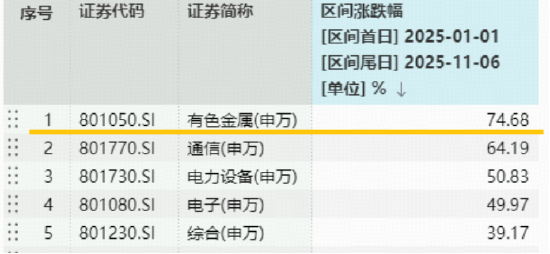
Core Insights - The importance of non-ferrous metals is highlighted by two significant announcements: the inclusion of copper, silver, and uranium in the U.S. critical minerals list and China's commitment to optimizing export control processes for rare earths and other dual-use items [1][2]. Group 1: U.S. Critical Minerals List - The U.S. Geological Survey released the 2025 critical minerals list, which includes ten newly added minerals such as boron, copper, lead, metallurgical coal, phosphates, potassium salts, rhenium, silicon, silver, and uranium [1]. - Minerals on this list will receive government funding support and expedited approval processes, emphasizing their strategic importance in the current international context [1]. Group 2: China's Export Control Measures - China's Ministry of Commerce stated that items like rare earths have dual-use properties and will be permitted for compliant applications, aiming to enhance communication and cooperation with other countries [1]. - The focus is on ensuring the stability and security of global supply chains while promoting compliant trade practices [1]. Group 3: Market Dynamics and Investment Opportunities - The non-ferrous metals sector is expected to benefit from "resource nationalism," which exacerbates supply-demand conflicts as resource-rich countries tighten controls, leading to increased development costs and potential price surges for strategic metals like copper [1]. - The anticipated start of a new macroeconomic cycle, indicated by narrowing declines in the Producer Price Index (PPI), suggests that industrial and minor metals may become core investment targets in the upcoming market [1]. Group 4: Performance of Non-Ferrous Metals Sector - The non-ferrous metals sector has seen a significant increase of 74.68%, leading the industry, supported by strong fundamentals [2]. - Among the 60 stocks in the leading non-ferrous metals ETF (159876), 56 companies reported profits, with 44 showing year-on-year net profit growth, including notable increases from companies like Chuangjiang New Material and Guocheng Mining [2]. Group 5: Investment Strategy - Direct investment in the non-ferrous metals sector allows investors to benefit from both the safe-haven value of precious metals and the growth potential of industrial metals in high-demand sectors like renewable energy and aerospace [2]. - The non-ferrous metals ETF (159876) provides a diversified approach, tracking a range of metals including copper, aluminum, gold, rare earths, and lithium, which helps mitigate risks associated with investing in single metal sectors [3].


西部证券晨会纪要-20251107
Western Securities· 2025-11-07 02:23
Group 1: Banking Sector - The report indicates that since 2022, banks have been utilizing diversified methods to accelerate the write-off and transfer of retail loans, which is expected to quickly clear existing non-performing assets [1][7][8] - As of Q2 2025, the total retail loan amount of listed banks reached 63.3 trillion yuan, accounting for 34.3% of total loans, with personal housing loans being the largest component [7][8] - The retail loan non-performing rate has been on the rise, reaching 1.29% in Q2 2025, which is an increase of 13 basis points from Q4 2024, indicating ongoing pressure on asset quality [7][8][9] Group 2: Electronics Sector - Aojie Technology - Aojie Technology reported a revenue of 28.80 billion yuan for the first three quarters of 2025, representing a year-on-year increase of 13.4% [11][12] - The company’s core business, cellular baseband chips, saw a revenue growth of approximately 25%, significantly improving its gross margin [11][12] - Revenue projections for 2025, 2026, and 2027 are estimated at 44.12 billion yuan, 57.70 billion yuan, and 73.34 billion yuan respectively, with a corresponding price-to-sales ratio of 8, 6, and 5 times [12][13] Group 3: Computer Sector - Jingwei Hengrun - Jingwei Hengrun achieved a revenue of 44.64 billion yuan in the first three quarters of 2025, marking a year-on-year growth of 25.88% [15][16] - The company is expanding its smart port solutions, having successfully delivered automated driving vehicles to a significant client, indicating strong commercial traction [15][16] - Revenue forecasts for 2025, 2026, and 2027 are projected at 70.8 billion yuan, 90.9 billion yuan, and 109.1 billion yuan, with expected net profits of 0.61 billion yuan, 3.85 billion yuan, and 6.19 billion yuan respectively [15][16] Group 4: Power Equipment Sector - Terui De - Terui De reported a revenue of 98.34 billion yuan for the first three quarters of 2025, reflecting a year-on-year increase of 10.53% [18][19] - The company’s net profit for the same period was 6.86 billion yuan, a significant increase of 53.55% year-on-year [18][19] - The company is expanding its overseas market presence, with a notable project completed in Saudi Arabia, enhancing its profitability [19][20] Group 5: Rare Earth Sector - Northern Rare Earth - Northern Rare Earth reported a revenue of 302.92 billion yuan for the first three quarters of 2025, a year-on-year increase of 40.50% [22][23] - The company’s net profit surged by 280.27% to 15.41 billion yuan, driven by rising rare earth prices [22][23] - The production of rare earth oxides increased by 93.45% year-on-year, indicating strong demand and operational efficiency [23][24] Group 6: Automotive Sector - BYD - BYD achieved a revenue of 566.27 billion yuan in the first three quarters of 2025, a year-on-year growth of 12.75% [25][26] - The company sold 3,260,146 vehicles in the same period, representing an 18.64% increase year-on-year [25][26] - Despite revenue growth, net profit decreased by 7.55% due to increased R&D expenses and reduced foreign exchange gains [25][26] Group 7: Non-Ferrous Metals Sector - Srey New Materials - Srey New Materials reported a revenue of 11.74 billion yuan for the first three quarters of 2025, a year-on-year increase of 21.74% [31][32] - The company’s net profit for the same period was 1.08 billion yuan, reflecting a growth of 37.74% [31][32] - The company is expanding its product offerings to meet the growing demands in commercial aerospace and medical imaging sectors [32]




北方稀土(600111):25年三季报业绩点评:稀土行业Q3景气度持续上行,公司实现量价齐升
Western Securities· 2025-11-06 12:04
Investment Rating - The report assigns a rating of "Accumulate" for the company [6][11]. Core Views - The rare earth industry has seen a significant increase in prosperity in Q3 2025, with the company achieving both volume and price growth [1][2]. - For the first three quarters of 2025, the company reported operating revenue of 30.292 billion yuan, a year-on-year increase of 40.50%, and a net profit attributable to shareholders of 1.541 billion yuan, a year-on-year increase of 280.27% [1][3]. - The substantial growth in Q3 performance is primarily attributed to a significant rise in rare earth prices [1][3]. Summary by Sections Financial Performance - In Q3 2025, the company achieved operating revenue of 11.425 billion yuan, a year-on-year increase of 33.32% and a quarter-on-quarter increase of 19.27% [1][2]. - The net profit attributable to shareholders for Q3 was 610 million yuan, a year-on-year increase of 69.48% and a quarter-on-quarter increase of 21.84% [1][2]. - The non-recurring net profit for Q3 was 466 million yuan, a year-on-year increase of 85.91% and a quarter-on-quarter increase of 0.8% [1][2]. Production and Sales - The production of rare earth oxides reached 22,000 tons in the first three quarters of 2025, a year-on-year increase of 93.45% [2]. - The production of rare earth salts was 109,800 tons, a year-on-year increase of 3.7%, and rare earth metals reached 36,300 tons, a year-on-year increase of 26.67% [2]. - In Q3 2025, the production of rare earth magnetic materials was 19,700 tons, a year-on-year increase of 15.68% [2]. Price Trends - The market price of praseodymium-neodymium oxide in Q3 2025 was 540,000 yuan per ton, a year-on-year increase of 39.10% and a quarter-on-quarter increase of 24.96% [3]. - The average market price for the first three quarters of 2025 was 467,300 yuan per ton, a year-on-year increase of 21.81% [3]. Earnings Forecast - The company is expected to have EPS of 0.67, 0.86, and 1.10 yuan for the years 2025, 2026, and 2027 respectively, with corresponding PE ratios of 71.9, 56.0, and 43.6 [3][4].
德媒:要不是中国把所有脏活累活全给干了,欧洲今天也不会这么惨
Sou Hu Cai Jing· 2025-11-05 13:58
Core Insights - China has significantly advanced in the rare earth industry, leaving Western countries at a disadvantage due to their earlier decision to outsource rare earth processing to China [2][3][5] - Rare earth elements, consisting of 17 different elements, are crucial for various technologies, including electric vehicles, wind turbines, and military applications [2][5] - The shift of rare earth production to China began in the 1990s, driven by Western companies seeking lower costs and less stringent environmental regulations [3][5][8] Industry Developments - In the 1990s, Western countries, including the US and Australia, had significant rare earth production but faced high costs and environmental challenges, leading to a decline in domestic production [3][5] - By 2008, China accounted for 80% of global rare earth exports, while Western countries relied on technology transfers to access cheaper Chinese products [5][6] - The European Union recognized the risks of dependency on Chinese rare earths but has been slow to take action, with recent initiatives aiming to reduce reliance by increasing local production [6][8] Market Dynamics - China's rare earth production reached 100,000 tons in 2015, while European demand for electric vehicles surged, highlighting the growing dependency on Chinese supply [6][8] - The EU's recent strategies, including the RESourceEU plan, aim to reduce reliance on China by developing local mining capabilities, although this is expected to take years [8][10] - China's dominance in the rare earth market has led to concerns in Europe regarding national defense and green energy initiatives, as the continent struggles to secure alternative sources [8][10]
11月5日投资时钟(399391)指数涨0.03%,成份股国城矿业(000688)领涨
Sou Hu Cai Jing· 2025-11-05 09:55
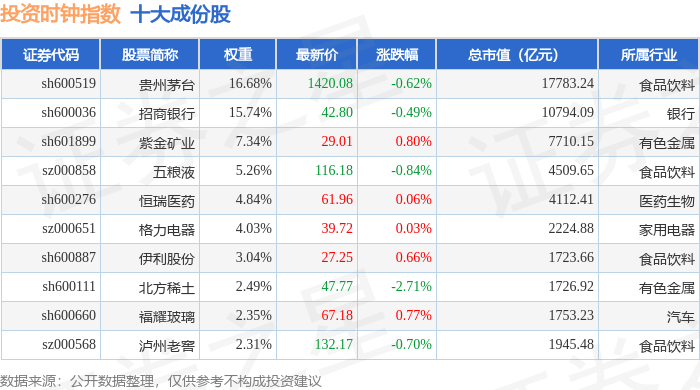
Market Overview - The Investment Clock Index (399391) closed at 3348.13 points, up 0.03%, with a trading volume of 78.792 billion yuan and a turnover rate of 0.81% [1] - Among the index constituents, 71 stocks rose while 28 stocks fell, with Guocheng Mining leading the gainers at a 9.42% increase and Dalian Shengya leading the decliners at a 9.99% decrease [1] Top Constituents - The top ten constituents of the Investment Clock Index are as follows: - Kweichow Moutai (sh600519) holds a weight of 16.68% and closed at 1420.08 yuan, down 0.62% with a market cap of 1778.324 billion yuan [1] - China Merchants Bank (sh600036) has a weight of 15.74%, closing at 42.80 yuan, down 0.49% with a market cap of 1079.409 billion yuan [1] - Yunnan Tin Company (sh601899) has a weight of 7.34%, closing at 29.01 yuan, up 0.80% with a market cap of 771.015 billion yuan [1] - Wuliangye Yibin (sz000858) has a weight of 5.26%, closing at 116.18 yuan, down 0.84% with a market cap of 450.965 billion yuan [1] - Hengrui Medicine (sh600276) has a weight of 4.84%, closing at 61.96 yuan, up 0.06% with a market cap of 411.241 billion yuan [1] - Gree Electric Appliances (sz000651) has a weight of 4.03%, closing at 39.72 yuan, up 0.03% with a market cap of 222.488 billion yuan [1] - Yili Industrial Group (sh600887) has a weight of 3.04%, closing at 27.25 yuan, up 0.66% with a market cap of 172.366 billion yuan [1] - Northern Rare Earth (sh600111) has a weight of 2.49%, closing at 47.77 yuan, down 2.71% with a market cap of 172.692 billion yuan [1] - Fuyao Glass (sh600660) has a weight of 2.35%, closing at 67.18 yuan, up 0.77% with a market cap of 175.323 billion yuan [1] - Jilin Chemical (sz000568) has a weight of 2.31%, closing at 132.17 yuan, down 0.70% with a market cap of 194.548 billion yuan [1] Capital Flow - The net outflow of main funds from the index constituents totaled 677 million yuan, while retail investors saw a net inflow of 708 million yuan [3] - Detailed capital flow for selected stocks includes: - China Zhongjin (601888) saw a main fund net inflow of 36.4 million yuan, while retail funds had a net outflow of 93.414 million yuan [3] - Jiangxi Copper (600362) had a main fund net inflow of 18.2 million yuan, with retail funds experiencing a net outflow of 70.3612 million yuan [3] - Weichai Power (000338) had a main fund net inflow of 13.5 million yuan, while retail funds had a net inflow of 1.60758 million yuan [3] - Giant Network (002558) had a main fund net inflow of 11.8 million yuan, with retail funds experiencing a net outflow of 65.0268 million yuan [3] - China Coal Energy (601898) had a main fund net inflow of 11.7 million yuan, while retail funds had a net outflow of 79.0666 million yuan [3]