
PETROCHINA(601857)

Search documents
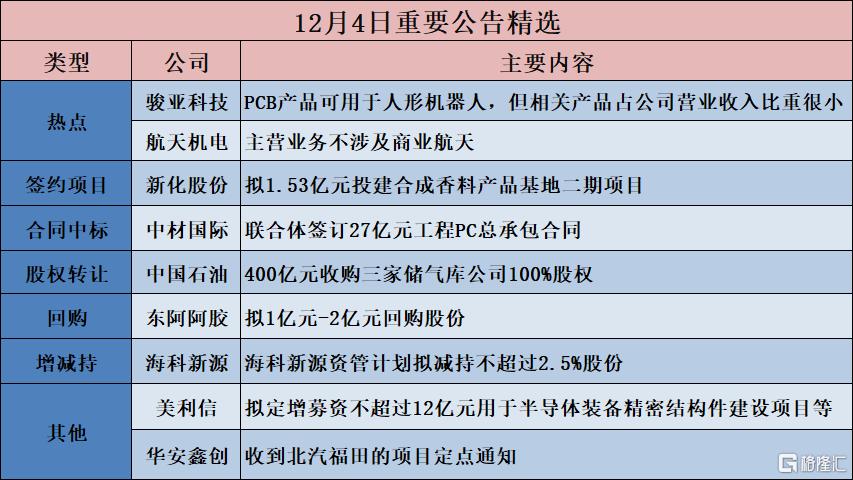
公告精选︱新化股份:拟1.53亿元投建合成香料产品基地二期项目;航天机电:主营业务不涉及商业航天
Ge Long Hui· 2025-12-05 00:40
Key Points - Junya Technology's PCB products can be used in humanoid robots, but these products account for a very small proportion of the company's revenue [1] - Aerospace Machinery's main business does not involve commercial aerospace [1] - Xinhua Co. plans to invest 153 million yuan in the second phase of its synthetic flavor product base [1] - China National Petroleum plans to acquire 100% equity of three gas storage companies for 40 billion yuan [1] - Dong'e Ejiao intends to repurchase shares worth 100 million to 200 million yuan [1] - Haike New Source Asset Management plans to reduce its holdings by no more than 2.5% [2] - Meilixin plans to raise no more than 1.2 billion yuan for the construction of precision structural components for semiconductor equipment [2] - Huazhong Xinchuang received project designation notification from Beiqi Foton [2]





大庆古龙页岩油示范区年产首次破百万吨 探明储量1.58亿吨
Yang Shi Xin Wen· 2025-12-04 23:53
中国石油大庆油田总地质师白雪峰:古龙页岩油的成功勘探开发,不仅实现了陆相页岩油勘探开发理 论、核心关键技术的双突破,更为同类型页岩油开发提供可借鉴的经验。目前,古龙页岩油已提交探明 储量1.58亿吨,我们规划到"十五五"末,年产量要达到300万吨。 (文章来源:央视新闻) 记者今天从中国石油获悉,大庆古龙陆相页岩油示范区年产量首次突破100万吨,创历史同期最高水 平,我国页岩油国家级示范区建设取得重大突破。 大庆古龙陆相页岩油国家级示范区地处松辽盆地北部,位于黑龙江省大庆市杜尔伯特蒙古族自治县境 内,覆盖面积2778平方公里。 中国石油大庆油田公司执行董事朱国文:和国内外其他页岩油相比,我们是在泥里找油,储油孔隙更 小,开发难度更大。依托全国重点实验室,打造开放式、高水平的研究平台,实现了页岩油产量连年倍 增,预计年底产量将超过108万吨。 大庆油田于2021年启动古龙页岩油国家级示范区建设,2022年示范区进入规模化试采初期,全年产油近 10万吨,实现初步产能释放。2024年全年产油超40万吨,实现连续三年产量翻番的跨越式发展。截至目 前,示范区累计完钻水平井393口,累产油超167万吨。 ...

中国石油签署逾400亿元合同 收购三家储气库全部股权
Zheng Quan Shi Bao Wang· 2025-12-04 23:26
Core Viewpoint - China National Petroleum Corporation (CNPC) has announced the acquisition of three gas storage companies for a total price of 40.016 billion yuan, enhancing its gas supply capabilities and ensuring stable operations in the natural gas industry [1][2] Group 1: Acquisition Details - CNPC's wholly-owned subsidiary, Taihu Investment, has completed the establishment of three joint venture companies with National Pipeline Network Group and signed a formal equity acquisition contract [1] - The three acquired companies are Xinjiang Oilfield Gas Storage Co., Chongqing Xiangguosi Gas Storage Co., and Liaohe Oilfield (Panjin) Gas Storage Co., with respective acquisition prices of 17.066 billion yuan, 9.995 billion yuan, and 12.955 billion yuan [1][2] - The completion dates for the establishment of the gas storage companies are set for November 20, 21, and 24, 2025, with shareholding structures defined [1] Group 2: Strategic Importance - The geographical distribution of the acquired companies covers key natural gas regions in Northwest, Southwest, and Northeast China, creating a complementary supply guarantee structure [2] - The Xinjiang gas storage facility is a crucial hub for gas peak shaving in the Northwest, while the Chongqing facility serves as a key storage facility in the Southwest [2] - The acquisition will add 10.97 billion cubic meters of working gas capacity, enhancing CNPC's gas storage and peak shaving capabilities, thereby maximizing the overall efficiency of the natural gas supply chain [2]
5年奋战,从单井高产到区块稳产 大庆古龙页岩油年产突破百万吨
Ren Min Ri Bao· 2025-12-04 21:59
本报哈尔滨12月4日电 (记者崔佳、祝大伟)12月3日,中国石油大庆古龙陆相页岩油国家级示范区年 产量达到100万吨,提前28天完成示范区年产量任务。今年,该示范区首次向国家提交探明储量1.58亿 吨。 5年奋战,实现连年倍增、快速上产。"我们在非常规油气领域迈出了关键一步。"大庆油田公司副总经 理、总地质师白雪峰说。 近年来,大庆市大力支持服务页岩油勘探开发,积极围绕页岩油油服、装备及下游精深加工谋划产业发 展。目前,作为页岩油开发核心区域,肇源县引进18户油服企业,搭建起全产业链。大庆市委主要负责 同志表示,大庆市将着力谋划推动页岩油开发加工与地方发展深度对接、与产业规划紧密结合,带动石 油化工、装备制造、技术服务等产业链发展。 (文章来源:人民日报) 大庆古龙页岩油是典型的陆相泥纹型页岩油,储层孔隙以纳米级为主,开发难度极大。"常规石油开采 如同从鲜豆腐块中挤水,但页岩质地致密如铁板,缺乏天然孔隙通道,页岩油开采好比从水泥块中挤 水。"大庆油田页岩油勘探开发指挥部副总指挥代晓东说。 5年攻关,大庆油田始终坚持高水平科技自立自强。原创两大基础理论、攻关5项关键技术、突破7个传 统认识,构建起陆相页岩油产油 ...
中国石油(601857.SH):400亿元收购三家储气库公司100%股权
Ge Long Hui· 2025-12-04 21:10
Core Viewpoint - China National Petroleum Corporation (CNPC) has completed the establishment of three joint ventures and signed equity acquisition contracts, acquiring 100% stakes in three gas storage companies for a total of 40 billion yuan [1] Group 1: Acquisition Details - The three joint ventures include CNPC Xinjiang Gas Storage, CNPC Xiangguosi Gas Storage, and CNPC Liaoning Gas Storage, which acquired 100% equity of Xinjiang Oilfield Gas Storage Company, Xiangguosi Gas Storage Company, and Liaohe Oilfield Gas Storage Company respectively [1] - The total acquisition amount is 40 billion yuan [1] Group 2: Strategic Importance - This transaction is beneficial for ensuring the stable operation and high-quality development of the company's natural gas industry chain [1] - Gas storage facilities are crucial links in the natural gas production, transportation, storage, and sales process, serving as tools for peak shaving and balancing production from gas fields [1] Group 3: Operational Impact - The acquisition will add 10.97 billion cubic meters of working gas capacity to the storage facilities, enhancing the company's ability to match gas storage with sales [1] - The three gas storage companies will be included in the company's consolidated financial statements following the completion of the transaction [1]
港股公告掘金 | 中国石油股份附属拟收购新疆储气库、相国寺储气库及辽河储气库全部股权
Zhi Tong Cai Jing· 2025-12-04 15:14
Major Events - Meet Xiaomian (02408) has set its share price at HKD 7.04, with the Hong Kong public offering receiving a subscription rate of 425.97 times [1] - Naxin Micro (02676) has set its share price at HKD 116.00 per H-share, with an expected listing date of December 8 [1] - Tianyu Semiconductor (02658) received a subscription rate of 60.63 times for its Hong Kong public offering, with a listing date of December 5 [1] - China Petroleum & Chemical Corporation (00857) plans to acquire all equity interests in the Xiangguosi Gas Storage and Liaohe Gas Storage [1] - China Power (00931) intends to issue discounted shares to the International Finance Corporation to expand its capital base and is advancing a large LNG project acquisition [1] - TECHSTARACQ-Z (07855) has finalized financing of approximately HKD 371 million from Seyond Holdings Ltd., with NIO Inc. (09866) increasing its subscription by HKD 286.7 million [1] - Kelun-Biotech (06990) has established a strategic partnership with Crescent Biopharma to jointly develop and commercialize cancer treatment methods [1] - Yihe Holdings (01662) subsidiary Trio AI has formed a strategic partnership with ABBY Pay to explore and implement AI-driven payment processing solutions [1] - Quzhi Group (00917) has established a strategic partnership with Dubai to jointly promote the HOLOX project [1] - Sihuan Pharmaceutical (02005) has received approval from the National Medical Products Administration for Bilastine and Picotamide to be used as raw materials in listed formulations [1] - China Biopharmaceutical (01177) has received clinical trial application approvals for TQF3250, an oral GLP-1 receptor agonist, from NMPA and FDA [1] - Country Garden (02007) has received approval from relevant bondholders for its domestic bond restructuring plan [1] - Longguang Group (03380) has accumulated debt restructuring offers for bonds with a total face value of RMB 13.66 billion [1] - United Energy Group (00467) has completed a financing loan arrangement for reserves [1] Buybacks/Reductions - Tencent Holdings (00700) repurchased 1.044 million shares at a cost of approximately HKD 636 million on December 4 [2] - Midea Group (00300) repurchased 1.2177 million A-shares for a total of approximately RMB 99.9982 million on December 4 [2] - COSCO Shipping Holdings (01919) repurchased 3 million shares at a cost of approximately HKD 41.8218 million on December 4 [2] - Kuaishou-W (01024) repurchased 445,000 shares for approximately HKD 29.923 million on December 4 [2] - China Feihe (06186) repurchased 6.281 million shares at a cost of approximately HKD 25.7521 million on December 4 [2] - Kingsoft (03888) repurchased 355,600 shares for approximately HKD 9.99756 million on December 4 [2] - Weimob Group (02013) saw its chairman Sun Taoyong increase his holdings by a total of 1.534 million shares [2] - Green Tea Group (06831) plans to repurchase shares for a total price not exceeding RMB 130 million [2] Operating Performance - Greentown China (03900) reported total contract sales of approximately RMB 223.5 billion for the first 11 months, a year-on-year decrease of 9.44% [2] - China Overseas Macro Group (00081) reported cumulative contract sales of RMB 29.615 billion for the first 11 months, down 16.6% year-on-year [3] - China Overseas Development (00688) reported cumulative property sales of approximately RMB 211.399 billion for the first 11 months, a year-on-year decrease of 21.8% [3] - Sunac China (01918) achieved contract sales of approximately RMB 33.89 billion for the first 11 months, down 25.34% year-on-year [3] - Gemdale Corporation (00535) reported cumulative contract sales of approximately RMB 9.874 billion for the first 11 months, a year-on-year decrease of 43.5% [3] - Hongyang Real Estate (01996) reported cumulative contract sales of RMB 4.181 billion for the first 11 months, down 47.87% year-on-year [3] - Country Garden (02007) reported contract sales of approximately RMB 2.35 billion in November attributed to shareholders [3]
中国石油申请基于渗流空间变换的砾岩油藏等效渗透率计算方法专利,对指导非常规油气资源的有效开发具有重要价值
Jin Rong Jie· 2025-12-04 15:08
Group 1 - The core viewpoint of the news is that China National Petroleum Corporation (CNPC) has applied for a patent for a method to calculate equivalent permeability in gravel oil reservoirs, which is significant for enhancing unconventional oil and gas resource development and optimizing gas drive extraction strategies [1]. Group 2 - CNPC was established in 1999 and is primarily engaged in oil and gas extraction, with a registered capital of 18,302,097,000 RMB [2]. - The company has made investments in 1,294 enterprises and participated in 443 bidding projects, holding 38 trademark records and 5,000 patent records, along with 168 administrative licenses [2].
中国石油(601857)披露关于太湖投资与管网储能新设合资公司并收购储气库公司股权暨关联交易的进展公告,12月04日股价上涨0.81%
Sou Hu Cai Jing· 2025-12-04 14:44
《中国石油天然气股份有限公司关于太湖投资与管网储能新设合资公司并收购新疆油田储气库公 司、相国寺储气库公司、辽河油田储气库公司100%股权暨关联交易的进展公告》 以上内容为证券之星据公开信息整理,由AI算法生成(网信算备310104345710301240019号),不构成 投资建议。 近日,中国石油天然气股份有限公司发布关于太湖投资与管网储能新设合资公司并收购新疆油田储气库 公司、相国寺储气库公司、辽河油田储气库公司100%股权暨关联交易的进展公告。公告显示,公司全 资子公司太湖投资与国家管网集团储能技术有限公司等共同设立合资公司,收购上述三家储气库公司 100%股权,合计收购金额4,001,603.38万元。三家合资公司已于2025年11月20日至24日完成设立,相关 股权收购合同已于2025年12月4日签署,交割日定为2025年12月31日。交易完成后,三家公司预计将纳 入公司合并报表范围,有助于提升公司储气调峰能力,新增工作气量109.7亿方。 最新公告列表 截至2025年12月4日收盘,中国石油(601857)报收于10.01元,较前一交易日上涨0.81%,最新总市值 为18320.4亿元。该股当日 ...
中国石油化工股份12月4日斥资778.88万港元回购173.2万股
Zhi Tong Cai Jing· 2025-12-04 14:33
中国石油化工股份(00386)发布公告,于2025年12月4日,该公司斥资778.88万港元回购173.2万股股份, 每股回购价格为4.48-4.54港元。 ...
中国石油化工股份(00386.HK)12月4日回购173.20万股,耗资778.88万港元
Zheng Quan Shi Bao Wang· 2025-12-04 13:34
证券时报·数据宝统计,中国石油化工股份在港交所公告显示,12月4日以每股4.480港元至4.540港元的 价格回购173.20万股,回购金额达778.88万港元。该股当日收盘价4.500港元,下跌0.22%,全天成交额 4.35亿港元。 自10月30日以来公司已连续26日进行回购,合计回购1.20亿股,累计回购金额5.26亿港元。 其间该股累 计上涨6.64%。 今年以来该股累计进行59次回购,合计回购3.42亿股,累计回购金额15.93亿港元。(数据宝) 中国石油化工股份回购明细 | 日期 | 回购股数(万股) | 回购最高价(港元) | 回购最低价(港元) | 回购金额(万港元) | | --- | --- | --- | --- | --- | | 2025.12.04 | 173.20 | 4.540 | 4.480 | 778.88 | | 2025.12.03 | 180.00 | 4.560 | 4.500 | 814.16 | | 2025.12.02 | 120.00 | 4.550 | 4.450 | 541.76 | | 2025.12.01 | 112.80 | 4.460 | 4.4 ...
