
YONGHUI SUPERSTORES(601933)

Search documents
永辉超市(601933) - 永辉超市股份有限公司第六届董事会独立董事第五次专门会议审查意见
2026-01-20 11:00
第六届董事会独立董事第五次专门会议审查意见 根据《中华人民共和国公司法》《中华人民共和国证券法》《上海证券交易所 股票上市规则》《上市公司独立董事管理办法》及永辉超市股份有限公司(以下 简称"公司")《公司章程》等有关规定,我们作为公司的独立董事,于 2026 年 1 月 19 日召开第六届董事会独立董事第五次专门会议,就审议事项发表如下审 查意见: 永辉超市股份有限公司第六届董事会独立董事第五次专门会议审查意见 永辉超市股份有限公司 一、关于公司 2025 年度关联交易执行情况及 2026 年关联交易计划的议案 1 / 1 独立董事: 刘琨、柏涛、谢贞发 二〇二六年一月二十一日 经审查,全体独立董事认为:公司 2025 年度关联交易执行情况及 2026 年 关联交易计划遵循了公平、公正、公开原则,是公司经营发展所需,有利于促进 公司业务发展,交易定价均以市场价格为依据确定,交易价格公允合理,不存在 损害公司及股东、特别是中小股东利益的行为。因此,我们同意《关于公司 2025 年度关联交易执行情况及 2026 年关联交易计划的议案》,并同意将该议案提交 公司第六届董事会第十次会议进行审议,董事会在审议该议案时 ...

永辉超市(601933) - 永辉超市股份有限公司关于公司2025年度关联交易执行情况及2026年关联交易计划的公告
2026-01-20 11:00
证券代码:601933 证券简称:永辉超市 公告编号:2026-005 永辉超市股份有限公司 关于公司 2025 年度关联交易执行情况及 2026 年关联交易计划的公告 本公司及董事会全体成员保证本公告内容不存在任何虚假记载、误导性陈述或者 重大遗漏,并对其内容的真实性、准确性和完整性承担法律责任。 重要内容提示: ●是否需要提交股东会审议:是 ●日常关联交易对公司的影响:有利于上市公司生产经营,不会对公司的经 营成果和财务状况产生不利影响,不会对关联方形成较大的依赖,不会损害公司 或中小股东的利益。 一、 日常关联交易基本情况 (一)日常关联交易履行的审议程序 2 | 关联交易类别 | 关联人 | 年预计发生金额(万 2025 | 年实际发生金额(万 2025 | | --- | --- | --- | --- | | | | 元) | 元)(未经审计) | | 向关联人支付资金使用费 | 百佳(中国)投资有限公司 | 500.00 | 232.87 | | | 福建联创智业建设工程有限公司 | | 245.28 | | | 小计 | 500.00 | 478.15 | | 向关联人出售商品 | 京东集团 ...
永辉超市(601933) - 永辉超市股份有限公司关于召开2026年第一次临时股东会的通知
2026-01-20 11:00
证券代码:601933 证券简称:永辉超市 公告编号:2026-006 永辉超市股份有限公司 关于召开2026年第一次临时股东会的通知 本公司董事会及全体董事保证本公告内容不存在任何虚假记载、误导性陈述 或者重大遗漏,并对其内容的真实性、准确性和完整性承担法律责任。 重要内容提示: 一、 召开会议的基本情况 (一) 股东会类型和届次 2026年第一次临时股东会 召开的日期时间:2026 年 2 月 6 日 13 点 30 分 召开地点:福建省福州市鼓楼区湖头街 120 号(永辉集团)6 楼会议室 涉及融资融券、转融通业务、约定购回业务相关账户以及沪股通投资者 的投票,应按照《上海证券交易所上市公司自律监管指引第 1 号 — 规范运 作》等有关规定执行。 (七) 涉及公开征集股东投票权 (五) 网络投票的系统、起止日期和投票时间。 网络投票系统:上海证券交易所股东会网络投票系统 股东会召开日期:2026年2月6日 本次股东会采用的网络投票系统:上海证券交易所股东会网络投票系统 (二) 股东会召集人:董事会 (三) 投票方式:本次股东会所采用的表决方式是现场投票和网络投票相结合 的方式 (四) 现场会议召开的日期 ...
永辉超市(601933) - 永辉超市股份有限公司第六届董事会第十次会议决议公告
2026-01-20 11:00
永辉超市股份有限公司 第六届董事会第十次会议决议公告 本公司及董事会全体成员保证本公告内容不存在任何虚假记载、误导性陈述 或者重大遗漏,并对其内容的真实性、准确性和完整性承担法律责任。 永辉超市股份有限公司(下称"公司"或"永辉超市")第六届董事会第十 次会议于 2026 年 1 月 19 日在公司左海总部六楼会议室以现场结合通讯方式召 开。会议应出席董事 9 人,实际出席会议董事 9 人。公司高级管理人员列席本 次会议。会议的通知、召开符合《中华人民共和国公司法》及其他相关规定。经 全体董事审议和表决,会议通过如下决议: 一、关于公司2025年度关联交易执行情况及2026年关联交易计划的议案 证券代码:601933 证券简称:永辉超市 公告编号: 2026-004 具体内容详见公司同日披露于上海证券交易所网站(www.sse.com.cn)的 《永辉超市股份有限公司关于公司 2025 年度关联交易执行情况及 2026 年关联 交易计划的公告》(公告编号:2026-005) 根据《永辉超市股份有限公司关联交易管理办法》规定,关联董事张轩松先 生、张轩宁先生需回避此项议案,因涉及向关联公司福建轩辉房地产开发有限 ...
永辉超市:2025年预亏21.4亿元
Ge Long Hui· 2026-01-20 10:52
Core Viewpoint - The company, Yonghui Supermarket, anticipates a significant net loss for 2025, with a projected net profit attributable to shareholders of -2.14 billion yuan and a net profit of -2.94 billion yuan after excluding non-recurring gains and losses. This reflects a strategic shift from "scale expansion" to "quality growth" [1] Group 1: Strategic Adjustments - In 2025, the company undertook major operational strategic adjustments, repositioning itself with the strategy of "New Yonghui, New Quality" [1] - The company deeply adjusted 315 stores and closed 381 stores that did not align with its future strategic positioning, leading to substantial losses [1] - The adjustments resulted in asset write-off losses and one-time setup costs totaling approximately 910 million yuan, along with an estimated gross profit loss of about 300 million yuan due to store renovations [1] Group 2: Supply Chain Reform - The company initiated a supply chain reform based on the principles of "transparency, quality-driven, and efficiency improvement," focusing on five key areas: "sunshine supply chain, bare-price direct procurement, core focus, cold chain upgrade, and store collaboration" [1] - Short-term challenges include stock shortages and declining gross margins, which have impacted revenue; however, these effects are gradually being mitigated as the supply chain reform progresses [1] Group 3: Investment and Asset Impairment - The company recognized a fair value change loss of 236 million yuan on its overseas equity investment in Advantage Solutions due to a continuous decline in stock price [2] - The company plans to recognize an impairment provision of approximately 162 million yuan for long-term assets, primarily related to continuously loss-making store assets, pending final audit results [2]
永辉超市(601933.SH):2025年预亏21.4亿元
Ge Long Hui A P P· 2026-01-20 10:44
Core Viewpoint - The company, Yonghui Supermarket, anticipates a significant net loss for 2025, with a projected net profit attributable to shareholders of -2.14 billion yuan and a net profit of -2.94 billion yuan after excluding non-recurring gains and losses. This shift is part of a strategic transition from "scale expansion" to "quality growth" [1] Group 1: Strategic Adjustments - In 2025, the company undertook major operational strategic adjustments, repositioning itself with the strategy of "New Yonghui, New Quality" [1] - The company deeply adjusted 315 stores and closed 381 stores that did not align with its future strategic positioning, leading to significant losses [1] - The adjustments resulted in asset write-off losses and one-time setup costs totaling approximately 910 million yuan, along with an estimated gross profit loss of about 300 million yuan due to store renovations [1] Group 2: Supply Chain Reform - The company initiated a supply chain reform based on the principles of "transparency, quality-driven, and efficiency improvement," focusing on five key areas: "sunshine supply chain, bare-price direct procurement, core focus, cold chain upgrade, and store collaboration" [1] - Short-term challenges include stock shortages and declining gross margins, which have impacted revenue; however, these effects are gradually being mitigated as the supply chain reform progresses [1] Group 3: Investment and Asset Impairment - The company recognized a fair value loss of 236 million yuan on its overseas equity investment in Advantage Solutions due to a continuous decline in stock price [2] - Additionally, the company plans to recognize an impairment provision of approximately 162 million yuan for long-term assets, primarily related to underperforming store assets, pending final audit results [2]
永辉超市:预计2025年净利润亏损21.4亿元
Xin Lang Cai Jing· 2026-01-20 10:44
Core Viewpoint - The company expects a net profit loss of 2.14 billion yuan for 2025, compared to a loss of 1.47 billion yuan in the previous year [1] - The company anticipates a net profit loss of 2.94 billion yuan after deducting non-recurring gains and losses for 2025 [1] - The company is shifting its strategic focus from "scale expansion" to "quality growth," rebranding as "New Yonghui, New Quality" [1] Financial Performance - The projected net profit loss for 2025 is 2.14 billion yuan, an increase in loss compared to the previous year's 1.47 billion yuan [1] - The anticipated loss after excluding non-recurring items is 2.94 billion yuan for 2025 [1] Strategic Adjustments - The company has made significant operational adjustments, including a deep restructuring of 315 stores during the reporting period [1] - A total of 381 stores that do not align with the company's future strategic positioning have been closed [1]
永辉超市:预计2025年净亏损21.4亿元
Mei Ri Jing Ji Xin Wen· 2026-01-20 10:44
Core Viewpoint - The company, Yonghui Supermarket, announced a significant net profit loss forecast for 2025, projecting a net profit attributable to shareholders of -2.14 billion yuan, compared to -1.47 billion yuan in the previous year [1] Group 1: Strategic Adjustments - In 2025, the company shifted its operational strategy from "scale expansion" to "quality growth," rebranding itself under the strategy of "New Yonghui, New Quality" [1] - During the reporting period, the company made substantial adjustments to its store layout, deeply modifying 315 stores and closing 381 stores that did not align with its future strategic positioning [1] Group 2: Financial Impact of Store Adjustments - The adjustments to the stores resulted in significant financial impacts, including asset write-off losses, loss of operating income due to store renovations, and one-time startup costs, totaling approximately 910 million yuan [1] - The estimated gross profit loss due to store closures for renovations is around 300 million yuan [1] - The closure of 381 stores also incurred substantial losses, including asset write-off losses, employee severance compensation, and lease-related penalties [1] Group 3: Investment and Asset Impairment - The company recognized a fair value change loss of 236 million yuan on its overseas equity investment in Advantage Solutions due to a continuous decline in stock price [1] - A preliminary assessment indicates that the company will recognize an impairment provision of 162 million yuan for long-term assets, primarily related to continuously loss-making store assets, with the final amount subject to audit results [1]
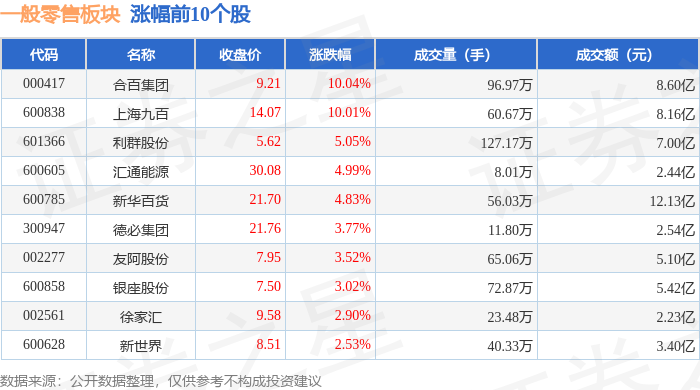
一般零售板块1月20日涨0.19%,合百集团领涨,主力资金净流入1.05亿元
Zheng Xing Xing Ye Ri Bao· 2026-01-20 08:56
Core Viewpoint - The general retail sector experienced a slight increase of 0.19% on January 20, with HeBai Group leading the gains, while the Shanghai Composite Index fell by 0.01% and the Shenzhen Component Index decreased by 0.97% [1]. Group 1: Stock Performance - HeBai Group (000417) closed at 9.21, up 10.04%, with a trading volume of 969,700 shares and a transaction value of 860 million yuan [1]. - Shanghai Jiubai (600838) closed at 14.07, up 10.01%, with a trading volume of 606,700 shares and a transaction value of 816 million yuan [1]. - LiQun Co. (601366) closed at 5.62, up 5.05%, with a trading volume of 1,271,700 shares and a transaction value of 700 million yuan [1]. - Other notable performers include Huitong Energy (600605) with a 4.99% increase and XinHua Department Store (600785) with a 4.83% increase [1]. Group 2: Market Trends - The general retail sector saw a net inflow of 105 million yuan from institutional investors, while retail investors experienced a net outflow of 66.77 million yuan [2]. - The overall trading activity indicates a mixed sentiment among retail investors, with significant outflows despite the sector's slight gain [2]. Group 3: Capital Flow Analysis - Shanghai Jiubai (600838) had a net inflow of 183 million yuan from institutional investors, but a net outflow of 82.23 million yuan from retail investors [3]. - HeBai Group (000417) also saw a net inflow of 141 million yuan from institutional investors, with retail investors withdrawing 73.61 million yuan [3]. - Other companies like Yonghui Supermarket (601933) and Wangfujing (600859) showed varying levels of net inflow and outflow, indicating diverse investor behavior across the sector [3].




永辉超市发布2026新年礼盒矩阵 定制礼盒占比达40%
Bei Jing Shang Bao· 2026-01-19 12:00
Group 1 - The core viewpoint of the articles highlights Yonghui Supermarket's transition into a new phase of self-operation focused on "product strength" and "scene strength," with the 2026 New Year Festival serving as a critical testing point for this new model [1] - Yonghui has launched a gift box matrix covering three core scenarios: health nourishment, social gatherings, and home cooking, featuring approximately 150 products with over 70% being new items, and 40% of the gift boxes being customized [1] - According to Nielsen IQ's report, about 25% of consumers plan to increase their spending on festive gifts, indicating a trend towards healthier, higher-quality, and more emotional gift consumption [1] Group 2 - Yonghui's global direct procurement supply chain is a crucial support for the New Year Festival, providing a solid quality foundation for the gift box products [2] - Chilean cherries have emerged as a star product for the New Year Festival, achieving sales exceeding 50 million yuan during the New Year period and nearly 200% year-on-year growth since its launch [2] - To address the pain points of gift delivery during the Spring Festival, Yonghui has introduced gift storage and delivery services, allowing consumers to temporarily store large items or have gifts sent across cities [2]