
Nanhua Futures(603093)

Search documents
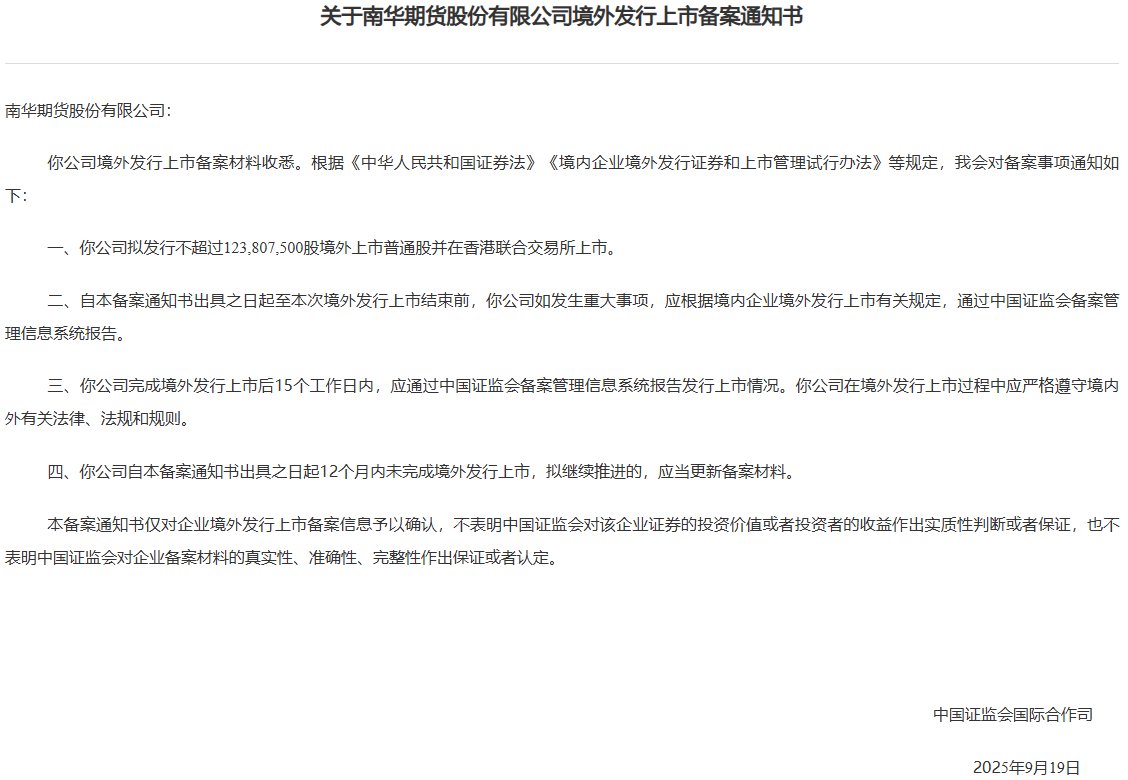
南华期货港股IPO获中国证监会备案
Zhi Tong Cai Jing· 2025-09-22 08:45
Group 1 - The China Securities Regulatory Commission has issued a notice regarding Nanhua Futures Co., Ltd.'s application for overseas listing, allowing the company to issue up to 123,807,500 shares for listing on the Hong Kong Stock Exchange [1] - Nanhua Futures is a financial service provider headquartered in China, focusing on futures and derivatives, offering comprehensive and customized risk management services to industrial clients, financial institutions, and individual investors [3] - According to a Frost & Sullivan report, Nanhua Futures ranks 8th among all futures companies in China by total revenue in 2023, and ranks 1st among non-financial institution-related futures companies [3] Group 2 - In terms of futures brokerage commission income, Nanhua Futures ranks 12th among all futures companies in China for 2023 [3] - The company ranks 1st among all futures companies in China based on overseas income for 2023 [3]


商品策略周报:节前观望-20250922
Nan Hua Qi Huo· 2025-09-22 05:41
Report Summary 1. Investment Rating No investment rating for the industry is provided in the report. 2. Core Viewpoints - Due to the anti - involution theme, exchange measures like position limits and fee hikes, and the delivery logic of the 2509 contract, some varieties with weak supply - demand fundamentals have seen continuous declines. In September, some varieties started to stabilize after losing the downward guidance of the 09 contract. The impact of the anti - involution theme is limited. With the National Day holiday approaching, it's advisable to control positions and operate cautiously [2][3][5]. - Anti - involution varieties are relatively strong, while the non - ferrous sector is bearish [3]. - The anti - involution is a long - term theme. After a sharp rise in July, trading volume and open interest of anti - involution varieties decreased due to position limits and fee hikes, and some varieties with weak industrial supply - demand in the real - world declined in mid - and late - August. After September 1st, these varieties showed signs of stopping the decline and stabilizing. The implementation of anti - involution policies in the industrial end is a key influencing factor. The Fed's interest - rate cut cycle led to the outflow of profit - taking funds, causing a downward adjustment in the non - ferrous sector. For agricultural products, if the Sino - US tariff negotiation progresses smoothly, domestic agricultural products will face pressure [4]. 3. Directory Summaries 3.1. Capital Flow - The total capital flow is - 5.637 billion yuan, with significant outflows in non - ferrous metals (- 3.211 billion yuan) and precious metals (- 224 million yuan), and inflows in soft commodities (239 million yuan) and oils and fats (123 million yuan) [8]. 3.2. Weekly Data of Black and Non - ferrous Metals - Data such as price percentile, inventory percentile, valuation percentile, open interest percentile, open interest change percentile, and annualized basis are provided for various black and non - ferrous metal varieties. For example, iron ore has a price percentile of 21.5%, a inventory percentile of 55.0%, etc. [8] 3.3. Weekly Data of Energy and Chemicals - Similar data is presented for energy and chemical varieties. For instance, fuel oil has a price percentile of 4.9%, a inventory percentile of 36.7%, etc. [10] 3.4. Weekly Data of Agricultural Products - Data for agricultural product varieties are shown, like soybean meal with a price percentile of 6.1%, a inventory percentile of 77.4%, etc. [11] 3.5. Capital Flow Diagrams - There are diagrams showing the capital flow of black varieties, olefin varieties, polyester varieties, other chemical varieties, energy varieties, oils and fats and oilseeds, agricultural and sideline products, and non - ferrous sectors [12][16][17][19][21][22][26]
聚酯产业风险管理日报:成本与情绪双杀,价格积弱-20250919
Nan Hua Qi Huo· 2025-09-19 11:47
Report Overview - Report Title: Polyester Industry Risk Management Daily - Cost and Sentiment Double Blow, Prices Weakening - Date: September 19, 2025 - Analysts: Dai Yifan, Zhou Jiawei 1. Report Industry Investment Rating - No information provided 2. Report's Core View - The ethylene glycol market currently has limited supply - demand drivers and is expected to oscillate in the range of 4200 - 4400. Price breakthroughs depend on cost - side and macro - drivers. With short - term sentiment causing an over - decline, there is price support, and it is advisable to moderately sell out - of - the - money put options [3]. 3. Summary by Relevant Contents Polyester Price and Volatility - The monthly price ranges for different polyester products are: ethylene glycol 4150 - 4450, PX 6300 - 7000, PTA 4400 - 5000, and bottle chips 5500 - 6100. The 20 - day rolling current volatilities are 9.62% for ethylene glycol, 11.03% for PX, 10.04% for PTA, and 7.59% for bottle chips. Their 3 - year historical percentile of current volatility are 2.5%, 7.8%, 7.2%, and 0.8% respectively [2]. Polyester Hedging Strategies Inventory Management - For high finished - product inventory and concerns about ethylene glycol price drops, with a long spot exposure, it is recommended to short ethylene glycol futures (EG2601) with a 25% hedging ratio at an entry range of 4320 - 4420 to lock in profits and cover production costs. Also, buy put options (EG2601P4100) and sell call options (EG2601C4500) with a 50% hedging ratio at entry ranges of 20 - 30 and 50 - 80 respectively to prevent price drops and reduce capital costs [2]. Procurement Management - For low procurement inventory and purchasing based on orders, with a short spot exposure, it is recommended to buy ethylene glycol futures (EG2601) with a 50% hedging ratio at an entry range of 4180 - 4250 to lock in procurement costs. Sell put options (EG2601P4100) with a 75% hedging ratio at an entry range of 50 - 80 to collect premiums and lock in the purchase price of spot ethylene glycol [2]. Core Contradiction of Ethylene Glycol - Ethylene glycol has limited fundamental drivers recently. Under the expectation of continuous inventory accumulation after October, it has become a concentrated short - position target for funds. The inventory accumulation expectation in the fourth quarter is advanced and magnified due to new capacity, putting pressure on valuation. With much of the inventory - accumulation expectation already priced in, chasing short positions is not recommended before its realization. The supply side has no significant incremental capacity, lacking supply elasticity. Considering low inventory, low valuation, and inelastic supply, the short - term downward space is limited, while upward price movement is more elastic with unexpected drivers. It is expected to oscillate between 4200 - 4400, and price breakthroughs depend on cost and macro - drivers [3]. 利多解读 (Positive Factors) - The increase in thermal coal prices has compressed the profit of marginal coal - based production units to near the cost line [4]. 利空解读 (Negative Factors) - The 200,000 - ton ethylene glycol plant of Ningxia Kunpeng is planned to start trial production at the end of October, and its progress should be monitored. The new 800,000 - ton ethylene glycol capacity of Yulong is expected to be put into operation ahead of schedule at the end of September or early October, with an additional 50,000 - 60,000 tons of output in October [6]. Polyester Daily Data - The report provides price, price difference, processing fee, and sales rate data for various polyester - related products such as Brent crude oil, naphtha, PX, PTA, ethylene glycol, polyester filaments, and polyester chips on September 19, 2025, compared with previous days and weeks [8][9].
南华镍、不锈钢产业风险管理日报-20250919
Nan Hua Qi Huo· 2025-09-19 11:13
Group 1: Price and Volatility Forecast - The price range forecast for Shanghai Nickel is 118,000 - 126,000 yuan/ton, with a current 20 - day rolling volatility of 15.17% and a historical percentile of 3.2% [2] - The price range forecast for stainless steel is 12,500 - 13,100 yuan/ton, with a current 20 - day rolling volatility of 7.80% and a historical percentile of 1.7% [2] Group 2: Risk Management Strategies Shanghai Nickel - **Inventory Management**: When product sales prices fall and inventory has impairment risk, sell Shanghai Nickel futures (NI main contract) at a 60% hedge ratio and sell call options (OTC/ETO) at a 50% hedge ratio, with a strategy level of 2 [2] - **Procurement Management**: When the company has future production procurement needs and is worried about rising raw material prices, buy far - month NI contracts according to the production plan, sell put options (ETO/OTC), and buy out - of - the - money call options (ETO/OTC), with a strategy level of 3 [2] Stainless Steel - **Inventory Management**: When product sales prices fall and inventory has impairment risk, sell stainless steel futures (SS main contract) at a 60% hedge ratio and sell call options (OTC/ETO) at a 50% hedge ratio, with a strategy level of 2 [3] - **Procurement Management**: When the company has future production procurement needs and is worried about rising raw material prices, buy far - month SS contracts according to the production plan, sell put options (ETO/OTC), and buy out - of - the - money call options (ETO/OTC), with a strategy level of 3 [3] Group 3: Core Contradictions - Shanghai Nickel and stainless steel disk oscillated weakly during the day. After the expected interest rate cut, the overall market was weak, and the fundamentals had no obvious changes [3] - In the nickel ore sector, Indonesia's second - phase benchmark price was released, and the ore end was raised. The supply concern in the ore sector has not been eliminated [3] - In the new energy sector, there is still support. The continuous rise in cobalt prices has driven up the prices of MHP and nickel salts. The market circulation is tight, and subsequent strength may continue [3] - The nickel - iron quotation is still firm, but the actual high - price transactions have declined. The stainless steel disk lost the 12,900 - yuan line during the day, and the actual transactions were limited [3] - At the macro level, the Fed's interest rate cut did not exceed expectations, and the overall market was weak [3] Group 4: Bullish and Bearish Factors Bullish Factors - Indonesia's APNI plans to revise the HPM formula and add elements such as iron and cobalt [5] - Indonesia shortens the nickel ore quota license period from three years to one year [5] - Stainless steel has been destocking for several weeks [5] - Indonesia's forestry working group takes over part of the nickel mining area of PT Weda Bay [5] Bearish Factors - The pure nickel inventory is high [5] - Sino - US tariff disturbances still exist [5] - The uncertainty of the EU's stainless steel import tariff has increased [5] - South Korea's anti - dumping duty on Chinese stainless steel thick plates has been implemented [5] - Stainless steel spot transactions are relatively weak [5] Group 5: Market Data Nickel Disk - The latest value of Shanghai Nickel main continuous is 121,500 yuan/ton, with a daily change of 560 yuan and a daily change rate of 0% [5] - The trading volume decreased by 23.23% to 62,653 lots, and the open interest decreased by 8.40% to 50,421 lots [5] Stainless Steel Disk - The latest value of stainless steel main continuous is 12,860 yuan/ton, with a daily change of - 15 yuan and a daily change rate of 0% [5] - The trading volume decreased by 33.50% to 116,925 lots, and the open interest decreased by 0.79% to 131,185 lots [5] Group 6: Industry Inventory - The domestic social inventory of nickel is 41,055 tons, an increase of 1,125 tons from the previous period [6] - The LME nickel inventory is 228,444 tons, a decrease of 6 tons from the previous period [6] - The stainless steel social inventory is 897,200 tons, a decrease of 5,400 tons from the previous period [6] - The nickel pig iron inventory is 28,652 tons, a decrease of 614.5 tons from the previous period [6] Group 7: Industry News - CATL and Antam promote the construction of a nickel integrated smelter [7]
多元金融板块9月19日跌2.31%,建元信托领跌,主力资金净流出7.47亿元
Zheng Xing Xing Ye Ri Bao· 2025-09-19 08:53
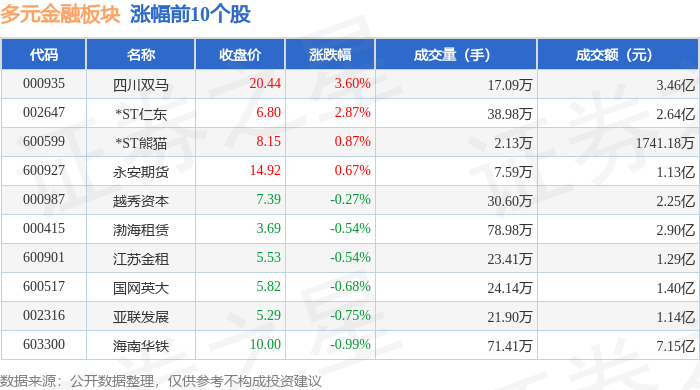
Market Overview - The diversified financial sector experienced a decline of 2.31% on September 19, with Jianyuan Trust leading the drop [1] - The Shanghai Composite Index closed at 3820.09, down 0.3%, while the Shenzhen Component Index closed at 13070.86, down 0.04% [1] Individual Stock Performance - Sichuan Shuangma (000935) saw a closing price of 20.44, with an increase of 3.60% and a trading volume of 170,900 shares, totaling a transaction value of 346 million [1] - Jianyuan Trust (600816) closed at 3.22, down 10.06%, with a trading volume of 4,263,700 shares and a transaction value of 1.414 billion [2] - Zhongyou Capital (000617) closed at 10.61, down 4.50%, with a transaction value of 2.015 billion [2] Capital Flow Analysis - The diversified financial sector saw a net outflow of 747 million from institutional investors, while retail investors experienced a net inflow of 627 million [2] - The main capital inflow and outflow for selected stocks indicate varied investor sentiment, with Sichuan Shuangma receiving a net inflow of 15.36 million from institutional investors [3] - Jianyuan Trust experienced a significant net outflow of 5.32 million from institutional investors, reflecting negative sentiment [3]


南华干散货运输市场日报:大宗商品发运需求持续向好,综合运价指数涨幅扩大-20250919
Nan Hua Qi Huo· 2025-09-19 08:19
Report Industry Investment Rating No relevant content provided. Core View of the Report As of the reporting date, the shipment volume of industrial products remained high, which marginally supported the transportation demand for large vessels such as Capesize ships. The week-on-week increase in the Capesize ship freight index BCI expanded, driving the further rise of the BDI composite freight index. Meanwhile, the increase in the BSI & BHSI freight indices narrowed, and the BPI freight index turned down, indicating weak freight rates on some routes. The significant increase in shipments from countries like Russia and Australia, especially the growth in wheat and soybean shipments, supported the transportation demand for Panamax and Handysize ships. The continued substantial increase in the shipment volume of industrial products such as Australian iron ore, South African coal, Russian coal, and Guinean bauxite supported the transportation demand for Capesize ships. Against the backdrop of the significant increase in agricultural product shipments and the high demand for industrial product shipments, dry bulk carriers continued to benefit [1]. Summary by Relevant Catalogs 1. Spot Index Review 1.1 BDI Freight Index Analysis Compared with the data on September 11, except for the week-on-week decline of the BPI freight index, the week-on-week increase of the freight indices of other mainstream ship types continued. Among the sub - ship type freight indices, the weekly increase of the BCI freight index expanded to 12%, and the increase of the BSI & BHSI freight indices narrowed to less than 1%. However, the increase of the BDI composite freight index expanded. Specifically, the BDI composite freight index closed at 2205 points, a week-on-week increase of 4.45%; the BCI freight index closed at 3411 points, a week-on-week increase of 12.17%; the BPI freight index closed at 1881 points, a week-on-week decrease of 5.86%; the BSI freight index closed at 1492 points, a week-on-week increase of 0.54%; the BHSI freight index closed at 809 points, a week-on-week increase of 1% [4]. 1.2 FDI Far - East Dry Bulk Freight Index On September 18, the FDI composite index, FDI rental freight index, and FDI spot freight index all rebounded. In the FDI rental freight index, the rental freight of Capesize ships still increased month - on - month. Specifically, the FDI composite freight index closed at 1378.93 points, a month - on - month increase of 1.18%; the FDI rental index closed at 1708.96 points, a month - on - month increase of 1.68%; among them, the Capesize ship rental index closed at 1883.36 points, a month - on - month increase of 4.23%; the Panamax ship rental index closed at 1549.47 points, a month - on - month decrease of 0.24%; the Handymax ship rental index closed at 1635.91 points, a month - on - month decrease of 0.25%; the FDI freight index closed at 1158.92 points, a month - on - month increase of 0.7% [9]. 2. Dry Bulk Shipment Situation Tracking 2.1 Number of Vessels Used for Shipment by Shipping Countries on the Day The main shipping countries for industrial products include Indonesia, Australia, Guinea, Russia, the United States, South Africa, Brazil, Canada, India, Colombia, Serbia, and Mozambique. The main shipping countries for agricultural products include Russia, Argentina, Australia, Ukraine, and the United States. On September 19, among the main agricultural product shipping countries, Brazil used 54 ships for shipment, Russia used 20 ships, Argentina used 23 ships, Romania used 1 ship, and Australia used 4 ships. Among the main industrial product shipping countries, Australia used 57 ships, Guinea used 36 ships, Indonesia used 44 ships, Russia used 24 ships, South Africa used 15 ships, Brazil used 15 ships, and the United States used 9 ships [13][14]. 2.2 Shipment Volume and Vessel Usage Analysis on the Day In terms of agricultural product shipments, 20 ships were used for corn shipments, 29 for wheat, 25 for soybeans, 9 for soybean meal, and 15 for sugar. In terms of industrial product shipments, 110 ships were used for coal, 77 for iron ore, and 14 for other dry goods. By ship type, the shipment of agricultural products required the most Post - Panamax ships (40), followed by 28 Handymax ships and 22 Handysize ships. The shipment of industrial products required the most Capesize ships (96), followed by 69 Post - Panamax ships and 53 Handymax ships [15]. 3. Tracking of the Number of Ships at Major Ports The weekly data showed that except for the decrease in the number of ships at Australian ports, the number of ships at other ports increased week - on - week. In particular, the number of ships at major Chinese ports increased by 8. The data for mid - to - late September showed an increase at "four ports" with an expanding growth rate. It is expected that the number of dry bulk ships docked at Chinese ports will increase by 4 week - on - week, the number of ships docked at six Australian ports will increase by 9, the number of ships at South African ports will increase by 2, and the number of ships at Brazilian ports will increase by 1 [15][16]. 4. Relationship between Freight and Commodity Prices - Brazilian soybeans: On September 18, the price of Brazilian soybeans was $40/ton. On September 19, the near - term shipping quote for Brazilian soybeans was 3986.98 yuan/ton. - Iron ore: On September 18, the latest quote for the BCI C10_14 route freight was $30,205/day. On September 18, the latest quote for the iron ore arrival price was $120.8/thousand tons. - Steam coal: On September 18, the latest quote for the BPI P3A_03 route freight was $14,490/day. On September 18, the latest quote for the steam coal arrival price was 555.93 yuan/ton. - Logs: On September 18, the Handysize ship freight index was quoted at 805.4 points. On September 19, the quote for 4 - meter medium ACFR radiata pine was $114/cubic meter [20].
原料到港有限 菜籽粕走势暂跟随豆粕趋势为主
Jin Tou Wang· 2025-09-19 07:05
Group 1 - The main contract for rapeseed meal futures experienced a rapid increase, reaching a peak of 2530.00 yuan, with a current price of 2525.00 yuan, reflecting a rise of 2.27% [1] - Domestic supply pressure is reduced due to a decrease in the arrival of rapeseed, while seasonal demand for rapeseed meal in aquaculture is increasing [2][4] - The implementation of temporary anti-dumping measures on rapeseed by China further weakens long-term supply expectations [2] Group 2 - Short-term trends for rapeseed meal are expected to follow soybean meal prices, with limited arrivals of rapeseed impacting inventory levels [3][4] - The current low inventory levels at major domestic ports are attributed to a decrease in the arrival of Canadian rapeseed, although year-on-year levels remain high [4] - The ongoing negotiations between China and Canada regarding tariffs on rapeseed may influence future market conditions, but the impact is considered limited [4]

放量之下,警惕回调放大
Nan Hua Qi Huo· 2025-09-18 08:57
Group 1: Report Investment Rating - No information provided Group 2: Core Views - Today, the stock market oscillated and declined with a significant increase in trading volume in both the stock and futures markets. After the Fed's interest rate cut was confirmed, the demand for profit - taking at high levels and short - hedging is expected to rise. The electronics, communication, and social service industries related to holidays showed relative resilience. The market has already priced in a 25BP interest rate cut in September and two cuts within the year, so today's stock market correction was expected. Given the large trading volume, there is a need to be vigilant about an enlarged correction. Attention should be paid to the trading volume and the support of the 20 - day moving average of the stock index. If the closing price falls below the 20 - day moving average, the downside space may open further. Additionally, the further development of Sino - US trade relations is a major short - term uncertainty [4] Group 3: Market Review Summary - Today, the stock index had a large - scale increase in volume, and the scale index weakened overall. For example, the CSI 300 index closed down 1.16%. The trading volume of the two markets rebounded to 7584.20 billion yuan. All stock index futures declined with increased volume [2] Group 4: Important Information Summary - The Ministry of Commerce responded to the TikTok issue, stating that it will never seek any agreement at the expense of principles, corporate interests, and international fairness and justice [3] Group 5: Strategy Recommendation - Futures Market Observation | | IF | IH | IC | IM | | --- | --- | --- | --- | --- | | Main contract intraday change (%) | -1.35 | -1.45 | -1.00 | -1.19 | | Trading volume (10,000 lots) | 22.0019 | 10.0595 | 23.6268 | 42.8973 | | Trading volume MoM (10,000 lots) | 5.752 | 3.5836 | 7.2444 | 14.307 | | Open interest (10,000 lots) | 28.8603 | 11.4842 | 27.1127 | 40.5154 | | Open interest MoM (10,000 lots) | 1.4691 | 1.0071 | 1.9056 | 2.5806 | [5] Group 6: Strategy Recommendation - Spot Market Observation | Name | Value | | --- | --- | | Shanghai Composite Index change (%) | -1.15 | | Shenzhen Component Index change (%) | -1.06 | | Ratio of rising to falling stocks | 0.22 | | Trading volume of the two markets (billion yuan) | 31351.58 | | Trading volume MoM (billion yuan) | 7584.20 | [6] Group 7: Other Data Summaries - Data on the ratio of margin trading volume to A - share trading volume, cross - variety strength, and index premium/discount rates are presented in graphical forms, showing trends over different time periods from 2023 - 2025 [7][8][9][10][11][12][13][14][15][16][17][18]
油脂产业?险管理?报
Nan Hua Qi Huo· 2025-09-18 08:02
Report Information - Report Name: Oil Industry Risk Management Daily [1] - Date: September 18, 2025 [1] - Analyst: Chen Chen [1] - Investment Consulting Qualification Certificate Number: Z0022868 [1] - Transaction Consulting Business Qualification: CSRC License [2011] No. 1290 [1] Industry Investment Rating No relevant information provided. Core Views - Current domestic oil market has limited positive factors, mainly driven by uncertainties in origin supply, US biodiesel policy, and international trade relations [3] - Palm oil in Malaysia entered the production - reduction season early due to drought, and inventory pressure is expected to ease; Indonesia's B40 policy and slow production recovery limit export growth; India's consumption season supports global palm oil consumption [3] - US biodiesel policy supports US soybean crushing, and the tightened US soybean balance sheet supports soybean prices. Sino - US trade relations may lead to a soybean import gap in Q4 [3] - For rapeseed oil, recent origin weather has little impact, and China - Canada relations are a focus. Importing directly and opening the Australian rapeseed import window may make up for the Canadian gap [3] - Short - term market may fluctuate widely. Strategies should be based on a volatile outlook, not recommended to short. Consider P1 - 5 positive spread opportunities and the possibility of Y01 - P01 spread narrowing [3] Key Points by Content Price Forecast and Hedging Strategies - **Price Forecast**: Monthly price ranges are 8200 - 9000 yuan/ton for soybean oil, 9700 - 10300 yuan/ton for rapeseed oil, and 9200 - 9900 yuan/ton for palm oil. Current 20 - day rolling volatilities are 11.5%, 10.4%, and 20.2% respectively, with 3 - year historical percentiles of 2.4%, 0.1%, and 24.1% [2] - **Hedging Strategies**: Traders with high oil inventory can short soybean oil futures (Y2601) with a 25% ratio at 8900 - 9000 yuan/ton; refineries with low inventory can buy soybean oil futures (Y2601) with a 50% ratio at 8200 - 8500 yuan/ton; oil mills worried about high - cost inventory can short soybean oil futures (Y2601) with a 50% ratio at 8800 - 8900 yuan/ton [2] Market Analysis - **Leveraging Factors**: Floods in Sabah may reduce Malaysian palm oil production; SPPOMA data shows a decline in production; China's Mid - Autumn Festival and National Day may boost downstream demand [6] - **Restraining Factors**: USDA's higher - than - expected US soybean yield eases supply pressure; Uncertainty in US biodiesel policy due to opposition from some state senators; High domestic oil inventory restricts price increase [6][7] Price Data - **Palm Oil**: Palm oil 01 is at 9424 yuan/ton (-0.61%), 05 at 9212 yuan/ton (-0.43%), 09 at 8888 yuan/ton (-0.13%); BMD palm oil main contract is at 4427 ringgit/ton (-1.07%); Guangzhou 24 - degree palm oil is at 9210 yuan/ton (-170) [7][9] - **Soybean Oil**: Soybean oil 01 is at 8366 yuan/ton (0%), 05 at 8098 yuan/ton (0%), 09 at 8048 yuan/ton (0%); CBOT soybean oil main contract is at 51.82 cents/pound (-2.58%); Shandong first - grade soybean oil spot is at 8540 yuan/ton (+30) [15][16] - **Rapeseed Oil**: Rapeseed oil 01 is at 9999 yuan/ton (0), 05 at 9533 yuan/ton (0), 09 at 9456 yuan/ton (0); ICE Canadian rapeseed near - month contract is at 624.6 Canadian dollars/ton (-3.5); East China rapeseed oil spot is at 10110 yuan/ton (+50) [18]
南华期货股价跌5.01%,南方基金旗下1只基金位居十大流通股东,持有168.39万股浮亏损失193.65万元
Xin Lang Cai Jing· 2025-09-18 07:07
Group 1 - Nanhua Futures experienced a decline of 5.01% on September 18, with a stock price of 21.82 CNY per share, a trading volume of 381 million CNY, a turnover rate of 2.81%, and a total market capitalization of 13.312 billion CNY [1] - The company, established on May 28, 1996, and listed on August 30, 2019, is based in Hangzhou, Zhejiang Province, and its main business includes futures brokerage, wealth management, risk management, overseas financial services, and futures investment consulting [1] - The revenue composition of Nanhua Futures is as follows: risk management business 50.19%, overseas financial services 29.70%, futures brokerage 17.32%, wealth management 2.51%, and other businesses 0.28% [1] Group 2 - Nanhua Futures' major circulating shareholder is a fund under Southern Fund, specifically the Southern CSI 1000 ETF (512100), which increased its holdings by 310,800 shares in the second quarter, totaling 1.6839 million shares, representing 0.28% of circulating shares [2] - The estimated floating loss for the Southern CSI 1000 ETF today is approximately 1.9365 million CNY [2] - The Southern CSI 1000 ETF was established on September 29, 2016, with a current scale of 64.953 billion CNY, and has achieved a year-to-date return of 28.17%, ranking 1822 out of 4222 in its category, and a one-year return of 72.87%, ranking 1263 out of 3804 [2]