HUAYOU COBALT(603799)

Search documents
2025年镍及不锈钢市场回顾及2026年走势展望:寒波滞舟横浅滩,暗蓄长风待举帆
Fang Zheng Zhong Qi Qi Huo· 2025-12-15 06:03
Group 1: Industry Investment Rating - No information provided Group 2: Core Views - No information provided Group 3: Summary by Related Catalogs Indonesia's Nickel - Related Projects - In 2025, several MHP projects are planned or in operation, such as the 2 - capacity Green Eco (IMIP) by GEM, which was put into production in March 2025, and the 6.7 - capacity Blue Flame (WedaBay - IWIP) by Tsingshan + Merdeka, to be put into production in 2025Q4. There are also high - matte nickel projects like the 6 - capacity Zhongqing New Energy Phase II Expansion by Zhongwei from 2025Q1 - Q2 [40]. - For NPI projects in 2025 - 2026, PT Ceria Nugraha Indotama (Ceria) Kolaka has a planned capacity of 5.56 in 2025Q2, and the Dong Kalimantan Steel Phase II was postponed to 2025Q1 with a capacity of 1.9 [43]. - Regarding refined nickel projects in China and Indonesia from 2025 - 2026, China's total capacity is expected to increase from 46.18 in 2024 to 58.58 in 2025 and 67.78 in 2026, while Indonesia's will rise from 10 in 2024 to 13 in 2025 and 19 in 2026 [44]. Nickel Industry Import and Export Data - From January - October 2025, nickel ore imports were 4,682,830.3 tons with a year - on - year increase of 11.8192%, and the annual cumulative imports were 36,885,298.93 tons with a 11.1072% increase. Nickel pig iron imports were 905,144.28 tons with a 31.7213% increase, and the annual cumulative was 9,210,532.888 tons with a 30.6491% increase [64]. - Refined nickel imports were 9,741.246 tons with a 0.594038% increase, and the annual cumulative was 195,124.014 tons with a 178.853% increase. Nickel's wet - process intermediate imports were 151,253.93 tons with a 26.2993% increase, and the annual cumulative was 1,530,353.727 tons with a 29.3579% increase [64]. Market Data and Trends - The LME nickel inventory decreased by 1,818 tons from October to November 2025, with China's inventory decreasing by 1,476 tons, and Australia's by 666 tons [81]. - In terms of the growth rate of the nickel industry's upstream and downstream from 2023 - 2025, MHP had a 70.28% growth in 2023, reaching 310,000 nickel tons in 2024 with a 94% growth, and is expected to reach 440,000 nickel tons in 2025 [97]. - The global nickel supply - demand balance shows a surplus, with the surplus increasing from 17.9 in 2024 to 21 in 2025 and 26 in 2026. The global stainless - steel market also shows a certain supply - demand pattern, with China's apparent consumption of stainless steel increasing from 3,249 in 2024 to 3,370 in 2025 and 3,500 in 2026 [106][107]. Stock Performance - As of December 11, 2025, among downstream stainless - steel related stocks, Taiyuan Iron & Steel Stainless Steel (000825.SZ) had a 30.42% annual increase, while Hals (002615.SZ) had a - 0.26% decrease [129]. - Among upstream and mid - stream nickel - related stocks, Huayou Cobalt (603799.SH) had a 120.69% annual increase, and Hengli Industry (000622.SZ) had a - 92.54% decrease [129].


俄乌冲突新进展,泽连斯基同意不加入北约!
Xin Lang Cai Jing· 2025-12-15 05:48
Group 1 - The core breakthrough of the peace agreement involves a shift from territorial deadlock to security guarantees, with key terms revised to focus on practical aspects like ceasefire and prisoner exchanges while postponing core disputes over territory and NATO membership [2][21] - Ukraine has accepted a collective defense commitment similar to NATO's Article 5 from the US and Europe, while excluding direct NATO membership, and the limit on the Ukrainian military size has been increased from 600,000 to 800,000, maintaining defense autonomy [2][21] Group 2 - The US is leading a transactional diplomacy approach, exchanging security guarantees for Ukrainian concessions, particularly targeting the development rights of Ukrainian mineral resources, with 50% of the reconstruction fund's revenue allocated to the US [3][22] - Europe is participating passively, with Germany, France, and the UK proposing a modified peace plan emphasizing that territorial issues should be decided by a national referendum in Ukraine, attempting to weaken US unilateral dominance [3][22] Group 3 - Ukraine's compromise is driven by dual pressures of military and economic exhaustion, with Russia controlling 120,000 square kilometers of Ukrainian territory (20% of the country), highlighting vulnerabilities in Ukraine's defense system [4][24] - The infrastructure in Ukraine has suffered systemic damage, necessitating a comprehensive ceasefire to ensure wartime elections, forcing Ukraine to trade resources for security [5][25] Group 4 - The US has a strategic interest in key minerals, with Ukraine's lithium and titanium reserves ranking among the top globally, and the mineral agreement stipulates that 50% of future mineral revenues will fund the US-led reconstruction efforts to offset military aid costs [6][26] Group 5 - The geopolitical landscape is shifting towards a tripartite balance among the US, Russia, and Europe, with the US prioritizing resource control through security agreements that bind Ukraine's mineral development rights, thereby diminishing Europe's economic influence in Ukraine [7][27] - There is a tacit agreement between the US and Russia, allowing Russia to maintain control over eastern Ukraine in exchange for halting further advances, which reduces US strategic investments [8][28] Group 6 - Europe faces a dilemma of marginalization, losing security discourse power, as Germany and France push for the "Eastern Sentinel" initiative to strengthen eastern defense but cannot prevent direct negotiations between the US and Russia [9][29] - The competition for resources is intensifying, with the EU submitting a mineral cooperation agreement to compete with the US for dominance over Ukrainian lithium and titanium [10][30] Group 7 - Investment opportunities arise from the urgent need for reconstruction in Ukraine's energy and transportation infrastructure, with international engineering firms like China Power Construction (601669) and China Communications Construction (601800) likely to secure contracts [11][31] - The repair of the electrical grid and construction of natural gas pipelines will drive equipment exports from companies like XJ Electric (000400) and Beiken Energy (002828) [12][32] Group 8 - The development of lithium mines in Ukraine will benefit battery manufacturers like CATL (300750) and Huayou Cobalt (603799) as they diversify their supply chains, while titanium processing will attract attention to Baotai Co. (600456) [13][33] - The restoration of the Black Sea grain corridor will benefit agricultural trade, reducing import costs for companies like COFCO Corporation (600737) and Suqian Agricultural Development (601952) [14][34] Group 9 - The peace agreement signals the start of a post-war reconstruction cycle, presenting structural opportunities in infrastructure, minerals, and agriculture, with investors needing to monitor the progress of the agreement and the dynamics of US-European resource competition [20][38]




金属:美联储如期降息,行业继续共振上行
2025-12-15 01:55
Summary of Key Points from Conference Call Records Industry Overview - **Metals Industry**: The records discuss the metals industry, particularly focusing on precious metals, industrial metals, and energy metals, with insights into market trends and forecasts for 2026 [1][2][6][12][26]. Precious Metals - **Silver Price Volatility**: Silver prices have experienced significant fluctuations due to decreasing inventories and demand expectations, with a short-term pullback influenced by AI trends, but long-term trends are expected to follow gold prices [1][3]. - **Federal Reserve's Impact**: The recent 25 basis point rate cut by the Federal Reserve and the initiation of short-term U.S. debt purchases have enhanced liquidity expectations, driving precious metal prices upward, with silver reaching nearly $64 per ounce [2][5]. - **Long-term Support Factors**: Factors such as the Federal Reserve's asset purchases, interest rate cuts, and the U.S. strategic shift away from the dollar are expected to provide long-term support for precious metal prices [1][4][5]. Industrial Metals - **Optimistic Outlook**: The industrial metals market outlook is optimistic, with expectations of demand rebound in traditional manufacturing and real estate due to easing high-interest rates and supportive policies from China's 14th Five-Year Plan [1][6]. - **Copper Price Trends**: Copper prices reached new highs following the Fed's rate cut but faced adjustments due to concerns over AI and U.S. economic data. Future price trends will depend on economic resilience indicators [7][8]. - **Aluminum Market Dynamics**: The aluminum market is expected to remain strong due to fiscal and monetary easing, despite seasonal demand pressures. The overall demand is anticipated to be supported by storage and export activities [10][11]. Energy Metals - **Lithium Demand**: Lithium demand remains robust, driven by the economics of energy storage, with high order expectations for 2026. Supply-side disruptions continue, maintaining a tight supply-demand balance [12][15]. - **Cobalt Market Stability**: Cobalt prices are expected to remain stable in the short term, with supply concerns easing due to improved political conditions in the Democratic Republic of Congo [12][13]. Steel Industry - **Policy Changes**: The steel industry has reinstated the steel export license system to optimize export structures and limit low-value product exports, which is expected to impact the market significantly [23][24]. - **Investment Opportunities**: Despite short-term market reactions to new policies, there are long-term investment opportunities in high-end manufacturing steel companies, which are less affected by these changes [24][25]. Conclusion - **Investment Strategy**: The overall analysis indicates various investment opportunities across precious metals, industrial metals, and energy metals, emphasizing the need to monitor policy changes and market dynamics closely to adjust investment strategies accordingly [26].




——金属&新材料行业周报20251208-20251212:降息如期落地,金属价格强势-20251214
Shenwan Hongyuan Securities· 2025-12-14 11:14
FFFF 2025 年 12 月 14 日 本期投资提示: 一周行情回顾:据 ifind,环比上周 1) 上证指数下跌 0.34%,深证成指上涨 0.84%,沪深 300 下跌 ● 0.08%,有色金属(申万)指数下跌 0.47%,跑输沪深 300 指数 0.39 个百分点。2) 分子板块看,环比 上周,贵金属上涨 1.50%,铝下跌 4.72%,能源金属上涨 0.48%,小金属上涨 1.76%,铜下跌 0.83%, 铅锌下跌 1.45%,金属新材料上涨 2.71%。 相关研究 若研究院 证券分析师 郭中伟 A0230524120004 quozw@swsresearch.com 马焰明 A0230523090003 maym@swsresearch.com 陈松涛 A0230523090002 chenst@swsresearch.com 马昕晔 A0230511090002 maxy@swsresearch.com 联系人 郭中耀 A0230124070003 quozy@swsresearch.com 申万宏源研究微信服务号 请务必仔细阅读正文之后的各项信息披露与声明 降息如期落地,金属价格强势 波段人 ...


美联储如期降息,看好金属价格上涨弹性
GOLDEN SUN SECURITIES· 2025-12-14 08:23
Investment Rating - The report maintains a "Buy" rating for several companies in the non-ferrous metals sector, including Shandong Gold, Zijin Mining, and others [3][6]. Core Views - The report highlights that the Federal Reserve's interest rate cut and balance sheet expansion are favorable for precious metals, with expectations of further rate cuts in 2026 [1][35]. - For industrial metals, the report notes that copper inventories are increasing in the U.S., while non-U.S. regions face supply tightness, which could lead to a short squeeze [2]. - The aluminum market is supported by positive macroeconomic policies and low inventory levels, leading to a strong price floor [2]. - Nickel prices are expected to remain low due to seasonal demand weakness [2]. - Lithium prices are experiencing fluctuations due to supply disruptions, while cobalt supply is set to increase with the resumption of exports from the Democratic Republic of Congo [2]. Summary by Sections Precious Metals - The Federal Reserve's recent actions are expected to boost liquidity and support precious metal prices [1][35]. - The market anticipates two rate cuts in 2026, which could influence precious metal investments positively [1][35]. Industrial Metals - **Copper**: U.S. copper inventories are rising, while low inventories in non-U.S. regions raise concerns about supply [2]. - **Aluminum**: The aluminum market is experiencing a strong price support due to positive economic data and low inventory levels [2]. - **Nickel**: Nickel prices are projected to remain low as demand enters a seasonal downturn [2]. Energy Metals - **Lithium**: Prices are fluctuating due to supply disruptions, with recent increases in lithium carbonate prices [2]. - **Cobalt**: The resumption of cobalt exports from the Democratic Republic of Congo is expected to stabilize supply and maintain high price levels [2]. Key Companies to Watch - The report suggests monitoring companies such as Shandong Gold, Zijin Mining, and others for potential investment opportunities [1][2][6].



【投资视角】启示2025:中国电池回收行业投融资及兼并重组分析(附投融资事件、产业园区和兼并重组等)
Qian Zhan Wang· 2025-12-14 06:09
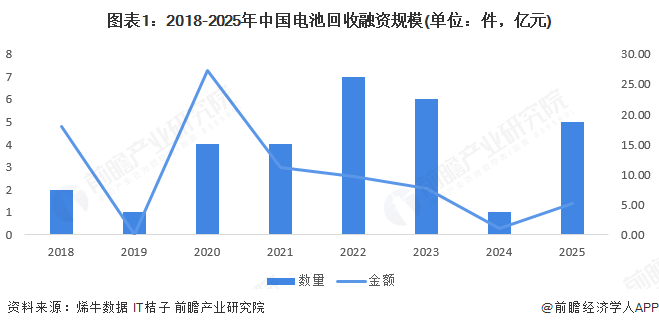
Key Points - The Chinese battery recycling industry has experienced fluctuations in financing events and amounts from 2018 to 2024, with 2022 recording the highest number of financing events at 7 and 2020 having the highest financing amount at 2.729 billion yuan [1] - As of November 3, 2025, there have been 5 financing events totaling 525 million yuan [1] - The majority of financing events from 2018 to 2025 are concentrated in strategic, angel, and A rounds, with strategic rounds accounting for 20%, and both angel and A rounds at 17% each, indicating an early-stage investment landscape [2][5] - The geographical distribution of financing events shows that Guangdong, Jiangxi, and Hubei are the primary regions, with Guangdong having the highest number of events at 7, representing 23% of the total [6] - Investment entities dominate the financing landscape, making up 77% of the total investment events from 2018 to 2025 [10] - Successful IPOs in the battery recycling sector include companies like Zhongwei Co., Greenme, Huayou Cobalt, Guanghua Technology, Fangyuan Co., Ganfeng Lithium, and Tianqi Lithium [12] - Key industrial parks for battery recycling are located in Hubei, Hunan, Zhejiang, and Guangdong, with significant projects such as the comprehensive recycling park in Hubei and the high-end material industrial park in Hunan [13][15] - Mergers and acquisitions in the battery recycling industry are primarily vertical and horizontal, with notable transactions including Huayou Cobalt's acquisition of a majority stake in a Zimbabwean lithium mining company for 378 million USD [17]




有色能源金属行业周报:短期锂价或维持震荡,战略金属价值重估背景下看好锑钴钨锡等金属-20251214
HUAXI Securities· 2025-12-14 05:36
Investment Rating - The industry rating is "Recommended" [3] Core Views - Short-term lithium prices are expected to remain volatile, with a positive outlook on antimony, cobalt, tungsten, and tin due to a reassessment of strategic metal values [1][2][7] - Supply concerns in the nickel market are supported by the lack of new approvals from Indonesia's RKAB, which may lead to price stabilization [1][28] - The cobalt market is expected to see continued price increases due to structural supply tightness, with Congo's export regulations impacting availability [2][5][16] - Antimony prices are anticipated to converge towards higher overseas prices due to export controls and tight domestic supply [6][17] - The lithium market is experiencing a strong demand backdrop, with expectations of continued inventory depletion supporting prices [7][17] - The rare earth market is tightening due to Vietnam's export ban, which is expected to support prices [9][18] - Tin prices are supported by ongoing supply concerns from overseas sources, particularly from Myanmar and Congo [11][20] - Tungsten prices are expected to remain supported due to supply constraints and regulatory controls [12][21] - The uranium market is facing supply tightness, which is likely to support prices amid geopolitical uncertainties [14][22] Summary by Sections Nickel and Cobalt Industry Update - Nickel prices are under pressure due to stable demand but cautious purchasing from smelters, with LME nickel closing at $14,420 per ton, down 2.04% [1][28] - Cobalt prices are expected to rise further, with Congo's export regulations causing supply constraints [2][5][16] Antimony Industry Update - Domestic antimony prices are lower compared to international prices, but supply tightness is expected to support future price increases [6][17] Lithium Industry Update - Lithium carbonate prices have increased, with a strong demand outlook from the electric vehicle sector [7][17] Rare Earth Industry Update - Vietnam's recent export ban on rare earths is expected to tighten global supply and support prices [9][18] Tin Industry Update - Tin prices are supported by supply concerns from Myanmar and Congo, with LME tin prices rising to $41,905 per ton [11][20] Tungsten Industry Update - Tungsten prices are expected to remain high due to supply constraints and regulatory measures [12][21] Uranium Industry Update - The uranium market is facing supply tightness, with prices supported by geopolitical factors and production delays [14][22]


有色金属周报20251213:国内外财政+货币共振,金属价格继续上行-20251213
Guolian Minsheng Securities· 2025-12-13 14:33
Investment Rating - The report maintains a "Buy" rating for all key companies listed, including Zijin Mining, Luoyang Molybdenum, and Huayou Cobalt [2][4]. Core Views - The report highlights that the metal prices are expected to continue rising due to the resonance of domestic and foreign fiscal and monetary policies, with a focus on the upcoming economic growth under the "14th Five-Year Plan" [8][21]. - The report emphasizes the strong demand in the lithium battery sector and the ongoing supply constraints in cobalt, indicating a bullish outlook for energy metals [8][83]. Summary by Sections Industry and Stock Performance - The report notes a decline in the Shanghai Composite Index by 0.34% and a 1.10% drop in the SW Nonferrous Index during the week [8]. - Key stocks in the nonferrous metal sector showed varied performance, with significant recommendations for companies like Zijin Mining and Luoyang Molybdenum [2][11]. Base Metals - Aluminum prices decreased by 0.88% to $2875 per ton, while copper prices fell by 0.96% to $11552.5 per ton, with zinc prices increasing by 1.31% to $3139 per ton [12][21]. - The report indicates that the domestic aluminum production capacity is stable at 44.39 million tons, with a slight increase in operational capacity due to high profits [21][23]. Precious Metals - Gold prices increased by 2.42% to $4329.80 per ounce, and silver prices rose by 5.59% to $62.09 per ounce, driven by the Federal Reserve's interest rate cuts [12][68]. - The report suggests a bullish outlook for gold and silver prices, supported by central bank purchases and weakening dollar credit [68][69]. Energy Metals - The lithium market is experiencing stable growth in supply, while demand from the energy storage sector continues to rise, leading to a positive outlook for lithium prices [8][83]. - Cobalt supply remains tight, with the Congo's cobalt export quotas expected to impact the market dynamics positively [8][83]. Other Minor Metals - The report discusses the fluctuations in prices for minor metals, including molybdenum and tungsten, with significant price increases noted for tungsten [15][83]. - The overall sentiment in the minor metals market remains cautious, with a focus on supply-demand dynamics and policy changes [55][85].

14.64亿元主力资金今日抢筹有色金属板块
Zheng Quan Shi Bao Wang· 2025-12-12 09:29
Market Overview - The Shanghai Composite Index rose by 0.41% on December 12, with 21 out of the 28 sectors experiencing gains, led by the non-ferrous metals and electronics sectors, which increased by 1.50% and 1.46% respectively [1] - The trading day saw a net outflow of 4.872 billion yuan from the main funds across the two markets, with 14 sectors receiving net inflows [1] Sector Performance - The non-ferrous metals sector had a notable increase of 1.50%, with a net inflow of 1.464 billion yuan, and 106 out of 138 stocks in this sector rose, including 3 stocks that hit the daily limit [2] - The power equipment sector led the net inflow with 2.805 billion yuan, followed by the machinery equipment sector with a net inflow of 1.771 billion yuan [1] Fund Flow Analysis - The non-ferrous metals sector saw significant individual stock performances, with the top net inflow stock being Antai Technology, which received 859 million yuan, followed by Zhongzhou Special Materials and Xingye Silver Tin with inflows of 542 million yuan and 209 million yuan respectively [2] - Conversely, the electronic sector experienced the largest net outflow, totaling 3.703 billion yuan, followed by the computer sector with a net outflow of 2.501 billion yuan [1] Top Gainers in Non-Ferrous Metals - Key stocks in the non-ferrous metals sector included: - Antai Technology: +9.98% with a turnover rate of 15.69% and a main fund flow of 858.70 million yuan - Zhongzhou Special Materials: +20.01% with a turnover rate of 28.24% and a main fund flow of 541.53 million yuan - Xingye Silver Tin: +3.25% with a turnover rate of 3.30% and a main fund flow of 209.37 million yuan [2] Top Losers in Non-Ferrous Metals - The non-ferrous metals sector also had notable outflows, with: - Tianqi Lithium: -2.75% with a main fund outflow of 461 million yuan - Huayou Cobalt: +0.02% with a main fund outflow of 418.59 million yuan - Ganfeng Lithium: -2.68% with a main fund outflow of 412.56 million yuan [3]


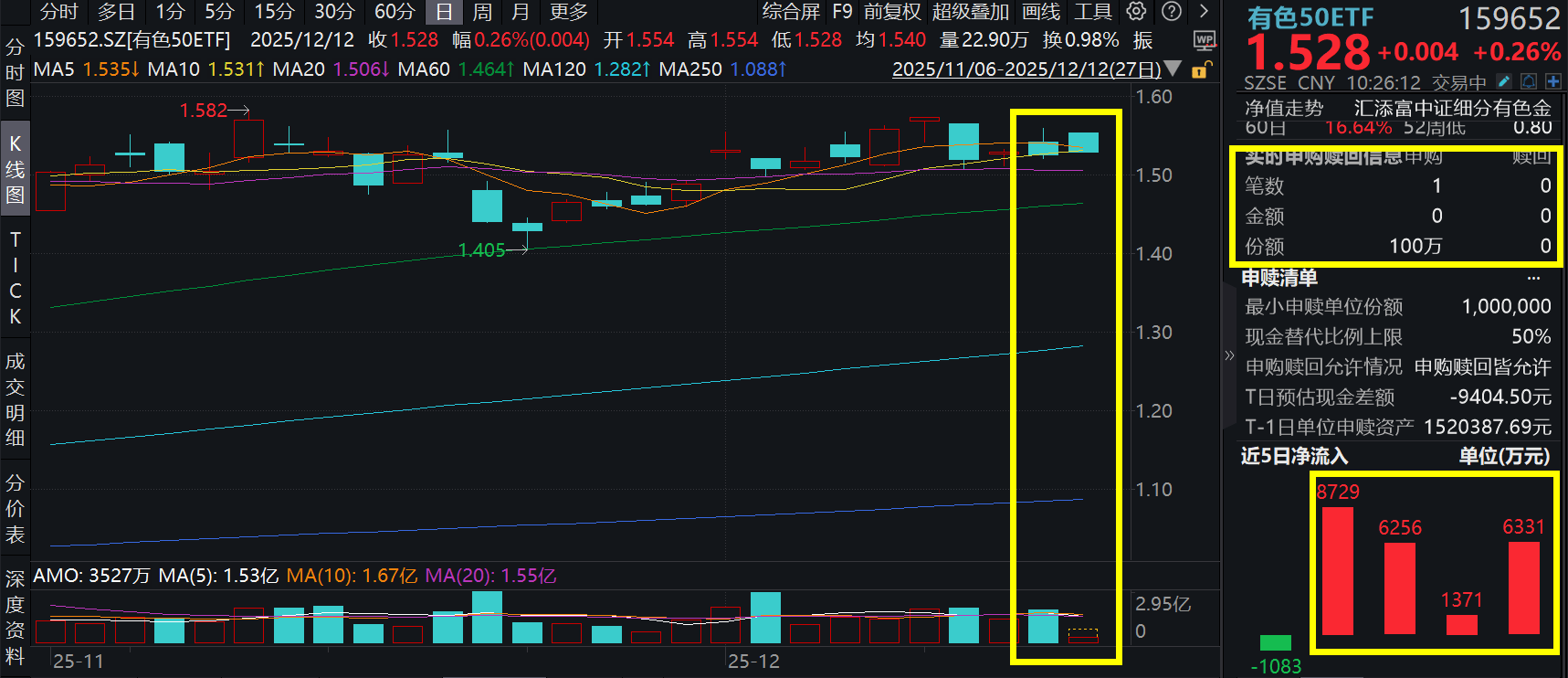
铜、银双双再创新高!紫金矿业涨超1%,有色50ETF(159652)连续4日强势吸金超2亿元,资金盘中再度出手!2026年有色金属怎么看,一文读懂!
Sou Hu Cai Jing· 2025-12-12 03:02
Core Viewpoint - The non-ferrous metal sector is experiencing a significant inflow of capital, with the Non-Ferrous 50 ETF (159652) seeing a net inflow of over 150,000 yuan and a cumulative net subscription exceeding 200 million yuan over the past five days, indicating strong investor interest [1][3]. Group 1: Market Performance - As of December 12, the Non-Ferrous 50 ETF (159652) opened strong, rising by 0.26% and briefly exceeding 1% during the morning session [1]. - The performance of the underlying index components is mixed, with companies like Zhongjin Gold and Shandong Gold rising over 2%, while companies such as Ganfeng Lithium and Tianqi Lithium fell over 3% [2][3]. - The ETF has shown a consistent trend of capital inflow, with a net subscription of 100,000 units during the session, reflecting ongoing investor confidence [1]. Group 2: Price Trends and Influences - The non-ferrous metal sector, particularly silver and copper, has seen significant price increases, with copper prices up 35% year-to-date, potentially marking the largest annual gain since 2009 [5]. - Silver prices have also reached historical highs, with a year-to-date increase exceeding 100% [5]. - The macroeconomic environment, including the Federal Reserve's interest rate cuts, is expected to continue supporting the prices of precious metals [6][7]. Group 3: Future Outlook - Looking ahead to 2026, the non-ferrous metal sector is expected to be driven by macroeconomic factors and fundamental supply-demand dynamics, with a focus on the weakening of the US dollar and ongoing supply constraints [6][7]. - The anticipated increase in demand for industrial metals, driven by new growth areas, is expected to enhance price elasticity [6]. - The copper market is projected to face supply constraints, with a slight increase in global copper production expected but limited by high disturbance rates [8]. Group 4: Investment Opportunities - The Non-Ferrous 50 ETF (159652) is highlighted as a leading investment vehicle, with a high concentration of strategic metals such as copper and gold, and a significant portion of its index comprising these metals [10][12]. - The ETF's index has a copper content of 31% and gold content of 14%, making it attractive for investors looking to capitalize on the non-ferrous metal supercycle [12]. - The ETF has demonstrated superior performance with a cumulative return leading its peers since 2022, driven by earnings rather than valuation expansion [14].