CMOC(603993)

Search documents
丝路上的乞力马扎罗山
Ge Long Hui· 2026-01-30 12:53
Group 1 - The U.S. is experiencing a significant cold wave affecting 22 states, leading the Department of Homeland Security to advise against using the term "ICE" in weather forecasts to avoid negative associations with the U.S. Immigration and Customs Enforcement agency [4] - The term "ICE" has dual meanings, referring both to ice and the immigration enforcement agency, which has a poor public image [4] - This situation reflects a broader internal division within American society, where different factions are increasingly hostile towards each other, causing major issues to become contentious [5] Group 2 - The U.S. has adopted the "Indo-Pacific Strategy," initiated by the Trump administration in 2017, which emphasizes India's role as a key partner in regional security and economic cooperation [9] - Major U.S. corporations, including General Motors, Amazon, Microsoft, and Apple, have heavily invested in India, indicating strong corporate support for the country [10][11] - The media narrative has shifted to portray India as a rising power, often referred to as "the next China," highlighting its potential as a destination for investment and innovation [12] Group 3 - Despite the optimistic outlook, many U.S. companies have faced significant challenges in India, with General Motors incurring a loss of $1 billion before deciding to exit the market [16] - The average time to close a factory in India is reported to be 4.3 years, which is significantly longer than in other countries, indicating operational difficulties [17] - Over 2,000 multinational companies have paused their operations in India in recent years, suggesting a trend of disillusionment with the Indian market [18] Group 4 - India's manufacturing sector has not met expectations, with the "Make in India" initiative failing to deliver significant results, as evidenced by a 96.5% drop in net foreign direct investment (FDI) to $353 million for the fiscal year 2024-2025 [21][22] - In contrast, U.S. FDI in India remains substantial, with a stock of $54.76 billion as of September 2024, indicating continued American interest despite challenges [23] - Companies like Ford are planning to re-enter the Indian market, and tech giants are investing in India's digital infrastructure, showing a complex relationship between optimism and reality [24][25] Group 5 - The article contrasts India with Africa, highlighting that both regions share similar challenges in industrialization and infrastructure development, but Africa is seen as having greater potential due to its vast resources and younger population [31][35] - Africa's population is projected to grow significantly, with the labor force expected to increase dramatically by 2050, presenting a potential advantage over India [35] - The African Continental Free Trade Area (AfCFTA) is establishing a unified market, with intra-African trade expected to grow significantly, further enhancing Africa's economic prospects [41][42] Group 6 - The article emphasizes that while both India and Africa face industrialization challenges, Africa's resource wealth and emerging market potential position it as a "super growth pole" [48] - U.S. investment strategies appear to be shifting towards India as a counterbalance to China's influence in Africa, despite the latter's advantages [81] - The narrative suggests that the U.S. is increasingly focusing on India due to its geopolitical significance, while simultaneously losing ground in Africa [81]



金价跳水!一天暴跌超400美元,“说话间就跌了几十元”
Mei Ri Jing Ji Xin Wen· 2026-01-30 12:20
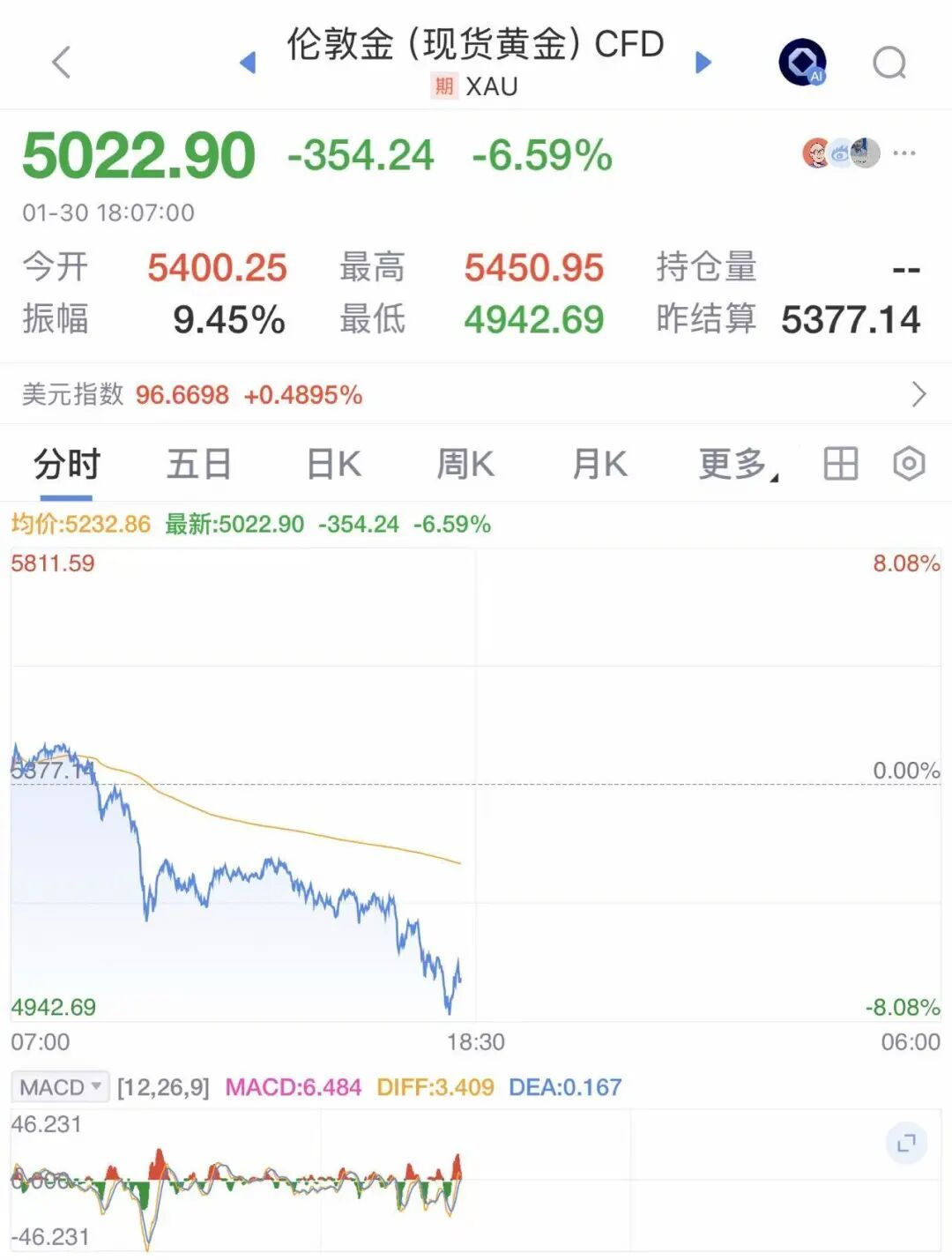
Group 1: Gold Price Movement - On January 30, international gold prices experienced a significant drop, with spot gold falling from a peak of $5,450 per ounce to below $5,000, marking a maximum decline of 8% [1] - Concurrently, international silver prices also plummeted, with spot silver dropping below $100, experiencing a decline of over 17% [3] Group 2: Impact on A-Share Market - The A-share gold concept sector faced a "limit down" wave, with multiple companies such as Yunnan Copper, Jiangxi Copper, and Zhongjin Gold hitting the trading limit [5] - Specific stock performances included Shandong Gold and Sichuan Gold both declining by 10% [7] Group 3: Jewelry and Retail Market Reaction - Several gold jewelry brands significantly reduced their prices, with quotes for 24K gold jewelry dropping to around 1,620 to 1,685 yuan per gram, down from over 1,700 yuan [12] - In Beijing, gold buyback prices were adjusted downwards by nearly 70 yuan per gram within a single day, causing hesitation among sellers [12][13] Group 4: Market Sentiment and Analyst Views - Analyst Dan Bin expressed a bearish outlook on gold and silver, suggesting that extreme price increases often lead to sharp declines [15] - Historical patterns indicate that gold prices have previously experienced significant volatility, with analysts noting that market conditions such as U.S. economic performance and geopolitical risks will influence future price movements [16] Group 5: Global Gold Demand Trends - The World Gold Council reported that global gold demand is projected to reach 5,002 tons by 2025, driven by investment demand and geopolitical uncertainties [18] - In 2025, global gold ETF demand is expected to increase significantly, with North American funds contributing the majority of the growth [19] - China's gold investment demand is also anticipated to remain strong, with a notable increase in gold bar and coin purchases [20]



2026年有色金属及新材料行业投资策略报告:供给约束叠加需求变化,多种金属价值面临重塑
Guoyuan Securities· 2026-01-30 10:24
Investment Rating - The report maintains a positive investment rating for the non-ferrous metals and new materials industry, indicating a high cost-performance investment stage with potential for sustained growth [1][5]. Core Insights - The non-ferrous metals sector has shown a significant increase, with the Shenwan Non-Ferrous Metals Index rising by 94.73% in 2025, outperforming the CSI 300 Index by 77.07 percentage points [1][13]. - Geopolitical tensions, particularly between major powers like the US and China, are expected to continue impacting the stability of the metal supply chain, leading to increased raw material costs and upward price pressures on strategic metals [2][30]. - The demand outlook for non-ferrous metals remains strong, driven by emerging industries such as electric vehicles, renewable energy, and artificial intelligence, which require high-performance materials [4][34]. Summary by Sections Industry Overview - The non-ferrous metals industry is experiencing a transformation due to supply constraints and changing demand dynamics, with certain metals reaching new price highs [1][2]. - The industry is positioned for growth, supported by favorable policies and a robust demand from new technologies [24][25]. Investment Opportunities - Investment opportunities are particularly favorable in precious metals, copper, and strategic metals, with recommendations to focus on leading companies in high-growth sectors [3][5]. - Key companies to watch include Zijin Mining, Luoyang Molybdenum, Jiangxi Copper, and Northern Rare Earth [5]. Emerging Trends - The rapid expansion of new industries is creating a strategic demand for upstream materials, which are now subject to stricter performance and purity standards [4][34]. - The shift towards electric vehicles and renewable energy is expected to sustain high demand for metals like lithium, copper, and rare earth elements [36][42]. Market Dynamics - The report highlights the tightening supply of strategic metals due to increased global regulatory controls, which is expected to lead to a supply-demand imbalance [31][32]. - The copper market is particularly noted for its supply constraints and increasing demand, with a significant reliance on imports to meet domestic needs [46][47]. Future Outlook - The profitability outlook for the non-ferrous metals sector is expected to improve, with potential for continued price increases in copper, aluminum, and gold, driven by strong industrial demand and macroeconomic conditions [15][30].
有色金属行业双周报(2026、01、16-2026、01、29):金属价格高位震荡,有色板块分化加剧-20260130
Dongguan Securities· 2026-01-30 08:58
行 业 有色金属行业 标配(维持) 有色金属行业双周报(2026/01/16-2026/01/29) 金属价格高位震荡,有色板块分化加剧 2026 年 1 月 30 日 S0340523120001 电话:0769-23320072 邮箱: xuzhengkun@dgzq.com.cn 行 业 研 究 资料来源:东莞证券研究所,iFind 相关报告 投资要点: 申万有色金属行业指数走势 贵金属。黄金方面,近期在地缘局势扰动以及资金涌入等推动下,黄金价格 再度上行。短期需重点关注避险情绪退却、投机资金退出等风险。截至1月29 日,COMEX黄金价格收于5410.80美元/盎司,较1月初上涨1068.9美元,COMEX 白银价格收于115.79元/盎司,较1月初上涨44.81美元,上海黄金交易所黄金 Au(T+D)价格收于1243.40元/克,较1月初上涨269.01元。建议关注紫金矿 业(601899)。 工业金属。在全球降息周期开启的大背景下,有色金属价格屡创新高。随着 主流工业金属铜、锡等供需格局加快转好,以及工业金属补涨贵金属的机会 仍存,工业金属价格有望进一步上行。截至1月29日,LME铜价收于1370 ...



2026年有色金属及新材料行业投资策略报告:供给约束叠加需求变化,多种金属价值面临重塑-20260130
Guoyuan Securities· 2026-01-30 08:43
Core Insights - The report indicates that the non-ferrous metals and new materials industry is currently in a high cost-performance investment phase, with expectations for continued growth [1] - As of December 31, 2025, the Shenwan Non-Ferrous Metals Index has seen a cumulative increase of 94.73% for the year, ranking first among 31 Shenwan primary industries, significantly outperforming the CSI 300 Index by 77.07 percentage points [1][13] - The industry is influenced by international dynamics and changes in supply patterns, with some metal prices reaching new highs [1] Supply and Demand Dynamics - The ongoing strategic competition between major powers like the US and China has made upstream metal resources a critical area of contention, leading to significant impacts on the stability of the metal supply chain [2] - Supply disruptions are expected to increase raw material costs, while tighter controls on strategic metals by various countries will further exacerbate price pressures [2] - The demand outlook for non-ferrous metals is clear, supported by long-term fundamentals [2] Investment Opportunities - The report highlights investment opportunities in precious metals, copper, and strategic metals, noting that gold has evolved into a strategic asset for managing systemic risks, with central banks likely to increase gold reserves [3] - The mining of copper is becoming increasingly challenging, with supply constraints supporting a long-term upward price trend [3] - The geopolitical competition is expected to lead to enhanced resource controls, creating structural investment opportunities in related sectors [3] Emerging Industries and Material Demand - Rapidly expanding sectors such as artificial intelligence, electric vehicles, renewable energy, and high-end semiconductors are driving unprecedented demand for upstream materials, which are now classified as "key strategic materials" or "high-tech value-added new materials" [4] - The performance, purity, form, and functionality of materials are subject to increasingly stringent standards, indicating a fundamental shift in investment logic [4] Recommendations - The report recommends focusing on sectors such as copper, gold, and strategic metals, particularly in 2026, with an emphasis on leading companies that operate in high-growth areas with strong technological monopolies [5] - Specific companies to watch include Zijin Mining, Luoyang Molybdenum, Jiangxi Copper, Tongling Nonferrous Metals, China Rare Earth, Northern Rare Earth, Shenghe Resources, Xiamen Tungsten, Zhongtung High-tech, and Zhangyuan Tungsten [5]
万亿龙头巨震!差1分,险跌停
Zhong Guo Zheng Quan Bao· 2026-01-30 04:37
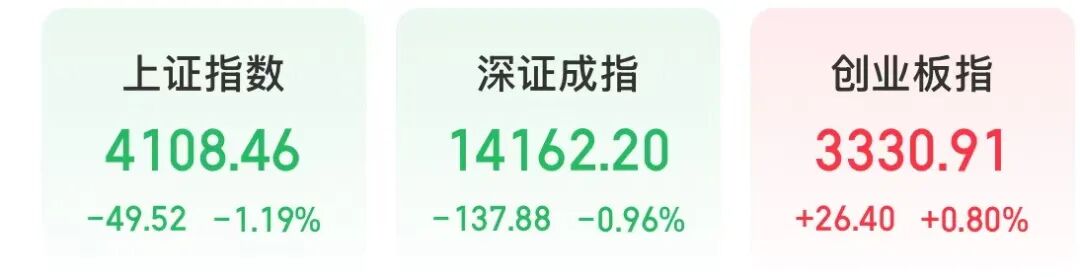
Group 1: Precious Metals Market - Spot gold first broke the $5500/oz mark, reaching nearly $5600/oz before dropping below $5200/oz [1] - The non-ferrous metals sector saw significant declines, with major companies like Zijin Mining and Luoyang Molybdenum falling over 8% and 9% respectively [1] - The performance of the non-ferrous metals sector pressured the Shanghai Composite Index and Shenzhen Component Index, while the ChiNext Index rose due to gains in key stocks like CATL and Sungrow [1] Group 2: Agricultural and Consumer Sectors - Some cyclical sectors showed strong performance, with agriculture and aquaculture sectors rising significantly, indicating a typical rotation pattern in commodity markets [1] - The rise in agricultural products is expected to transmit to the aquaculture sector and further into the consumer market [1] - By the close of the morning session, the Shanghai Composite Index fell by 1.19%, the Shenzhen Component Index by 0.96%, while the ChiNext Index increased by 0.8% [1] Group 3: Film and Entertainment Sector - The film and cinema sector saw active performance, with stocks like Hengdian Film and Happiness Blue Sea experiencing significant gains [4][6] - A favorable policy environment, including the State Council's plan to enhance service consumption, is expected to support the film industry [6][7] - The upcoming 2026 Spring Festival film lineup is anticipated to drive market recovery, with multiple new films scheduled for release [7] Group 4: AI and Optical Communication Sector - The North American computing power chain showed strong performance, with stocks like "Yizhongtian" and Tianfu Communication reaching historical highs [7] - The demand for AI computing power is driving upgrades in the optical communication industry, with strong demand for high-speed optical modules [10] - Despite short-term supply gaps in high-speed optical chips, upstream manufacturers are actively expanding production, which is expected to alleviate supply chain bottlenecks [10]


铜业股跌幅居前 市场AI担忧再起 短期铜价震荡承压
Zhi Tong Cai Jing· 2026-01-30 04:07
国泰海通表示,宏观情绪调整叠加英伟达修正数据中心铜需求量,短期铜价震荡承压。然铜矿供给仍旧 紧张,现货铜精矿加工费持续下跌,AI和电网建设带来的需求逻辑仍在,近期国家电网表示十五五期 间固定资产投资预计为4万亿,较十四五增长40%。同时海内外流动性宽松的趋势未变,为铜价提供有 力支撑。 铜业股跌幅居前,截至发稿,中国有色矿业(01258)跌12.45%,报15.96港元;江西铜业(600362)股份 (00358)跌9.2%,报47.94港元;五矿资源(01208)跌8.71%,报10.38港元;洛阳钼业(603993)(03993)跌 6.84%,报22.62港元。 消息面上,近日,微软公布第二财季财报显示,该公司季度资本支出飙升至历史新高,同时云业务销售 增速放缓,引发投资者担忧其在人工智能领域的大规模投入可能需要比预期更长的时间才能见效。银河 期货市场观点认为,前期金银快速拉涨后,铜价跟随相对缓慢,铜矿扰动成为本轮上涨的导火索,在情 绪的资金的加持下,夜盘国内最高触及114160元/吨。之后由于微软、甲骨文等AI股暴跌,多头资金快 去离场,铜价收回日内全部涨幅,最低跌至104550元/吨。 ...
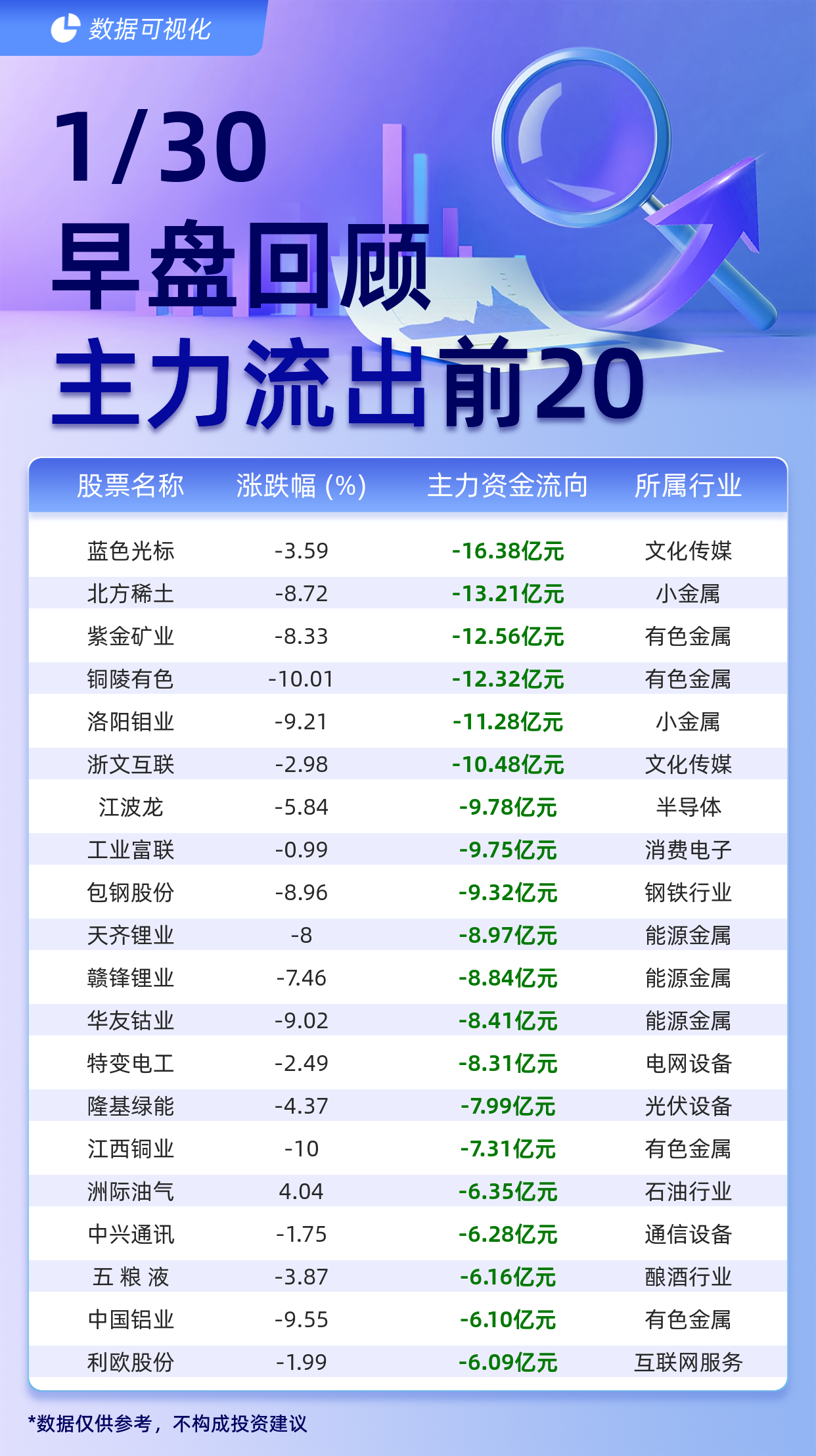
主力个股资金流出前20:蓝色光标流出16.38亿元、北方稀土流出13.21亿元




Jin Rong Jie· 2026-01-30 04:02
Core Viewpoint - The data indicates significant outflows of main funds from various stocks, with notable declines in share prices across multiple sectors, particularly in the rare metals and non-ferrous metals industries [1][2][3] Group 1: Stock Performance and Fund Outflows - BlueFocus Media experienced a fund outflow of 1.638 billion yuan, with a share price decline of 3.59% [2] - Northern Rare Earth saw a fund outflow of 1.321 billion yuan, with a share price drop of 8.72% [2] - Zijin Mining reported a fund outflow of 1.256 billion yuan, with a decrease in share price of 8.33% [2] - Tongling Nonferrous Metals had a fund outflow of 1.232 billion yuan, with a share price decline of 10.01% [2] - Luoyang Molybdenum experienced a fund outflow of 1.128 billion yuan, with a share price drop of 9.21% [2] Group 2: Sector Analysis - The rare metals sector, represented by Northern Rare Earth and Luoyang Molybdenum, is facing significant fund outflows and price declines [2][3] - The non-ferrous metals sector, including companies like Zijin Mining and Tongling Nonferrous Metals, is also experiencing substantial outflows, indicating potential challenges in this industry [2][3] - The energy metals sector, represented by Tianqi Lithium and Ganfeng Lithium, shows notable fund outflows, with share price declines of 8% and 7.46% respectively [2][3]
金属供需逻辑依然坚实,有色ETF鹏华(159880)盘中净申购1100万份
Sou Hu Cai Jing· 2026-01-30 03:37
Group 1 - The core viewpoint of the news is the anticipation of Kevin Warsh being nominated as the new Federal Reserve Chairman, which has led to a significant drop in the prices of non-ferrous stocks [1] - The market prediction for Warsh's nomination has surged to 87% according to Polymarket, indicating strong market sentiment towards a hawkish candidate [1] - The report from Guojin Securities outlines the main logic for the non-ferrous sector this year, highlighting low supply due to low capital expenditure, domestic anti-competition measures, and overseas resource nationalism [1] Group 2 - The demand for non-ferrous metals is driven by AI, new energy, and the reconstruction of manufacturing in Europe and the US [1] - The report emphasizes strong inventory replenishment due to low existing inventories across supply chains and the initiation of a national reserve cycle in the US [1] - Despite recent price volatility due to regional issues, the fundamental outlook for commodity prices remains strong, with macroeconomic fluctuations being the only potential disruptor [1] Group 3 - As of January 30, 2026, the non-ferrous metal industry index (399395) saw significant declines in major stocks, with Nanshan Aluminum leading at a drop of 10.05% [2] - The non-ferrous ETF Penghua (159880) decreased by 8.66%, with a latest price of 2.39 yuan and a net inflow of 11 million units over the past seven days [2] - The top ten weighted stocks in the non-ferrous metal industry index account for 51.65% of the index, including companies like Zijin Mining and Ganfeng Lithium [2]




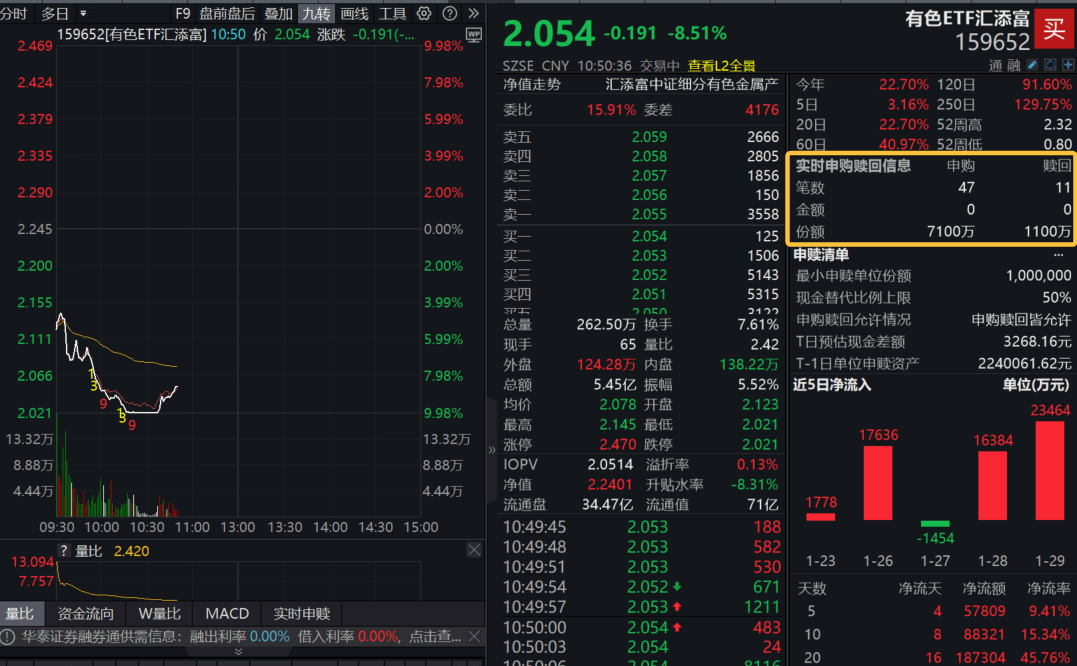
黄金等大宗商品大幅震荡!有色新高后首度重挫,有色ETF汇添富(159652)盘中跌幅收窄,资金实时涌入超1亿元!紫金矿业、洛阳钼业跌超7%
Sou Hu Cai Jing· 2026-01-30 03:20
Market Overview - On January 30, the A-share market experienced a volatile correction, with the non-ferrous sector showing dramatic fluctuations, leading to significant declines in gold and non-ferrous ETFs, which approached their daily limit down before narrowing losses [1][3] - The non-ferrous ETF Huatai-PineBridge (159652) saw a drop of over 9%, which later reduced to 8%, with net subscriptions reaching 60 million units, translating to over 120 million yuan in net subscription amount [1] Precious Metals - The long-term outlook for gold remains strong due to factors such as de-dollarization, central bank gold purchases, and geopolitical conflicts, although short-term pullback risks should be monitored [1][5] - Recent market dynamics saw COMEX gold futures reaching historical highs, while spot silver surged over 4%, and London copper prices jumped 8%, surpassing $14,000 per ton [3][5] Industrial Metals - The copper market is currently experiencing short-term emotional volatility, but the long-term logic remains intact, supported by tight supply and ongoing demand from AI and power grid construction [8] - Aluminum prices are expected to maintain high volatility due to mixed macroeconomic signals, with domestic production increasing and inventory pressures mounting [8] Investment Opportunities - The non-ferrous ETF Huatai-PineBridge (159652) is highlighted for its comprehensive coverage of various metal sectors, including gold, copper, aluminum, lithium, and rare earths, positioning it to benefit from the super cycle in non-ferrous metals [11][14] - The ETF has shown superior performance with a cumulative return leading its peers since 2022, and its valuation remains reasonable, indicating that price increases are driven by earnings rather than valuation expansion [16][17] Historical Trends - Historical patterns suggest that the non-ferrous sector is likely to continue its strong performance, particularly during the second phase of major market cycles, which is characterized by profit-driven price increases [9]