Chongqing Baiya Sanitary Products (003006)

Search documents
个护用品板块1月20日涨1.77%,延江股份领涨,主力资金净流出4799.98万元
Zheng Xing Xing Ye Ri Bao· 2026-01-20 09:00
Group 1 - The personal care products sector increased by 1.77% on January 20, with Yanjiang Co., Ltd. leading the gains [1] - The Shanghai Composite Index closed at 4113.65, down 0.01%, while the Shenzhen Component Index closed at 14155.63, down 0.97% [1] - Key stocks in the personal care sector showed varied performance, with Yanjiang Co., Ltd. closing at 19.40, up 9.11%, and Ziya Co., Ltd. at 22.51, up 4.16% [1] Group 2 - The personal care products sector experienced a net outflow of 47.99 million yuan from institutional investors, while retail investors saw a net inflow of 9.42 million yuan [2] - The trading volume for Yanjiang Co., Ltd. was 638,400 shares, with a total transaction value of 1.257 billion yuan [1] - The stock performance of major companies included a 2.51% increase for Beijia Co. and a 2.25% increase for Dengkang Oral Care [1][2] Group 3 - The net inflow from retail investors for the stock of Yiyi Co. was 400.92 million yuan, while the net outflow from institutional investors was 595.82 million yuan for Kela Co. [3] - The net inflow for Ziya Co. was 299.34 million yuan from retail investors, while it faced a net outflow of 1,407.33 million yuan from institutional investors [3] - The overall market sentiment showed mixed results, with some stocks like Yiyi Co. and Beijia Co. attracting retail interest despite institutional outflows [3]




百亚股份:公司将密切关注银发经济相关政策导向,持续跟踪养老护理领域的市场机遇
Cai Jing Wang· 2026-01-20 07:17
Core Viewpoint - The company focuses on the research, production, and sales of disposable personal hygiene products, including sanitary napkins, baby diapers, and adult incontinence products [1] Group 1: Company Performance - For the period from January to September 2025, the company achieved a revenue of 2.623 billion yuan, representing a year-on-year growth of 12.80% [1] - The net profit attributable to the parent company was 245 million yuan, with a year-on-year increase of 2.53% [1] Group 2: Product Lines - The company's brand "Ziyoudian" is associated with sanitary napkins, "Haozhi" is linked to baby diapers, and "Danning" is related to adult incontinence products [1] Group 3: Market Focus - The company will closely monitor policies and industry trends related to the silver economy and continuously track market opportunities and industrial upgrades in the elderly care sector [1]
未知机构:百亚股份重视26年利润弹性底部坚定推荐回答当下市场的核心分歧点-20260120
未知机构· 2026-01-20 02:10
Summary of Baia Co., Ltd. Conference Call Company Overview - **Company**: Baia Co., Ltd. - **Focus**: E-commerce performance and strategic adjustments for 2026 Key Points 1. 2026 E-commerce Performance - The company anticipates a significant reduction in losses for 2026 due to internal reflections and strategic corrections made after substantial losses in 2025 [1] - Adjustments include personnel changes aimed at improving profitability in the e-commerce segment [1] 2. Impact of E-commerce Slowdown - Concerns were raised about whether the slowdown in e-commerce would disrupt the company's operational logic [1] - Historically, e-commerce has played a crucial role in driving product popularity and offline traffic [1] - For 2026, the company will continue to focus on its PRO, organic cotton, and pants series, which are expected to maintain a solid flow of customers [1] 3. Expansion into New Provinces - The company has successfully completed its expansion into approximately 10 new provinces beyond its original five [1] - Future market share growth in these new provinces will increasingly depend on the effectiveness of the offline sales team [1] 4. Shift in Resource Allocation - Following the slowdown in e-commerce, the company plans to allocate more resources to offline operations [1] - National expansion is identified as the core driver of growth for the next 3-5 years [1] 5. Growth Rate Concerns - There are questions regarding whether the company will face a slowdown in growth due to the e-commerce decline [1] Additional Insights - The company is committed to enhancing its profitability and operational efficiency in response to market challenges [1] - The strategic focus on offline expansion indicates a shift in business model to adapt to changing market conditions [1]
个护用品板块1月19日涨1.96%,延江股份领涨,主力资金净流出5029.89万元
Zheng Xing Xing Ye Ri Bao· 2026-01-19 08:58
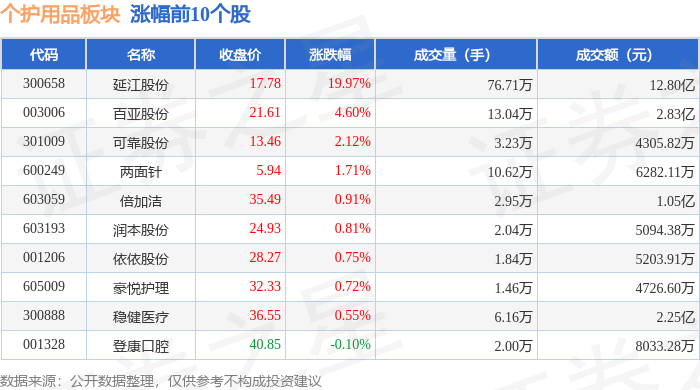
Core Viewpoint - The personal care products sector experienced a 1.96% increase on January 19, with Yanjiang Co., Ltd. leading the gains, while the Shanghai Composite Index rose by 0.29% and the Shenzhen Component Index increased by 0.09% [1] Group 1: Market Performance - The closing price of Yanjiang Co., Ltd. was 17.78, reflecting a significant increase of 19.97% with a trading volume of 767,100 shares and a transaction value of 1.28 billion yuan [1] - Baiya Co., Ltd. closed at 21.61, up by 4.60%, with a trading volume of 130,400 shares and a transaction value of 283 million yuan [1] - Reliable Co., Ltd. saw a closing price of 13.46, increasing by 2.12% with a trading volume of 32,300 shares [1] Group 2: Fund Flow Analysis - The personal care products sector had a net outflow of 50.30 million yuan from institutional investors, while retail investors saw a net inflow of 17.49 million yuan [2] - The main funds showed a net inflow of 7.99 million yuan into Stable Medical, while the retail funds had a net outflow of 16.41 million yuan [3] - In contrast, Jingya Co., Ltd. experienced a net outflow of 3.24 million yuan from main funds, but retail funds showed a net inflow of 5.23 million yuan [3]
百亚股份:未与日本东海特殊钢金属株式会社有合作
Mei Ri Jing Ji Xin Wen· 2026-01-19 04:01
(文章来源:每日经济新闻) 每经AI快讯,有投资者在投资者互动平台提问:请问公司和日本东海特殊钢金属株式会社有合作吗? 百亚股份(003006.SZ)1月19日在投资者互动平台表示,公司未与日本东海特殊钢金属株式会社有合 作。 ...
个护用品板块1月15日跌1.72%,稳健医疗领跌,主力资金净流入53.17万元
Zheng Xing Xing Ye Ri Bao· 2026-01-15 08:59
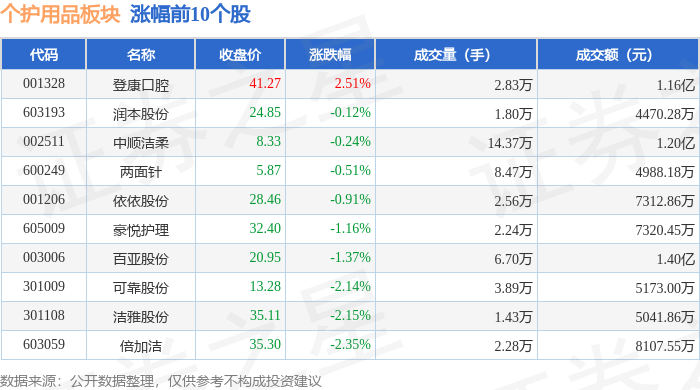
Core Viewpoint - The personal care products sector experienced a decline of 1.72% on January 15, with a notable drop in the stock of Wanjian Medical, while the overall market showed mixed results with the Shanghai Composite Index down 0.33% and the Shenzhen Component Index up 0.41% [1] Group 1: Market Performance - The personal care products sector's decline was led by Wanjian Medical, which fell by 3.57% to a closing price of 38.08 [2] - The Shanghai Composite Index closed at 4112.6, down 0.33%, while the Shenzhen Component Index closed at 14306.73, up 0.41% [1] Group 2: Individual Stock Performance - Notable stock performances included: - Dengkang Oral (001328) rose by 2.51% to 41.27 with a trading volume of 28,300 shares and a transaction value of 116 million [1] - Other stocks such as Zhongshun Jierou (002511) and Liangmian Needle (600249) saw minor declines of 0.24% and 0.51% respectively [1] - The largest decline was observed in Wanjian Medical (300888), which dropped by 3.57% [2] Group 3: Capital Flow - The personal care products sector saw a net inflow of 531,700 yuan from institutional investors, while retail investors experienced a net outflow of 2,407,430 yuan [2] - The capital flow for individual stocks indicated that Wanjian Medical had a net inflow of 21,931,300 yuan from institutional investors, but a significant outflow of 45,204,800 yuan from retail investors [3]


个护用品板块1月14日涨0.2%,百亚股份领涨,主力资金净流入432.12万元
Zheng Xing Xing Ye Ri Bao· 2026-01-14 08:57
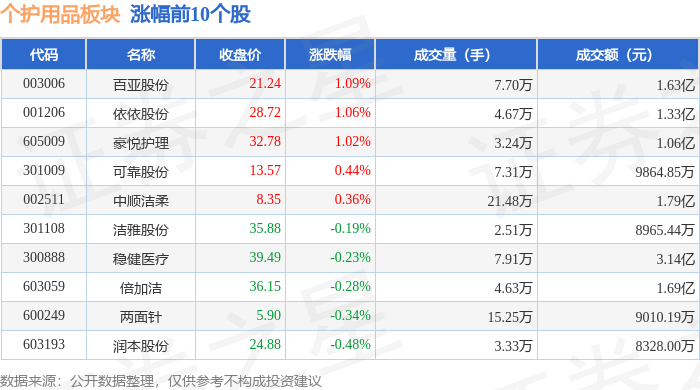
Core Viewpoint - The personal care products sector experienced a slight increase of 0.2% on January 14, with Baiya Co., Ltd. leading the gains, while the Shanghai Composite Index fell by 0.31% and the Shenzhen Component Index rose by 0.56% [1]. Group 1: Market Performance - The closing price of Baiya Co., Ltd. was 21.24, with an increase of 1.09% and a trading volume of 77,000 shares, amounting to a transaction value of 163 million yuan [1]. - Other notable performers included Yiyi Co., Ltd. with a closing price of 28.72 and a rise of 1.06%, and Haoyue Care with a closing price of 32.78 and an increase of 1.02% [1]. - Conversely, companies like Jiya Co., Ltd. and Wanjian Medical saw slight declines of 0.19% and 0.23%, respectively [1]. Group 2: Capital Flow - The personal care products sector saw a net inflow of 4.32 million yuan from institutional investors, while retail investors experienced a net outflow of 7.12 million yuan [2]. - The capital flow data indicates that Yiyi Co., Ltd. had a significant net inflow of 13.31 million yuan from institutional investors, while it faced a net outflow of 6.19 million yuan from retail investors [3]. - Other companies like Haoyue Care and Dongkang Oral also showed mixed capital flows, with institutional inflows but retail outflows [3].
个护用品板块1月13日跌0.03%,百亚股份领跌,主力资金净流入1719.79万元
Zheng Xing Xing Ye Ri Bao· 2026-01-13 09:06
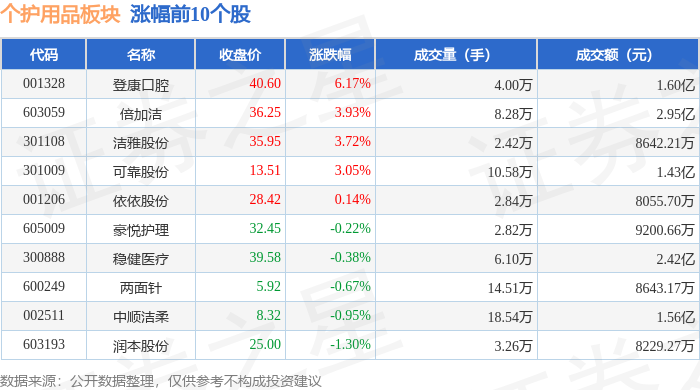
Market Overview - The personal care products sector experienced a slight decline of 0.03% on January 13, with Baiya Co., Ltd. leading the drop [1] - The Shanghai Composite Index closed at 4138.76, down 0.64%, while the Shenzhen Component Index closed at 14169.4, down 1.37% [1] Stock Performance - Notable gainers in the personal care sector included: - Dengkang Oral Care (001328) with a closing price of 40.60, up 6.17% [1] - Beijia Clean (603059) with a closing price of 36.25, up 3.93% [1] - Jieya Co., Ltd. (301108) with a closing price of 35.95, up 3.72% [1] - Other stocks showed mixed performance, with some experiencing declines, such as: - Two-Sided Needle (600249) down 0.67% to 5.92 [1] - Zhongshun Jiesang (002511) down 0.95% to 8.32 [1] Capital Flow - The personal care products sector saw a net inflow of 17.19 million yuan from institutional investors, while retail investors experienced a net outflow of 20.21 million yuan [2] - The capital flow for individual stocks indicated that: - Reliable Co., Ltd. (301009) had a net inflow of 10.73 million yuan from institutional investors [3] - Beijia Clean (603059) faced a net outflow of 3.99 million yuan from institutional investors [3]
百亚股份:公司会定期开展消费者调研
Zheng Quan Ri Bao Wang· 2026-01-12 11:41
Group 1 - The company, Baiya Co., Ltd. (stock code: 003006), engages in regular consumer research to inform internal business decisions [1] - Major operational information will be disclosed in compliance with relevant laws and regulations [1]
个护用品板块1月12日涨1.28%,倍加洁领涨,主力资金净流出113.34万元
Zheng Xing Xing Ye Ri Bao· 2026-01-12 09:10
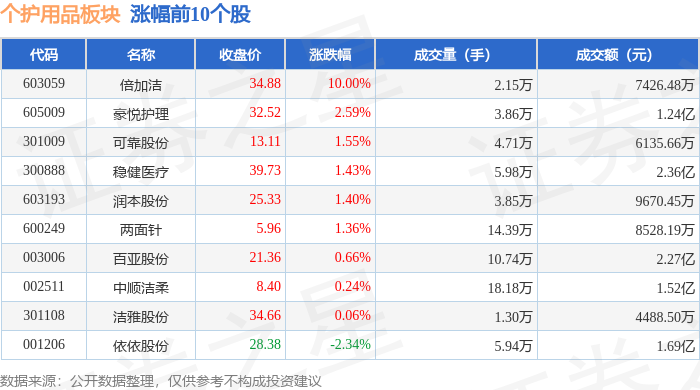
Market Overview - The personal care products sector increased by 1.28% on January 12, with Beijia leading the gains [1] - The Shanghai Composite Index closed at 4165.29, up by 1.09%, while the Shenzhen Component Index closed at 14366.91, up by 1.75% [1] Stock Performance - Beijia (603059) closed at 34.88, with a rise of 10.00% and a trading volume of 21,500 lots, resulting in a transaction value of 74.26 million yuan [1] - Haoyue Care (605009) closed at 32.52, up by 2.59%, with a trading volume of 38,600 lots and a transaction value of 124 million yuan [1] - Reliable Co. (301009) closed at 13.11, increasing by 1.55%, with a trading volume of 47,100 lots and a transaction value of 61.36 million yuan [1] - Other notable stocks include: - Wenjian Medical (300888) at 39.73, up by 1.43% [1] - Runben Co. (603193) at 25.33, up by 1.40% [1] - Liangmian Needle (600249) at 5.96, up by 1.36% [1] Capital Flow - The personal care products sector experienced a net outflow of 1.1334 million yuan from institutional investors, while retail investors saw a net inflow of 5.4803 million yuan [2] - The overall capital flow indicates that while institutional investors withdrew funds, retail investors were actively buying into the sector [2] Detailed Capital Flow Analysis - Beijia (603059) had a net inflow of 23.84 million yuan from institutional investors, but a net outflow of 9.50 million yuan from speculative funds [3] - Haoyue Care (605009) saw a net inflow of 18.45 million yuan from institutional investors, with a net outflow of 12.29 million yuan from speculative funds [3] - Reliable Co. (301009) experienced a net outflow of 5.92 million yuan from institutional investors, while retail investors contributed a net inflow of 6.46 million yuan [3]