
TSMC(TSM)

Search documents
民进党正亲手写下“卖台墓志铭”
Xin Lang Cai Jing· 2026-01-21 15:24
Group 1 - The article highlights the stark reality of Taiwan's economic situation, emphasizing that the Taiwanese government is sacrificing its semiconductor industry for hollow promises of support from the United States [2][3] - Taiwan has committed to a $500 billion investment in the U.S., with $250 billion backed by government guarantees and $250 billion from private capital, which is seen as merely an initial payment for future concessions [2] - The article criticizes the Taiwanese government's claim that TSMC will maintain 80% of its global production capacity by 2036, arguing that this is misleading given the planned relocation of significant production capabilities to the U.S. [2] Group 2 - The narrative suggests that Taiwan's fate is predetermined, with the U.S. willing to disregard the sovereignty of allies, raising concerns about Taiwan's reliance on military purchases and investments for protection [3] - The article warns that as Taiwan's semiconductor industry is depleted and young engineers leave, the social and economic foundations of Taiwan will deteriorate under political theatrics and false narratives [3] - It concludes that the current Taiwanese administration is writing a "tombstone" for Taiwan's future, portraying the loss of its semiconductor industry as a strategic victory, which is seen as a tragic reality [3]

卢特尼克的三巴掌,打不破“台独”的信息茧房
经济观察报· 2026-01-21 12:45
以台美协议的落实为标志,在台湾的经济版图中,半导体的分 量一定是会持续下降的。与此形成鲜明对比的是,台湾的军工 复合体正在野蛮生长。 作者:王义伟 封图:本报资料室 彼时的卢特尼克,真是得意洋洋。 因为,包括台积电赴美建厂在内,台湾方面承诺的对美投资金额高达5000亿美元。卢特尼克还 称,这只是头期款,如果台湾不兑现,来自台湾的电子产品(芯片)将被课以重税。 在笔者看来,作为特朗普政府的内阁成员,卢特尼克有失风度。他上述言语中表现出的对台湾的轻 视、蔑视,深深地刺痛了岛内蓝营。连日来,蓝营高层和蓝营媒体纷纷发表看法和评论,批评赖清 德当局出卖台湾利益。 1月21日,台湾《联合报》发表社论,题目是《卢特尼克三个大巴掌,打在谁脸上?》。 该社论也认定卢特尼克的表现是"得意洋洋",并指出"卢特尼克接受财经媒体CNBC专访,解读美 台关税谈判结果,得意洋洋道出血淋淋的谈判真相,结结实实打了赖政府三个大巴掌"。这三个巴 掌分别是:让特朗普开心、确认美国独赢、顺手搬走5000亿美元头期款和台积电四成先进产能。 岛内绿营,一方面对卢特尼克的言论装作听不见,一方面对台美协议进行粉饰。台湾行政部门负责 人卓荣泰说,台美达成共识 ...


台积电产能已证实:苹果今年不发iPhone 18标准版
Xin Lang Cai Jing· 2026-01-21 12:42
Core Viewpoint - Apple is adopting a "two releases a year" strategy for the iPhone 18 series, with different models being launched in two phases [1][4]. Group 1: Product Release Strategy - This fall, Apple will release the iPhone 18 Pro, iPhone 18 Pro Max, and iPhone Fold, while the standard version of the iPhone 18 is set to launch in spring 2027 [3][6]. - The phased release strategy is supported by TSMC's expansion plan for WMCM packaging capacity, which is expected to double to 120,000 wafers per month by 2027, up from approximately 60,000 wafers per month in 2026 [3][6][7]. Group 2: Technological Advancements - The iPhone 18 series will debut the A20 and A20 Pro chips, with the standard version featuring the A20 and the Pro series featuring the A20 Pro [3][6]. - Both chips will utilize TSMC's 2nm process technology, and the packaging method will shift from InFO to WMCM, allowing for greater integration of CPU, GPU, and neural network engine into a single package, enhancing flexibility [3][6].


台积电最大客户换人了!
国芯网· 2026-01-21 12:07
Core Viewpoint - The relationship between Apple and TSMC has shifted, with NVIDIA becoming TSMC's largest customer, accounting for 13% of its total revenue, while Apple no longer holds priority shipping rights [2][4]. Group 1: Customer Dynamics - TSMC has stopped granting Apple priority shipping rights, indicating a change in their long-standing partnership [4]. - NVIDIA has overtaken Apple as TSMC's largest customer, reflecting a significant shift in the semiconductor supply chain [2][4]. Group 2: Supply Chain and Production - TSMC's 2nm wafer supply is under pressure due to high demand, leading to continuous price increases for advanced process nodes over the past four years [4]. - The number of 2nm process tape-outs is 1.5 times that of 3nm, suggesting a competitive landscape with multiple clients vying for TSMC's advanced capacity [4]. Group 3: Strategic Moves by Apple - Apple is preparing for a transition to Intel as a second supplier for advanced processes, with plans to release M-series processors using Intel's 18A process by mid-2027 [4]. - The introduction of Intel as a secondary supplier is strategically significant for Apple, as it aims to enhance supply chain management while still relying heavily on TSMC in the foreseeable future [4].

通信周观点:台积电资本开支上修,算力供需共振景气向好-20260121
Changjiang Securities· 2026-01-21 11:32
丨证券研究报告丨 [Table_Summary] 2026 年第 2 周,通信板块上涨 0.99%,在长江一级行业中排名第 8 位;2026 年年初以来,通 信板块上涨 2.51%,在长江一级行业中排名第 19 位。台积电大幅上修 2026 年 Capex 至 520- 560 亿美元,直言产能非常紧张、未来三年资本支出将显著增加;AI 加速器营收占比提升明显, 2024-2029 年营收 CAGR 指引上调至接近 55%。OpenAI、CoreWeave、Meta 与 xAI 等头部 厂商持续扩建 AI 超算集群,锁定中长期算力与能源资源,全球 AI 算力需求强劲。 分析师及联系人 [Table_Author] 于海宁 SAC:S0490517110002 SFC:BUX641 请阅读最后评级说明和重要声明 %% %% %% %% 行业研究丨行业周报丨通信设备Ⅲ [Table_Title] 通信周观点:台积电资本开支上修,算力供需共 振景气向好 报告要点 research.95579.com 1 通信设备Ⅲ cjzqdt11111 [Table_Title 通信周观点:台积电资本开支上修,算力供需共 2] ...
市场开始质疑“超预期”逻辑! 美股高估值时代 没有强业绩指引=卖事实
智通财经网· 2026-01-21 11:30
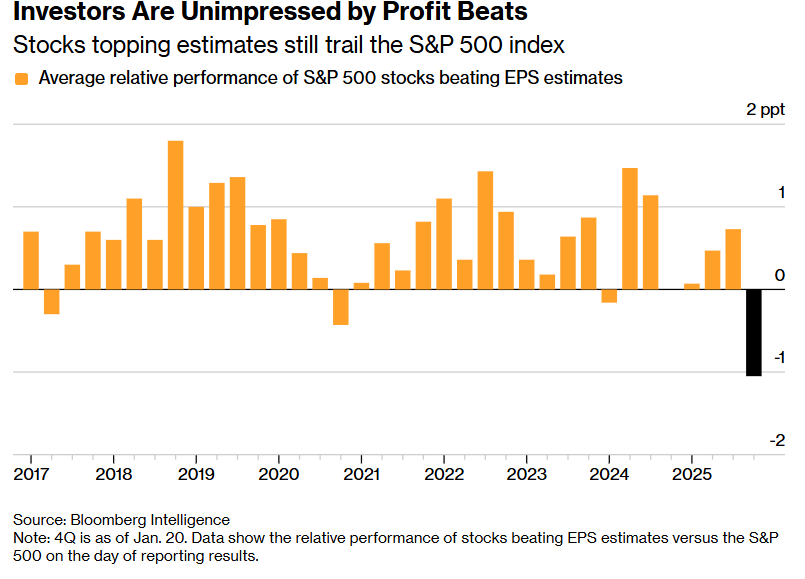
Core Viewpoint - The recent earnings season for U.S. stocks has shown that actual profits significantly exceeded market expectations, yet investors reacted with the worst stock price performance following earnings beats on record, indicating a cautious sentiment towards future guidance and macroeconomic uncertainties [1][5][15]. Group 1: Earnings Performance - Approximately 81% of S&P 500 companies reported actual profits that surpassed fourth-quarter consensus estimates, but their stock prices lagged the benchmark index by an average of 1.1 percentage points, marking the worst relative performance since 2017 [1][15]. - Companies like 3M and State Street saw significant stock price declines despite beating earnings expectations, as investors focused on their bleak forecasts [2][15]. - Netflix's disappointing earnings outlook led to a pre-market drop of about 6%, failing to provide a positive start to the earnings season for tech giants [2][15]. Group 2: Market Sentiment and Valuation - Investors are increasingly focused on management comments and earnings guidance, particularly regarding AI computing demand and consumer health, which are critical narratives for the ongoing bull market [6][13]. - The current market threshold for upward movement is not merely beating consensus expectations but rather providing strong forward guidance to justify high valuations in a sensitive macroeconomic environment [7][13]. - The S&P 500 is trading at approximately 22 times forward earnings, above the 10-year average of 19 times, indicating that any signs of weak demand could trigger significant sell-offs [13][15]. Group 3: Geopolitical and Economic Concerns - Concerns over geopolitical tensions and macroeconomic uncertainties, exacerbated by aggressive tariff threats from former President Trump, have led to increased scrutiny from investors in the historically high U.S. stock market [8][15]. - The potential for a global trade war has heightened investor caution, impacting sentiment towards the stock market as it enters its third year of a bull run [8][15]. Group 4: Specific Company Insights - TSMC reported exceptionally strong earnings, with a gross margin exceeding 60% and a projected revenue growth rate of nearly 30% for 2026, significantly boosting investor confidence in semiconductor stocks [14][15]. - The demand for DRAM and NAND storage chips remains robust, driven by the increasing importance of these products in AI training and inference systems, highlighting a critical growth area in the tech sector [13][14].
台积电(TSM):2025Q4 财报点评:2025Q4 业绩&2026Q1 指引超预期,资本支出攀升进入加速扩产期
Guohai Securities· 2026-01-21 11:18
Investment Rating - The report maintains a "Buy" rating for TSMC (Taiwan Semiconductor Manufacturing Company) [1][10] Core Insights - TSMC's Q4 2025 performance exceeded expectations with revenue of NT$10,460.9 billion (US$337.3 billion), a QoQ increase of 5.7% and YoY growth of 20.5% [3][6] - The company anticipates a nearly 30% revenue growth in 2026, surpassing Bloomberg's consensus estimate of approximately 25% [6][9] - TSMC's capital expenditure guidance for 2026 is set at US$52-56 billion, significantly higher than the consensus estimate of US$46.04 billion [6][9] Financial Performance Summary - In Q4 2025, TSMC achieved a gross margin of 62.3%, which is above the guidance of 59%-61% and Bloomberg's consensus of 60.6% [6][9] - The diluted EPS for Q4 2025 was NT$19.50, exceeding Bloomberg's estimate of NT$18.12 [6][9] - The revenue contribution from advanced processes (7nm and below) accounted for 77% of wafer revenue, with 7nm, 5nm, and 3nm processes contributing 14%, 35%, and 28% respectively [6][9] Future Projections - TSMC projects its revenue for 2026 to be NT$51,287 billion, with net profit expected to reach NT$24,403 billion [9][10] - The company anticipates a mid-to-high 50% CAGR for AI processor revenue over the next five years, while overall revenue CAGR is projected at 25% [7][9] - The target price for TSMC's stock is set at NT$2,286.50, with a corresponding ADR target price of US$434.14, reflecting a 20% premium [9][10]
芯片散热,三星有新招
半导体芯闻· 2026-01-21 10:13
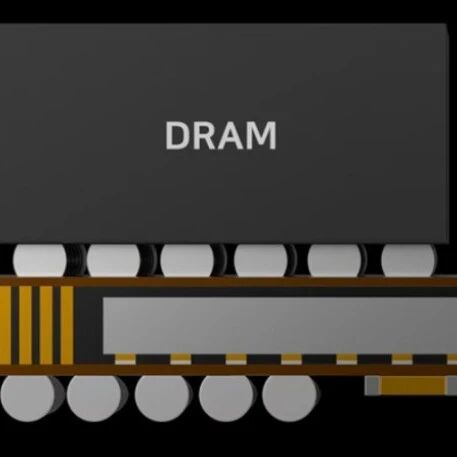
Core Viewpoint - The introduction of Heat Pass Block (HPB) technology by Samsung in the Exynos 2600 represents a significant advancement in mobile SoC thermal management, addressing the challenges posed by high-performance computing and the need for efficient heat dissipation [1][4]. Group 1: HPB Technology Overview - HPB is a metal thermal conduction structure integrated within the chip packaging, designed to shorten the distance for heat transfer from the chip core to the external cooling module [2]. - The primary material used for HPB is copper, which offers excellent thermal conductivity and performance among metals [2]. Group 2: Advantages and Challenges of HPB - The implementation of HPB establishes a more direct thermal pathway between the die and the external cooling system, effectively reducing thermal resistance, which is crucial for high-power chips [4]. - Despite its advantages, HPB introduces new constraints in engineering and product design, including increased volume and height, complexity in packaging design, and higher costs [4]. - The increased Z-axis height of HPB may limit space for other components like batteries or camera modules in slim phone designs [4]. - The complexity of HPB, being a multi-material structure, requires careful management of thermal expansion differences, impacting manufacturing yield and reliability [4]. - The cost implications of HPB packaging necessitate its initial application in flagship or Pro-level SoCs, making it less accessible for mid-range markets [4]. Group 3: Industry Comparison - In contrast, TSMC continues to utilize existing packaging and thermal design strategies without incorporating internal heat conduction structures like HPB, focusing instead on wafer-level multi-chip module (WMCM) packaging to mitigate localized heat concentration [5]. - This indicates a shift in thermal management strategies as mobile SoCs transition into high-power and high-density computing, evolving from single-path solutions to more integrated packaging and system design considerations [5].
惊天大逆转,产能严重不足
Ge Long Hui· 2026-01-21 10:13
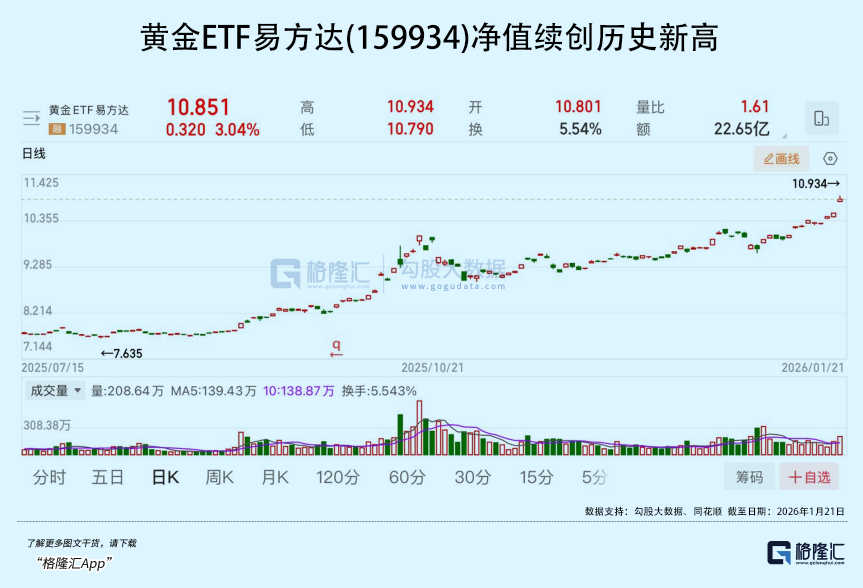
Group 1 - A-shares showed resilience despite a significant drop in overseas markets, with major indices rising, particularly in the gold and semiconductor sectors [1][5] - The semiconductor foundry sector is strong, with companies like SMIC and Hua Hong Semiconductor seeing gains of over 4% [6] - A report from TrendForce indicates a 2.4% reduction in global 8-inch foundry capacity by 2026 due to strategic cuts by TSMC and Samsung, while demand for AI-driven power management chips remains robust, pushing average capacity utilization rates above 90% [6][7] - Chinese foundries are positioned to benefit from the demand for 8-inch chips, with significant growth in storage chip production driven by AI [7][8] Group 2 - The gold sector is also performing well, with gold prices reaching $4,880 per ounce, and the gold ETF E Fund (159934) seeing a net inflow of 15.067 billion yuan over the past year [9][11][12] - The semiconductor market is experiencing a price surge, with reports indicating a potential 40-50% increase in storage chip prices by Q1 2026, driven by a combination of consumer electronics recovery and AI demand [15][19] - TSMC's capital expenditure guidance for 2026 has been significantly raised to between $52 billion and $56 billion, indicating strong demand for high-end chips [18][19] Group 3 - SMIC reported a record monthly production capacity of 1.023 million 8-inch equivalent wafers, with utilization rates reaching 95.8% [26] - The domestic semiconductor equipment market is expected to exceed 50 billion yuan in 2026, with a compound annual growth rate of around 30% [30] - The semiconductor equipment ETF E Fund (159558) is closely tied to the semiconductor materials and equipment sectors, covering key players in the industry [32]


封测涨价30%,国产算力产业链持续看好
East Money Securities· 2026-01-21 09:47
Investment Rating - The report maintains a rating of "Outperform" for the electronic industry, indicating a positive outlook compared to the broader market [2]. Core Insights - The report emphasizes that AI inference is driving innovation, with a focus on demand-driven Opex-related sectors, particularly in storage, power, ASIC, and supernodes [2][30]. - The semiconductor packaging industry is experiencing a significant price increase of 30%, driven by supply-demand imbalances and rising costs of raw materials [23][24][27]. - The report highlights the expected growth in the domestic computing power supply chain, particularly in storage and ASIC sectors, as companies like Yangtze Memory Technologies and ChangXin Memory Technologies expand production [2][30]. Summary by Sections Market Review - The Shanghai Composite Index decreased by 0.45%, while the Shenzhen Component Index increased by 1.14%. The Shenwan Electronics Index rose by 3.77%, ranking second among 31 Shenwan industries [1][13]. Weekly Focus - TSMC reported a 35% increase in profits, driven by strong demand for AI chips, with expected capital expenditures of $52 billion to $56 billion in 2026 [23]. - The packaging industry is benefiting from a recovery in demand, with companies like Li Cheng and Hua Dong Technology seeing increased capacity utilization and order visibility [23][24]. Storage Sector - The report anticipates a significant expansion year for NAND and DRAM production, driven by rising demand for SSDs and HBM products [30]. - Key players in the NAND and DRAM semiconductor supply chain include companies like Zhongwei Technology and Tuo Jing Technology [30]. Power Sector - The report identifies growth opportunities in the power sector, focusing on new technologies in both generation and consumption [31]. ASIC and Supernodes - The report expresses optimism regarding the full-stack model of ASIC inference, predicting an increase in market share for ASICs [31]. - It also notes the anticipated evolution of cabinet models, with growth expected in high-speed interconnects, cabinet manufacturing, and liquid cooling technologies [31]. Domestic Supply Chain - The report highlights improvements in domestic advanced process yields and capacity, which are expected to enhance the supply of domestic computing power chips [30][32].


