万华化学

Search documents
中银证券研究部2025年12月金股
Bank of China Securities· 2025-11-30 11:05
Core Viewpoints - The A-share market is expected to warm up for a bull market in early 2025, with stable funds likely to support the market amid unchanged policy attitudes. The current adjustment is seen as a healthy correction within the bull market, setting the stage for a pre-spring rally at the end of the year and the beginning of the next [4][2] - The AI industry chain is anticipated to be the main line for investment during this period, benefiting from improved liquidity expectations and risk appetite. The Sci-Tech 50 and ChiNext indices are expected to lead the recovery in broad-based indices [4][2] - The AI industry chain remains optimistic, with strong downstream demand and short-term supply challenges in AI infrastructure, presenting investment opportunities in power supply and computing power, particularly in domestic computing power [4][2] December Stock Picks - The December stock picks from Zhongyin Securities include: - Poly Real Estate Group (Real Estate) - Jitu Express-W (Transportation) - China Merchants Energy (Transportation) - Wanhua Chemical (Chemicals) - Anji Technology (Chemicals) - Huayou Cobalt (New Energy) - Anjii Food (Food and Beverage) - Changbai Mountain (Social Services) - Feiliwa (Electronics) [6][8] Real Estate Industry: Poly Real Estate Group - The company experienced a 48.1% year-on-year revenue growth in the first half of 2025, driven by increased project completions. However, net profit attributable to shareholders decreased by 44.3% due to investment losses and increased minority shareholder losses [8][9] - The company’s gross margin improved to 17.5%, up 3.2 percentage points year-on-year, while net profit margin decreased to 1.3% [8][9] - The company’s debt structure has improved, with total interest-bearing debt decreasing by 8.6% year-on-year, and all "three red lines" indicators turning green, indicating a healthier financial position [9][10] Transportation Industry: Jitu Express-W - The company achieved a total revenue of $5.499 billion in the first half of 2025, a year-on-year increase of 13.1%, with significant growth in the Southeast Asian market [13][14] - The company’s market share in Southeast Asia increased to 32.8%, while the Chinese market saw a 20% increase in package volume [14][15] - The company is focusing on cost optimization and has implemented a flexible pricing mechanism to enhance competitiveness [15] Transportation Industry: China Merchants Energy - The company reported a slight decrease in revenue to 25.799 billion yuan in 2024, but net profit increased by 5.59% to 5.107 billion yuan, indicating resilient profitability [16][17] - The fourth quarter saw a significant increase in shipping volume, particularly in high-value routes, contributing to a strong performance [16][17] Chemical Industry: Wanhua Chemical - The company’s revenue from polyurethane, petrochemical, and fine chemicals in the first half of 2025 was 36.888 billion yuan, 34.934 billion yuan, and 15.628 billion yuan, respectively, with the petrochemical segment facing short-term pressure [19][20] - The company’s management reforms have led to improved cost control and resource allocation efficiency, which is expected to enhance future performance [19][20] Chemical Industry: Anji Technology - The company reported continuous high growth in revenue and net profit in the first three quarters of 2025, with a gross margin of 56.61% [23][24] - The company’s polishing liquid sales increased by 38.23% year-on-year, indicating strong demand in the semiconductor market [24][25] New Energy Industry: Huayou Cobalt - The company achieved a net profit of 4.216 billion yuan in the first three quarters of 2025, a year-on-year increase of 39.59%, with a revenue growth of 29.57% [26][27] - The company is advancing its integrated layout with ongoing project developments in nickel and lithium production [26][27] Food and Beverage Industry: Anjii Food - The company reported a revenue increase of 6.6% year-on-year in Q3 2025, driven by product innovation and channel expansion [28][29] - The company is focusing on product structure optimization and cost control, maintaining stable profitability despite rising raw material costs [29][30] Social Services Industry: Changbai Mountain - The company experienced a 6.99% year-on-year revenue growth in the first three quarters of 2025, with a significant increase in tourist numbers during the peak season [31][32] - External transportation upgrades and internal project developments are expected to enhance future growth prospects [32] Electronics Industry: Feiliwa - The company is investing in expanding its quartz electronic fabric production capacity to meet the growing demand for high-end PCB materials [33][34] - The demand for quartz electronic fabric is expected to increase due to advancements in Ethernet switch chip technology [34][35]




纯苯、苯乙烯周报-20251130
Guo Tai Jun An Qi Huo· 2025-11-30 10:11
纯苯 01 纯苯、苯乙烯周报 国泰君安期货研究所·黄天圆 投资咨询从业资格号:Z0018016 日期:2025年11月30日 Guotai Junan Futures all rights reserved, please do not reprint | | | 本周纯苯、苯乙烯总结:底部区间震荡 | | --- | --- | --- | | 供应 | • • | 纯苯国产:12月检修11万吨,1月检修维持11万吨(假设考虑浙石化检修带来4.5万吨减量),主要是中化泉州、丽东、浙石化等装置检 | | | | 修量大。部分山东地炼在解决了配额问题之后仍会提高负荷,弥补部分产量损失。1月关注巴斯夫湛江新投产带来的纯苯增量。 | | | | 纯苯进口:外盘压力仍然偏大,韩国纯苯抛压在11月-12月仍然偏大,进口居高难下。1月目前进口分歧较大,预计仍然在45万吨左右的 | | | | 高进口,2月之后的进口待评估。 | | | • | 苯乙烯:12月检修8.5万吨,1月检修6.5万吨。12月之后装置开工逐步恢复,关注山东国恩化工装置开工带来的增量。 | | | • | 己内酰胺:CPL负反馈开始,工厂逐步降低负荷 ...
烧碱增量隐忧,PVC暂缓投产
Hua Tai Qi Huo· 2025-11-30 09:39
Report Industry Investment Rating No relevant content provided. Core Viewpoints of the Report - In 2026, the caustic soda market is expected to show a pattern of synchronous growth in supply and demand, but there will be a phased mismatch in rhythm and structure. The PVC market will face the triple characteristics of "high supply, pressured demand, and improved exports". The caustic soda market is expected to be volatile with a wide range, and the PVC market is expected to be volatile with a narrow range and the price center may move up [2][9]. - For caustic soda, the supply - side new capacity will continue to be released, and the demand - side main downstream alumina industry has a complex situation of "new investment and production cut expectations coexisting". For PVC, although the new capacity release slows down, the existing capacity output is still at a high level, and the industry is generally under pressure in a low - profit environment [9]. Summary According to the Table of Contents Annual Trend Review - In 2025, the PVC market fluctuated downward in the first half of the year and first rose then fell in the second half. The price was affected by factors such as social inventory, policy expectations, and overseas macro - uncertainties. The caustic soda market showed the characteristics of "falling from a high level and fluctuating in a range", and its price was driven by factors such as alumina demand, non - aluminum industry procurement rhythm, and chlor - alkali comprehensive cost [17][18]. Chlor - alkali New Capacity Situation - In 2025, the planned new capacity of the domestic PVC industry was 220 tons, and all were fulfilled by September, with a capacity growth rate of about 8%. In 2026, there is no clear new capacity plan. The new capacity of the domestic caustic soda industry in 2025 was significantly lower than expected, with only 90 tons added, and the planned new capacity in 2026 is about 256 tons, with an expected capacity growth rate of 5% [23][27]. Chlor - alkali Supply and Production Profit - **PVC**: As of October 2025, the cumulative PVC output was 2013 tons, a year - on - year increase of 3.34%. The production profit was in a deep - loss range for most of the time, and the industry supply pressure continued to exist [35]. - **Caustic Soda**: As of October 2025, the cumulative caustic soda output was 3514 tons, a year - on - year increase of 2.48%. The production profit was generally profitable, but it declined in November [48]. PVC and Caustic Soda Basis Trend and Future Judgment - **PVC**: In 2025, the PVC market maintained a negative basis structure. In the future, the negative basis structure will still be the norm, but the level may narrow slightly. - **Caustic Soda**: In 2025, the caustic soda basis fluctuated sharply. In 2026, the negative basis may appear more frequently, and the overall basis center level may face downward pressure [60][61]. Chlor - alkali Import and Export Analysis - **PVC**: From January to October 2025, the domestic PVC export volume was 323 tons, a year - on - year increase of 48.85%. The export to India is expected to be further boosted, and the export to other regions is also increasing. PVC products export showed a pattern of mixed performance in 2025 [67][85]. - **Caustic Soda**: From January to October 2025, the domestic caustic soda cumulative export volume was 349 tons, a year - on - year increase of 42%. Indonesia and Australia are the main export destinations [90]. Chlor - alkali Demand Status and Outlook - **PVC**: In 2025, the PVC market showed a pattern of "increased supply, high - growth exports, and weak domestic demand". In 2026, the demand will still be dragged down by the real - estate market and maintain a weak and stable state [103]. - **Caustic Soda**: The demand for caustic soda is mainly concentrated in industries such as alumina, viscose staple fiber, printing and dyeing, and papermaking. In 2026, the new alumina capacity may bring new demand for caustic soda, but there are uncertainties [121][122]. Chlor - alkali Inventory Status and Outlook - In 2025, the PVC social inventory showed a pattern of year - on - year accumulation. In 2026, the PVC supply - demand fundamentals are expected to remain loose, and the marginal change in export demand will be the key variable affecting the social inventory destocking rhythm [142][145].
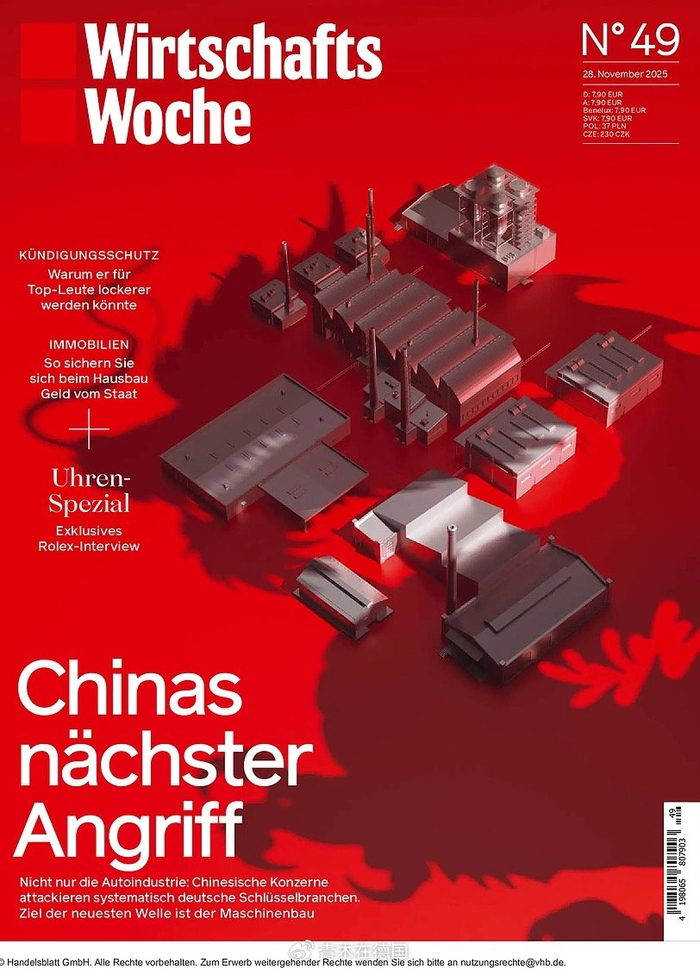
德媒:中企正攻击德国工业的最后堡垒
Xin Lang Cai Jing· 2025-11-30 09:25
Core Insights - The article discusses the strategic challenge posed by Chinese companies to Germany's mechanical engineering sector, which is considered the last major stronghold of German industry [1][4]. Group 1: Competitive Landscape - A study by Infront reveals that over 60% of European mechanical manufacturers feel they have lost or will lose their technological, quality, or brand advantages by the end of this decade [4]. - 75% of European mechanical manufacturers view competition from Chinese rivals as the "most pressing strategic challenge" globally [4]. - Chinese competitors are increasingly replacing German products in various sectors, such as Sany's forklifts overtaking Jungheinrich's models and Mindray's medical equipment competing with Siemens Healthineers [7]. Group 2: Industry Dynamics - The competitive edge of German mechanical engineering is declining due to late product launches, high prices, and insufficient user focus, leading to a loss of value associated with high-end European products [5][10]. - The COVID-19 pandemic has accelerated the shift, allowing Chinese manufacturers to capture market share as German companies cut production [10]. - Chinese executives perceive the current state of European mechanical engineering as lacking practicality, speed, and scalable innovation [10]. Group 3: Strategic Recommendations - German companies need to adopt more flexible business models and continuously adjust their product range and quality to compete effectively [12]. - Decisions aimed at the Chinese market may increasingly need to be made within China, as exemplified by Volkswagen's ability to independently develop and produce vehicles for the Chinese market [12]. - The value of the "Made in Germany" label is diminishing, while "Made in China" is becoming synonymous with innovation, cost-effectiveness, and new designs [12].

全球供需格局有望延续,关税重塑贸易流向
Hua Tai Qi Huo· 2025-11-30 09:16
1. Report Industry Investment Rating No information provided. 2. Core Viewpoints - In the short - term, due to the temporary supply - demand mismatch, the LPG market shows a tight fundamental situation and is oscillating strongly. However, in the medium - term, the supply elasticity of LPG is greater than the demand elasticity. Without large - scale supply disruptions, the supply will be abundant. The supply from the US and the Middle East is expected to grow, while the demand growth in Asia - Pacific countries is restricted by the weak profit of downstream devices. Overall, the global LPG market may continue the oversupply pattern in 2026, but geopolitical conflicts and weather may cause temporary supply - demand mismatches [6][127]. - Based on the decline of the oil price center and the expected oversupply of global LPG, there will be resistance to the upward movement of LPG prices in 2026. After the short - term strong oscillation caused by supply - demand mismatch, opportunities for shorting on rallies can be considered, and the registration of new warehouse receipts after the price rebound on the futures market should be monitored. Recently, the strong cracking spread of naphtha has made LPG more cost - effective, driving the substitution demand of some cracking devices. But if the Russia - Ukraine situation eases and sanctions are relaxed, the supply of Russian naphtha may increase, which could suppress the naphtha cracking spread and have an indirect negative impact on LPG valuation [7][128]. 3. Summary According to the Catalog 3.1 Supply - demand Imbalance in the Oil Market and Resistance to Oil Prices - In 2025, international oil prices were in a wide - range oscillating and declining trend. Taking Brent as a reference, the price center has moved down compared to last year. As of November 25, 2025, the average price of the Brent futures main contract was $68.87 per barrel, a 13.76% decrease from the average price in 2024 [14]. - In 2026, the oil market is expected to face downward pressure. The growth elasticity of oil demand has significantly decreased and cannot offset the release of surplus supply capacity. China's oil demand growth has slowed down, and the global oil consumption has entered a stage of low - growth. Although the supply growth rate will slow down next year, it is still expected to exceed demand, leading to an increase in global oil inventories [15]. 3.2 Weak Oscillation in the 2025 LPG Market and Tariff Disturbances - In 2025, the LPG market was in a weak oscillating pattern. The price center moved down due to the decline in oil prices. The Sino - US tariff conflict caused additional disturbances, mainly resulting in regional price differences rather than global trends [29]. - In Q1 2025, the LPG market was oscillating. Although there were some disturbances such as Middle - East device maintenance and US shipping delays, the impact was limited. The downstream demand in the Asia - Pacific region was weak, and there was no obvious supply shortage [29]. - In Q2 2025, the Sino - US tariff conflict led to a significant change in the trade pattern. China reduced its procurement from the US and turned to the Middle East. The supply - demand imbalance between the US and non - US sources supported the CP price and caused the FEI price to drop. After the tariff was reduced, the domestic market still had a wait - and - see attitude. The Middle - East geopolitical conflict in June also had a short - term impact on the LPG market [30]. - In Q3 2025, the LPG market was relatively stable, and the supply - demand imbalance continued [31]. - In Q4 2025, the Sino - US tariff issue resurfaced, but the impact on the market was smaller than in April. The supply in the Middle East decreased due to refinery maintenance, and the demand in India and Southeast Asia increased during the peak season, which supported the LPG price. However, the weak profit of domestic downstream chemical industries limited the upward movement of the domestic market [32]. 3.3 Continued Oversupply of Global LPG in 2026 and the Reshaping of Trade Flows 3.3.1 Growth in Middle - East LPG Supply - OPEC has gradually withdrawn from the production - cut agreement, and the LPG supply in the Middle East is expected to grow. Although the actual production increase may be different from the quota increase, the overall trend is upward. The UAE is promoting natural - gas field development projects, which will contribute to the growth of NGL supply. In 2026, the LPG supply in the Middle East is expected to increase year - on - year [47]. - In the short - term, the supply in Saudi Arabia and Kuwait has tightened due to refinery maintenance, but it is expected to return to the growth track after the maintenance is completed. Saudi Arabia will face more competition from the US, which may suppress the CP pricing in the medium - term. The US sanctions on Iran have increased, but the LPG supply in Iran has not been significantly affected [48][49]. 3.3.2 Growth in US LPG Supply - The production of NGL and LPG in the US has continued to grow in recent years. In 2025, the LPG export volume increased, and the export capacity has been improved through terminal expansion projects. Although there was a potential device failure in December 2025, it is not expected to affect the long - term supply trend [66]. - In 2026, the growth trend of US shale - gas production is expected to continue, and the production of NGL and LPG is also expected to increase. The expansion of export terminals will further enhance the export capacity [67]. 3.3.3 Reshaping of LPG Trade Flows - After the Sino - US tariff conflict in April 2025, China reduced its imports from the US and increased imports from the Middle East. Asian countries such as Japan, South Korea, and India increased their imports from the US. India signed a long - term LPG procurement agreement with the US, which will affect the CP and FEI pricing [85][86]. 3.3.4 Increase in Russian LPG Supply to China - In recent years, China's imports of LPG from Russia have been increasing. From January to November 2025, the import volume exceeded 700,000 tons, a 63.8% increase compared to the previous year. Although the absolute volume is limited by transportation bottlenecks, it has become an important marginal increment, especially for the Northeast region [102]. 3.3.5 Constraints on the Growth of China's LPG Demand - China's LPG demand has been growing, mainly driven by the commissioning of downstream chemical devices (mainly PDH). In 2026, about 3.75 million tons/year of propane dehydrogenation capacity is planned to be put into operation, which may contribute about 2.8 million tons of propane demand. However, the weak profit of the PDH industry has restricted the start - up of existing devices and the commissioning of new ones, so the actual demand growth may be lower than expected [105]. - Other devices such as ethylene - cracking also have potential for growth, but the low profit restricts the endogenous demand growth. The demand for LPG in the combustion sector lacks growth potential, and the demand growth in 2026 will still be mainly driven by the chemical downstream, with profit being the main limiting factor [107].
苯乙烯供应放缓,纯苯下游投产乏力
Hua Tai Qi Huo· 2025-11-30 09:09
Report Industry Investment Rating - The report gives a neutral rating for the unilateral market and suggests paying attention to the opportunity of going long on EB and short on BZ for spreads [1]. Core Viewpoints - In 2026, the new production of pure benzene will exceed the incremental demand from downstream production, leading to a stockpiling cycle. However, the processing fee of pure benzene is already at a low level and is expected to fluctuate at a low level. Pure benzene may maintain a weak and low - volatility oscillation. For styrene, the new production will slow down in 2026, and there are still production plans for downstream hard plastics. But the current port inventory of styrene is still high. One can track the rhythm of inventory reduction at the high - level to engage in the cross - variety trading opportunity of going long on EB and short on BZ [1][9]. Summary by Relevant Catalogs Market News and Important Data - In 2026, the nominal new production plan of pure benzene is 2.81 million tons/year, with the actual capacity growth weighted by production time at 1.37 million tons/year, and the actual capacity growth rate at 4.8%. The nominal growth in pure benzene demand due to new downstream capacity in China in 2026 is only 2.59 million tons/year, and the actual demand weighted by production time is only 0.64 million tons/year, with a demand growth rate of only 2.2%, significantly slower than in 2025. The annual balance sheet of pure benzene is expected to maintain a stockpiling pattern [7]. - In 2026, the nominal capacity growth of styrene is 0.93 million tons/year, and the actual capacity growth weighted by production time is 0.013 million tons/year, with an actual capacity growth rate of 0.5%, significantly slower than in 2025. The nominal growth in styrene demand due to the production of three major hard plastics in China in 2026 is 1.88 million tons/year, and the actual demand weighted by production time is 0.87 million tons/year, driving a 5.3% demand growth rate. In 2026, styrene may shift from a stockpiling to a destocking cycle, but it is necessary to pay attention to whether the downstream inventory operation is lower than expected [8]. Market Analysis - The new production of pure benzene in 2026 exceeds the incremental demand from downstream production, and it is expected to enter a stockpiling cycle. However, the processing fee of pure benzene is already at a low level and will oscillate at a low level. Styrene's new production will slow down in 2026, and there are still production plans for downstream hard plastics. One can track the rhythm of inventory reduction at the high - level to engage in the cross - variety trading opportunity of going long on EB and short on BZ [9]. Strategy - On an annual basis, the unilateral price will oscillate in a range. In the first half of the year, the production pressure of pure benzene still exists, and the price will oscillate weakly. In the second half of the year, attention should be paid to whether the summer gasoline blending and crude oil prices can support the unilateral price. For spreads, pay attention to widening the EB - BZ spread at low levels, especially in the first half of the year. In terms of inter - period trading, BZ still favors reverse arbitrage, while EB should track the annual inventory reduction rhythm for positive arbitrage opportunities [10]. Annual Balance Sheet Estimation Pure Benzene & EB - **Pure Benzene Annual Self - estimated Balance Sheet Outlook**: In 2026, the pressure on pure benzene still exists, but the downstream production is limited. The total supply of pure benzene in China will increase by 2.7%, and the total demand will increase by 1.5%. The inventory change will be a 280,000 - ton increase, with an inventory change rate of 0.9% [17]. - **Styrene Annual Self - estimated Balance Sheet Outlook**: In 2026, the new production of styrene will slow down, and it is waiting for further inventory digestion. The total supply of styrene in China will decrease by 0.6%, and the total demand will increase by 2.1%. The inventory change will be a 130,000 - ton decrease [21]. 2026 China Pure Benzene & Styrene Production Situation - The nominal capacity growth rate of pure benzene in China in 2026 is 9.8% (the actual capacity growth rate weighted by production time is about 4.8%), and the nominal capacity growth rate of styrene is 3.9% (the actual capacity growth rate weighted by production time is about 0.5%), significantly slower than in 2025 [26]. - The main large - scale pure benzene production in 2026 will be Huajin and Zhongsha Gulei in the third quarter, with greater production pressure in Q1 and Q4. The production of styrene will slow down significantly in 2026, mainly focusing on Huajin Aramco in the fourth quarter. Before the start of the peak summer gasoline - blending season, the EB - BZ spread is expected to widen in the first half of the year [28][29]. Styrene Fundamental Analysis - In 2025, styrene had a profit recovery and inventory reduction in the first half of the year and then entered a loss - making and production - reduction pattern in the second half. The main maintenance periods were in April - May and October - November, especially for non - integrated plants using purchased pure benzene in October - November [31]. - In 2025, the overseas styrene maintenance increased, but the export did not increase further. The overseas demand for styrene was weak, resulting in the situation where increased overseas maintenance did not significantly support China's styrene export [45]. - In 2025, the styrene port inventory accumulated to a historical high and is waiting for digestion. The main reasons for the inventory increase were the weakening of downstream demand and the impact of new production [67]. EB Downstream Situation - In the second half of 2025, the production schedule growth rate of white goods significantly declined. The export of white goods decreased due to the tariff war, and the domestic sales also decreased due to the exhaustion of government subsidies [70]. - In 2026, the planned production of EPS is 0.82 million tons/year, with a nominal capacity growth rate of 9.1%; the planned production of PS is 0.87 million tons/year, with a nominal capacity growth rate of 10.1%; the planned production of ABS is 0.4 million tons/year, with a nominal capacity growth rate of 3.3%. The production growth rate of ABS will slow down in 2026 [91]. Pure Benzene Fundamental Analysis - In 2025, the pure benzene port inventory had great pressure. The processing fee of pure benzene decreased throughout the year, and the port inventory reached a relatively high historical level in July, mainly due to weak overseas demand and poor performance of domestic downstream industries [102]. - In 2025, the summer gasoline blending in the US was weak, and more pure benzene from South Korea was diverted to China, resulting in a significant increase in China's pure benzene imports. The gasoline demand in the US in 2025 was weak, especially in the peak season from June to August, which affected the Asian aromatic hydrocarbon market [107]. Pure Benzene Downstream Situation - In 2025, the downstream operation of pure benzene was weak. The downstream operation of pure benzene was significantly differentiated, with the demand for pure benzene mainly supported by the high operation of styrene. The non - styrene downstream industries of pure benzene had little demand growth or even negative growth [121]. - In 2026, the planned production of styrene is 0.93 million tons/year, with a nominal capacity growth rate of 3.9%; the planned production of phenol is 1.08 million tons/year, with a nominal capacity growth rate of 14.1%; the planned production of aniline is 0.3 million tons/year, with a nominal capacity growth rate of 6.2%; the planned production of adipic acid is 0.6 million tons/year, with a nominal capacity growth rate of 14.5%. In the first half of 2026, the new demand for pure benzene from downstream production will be less than the new pure benzene production capacity, and the pure benzene processing fee is expected to be weak. In the third and fourth quarters, the downstream production of pure benzene will gradually exceed its own production [128][131].
化工行业周报20251130:海外天然气价格、六氟磷酸锂价格上涨,蛋氨酸价格下跌-20251130
Bank of China Securities· 2025-11-30 07:31
Investment Rating - The report rates the chemical industry as "Outperform" [1] Core Views - The report highlights the increase in overseas natural gas prices and lithium hexafluorophosphate prices, while methionine prices have decreased. It suggests focusing on undervalued industry leaders, the impact of "anti-involution" on supply in related sub-industries, and the importance of self-sufficiency in electronic materials and certain new energy materials companies amid price increases [1][12][31]. Summary by Sections Industry Dynamics - During the week of November 24-30, 2025, among 100 tracked chemical products, 29 saw price increases, 33 saw decreases, and 38 remained stable. Overall, 51% of products had a month-on-month average price increase, while 37% saw a decrease [8][31]. - The average price of lithium hexafluorophosphate rose to 170,000 CNY/ton, marking a 1.80% increase from the previous week and a 65.85% increase from the previous month [33]. - Methionine prices fell to 18.60 CNY/kg, down 3.13% from the previous week and 9.27% from the previous month [34]. Investment Recommendations - The report recommends focusing on undervalued industry leaders, the effects of "anti-involution" on supply, and companies in electronic materials and new energy materials that are experiencing price increases. It also suggests a long-term investment strategy based on policy support for demand recovery and supply-side optimization [12][31]. - Specific companies recommended include Wanhua Chemical, Hualu Hengsheng, and others, with a focus on sectors like fluorochemicals, agricultural chemicals, and new energy materials [12][31]. Market Performance - The basic chemical industry index rose by 2.98%, while the oil and petrochemical sector fell by 0.73% during the same week [8][12]. - The report notes that the WTI crude oil price closed at $58.55/barrel, with a weekly increase of 0.84%, and the Brent crude oil price closed at $63.20/barrel, with a weekly increase of 1.02% [9][32]. Price Trends - The report details that sulfur, ammonium nitrate, and other products saw significant price increases, while methionine and epoxy propane experienced notable declines [31][35]. Key Stocks - December's "golden stocks" include Wanhua Chemical and Anji Technology, reflecting strong performance and growth potential in their respective sectors [5][12].
基础化工行业周报:辛醇、锦纶切片价格上涨,关注反内卷和铬盐-20251130
Guohai Securities· 2025-11-30 07:01
Investment Rating - The report maintains a "Recommended" rating for the chemical industry [1] Core Insights - The chemical industry is expected to benefit from a shift in supply chain dynamics due to geopolitical tensions, particularly in semiconductor materials, leading to accelerated domestic replacements [5][6] - The chromium salt industry is experiencing a value reassessment driven by increased demand from AI data centers and commercial aircraft engines, with significant price increases noted [8][9] - The report highlights a potential upturn in the chemical industry as supply-side constraints and rising demand could enhance profitability and dividend yields for leading companies [6][10] Summary by Sections Industry Performance - The basic chemical sector has shown a 24.0% increase over the past 12 months, outperforming the CSI 300 index, which increased by 16.9% [3] Key Opportunities - Focus on low-cost expansion opportunities in companies such as Wanhua Chemical and Hualu Hengsheng, as well as sectors like tire manufacturing and pesticide formulations [6][9] - Emphasis on sectors with improving market conditions, including chromium salts, phosphate rock, and polyester filament [9][10] Price Trends - Recent price increases for key products include chromium oxide green at 35,500 CNY/ton and metallic chromium at 84,000 CNY/ton, both up by 1,000 CNY/ton from the previous week [8][16] - The report notes a tightening supply for isooctanol, with prices rising due to increased demand and production disruptions [13] Company Focus - The report identifies several key companies for investment, including Dongfang Shenghong, Hubei Yihua, and Wanhua Chemical, with positive earnings forecasts and attractive price-to-earnings ratios [28]


化工2025年三季报总结:化工产能周期拐点的再确认
Guotou Securities· 2025-11-30 04:03
Investment Rating - The report does not explicitly provide an investment rating for the chemical industry Core Insights - The chemical industry is experiencing a slight recovery in profitability, with a year-on-year increase in net profit of 7.54% for the first three quarters of 2025, reversing the declining trend since 2022 [20][23] - The overall revenue for the chemical industry increased by 2.96% year-on-year, reaching 18,663.84 billion yuan [20][23] - The CCPI index averaged 4021.69 points in Q3 2025, reflecting a year-on-year decrease of 11.37% and a quarter-on-quarter decrease of 1.90%, indicating that product prices remain at a low level [20][23] Summary by Sections 1. Revenue and Profit - The chemical industry achieved a revenue of 18,663.84 billion yuan in Q1-Q3 2025, up 2.96% year-on-year, and a net profit of 1,126.98 billion yuan, up 7.54% year-on-year, marking a significant recovery from the previous decline [20][23] - In Q3 2025, the industry recorded a revenue of 6,398.78 billion yuan, which is a slight decrease of 0.08% quarter-on-quarter but an increase of 2.27% year-on-year [23] 2. Profitability - The overall gross margin for the chemical industry in Q1-Q3 2025 was 17.10%, an increase of 0.23 percentage points year-on-year, while the net profit margin was 6.04%, up 0.26 percentage points year-on-year [2] - Specific sub-industries showed significant improvements in profitability, including pesticides (+31,346.91%), fluorochemicals (+124.56%), and adhesives and tapes (+91.69%) [28][30] 3. Cash Flow - The operating cash flow for the chemical industry increased by 20.33% year-on-year in Q1-Q3 2025, indicating strong cash flow management [3] - The net cash ratio has remained above 1 since 2018, reflecting good profitability quality within the industry [3] 4. Investment and R&D - The growth rate of construction projects in the chemical industry has slowed, with a total of 368.08 billion yuan in construction projects as of Q1-Q3 2025, down 16.66% year-on-year [10] - The capital expenditure for the industry in Q3 2025 was 57.919 billion yuan, up 10.81% year-on-year, but the overall trend in capital expenditure as a percentage of revenue is declining [10] 5. Debt Servicing Ability - The asset-liability ratio for the chemical industry was 45.21% as of Q3 2025, showing a slight improvement and indicating manageable debt levels [3][9] 6. Investment Recommendations - The report suggests focusing on four main investment lines: upstream resource assets with strong profitability certainty, supply-side optimization products, low-position leading stocks, and new productivity investment directions during the 14th Five-Year Plan [11][12][14][15]
化工上市公司发展报告(2025)
Sou Hu Cai Jing· 2025-11-29 01:17
Core Insights - The Chinese chemical industry is undergoing a profound strategic transformation driven by dual goals of "dual carbon" and high-quality development, with 2025 being a critical window for green, high-end, and refined upgrades [1] - A comprehensive guiding system has been established through various policies to promote high-quality development in the petrochemical sector, indicating a clear path for chemical listed companies to break through [1] - Green and low-carbon practices have become essential for corporate survival, with a mandate for key sub-industries to achieve over 30% of their capacity at benchmark energy efficiency levels by 2025 [1] Policy and Industry Transformation - Policies are focusing on high-end and refined chemical products, encouraging innovation through digital technologies and strengthening the industrial chain [2] - Companies are urged to enhance their technological capabilities and product iterations while collaborating with academic and research institutions to bridge the gap in technology transfer [2] - The elimination of outdated production capacity is accelerating, particularly in ecologically sensitive areas, with companies facing pressure to shut down or transform inefficient facilities [1] Market Dynamics - The chemical industry is currently in a phase of innovation-driven and globalized development, with a significant presence in the A-share market [29] - The industry is characterized by a structural adjustment where emerging sectors are growing rapidly while traditional sectors are experiencing a downturn [29] - The supply landscape is continuously optimizing, with compliance costs becoming a significant factor affecting profitability [29] Financial Performance - Revenue growth for chemical companies has turned positive, although profit growth remains negative, reflecting a challenging operating environment [30] - The overall profitability of the industry is under pressure, with significant variations in operational capabilities among companies [30] Capital and Investment Trends - There has been a contraction in IPOs and capital increases, with a focus on high-quality projects, while bond financing is gradually recovering [34] - Capital expenditures are shrinking year-on-year, indicating a cautious approach to new investments [35] Technological Innovation - R&D intensity is on the rise, with resources being directed towards high-end sectors, and the proportion of R&D personnel is increasing [36] - The industry is witnessing significant differentiation, with leading technology firms concentrating their efforts on innovation [36] Internationalization - Revenue from overseas markets is recovering, with leading companies deeply embedded in global markets [37] - Foreign investment in the sector is becoming more selective, reflecting global capital's focus on high-quality Chinese firms [39] Policy Guidance - Encouraging policies are centered on green and low-carbon initiatives, while restrictive policies are aimed at phasing out outdated production processes [40] - The capital market is supporting advanced green projects, guiding investments towards sustainable development [40]