宝马

Search documents
车企拼爆款重塑15万级市场
Bei Jing Ri Bao Ke Hu Duan· 2025-05-27 21:13
Group 1 - The automotive market under 150,000 yuan is experiencing a transformation, with both traditional fuel vehicles and new energy vehicles offering advanced features previously found in higher-priced models [1][2] - New energy vehicle companies are launching competitive models in the 100,000 to 150,000 yuan range, with brands like Xiaopeng, BYD, and NIO introducing intelligent features to attract consumers [2][3] - Luxury brands such as Audi and Cadillac are lowering entry-level prices to compete for consumers in the 150,000 yuan market, making previously unattainable models accessible [3] Group 2 - The intense price competition in the automotive industry is driven by a focus on maintaining sales volume, even at the cost of profitability [4] - Industry insiders express concerns about the sustainability of this price war, highlighting risks such as reduced quality and safety standards due to cost-cutting measures [4] - The profitability of the automotive sector is under pressure, with projected profit margins for 2024 at 4.3%, down 0.7 percentage points from 2023, indicating a challenging environment for manufacturers [4]


三一重工20250527
2025-05-27 15:28
Summary of Conference Call Notes Industry and Company Overview - The conference call discusses advancements in the robotics industry, particularly focusing on humanoid robots and their applications in industrial settings. Key companies mentioned include Tesla, Figure, Yongchuan Intelligent, and Sany Heavy Industry [2][3][5][7][11]. Key Points and Arguments 1. **Advancements in Humanoid Robots**: - Optimus robot by Tesla can perform complex tasks like cleaning and cooking using a single neural network and can learn from human videos, enhancing data acquisition efficiency [2][3]. - Figure robot successfully completed a 20-hour continuous shift on the BMW X3 production line, demonstrating its industrial application feasibility [2][3][5]. 2. **Market Interest in Humanoid Robots**: - There is a significant increase in market interest in the humanoid robot sector, particularly in undervalued yet high-quality companies [3]. - Investors are encouraged to track developments in humanoid and non-humanoid robots, including dexterous hands and exoskeletons, to identify potential investment opportunities [2][3][6]. 3. **Yongchuan Intelligent's Developments**: - Yongchuan Intelligent focuses on packaging machinery and has launched several dexterous hands and collaborative robots for the logistics industry, with over a thousand units shipped [2][7]. - The company aims to shorten payback periods through high cost-performance solutions [7]. 4. **HuiChuan Technology's Strategy**: - HuiChuan Technology has entered the humanoid robot field, targeting 14 industrial scenarios for gradual breakthroughs over the next three to five years [9][10]. - The company plans to launch a half-body humanoid robot and is expanding its production capabilities for components like linear guides and precision screws [10]. 5. **Sany Heavy Industry's IPO Plans**: - Sany Heavy Industry plans to issue shares on the Hong Kong Stock Exchange by Q3 or Q4 of 2025, with a focus on not accepting high discounts due to its already low valuation in the A-share market [11]. - The company reported a 10%-15% growth in both domestic and international markets in Q2, aligning with expectations [11]. 6. **Industrial Gas Price Trends**: - Liquid nitrogen prices increased by 3% year-on-year and surged by 6.6% month-on-month, indicating a recovery in chemical industry demand [12]. - Liquid oxygen prices remained stable, suggesting a bottoming out in the market [12]. 7. **Instrumentation Industry Recovery**: - The instrumentation sector shows signs of recovery, with a notable increase in revenue growth from 3% to over 7% for leading companies like Sede Technology [13][14]. - This marks a positive turning point after several quarters of decline [14]. 8. **Domestic vs. International Demand in Electrical Measurement Instruments**: - The domestic market for electrical measurement instruments is showing signs of improvement, with stable orders despite a challenging environment [16]. - Domestic companies like Puyuan Precision and Dingyang Technology are expected to benefit from the trend of domestic substitution [17]. 9. **Future Directions in Robotics and Automation**: - Beyond humanoid robots, there is a strong focus on non-humanoid robots, sensors, and exoskeletons, which have broad application prospects [6][18]. - The industry is encouraged to explore AI-enabled non-humanoid robotics for greater long-term returns [6]. Other Important Insights - The conference highlighted the importance of continuous monitoring of technological advancements and market dynamics in the robotics sector to identify investment opportunities [2][3][5][6]. - The potential for domestic substitution in the electrical measurement instrument sector is emphasized, indicating a long-term growth trend despite short-term fluctuations [17].

【重磅深度】继峰股份|系列深度报告(三):海外拐点临近,座椅加速放量
东吴汽车黄细里团队· 2025-05-27 14:39
Group 1 - The core viewpoint of the article is that the integration of Grammer is deepening, and the overseas performance inflection point has been basically established [1][9][10] - The company has completed the acquisition of Grammer and is advancing integration from multiple aspects, despite challenges such as the global pandemic and chip shortages [1][20][23] - In 2024, the company will continue to deepen the integration of Grammer overseas, with measures including the divestiture of the loss-making North American TMD subsidiary and strategic adjustments in the European region [1][28][29] Group 2 - The passenger car seat market is accelerating, with a market size exceeding 100 billion yuan in China, driven by consumer upgrades [2][39][43] - The industry has high barriers to entry, creating a favorable competitive landscape, with major players being foreign and joint ventures [2][47][51] - The company has secured a substantial number of high-quality seat projects, covering major OEMs, and an employee stock ownership plan is expected to enhance profitability [2][57][59] Group 3 - The company forecasts a significant improvement in performance, with net profits projected to reach 6.46 billion yuan, 10.97 billion yuan, and 13.84 billion yuan from 2025 to 2027 [4][61] - The company is positioned as a leading player in the passenger car seat industry, benefiting from a broad market space and accelerated domestic substitution [4][64] - The company maintains a "buy" rating due to its performance reversal and expected valuation premium [4][64]



海外本土化正当时 | 在巴西,中国车企的脚印越扎越深
Zhong Guo Qi Che Bao Wang· 2025-05-27 10:49
Core Insights - Chinese automotive manufacturers have achieved significant success in global exports, becoming the largest exporter in 2023, and are focusing on localization strategies to ensure sustainable growth in overseas markets [1][3] - The localization strategy involves deep integration across various aspects such as R&D, supply chain, talent, and marketing to better adapt to local market demands and enhance product competitiveness [1] Group 1: Localization in Brazil - Brazil is emerging as a strategic hub for Chinese automotive companies, with President Lula's visit to China highlighting the growing cooperation in the automotive sector [3][4] - Great Wall Motors and GAC Group are planning significant investments in Brazil, with GAC committing to invest $1.3 billion to establish a local manufacturing base and R&D center [4][6] - Several Chinese automakers, including Chery, JAC, Geely, BYD, and Great Wall, have established a presence in Brazil, using it as a gateway to the Latin American market [4][9] Group 2: Market Potential and Policy Support - Brazil is the sixth-largest automotive market globally, with a population exceeding 200 million and a growing middle class, making it attractive for Chinese automakers [10] - The Brazilian government has implemented policies favoring electric and hybrid vehicles, including tax exemptions for electric vehicles and incentives for local production, which have encouraged Chinese companies to invest [10][11] - The Brazilian Electric Vehicle Association reported a significant increase in electric vehicle sales, with a forecast that by 2030, electric and hybrid vehicles will surpass traditional fuel vehicles in sales [11] Group 3: Challenges and Adaptation - The Brazilian market is characterized by a strong presence of flex-fuel vehicles, which dominate the market, necessitating that Chinese companies adapt their products to local preferences [12][13] - Chinese automakers face challenges such as legal compliance, cultural adaptation, and competition from established local and international players, requiring a multifaceted strategy to navigate these obstacles [13] - The Brazilian Automotive Manufacturers Association has raised concerns about potential "dumping" practices by Chinese companies, indicating the need for Chinese firms to develop robust public relations and legal strategies [13]





特斯拉寒冬将至?全球用户兴趣滑坡,瑞银再度喊出“卖出”评级
Hua Er Jie Jian Wen· 2025-05-27 07:32
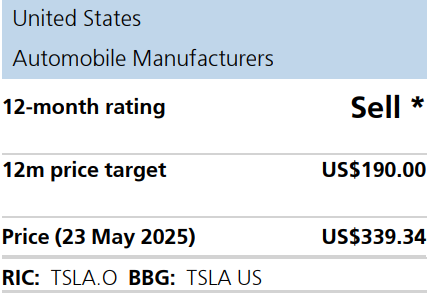
Core Viewpoint - Global consumer interest in Tesla is declining, leading UBS to maintain a "sell" rating with a target price of $190, indicating a potential 44% downside from the current price of $339.34 [1][2] Group 1: Consumer Interest Decline - The proportion of consumers considering purchasing a Tesla globally has decreased from 39% last year to 36% [3] - Tesla's status as the preferred electric vehicle brand has dropped significantly from 22% to 18% [6] - In the U.S., Tesla retains about 48% of the electric vehicle market share, but its preferred brand status has plummeted from 38% to 29%, a decline of 9 percentage points [9] Group 2: Challenges in Key Markets - In China, Tesla's preferred brand status has fallen from 18% to 14%, being surpassed by BYD and emerging brand Xiaomi [11] - Tesla's technological leadership perception in China is eroding, with BYD now viewed as the technology leader [12] - In Europe, Tesla's brand consideration has dropped to 33%, being overtaken by Audi and BMW, with its preferred brand status declining from 20% to 15%, a drop of 4.6 percentage points [17][19] Group 3: Autonomous Driving Concerns - Only about 12% of consumers are willing to pay over $7,600 for Tesla's autonomous driving feature, while the current price for FSD is $8,000 [20] - The mismatch between pricing and consumer willingness to pay may hinder Tesla's software service revenue growth potential [24] Group 4: Market Pricing and Affordability - The starting price for Model Y is approximately $45,000 in the U.S., aligning with about 50% of consumers' budgets; in China, it is 263,500 RMB, fitting about 58% of consumers; while in Germany, the €45,000 starting price aligns with less than 37% of consumers' budgets [24]
蓝思科技(300433):平台型精密制造厂商 业务布局多点开花
Xin Lang Cai Jing· 2025-05-27 06:33
Core Viewpoint - The company is positioned as a one-stop precision manufacturing solution provider for smart terminals, focusing on vertical integration and horizontal expansion in the industry chain [1] Group 1: Business Development - The company has expanded its product lines by establishing subsidiaries for new materials such as ceramics and sapphire, and has entered the smartphone mid-frame processing business through acquisitions [2] - The company has initiated a smart terminal assembly project, achieving a full industry chain layout from raw material production to complete assembly, which supports revenue growth [2] Group 2: Automotive Electronics - Since 2015, the company has been deeply involved in the new energy vehicle market, establishing long-term partnerships with major manufacturers like Tesla, BMW, and BYD [3] - The company produces a variety of automotive electronic products, including vehicle-mounted glass and components, which are expected to become a significant growth driver [3] Group 3: Emerging Businesses - The company has developed core manufacturing processes for foldable screens and supplies key components to major clients [4] - A strategic partnership with Rokid for AI/XR glasses has been established, covering the entire production chain from design to assembly [4] - The company has launched smart retail terminals in collaboration with Alipay, showcasing its rapid production capabilities [4] - The company has been involved in the robotics sector since 2016, successfully delivering humanoid robots in partnership with Zhiyuan Robotics [4] Group 4: Financial Projections - Revenue projections for 2025-2027 are estimated at 92.16 billion, 113.24 billion, and 132.63 billion yuan, with year-on-year growth rates of 31.85%, 22.88%, and 17.12% respectively [5] - Net profit forecasts for the same period are 5.03 billion, 6.40 billion, and 7.57 billion yuan, with growth rates of 38.91%, 27.05%, and 18.35% [5] - Earnings per share (EPS) are projected to be 1.01, 1.28, and 1.52 yuan for 2025, 2026, and 2027 respectively [5]

QuestMobile2025有孩家庭人群消费洞察报告:有孩家庭月活规模3.62亿,Z世代有孩比例超28%,引发两大消费趋势变化
QuestMobile· 2025-05-27 01:59
Core Insights - The article discusses the insights from the 2025 Children's Economy Report, highlighting the growth of families with children and the increasing influence of Gen Z parents in the consumer market [2][9]. Group 1: Family Demographics and Online Engagement - As of March 2025, the active user base of families with children reached 362 million, with an average monthly usage time of 190 hours, reflecting year-on-year increases of 2.8% and 4.8% respectively [10]. - The proportion of 90s parents has surpassed 45%, making them the dominant group, while Gen Z parents now account for 28.2% of families with children, marking their entry into parenting [13][12]. Group 2: Consumer Behavior and Preferences - Gen Z parents exhibit a significantly higher online spending capacity, with 85.5% of families able to spend over 2000 yuan, indicating a strong willingness to engage in higher-end consumption [12]. - Families with children show a preference for sectors that enhance family life quality and child development, such as travel, early education, and fresh food e-commerce [24]. Group 3: Emerging Consumption Trends - The demand for health and experiential consumption is rising among families with children, with active users on platforms like Hema and Sam's Club increasing by 33.6% and 54.2% respectively [21]. - The popularity of educational apps for early childhood, such as BabyBus and iQIYI's Qibabu, reflects a growing interest in engaging and educational content for children [26]. Group 4: Travel and Leisure Preferences - Families with children are increasingly favoring quality travel experiences, with a notable interest in educational travel, such as museum visits and university tours during school breaks [34]. - The demand for family-oriented travel planning and personalized experiences is evident, with significant engagement in apps related to family travel and accommodations [32]. Group 5: Marketing and Advertising Trends - There is a noticeable shift in advertising strategies for maternal and infant brands, with increased investment in short video and social media platforms, reflecting the preferences of younger parents [41]. - The advertising expenditure for maternal and infant products is projected to exceed 2 billion yuan by March 2025, with a year-on-year growth of 26.6% [42].

人形机器人,到底能不能投资?
3 6 Ke· 2025-05-27 01:36
Group 1: Core Insights - Humanoid robots can drive smarter automation, reduce costs, and enhance human labor productivity, but improper investment questions can lead to high costs and counterproductive outcomes [1][4] - The rapid development of general-purpose humanoid robots, driven by advancements in generative AI, mechatronics, and simulation technology, may reshape labor dynamics across various industries [3][4] - The cost of manufacturing humanoid robots has decreased by 40% in recent years, with projections indicating a drop from approximately $58,000 to $20,000 per robot by 2032 [4] Group 2: Investment Considerations - Companies must evaluate the specific roles humanoid robots can play in their operations, focusing on areas where they can outperform traditional industrial robots and create greater value [6] - A comprehensive cost-benefit analysis is essential for humanoid robot investments, considering both direct and indirect costs, with Robot as a Service (RaaS) offering a more cost-effective entry point [12] Group 3: Application Areas - Humanoid robots have proven valuable in manufacturing and warehousing, addressing labor shortages and performing hazardous tasks, with 58% of large factory managers believing they will become a cost-effective assembly standard by 2040 [7] - In healthcare, humanoid robots can assist with daily tasks for the elderly and those with special needs, demonstrating positive outcomes in social interaction and communication skills for children with autism [9] - In customer service, humanoid robots are increasingly being adopted in retail and hospitality sectors, particularly for tasks that are monotonous, dangerous, or repetitive [10] Group 4: Integration and Collaboration - Effective integration of humanoid robots into existing processes requires a focus on optimizing broader organizational workflows rather than isolated tasks [13] - Ensuring safe collaboration between personnel and humanoid robots is crucial, necessitating a culture of human-robot collaboration and adherence to safety best practices [14][15] Group 5: Future Outlook - The future of work is evolving with humanoid robots becoming integral to the workforce, offering new growth opportunities, efficiency improvements, and enhanced innovation capabilities [17]


欧盟称与美贸易谈判获得“新动力”,但企业却没那么乐观
Jin Shi Shu Ju· 2025-05-26 14:24
Group 1 - The recent phone call between US President Trump and EU Commission President von der Leyen has injected "new momentum" into trade negotiations, with Trump backing off from a 50% tariff threat on EU imports [1] - The EU is preparing for a meeting between trade representatives to discuss the next steps in negotiations, indicating a willingness to accelerate talks and maintain close communication [1][2] - Despite the temporary relief from tariffs, concerns remain among EU businesses about the unpredictability of US trade policies and the potential for future tariffs [2][3] Group 2 - EU companies, including major automotive manufacturers like Mercedes-Benz, Volkswagen, and BMW, are seeking clarity on how to plan for potential tariffs and the evolving trade environment [2] - The EU currently faces a 25% tariff on steel and aluminum, with a potential increase to 50% on various goods if no agreement is reached by July [4] - The uncertainty surrounding the applicability of the 50% tariff threat raises concerns about its impact on consumer prices for a wide range of products, from luxury goods to automotive [4]

宁德时代300亿投向匈牙利
起点锂电· 2025-05-26 11:12
Core Viewpoint - CATL's recent listing on the Hong Kong Stock Exchange marks a significant step in its global strategy, with a focus on expanding its production capacity in Europe, particularly through its Hungarian projects [1][2]. Group 1: Financial and Operational Highlights - CATL's stock opened at HKD 296 per share, a 12.55% increase from the issue price, leading to a market capitalization of HKD 1.43 trillion by May 26 [1]. - The company raised approximately HKD 353 billion, with 90% of the funds allocated to the construction of its Hungarian projects [1]. - The first phase of the Hungarian battery factory has seen an investment of around EUR 700 million, with expectations to complete the factory and production lines within the year [2]. Group 2: Project Details and Capacity - The Hungarian factory, with a planned total capacity of 100 GWh, is crucial for supplying battery products to major European automakers like BMW and Volkswagen [1]. - The project is divided into three phases, with the first two phases targeting a combined capacity of 72 GWh, requiring an investment of approximately EUR 4.9 billion [1]. - By 2026, CATL aims to employ around 3,000 people in Hungary, contributing to the creation of 9,000 jobs overall [5]. Group 3: Challenges and Competitive Landscape - CATL faces significant challenges in Europe, including high construction costs, regulatory hurdles, and competition from South Korean manufacturers who dominate the market [3][6]. - The construction cost for the Hungarian project is reported to be over twice that of domestic facilities in China, with environmental compliance costs exceeding EUR 1,500 per ton of battery produced [3]. - As of early 2024, CATL has achieved a market share of 38% in Europe, increasing to 43% in the first two months of 2025 [7]. Group 4: Strategic Initiatives - To address EU regulations, CATL is investing in local supply chains and forming strategic partnerships with local suppliers to enhance efficiency and reduce costs [4]. - The company is positioning itself as a "zero-carbon technology company," aiming to reshape perceptions of Chinese firms in the global market [4]. - The establishment of a local supply chain has reportedly led to a 20% reduction in raw material procurement costs and a 30% decrease in delivery times [4].