小米汽车

Search documents
车企去年销量“成绩单”出炉:目标完成度分化明显
Zheng Quan Ri Bao· 2026-01-04 16:59
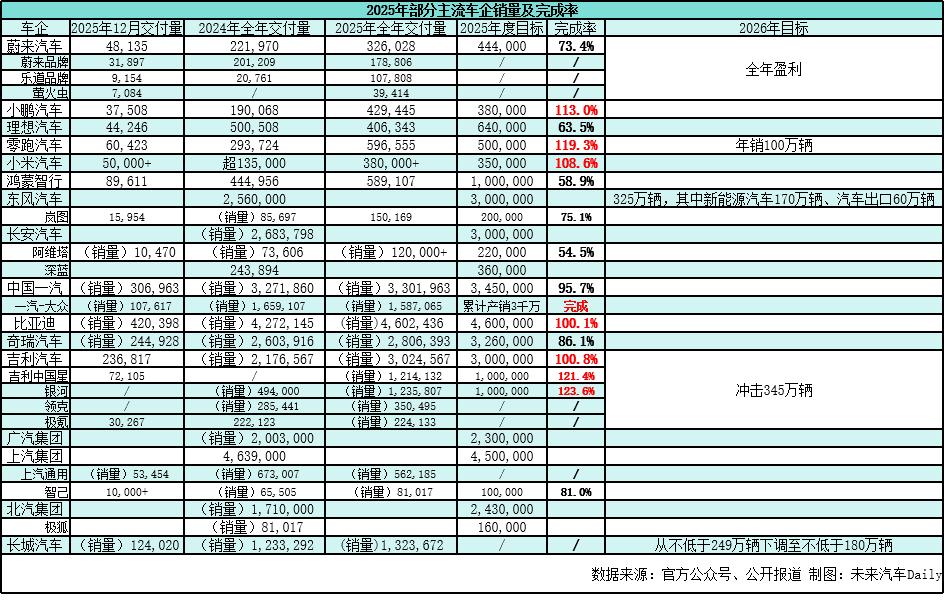
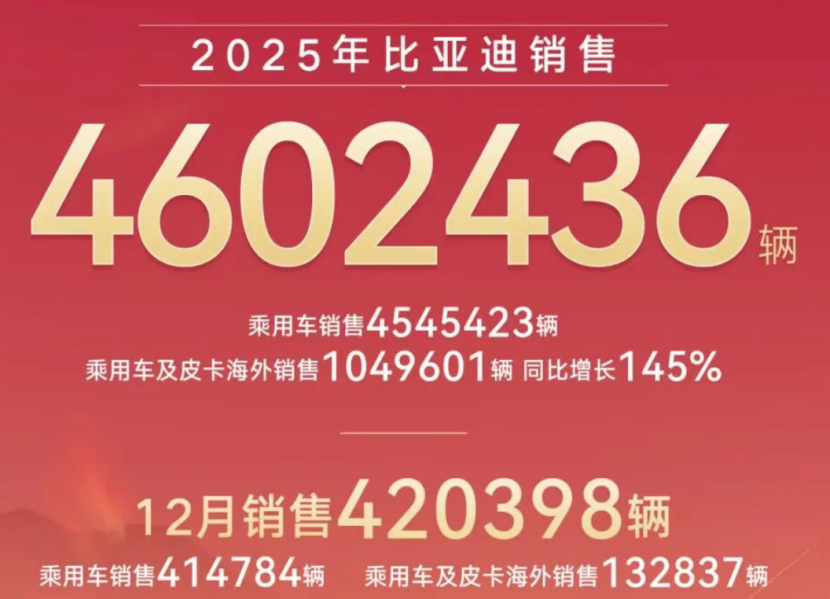
本报记者 刘钊 新年伊始,汽车行业2025年度销量数据陆续揭晓。 具体来看,比亚迪全年纯电动汽车销量首次超越特斯拉,成为全球第一。与此同时,吉利汽车、长安汽车、奇瑞汽车等传 统汽车集团在"新能源+出海"双主线下加速追赶,新势力车企则呈现"强者恒强、分化加剧"的竞争格局。 多维布局谋增长 从年度销量排行看,头部车企的位次变化首先来自"规模差距"的再度拉大。 其中,比亚迪2025年新能源汽车销量为460.24万辆,同比增长7.73%,其中纯电车型全年累计销量为225.67万辆,同比增长 27.86%。以纯电口径衡量,比亚迪已在年度销量上超过特斯拉,后者全年交付约164万辆。 这一"新旧王者"的更替,意味着全球纯电市场的竞争焦点正从单一明星车型驱动,转向以成本、供应链与产品矩阵为核心 的体系化竞争。比亚迪的成功背后,是其"双轮驱动+全链布局"战略的支撑。在产品结构上,比亚迪坚持"纯电+插混"并行策 略,DM-i系列纯电续航超125km,冬季续航达成率为86%,解决了消费者的里程焦虑。在技术层面,比亚迪凭借垂直整合的全 产业链优势,实现了较好的成本控制,再叠加刀片电池的安全优势,形成了核心竞争力。 整体来看,2025 ...

车企2025“年终考”成绩单出炉
Mei Ri Jing Ji Xin Wen· 2026-01-04 14:21
Core Insights - The 2025 Chinese automotive market showcased a "stronger getting stronger, increasing differentiation" trend amid deepening new energy transitions and intense industry competition [1] Group 1: Performance of Leading Companies - BYD achieved sales of 4.6024 million vehicles in 2025, with overseas sales surpassing 1 million for the first time, marking a 145% year-on-year increase in passenger and pickup truck sales [2] - BYD's pure electric vehicle sales reached 2.2567 million units, a nearly 28% increase, surpassing Tesla's 1.636 million units, making BYD the global leader in annual electric vehicle sales [2] - Geely also exceeded its annual sales target, achieving 3.0246 million units sold, a 39% year-on-year increase, with new energy vehicle sales reaching 1.6878 million units, up 90% [2] Group 2: Performance of Other Companies - Dongfeng Motor achieved its dual target of over 1 million new energy vehicles and 1.5 million total vehicle sales, with new energy vehicle sales reaching 1.04 million, a 21% increase [3] - Changan Automobile reported sales of 2.913 million vehicles, a growth of 8.5%, with new energy vehicle sales of 1.109 million, up 51% [5] - Chery Group sold 2.8064 million vehicles, a 7.8% increase, with new energy vehicle sales reaching 903,800 units, a 54.9% increase [5] Group 3: Underperformance of Certain Companies - China FAW achieved a total vehicle sales of 3.302 million, a 3.2% increase, but fell short of its target of 3.45 million [4] - Great Wall Motors reported sales of 1.3237 million vehicles, a 7.33% increase, but only achieved 33.09% of its 4 million target [5][6] - New energy vehicle sales for Great Wall reached 403,700 units, a 25.44% increase, but the overall performance was below expectations [5][6] Group 4: New Forces in the Market - Among new forces, Leap Motor, Xiaomi, and Xpeng all exceeded their annual sales targets, with Leap Motor achieving 596,600 units sold, marking a 119.3% target completion rate [7] - Xiaomi's vehicle deliveries surpassed 50,000 in December 2025, exceeding its annual target of 350,000 [7] - NIO and Li Auto, however, did not meet their targets, with NIO selling 326,000 units and Li Auto selling 406,300 units, both falling short of their respective goals [8][9]



2026年汽车以旧换新政策发布
Dong Zheng Qi Huo· 2026-01-04 13:43
1. Report Industry Investment Rating No information provided in the given content. 2. Core Viewpoints of the Report - China's new energy vehicle market penetration has rapidly increased in the past few years, exceeding 50% in 2025. In 2025, the domestic market shifted to "anti - involution", and exports gradually became a new growth point [3][122]. - Considering the overseas market trade environment, trade protectionism in Europe and the United States is severe, while countries along the Belt and Road and the Middle East have good development prospects. Regarding the development of the overseas new energy vehicle market itself, the development space of new energy vehicles in non - US regions is generally optimistic [3][122]. - In terms of the competition pattern, the market share of self - owned brands continues to expand. Enterprises with strong product capabilities, smooth overseas expansion, and high supply stability will be the core beneficiaries [3][122]. 3. Summary According to Relevant Catalogs 3.1 Financial Market Tracking - The report shows the one - week price changes of related sectors and listed companies, including the closing prices and one - week price change percentages of many vehicle manufacturers and power battery and material companies [12][15]. 3.2产业链数据跟踪 3.2.1 China New Energy Vehicle Market Tracking - **Sales and Exports**: Information on China's new energy vehicle sales, penetration rate, domestic sales, and exports is presented through relevant charts [16][18][20]. - **Inventory Changes**: Charts show the monthly new additions of new energy passenger vehicle channel inventory and manufacturer inventory [25][26]. - **Delivery Volume of Chinese New Energy Vehicle Enterprises**: The monthly delivery volumes of many new energy vehicle companies such as Leapmotor, Li Auto, XPeng, and NIO are presented [29][30][35]. 3.2.2 Global and Overseas New Energy Vehicle Market Tracking - **Global Market**: Charts show global new energy vehicle sales, penetration rate, and sales of EV and PHV [40][41][43]. - **European Market**: Information on European new energy vehicle sales, penetration rate, and sales of EV and PHV in countries like the UK, Germany, and France is presented [45][46][51]. - **North American Market**: Charts show North American new energy vehicle sales, penetration rate, and sales of EV and PHV [59][60][62]. - **Other Regions**: Information on new energy vehicle sales, penetration rate, and sales of EV and PHV in regions like Japan, South Korea, and Thailand is presented [63][64][67]. 3.2.3 Power Battery Industry Chain - Information on power battery loading volume (by material), export volume (by material), weekly average price of battery cells, and costs of cell materials is presented. It also includes data on the operating rates and prices of various battery materials such as ternary materials, phosphoric acid iron lithium, and negative electrode materials [79][81][84]. 3.2.4 Other Upstream Raw Materials - The daily prices of rubber, glass, steel, and aluminum are presented [100][101][102]. 3.3 Hot News Summaries 3.3.1 Industry Dynamics: China - In 2026, the implementation details of the car trade - in subsidy were introduced. The subsidy method changed from fixed - amount subsidy to subsidy based on the proportion of the new car's selling price, with the subsidy cap remaining unchanged [107]. - Four departments including the Ministry of Industry and Information Technology jointly issued the "Implementation Plan for the Digital Transformation of the Automobile Industry", proposing two - stage development goals and six key tasks [109]. - According to the Passenger Car Association, from December 1 - 28, the new energy retail sales increased by 5% year - on - year, and the cumulative retail sales since this year increased by 18% year - on - year [110]. 3.3.2 Enterprise Dynamics - BYD's sales in December 2025 were 420,398 vehicles. In 2025, its annual sales of pure - electric vehicles exceeded Tesla's for the first time, ranking first globally [112]. - Geely Auto's sales in December 2025 were 236,817 vehicles. It announced a sales target of 3.45 million vehicles in 2026 [113][115]. - Chery Group's sales in December 2025 were 244,928 vehicles. In 2026, it aims to have a sales growth rate 10 - 20 percentage points higher than the industry average [116][118]. - Xiaomi Auto's delivery volume in December 2025 exceeded 50,000 vehicles, and its delivery target in 2026 is 550,000 vehicles. It also plans to launch four new models in 2026 [119]. 3.4 Industry Views - From December 1 - 28, 2025, the retail growth rate of the domestic passenger car market was - 17%, and the new energy growth rate was + 5%. As of December 28, 2025, the cumulative annual growth rates were 4% and 18% respectively. Self - owned brands such as BYD and Geely remained strong, and exports became a new growth point [120]. - The US new energy vehicle market declined in November 2025, while the European and other regions showed growth. Overall, the development space of new energy vehicles in non - US regions is optimistic [121]. 3.5 Investment Suggestions - China's new energy vehicle market penetration rate has rapidly increased, and exports have become a new growth point. Non - US regions have good development prospects, and self - owned brands with certain advantages will be the core beneficiaries [122].
在一片销量创新高的欢呼声中,车企们将迎战更惨烈的2026年
3 6 Ke· 2026-01-04 02:11
Core Viewpoint - The Chinese automotive market is experiencing a downturn in December, with a significant year-on-year decline in retail sales, prompting companies to seek growth opportunities amidst challenging conditions [1][10]. Market Performance - From December 1 to 28, retail sales of passenger vehicles in China reached 1.928 million units, a 17% decrease compared to the same period last year and a 3% decline from the previous month [1]. - Traditional automakers like BYD reported a sales drop of 12% month-on-month and 18% year-on-year, despite achieving a total of 4.273 million units sold in 2023, marking a 144% increase in exports [6][7]. Company Highlights - NIO achieved a record delivery of 48,000 units in December, with 46% of this volume coming from the new ES8 model [3]. - Xpeng and Xiaomi also saw increases in deliveries, with Xpeng delivering 37,000 units and Xiaomi exceeding 50,000 units [3]. - Li Auto's monthly deliveries rose from 30,000 in November to 40,000 in December, aided by adjustments in production capacity [3][17]. - Homologous Intelligent achieved nearly 90,000 deliveries in December, becoming the top performer among new energy vehicle brands [4][13]. Future Outlook - Industry experts anticipate a rebound in January 2026 due to the timing of the Spring Festival and the implementation of new subsidy policies [8]. - However, the overall automotive industry is expected to remain under pressure throughout 2026 [9]. Competitive Landscape - The competition among automakers is intensifying, with companies like BYD, Li Auto, and others adjusting their sales targets and strategies in response to market conditions [20][23]. - New models and technological advancements are being prioritized, with companies focusing on high-value offerings to navigate the changing market dynamics [30][31].

【钛晨报】推动REITs市场高质量发展,证监会最新发声;百度:计划分拆昆仑芯并于港交所独立上市;沃伦·巴菲特正式退休,卸任伯克希尔·哈撒韦首席执行官
Sou Hu Cai Jing· 2026-01-03 23:58
Group 1 - The China Securities Regulatory Commission (CSRC) issued a notice to promote the high-quality development of the Real Estate Investment Trusts (REITs) market, emphasizing the need to accelerate the construction of the REITs market system [2][3] - The notice calls for expanding the REITs market by increasing the supply of quality REITs and enhancing the market's diversity and scale, while also improving the fundraising system and market pricing mechanisms [2][3] - It supports well-governed and financially stable listed REITs to strengthen their asset scale and risk resilience through asset acquisitions, fundraising, and mergers [2][3] Group 2 - The notice encourages the development of a robust secondary market for REITs, including the creation of relevant index systems and innovative products like REITs ETFs to enhance investor asset allocation options [3] - It aims to attract long-term funds such as insurance and pension funds into the REITs market, enhancing market stability [3] - The CSRC plans to improve the REITs issuance and trading mechanisms, ensuring better information disclosure and market constraints [3] Group 3 - The notice highlights the importance of legislative support for REITs, aiming to establish a legal foundation for the market's high-quality development [3] - It emphasizes the need for a multi-tiered REITs market system to enhance inclusivity and adaptability [3]
新造车2025年复盘:零跑登顶,小鹏逆袭,理想遇挫
创业邦· 2026-01-03 10:22
Core Viewpoint - The 2025 sales data reveals a significant shift in the Chinese electric vehicle (EV) market, with new players like Leap Motor, Huawei's Homologous Intelligent Driving, and Xiaomi emerging as strong competitors against established brands like BYD and Geely [6][12]. Group 1: 2025 Sales Performance - BYD led the market with 4.6024 million units sold, achieving 100% of its target [7]. - Geely surpassed 3 million units, reaching 3.0246 million with a 39% year-on-year growth [7]. - Leap Motor emerged as the top new force with nearly 600,000 units sold, marking a 103% increase [8][12]. - Homologous Intelligent Driving ranked second among new forces with 589,100 units delivered, primarily driven by the Wanjie brand [8]. - Xiaomi entered the top five with over 400,000 units sold, leveraging its ecosystem and brand loyalty [17]. Group 2: Competitive Landscape - The competition among new forces has intensified, with Leap Motor, Homologous Intelligent Driving, and Xiaomi leading the charge, while traditional players like BYD and Geely maintain their dominance [10][12]. - The market is shifting from a focus on capturing the fuel vehicle market to a more competitive landscape where companies vie for each other's market share [10]. - The new forces are increasingly focusing on systemic capabilities rather than just product features or pricing [18]. Group 3: Strategic Insights - Leap Motor's success is attributed to its cost control and high component sharing rate, which allows it to offer competitive pricing while maintaining quality [15][18]. - Xiaomi's approach combines its consumer electronics experience with automotive production, achieving a gross margin of 26.4% in Q3 2025 [17]. - The high-end players like Ideal, Homologous Intelligent Driving, and NIO face challenges as the market shifts towards technology competition rather than just configuration [19][23]. Group 4: Future Outlook - The penetration rate of new energy vehicles is expected to exceed 60% in 2026, leading to intensified competition [10]. - Companies are setting ambitious sales targets for 2026, with Homologous Intelligent Driving aiming for 1 to 1.3 million units and Leap Motor targeting 1 million [10]. - The competition will evolve into a "value war," focusing on better battery performance, intelligent features, and overall vehicle quality [29][30].



2025年车企销量排名出炉:比亚迪、吉利、奇瑞稳居前三,造车新势力分化加剧,零跑、小鹏、小米完成目标
Feng Huang Wang Cai Jing· 2026-01-02 14:45
Core Insights - The Chinese automotive industry is experiencing a significant transformation, with traditional giants expanding rapidly while new energy vehicle startups face intense competition and market reshuffling [1] Traditional Giants' Performance - BYD continues to lead the market with total sales exceeding 4.6 million units in 2025, marking a nearly 8% year-on-year increase. Pure electric vehicle sales reached 2.2567 million units, up 27.86% [2] - BYD's overseas sales surpassed 1 million units for the first time, achieving 1.0496 million units, a staggering 145% increase year-on-year [2] - Geely Automotive achieved over 3.02 million units in sales, exceeding its target of 3 million units with a 39% year-on-year growth, driven by a 90% increase in new energy vehicle sales [3] - Chery Automotive sold over 2.8 million units, a 7.8% increase, and maintained its position as the top exporter of Chinese passenger cars for 23 consecutive years [5] - Great Wall Motors sold over 1.32 million units, a 7.33% increase, with new energy vehicle sales reaching 403,700 units, up 25.44% [7] New Energy Vehicle Startups' Struggles - The new energy vehicle sector shows significant differentiation, with only Leap Motor, Xiaomi, and XPeng meeting their annual sales targets [8] - Leap Motor emerged as a surprise leader with nearly 600,000 units sold, achieving a target completion rate of over 119% [8] - Homtruck followed closely with 589,100 units sold, but fell short of its 1 million target, achieving only 59% of its goal [8] - XPeng sold 429,400 units, surpassing Li Auto, with a year-on-year growth of 125.94% and a target completion rate of over 113% [10] - Li Auto faced a decline, selling 406,300 units, down 18.81% year-on-year, and only achieving 58.05% of its target [10] Market Dynamics and Future Outlook - The competitive landscape is shifting, with traditional automakers gaining strength while new entrants like Leap Motor and Xiaomi are rising [11] - The upcoming subsidy policies for 2026 are expected to intensify competition, focusing on product strength, technological capabilities, and brand value [12] - The automotive industry is poised for further transformation as market dynamics evolve, indicating that no company's position is guaranteed [12]
2025车市,谁封神谁掉队?
凤凰网财经· 2026-01-02 13:42
Core Viewpoint - The Chinese automotive industry is undergoing a significant transformation, with traditional giants expanding rapidly while new energy vehicle startups face intense competition and market reshuffling [1][2]. Group 1: Traditional Giants' Performance - BYD continues to lead the market with total sales exceeding 4.6 million units in 2025, marking an 8% year-on-year increase. Pure electric vehicle sales reached 2.2567 million units, up 27.86% [3]. - BYD's overseas sales surpassed 1 million units for the first time, with a remarkable 145% increase year-on-year, indicating its growth as a global player [3]. - Geely achieved over 3.02 million units in sales, exceeding its target of 3 million units with a 39% year-on-year increase. Its new energy vehicle sales approached 1.69 million units, soaring by 90% [5]. - Chery sold over 2.8 million units, a 7.8% increase, and maintained its position as the top exporter of Chinese passenger cars for 23 consecutive years, with exports exceeding 1.34 million units, up 17.4% [8]. - Great Wall Motors sold over 1.32 million units, a 7.33% increase, with new energy vehicle sales reaching 403,700 units, up 25.44% [10]. Group 2: New Energy Vehicle Startups' Performance - The new energy vehicle startups showed significant differentiation, with only Leap Motor, Xiaomi, and XPeng meeting their annual sales targets [12]. - Leap Motor emerged as a surprise leader with nearly 600,000 units sold, achieving a target completion rate of over 119% [12]. - XPeng sold 429,400 units, surpassing its target with a 125.94% year-on-year growth, while NIO sold 326,000 units, a 46.9% increase [15]. - Li Auto faced challenges, selling 406,300 units, down 18.81% year-on-year, and only achieving 58.05% of its target [15]. - Xiaomi's sales reached over 35,000 units, successfully meeting its annual target, while other brands like Deep Blue and Avita struggled to meet their goals [16]. Group 3: Market Dynamics and Future Outlook - The automotive market is expected to become more competitive as new subsidy policies are introduced in 2026, emphasizing product strength, technological capabilities, and brand value [19]. - The rapid changes in market positions among startups highlight the volatility and competitive nature of the industry, with no brand's position being secure [17].
七成新势力车企年度KPI翻车! 谁是“销量倒退玩家”?
Xin Lang Cai Jing· 2026-01-02 10:11
Core Insights - The new energy vehicle industry is facing significant challenges, with many companies failing to meet their annual sales targets, indicating a competitive and rapidly evolving market environment [2][11]. Group 1: Performance of Key Players - Among the "Wei Xiao Li" trio, only XPeng Motors met its sales target, while NIO fell short but achieved a nearly 50% year-on-year growth, and Li Auto was the only company in the top 15 to experience a year-on-year sales decline of 18.8% [3][5][10]. - Xiaomi's automotive division achieved approximately 410,000 units in sales, surpassing its target by 17% [4][11]. - Overall, 8 out of 12 new energy vehicle companies failed to meet their annual targets, representing about 67% of the companies analyzed [4][11]. Group 2: Company-Specific Challenges - NIO aimed for a sales target of 440,000 units but only sold 326,000 units, despite a year-on-year growth of 46.88% [5][13]. - Li Auto's sales for the year were 406,300 units, achieving only 58.05% of its ambitious target of 700,000 units, marking a significant setback for the company [6][14]. - Changan's brands, including Avita and Deep Blue, also struggled, with Deep Blue's sales falling short of its revised target of 360,000 units, achieving only 333,100 units [8][16]. Group 3: Market Dynamics and Future Outlook - The competitive landscape is characterized by overcapacity, intense competition, and price wars, making it difficult for companies to meet their sales goals [17]. - Industry experts suggest that the current instability in the new energy vehicle market contrasts with the more stable dynamics of traditional fuel vehicles, indicating a period of rapid evolution and competition [17].
七成新势力车企年度KPI翻车!谁是“销量倒退玩家”?
新浪财经· 2026-01-02 10:05
Core Viewpoint - The article discusses the annual sales performance of new energy vehicle companies in 2025, highlighting the competitive landscape and the challenges faced by key players in the industry, particularly the "Wei Xiaoli" trio: NIO, Li Auto, and Xpeng [3][4][7]. Group 1: Sales Performance of Key Players - Among the "Wei Xiaoli" trio, Xpeng is the only company that exceeded its sales target, while NIO achieved a nearly 50% year-on-year growth but fell short of its annual goal. Li Auto lagged behind, completing only 58% of its target and experiencing an 18.8% decline in year-on-year sales, making it the only company in the top 15 to report a decrease [4][6][8]. - Xiaomi's automotive division achieved approximately 410,000 units in sales, surpassing its target by 17% [5]. - Of the 15 new energy vehicle companies analyzed, 8 failed to meet their annual targets, representing about 67% of the group [6]. Group 2: Individual Company Insights - NIO aimed for a sales target of 440,000 units but only sold 326,000 units, despite a year-on-year growth of 46.88%. The founder emphasized the need for strategic focus and resilience in a competitive environment [7][8]. - Li Auto's sales for the year were 406,300 units, significantly below its target of 700,000 units, marking a year-on-year decline of 18.81% [8]. - Leap Motor achieved a record annual sales of 596,600 units, with a year-on-year growth of 103.1%, and aims for a million sales in 2026 [9]. Group 3: Challenges Faced by Other Companies - Changan's brands, including Avita and Deep Blue, did not meet their sales targets, with Deep Blue's sales falling short despite a revised target [11]. - Dongfeng's brand, Lantu, also failed to meet its goal, selling 150,200 units, achieving a completion rate of 75.1% [11]. - The overall market environment is characterized by overcapacity, intense competition, and price wars, making it difficult for companies to achieve their sales targets [11].