
卫星化学

Search documents
卫星化学及烯烃行业周度动态跟踪-20260114
Huaan Securities· 2026-01-14 05:30
Investment Rating - The report maintains a positive investment rating for the chemical industry, specifically recommending leading companies in the light hydrocarbon sector, such as Satellite Chemical [4]. Core Insights - Ethane prices have continued to decline, reaching 1277 RMB/ton as of January 9, with a week-on-week decrease of 3.10% [4]. - Natural gas prices have significantly dropped by 29.02% week-on-week, while ethylene and liquid chlorine prices remained stable [4]. - The report anticipates that despite fluctuations, ethane prices will continue to decline due to a loose supply-demand balance, with expectations for recovery in downstream demand this year [4]. - The report highlights the historical price percentiles for key downstream products, indicating they are currently in a mid-low percentile range [4]. Price Trends of Major Products and Raw Materials - As of January 9, the latest prices for polyethylene, epoxy ethane, polyester monomer, ethylene glycol, and styrene are 6534, 5750, 8200, 3829, and 6796 RMB/ton respectively, with varying week-on-week changes [16][18]. - The report notes that the price of polypropylene has slightly increased by 1.79% week-on-week, while acrylic acid prices remained stable [33][36]. - Brent crude oil prices were recorded at 61.08 USD/barrel, with a week-on-week decrease of 0.34%, and natural gas prices at 3.02 USD/MMBtu, down 29.02% [41][44]. Price Differentials - As of January 9, the price differentials for ethylene-ethane, ethylene glycol-ethylene, and other product pairs have shown various changes, with some differentials widening [62][65]. - The ethylene-ethane differential increased by 1.30%, while the ethylene glycol-ethylene differential decreased by 8.40% [70][74]. Competitive Landscape and Downstream Demand - The report indicates that the ethylene-naphtha differential is -1301 RMB/ton, reflecting a week-on-week decrease of 1.04% [87]. - The cost advantages of ethane cracking over other routes have been emphasized, particularly with the recent decline in ethane prices [90].

化工ETF(159870)盘中净申购近4.4亿份,供需改善与减产共振驱动聚酯产业链利润修复
Xin Lang Cai Jing· 2026-01-14 03:54
Group 1 - The PX supply-demand pattern continues to improve, with no new production capacity expected before the end of 2026. Limited domestic PX capacity increase is anticipated next year, with Huajin's 2 million tons facility not expected to be operational until the end of next year, maintaining a rigid supply before then. Overseas refineries are experiencing strong oil product demand, with some chemical products being converted to refined oil, further squeezing PX supply [1] - On the demand side, two PTA facilities in India are gradually coming online, with one recently starting PX external procurement, contributing to demand growth. Recent futures and spot prices have surged, reflecting expectations of an optimized supply-demand pattern [1] - The reduction in long filament production has enhanced collaboration among leading companies, coupled with a gradual recovery in demand and smooth cost transmission. Last week, leading long filament companies reached a consensus on production cuts, planning a 10% reduction in POY and a 15% reduction in FDY, with price increases of 50 yuan/ton followed by another 100 yuan/ton. The current long filament operating rate is 89%, with POY/FDY inventory decreasing to 13-14 days, a reduction of about 4 days month-on-month, indicating strong demand [1] Group 2 - As of January 14, the chemical ETF (159870.SZ) rose by 1.18%, and its associated index, the segmented chemical index (000813.CSI), increased by 1.19%. Among major constituent stocks, Baofeng Energy rose by 5.52%, Junzheng Group by 10.10%, Tongkun Co. by 6.52%, Satellite Chemical by 3.85%, and Wanhua Chemical by 0.67%. During the trading session, net subscriptions exceeded 440 million shares, marking a push for 10 consecutive days of net subscriptions [2] - Related products include the chemical ETF (159870) and linked funds (Class A 014942, Class C 014943, Class I 022792). Related stocks include Wanhua Chemical (600309), Yilake Co. (000792), Cangge Mining (000408), Tianci Materials (002709), Hengli Petrochemical (600346), Juhua Co. (600160), Hualu Hengsheng (600426), Yuntianhua (600096), Baofeng Energy (600989), and Jinfat Technology (600143). A MACD golden cross signal has formed, indicating a positive trend for these stocks [3]
石油化工行业周报(2026/1/5—2026/1/11):欧佩克+继续暂停增产,短期原油供应端支撑明确-20260112
Shenwan Hongyuan Securities· 2026-01-12 15:24
Investment Rating - The report maintains a neutral outlook on the oil and chemical industry for 2026, with specific recommendations for various companies based on their performance and market conditions [10]. Core Insights - OPEC+ has decided to continue its production cuts, with a focus on cautious and flexible adjustments based on market conditions. The group has reaffirmed its commitment to compensate for overproduction since January 2024, which is expected to support oil prices in the short term [2][5]. - The downstream polyester sector is tightening in supply and demand, with expectations for improvement in market conditions. Key recommendations include high-quality companies in polyester filament and bottle-grade materials [10]. - The report highlights that oil prices are expected to stabilize, with a limited downside, and suggests focusing on companies with strong dividend yields and improving operational quality [10]. Summary by Sections OPEC+ Production Plans - OPEC+ has confirmed a pause in its planned production increase of 1.65 million barrels per day for February and March 2026 due to seasonal demand weakness. The group emphasizes the need for full compensation for overproduction since January 2024 [2][5]. - The actual production for Q1 2026 is expected to be lower than nominal quotas, with adjustments in compensation plans leading to a reduction of 0.1-0.2 million barrels per day compared to nominal quotas [5]. Price Trends - As of January 9, 2026, Brent crude oil futures closed at $63.34 per barrel, reflecting a week-on-week increase of 4.26%. WTI futures rose to $59.12 per barrel, up 3.14% [14]. - The report notes that the average price for Brent and WTI for the week was $61.55 and $57.66 per barrel, respectively, indicating slight fluctuations in the market [14]. Company Recommendations - The report recommends focusing on high-quality companies in the polyester sector, such as Tongkun Co. and Wankai New Materials, as well as major refining companies like Hengli Petrochemical and Rongsheng Petrochemical, which are expected to benefit from improved cost structures and competitive advantages [10]. - It also highlights the offshore oil service sector, suggesting continued optimism for companies like CNOOC Services and Haiyou Engineering due to high capital expenditures in offshore exploration [10]. Market Dynamics - The report indicates that the U.S. oil production for January 2, 2026, was 13.81 million barrels per day, showing a slight decrease from the previous week but a year-on-year increase of 330,000 barrels per day [23]. - The number of active oil rigs in the U.S. decreased to 544, down 2 from the previous week and down 40 year-on-year, indicating a potential slowdown in exploration activities [25]. Valuation Metrics - The report provides a valuation table for key companies in the oil and chemical sector, detailing market capitalization, earnings per share (EPS), and price-to-earnings (PE) ratios for companies like China National Petroleum and Hengli Petrochemical [11].



石油化工行业周报:欧佩克+继续暂停增产,短期原油供应端支撑明确-20260112
Shenwan Hongyuan Securities· 2026-01-12 12:42
Investment Rating - The report maintains a positive outlook on the oil and petrochemical industry, indicating a favorable investment rating due to clear short-term support from the oil supply side [2][3]. Core Insights - OPEC+ continues to pause production increases, with a focus on compensating for overproduction since January 2024, which strengthens short-term supply support [2][3]. - The upstream sector is experiencing rising oil prices, while day rates for self-elevating drilling rigs are declining, indicating a mixed outlook for drilling services [2][13]. - The refining sector shows a decrease in overseas refined oil crack spreads, while olefin spreads are increasing, suggesting a potential improvement in refining profitability [2][47]. - The polyester sector is witnessing a decline in PTA profitability but an increase in polyester filament profitability, indicating a need for close monitoring of demand changes [2][10]. Summary by Sections Upstream Sector - Brent crude oil futures closed at $63.34 per barrel, up 4.26% week-on-week, while WTI futures rose 3.14% to $59.12 per barrel [13]. - U.S. commercial crude oil inventories decreased by 3.83 million barrels to 419 million barrels, which is 3% lower than the five-year average [14]. - The number of active U.S. drilling rigs decreased to 544, down 2 rigs from the previous week and down 40 rigs year-on-year [27]. Refining Sector - The Singapore refining margin for major products was $11.04 per barrel, down $4.15 from the previous week [49]. - The U.S. gasoline RBOB-WTI spread increased to $15.4 per barrel, up $1.3 from the previous week, but still below the historical average of $24.5 per barrel [52]. - The olefin sector shows a positive trend with an increase in the ethylene-crude oil spread, indicating potential profitability improvements [57]. Polyester Sector - PTA prices have declined, with the average price in East China at 5069.25 CNY per ton, down 0.75% week-on-week [2]. - The polyester filament POY spread increased to 905 CNY per ton, up 17 CNY from the previous week, indicating a slight improvement in profitability [2][10]. - The overall performance of the polyester industry is average, with expectations for gradual improvement as new capacity comes online [2][10]. Investment Recommendations - The report recommends focusing on high-quality companies in the polyester sector, such as Tongkun Co. and Wankai New Materials, due to tightening supply and demand conditions [10]. - It suggests monitoring large refining companies like Hengli Petrochemical and Rongsheng Petrochemical, which may benefit from improved cost structures and competitive advantages [10]. - The upstream exploration and development sector remains robust, with recommendations for offshore oil service companies like CNOOC Services and Offshore Engineering [10].


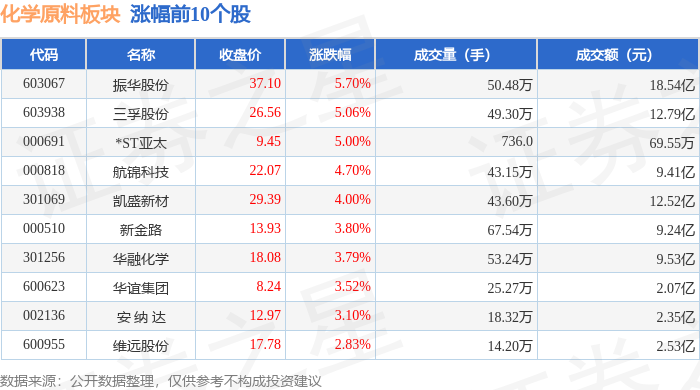
化学原料板块1月12日跌0.1%,亚星化学领跌,主力资金净流出4.38亿元
Zheng Xing Xing Ye Ri Bao· 2026-01-12 09:00
证券之星消息,1月12日化学原料板块较上一交易日下跌0.1%,亚星化学领跌。当日上证指数报收于 4165.29,上涨1.09%。深证成指报收于14366.91,上涨1.75%。化学原料板块个股涨跌见下表: | 代码 | 名称 | 收盘价 | 涨跌幅 | 成交量(手) | 成交额(元) | | --- | --- | --- | --- | --- | --- | | 616009 | 亚星化学 | 8.33 | -6.93% | 19.14万 | 1.61亿 | | 600784 | 鲁银投资 | 7.73 | -2.89% | 62.30万 | 4.83亿 | | 600367 | 红星发展 | 18.19 | -2.47% | 31.13万 | 5.65 Z | | 000683 | 博源化工 | 7.37 | -2.38% | 64.54万 | 4.76亿 | | 600989 | 宝丰能源 | 19.37 | -2.32% | 52.78万 | 10.28亿 | | 600714 | 金瑞矿业 | 12.84 | -2.28% | 14.37万 | 1.83亿 | | 002601 | 龙佰集团 | ...


能源成本下行-看好商品周期与科技主线需求共振-能源及有色行业2026年度投资策略
2026-01-12 01:41
Summary of Key Points from Conference Call Records Industry Overview - The conference call discusses the energy and non-ferrous metal industries, focusing on commodity cycles and market dynamics in 2026 [1][2]. Core Insights and Arguments - **Commodity Cycle Dynamics**: The acceleration of commodity cycle rotation is influenced by global economic recovery and pandemic impacts, similar to the commodity volatility seen after the collapse of the Bretton Woods system in the 1970s. It is challenging to determine the current cycle position, necessitating a comprehensive analysis of various commodities to identify patterns [1][2]. - **Oil Prices and Commodity Volatility**: Oil prices are highly correlated with overall commodity volatility, serving as a benchmark for energy costs. Gold has started to rise as a leading indicator, but other commodities have not followed suit significantly, likely due to the lack of a clear upward trend in oil prices [1][4]. - **Gold Price Influences**: The price of gold is affected by the transition between the old and new world orders. Currently, gold is viewed as a safe-haven asset amid the remnants of the old world wealth. Historical trends show that after the decoupling of the dollar from gold in 1971, significant price increases in gold and other commodities occurred due to excessive dollar issuance [5]. - **U.S. Treasury Credit and Precious Metals**: The loosening of U.S. Treasury credit post-2009 financial crisis has led to increased market preference for precious metals as a hedge. Despite multiple interest rate cuts by the Federal Reserve, Treasury yields have not significantly decreased, indicating a weakening preference for Treasury securities [6]. - **Future Gold Price Trends**: A long-term downward expectation for the U.S. dollar index, driven by an expanding trade deficit and potential appreciation of the Renminbi, suggests that gold prices may have room to rise [7]. - **Oil Supply and Demand**: Short-term oil supply and demand are heavily influenced by political factors, while long-term demand changes will have a more significant impact on price volatility. Current U.S. inventory increases and stable Chinese supply contribute to short-term price stability, but long-term demand fluctuations could lead to potential volatility [8]. - **U.S. Oil Production and Price Forecast**: U.S. oil production has seen a year-on-year increase of approximately 300,000 barrels, but the number of drilling rigs is declining. The forecast for oil prices in 2026 is expected to fluctuate between $40 and $70 per barrel, with a more stable range of $50 to $70 per barrel if political factors are excluded [9][10]. Additional Important Insights - **Energy Costs in China**: Domestic energy costs are stable, with sufficient supply in coal and natural gas, leading to no significant price increases. Electricity prices are expected to have limited rebound potential due to overall cost constraints [11]. - **Non-Ferrous Metals Market**: The aluminum market is expected to remain in a supply-demand imbalance due to limited domestic production capacity and stable demand growth. Copper prices are projected to range between $11,000 and $15,000 per ton in 2026, driven by increasing demand in power construction and unstable production in major copper mining regions [12][13]. - **Domestic Economic Impact on Metal Demand**: The demand for non-ferrous metals is closely tied to domestic economic development, particularly in sectors like real estate and automotive. A positive GDP outlook suggests continued growth in aluminum demand [14]. - **Global Copper Inventory and Consumption**: As of September 2025, global electrolytic copper inventory was 1.451 million tons, with a consumption increase of 3% year-on-year, indicating a stable demand environment [15]. - **Challenges in the Copper Market**: The domestic copper market faces challenges such as resource scarcity and price increases affecting downstream procurement. Additionally, cyclical patterns in the manufacturing sector impact demand [16][17]. - **Cable Demand in China**: There is strong demand for cables driven by investments in power generation and infrastructure, with a rebound in terminal electrical equipment demand noted [18]. - **Silver Market Dynamics**: The silver market is influenced by financial attributes, with increased speculative demand as gold prices rise. Industrial demand, particularly from photovoltaic and electronics sectors, is expected to support silver prices [19]. - **Rare Earth Industry Development**: The rare earth industry in China is positioned as a competitive sector, benefiting from trends in high-end manufacturing and energy equipment [20]. - **Commodity Market Trends**: The commodity market is experiencing structural demand resonance rather than short-term volatility, with significant implications from U.S. monetary policy and inflation on commodity prices [21]. - **Investment Recommendations**: Suggested investments include resource companies like PetroChina and CNOOC, integrated firms such as Hengli and Rongsheng, and non-ferrous metal companies like Yun Aluminum and Huadong Cable. Additionally, companies in the rare earth sector are noted for their potential [22].
卫星化学1月9日获融资买入1.17亿元,融资余额15.61亿元
Xin Lang Cai Jing· 2026-01-12 01:32
Group 1 - Satellite Chemical's stock price decreased by 1.59% on January 9, with a trading volume of 9.56 billion yuan. The financing buy amount was 1.17 billion yuan, while the financing repayment was 1.09 billion yuan, resulting in a net financing purchase of 823.78 million yuan. The total financing and securities lending balance reached 15.65 billion yuan as of January 9 [1] - The financing balance of Satellite Chemical was 15.61 billion yuan, accounting for 2.50% of the circulating market value, which is above the 60th percentile level over the past year, indicating a high position [1] - In terms of securities lending, 7,500 shares were repaid and 6,000 shares were sold on January 9, with a selling amount of 111,100 yuan. The remaining securities lending volume was 251,900 shares, with a balance of 4.67 million yuan, also above the 70th percentile level over the past year, indicating a high position [1] Group 2 - As of September 30, the number of shareholders of Satellite Chemical was 89,400, a decrease of 4.05% from the previous period. The average circulating shares per person increased by 4.22% to 37,663 shares [2] - For the period from January to September 2025, Satellite Chemical achieved an operating income of 34.77 billion yuan, a year-on-year increase of 7.73%, and a net profit attributable to the parent company of 3.76 billion yuan, a year-on-year increase of 1.69% [2] - Since its A-share listing, Satellite Chemical has distributed a total of 5.73 billion yuan in dividends, with 3.03 billion yuan distributed in the last three years [2] - As of September 30, 2025, the top ten circulating shareholders included Hong Kong Central Clearing Limited as the third-largest shareholder with 234 million shares, an increase of 83.81 million shares from the previous period. Other notable shareholders include Huatai-PB CSI 300 ETF and Penghua CSI Subdivision Chemical Industry Theme ETF [2]
基础化工周报:万华新疆、韩国韩华TDI临时停车,国内TDI价格上行-20260111
Soochow Securities· 2026-01-11 15:39
Investment Rating - The industry investment rating is "Overweight," indicating an expected outperformance of the industry index relative to the benchmark by more than 5% over the next six months [70]. Core Insights - The average prices for pure MDI, polymer MDI, and TDI are reported at 18,043, 14,171, and 14,478 CNY/ton respectively, with TDI showing a week-on-week increase of 59 CNY/ton [2]. - The average prices for ethane, propane, and coal are 1,165, 4,172, and 520 CNY/ton respectively, with ethane decreasing by 85 CNY/ton and propane increasing by 45 CNY/ton [2]. - The average prices for synthetic ammonia, urea, DMF, and acetic acid are 2,213, 1,724, 3,787, and 2,546 CNY/ton respectively, with synthetic ammonia decreasing by 34 CNY/ton and urea increasing by 12 CNY/ton [2]. - The average prices for animal nutrition products such as VA and VE are 62.5 and 54.9 CNY/kg respectively, with no significant changes [2]. Summary by Sections Polyurethane Sector - The average prices for pure MDI, polymer MDI, and TDI are 18,043, 14,171, and 14,478 CNY/ton respectively, with TDI showing a week-on-week increase of 59 CNY/ton [2][16][20]. Oil, Coal, and Olefins Sector - Ethane and propane average prices are 1,165 and 4,172 CNY/ton respectively, with ethane decreasing by 85 CNY/ton and propane increasing by 45 CNY/ton [2][24][31]. - The average price for polyethylene is 6,800 CNY/ton, reflecting a week-on-week increase of 30 CNY/ton [2]. Coal Chemical Sector - The average prices for synthetic ammonia, urea, DMF, and acetic acid are 2,213, 1,724, 3,787, and 2,546 CNY/ton respectively, with synthetic ammonia decreasing by 34 CNY/ton and urea increasing by 12 CNY/ton [2][40][48][49]. Animal Nutrition Sector - The average prices for VA, VE, solid egg amino acid, and liquid egg amino acid are 62.5, 54.9, 17.6, and 14.2 CNY/kg respectively, with no significant changes [2][56][62].



能源化工合成橡胶周度报告-20260111
Guo Tai Jun An Qi Huo· 2026-01-11 13:28
Report Overview - Report Title: Synthetic Rubber Weekly Report - Report Date: January 11, 2026 - Report Author: Yang Honghan 1. Report Industry Investment Rating - Not provided in the content 2. Report Core Viewpoints - The synthetic rubber market is expected to experience high-level oscillations in the short term [2][4] - The upward trend of butadiene is expected to slow down [6] 3. Summary by Relevant Catalogs 3.1 Synthetic Rubber 3.1.1 Supply - During the cycle, Maoming Petrochemical and Dushanzi Petrochemical's high-cis butadiene rubber plants continued to be shut down, while the load of individual butadiene rubber plants increased, with the capacity utilization rate reaching an absolute high level. The output of high-cis butadiene rubber in this cycle was 31,800 tons, an increase of 800 tons compared to the previous cycle, a month-on-month increase of 2.55%, and the capacity utilization rate was 79.15%, a month-on-month increase of 1.97 percentage points. It is expected that there will be limited changes in domestic butadiene plants in the next cycle [5] 3.1.2 Demand - In terms of rigid demand, some enterprises were still in the shutdown and maintenance state during the "New Year's Day" holiday this week, gradually resuming work around the 4th. The production scheduling did not operate normally for most of the week, dragging down the overall capacity utilization rate to continue to decline. The shipment was slow during the cycle, and the inventory reduction rhythm was lower than expected. It is expected that the capacity utilization rate of tire sample enterprises will increase in a restorative manner in the next cycle, and the overall output will increase with the resumption of work and production of maintenance enterprises. Some enterprises continued to control production flexibly to control finished product inventory, which will limit the recent increase range [5] - In terms of alternative demand, the price difference between the main contracts of NR-BR is gradually narrowing, and the alternative demand remains at a high level. Therefore, the overall demand side of butadiene rubber maintains a high year-on-year growth rate [5] 3.1.3 Inventory - As of January 7, 2026, the domestic butadiene rubber inventory was 33,100 tons, a decrease of 400 tons compared to the previous cycle, a month-on-month decrease of 1.08%. The output of domestic butadiene rubber continued to be at a high level this cycle. The butadiene market was boosted by a sharp increase in the raw material market, and the shipment of production enterprises improved somewhat. However, there was some inventory waiting to be picked up after being sold. The overall inventory level changed little. Against the background of obvious differences in the negotiation focus, the inventory of individual sample traders decreased slightly during the downstream rigid demand price-pressing procurement follow-up [5] 3.1.4 Valuation - Currently, the static valuation range of the butadiene rubber futures fundamentals is 11,100 - 12,100 yuan/ton. Due to the strong expectation of butadiene in futures trading, the futures are at a premium to the spot, and the upper limit of the static valuation is temporarily invalid. The valuation logic has changed from the cost side providing support for the lower valuation to the NR-BR price difference providing support for the lower valuation [5] 3.1.5 Strategy - Unilateral: The unilateral trend has changed from being relatively strong in the previous period to high-level oscillations; the upper pressure is 12,000 - 12,100 yuan/ton (moving dynamically following the spot trend of butadiene rubber), and the lower support is 11,100 - 11,200 yuan/ton (supported by the NR-BR price difference and butadiene cost) [5] - Cross-variety: The price difference between NR-BR is gradually narrowing [5] 3.2 Butadiene 3.2.1 Supply - In this cycle (January 2 - 8, 2026), the estimated weekly output of Chinese butadiene industry sample enterprises was 113,600 tons, an increase of 200 tons compared to the previous cycle, a month-on-month increase of 0.18%. During the week, plants such as Nanjing Chengzhi, Sierbang, Yanshan Petrochemical, a unit of Shanghai Petrochemical, Maoming Petrochemical 2, and Sinochem Quanzhou Petrochemical remained shut down, and there were no obvious changes in other plants, with a slight increase in weekly output. Next week, it is expected that the weekly output of Chinese butadiene sample enterprises will be around 112,300 tons, a slight reduction compared to this cycle. There are no plans to restart plants next week, and the maintenance situation of Hainan Refining & Chemical needs further attention [6] 3.2.2 Demand - In terms of synthetic rubber, the operating rates of butadiene rubber and styrene-butadiene rubber will remain at a high level in the medium term, maintaining a year-on-year high demand for butadiene. In the short term, with the reduction of butadiene rubber plant maintenance, it is expected that the rigid demand procurement volume of synthetic rubber for butadiene will remain at a high level [6] - In terms of ABS, the inventory pressure is relatively high, and it is expected that the demand for butadiene will only maintain a constant level, with relatively limited incremental demand [6] - In terms of SBS, the operating rate has increased slightly, maintaining rigid demand procurement for butadiene with little change [6] 3.2.3 Inventory - In this cycle (January 1 - 7, 2026), the domestic butadiene inventory decreased slightly, and the total sample inventory continued to decline by 4.28% compared to last week. Among them, the inventory of sample enterprises fluctuated slightly, with a slight increase of 0.48% compared to last week. Although high-price transactions were slightly slow, affecting the slow inventory reduction, there was no obvious inventory pressure overall. The sample port inventory decreased significantly by 7.61% compared to last week. The arrival of imported ships was limited during the week, and the raw material inventory of downstream industries was normally consumed. Although there was some trading inventory, the market expectation was relatively strong in the later period, and it was in an inventory reduction cycle overall [6] 3.2.4 Viewpoint - In the short term, the relatively low absolute price has driven downstream periodic replenishment, and the transactions have improved. In addition, the prices of butadiene in Asia and Europe are relatively strong. Overall, butadiene is still relatively strong in the short term. However, due to the weakening of short-term spot market transactions, it is expected that the upward trend of butadiene will slow down [6]
——基础化工行业周报:多晶硅、丁二烯价格上涨,关注反内卷和铬盐-20260111
Guohai Securities· 2026-01-11 13:03
Investment Rating - The report maintains a "Recommended" rating for the chemical industry [1] Core Insights - The chemical industry is expected to experience an upward cycle due to the implementation of "anti-involution" policies in China and the accelerated exit of some European facilities [29] - The report highlights the potential for domestic substitution of semiconductor materials from Japan due to rising geopolitical tensions, which could benefit various companies in the sector [5] - The chromium salt industry is undergoing a value reassessment driven by increased demand from AI data centers and commercial aircraft engines, with a projected supply-demand gap of 340,900 tons by 2028 [8] Summary by Sections Industry Performance - The chemical industry has shown strong relative performance with a 1-month increase of 10.7%, 3-month increase of 9.6%, and a 12-month increase of 45.1%, outperforming the CSI 300 index [3] Price Trends - Key products such as lithium carbonate and polysilicon have seen significant price increases, supported by policy guidance and industry self-discipline [12] - The price of chromium salts has remained stable, with metal chromium priced at 82,000 CNY/ton as of January 9, 2026 [15] Investment Opportunities - Focus on companies with low-cost expansion capabilities, such as Wanhu Chemical and Hualu Hengsheng, as well as those in sectors with improving market conditions like chromium salts and phosphates [6][9] - High dividend yield opportunities are identified in state-owned enterprises like China Petroleum and China National Chemical [10] Key Company Tracking - Companies such as Dongfang Shenghong and Huabei Yihua are highlighted for their earnings potential, with projected EPS growth for 2026 [30] - The report tracks specific price movements for various chemicals, including a notable increase in the price of ammonium phosphate and a stable price for urea [17][19]


