
五矿资源

Search documents
ETF盘中资讯|中国为何会迎来“有色牛市”?有色企业顺势突围!有色龙头ETF(159876)近20日狂揽2亿元
Sou Hu Cai Jing· 2025-12-16 02:17
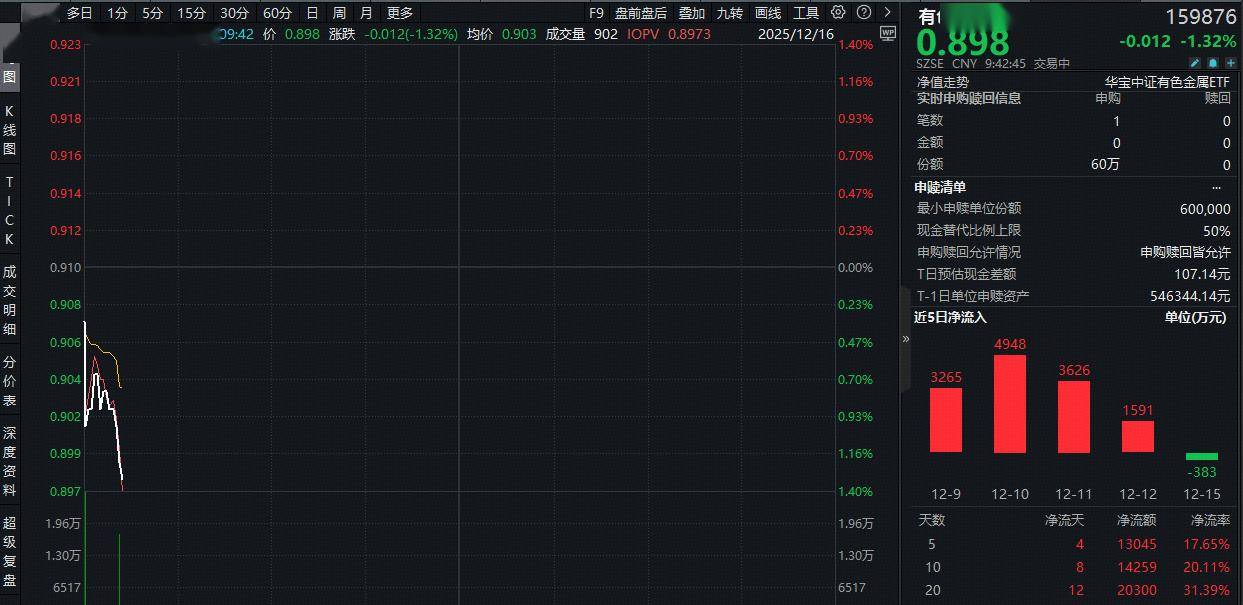
Core Viewpoint - The A-share market is experiencing a correction, with the major indices in the red, while the leading ETF in the non-ferrous metals sector has seen a decline of 1.32%. However, it has attracted a net inflow of 203 million yuan over the past 20 days, indicating positive sentiment towards the non-ferrous metals sector's future performance [1]. Group 1: Non-Ferrous Metals Sector Performance - The leading ETF in the non-ferrous metals sector (159876) has seen a price drop of 1.32% in the market, reflecting a broader market correction [1]. - Notable stocks within the ETF include Xiamen Tungsten, Luoyang Molybdenum, and Jiangxi Copper, which have shown gains, while companies like Western Superconducting and Chuangjiang New Material have experienced declines exceeding 4% [1]. Group 2: Investment Sentiment and Market Analysis - Analysts suggest that the positive investment sentiment in the non-ferrous metals sector is driven by China's ambition to transition from a manufacturing power to a manufacturing stronghold, with non-ferrous companies emerging as key players [2]. - China is the world's largest producer and consumer of gold, holding an 11% share of global gold production, with leading companies like Zijin Mining and Shandong Gold forming a competitive industry structure [2]. - In copper, Chinese companies have established a complete industrial chain, with a projected refined copper output of 13.64 million tons in 2024, accounting for 50% of global production [3]. - The aluminum sector benefits from low-cost electricity and a complete industrial chain, with China's electrolytic aluminum capacity reaching 44 million tons, representing 57% of global supply [3]. Group 3: Future Outlook - Institutions generally expect the non-ferrous metals sector to continue its bullish trend, with firms like Zhongtai Securities and CITIC Securities expressing optimism about the ongoing bull market in non-ferrous metals [3]. - The non-ferrous metals ETF (159876) and its associated funds provide comprehensive coverage across various metals, allowing for risk diversification and making it suitable for inclusion in investment portfolios [4].


中国为何会迎来“有色牛市”?有色企业顺势突围!有色龙头ETF(159876)近20日狂揽2亿元
Xin Lang Cai Jing· 2025-12-16 01:59
Core Viewpoint - The market is currently experiencing a consolidation phase, with the A-share indices showing a downward trend. However, there is significant capital inflow into the non-ferrous metals sector, indicating positive sentiment towards its future performance [1][8]. Group 1: Market Performance - The non-ferrous metals ETF (159876) has seen a price drop of 1.32% in the market, but it has attracted 203 million yuan in capital over the past 20 days, reflecting investor confidence in the sector [1][8]. - Leading stocks such as Xiamen Tungsten, Luoyang Molybdenum, and Jiangxi Copper have shown positive performance, while companies like Western Superconducting and Chuangjiang New Material have experienced declines exceeding 4% [1][8]. Group 2: Sector Analysis - Analysts attribute the active investment in the non-ferrous metals sector to China's ambition to transition from a manufacturing power to a manufacturing stronghold, with non-ferrous companies emerging as successful players in this landscape [3][4]. - In gold, China holds an 11% share of global gold production, with leading companies like Zijin Mining and Shandong Gold forming a competitive industry structure [3][10]. - For copper, China's refined copper production is projected to reach 13.64 million tons in 2024, accounting for 50% of global output, with a CR5 capacity concentration of 58% [3][10]. - In aluminum, China dominates the global market with 4.4 million tons of electrolytic aluminum capacity, representing 57% of global supply, and the top seven Chinese companies account for 37% of global production [3][10]. Group 3: Future Outlook - Industry experts believe that the non-ferrous metals sector is likely to continue its bullish trend, with institutions like Zhongtai Securities and CITIC Securities expressing optimism about the ongoing commodity investment enthusiasm [4][10]. - The non-ferrous metals ETF and its associated funds provide comprehensive coverage across various metals, allowing for risk diversification and making them suitable for investment portfolios [5][11].
11月经济数据增长继续放缓,股市跟随调整
Dong Zheng Qi Huo· 2025-12-16 01:17
1. Report Industry Investment Ratings No relevant content provided. 2. Core Views of the Report - The economic data growth in November continued to slow down, and the stock market adjusted accordingly. Weak economic data may prompt the acceleration of policy introduction, and attention should be paid to policy changes [2][23]. - The gold price fluctuated slightly and rose, approaching the previous high, with increased intraday volatility. The market is concerned about the upcoming US November non - farm payroll data, and the interest rate cut expectation is fully priced. The overall tone of the Fed officials' speeches is neutral [15]. - The US stock market is expected to fluctuate at a high level in the short term, with internal differences among Fed officials and concerns about the Fed's independence [21]. - The bond market is dominated by institutional behavior, and it is recommended to focus on the right - side long - buying opportunities [28]. - For various commodities, different trends and investment suggestions are presented based on their respective fundamentals, such as the supply and demand situation, production data, and policy factors [32][41][48]. 3. Summary by Directory 3.1 Financial News and Comments 3.1.1 Macro Strategy (Gold) - Trump believes the peace agreement is closer than ever. Gold price fluctuated slightly up, approaching the previous high, with increased intraday volatility. The market focuses on the US November non - farm payroll data, and the interest rate cut expectation is fully priced. Fed officials' speeches are neutral. It is not recommended to chase the high [14][15][16]. 3.1.2 Macro Strategy (US Stock Index Futures) - There are variables in the selection of the new Fed chairman, and internal differences among Fed officials are large. The US stock market is expected to fluctuate at a high level in the short term [17][21]. 3.1.3 Macro Strategy (Stock Index Futures) - The economic data in November continued to weaken, and the stock market adjusted. High - valuation and high - expectation stocks face upward pressure. It is recommended to evenly allocate long positions in various stock indexes [22][23][24]. 3.1.4 Macro Strategy (Treasury Bond Futures) - The economic data in November was weak. The bond market decline was dominated by institutional behavior. It is recommended to focus on the right - side long - buying opportunities [25][27][28]. 3.2 Commodity News and Comments 3.2.1 Agricultural Products (Soybean Meal) - The inventory of soybean meal in oil mills decreased. NOPA's crushing data was lower than expected, and the CBOT soybean was weak. Brazilian exports increased, and the sowing was basically completed. It is recommended to continue to pay attention to China's soybean procurement, state reserve trends, and South American weather [29][32]. 3.2.2 Agricultural Products (Corn Starch) - The theoretical profit of starch enterprises remained in a good state, and the CS - C futures spread strengthened slightly. It is expected that the rice - flour spread will continue to fluctuate [33][34]. 3.2.3 Agricultural Products (Corn) - The spot price was generally stable, and the futures price first fluctuated narrowly and then dived. It is recommended to short 03 and 05 contracts on rallies in the short and medium term and pay attention to the long - buying opportunities for 07 and 09 contracts at low prices in the long term [35][36]. 3.2.4 Black Metals (Rebar/Hot - Rolled Coil) - The steel price fluctuated. The building materials demand was weak, but it was not far beyond expectations. The manufacturing demand remained resilient. It is recommended to treat the steel price with a fluctuating mindset [37][41][42]. 3.2.5 Black Metals (Coking Coal/Coke) - The coking coal price in the Linfen market was weakly stable. The supply decreased, and the demand was weak. It is necessary to pay attention to whether subsequent replenishment can support the market [43][44][45]. 3.2.6 Agricultural Products (Soybean Oil/Rapeseed Oil/Palm Oil) - The export of Malaysian palm oil from December 1 - 15 decreased. The supply pressure of palm oil was obvious. It is recommended to wait for the supply pressure to ease and then consider long - buying [46][47][48]. 3.2.7 Non - Ferrous Metals (Alumina) - A large - scale mining enterprise in Guinea will resume production. The downstream inventory is high, and the supply surplus pressure remains. It is recommended to wait and see [49][50]. 3.2.8 Non - Ferrous Metals (Polysilicon) - The polysilicon capacity integration and acquisition platform was officially launched. It is expected that the spot price is difficult to fall. It is recommended to pay attention to the long - buying opportunities after the futures price is at a discount to the spot price [52][54]. 3.2.9 Non - Ferrous Metals (Industrial Silicon) - The power price in Yunnan in 2026 was announced. The inventory increased slightly. It is recommended to pay attention to the short - selling opportunities on rallies [55][56][57]. 3.2.10 Non - Ferrous Metals (Lead) - The LME lead price and the Shanghai lead price fluctuated and declined. The social inventory increased slightly. It is recommended to short on rallies in the short term [58][59]. 3.2.11 Non - Ferrous Metals (Zinc) - The LME zinc price fluctuated and declined. The domestic zinc demand increased, and the inventory decreased. It is recommended to buy on pullbacks, hold long - spread positions, and maintain the long - domestic and short - overseas strategy [60][63]. 3.2.12 Non - Ferrous Metals (Nickel) - The supply surplus of nickel is expected to increase. The short - term disk is expected to be weak at a low level. It is not recommended to chase the short. It is necessary to pay attention to the supply changes in Indonesia [64][66]. 3.2.13 Non - Ferrous Metals (Lithium Carbonate) - The price of lithium iron phosphate increased. The supply may increase after the resumption of production, and the demand may decline in the off - season. It is recommended to buy on pullbacks in the long term [67][69]. 3.2.14 Non - Ferrous Metals (Copper) - The macro - mid - term support for copper remains, but the short - term expected difference is significant. The short - term spot premium is expected to be under pressure. It is recommended to wait and see in the short term and buy on pullbacks in the mid - term [70][72]. 3.2.15 Non - Ferrous Metals (Tin) - The inventory of tin increased at home and abroad. The supply increased, and the demand was weak. It is expected that the tin price will fluctuate at a high level in the short term [74][75]. 3.2.16 Energy Chemicals (Crude Oil) - The oil price continued to decline. The concern about oversupply depressed the oil price. It is expected to be weakly fluctuating in the short term [76][77]. 3.2.17 Energy Chemicals (Asphalt) - The refinery inventory of asphalt increased, and the social inventory decreased. The supply increased, and the demand weakened. It is expected to be weakly fluctuating in the short term [78][79][80]. 3.2.18 Energy Chemicals (Methanol) - Two methanol plants in Iran stopped production. The short - term opportunity for methanol is limited, and it is recommended to wait and see [80][81]. 3.2.19 Energy Chemicals (PTA) - The PTA spot market negotiation was average, and the basis was strong. The supply - demand pattern improved in the medium - and long - term. It is recommended to buy on pullbacks in the medium - term [82][83]. 3.2.20 Energy Chemicals (Urea) - The urea price fluctuated weakly. It is necessary to pay attention to the demand for spring plowing and the new export quota policy [86][87]. 3.2.21 Energy Chemicals (Styrene) - The inventory of pure benzene in East China ports was stable. The pure benzene was in a bottom - grinding stage. It is recommended to pay attention to the long - buying opportunities for far - month contracts on panic selling [88][90]. 3.2.22 Energy Chemicals (PVC) - The PVC price rebounded. The supply remained high, and the demand was weak. It is necessary to pay attention to the supply - demand changes in 2026 [91][92].
——2025年铜市场回顾与2026年展望:铜:金银牛市奏华音余韵未散铜声起
Fang Zheng Zhong Qi Qi Huo· 2025-12-15 05:23
1. Report's Industry Investment Rating No information provided in the given content. 2. Core Views of the Report - In 2025, copper was the most outstanding variety in the non - ferrous metal sector, with the best supply - demand fundamentals, the strongest financial attributes, and the smoothest upward logic. Its annual increase was the largest since 2009 [1]. - In 2026, copper is expected to be one of the strongest - performing commodities. The supply of copper concentrates will be tighter than in 2025, and the global copper supply - demand pattern will shift from a tight balance to a supply shortage. The copper - gold ratio has room for significant repair, and valuation repair may become the underlying driver of copper price increases in 2026. The expected trading range of the main Shanghai copper contract is 89,000 - 91,000 yuan/ton as the support and 130,000 - 140,000 yuan/ton as the resistance [2][3]. 3. Summary According to the Directory First Part: Long - term Copper Price Trend Analysis and 2025 Trend Review - **Copper Price Historical Trend Review**: From the 1990s to 2023, copper prices experienced five major upward cycles, mainly driven by factors such as economic growth, financial attributes, and supply - demand imbalances. Since 2024, the contradiction of tight global copper mine supply has been prominent, and in 2025, the structural contradiction of refined copper inventory dominated the copper price trend [13][14][19]. - **2025 Copper Price Trend Review**: In 2025, the copper price showed different trends in different stages. In the first quarter, it oscillated strongly; in April, it recovered after a decline; from May to August, it fluctuated at a high level; from September to December, it entered a second main upward wave and reached a new high. Supply - side disturbances and demand - side changes were the main driving factors [22][24][27]. Second Part: Domestic and Overseas Macroeconomic Influencing Factors - **Domestic Economic K - shaped Differentiation, New and Old Kinetic Energies at Two Extremes**: In 2025, China's economic growth kinetic energy shifted from investment to consumption and exports. Investment also shifted from traditional infrastructure and real estate to high - end manufacturing, digital economy, and new energy. The anti - involution policy in the third quarter boosted inflation to some extent. In 2026, China's economy will continue this transformation trend, and copper will benefit from strong demand in related fields [33][42][44]. - **The US Dollar Index Enters the Middle of the Downtrend, and the US Manufacturing Industry Enters the Expansion Cycle**: In the future, the US copper demand has great growth potential. The US manufacturing industry has been performing strongly, and the "Creation Mission" plan will increase copper demand. The US dollar index is expected to continue to decline in 2026, which will boost the copper price from a valuation perspective [56][57][72]. Third Part: Spot Premiums and Discounts No specific summary content provided in the text, only a figure about the seasonal trend of spot premiums and discounts is mentioned [75]. Fourth Part: Global Copper Supply Analysis - **Frequent Disturbances in Global Copper Mine Supply, Strong Constraints on Copper Concentrate Production**: In the long - term, global copper mines face problems such as slow production growth and declining grades. In 2025, supply disturbances increased, and the annual production growth rate was expected to be less than 2%. The global competition for copper resources is intensifying. In 2026, the supply of copper concentrates is expected to remain tight [78][79][95]. - **The Tight Supply of the Mining End Has Not Been Transmitted to the Smelting End, and China's Electrolytic Copper Production Has Reached Record Highs**: In 2025, although the supply of copper concentrates in China was tight and TC processing fees hit a record low, electrolytic copper production still increased significantly, mainly due to new capacity, high prices of by - products, and the substitution of scrap copper. In 2026, the supply of copper concentrates will still be tight, and China's electrolytic copper production is expected to remain at a high level but may slightly decline year - on - year [107][108][111]. - **The Spread between Refined and Scrap Copper Widens, and the Supply of Recycled Copper Resources Is Tight**: In 2025, the supply of scrap copper in China was tight, mainly due to concerns about tariffs on US scrap copper imports and policy impacts on recycled copper rod enterprises. In 2026, the situation of tight scrap copper supply may continue [123][124][127]. - **The Willingness to Export Electrolytic Copper Has Significantly Increased, and Imports Have Decreased**: In 2025, affected by the expected US tariff on copper imports, the export willingness of electrolytic copper in China increased, and imports decreased. The demand for copper concentrate imports increased [132][133][134]. Fifth Part: Global Inventory Structural Contradictions Are Prominent Since 2024, the impact of the global copper inventory structure on the price has been increasing. In 2025, the total inventory of the three major exchanges increased, but the COMEX inventory increased significantly, while the Shanghai and London inventories were maintained at low levels. In 2026, the structural contradiction of global copper inventory is expected to remain difficult to resolve [141][142][143]. Sixth Part: Copper Demand Analysis - **China's Copper Product Output Reached a Record High, and the Output Growth Rates of Refined Copper Rods and Copper Foil Were Obvious**: In 2025, China's copper product output reached a record high, with the output of refined copper rods and copper foil growing rapidly. In 2026, the output growth rate of refined copper rods is expected to increase, while the output of copper tubes and copper rods may decline, and the demand for copper foil is expected to continue to grow at a high rate [149][150][151]. - **Power Grid and New Energy Demand Are Strong, and Real Estate Demand Continues to Be Weak**: In 2025, power grid investment increased, while real estate investment declined, and the demand for copper in the home appliance sector weakened. In 2026, power grid investment is expected to achieve double - digit growth, while real estate and home appliance demand are expected to have limited improvement [169][170][171]. - **New Energy and AI Fields Are Expected to Be Important Sources of Future Copper Demand Increases**: In 2025, the copper consumption in the new energy industry increased. In the future, the new energy vehicle market is expected to maintain a growth rate of over 20%, and the copper demand in the AI field is expected to increase explosively. By 2030, the combined copper demand in the new energy and AI fields is expected to account for 22% of the total demand [181][182][185]. Seventh Part: Arbitrage Analysis In 2025, there were differences in the price increases of major global copper markets in the first half of the year. The copper - to - zinc ratio continued to rise. In 2026, the copper - to - zinc ratio is expected to continue to increase, and the copper - to - London ratio still has room to decline [202][204]. Eighth Part: Position Analysis In 2025, the net long positions in the COMEX copper futures and options market increased significantly, and the long positions of LME copper investment funds also increased. The investment funds had an obvious impact on the copper price [210]. Ninth Part: Seasonal Analysis Copper prices tend to perform well in January, March, October, November, and December, mainly due to demand - side factors such as policy support and seasonal demand peaks [215]. Tenth Part: Copper Options Market Analysis In 2025, the implied volatility of copper options showed an upward trend, and the option market was bullish on copper prices. In 2026, the implied volatility center of copper is expected to move up, which is beneficial to option buyers [218]. Eleventh Part: Copper Supply - Demand Balance Sheet In 2025, the global copper market's supply - surplus situation improved. In 2026, the global copper market is expected to shift from a supply surplus to a supply shortage, with an expected shortage of 150,000 tons [226]. Twelfth Part: Technical Trend Analysis From a technical perspective, copper has broken through the nearly 20 - year oscillation range since 2006, and the future upward space is promising [232]. Thirteenth Part: Full - text Summary and Operational Suggestions In 2026, copper is expected to be one of the strongest - performing commodities. The supply - demand pattern will shift to a shortage. The recommended operations are for downstream demanders to conduct long - hedging in far - month contracts, for spot holders to hold and wait for price increases, and for option buyers to consider buying call options [235][236]. Fourteenth Part: Related Stocks The report lists the performance of some copper - related stocks in 2025, including their year - to - date price increases and current prices [237].

经济工作会议解读开局年的新思路
2025-12-15 01:55
Summary of Key Points from the Conference Call Industry Overview - The focus of the 2026 economic work is on "qualitative effective improvement" through optimizing fiscal expenditure and income structure, deepening industrial policy, and enhancing monetary policy coordination, laying the foundation for the 14th Five-Year Plan [1][2] - The capital market is expected to benefit from qualitative improvements, with profit growth driving market development, particularly in the midstream manufacturing sector [1][6] - Key sectors to watch include chemicals, new energy chains, real estate chains, and healthcare chains, as well as the potential for service consumption growth [1][6] Core Insights and Arguments - The economic policy for 2026 emphasizes a combination of cross-cycle and counter-cyclical measures, focusing on qualitative improvements rather than quantitative growth, differing significantly from the 2024 approach [2][3] - The real estate market is expected to stabilize through risk mitigation measures, encouraging the acquisition of existing properties for affordable housing construction [4][14] - The automotive industry anticipates a flat or slightly positive growth in domestic insurance demand for 2026, supported by trade-in and scrappage policies [11][12] - The metal sector is projected to benefit from domestic demand-driven economic models, with a focus on aluminum, copper, and gold prices due to supportive macro policies [9][10] Additional Important Insights - The manufacturing sector is expected to see significant AI integration, enhancing production efficiency and driving industrial upgrades [17][18] - The semiconductor equipment, liquid cooling equipment, and power facility sectors are anticipated to enter a phase of order and revenue realization in 2026 [18] - The AI application landscape is set for substantial growth, particularly in robotics and smart hardware, with major companies planning product launches [19] - The real estate market's inventory is expected to decrease significantly, improving fundamentals and benefiting companies focused on improving housing supply [16] - The non-banking financial sector is encouraged to enhance capital market reforms, with a focus on improving the quality of small financial institutions [27][28] Recommendations for Investment - In the automotive sector, companies with high overseas exposure and strong positions in AI and robotics, such as Geely, Xpeng, and BYD, are recommended [13] - For the metal sector, companies like China Aluminum, China Nonferrous Mining, and Wugang Resources are highlighted due to their potential in aluminum and copper markets [9][10] - In the real estate sector, firms focusing on improving housing supply in core cities are expected to benefit from supportive policies [14][16] - In the semiconductor and equipment sectors, companies involved in AI infrastructure and related technologies are recommended for investment [17][18]
美国铜期货交易价格屡创新高,机构看好大宗铜趋势走强(附概念股)
Zhi Tong Cai Jing· 2025-12-15 01:37
智通财经获悉,随着美国铜期货交易价格屡创新高,近年来长期低迷的欧洲铜类矿业股即将为自2016年 以来的最佳年度画上圆满句号。对全球股票市场的铜类股票多头势力而言,下一年能否继续强劲上涨且 再度创下2016年之后的最佳年份,可能取决于美国铜期货价格是否能不断刷新历史高位以及LME铜价 能否在2026年持续上涨至突破历史最高点位。 来自花旗集团(Citigroup Inc.)的矿业分析师们表示,大宗商品贸易领军者嘉能可(Glencore Plc)是他们对 2026年的首选股票标的,并预计近期涨势强劲的该股在未来12个月该股将上涨约15%,主要因为该公司 正努力提升铜产量。 铜矿系列有色金属港股: 铜矿:洛阳钼业(03993)、紫金矿业(02899)、五矿资源(01208)、江西铜业(00358)、中国有色 矿业(01258)、中国中冶(01618)等; 覆铜板:建滔积层板(01888)、建滔集团(00148) 股票频道更多独家策划、专家专栏,免费查阅>> 责任编辑:栎树 在Oddo BHF看来,全球矿业巨头力拓集团(Rio Tinto Group)在铜业务方面拥有"非常有吸引力的发展路 线图",并且随着其位于几内 ...
美国铜期货交易价格屡创新高 机构看好大宗铜趋势走强(附概念股)
Zhi Tong Cai Jing· 2025-12-15 01:31
Group 1 - The article highlights that U.S. copper futures prices are reaching new highs, which may lead to the best annual performance for European copper mining stocks since 2016 [1] - Citigroup analysts favor Glencore Plc as their top stock pick for 2026, expecting a 15% increase in the stock price over the next 12 months due to the company's efforts to boost copper production [1] - Oddo BHF sees Rio Tinto Group as having an attractive development roadmap in its copper business, particularly with the ramp-up of its Simandou project in Guinea, which should help increase iron ore production [1] Group 2 - Oddo mining analyst Maxime Kogge maintains a bullish outlook on mining stocks for next year, but warns that a significant slowdown in the Asian economy could negatively impact market sentiment [2] - Citic Construction's report indicates that gold and silver performed strongly last week, while other risk assets were weaker, suggesting a strong outlook for precious metals in 2025 [2] - The report outlines that the precious metals market in 2025 could be influenced by various factors, including tax changes and global economic concerns, with copper expected to be the next major commodity after gold and silver [2] Group 3 - The article lists several copper mining companies in the Hong Kong stock market, including Luoyang Molybdenum (603993), Zijin Mining (601899), and Jiangxi Copper (600362) [3] - It also mentions companies involved in copper-clad laminates, such as Kintor Group (01888) and Kintor Holdings (00148) [3]
港股概念追踪|美国铜期货交易价格屡创新高 机构看好大宗铜趋势走强(附概念股)
智通财经网· 2025-12-15 00:36
Group 1 - The core viewpoint is that European copper mining stocks are poised for their best annual performance since 2016, driven by rising U.S. copper futures prices and the potential for continued growth in 2026 [1] - Citigroup analysts favor Glencore Plc as their top stock pick for 2026, expecting a 15% increase in the stock price over the next 12 months due to the company's efforts to boost copper production [1] - Oddo BHF highlights Rio Tinto Group's attractive development roadmap in copper, particularly with the ramp-up of its Simandou project in Guinea, which is expected to enhance iron ore production [1] Group 2 - Oddo mining analyst Maxime Kogge maintains a bullish outlook on mining stocks for next year, emphasizing that a significant slowdown in the Asian economy could negatively impact market sentiment [2] - Citic Construction's report indicates that gold and silver performed strongly last week, while other risk assets were weaker, with precious metals expected to dominate the market in 2025 [2] - The report outlines three phases for precious metals in 2025, influenced by factors such as tariffs and Federal Reserve policies, suggesting that copper will be the next major commodity to watch after gold and silver [2] Group 3 - Key copper mining stocks in the Hong Kong market include Luoyang Molybdenum (03993), Zijin Mining (02899), Minmetals Resources (01208), Jiangxi Copper (00358), China Nonferrous Mining (01258), and China Metallurgical Group (01618) [3] - Key players in the copper-clad board sector include Kingboard Laminates (01888) and Kingboard Chemical Holdings (00148) [3]



有色金属大宗商品周报(2025/12/8-2025/12/12):美联储如期降息25BP,铜价上行-20251214
Hua Yuan Zheng Quan· 2025-12-14 04:22
Investment Rating - The investment rating for the non-ferrous metals industry is "Positive" (maintained) [4] Core Views - The Federal Reserve's decision to lower interest rates by 25 basis points has led to an increase in copper prices. The week saw fluctuations in copper prices with LME copper up by 1.54%, SHFE copper up by 1.40%, and NY copper down by 1.75%. The overall copper inventory has slightly increased, indicating a potential shift in supply-demand dynamics towards a shortage in the medium to long term [5][25] - Aluminum prices are expected to rise due to inventory depletion, despite a recent drop in alumina prices. The overall aluminum inventory has decreased, suggesting a tightening supply [5][36] - Lithium demand remains strong, with lithium salt inventories continuing to decline, indicating a potential upward price trend driven by demand [5][79] - Cobalt prices are expected to continue rising due to a tight supply of raw materials, despite recent fluctuations in prices [5][92] Summary by Sections 1. Industry Overview - The Federal Reserve lowered the interest rate by 25 basis points, aligning with expectations. Initial jobless claims in the U.S. exceeded expectations, indicating potential economic concerns [9][10] 2. Market Performance - The overall performance of the non-ferrous metals sector showed a decline, with the Shenwan non-ferrous index down by 0.47%, underperforming the Shanghai Composite Index by 0.13 percentage points [11][12] 3. Valuation Changes - The PE_TTM for the Shenwan non-ferrous sector is 26.23, with a decrease of 0.19 from the previous week. The PB_LF is 3.24, also showing a slight decrease [20][23] 4. Industrial Metals - Copper prices have shown an upward trend, with LME copper prices increasing by 1.54% and SHFE copper prices by 1.40%. Inventory levels have also seen a slight increase [25][36] - Aluminum prices are under pressure from rising inventories of alumina, while aluminum prices remain high due to inventory depletion [36][50] - Lead and zinc prices have shown mixed performance, with lead prices declining and zinc prices increasing [50][62] 5. Energy Metals - Lithium prices have increased, with lithium carbonate reaching 94,500 yuan per ton, indicating a strong demand outlook [79][86] - Cobalt prices have also risen, with MB cobalt increasing to 24.33 USD per pound, reflecting ongoing supply constraints [92][97]
有色金属周报20251213:国内外财政+货币共振,金属价格继续上行-20251213
Guolian Minsheng Securities· 2025-12-13 14:33
Investment Rating - The report maintains a "Buy" rating for all key companies listed, including Zijin Mining, Luoyang Molybdenum, and Huayou Cobalt [2][4]. Core Views - The report highlights that the metal prices are expected to continue rising due to the resonance of domestic and foreign fiscal and monetary policies, with a focus on the upcoming economic growth under the "14th Five-Year Plan" [8][21]. - The report emphasizes the strong demand in the lithium battery sector and the ongoing supply constraints in cobalt, indicating a bullish outlook for energy metals [8][83]. Summary by Sections Industry and Stock Performance - The report notes a decline in the Shanghai Composite Index by 0.34% and a 1.10% drop in the SW Nonferrous Index during the week [8]. - Key stocks in the nonferrous metal sector showed varied performance, with significant recommendations for companies like Zijin Mining and Luoyang Molybdenum [2][11]. Base Metals - Aluminum prices decreased by 0.88% to $2875 per ton, while copper prices fell by 0.96% to $11552.5 per ton, with zinc prices increasing by 1.31% to $3139 per ton [12][21]. - The report indicates that the domestic aluminum production capacity is stable at 44.39 million tons, with a slight increase in operational capacity due to high profits [21][23]. Precious Metals - Gold prices increased by 2.42% to $4329.80 per ounce, and silver prices rose by 5.59% to $62.09 per ounce, driven by the Federal Reserve's interest rate cuts [12][68]. - The report suggests a bullish outlook for gold and silver prices, supported by central bank purchases and weakening dollar credit [68][69]. Energy Metals - The lithium market is experiencing stable growth in supply, while demand from the energy storage sector continues to rise, leading to a positive outlook for lithium prices [8][83]. - Cobalt supply remains tight, with the Congo's cobalt export quotas expected to impact the market dynamics positively [8][83]. Other Minor Metals - The report discusses the fluctuations in prices for minor metals, including molybdenum and tungsten, with significant price increases noted for tungsten [15][83]. - The overall sentiment in the minor metals market remains cautious, with a focus on supply-demand dynamics and policy changes [55][85].



