三星

Search documents
“非洲手机之王”传音即将退位? 利润腰斩!
Xin Lang Ke Ji· 2026-02-05 02:46
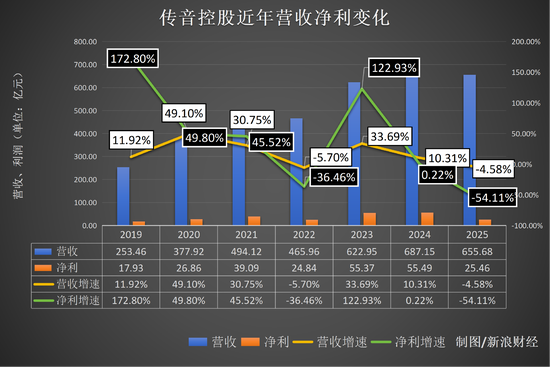
Core Viewpoint - Transsion Holdings is expected to experience a decline in both revenue and net profit in 2025, with net profit projected to be halved, marking the worst performance since its listing [1][4][2]. Financial Performance - The company anticipates a revenue of approximately 65.568 billion yuan in 2025, a decrease of about 31.47 billion yuan or 4.58% year-on-year [2]. - The net profit is expected to be around 2.546 billion yuan, down by approximately 30.03 billion yuan or 54.11% compared to the previous year [2][4]. Market Competition - Transsion's market share is under pressure due to intensified competition in key markets like Africa and South Asia, with competitors such as Xiaomi and Honor showing significant growth rates of 34% and 158% respectively [1][7]. - Despite maintaining the largest market share in Africa, Transsion's growth rate of 25% is being outpaced by its competitors [7]. Cost and Pricing Issues - The company cites rising storage prices as a significant factor affecting its cost and gross margin, with the average price of its smartphones being only 332.1 yuan and feature phones at 50.1 yuan [1][8]. - The global storage market has seen prices increase by over 40%, impacting the overall cost structure for smartphone manufacturers [6][7]. Diversification Efforts - To mitigate risks, Transsion is exploring new business areas such as mobility and energy storage, although these new ventures currently contribute only about 8.8% to total revenue [11][13]. - The company has established a mobility division and is expanding into electric two-wheelers and energy storage products, but these initiatives have yet to significantly impact overall revenue [11][12]. Historical Context - Since its listing on the Sci-Tech Innovation Board in 2019, Transsion had previously maintained strong growth until a decline in 2022, attributed to global macroeconomic factors and increased R&D expenses [4][5]. - The current forecast for 2025 represents a continuation of this downward trend, with net profit expected to be the lowest since the company's IPO [4][5].


高通电话会:AI数据中心“抽干”DRAM产能,内存短缺将决定今年手机市场规模
Hua Er Jie Jian Wen· 2026-02-05 01:45
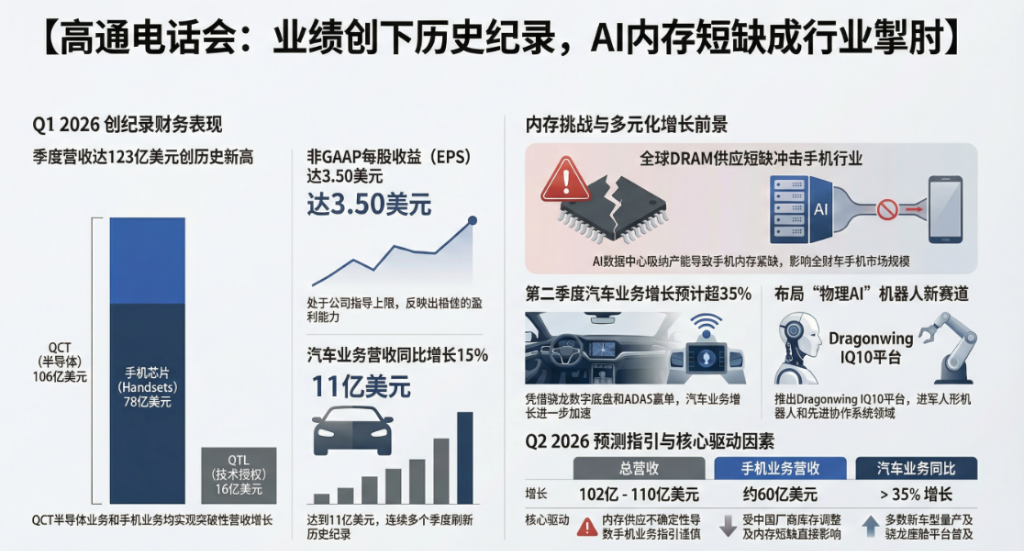
Core Insights - Qualcomm reported record earnings for Q1 FY2026, with revenue reaching $12.3 billion and non-GAAP EPS at $3.50, driven by strong performance in its QCT (chip business) segment, which generated $10.6 billion in revenue [16][24] - The company anticipates a decline in mobile chip revenue to approximately $6 billion in Q2 due to supply chain constraints, particularly in DRAM availability, which is expected to impact the overall mobile market size for the fiscal year [4][26] Financial Performance - Qualcomm's QCT segment achieved record revenue of $10.6 billion, with mobile revenue hitting $7.8 billion, benefiting from the launch of flagship smartphones [16][24] - The automotive business also set a record with $1.1 billion in revenue, reflecting a 15% year-over-year increase [16][24] - The company returned $3.6 billion to shareholders, including $2.6 billion in stock buybacks and $949 million in dividends [24] Supply Chain Challenges - Qualcomm's CEO highlighted a significant memory shortage affecting the mobile industry, primarily due to memory suppliers reallocating production capacity to HBM (High Bandwidth Memory) for AI data centers, leading to increased prices and supply constraints [4][16] - The company noted that several mobile OEMs are adopting a cautious approach, reducing chip inventory in response to the constrained supply environment [4][26] Market Position and Strategy - Despite supply challenges, Qualcomm maintains a strong position in the high-end smartphone market, expecting to retain approximately 75% market share with Samsung's upcoming flagship devices [5][17] - The company is also focusing on the emerging AI smartphone market, with ByteDance's launch of an AI smartphone being a significant milestone [5][18] Diversification and Growth Areas - Qualcomm's automotive business is projected to grow over 35% in Q2, supported by a long-term supply agreement with Volkswagen Group, which includes brands like Audi and Porsche [6][20] - In the PC sector, Qualcomm is advancing its Windows on ARM ecosystem, with the Snapdragon X2 Plus platform already featured in 18 new PCs showcased at CES [8][19] - The company is making significant strides in the robotics sector with the launch of the Dragonwing IQ10 series chips, aimed at accelerating the commercialization of various robotic applications [9][21] Data Center Ambitions - Qualcomm reiterated its commitment to the data center market, focusing on specialized inference chips for disaggregated data centers, with expectations of generating substantial revenue by 2027 [10][12][22] - The company is executing a dual strategy involving Oryon CPUs and RISC-V architecture, bolstered by acquisitions to enhance its data center capabilities [11][22]

2纳米被疯抢的原因
半导体行业观察· 2026-02-05 01:08
Core Insights - The introduction of 2nm and more advanced process nodes will require new power consumption and thermal management methods, while also providing greater design flexibility and more options for performance enhancement and cost optimization [2] - The semiconductor market is evolving, with a shift from traditional low-power chips for mobile devices and high-performance chips for servers to more specialized applications driven by artificial intelligence [2][3] - The transition to multi-die components allows for prioritization of different processors and functionalities, simplifying emergency plans during component shortages [2][3] Group 1: Design and Manufacturing Challenges - The complexity of integrating various components in chipsets is significant, as designing and manufacturing chipsets is easier than integrating them [4] - A hybrid design approach allows for the combination of different standard cells, enhancing flexibility and performance while managing power consumption [5] - The interconnect technology between chips has improved, allowing for the mixing of different process nodes, which helps mitigate cost and yield challenges [6] Group 2: Performance and Power Management - The performance and power advantages of new nodes are not absolute; the real value lies in how close the system can approach the physical limits of silicon [7] - The economic benefits of 2nm technology depend on intelligent management of the power band, as excessive power bands can lead to wasted investments [7] - The trend of increasing power density with each new node presents challenges in thermal management, necessitating advanced cooling solutions [11][12] Group 3: Market Dynamics and Future Directions - The reasons for upgrading to higher process nodes are no longer based on a single factor but vary by market segment and workload [15] - The integration of multiple nodes in a single design is becoming more common, with new PPA/C trade-offs to balance priorities in large systems [15] - The semiconductor industry is at a turning point, requiring continuous management of correctness rather than assuming everything is normal at acceptance [10]


国信证券晨会纪要-20260205
Guoxin Securities· 2026-02-05 01:06
Macro and Strategy - The report discusses the "anti-involution" policy aimed at addressing overcapacity and disorderly competition, marking a significant shift in the construction of a unified national market [6][8] - The policy evolution is divided into three phases, with the current phase focusing on systematic implementation to eliminate local protectionism and market segmentation [6][7] - The report emphasizes the need for administrative coordination to break down local protection and industry barriers, while also advocating for a long-term focus on reasonable profit margins for enterprises [8][9] Industry and Company - The electronic industry report highlights the rapid emergence of AI applications, with a focus on the computing power chain becoming a central investment theme [16] - The automotive industry report notes that the penetration rate of NOA (Navigation on Autopilot) in urban areas has exceeded 20%, with significant investments in autonomous driving technologies [23][24] - The agricultural sector report indicates a rise in potassium fertilizer contract prices and increased demand for phosphate rock driven by energy storage needs [3] - The real estate sector in Hong Kong shows signs of recovery, with a 21% increase in private residential transaction volume in 2025, marking the second-highest level since 2013 [33][34] - The report on public REITs indicates a continued divergence in performance across different asset types, with a strong long-term allocation value expected as the market matures [10][11] Investment Strategies - The report suggests focusing on sectors benefiting from policy support and strong fundamentals, such as affordable housing and new infrastructure related to digital economy upgrades [10][11] - In the automotive sector, recommendations include investing in companies with strong new product cycles and those involved in intelligent driving technologies [26][29] - The report advises on maintaining a balanced asset allocation strategy, particularly in light of potential market volatility and economic recovery signals [12][13]
深度解读 | 索尼与TCL的战略合作布局
Canalys· 2026-02-05 01:03
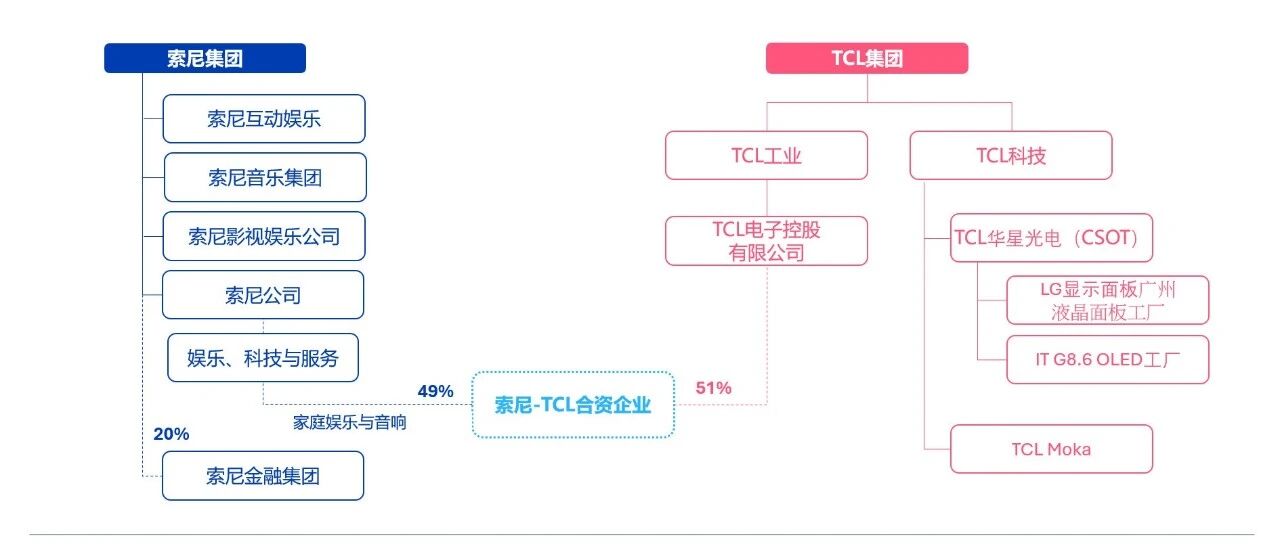
Group 1: Sony's Strategic Decisions - Sony Group made a strategic decision to partially spin off its financial business for an IPO in October 2025, aiming to enhance capital efficiency and focus on content-driven core businesses [1] - The spin-off allows the new Sony Financial Group to continue using the "Sony" brand while Sony retains approximately 20% equity to share in the business's profits and long-term value [1] - The Home Entertainment & Sound business, part of the Entertainment, Technology & Services (ETS) segment, has faced operational losses and requires structural adjustments to improve profitability and optimize resource allocation [1] Group 2: Challenges in Sony's TV Business - Sony's TV business sustainability is increasingly challenged by fierce price competition from Chinese manufacturers and the dominance of Samsung and LG in the high-end market [2] - Declining production volumes have led to increased operational costs and inventory management pressures, creating uncertainty for future business development [2] - Selling the TV business or shifting to a licensing model is not feasible as it could harm Sony's overall brand image [2] Group 3: Joint Venture with TCL - Sony chose to establish a joint venture with TCL to retain control over the Sony and Bravia brands while alleviating financial pressure from the loss-making TV business [2] - Sony will hold a 49% stake in the joint venture, allowing it to benefit from the partnership while focusing on R&D and product quality [2] Group 4: TCL's Position and Strategy - TCL has rapidly developed its TV business, solidifying its position as the world's second-largest TV manufacturer, benefiting from a vertically integrated business structure [3] - The company faces challenges as it diversifies into platform advertising and e-commerce, with traditional retailers entering the TV hardware market [3] - TCL's core value lies in its dual pillars: TCL Technology and TCL Industry, establishing it as a global high-tech leader in the display and consumer electronics market [3] Group 5: Technological Advancements and Collaboration - TCL needs to expand its high-end panel supply to advance its high-tech strategy, with recent investments in IT OLED technology potentially benefiting from collaboration with Sony [4] - The joint venture can leverage TCL's manufacturing capabilities to improve Sony's product cost structure while maintaining strict quality standards [4] - This collaboration aims to enhance TCL's technological capabilities and align with Sony's high-end brand standards for greater growth potential [4] Group 6: Market Dynamics and Future Projections - Sony's annual TV shipment has declined from a peak of 21.6 million units in 2010, projected to fall below 4 million units by 2025, while TCL's shipments are expected to exceed 30 million units [7] - Even combined, Sony and TCL's shipments will not surpass Samsung's leading global shipment volume by 2025 [7] - Sony's advanced XR backlight technology and expertise in OLED development may provide a competitive edge in the OLED TV market in the medium to long term [7]

微信屏蔽元宝红包链接;马斯克成全球首位身家超8000亿美元者;盖茨严词驳斥爱泼斯坦指控;iQOO15Ultra手机发布......
Sou Hu Cai Jing· 2026-02-05 00:45
Group 1 - Tencent's Yuanbao AI red envelope sharing has been changed to "password red envelope" after WeChat banned links related to it due to excessive marketing and inducement sharing behaviors [2] - Elon Musk becomes the world's first person with a net worth exceeding $800 billion, reaching $852 billion after SpaceX's acquisition of xAI, surpassing the second richest person, Larry Page, by $578 billion [3] - iQOO 15 Ultra smartphone launched with Snapdragon 8 Elite Gen5 processor, active cooling fan, and pressure-sensitive shoulder keys, starting at 5499 yuan [7] Group 2 - Xiaohongshu's valuation has soared to $50 billion, with a head fund reportedly selling part of its shares at this valuation [9] - Intel's CEO confirmed the appointment of a new chief architect for GPU development to meet the surging demand for AI data center chips, while also stating that the shortage of storage chips may last until 2028 [10] - BYD announced the launch of its first B-class pure electric SUV, the Song Ultra EV [11] Group 3 - Samsung and SK Hynix are expected to record their highest profit margins in a decade this year, with NAND products potentially reaching historical profitability levels [15] - The China Photovoltaic Industry Association responded to the "space photovoltaic" concept surge, stating that related technologies are still in the early stages of exploration and verification [16] - 360 million drivers in China have successfully obtained electronic driving licenses, accelerating the digitalization of traffic management [17] Group 4 - Ford and Geely are reportedly discussing cooperation to leverage Ford's production capacity and Geely's smart driving technology for mutual benefit [24] - Microsoft has promoted four sales executives to executive vice president to accelerate AI business growth, reallocating more computing resources to AI products [25] - AMD's CEO stated that despite rising memory prices potentially leading to a decline in the global PC market in 2026, the company will focus on the enterprise and high-end markets for continued growth [44]



“非洲手机之王”传音即将退位? 利润腰斩!50元手机扛不住存储涨价 | BUG
Xin Lang Cai Jing· 2026-02-05 00:36
Core Viewpoint - Transsion Holdings is expected to experience a decline in both revenue and net profit in 2025, with net profit halving, marking the worst performance since its listing [2][3][17]. Group 1: Financial Performance - The company forecasts a revenue of approximately 65.568 billion yuan for 2025, a decrease of about 3.147 billion yuan or 4.58% year-on-year [3][17]. - The expected net profit for 2025 is around 2.546 billion yuan, down by approximately 3.003 billion yuan or 54.11% compared to the previous year [3][17]. - In the first half of 2025, Transsion reported a revenue of 29.077 billion yuan, a decline of 15.86% year-on-year, and a net profit of 1.213 billion yuan, down 57.48% year-on-year [21]. Group 2: Market Challenges - The increase in storage prices has significantly impacted the company's cost and gross margin, with the average price of Transsion's smartphones at 332.1 yuan and feature phones at 50.1 yuan [2][24]. - Competition in key markets such as Africa and South Asia has intensified, with competitors like Xiaomi and Honor showing growth rates of 34% and 158% respectively, putting pressure on Transsion's market share [2][8][23]. - The global smartphone market is experiencing sluggish growth, with a projected 2% increase in shipments for 2025, which is a slowdown compared to 2024 [8][23]. Group 3: Strategic Responses - To mitigate risks, Transsion is diversifying into new businesses such as mobility and energy storage, although its mobile phone business still accounts for about 90% of total revenue [2][12][29]. - The company is exploring various directions for diversification, including electric two-wheelers and energy storage products, but these new ventures currently contribute a limited revenue share [10][27][28]. - Transsion aims to strengthen its local advantages in Africa, enhance its service and channel systems, and accelerate technological upgrades and product innovation to seek breakthroughs in the mid-to-high-end market [10][25][26].

从“猎奇”到“信赖”:折叠屏手机用户发展洞察报告
艾瑞咨询· 2026-02-05 00:00
Core Insights - The global foldable smartphone market is experiencing continuous growth, particularly in China, driven by technological advancements and an improved supply chain, leading to product diversification [1] - China has emerged as the main growth engine for the global foldable smartphone market, with Huawei maintaining a significant market share [1][18] - User willingness to purchase foldable smartphones is increasing, with higher expectations for product functionality and experience [1] Market Overview - The global smartphone market has transitioned into a saturated phase since 2017, with annual shipment volumes declining by approximately 2.52%, projected to reach 1.22 billion units by 2024 [2] - The foldable smartphone segment is seen as a strategic direction to overcome market growth bottlenecks, with expected high growth in shipments from 2022 to 2024 [5] Competitive Landscape - The foldable smartphone industry chain includes upstream raw material supply, midstream design and manufacturing, and downstream sales [7] - Chinese manufacturers, led by Huawei and Samsung, are driving the industry forward through strong technological capabilities and market influence [7][8] User Behavior and Preferences - The user demographic for foldable smartphones shows a preference among high-education individuals, with over 75% of users holding a bachelor's degree or higher [20] - The majority of users spend between 5,000 to 9,000 yuan on foldable smartphones, with Huawei being the most popular brand, accounting for 62.3% of usage [22] - Key reasons for purchasing foldable smartphones include a stronger sense of technology and innovation, with 44.7% of users citing this as a primary factor [24] Brand Recognition and Perception - Huawei leads in brand recognition across various metrics, significantly ahead of competitors like Samsung, Xiaomi, and OPPO [26] - In terms of brand image, Huawei excels in high-end perception, business appeal, and innovation, reinforcing its leadership in the foldable smartphone sector [28] User Satisfaction and Future Intentions - User satisfaction is highest for Huawei, indicating strong brand loyalty, followed by Xiaomi and Samsung [30] - Over 90% of consumers are considering purchasing a foldable smartphone for their next device, with a focus on reliability and battery life [41] Market Transition - The foldable smartphone market is transitioning from a niche segment to mainstream practicality, driven by hardware maturity and software ecosystem improvements [43] - The hardware is evolving from merely functional to providing a comprehensive user experience, with innovations in hinge and screen technology [45] - Consumers are shifting from "novelty" to "regular use," with 95.5% expressing willingness to switch to foldable smartphones in the future [47]

中信建投:出海红利与变革周期为家电板块两条投资主线
智通财经网· 2026-02-04 23:49
Core Viewpoint - The home appliance sector is expected to underperform the CSI 300 index in 2025 due to tariff increases, fluctuations in the trade-in policy, and high base expectations in the second half of the year. Long-term competitiveness will return to product innovation and efficiency advantages, with two main investment themes: overseas expansion as a key growth source and transformation dividends [1]. Group 1: Black Goods Market - Domestic demand is gradually under pressure, while Chinese companies accelerate overseas expansion and enhance their positions in high-end markets. The internal sales stimulus effect is weakening, and external sales expectations are improving. The overall shipment volume of the Chinese television market is projected to decline by 6.8% year-on-year in 2025, with retail sales expected to drop by about 10% [2]. - The "national subsidy" policy's continuation is uncertain, and if no alternative stimulus is provided, the shipment volume in 2026 may decline by over 10%. However, the upcoming sports events in 2026 are expected to boost overseas television demand, making overseas market expansion a priority for Chinese television companies [2]. Group 2: Market Share and Competition - TCL and Hisense have increased their domestic and international market shares, with both companies exceeding 13 million units in global shipments in the first half of 2025, achieving a global market share of over 14%. Hisense's domestic and overseas market shares are 21.1% and 12.7%, while TCL's are 18.9% and 13.8% respectively [3]. - The competitive landscape is shifting as Samsung's market share has decreased, providing Chinese brands with significant opportunities to capture market share. Hisense and TCL are expected to lead the global market within three years, with a focus on maintaining growth in global market share [3]. Group 3: High-End Market Trends - The high-end television market is experiencing a recovery, with global high-end television shipments and revenue increasing by 40% and 21% year-on-year respectively in Q2 2025. The average size of televisions shipped globally has also increased, indicating a trend towards larger screens [4]. - MiniLED technology is gaining traction in the high-end market, with its shipment volume and revenue growing by 101% and 66% year-on-year in Q2 2025, respectively. This trend is reducing the importance of OLED technology in the high-end segment, benefiting Chinese brands that promote MiniLED televisions [4]. Group 4: Profitability and Structural Upgrades - Chinese brands are capturing more high-end market share, with TCL's global shipments of televisions 65 inches and above increasing by 26.9% year-on-year in Q2 2025. The average size of TCL's global shipments has risen to 53.4 inches, with significant growth in quantum dot and MiniLED television shipments [5]. - The shift towards larger and higher-end televisions is a key factor in improving profitability for brands like Hisense and TCL, as they leverage their advantages in MiniLED technology and competitive pricing in the LCD segment [5].

被中国杀手锏打痛,特朗普开启120亿美元新计划,开启稀土争夺战
Sou Hu Cai Jing· 2026-02-04 20:49
Core Points - The "Treasury Plan" is a strategic mineral reserve project signed by President Trump, totaling $12 billion, aimed at establishing a strategic reserve of critical minerals for U.S. manufacturers to mitigate supply chain disruption risks, particularly in response to China's rare earth control during the 2025 U.S.-China trade conflict [1][3] Group 1: Plan Overview - The plan is financed by a $10 billion loan from the Export-Import Bank of the United States, along with approximately $2 billion in private capital, covering critical minerals such as rare earths, copper, and lithium [3] - The goal is to create a 60-day emergency mineral reserve, with participation from major companies like General Motors, Boeing, and Google [3] - The operational mechanism allows companies to withdraw minerals from the reserve at predetermined prices, helping them avoid price volatility without needing to stockpile [5] Group 2: Market Context - As of 2024, the U.S. is entirely reliant on imports for 12 critical minerals, with over 50% import reliance for an additional 29 minerals, highlighting vulnerabilities in the U.S. critical mineral supply chain [5] - The plan's funding structure indicates that the $10 billion loan is for 15 years, significantly larger than previous transactions by the Export-Import Bank [7] Group 3: Technical Challenges - The main challenges for the "Treasury Plan" include the need for technology and capacity expansion in rare earth separation and refining, where China currently holds a dominant position [9] - China accounts for over 90% of global rare earth refining capacity and holds 85% of patents in heavy rare earth separation technology [9] Group 4: Military and Industrial Implications - Rare earths are critical for military applications, with over 78% of materials used in U.S. military equipment sourced from China [11] - The 2025 export control measures by China on rare earths have significantly impacted U.S. industries, including automotive and high-tech sectors, leading to price surges in rare earth elements [11] Group 5: Broader Industry Movements - The U.S. government has been actively investing in domestic rare earth producers, with significant funding directed towards companies like Mountain Pass Materials and American Lithium [12] - The global distribution of rare earth resources is heavily skewed towards China, which holds about 23% of global reserves but supplies over 90% of the market [14][16]