奔驰

Search documents
四电机、主动悬架,盘点那些超豪华车型的技术
Zhong Guo Zhi Liang Xin Wen Wang· 2025-10-17 08:49
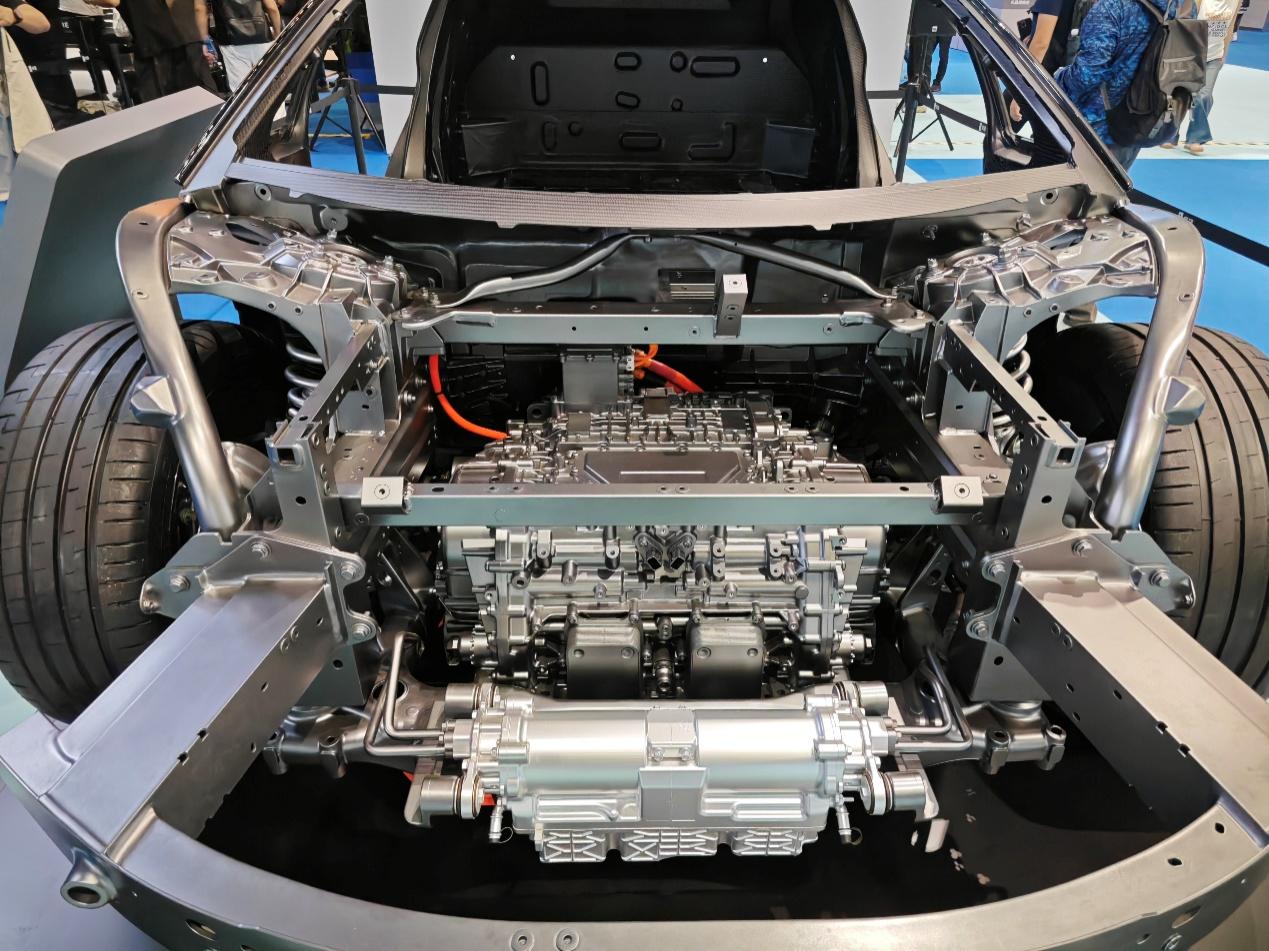
Group 1: Advanced Electric Drive Technologies - The current trend in high-end vehicles includes three and four motor distributed electric drive technologies, with models like Tengshi N9 and Xiaomi SU7 Ultra starting at approximately 400,000 yuan [2] - Two motors can achieve four-wheel drive, but adding more motors allows for better performance and control, as seen in models like BYD Yangwang U8 and Mercedes G580, which can perform precise maneuvers and rapid acceleration despite their weight [5][6] - The use of axial flux motors is emerging, offering higher power density and efficiency compared to traditional radial flux motors, as demonstrated in the AMG GT XX concept car [19][25] Group 2: Active Suspension Systems - Active suspension systems are primarily found in high-end models such as BYD Yangwang series and NIO ET9, with entry prices around 800,000 yuan, providing significant benefits in comfort and handling [6][12] - These systems can dynamically adjust suspension stiffness and height, enhancing ride comfort and vehicle stability during various driving conditions [8][10] - Advanced active suspensions can also adapt to different scenarios, such as raising for off-road clearance or lowering for improved aerodynamics at high speeds [12] Group 3: Aerodynamic Enhancements - Modern vehicles are increasingly incorporating aerodynamic features for improved performance and efficiency, such as active rear wings that provide significant downforce and braking assistance [13][15][16] - Active aerodynamic components, like adjustable wheel rims and air intakes, are designed to optimize cooling and reduce drag, thereby enhancing vehicle range and performance [18] Group 4: Innovative Engine Technologies - The FreeValve technology, which eliminates the camshaft in engines, allows for independent control of each valve, simplifying engine structure and improving efficiency [26][28][29] - This technology enables the engine to switch between different operating cycles seamlessly, optimizing performance based on driving conditions [29]

宝马、奥迪、奔驰等德系豪车,为啥卖不动了?
Xin Jing Bao· 2025-10-17 00:16
Core Insights - The sales performance of German luxury car brands in the Chinese market has significantly declined, with BMW, Mercedes-Benz, and Audi all reporting varying degrees of sales drops in 2023 [1][2][4]. Sales Performance - BMW's sales in China for Q3 2023 were 147,100 units, a slight decrease of 0.4% year-on-year, while the total for the first three quarters was 464,000 units, down 11.2% year-on-year, marking China as its only declining market globally [1]. - Mercedes-Benz reported Q3 sales of 125,000 units in China, a decline of 27%, and a total of 418,000 units for the first three quarters, down 18% year-on-year [2]. - Audi's sales in China for the first half of 2023 saw a decline of over 10%, although specific Q3 figures were not disclosed [2]. - Porsche faced a more severe challenge, with Q3 sales in China at 32,200 units, down 26% year-on-year [2]. Market Dynamics - The customer traffic in luxury car showrooms has decreased, with many potential buyers opting for domestic high-end brands instead of German luxury vehicles [1][2][3]. - Discounts on various models are significant, with some Audi models offering discounts up to 120,000 yuan and Mercedes-Benz models exceeding 100,000 yuan [2]. Competitive Landscape - Domestic brands are increasingly competing with German luxury cars across various price segments, with models from Tesla, NIO, and others gaining traction [4][5]. - The market share of German luxury brands has dropped from 18.4% in January to 14.3% in September 2023, indicating a significant loss in retail market share [5]. Electric Vehicle Transition - German luxury brands are lagging in electric vehicle (EV) sales, with models like BMW's iX3 and iX1 showing low monthly sales figures [6]. - Analysts highlight three main challenges for German luxury brands: the need for a stronger shift towards electric and smart vehicles, cautious consumer purchasing behavior, and the perception of poor value for luxury cars [6][7]. Strategic Adjustments - In response to the electric vehicle trend, German brands are adjusting their strategies, with Audi retracting its timeline for phasing out internal combustion engines and BMW reviving its range-extended hybrid technology [7]. - There is a focus on enhancing resource allocation efficiency in the Chinese market, including leveraging local supply chains and developing localized products [7].
降价减少、促销平缓 9月乘用车市场格局微变
Mei Ri Jing Ji Xin Wen· 2025-10-16 14:01
Core Insights - The Chinese automotive market experienced both month-on-month and year-on-year growth in September 2025, with retail sales reaching 2.241 million units, a 6.3% increase year-on-year and an 11.0% increase month-on-month [1] - The trend of "decreasing price competition and stable promotions" is emerging in the market, leading to a more stable automotive environment [1] - Domestic brands continue to outperform, while joint venture brands face challenges, with only a few exceptions showing positive performance [1] Domestic Brands Performance - In September, domestic brands achieved retail sales of 1.5 million units, marking a 13% year-on-year increase and a 12.9% month-on-month increase, capturing 66.9% of the domestic retail market share, up 3.6 percentage points year-on-year [2] - The penetration rate of new energy vehicles (NEVs) among domestic brands reached 78.1%, solidifying their position as a sales driver [2] - BYD remains a leader among domestic brands, although it experienced its first year-on-year decline in sales since March 2024, with September sales at 396,200 units, down 5.52% [2] Key Competitors in Domestic Market - Geely and Chery are actively increasing their market share in the NEV sector, with Geely reporting sales of 273,100 units in September, a 35.24% year-on-year increase [3] - Chery, which recently listed on the Hong Kong Stock Exchange, achieved sales of 255,600 units in September, up 8.90% year-on-year [3] - Other domestic brands like Changan and Great Wall also reported significant growth, with Changan's sales at 266,300 units (up 24.92% year-on-year) and Great Wall's at over 133,600 units (up 23.29% year-on-year) [3] Joint Venture Brands Performance - Joint venture brands saw a month-on-month sales increase but faced year-on-year declines, with mainstream joint venture brands retailing 490,000 units in September, down 6% year-on-year [4] - Luxury brands also experienced a year-on-year decline, with sales of 240,000 units in September, down 1% year-on-year [4] - Volkswagen's joint ventures showed mixed results, with SAIC Volkswagen achieving a record high of 94,100 units sold, while FAW-Volkswagen faced a similar decline as other mainstream joint ventures [4] Performance of Foreign Brands - Japanese brands held an 11.6% market share in September, down 1.1 percentage points year-on-year, with mixed performances among different brands [5] - American brands saw a slight increase in market share to 5.8%, with SAIC General reporting a remarkable year-on-year sales increase of over 124% [5]





德系豪车为啥不香了?在华销量不振,市场份额被蚕食
Xin Jing Bao· 2025-10-16 11:21
Core Insights - The sales of German luxury car brands in China have significantly declined, with BMW, Mercedes-Benz, and Audi all reporting varying degrees of sales drops in 2023 [2][4][6] - The market share of German luxury brands has been eroded by domestic competitors, particularly in the price range of 200,000 to 400,000 yuan, where brands like Tesla and NIO are gaining traction [4][5] - The shift towards electric and intelligent vehicles is still lagging for German luxury brands, with their electric models not achieving significant sales figures [6][7] Group 1: Sales Performance - BMW's sales in China for Q3 2023 were 147,100 units, a slight decrease of 0.4% year-on-year, while the total for the first three quarters was 464,000 units, down 11.2% [2] - Mercedes-Benz experienced a more severe decline, with Q3 sales of 125,000 units, down 27%, and a total of 418,000 units for the first three quarters, down 18% [2] - Porsche's sales in China for the first three quarters were 32,200 units, reflecting a 26% year-on-year decrease [2] Group 2: Market Dynamics - The retail market share of German brands dropped from 18.4% in January to 14.3% in September 2023, with luxury brand retail share at 10.8%, down 0.8 percentage points year-on-year [5] - Domestic brands are increasingly competing with German luxury cars across various price segments, leading to a notable shift in consumer preferences [4][5] Group 3: Electric and Intelligent Vehicle Transition - German luxury brands are facing challenges in the electric vehicle segment, with models like BMW's iX3 and iX1 showing low sales figures, maintaining around a thousand units per month [6] - Analysts suggest that the transition to electric and intelligent vehicles is crucial for German brands to remain competitive against new entrants in the luxury market [6][7] - Adjustments in electric vehicle strategies have been made, with brands like Audi and Mercedes-Benz revising their timelines for phasing out internal combustion engines [7]
9月车市格局微变:上汽夺得第一,新势力纯电车型销量占比超七成
Mei Ri Jing Ji Xin Wen· 2025-10-15 12:17
Core Insights - The automotive market in September experienced both month-on-month and year-on-year growth, with retail sales reaching 2.241 million units, a 6.3% increase year-on-year and an 11.0% increase month-on-month [1] - Domestic brands captured two-thirds of the market share, with retail sales of 1.5 million units, reflecting a 13% year-on-year increase and a 12.9% month-on-month increase [2] - New energy vehicles (NEVs) and exports significantly contributed to the growth of domestic brands, with NEV penetration among domestic brands reaching 78.1% [2] Domestic Brands Performance - Domestic brands achieved a retail market share of 66.9% in September, up 3.6 percentage points year-on-year, and a cumulative market share of 64.8% for the first nine months of the year, an increase of 5.9 percentage points [2] - BYD led the domestic brands but experienced its first year-on-year decline in sales since March 2024, with September sales at 396,200 units, down 5.52% [2][4] - Geely and Chery are gaining market share in the NEV sector, with Geely's sales reaching 273,100 units in September, a 35.24% year-on-year increase, and Chery's sales at 255,600 units, an 8.90% increase [5] Joint Venture and Luxury Brands - Joint venture brands faced challenges, with retail sales of 490,000 units in September, down 6% year-on-year, despite a 4% month-on-month increase [6] - Luxury brands saw a slight year-on-year decline, with retail sales of 240,000 units, down 1%, but a 16% month-on-month increase [6] - The market share of German brands decreased by 2.3 percentage points to 14.3% in September, indicating a shift towards domestic brands [6] New Energy Vehicle Market - The penetration rate of NEVs among domestic brands remains high at 70.1%, despite a slight year-on-year decline of 2.3 percentage points [2] - New energy vehicles accounted for 6.6% of joint venture brands and 40% of luxury brands in September [6] Emerging Players - New energy vehicle startups showed significant growth, with Leap Motor leading the segment with approximately 66,700 units delivered in September, a 97% year-on-year increase [8]
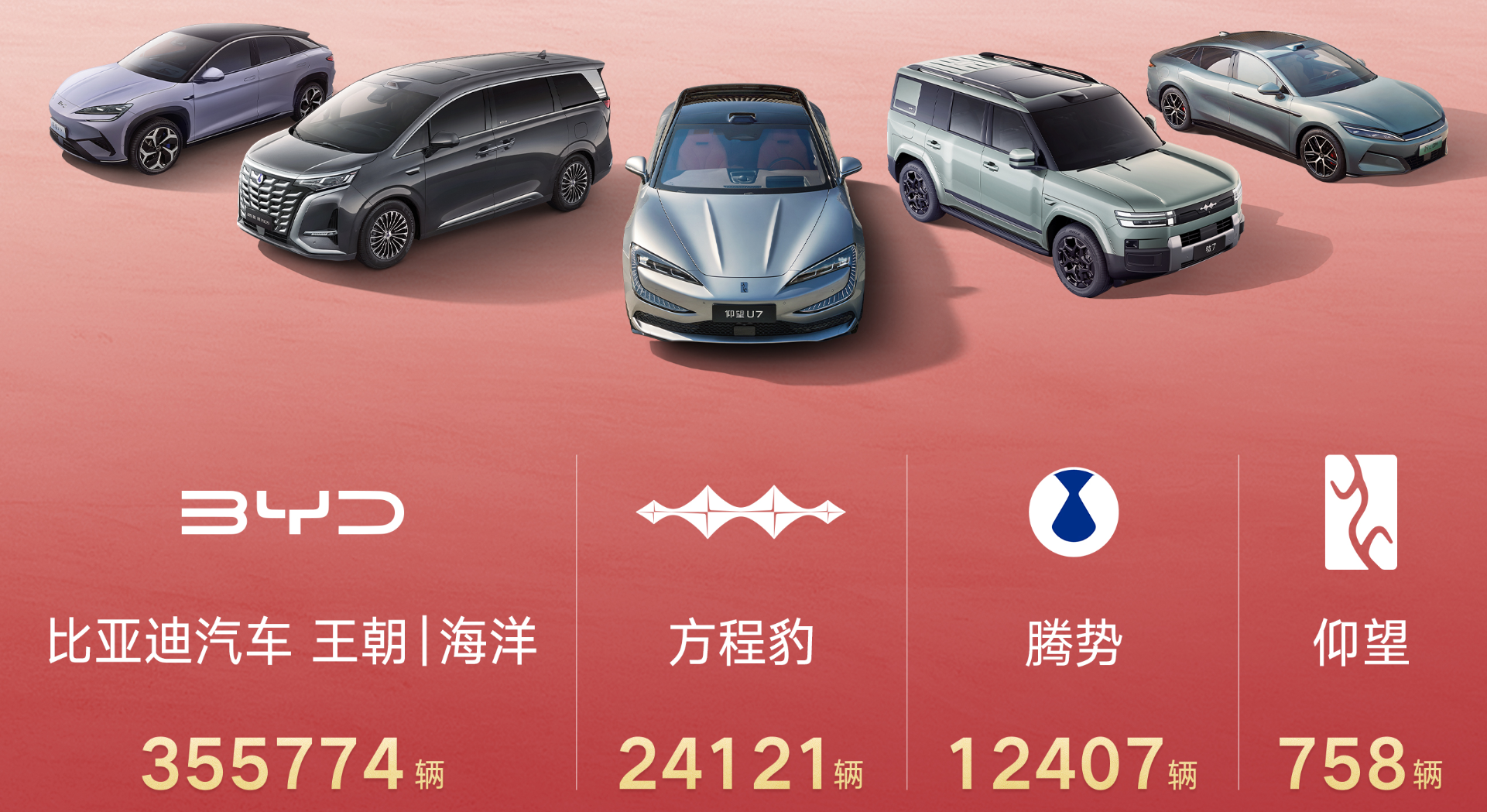
降价减少、促销平缓!9月车市格局微变:上汽夺得第一,新势力纯电车型销量占比超七成
Mei Ri Jing Ji Xin Wen· 2025-10-15 12:07
Core Insights - The automotive market in September 2025 experienced both month-on-month and year-on-year growth, with retail sales reaching 2.241 million units, a 6.3% increase year-on-year and an 11.0% increase month-on-month [1] - The overall retail sales for the year reached 17.005 million units, marking a 9.2% year-on-year increase, setting a new historical peak [1] - The market is shifting towards a more stable operation characterized by reduced price competition and moderate promotions, driven by a wave against "involution" [1] Domestic Brands Performance - Domestic brands captured 66.9% of the market share in September, with retail sales of 1.5 million units, reflecting a 13% year-on-year increase and a 12.9% month-on-month increase [2] - From January to September, the market share of domestic brands was 64.8%, up 5.9 percentage points from the previous year [2] - The penetration rate of new energy vehicles (NEVs) among domestic brands reached 78.1%, solidifying their position as a sales engine [2] - BYD, while still leading domestic brands, saw a 5.52% year-on-year decline in September sales, totaling 396,200 units, ending an 18-month growth streak [2][4] Key Competitors in Domestic Market - Geely and Chery are gaining traction in the NEV market, with Geely reporting sales of 273,100 units in September, a 35.24% year-on-year increase [4] - Chery, which went public in Hong Kong in September, achieved sales of 255,600 units, a year-on-year increase of 8.90% [4] - Changan and Great Wall Motors also reported significant growth, with Changan's sales at 266,300 units (up 24.92% year-on-year) and Great Wall's at over 133,600 units (up 23.29% year-on-year) [5] Joint Venture and Luxury Brands - Joint venture brands faced challenges, with retail sales of 490,000 units in September, down 6% year-on-year, despite a 4% month-on-month increase [6] - Luxury brands sold 240,000 units, down 1% year-on-year, but up 16% month-on-month, with a NEV penetration rate of 40% [6] - Volkswagen's joint ventures showed mixed results, with SAIC Volkswagen achieving a record high of 94,100 units sold, while FAW-Volkswagen experienced a year-on-year decline [6] New Energy Vehicle Market Dynamics - The new energy vehicle segment is seeing a shift, with the penetration of pure electric vehicles increasing significantly [12] - The new energy vehicle market is characterized by a growing share of small and high-end electric vehicles, driven by declining battery costs and the introduction of new models [12] - The market share of independent new energy brands reached 12.5%, up 1.2 percentage points year-on-year, with brands like Deep Blue and Zeekr performing well [12] Emerging Players in the Market - New energy vehicle startups are showing strong performance, with Leap Motor leading the segment with approximately 66,700 units delivered in September, a 97% year-on-year increase [8] - Xiaopeng and Xiaomi both surpassed 40,000 units in monthly sales, marking a significant milestone for the new energy vehicle sector [11] - Overall, the new energy vehicle startups achieved a retail market share of 20.2% in September, up 3.4 percentage points year-on-year [11]
站在港股IPO门口,赛力斯还能做“亲儿子”吗?
Tai Mei Ti A P P· 2025-10-15 10:54
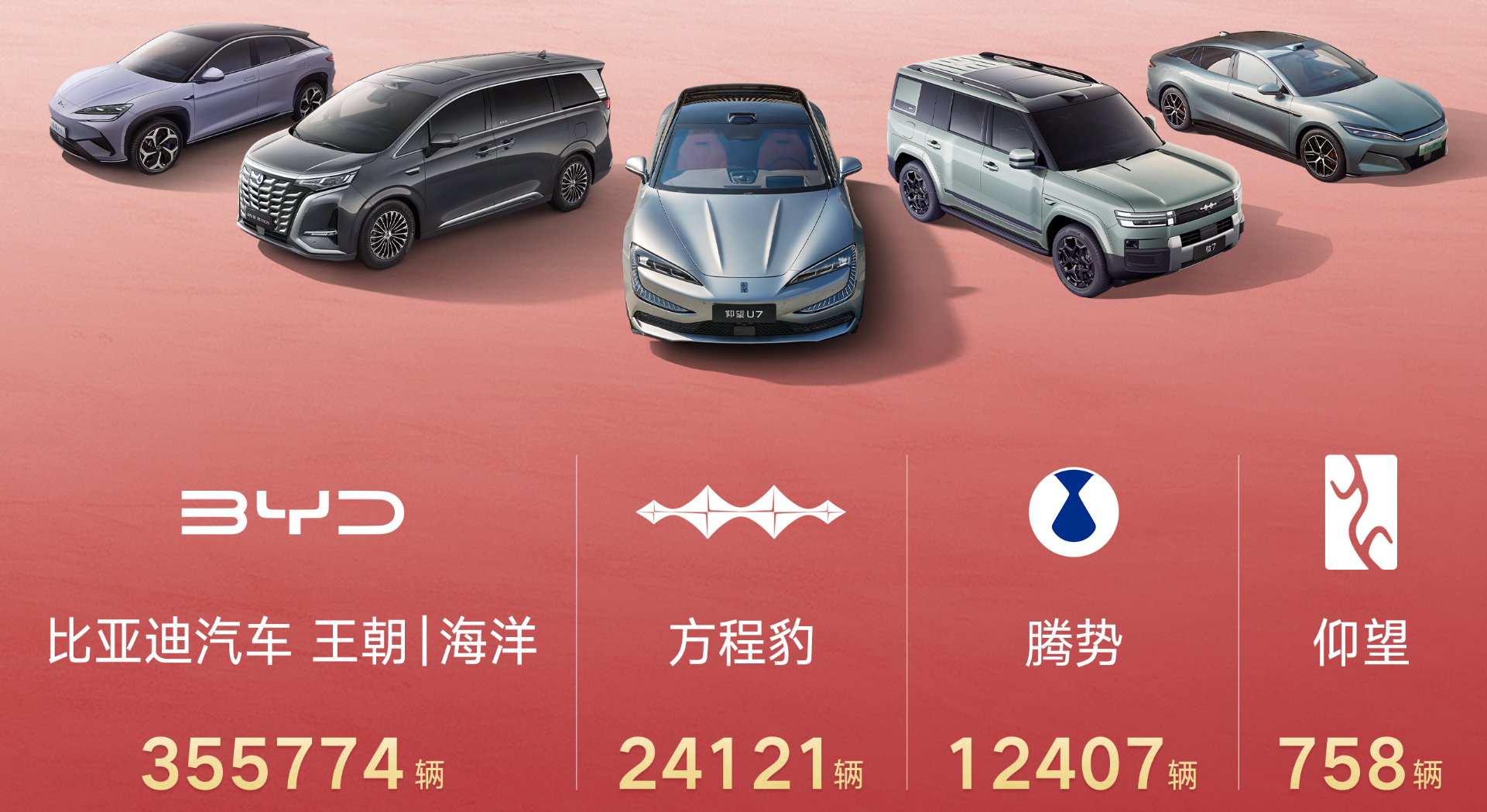
Core Insights - The article discusses the rapid rise of Seres, a once marginal electric vehicle manufacturer, which has embraced Huawei's technology and resources, leading to a market capitalization exceeding 200 billion [2][3] - However, as Huawei expands its partnerships with other automakers, Seres faces increased competition and must prove its ability to survive independently while navigating the challenges of the market [2][3][4] Group 1: Competitive Landscape - Seres initially benefited from exclusive support from Huawei, which provided access to technology, branding, and sales channels, resulting in significant sales growth [3][4] - The expansion of Huawei's automotive partnerships has diluted Seres' unique position, as multiple brands now compete for resources and market attention within Huawei's ecosystem [5][6] - Seres is now confronted with fierce competition in various market segments, including luxury SUVs and mid-sized SUVs, from established players like Li Auto, Tesla, and BYD [6][7] Group 2: Financial Challenges - Despite reporting a net profit of 2.94 billion yuan in the first half of the year, Seres has a high debt-to-asset ratio of 76%, indicating significant financial strain [6][7] - The company faces a cash flow crisis, with a decline in operating cash flow by 12% year-on-year, and a current ratio of 0.89, which is below the industry average [6][7] - Inventory levels have increased by 28% despite a 4% drop in revenue, suggesting potential issues with market demand and cash management [6][7] Group 3: Global Expansion and Geopolitical Challenges - Seres plans to use its upcoming IPO to fund research and development, expand overseas, and improve working capital, with 70% of the raised funds allocated for R&D [8][9] - The company has experienced a 31% decline in overseas deliveries, highlighting challenges in international markets, particularly in Europe and the U.S. due to rising tariffs and trade barriers [8][9] - Seres' reliance on Huawei's technology may pose additional challenges in foreign markets, where scrutiny and regulatory hurdles are increasing [9][10] Group 4: Future Outlook - The success of Seres' IPO is seen as a critical step in establishing a global presence and moving beyond its dependence on Huawei [9][10] - The company must craft a compelling growth narrative that transcends its reliance on Huawei to attract international investors and build a competitive brand [10]

自动驾驶大爆发,19起融资吸金超300亿,四大赛道都很火热
3 6 Ke· 2025-10-15 00:35
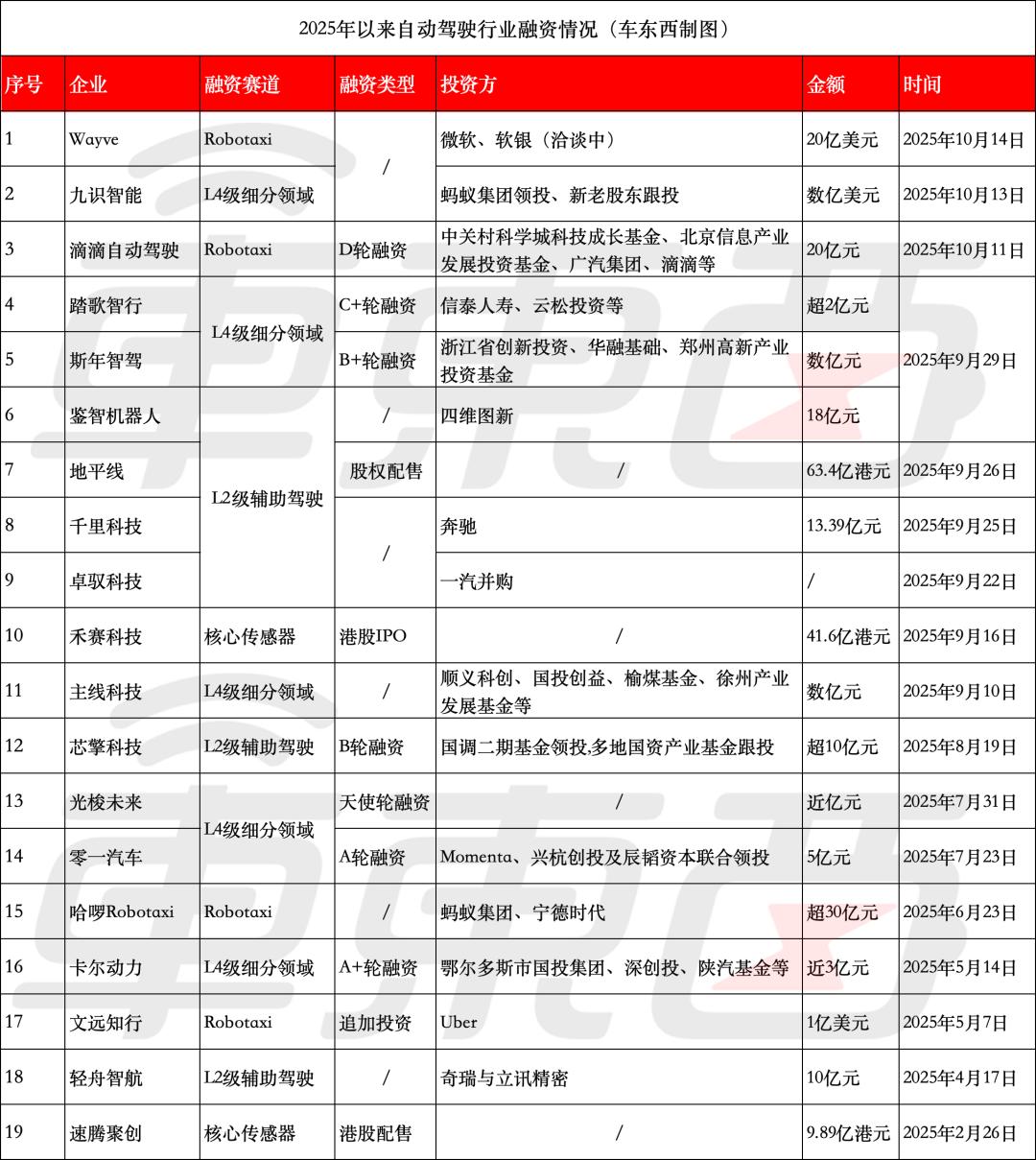
Core Insights - The autonomous driving industry is experiencing a significant surge in financing, with 11 funding events in the past month totaling over 29.2 billion yuan, bringing the total for the year to 36.7 billion yuan across 19 events [1][2][22] - This marks a stark contrast to the previous three years of capital winter, indicating a renewed confidence in the commercialization prospects of autonomous driving by 2025 [1][22] Financing Overview - The financing landscape is dominated by four main areas: L2-level assisted driving, L4-level niche applications, Robotaxi, and core sensors [3][11] - L2-level assisted driving saw six financing events this year, with notable funding including Horizon Robotics raising approximately 6.34 billion HKD (around 5.81 billion yuan) to expand overseas and support high-level assisted driving solutions [4][11] - The Robotaxi sector is particularly lucrative, with significant funding such as Didi Autonomous Driving's 2 billion yuan in Series D financing aimed at AI core algorithm development and L4 application deployment [11][16] - L4-level applications, focusing on closed or semi-closed environments, have attracted the most funding, with seven companies receiving investments, including a recent multi-million dollar round for Jiushi Intelligent [17][19] Market Dynamics - The capital market's enthusiasm for autonomous driving has markedly increased compared to the previous three years, which were characterized by a downturn in funding and operational challenges for major companies like Argo AI and Cruise [22][25] - The turning point in 2025 is attributed to a combination of technological advancements, market readiness, and supportive policies, with Tesla's launch of Robotaxi products serving as a strong market signal [25][27] - The investment focus has shifted towards companies with clear commercial applications, particularly in the Robotaxi and L4 niche sectors, reflecting a pragmatic approach to funding [27][30] Conclusion - The influx of capital is accelerating the commercialization of autonomous driving technologies, with companies that demonstrate viable applications receiving increased support [30] - The industry is poised for a transformative year in 2025, as the convergence of technology and investment is expected to turn autonomous driving from a vision into reality [30]

格林大华期货早盘提示-20251015
Ge Lin Qi Huo· 2025-10-14 23:30
1. Report Industry Investment Rating - No specific industry investment rating is provided in the report. 2. Core Viewpoints - The global economy is entering the top - region due to the US's continuous wrong policies [2] - If the MSCI China Index drops to 74, it will get strong support and investors may buy on the dip. A - shares' current valuation is reasonably low, attractive to foreign investors for global diversification and hedging US dollar asset risks [1] 3. Summary by Relevant Information 3.1 Corporate Investment and Cooperation - JPMorgan Chase launches a ten - year $1.5 trillion "Safety and Resilience Initiative", planning to invest up to $1 billion in 27 sub - technologies of four major fields including supply - chain manufacturing, defense aviation, energy technology, and frontier technology [1] - OpenAI and Broadcom cooperate to launch custom chips with a total capacity of 10GW. OpenAI is responsible for design, and Broadcom will start development and deployment in the second half of 2026 [1] - Google will invest $9 billion in South Carolina by 2027 to expand existing data - center parks and build new sites to support cloud - computing and AI application growth [1] - OpenAI has signed agreements worth about $1 trillion with giants like Oracle, Infineon, and AMD, expecting over 30GW of computing - power support in the next decade [1] - Alibaba is actively promoting 380 billion yuan of AI infrastructure construction and plans to increase investment [2] 3.2 Market and Economic Data - China's September export value was $328.5 billion, with an 8.3% year - on - year increase, and imports had a 7.4% year - on - year increase, reaching a six - month high for exports and a 17 - month high for imports [1] - In the HSBC emerging - market survey, China is the top stock - investment market. 100 surveyed institutions manage $423 billion of emerging - market assets [2] 3.3 Industry Trends - The German auto industry is facing a large - scale lay - off wave due to the slow European new - energy transition (15% pure - electric vehicle penetration rate) and the rise of the Chinese supply chain [1] - A large amount of funds are flowing from currency and treasury bonds to alternative assets, which may just be the beginning [1] 3.4 Technological Competition - China's control of rare earths is a response to the US's restrictions on mature - process semiconductor equipment materials, which may disrupt the US's AI chip production and cause turmoil in US stocks [1][2] - Huawei's Ascend chips' computing power in "ultra - node + cluster" is more than one year ahead of NVIDIA [2]

四季度决战,哪几家完不成年度目标
汽车商业评论· 2025-10-14 23:08
Core Viewpoint - The automotive industry is facing intense competition in the current market, with companies setting higher sales targets than the previous year, leading to potential overproduction and inventory issues [4][5]. Group 1: Sales Targets and Performance - Many automotive companies have set ambitious sales targets for 2025, but achieving these targets is challenging given the current market conditions [5]. - Among the companies analyzed, only XPeng has exceeded a 75% completion rate of its sales target, attributed to its conservative initial target setting [8]. - Companies like SAIC, Geely, BYD, and Xiaomi have also achieved over 70% completion rates [9]. Group 2: Market Trends and Consumer Behavior - The fourth quarter is critical for sales, especially with the upcoming tax incentives, prompting companies to accelerate new vehicle launches [5][12]. - Data from the "TQ Auto Flow" platform indicates a decline in foot traffic to dealerships during the National Day holiday compared to previous years, suggesting a potential decrease in consumer interest [14][16]. - The foot traffic data shows that some dealerships experienced lower visitor numbers than expected, with many consumers opting for travel instead of car shopping [14][19]. Group 3: Company-Specific Insights - For FAW Toyota, the main markets are Guangdong, Shandong, Jiangsu, and Zhejiang, with a notable decline in foot traffic during the holiday period [17][19]. - GAC Toyota's sales are also concentrated in similar regions, with a strong performance from hybrid and electric models, which accounted for about 50% of their total sales [22]. - Both FAW and SAIC Volkswagen reported lower foot traffic during the holiday compared to 2024, indicating challenges ahead for 2025 [24][30]. Group 4: New Energy Vehicle (NEV) Trends - NIO, XPeng, and Li Auto are experiencing growth in brand recognition and sales, with NIO achieving a total delivery of 201,000 vehicles by Q3 2025 [46]. - XPeng reported a significant year-on-year increase in deliveries, reaching 313,000 vehicles, but faces pressure on profitability and cost management [49]. - Li Auto's performance is lagging behind its ambitious target of 640,000 vehicles, with production delays affecting new models [51]. Group 5: Future Outlook - The competition in the NEV market is expected to intensify as traditional automakers introduce new models, potentially leading to price wars and increased mergers and acquisitions [54].