蒙牛

Search documents
科拓生物20250806
2025-08-06 14:45
Summary of Key Points from the Conference Call of Ketaobiotech Company Overview - Ketaobiotech's main business segments include compound food additives and probiotics, with probiotics currently being the primary growth driver as the compound food additives segment has shrunk to about 10% of revenue due to declining sales of long-life yogurt [2][3]. Core Business Insights - The probiotics business has shown an annual growth rate exceeding 20%, significantly higher than the industry average, and the company continues to gain market share [2][3]. - The domestic probiotics market is nearing 100 billion, with a growth rate of approximately 20% over the past few years. The marketing of weight loss benefits is expected to drive industry growth in 2025 [2][5]. - Ketaobiotech holds a 7% stake in Wuka Laboratory, which is projected to achieve revenues of 1 billion in 2025, benefiting from the weight loss marketing strategy [2][7]. Market Dynamics - The probiotics market is dominated by foreign brands, with DuPont holding a 50% market share, while domestic brands account for only about 10%. This presents a significant opportunity for domestic brands like Ketaobiotech to capture market share [6][12]. - The company’s stock price has surged due to rapid growth in the probiotics sector and advancements in innovative drugs, including a clinical trial approval for a cancer treatment [7][8]. Competitive Advantages - Ketaobiotech's core competitive advantages include strong technical barriers, a rich resource library of 32,000 strains of lactic acid bacteria, and a solid clinical validation system [4][9][15]. - The company has established multiple collaboration models, including direct sales of bacterial powder, ODM/OEM custom production, and proprietary brand sales, which cater to diverse customer needs [4][16]. Future Growth Projections - Ketaobiotech is expected to achieve approximately 440 million in revenue in 2025, with a growth rate of 45%, primarily driven by the rapid growth of edible probiotics and microbial preparations for plants and animals [4][22]. - The company plans to expand production capacity, with new facilities expected to contribute an additional 500-800 million in revenue once fully operational [20][21]. Challenges and Opportunities - Domestic brands face challenges such as R&D barriers, production technology, and intellectual property issues, but the increasing demand for domestic raw materials due to trade tensions presents opportunities for Ketaobiotech [12][14]. - The company is actively pursuing international market opportunities and domestic replacement strategies, aiming to increase market share and drive growth [20][23]. New Product Developments - Ketaobiotech is launching several new products aimed at the consumer market, including "Cocoa Tribute," which is expected to generate significant revenue [24]. Conclusion - Ketaobiotech is well-positioned for future growth in the probiotics market, leveraging its competitive advantages, expanding its product offerings, and capitalizing on market trends and consumer demands [8][13].

喜茶爆单,抹茶“杀疯”,中国抹茶会是下一个Labubu吗?
创业邦· 2025-08-02 10:07
Core Viewpoint - The article discusses the recent surge in popularity of matcha products, particularly highlighting the impact of BLACKPINK member's social media post on HEYTEA's "Triple Thick Matcha," which led to a significant increase in global orders and sales [4][6][10]. Group 1: Market Trends - There has been a notable increase in matcha product launches across various brands, with HEYTEA introducing multiple matcha beverages and other brands like Nayuki and Cha Bai Dao also releasing popular matcha items [7][21]. - The Asia-Pacific region accounted for 57.76% of the global matcha market in 2023, with China and Japan recognized as historical centers for matcha production [9][33]. - Matcha's association with Japan persists, despite its origins in China, as consumers increasingly discover the historical roots of matcha in regions like Jing Mountain, Hangzhou [30][32]. Group 2: HEYTEA's Response - Following the social media post, HEYTEA's sales of the "Triple Thick Matcha" increased by over 500% in cities like Shanghai and Hangzhou within a day [12]. - HEYTEA's global stores quickly adapted by launching promotional activities, including a buy-one-get-one-free offer for matcha drinks, although this led to shortages in matcha supplies [16][20]. - The brand's marketing strategy included creating artist-customized versions of the matcha drink to attract fans and enhance engagement [16][14]. Group 3: Regional Production Insights - China has become the largest producer and consumer of matcha globally, with production concentrated in regions like Jing Mountain, Guizhou, and Hubei [33][40]. - Jing Mountain's matcha production is expected to exceed 5,000 tons by 2025, with significant investments in local tea development [34][36]. - Guizhou's matcha production surpassed 1,200 tons last year, and the region is recognized for its modern matcha processing facilities [40]. Group 4: Branding and Market Positioning - The article emphasizes the need for "Chinese matcha" to establish a stronger brand identity to compete with Japanese matcha products [48]. - Successful examples from other regions, such as the rapid growth of Liuzhou's snail noodles, illustrate the potential for local specialties to gain national recognition through effective branding and marketing strategies [51]. - The article suggests that enhancing product visibility, leveraging local heritage, and creating engaging marketing campaigns can help elevate the status of Chinese matcha in the global market [55].


中泰国际每日晨讯-20250730
ZHONGTAI INTERNATIONAL SECURITIES· 2025-07-30 02:07
Market Performance - The Hang Seng Index closed at 25,524 points, down 38 points or 0.2%, after a 1.2% intraday decline, indicating resilience despite early pressure[1] - The Hang Seng Tech Index fell by 0.4%, closing at 5,644 points, reflecting a similar trend[1] - Total market turnover reached HKD 267 billion, with a net inflow of HKD 12.72 billion through the Stock Connect, showing strong support[1] Market Trends - Since mid-July, cumulative net inflow through Stock Connect has reached HKD 116 billion over the past 20 trading days, indicating increased investor interest[1] - The market is experiencing a high risk appetite, particularly in the biotech and brokerage sectors, with several biotech stocks hitting new highs[1] Short-term Risks - The Hang Seng Index faces short-term adjustment risks due to three factors: 1. Technical indicators are overbought, with the 50-day and 250-day moving averages at extreme levels of 93%[2] 2. August has historically been a weak month for the index, with an average decline of 2.1% over the past 15 years and a rise rate of only 26.7%[2] 3. The US dollar may rebound, as it has historically increased by an average of 0.1% in August, potentially pressuring emerging markets like Hong Kong[2] Policy Impact - Government policies, such as the implementation of a nationwide childcare subsidy starting January 1, 2025, are expected to boost market sentiment[3] - The healthcare sector saw a significant rise, with the Hang Seng Healthcare Index up 3.8%, driven by strong performances in innovative drugs and medical devices[4] Real Estate Insights - New home sales in 30 major cities fell by 16.8% year-on-year, with a total volume of 1.4 million square meters sold, indicating ongoing weakness in the real estate market[5] - The inventory-to-sales ratio for major cities rose to 129.8, up from 101.3 a year ago, suggesting increasing supply pressure[7] - Land transaction volumes also dropped significantly, down 48.6% year-on-year, reflecting a slowdown in real estate development activity[8]
东鹏饮料,毛利率下滑丨消费参考
2 1 Shi Ji Jing Ji Bao Dao· 2025-07-30 00:48
Core Viewpoint - Dongpeng Beverage maintains growth amidst a wave of cost-effectiveness, with significant revenue and profit increases reported for the first half of 2025 [1][2]. Financial Performance - In the first half of 2025, Dongpeng Beverage's revenue grew by 36.37% year-on-year to 10.737 billion yuan, while net profit attributable to shareholders increased by 37.22% to 2.375 billion yuan [1]. - For Q2 2025, the company reported revenue of 5.889 billion yuan, a 34.10% increase year-on-year, and a net profit of 1.395 billion yuan, up 30.75% [1]. Product Sales - New product sales, particularly "Bup Shui La" and other beverages, contributed significantly to revenue growth, with Q2 revenues of 4.46 billion yuan from Dongpeng Special Drink, 0.92 billion yuan from Bup Shui La (up 190.1%), and 0.50 billion yuan from other drinks (up 61.2%) [1]. - The proportion of revenue from Dongpeng Special Drink decreased by 9.3 percentage points to 77.9% [1]. Regional Performance - In Q2, Dongpeng Beverage generated 1.42 billion yuan in Guangdong, 3.55 billion yuan in other regions, and 0.91 billion yuan from online and direct sales, with year-on-year growth rates of 19.5%, 39.0%, and 42.8%, respectively [1]. Margin and Cost Structure - The gross margin for Dongpeng Beverage in Q2 was 45.7%, down 0.4 percentage points year-on-year [2]. - Sales, management, R&D, and financial expenses increased by 0.5%, 0.3%, decreased by 0.2%, and increased by 0.6% respectively during the same period [2]. Competitive Landscape - The company is facing pressure from a price war in the industry, which has led to increased promotional discounts affecting gross margins [3]. - Dongpeng Beverage is investing heavily in sales personnel, with employee compensation rising by 26.06% year-on-year, and channel promotion expenses increasing by 61.20% due to accelerated investment in freezers [3][4]. Strategic Positioning - Despite the challenges posed by the competitive environment, Dongpeng Beverage has established certain advantages that may help it navigate the intensified competition [5].

千亿育儿补贴,为何没炒热飞鹤们的股价
2 1 Shi Ji Jing Ji Bao Dao· 2025-07-29 12:40
Group 1: Policy Overview - The "Childcare Subsidy Implementation Plan" was officially announced on July 28, 2025, providing subsidies for children under three years old starting January 1, 2025, with an annual subsidy of 3,600 yuan per child [1] - The subsidy is expected to benefit over 20 million families annually, with a total estimated scale of over 1 trillion yuan for the program [2] Group 2: Local Government Initiatives - Local governments have already implemented various childcare subsidy programs, with Sichuan's Panzhihua being the first to offer monthly subsidies of 500 yuan per child for families with two or more children [4] - Other regions, such as Hubei and Xinjiang, have introduced unique combinations of subsidies, including cash, tax deductions, and extended maternity leave [5] Group 3: Market Impact - The introduction of childcare subsidies is expected to significantly impact the infant formula market, with companies like Sunshine Dairy and Knight Dairy seeing stock price increases following the announcement [7] - However, major players in the infant formula market, such as Feihe and Yili, have shown limited stock performance, indicating mixed market confidence [8] Group 4: Market Trends - The infant formula retail market in China is projected to reach approximately 136.7 billion yuan in 2024, with a compound annual growth rate (CAGR) of -4.2% from 2020 to 2024 [9] - Despite a slight recovery in birth rates, the overall demand for infant formula remains weak, with a significant decline in marriage registrations indicating potential future decreases in newborn numbers [10] Group 5: Consumer Behavior - Parents are increasingly willing to invest in higher-quality infant formula, with the ultra-premium segment experiencing a 13.3% growth in early 2024 [11] - The market is becoming polarized, with foreign brands like Danone and FrieslandCampina gaining market share in the high-end segment, while domestic brands face challenges [12] Group 6: Company Strategies - Feihe has announced a special subsidy program of 1.2 billion yuan to stimulate demand, while Yili has also launched a significant subsidy initiative [14] - Despite these efforts, Feihe anticipates a revenue decline of 8%-10% in the first half of the year, attributed to reduced purchasing demand following the subsidy announcements [13]
食品饮料周观点:关注中报成长标的,白酒底部看绝对价值-20250727
GOLDEN SUN SECURITIES· 2025-07-27 10:46
Investment Rating - The report maintains an "Increase" rating for the food and beverage industry, indicating a positive outlook for the sector [5]. Core Views - The liquor industry is strengthening its internal capabilities, with companies focusing on management, product, and channel improvements. The industry is currently at a low valuation and is expected to stabilize as sales pressure eases [2]. - In the beer and beverage sector, East Peak Beverage reported impressive mid-year results, while the industry continues to show high growth potential despite intense competition [3]. - The report highlights the ongoing transformation in product selection at Sam's Club, emphasizing operational efficiency through local supply chain adjustments [4]. Summary by Sections Liquor Industry - The liquor sector is in a phase of continuous improvement, with major companies like Guizhou Moutai and Shanxi Fenjiu enhancing their management and product offerings. The industry is currently experiencing a seasonal downturn, but valuations are low, suggesting potential for recovery [2]. Beer and Beverage Sector - The beer segment is advised to focus on high-growth products and structural performance, with companies like Yanjing Beer and Zhujiang Beer being highlighted. East Peak Beverage's revenue for the first half of 2025 reached 10.737 billion yuan, a year-on-year increase of 36.37% [3]. Food Sector - Sam's Club is undergoing a significant product selection transformation, with a shift towards national best-selling items to improve operational efficiency. The report notes that the low-temperature dairy market is performing better than the ambient temperature segment [4][7].




华泰证券今日早参-20250722
HTSC· 2025-07-22 01:20
Group 1: Macro Insights - The Japanese ruling coalition lost its majority in the recent Senate elections, marking the first time since 1955 that it has lost control of both houses, raising concerns about future fiscal policy changes [2] Group 2: Mechanical Equipment - The Yarlung Zangbo River downstream hydropower project has officially commenced, with a total investment of approximately 1.2 trillion yuan, significantly exceeding many major infrastructure projects in China [2][5] - The project is expected to generate about 300 billion kilowatt-hours annually, which is three times the output of the Three Gorges project, and will create substantial demand for related mechanical equipment [5][7] Group 3: Power Equipment and New Energy - In June 2025, China's inverter exports reached 6.59 billion yuan, a month-on-month increase of 10.3%, with a total of 5.129 million units exported [4] - The Yarlung Zangbo project is anticipated to drive approximately 720 billion yuan in new orders for hydropower equipment and 500 billion yuan for transmission and transformation equipment, benefiting leading companies in these sectors [5][7] Group 4: Construction and Building Materials - The Yarlung Zangbo hydropower project is expected to boost demand for construction materials such as cement and functional materials due to its high technical requirements and standards [7] - The project is the largest planned hydropower station globally, with a total investment of around 1.2 trillion yuan, which will likely enhance the construction sector's activity [7] Group 5: Consumer Goods - The dairy industry in China is currently experiencing a restructuring phase, with expectations of a return to supply-demand balance by 2026, driven by a decrease in raw milk production and moderate improvement in terminal demand [9] - Major dairy companies like Yili and Mengniu are focusing on improving profit margins as they navigate through the current market conditions [9][10] Group 6: Key Companies - Huaxin Cement is expanding its global footprint through acquisitions, which is expected to enhance its scale and profitability [10] - China Shipbuilding Industry Corporation's merger with China Shipbuilding Heavy Industry is progressing smoothly, which is anticipated to improve operational efficiency and competitiveness in shipbuilding [10]
2025年第29周:食品饮料行业周度市场观察
艾瑞咨询· 2025-07-21 08:25
Industry Overview - The beverage market in 2024 shows significant growth with a 7.8% increase in overall sales, driven by health-oriented drinks like sugar-free tea and functional beverages, which grew by 16.6% and 12.1% respectively, with sugar-free tea experiencing a remarkable 60% growth [2] - The sugar-free tea market is becoming increasingly concentrated, with Nongfu Spring holding over 70% market share, while electrolyte drinks are emerging as a new growth point, led by brands like Yuanqi Forest [2] - The trend towards health and taste is expected to drive competition in the beverage market, focusing on efficiency and differentiation [2] Tropical Fruit Trends - Guava has emerged as a popular ingredient in the beverage industry, with brands like Heytea and Shuyi Shao Xian Cao launching new guava products, reflecting its high aesthetic appeal and health benefits [3][4] - The rise of guava is attributed to its vibrant color, high vitamin C content, and low calories, making it versatile for innovation [3] Functional Foods and Health Trends - The functional food industry, particularly traditional Chinese medicine-based products, is evolving from simple cultivation to a complete industrial chain, benefiting from health consumption upgrades and policy support [5] - The market for traditional Chinese medicinal foods is expected to grow significantly, with a focus on personalized nutrition and health benefits [5] Local Brand Preference - Young Chinese consumers are increasingly favoring local brands over foreign ones, with domestic ice cream brands gaining market share at the expense of international brands like Häagen-Dazs [6] - Local brands are leveraging innovation and flexible marketing strategies to attract the younger generation, reflecting a deeper transformation in the Chinese consumer market [6] Condiment Industry Dynamics - The condiment industry is experiencing a "Matthew Effect," where leading brands like Haitian and Hengshun are becoming stronger, while new product trends focus on health and premiumization [7] - Despite challenges such as raw material price fluctuations, leading brands are maintaining stable growth and improving market share [7] Coconut Water Market - Coconut water is gaining traction as a natural health drink, with market growth expected to reach 7.8 billion yuan by 2024, driven by consumer demand for functional beverages [8] - The market is projected to reach 20 billion yuan by 2029, with supply chain and channel integration being key competitive factors [8] Niche Beverage Segments - The beverage industry is diversifying into niche segments, with brands like Huiyuan Juice launching low-priced birch juice products [9] - The trend towards sugar reduction and functional nutrition is driving the growth of traditional Chinese health water brands, with expectations of market size exceeding 10 billion yuan by 2028 [9] Health-Conscious Beverage Trends - The rise of traditional Chinese health water is attributed to the growing health consciousness among consumers, with market size expected to grow from 0.1 billion yuan in 2018 to 4.5 billion yuan in 2023 [10] - Brands are innovating with unique ingredient combinations to differentiate their products in a crowded market [10] Electrolyte Water Growth - Electrolyte water is becoming a mainstream choice, particularly among health-conscious consumers, with the market expected to reach 23.5 billion yuan by 2025 [13] - The shift from "pleasure consumption" to "functional consumption" is evident, with brands like Yuanqi Forest leading the charge [18] Market Dynamics and Innovations - The beverage market is witnessing a shift towards larger packaging sizes, with 1.5L bottles gaining popularity due to perceived value and cost efficiency [23] - Companies are exploring cross-industry collaborations, such as the partnership between Dairy Farm and Mengniu to launch high-end dairy products [25] Strategic Acquisitions - Ferrero's acquisition of WK Kellogg for $3.1 billion is aimed at expanding its breakfast cereal market presence, complementing its existing chocolate business [20] - This strategic move reflects a broader trend of food companies diversifying their product offerings to capture more market share [20]




华泰证券今日早参-20250721
HTSC· 2025-07-21 02:04
Macro Insights - The recent increase in port activity suggests a high export sentiment ahead of tariff exemptions, with June exports supporting industrial production recovery [2][3] - The Ministry of Industry and Information Technology plans to introduce growth stabilization measures for ten key industries, indicating a rise in "anti-involution" policies and price increases in the black and photovoltaic supply chains [2] Market Strategy - A-share market shows signs of strength, with a shift towards large-cap growth stocks. The "anti-involution" sectors are expected to see valuation recovery, supporting market momentum [3] - Mid-year financial data indicates a strong performance, improving mid-term profit expectations across the A-share market. Focus on sectors like aviation equipment, wind power, and storage for potential growth [3] Fixed Income Insights - Investors exhibit a preference for equities over bonds, with expectations of stable economic production but weak demand. The bond market remains in a volatile state, with a focus on long-term and ultra-long-term bonds [7] - The recent survey indicates a strong interest in macro topics such as consumption policies and tariff negotiations, with a stable funding environment supporting bond market demand [7] Power Equipment and Renewable Energy - The commencement of the Yarlung Zangbo River hydropower project is expected to generate significant investment opportunities, with estimated project values between 53.5 billion and 95.4 billion [9] - Leading companies in the sector, such as Dongfang Electric and Harbin Electric, are anticipated to benefit from sustained order growth, potentially alleviating market concerns regarding order sustainability [9] Transportation and Logistics - The logistics sector is experiencing growth driven by strong online consumption, with courier volumes showing significant year-on-year increases. The "anti-involution" initiative is expected to stabilize end-user pricing, benefiting major logistics companies [10] Semiconductor Industry - TSMC reported a strong Q2 performance with revenues of USD 30.07 billion, exceeding guidance due to robust demand for advanced nodes. The company raised its 2025 revenue growth forecast to approximately 30% [16] - The anticipated growth in AI demand is expected to drive revenue increases in advanced process technologies, with a positive outlook for TSMC's operational performance [16] Consumer Goods - The dairy industry is undergoing a restructuring phase, with expectations of a return to supply-demand balance by 2026. The recovery in raw milk prices is projected to positively impact upstream dairy farming profits [12] - Major players like Yili and Mengniu are expected to benefit from improved profit margins as the industry stabilizes and demand recovers [12]
【干货】奶酪产业链全景梳理及区域热力地图
Qian Zhan Wang· 2025-07-19 03:11
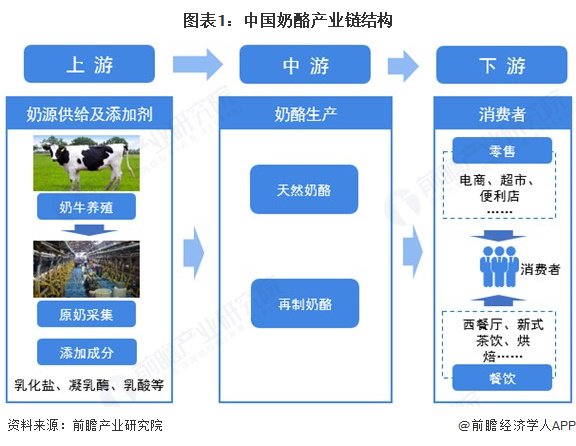
Core Insights - The cheese industry has a long supply chain that spans primary, secondary, and tertiary industries, with upstream focusing on milk supply and added ingredients, midstream on cheese production, and downstream on food service and retail channels [1][2][6] Industry Structure - The upstream segment consists of dairy farms and raw milk suppliers, with major players including YouRan Dairy, Modern Dairy, and others [2] - The midstream includes cheese manufacturers, with domestic participants like Mengniu, Yili, and Miaokelan Duo, and international brands such as Anchor and Kraft Heinz [2] - The downstream retail sector encompasses both online platforms like Taobao and JD.com, and offline supermarkets such as Walmart and Carrefour, as well as food service outlets like KFC and Starbucks [2][6] Regional Distribution - The upstream dairy supply is concentrated in regions like Inner Mongolia, Heilongjiang, and Shandong, while cheese production is primarily located in coastal areas [6] - Consumer demand is stronger in southern and coastal regions, indicating a north-south distribution pattern in the cheese industry [6] Cost Structure - The cost structure for processed cheese, such as cheese sticks, shows that raw material costs can exceed 50%, with packaging and processing costs accounting for approximately 17% and 28% respectively [9] - The cheese content in products often meets or exceeds 50%, impacting the overall cost structure [9] Price Transmission Mechanism - The cheese market price is influenced by supply-side costs, manufacturing costs, and consumer demand elasticity, creating a complex price transmission mechanism [12] - The final consumer price is affected by the cumulative costs from the supply chain, including raw material prices and brand premiums [12] Value Chain Analysis - The upstream segment has a higher profit margin, with companies competing for stable and quality milk supply [13] - Midstream cheese manufacturers like Miaokelan Duo have gross margins around 45%-50%, while downstream distributors have margins of 29%-33% [13]