信用利差
Search documents
【申万固收|信用周报】信用债ETF冲量规模回落,信用利差整体收窄——信用债市场周度跟踪(20260105-20260111)
申万宏源证券上海北京西路营业部· 2026-01-14 02:07
【申万宏源固收】黄伟平 杨雪芳 张晋源 曹璇 一级市场:太期普通信用债净供给环比上升,二永债无新发行与到期。木明(2026.01.05-2026.01.11) 普通信用债合计发行/备购资2699亿元/1311亿元/ |- HB (2025.12.22-2025.12.28) 分别为2550亿元(450亿元,其中,产业债发行环比下降至1392亿元,将融资环比大幅上升至917亿元;城投债发行环比大幅上升至1307 亿元,为25年11月以来最高值,净融资环比上升至394亿元。本期银行二永债无发行/到期(上期分别为549亿元/397亿元)。 级市场: 收益率涨跌互现,信用利差整体收窄、1V收窄幅度最大, 跨年后第一周供给担忧仍在但资金面相对平稳, 信用债表现抗跌、信用利差整体收窄, 1v反端表 午中长端。具体来看,收益率方面,各期限等级表现分化,其中7Y表现最好、整体下行(AA+/AA/AA-级城投债均为-2.36BP;AA+/AA级中震均为-2.35BP), BP) 外全部下行(AAA/AA+级银行永续债分别为-3.58/-3.59BP) ; 而5Y则 其次为10Y长端二级资本债表现较弱(AA+/AA/AA-级均为 ...
“特朗普变量”搅局财报季! 白宫施压信用卡利率 华尔街金融巨头们或将掀发债狂潮抽走流动性
Zhi Tong Cai Jing· 2026-01-13 00:20
高评级发债规模往往会在一级市场吸收庞大资金,进而带来短期的"供给压力"很容易把金融条件收紧, 更直接的影响通常体现在信用利差/无风险利率的短期内技术性上行、以及债券市场流动性溢价上,因 此华尔街金融巨头们突然间的因某种压力而选择大规模集中发债可能成为股票市场、加密货币以及高收 益率公司债等风险资产的"边际逆风因素"。 债券交易员们视角中所谓的"Big Six / 华尔街六大金融巨头"通常指美国六家最具系统重要性的综合性商 业银行与投行集团,分别是:摩根大通(JPMorgan Chase)、美国银行(Bank of America)、花旗集团 (Citigroup)、富国银行(Wells Fargo)、高盛(Goldman Sachs)、摩根士丹利(Morgan Stanley)。 美国股市财报季也将拉开帷幕,华尔街这些最大规模的金融巨头们将率先发布财报。因此本轮最新的美 股财报季不仅将是对华尔街这些金融巨头们对于美股2026年延续牛市的一致预期的重大考验——华尔街 分析师们普遍预期标普500指数将在2026年继续上演牛市轨迹且有望冲击8000点位,对于这些股价本就 因美股长期牛市氛围、投行业务复苏以及客户们股 ...
不好!外资大佬提示风险
Sou Hu Cai Jing· 2026-01-12 08:24
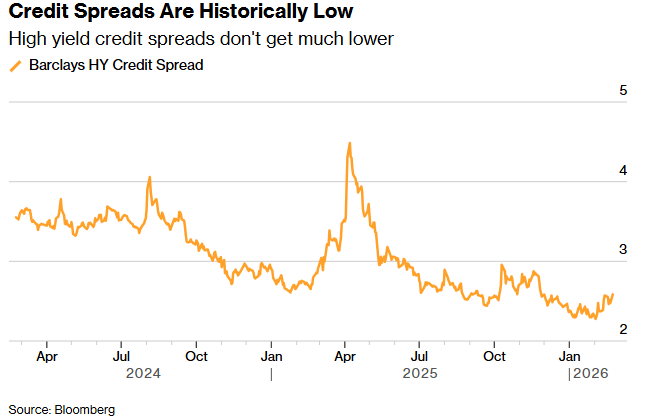
Group 1 - The core viewpoint is that 2025 will not be a victorious year for U.S. stocks, but rather a year of currency credit changes and capital rotation, with the "cost-performance" of U.S. stock assets dropping to a low point [1] - Dalio warns of the "nominal return" trap, indicating that almost all fiat currencies are depreciating against gold, with the U.S. dollar losing 39% of its value against gold. This suggests that apparent asset returns may be misleading when considering the real purchasing power of currency [2] - The shift in capital and wealth is moving from the U.S. to other regions, which may drive further rebalancing and diversification in asset allocation [3] Group 2 - Dalio highlights that the performance of U.S. stocks in 2025 will be driven by two main forces: earnings growth and P/E expansion, with an estimated total return of approximately 18% for the S&P 500, driven by a 12% earnings growth and a 5% increase in P/E [4] - The earnings growth is primarily attributed to the "seven giants" in the S&P 500, which account for one-third of the index's market value and are expected to see a 22% growth in earnings [4] - Dalio emphasizes the need to closely monitor whether the upward trend in profit margins can continue and how much of this can be realized as actual profits, as current market pricing assumes this trend will persist [5] Group 3 - Long-term expected returns for stocks are estimated to be around 4.7%, with current bond returns at approximately 4.9%, indicating a very thin equity risk premium [6] - The narrowing of credit spreads to very low levels may benefit lower-rated credit assets and stocks in the short term, but limits the potential for further narrowing, making it easier for spreads to expand, which would negatively impact these assets [6] - Dalio notes that the current market cannot be considered cheap, and he views the AI boom as being in the early stages of a bubble, which has significantly impacted nearly all assets and narratives [7]
【机构观债】2025年12月债市交投活跃度攀升 信用利差震荡运行
Xin Hua Cai Jing· 2026-01-12 08:09
统计数据显示,债券二级市场12月总成交金额376,780.29亿元,实现同比、环比双增长,增幅分别为 7.75%、10.60%。 新华财经北京1月12日电 2025年12月,债券二级市场交投氛围持续升温,总成交金额实现同比、环比双 增长,其中信用债成交增幅尤为显著。 当月,信用利差延续全年震荡态势,年末较年初明显收窄,但月末环比小幅走阔。分品种来看,产业债 多数行业利差走阔,城投债利差区域分化明显。展望后市,在宏观经济稳增长、政策流动性宽松等支撑 因素与政府债供给压力、海外政策波动等制约因素的平衡作用下,信用利差预计将维持窄幅震荡、小幅 收窄的运行格局。 按类型划分,利率债方面,12月成交金额219,753.95亿元,同比、环比分别增长7.15%、2.49%。信用债 方面,12月成交金额88,964.95亿元,同比、环比分别大幅增长17.90%、21.31%,成为拉动债市成交增 长的核心动力。 环比观察,2025年12月多数行业利差中枢环比走阔。其中建筑材料、汽车行业利差上行幅度超20bp,基 础化工、房地产行业利差增幅逾15bp;仅通信、钢铁和医药生物行业利差呈现收窄态势,分别下行 21bp、18bp和8b ...
关键变量是货币!达利欧最新复盘2025,预计美股长期回报或仅4.7%……︱重阳荐文
重阳投资· 2026-01-12 07:32
Group 1 - The core narrative of 2025 revolves around two main lines: the fluctuation of currency values, particularly the US dollar, other fiat currencies, and gold; and the relative underperformance of US stocks compared to non-US equities and gold, with gold being the best-performing asset of the year [2][7] - The article emphasizes that almost all fiat currencies weakened throughout the year, with the US dollar declining by 4% against the yuan and 12% against the euro, while gold saw a return of 65% in USD terms, outperforming the S&P 500's 18% return by 47 percentage points [9][11] - The article outlines three key principles related to currency depreciation, wealth distribution, and the nominal versus real returns of bonds, highlighting that currency devaluation can inflate nominal returns while diluting real purchasing power [12][14] Group 2 - US stocks, while strong in USD terms, significantly lagged behind non-US markets and gold when measured in stronger currencies, with European stocks outperforming US stocks by 23% and emerging market stocks returning 34% [18][19] - The S&P 500's performance was driven by a 12% growth in corporate earnings and a 5% increase in price-to-earnings (P/E) ratios, with the "seven giants" of the index accounting for a third of its market value and achieving a 22% earnings growth [19][20] - Long-term expected returns for stocks are estimated at around 4.7%, with current bond returns at approximately 4.9%, indicating a very thin equity risk premium and suggesting limited potential for additional returns from equities [21][22] Group 3 - The political landscape, particularly under the Trump administration, has influenced market dynamics, with policies aimed at revitalizing US manufacturing and AI technology, which have contributed to the observed market changes [29][30] - The shift from multilateralism to unilateralism in global politics has increased conflict risks and military spending, while also driving demand for gold and reducing overseas demand for US debt and assets [35] - The article concludes that the evolution of key forces such as debt, currency, market dynamics, domestic politics, geopolitical factors, natural forces, and new technologies will shape the overall investment landscape moving forward [37]
成交额超20亿元,公司债ETF(511030)实现3连涨
Sou Hu Cai Jing· 2026-01-12 01:41
Core Insights - The overall credit spread has narrowed, with the 1-year spread experiencing the most significant contraction [1][2] - Despite concerns about supply, the credit bond market has shown resilience, with short-term bonds outperforming longer-term ones [1][2] Group 1: Credit Bond Market Performance - In the first week after the New Year, credit bond ETFs experienced a significant outflow of funds, totaling 55.3 billion yuan over four days, nearly 50% of the inflow seen in December 2025 [2] - The yield on various credit bonds has shown mixed performance, with 7-year bonds performing the best, while 5-year bonds have seen an overall increase [1] - The turnover rate for public credit bonds and bank perpetual bonds has decreased this week [1] Group 2: Investment Strategies and Recommendations - The current market environment is favorable for investing in medium to short-term credit bonds, with a focus on capturing the certainty of interest rate spreads [2][3] - There is an opportunity to invest in high-grade public credit bonds with maturities of 3-5 years, particularly those rated AAA [3] - The overall leverage in the market remains low, indicating potential for increased leverage in credit bond investments [2][3] Group 3: ETF Performance Metrics - As of January 9, 2026, the company bond ETF has seen a 0.05% increase, marking three consecutive days of gains, with a current price of 106.74 yuan [5] - The latest scale of the company bond ETF reached 33.999 billion yuan, with a net inflow of 277 million yuan over the past five trading days [6] - The ETF closely tracks the China Bond - High-Grade Corporate Bond Spread Factor Index, providing a benchmark for high-grade corporate bond investments [6]
【固收】信用债发行量季节性上升,各行业信用利差涨跌互现——信用债周度观察(20260104-20260109)(张旭/秦方好)
光大证券研究· 2026-01-11 23:03
点击注册小程序 查看完整报告 特别申明: 本订阅号中所涉及的证券研究信息由光大证券研究所编写,仅面向光大证券专业投资者客 户,用作新媒体形势下研究信息和研究观点的沟通交流。非光大证券专业投资者客户,请勿 订阅、接收或使用本订阅号中的任何信息。本订阅号难以设置访问权限,若给您造成不便, 敬请谅解。光大证券研究所不会因关注、收到或阅读本订阅号推送内容而视相关人员为光大 证券的客户。 2、二级市场 利差方面,分行业来看,申万一级行业中,AAA级行业信用利差上行最大的为食品饮料,上行2.1BP,下行 最大的为通信,下行8.3BP;AA+级行业信用利差上行最大的为钢铁,上行3.6BP,下行最大的为机械设备,下 行13.1BP;AA级行业信用利差上行最大的为电子,上行4.4BP,下行最大的为传媒,下行10.3BP。 城投债分区域来看,本期AAA级信用利差上行最多的是云南,上行6.1BP,下行最多的是贵州,下行 8.6BP;AA+级信用利差上行最多的是辽宁,上行3.1BP,下行最多的是宁夏,下行10.5BP;AA级信用利 差上行最多的是云南,上行1.5BP,下行最多的是新疆,下行11BP。 交易量方面,信用债总成交量为14 ...
信用分析周报(2026/1/5-2026/1/11):关注边际修复行业的配置机会-20260111
Hua Yuan Zheng Quan· 2026-01-11 13:56
1. Report Industry Investment Rating No relevant content provided. 2. Core Viewpoints of the Report - Since the second half of 2025, the "anti-involution" policy has catalyzed the stabilization and recovery of commodity prices, and the fundamentals of some industries have shown signs of repair. For example, the non-ferrous metals industry has seen an upward shift in the price center of major metals under the multiple positive factors of continuous increase in policy support for stable growth, rapid expansion of downstream emerging industry demand, and steady improvement in domestic resource security capabilities. The profitability, operational capacity, and solvency of issuing entities have been enhanced. In 2026, the excess returns in the credit bond market may come from the value discovery of industries with fundamental repair. For the non-ferrous metals industry with fundamental repair, it is recommended to focus on allocating AA+/AAA-level central enterprises and regional leading state-owned enterprises and appropriately extend the duration, while also paying attention to avoiding the credit risks of bonds issued by small and medium-sized smelting and processing enterprises with low resource self-sufficiency rates and single industrial chain layouts [5][7][48] - Overall, this week, the credit spreads of most industries and ratings were compressed by less than 10BP, while the AA+ credit spread of the non-bank financial sector widened significantly by 20BP. In terms of urban investment bonds, the credit spreads of urban investment bonds with different maturities were compressed by 1-4BP compared with last week. In terms of industrial bonds, the short-term (1Y) credit spreads of industrial bonds widened significantly, while those above 1Y were mostly compressed to varying degrees. In terms of bank capital bonds, the short-term (within 1Y) spreads of bank perpetual and secondary capital bonds widened slightly, the 3Y spreads were significantly compressed, and the medium- and long-term (5-10Y) spreads were slightly compressed [6][47][48] 3. Summary According to the Directory 3.1 This Week's Credit Hot Events - On January 9th, the National Association of Financial Market Institutional Investors (NAFMII) issued a business reminder on further standardizing the issuance of debt financing instruments, emphasizing five aspects: distribution information entry, withdrawal reporting, subscription record-keeping, lead underwriting syndicate mechanism, and information disclosure quality. It is expected that in the short term (Q1 2026), the issuance efficiency of inter-bank bonds may decline, and the issuance difficulty of some weakly qualified issuers may increase. In the long term, the inter-bank bond issuance market will become more standardized and transparent, which is conducive to improving market liquidity and pricing efficiency [11][12][13] - On January 9th, the Guizhou Provincial People's Government issued policies to support the integrated development of industry, county prosperity, and people's well-being. In the short term, the policies will directly support county-level "Three Guarantees" and debt risk mitigation. In the long term, they will support the continuous improvement of local debts through industrial upgrading and fiscal revenue growth. For the existing platform debts in Guizhou, the policies strengthen the financing support for high-quality projects and force county-level platforms to transform into operating entities, which may further intensify regional credit differentiation [14][15] 3.2 Primary Market 3.2.1 Net Financing Scale - This week, the net financing of credit bonds (excluding asset-backed securities) was 115.3 billion yuan, an increase of 191.6 billion yuan compared with last week. The total issuance was 285.5 billion yuan, an increase of 209.2 billion yuan, and the total repayment was 170.3 billion yuan, an increase of 17.6 billion yuan. The net financing of asset-backed securities was 14.7 billion yuan, an increase of 15 billion yuan [16] - By product type, the net financing of urban investment bonds was 30.9 billion yuan, an increase of 37.5 billion yuan; the net financing of industrial bonds was 89.7 billion yuan, an increase of 144.5 billion yuan; and the net financing of financial bonds was -5.4 billion yuan, an increase of 9.6 billion yuan [16] 3.2.2 Issuance Cost - This week, the issuance volume of urban investment bonds and industrial bonds increased significantly, and the issuance rates of AA and AA+ decreased significantly compared with last week. Specifically, the average issuance rates of AA urban investment bonds and industrial bonds were in the range of 2.6-2.8%, the average issuance rates of AA+ urban investment bonds and industrial bonds were in the range of 2.2-2.3%, and the issuance rates of AAA-level bonds of different varieties were all below 2.3% [23] 3.3 Secondary Market 3.3.1 Transaction Volume - In terms of trading volume, the trading volume of credit bonds (excluding asset-backed securities) increased by 554.6 billion yuan compared with last week. Among them, the trading volume of urban investment bonds was 246 billion yuan, an increase of 139.5 billion yuan; the trading volume of industrial bonds was 329.6 billion yuan, an increase of 172.8 billion yuan; the trading volume of financial bonds was 498.8 billion yuan, an increase of 242.3 billion yuan. The trading volume of asset-backed securities was 16.2 billion yuan, an increase of 4.8 billion yuan [24] - In terms of turnover rate, the overall turnover rate of credit bonds increased compared with last week. Specifically, the turnover rate of urban investment bonds was 1.58%, an increase of 0.89 percentage points; the turnover rate of industrial bonds was 1.7%, an increase of 0.89 percentage points; the turnover rate of financial bonds was 3.21%, an increase of 1.56 percentage points. The turnover rate of asset-backed securities was 0.44%, an increase of 0.13 percentage points [25] 3.3.2 Yield - This week, the yields of 5Y credit bonds of different ratings widened slightly, while the yields of credit bonds of other ratings and maturities fluctuated by no more than 3BP compared with last week. Taking AA+ 5Y bonds of each variety as an example, the yields of different varieties all increased to varying degrees [27][28] 3.3.3 Credit Spread - Overall, the credit spreads of most industries and ratings were compressed by less than 10BP this week, while the AA+ credit spread of the non-bank financial sector widened significantly by 20BP. Specifically, the credit spreads of AA media, mining, commercial trade, and transportation industries were compressed by 7BP, 6BP, 7BP, and 6BP respectively; the credit spreads of AA+ building materials and machinery industries were compressed by 8BP and 10BP respectively; the credit spread of the AAA computer industry was compressed by 7BP. The credit spreads of other industries and ratings fluctuated by no more than 5BP [31] - **Urban Investment Bonds**: In terms of maturity, the credit spreads of urban investment bonds of different maturities were compressed by 1-4BP compared with last week. In terms of regions, the credit spreads of urban investment bonds in different regions were compressed to varying degrees [36][37] - **Industrial Bonds**: This week, the short-term (1Y) credit spreads of industrial bonds widened significantly, while those above 1Y were mostly compressed to varying degrees [40] - **Bank Capital Bonds**: This week, the short-term (within 1Y) spreads of bank perpetual and secondary capital bonds widened slightly, the 3Y spreads were significantly compressed, and the medium- and long-term (5-10Y) spreads were slightly compressed [43] 3.4 This Week's Bond Market Sentiment - This week, the implied ratings of 41 bond issues of 8 entities were downgraded, including 16 issues of AVIC Industry Finance Holdings Co., Ltd. and 10 issues of New Hope Wuxin Industrial Group Co., Ltd. The "21 Wantong 02" issued by Guangxi Wantong Real Estate Co., Ltd. was extended; the "H20 Zhengrong 2" issued by Zhengrong Real Estate Holdings Co., Ltd. defaulted substantially; Shandong Zhangqiu Blower Co., Ltd. was placed on the watch list, and its "Zhanggu Convertible Bond" was also placed on the watch list [4][45] 3.5 Investment Recommendations - This week, a total of 1,323.6 billion yuan of reverse repurchases matured in the open market, and the central bank conducted a total of 102.2 billion yuan of reverse repurchase operations, resulting in a net withdrawal of 1,221.4 billion yuan for the whole week. As of the close on Friday, DR001 closed at 1.28% [6] - For the non-ferrous metals industry with fundamental repair, it is recommended to focus on allocating AA+/AAA-level central enterprises and regional leading state-owned enterprises and appropriately extend the duration, while also paying attention to avoiding the credit risks of bonds issued by small and medium-sized smelting and processing enterprises with low resource self-sufficiency rates and single industrial chain layouts [7][48]
信用利差周度跟踪20260109:信用利差全线收窄二永债表现强势-20260111
Huafu Securities· 2026-01-11 05:25
固 定 收 益 2026 年 01 月 11 日 信用利差全线收窄 二永债表现强势 —— 信用利差周度跟踪 20260109 投资要点: 固 定 收 益 定 期 报 告 利率上行信用展现韧性,信用利差全线收窄。本周(1 月 4 日至 1 月 9 日)利率债震荡偏弱,收益率总体上行,1Y、3Y 和 10Y 期国开债收益率 分别上行 3BP,5Y 期上行 4BP,7Y 期上行 2BP。信用债表现强于利率债, 1Y 期 AA+及以上等级信用债收益率下行 2BP,其余等级上行 1BP;3Y 期 AAA 与 AA 级收益率持平,其余等级下行 1-2BP; 5Y 期 AA+及以上等级 收益率上行 1BP,其余等级上行 3BP;7Y 期 AAA 级收益率持平,其余等 级下行 2BP;10Y 期 AAA 信用债下行 1BP,其余等级持平。信用利差全线 收窄,1Y 期 AA+及以上等级信用利差下行 5BP,其余等级下行 2BP;3Y 期各等级利差下行 3-5BP;5Y 期 AA+及以上等级利差下行 3BP,其余等级 下行 1BP;7Y 期 AAA 级利差下行 2BP,其余等级下行 4BP;10Y 期各等 级利差下行 3-4BP ...
达利欧最新发布:2026年,我们该怎样调整投资思路?
雪球· 2026-01-07 13:00
Group 1 - The core narrative of 2025 revolves around two main lines: the fluctuation of currency values, particularly the US dollar against other currencies and gold, and the relative performance of US stocks compared to non-US stocks and gold, with gold being the best-performing asset of the year [3][6]. - The AI boom is perceived to be in the early stages of a bubble, and while US stocks appear strong in dollar terms, their performance is significantly weaker when compared to non-US equities and gold [4][6]. - The expected long-term return on stocks is estimated at approximately 4.7%, while existing bond returns are around 4.9%, indicating a very thin equity risk premium [28][29]. Group 2 - The US dollar depreciated against several currencies, with a 4% drop against the Chinese yuan and a 39% decline against gold, leading to a general weakening of all fiat currencies [8][10]. - Gold provided a return of 65% in dollar terms, significantly outperforming the S&P 500's 18% return, highlighting the importance of currency valuation in assessing investment returns [11][12]. - The performance of non-US equities was notably better, with European stocks outperforming US stocks by 23%, Chinese stocks by 21%, and overall emerging market stocks achieving a return of 34% [20][21]. Group 3 - The political landscape, particularly under the Trump administration, has influenced market dynamics, with policies aimed at revitalizing US manufacturing and AI technology impacting capital flows and asset allocation [36][38]. - The shift from multilateralism to unilateralism in global politics has increased conflict risks and heightened military spending, which in turn has affected investment strategies and demand for gold [47]. - The ongoing debate over wealth distribution and inflation is expected to become a central political issue, potentially influencing market conditions and investor sentiment in the coming years [40][46].