反内卷

Search documents
拆解车企2026新年致辞:反内卷、求质量成为集体共识
Jing Ji Guan Cha Wang· 2026-01-08 05:19
Core Insights - The automotive industry is undergoing a collective reflection on the competitive landscape, with major companies advocating against "involution" and promoting fair competition for healthy industry development [2][3] - There is a consensus that excessive price competition erodes profits and stifles innovation, prompting leading companies to shift focus from short-term market share to long-term competitiveness [2][3] - Emphasis on safety has become a key topic in the industry, with companies like Chery and GAC highlighting their commitment to exceeding safety standards and enhancing consumer trust [3][4] Group 1: Involution and Competition - Major automotive companies are calling for an end to "involution" in competition, focusing on technology, quality, brand, and user experience rather than just cost and price [2] - Geely's chairman reflects on the importance of moving away from low-price competition, marking a pivotal shift in the company's development [2] - The industry recognizes that internal competition leads to mutual deprivation in a stagnant market, hindering long-term strategic positioning [2] Group 2: Safety and Quality - Safety has emerged as a critical focus, with companies like Chery establishing stringent quality standards and receiving accolades for their commitment to safety [3][4] - GAC emphasizes that safety is a non-negotiable baseline, introducing comprehensive safety policies to address potential risks associated with electric vehicles [4][5] - Geely has expanded its safety vision to include data and software security, reflecting a broader understanding of safety beyond physical vehicle parameters [5] Group 3: Openness and Collaboration - The competitive landscape is evolving from direct confrontations among automakers to collaborative relationships across the supply chain [7][8] - Companies like SAIC and GAC are actively forming partnerships with tech firms and other industries to build a more integrated ecosystem [7][8] - Chery's initiative to create an open innovation platform with global universities illustrates a shift towards collaborative technological advancement [9] Group 4: Intelligence and Electrification - The consensus among automakers is that electrification is a prerequisite, while intelligence will determine competitive positioning in the future [11] - Companies are investing in advanced technologies, with NIO and Geely leading in the development of smart driving systems and integrated software solutions [11] - The automotive sector is transitioning towards becoming intelligent nodes within a broader digital ecosystem, enhancing user experience and connectivity [12] Group 5: Global Expansion - The trend of "going global" is increasingly seen as a critical factor for the future of automotive companies, with many emphasizing the need for a structured approach to international markets [13][14] - BYD and Dongfeng are accelerating their global strategies, focusing on localizing production and services to build sustainable competitive advantages [14][15] - The shift from mere product export to a comprehensive value chain approach is becoming essential for establishing a strong presence in overseas markets [15]


资讯早间报:隔夜夜盘市场走势-20260108
Guan Tong Qi Huo· 2026-01-08 05:16
地址:北京市朝阳区朝阳门外大街甲 6 号万通中心 D 座 20 层(100020) 总机:010-8535 6666 注:本报告资讯信息来源于万得资讯和金十数据,冠通研究整理编辑 本公司具备期货交易咨询业务资格,请务必阅读免责声明。 分析师:王静,执业资格证号 F0235424/Z0000771。 免责声明: 本报告中的信息均来源于公开资料,我公司对这些信息的准确性和完整性不作任何保证。报告中的内容和 意见仅供参考,并不构成对所述品种买卖的出价或征价。我公司及其雇员对使用本报告及其内容所引发的 任何直接或间接损失概不负责。本报告仅向特定客户传送,版权归冠通期货所有。未经我公司书面许可, 任何机构和个人均不得以任何形式翻版,复制,引用或转载。如引用、转载、刊发,须注明出处为冠通期 货股份有限公司。 资讯早间报 发布日期: 2026/01/08 隔夜夜盘市场走势 1.国内商品期市收盘多数上涨,基本金属涨幅居前,沪镍涨停;黑色系全部上涨, 焦煤、焦炭涨停;化工品多数上涨,纯碱涨 7.53%;贵金属涨跌参半,铂金跌 2.47%。 2.美油主力合约收跌 1.28%,报 56.4 美元/桶;布伦特原油主力合约跌 0.51 ...
市场那些事丨岁末年初,春季行情抢跑在即?
Sou Hu Cai Jing· 2026-01-08 03:19
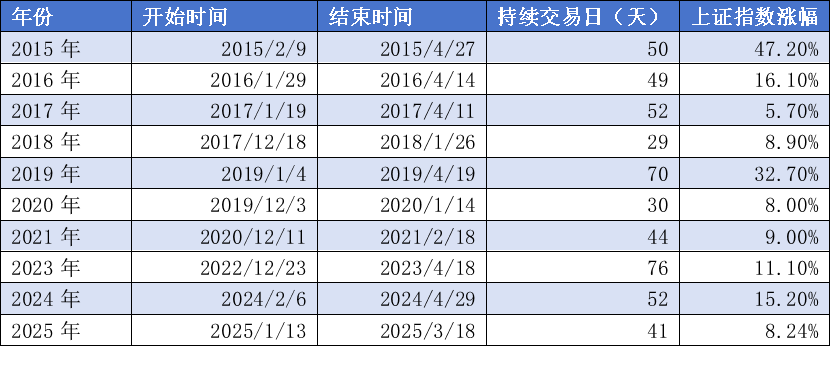
Group 1: Spring Market Dynamics - The spring market is characterized by a combination of policy expectations, liquidity easing, and an earnings vacuum period, creating a stage for market opportunities rather than being solely driven by seasonal factors [1] - The initiation of the spring market has been occurring earlier, with data showing that in the last five years, three instances saw the spring market start in December of the previous year, indicating a new market trend of "year-end sprint" [2] Group 2: Historical Performance - Historical data indicates that the spring market has varied in duration and performance, with the Shanghai Composite Index showing significant gains in various years, such as a 47.20% increase in 2015 and a projected 15.20% increase in 2024 [3] Group 3: External and Domestic Support - On the international front, reduced uncertainties, such as the U.S. Federal Reserve's interest rate cuts and a weaker dollar, are expected to enhance liquidity and attract foreign capital into the A-share market [4] - Domestically, a series of policy measures and early issuance of local government bonds are expected to provide strong support for economic recovery and market growth, with significant inflows into A-share ETFs indicating a favorable liquidity environment [5] Group 4: Investment Strategies - Investors are advised to focus on three main sectors: - The technology sector, which is expected to benefit from policy support in areas like artificial intelligence and semiconductor industries [6] - The cyclical sector, particularly in renewable energy and high-end manufacturing, which is anticipated to gain from global economic recovery and domestic policy initiatives [6]
“反内卷”叠加增长预期, 2026年碳酸锂能否继续“狂飙”?
Zhong Guo Jing Ying Bao· 2026-01-08 03:03
Core Viewpoint - The lithium carbonate market is expected to experience a rebound in 2025, with prices showing a V-shaped recovery after hitting a low of 59,000 yuan/ton in June, eventually surpassing 130,000 yuan/ton by December, marking an increase of over 120% from the low point [1][2]. Price Trends - In early 2025, lithium carbonate prices fluctuated around 75,200 yuan/ton, dropping below 70,000 yuan/ton by the end of April and reaching a low of 59,000 yuan/ton in June [1]. - By July 2025, prices began to rebound, breaking through 65,000 yuan/ton on July 14, 70,000 yuan/ton on July 21, and closing at 76,680 yuan on July 24, eventually exceeding 120,000 yuan/ton by December 23 [2]. - The price increase is attributed to a combination of factors, including strong demand from the energy storage sector and a reduction in market inventory [2][3]. Demand and Supply Dynamics - The global demand for lithium carbonate is projected to reach 2 million tons by 2026, driven by the growth in electric vehicles and energy storage applications [6]. - The domestic market in China accounted for 63.3% of global power battery installations from January to October 2025, with significant contributions from leading companies [3]. - The new energy storage capacity in China exceeded 100 million kilowatts by September 2025, representing a growth of over 30 times compared to the end of the 13th Five-Year Plan [4]. Industry Performance - Companies in the lithium sector, such as Tianqi Lithium and Ganfeng Lithium, have seen significant stock price recoveries, with increases of over 160% and 173% respectively since their lows in April [3]. - Ganfeng Lithium reported a 364.02% year-on-year increase in net profit for the third quarter [3]. Future Outlook - The lithium market is expected to face uncertainties in 2026, with potential price corrections if demand from the energy storage sector does not meet expectations [7]. - The development of alternative technologies, such as sodium batteries, may introduce new dynamics to the market, although current production costs and scale are not yet comparable to lithium batteries [8].




地缘避险情绪升温,BCOM指数权重调整启动
Hua Tai Qi Huo· 2026-01-08 02:56
Report Industry Investment Rating No relevant content provided. Core Viewpoints - Policy expectations are swinging back and forth. After a series of important domestic meetings and the Fed's return to a "restrictive" stance in December, there are risks of policy expectation swings both at home and abroad, with asset sentiment deviating from the macro situation. Future commodity prices will be determined by supply - side risks and loose monetary policies due to global geopolitical instability [1]. - There is a certain divergence in domestic and foreign economic outlooks. Overseas economic sentiment has been declining since October, while China's exports and new orders remain positive. China's November economic data was under pressure, but the official manufacturing and non - manufacturing PMIs in December returned to the expansion range [2]. - For commodity investment, focus on high - certainty sectors such as non - ferrous metals and precious metals. There are also opportunities for low - valued commodities to make up for price increases. In the energy sector, pay attention to the growth expectation of crude oil supply after the US "temporary management" of Venezuela. In the chemical industry, focus on the "anti - involution" space of some varieties. For agricultural products, pay attention to weather expectations and short - term pig diseases [3]. Summary by Related Catalogs Market Analysis - Policy expectations are unstable. After the Central Economic Work Conference in December and the 2026 People's Bank of China Work Conference in January, there are uncertainties in domestic and foreign policies. The Fed has internal differences. Geopolitical tensions during the New Year's Day holiday have increased supply - side risks for commodities [1]. - On January 7, the A - share market showed mixed performance. The semiconductor industry chain was active, and the coal sector had a strong performance. In the commodity futures market, many contracts such as nickel, coke, and coking coal reached the daily limit [1]. Domestic and Foreign Economic Data - Overseas economic sentiment has been declining since October, while China's November foreign trade growth rebounded. China's November economic data was under pressure, but the December official manufacturing and non - manufacturing PMIs returned to the expansion range. The US November non - farm payrolls recovered but were still weak, and the unemployment rate reached a four - year high [2]. Commodity Investment - Focus on non - ferrous metals and precious metals. Among non - ferrous metals, aluminum is a good choice. In the energy sector, pay attention to the situation in Venezuela and Iran. In the chemical industry, focus on the "anti - involution" space of methanol, PTA, etc. For agricultural products, pay attention to weather and pig diseases. There are opportunities to buy precious metals at low prices, but short - term silver risks have increased [3]. Strategy - For commodities and stock index futures, consider buying on dips in stock index futures, precious metals, and non - ferrous metals [4]. Key News - China's central bank increased its gold reserves for the 14th consecutive month in December. On January 8, the central bank carried out a 1.1 trillion - yuan buy - out reverse repurchase operation. The US Supreme Court will rule on the tariff issue on January 9. Trump announced that Venezuela will transfer 30 - 50 million barrels of oil to the US [6].
太平洋证券:光伏行业反内卷加速供需重塑 重视新技术、新场景
Zhi Tong Cai Jing· 2026-01-08 02:55
Core Viewpoint - The photovoltaic industry is expected to accelerate supply-demand restructuring driven by the "anti-involution" trend, leading to gradual profit recovery by 2026 [1] Group 1: Supply-Demand Restructuring - The "anti-involution" spirit is deeply penetrating the photovoltaic industry, with main chain prices recovering from the top down, and auxiliary material leading companies showing significant profit recovery by Q3 2025 [1] - The rapid development of energy storage, alongside the implementation of grid parity for solar storage in key markets like China, the US, and Europe, is expected to alleviate the impact of increased photovoltaic installations on the grid [1] - The long-term demand outlook is optimistic due to rising computing power needs and breakthroughs in core photovoltaic technologies for space stations, which will open new application scenarios [1] Group 2: Technology Iteration and Profit Recovery - The penetration rate of low-silver and silver-free technologies is expected to rise quickly, with leading companies likely to recover profits faster than the industry average due to rapid cost reduction in component production [2] - The introduction of low-silver solutions by JinkoSolar and silver-free technologies by LONGi Green Energy is highlighted as key developments in this technology iteration [2] Group 3: Auxiliary Material Companies - Auxiliary material companies are expected to accelerate profit recovery through diversified business layouts, as the pressure on the photovoltaic main chain has been ongoing for over three years [3] - Leading companies in auxiliary materials are preparing for a second growth phase, with non-photovoltaic business proportions expected to increase, contributing to revenue and profit reversals [3] Group 4: Beneficiary Analysis - Companies leading in low-silver and silver-free technology iterations, such as LONGi Green Energy, JinkoSolar, Aiko Solar, and Tongwei Co., are expected to benefit from cost advantages [4] - Companies actively integrating energy storage with photovoltaic operations, like Trina Solar, JinkoSolar, LONGi Green Energy, and JA Solar, are likely to see profit recovery [4] - Leading companies in supporting facilities, such as DKE Holdings, Juhua Materials, and Foster, are expected to continue profit recovery through new technology breakthroughs and business expansions [4]




化工行业供给侧有望结构性优化,化工ETF嘉实(159129)把握行业新一轮景气周期机遇
Xin Lang Cai Jing· 2026-01-08 02:41
Group 1 - The core viewpoint of the articles indicates a mixed performance in the chemical industry, with the sub-index showing a slight decline while certain stocks experience significant gains [1] - The chemical industry is witnessing a recovery in global manufacturing since Q3 2025, but the PPI for chemical products is weakening year-on-year, indicating a complex demand-side scenario [1] - Domestic real estate is at a cyclical low, while new energy vehicle sales continue to grow, contributing to a stable retail sales growth [1] - China is positioned as a global leader in the chemical industry, with stable production capacity compared to declining utilization rates in the EU [1] - The market is seeing strong performance in sectors like fluorine chemicals and phosphate fertilizers, alongside price increases in niche products driven by accidents [1] - The overall valuation of the basic chemical sector is showing significant recovery [1] Group 2 - The top ten weighted stocks in the chemical sub-index account for 45.31% of the index, with major players including Wanhu Chemical and Salt Lake Shares [2] - The chemical ETF managed by Harvest closely tracks the chemical sub-index, focusing on the new economic cycle under the "anti-involution" policy [2] - Investors can also explore investment opportunities in the chemical sector through the chemical ETF linked fund [3]

黑色金属数据日报-20260108
Guo Mao Qi Huo· 2026-01-08 02:26
1. Report Industry Investment Rating - No information provided regarding the industry investment rating 2. Core Views of the Report - The steel market is in a state of oscillation, waiting for new driving forces. The black - sector needs new drivers and capital inflow. The iron and steel industry shows weak supply - demand, but iron - water production is stabilizing and rising, which weakens the negative impact on furnace materials. There is a de - stocking pressure in the plate market, but price support exists at low levels. Unilateral trading can adopt an oscillatory approach, and after January, it is more favorable for spot - futures positions [2]. - The sentiment of silicon - iron and manganese - silicon has turned positive, but the fundamentals are under pressure. The cost of silicon - iron is expected to rise due to differential electricity prices, but the impact is limited. Demand is poor and at a yearly low, while supply remains high, leading to a risk of price decline despite policy support [3][5]. - The coking coal and coke markets are oscillating. The spot market has a fifth - round price cut expectation, but the futures market rebounded after pricing in the cut. The market will continue to oscillate, and attention should be paid to the pre - festival restocking next week [9]. - The iron ore market is rising in resonance with other commodities. The price fluctuates greatly at high levels and should not be short - sold in the short term. The port inventory will continue to rise, and the price has an upper limit. Iron - water production is expected to stabilize and rise in January [9]. 3. Summary by Related Catalogs Futures Market - **Futures Prices and Changes**: On January 7th, the far - month contract closing prices and their changes were as follows: RB2610 was 3235 yuan/ton, up 93 yuan (2.96%); HC2610 was 3353 yuan/ton, up 90 yuan (2.76%); I2609 was 804.5 yuan/ton, up 30.5 yuan (3.94%); J2609 was 1851.5 yuan/ton, up 137 yuan (7.99%); JM2609 was 1246.5 yuan/ton, up 92 yuan (7.97%). The near - month contract closing prices and their changes were also provided, such as RB2605 at 3187 yuan/ton, up 89 yuan (2.87%) [1]. - **Spread and Ratio**: The cross - month spreads, such as RB2605 - 2610 at - 48 yuan/ton (down 3 yuan), and the spreads/ratios like the coil - rebar spread at 145 yuan/ton (down 7 yuan), were also presented [1]. Spot Market - **Steel Spot Prices**: On January 7th, the Shanghai rebar price was 3340 yuan/ton, up 70 yuan; the Tianjin rebar price was 3190 yuan/ton, up 60 yuan; the Guangzhou rebar price was 3540 yuan/ton, up 70 yuan; the Tangshan billet price was 2980 yuan/ton, up 30 yuan. The Shanghai hot - rolled coil price was 3320 yuan/ton, up 40 yuan; the Hangzhou hot - rolled coil price was 3370 yuan/ton, up 60 yuan; the Guangzhou hot - rolled coil price was 3310 yuan/ton, up 70 yuan [1]. - **Other Spot Prices**: The prices of other products such as coking coal, coke, and iron ore were also given, along with their price changes [1]. Market Analysis by Product Steel - The steel market is in an oscillatory state. Macroscopically, there is a lack of new drivers, and the black - sector needs new impetus. Industrially, the supply - demand of five major steel products is weak, but iron - water production is rising, weakening the negative impact on furnace materials. The plate market has de - stocking pressure, but price support exists at low levels [2]. Silicon - Iron and Manganese - Silicon - The sentiment has turned positive, but the fundamentals are under pressure. The cost of silicon - iron is expected to rise, but the impact is limited. Demand is poor, and supply remains high, leading to a risk of price decline despite policy support [3][5]. Coking Coal and Coke - The spot market has a fifth - round price cut expectation, and the futures market rebounded after pricing in the cut. The market will continue to oscillate, and attention should be paid to the pre - festival restocking next week [9]. Iron Ore - The iron ore market is rising in resonance with other commodities. The price fluctuates greatly at high levels and should not be short - sold in the short term. The port inventory will continue to rise, and the price has an upper limit. Iron - water production is expected to stabilize and rise in January [9].
日度策略参考-20260108
Guo Mao Qi Huo· 2026-01-08 02:26
Report Industry Investment Rating No specific industry investment ratings were provided in the report. Core Viewpoints of the Report - A-share market is expected to continue its upward trend in the short term and may rise further in 2026 compared to 2025, supported by macro policies, inflation, capital market reforms, and the role of Central Huijin [1]. - The bond market is favored by asset shortages and weak economic conditions, but the central bank has recently warned of interest rate risks [1]. - Metal prices are influenced by factors such as supply disruptions, macro sentiment, and cost changes. Some metals are expected to have upward trends, while others may experience volatility or are subject to supply concerns [1]. - Energy and chemical product prices are affected by factors such as geopolitical conflicts, supply and demand, and cost support. Some products are expected to have upward trends, while others may experience volatility [1]. - Agricultural product prices are influenced by factors such as seasonal changes, policy support, and supply and demand. Some products are expected to have upward trends, while others may experience volatility [1]. Summary by Category A-shares - A-share market has continuous trading volume increase. Short-term, the index is expected to remain strong. In 2026, the index may continue to rise on the basis of 2025, supported by macro policies, inflation, capital market reforms, and Central Huijin [1]. Bonds - Asset shortages and weak economic conditions are favorable for bond futures, but the central bank has recently warned of interest rate risks. Attention should be paid to the Bank of Japan's interest rate decision [1]. Metals - Copper: Supply disruptions and improved macro sentiment have led to a rise in copper prices, and the upward trend is expected to continue [1]. - Aluminum: Domestic electrolytic aluminum has accumulated inventory, but macro sentiment is positive, and global aluminum ingot supply is expected to tighten, leading to a strong aluminum price [1]. - Alumina: Supply has significant release potential, putting pressure on prices. However, the current price is close to the cost line, and the price is expected to oscillate [1]. - Zinc: Fundamentals have improved, and the cost center has shifted upward. With positive macro sentiment, zinc prices have risen, but the upside space is limited due to fundamental pressure [1]. - Nickel: Supply concerns have led to a significant increase in nickel prices and an increase in positions. The short-term price may be strongly oscillating, but high risks and volatility are present at high price levels. Attention should be paid to Indonesian policies and macro sentiment [1]. Industrial and Energy Chemicals - Polycrystalline silicon: Northwest production has increased, while southwest production has decreased. December production schedules for polycrystalline silicon and organic silicon have declined [1]. - Carbonate lithium: It is the traditional peak season for new energy vehicles, with strong energy storage demand and increased supply from restarts. Prices have risen rapidly in the short term [1]. - Rebar and hot-rolled coil: Futures-spot arbitrage positions can be rolled for profit-taking. The price valuation is not high, and short-selling is not recommended [1]. - Iron ore: Near-term contracts are restricted by production cuts, but the commodity sentiment is positive, and there is still an upward opportunity for far-term contracts [1]. - Silicone and ferrosilicon: There is a combination of weak reality and strong expectations. In the short term, expectations dominate, and energy consumption control and anti-involution may disrupt supply [1]. - Soda ash: The market sentiment has improved, and the supply and demand are supportive. The price is low and expected to be strong in the short term [1]. - Coking coal and coke: If the "capacity reduction" expectation continues to ferment and there is pre-holiday restocking of spot goods, there may still be room for price increases, but the actual increase is difficult to judge, and volatility increases after a significant rise [1]. Agricultural Products - Palm oil: The December MPOB data is expected to be bearish, but the price is expected to reverse under themes such as seasonal production cuts, the B50 policy, and US biofuels. Short-term rebounds due to macro sentiment should be watched out for [1]. - Soybean oil: The fundamentals are strong, and it is recommended to be overweight in the oil market. Consider the spread between soybean oil and palm oil [1]. - Cotton: There is support but no driving force in the short term. Future attention should be paid to the central government's No. 1 document in the first quarter of next year, planting area intentions, weather during the planting period, and peak season demand [1]. - Sugar: There is a global surplus and increased domestic supply. The short side consensus is strong. If the price continues to fall, there is strong cost support, but there is a lack of continuous driving force in the short term [1]. - Corn: With the release of reserve and imported grains, the supply has increased. The spot price is expected to be firm in the short term, and the futures price will oscillate within a range [1]. - Pulp: The 05 contract is expected to oscillate between 5400 - 5700 yuan/ton due to the tug-of-war between "strong supply" and "weak demand" [1]. - Logs: The spot price has shown signs of bottoming out and rebounding, and the downward space for the futures price is limited. However, the January overseas quotation has slightly declined, and there is a lack of upward driving factors. The price is expected to oscillate between 760 - 790 yuan/m³ [1]. Energy and Chemicals - Crude oil: OPEC+ has suspended production increases until the end of 2026. The uncertainty of the Russia-Ukraine peace agreement and US sanctions on Venezuelan oil exports have an impact [1]. - Fuel oil: Follows the trend of crude oil in the short term, with no prominent supply-demand contradictions [1]. - Asphalt: The "14th Five-Year Plan" rush demand is likely to be disproven, and the supply of Ma Rui crude oil is sufficient. The profit margin is high [1]. - Natural rubber: The raw material cost provides strong support, the futures-spot price difference has rebounded significantly, and the midstream inventory has increased substantially [1]. - BR rubber: The upward momentum has slowed down, the spot price has led the recovery of the basis, and the processing profit has narrowed. There are positive factors for future domestic butadiene exports [1]. - PTA: The PX market has experienced a sharp rise, and the PTA market is expected to remain tight in 2026. Domestic PTA maintains high production, and the gasoline spread provides support for aromatics [1]. - Ethylene glycol: Two MEG plants in Taiwan, China, plan to shut down next month. The price has rebounded rapidly due to supply-side news, and the downstream demand is slightly better than expected [1]. - Styrene: The Asian market is stable, with suppliers reluctant to cut prices due to losses and buyers pressing for lower prices due to weak downstream demand. The market is in a weak balance, and the upward momentum depends on overseas markets [1]. - Urea: The export sentiment has eased, and the upside space is limited due to insufficient domestic demand. There is support from anti-involution and the cost side [1]. - PE: There is a risk of rising crude oil prices due to geopolitical conflicts. The supply pressure is high, and the market expectation is weak due to planned production increases in 2026 [1]. - PP: The supply pressure is high, and the downstream improvement is less than expected. The cost is supported by high propylene monomer and crude oil prices [1]. - PVC: The global production is expected to be low in 2026, but the current supply pressure is rising. The demand is weak, and the implementation of differential electricity prices in the northwest may force the clearance of PVC production capacity [1]. - LPG: The January CP has risen unexpectedly, and the import cost provides strong support. Geopolitical conflicts have increased the risk premium. The inventory accumulation trend has slowed down, and the domestic port inventory is decreasing. The long-term demand for LPG is expected to increase [1]. Aviation - It is expected to peak in mid-January. Airlines are still cautious about trial resumptions [1].
ETF盘中资讯|化工板块低位震荡,化工ETF(516020)跌近1%!资金持续加码,机构看好盈利估值双升
Sou Hu Cai Jing· 2026-01-08 02:15
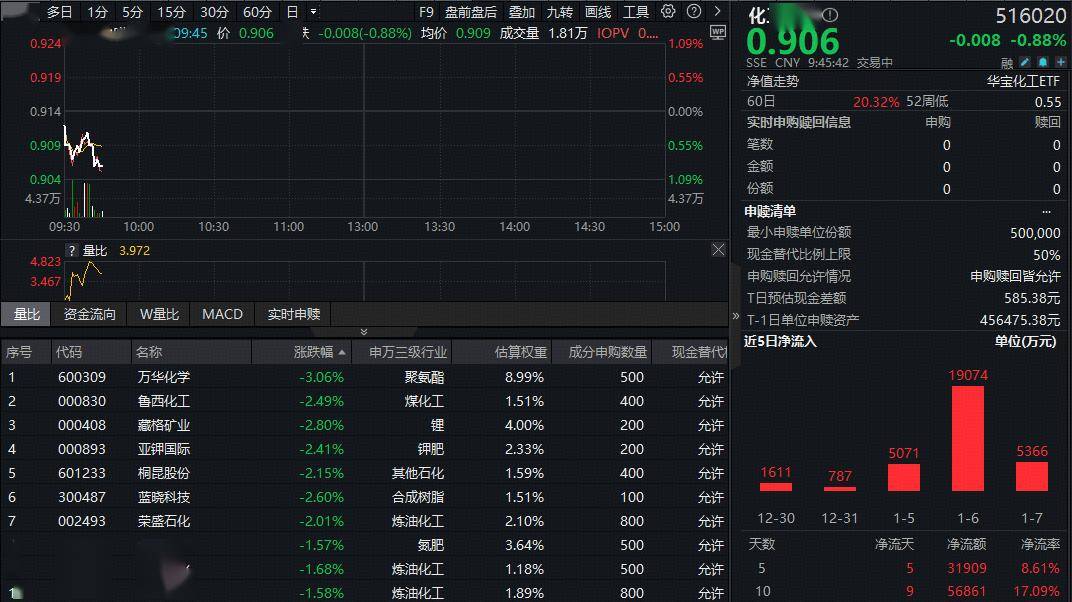
Group 1 - The chemical sector is experiencing a pullback, with the chemical ETF (516020) showing a decline of 0.88% as of the latest report [1] - Key stocks in the sector, including Wanhua Chemical, Luxi Chemical, and Cangge Mining, have seen significant declines, with Wanhua Chemical dropping over 3% [1][2] - The chemical ETF has attracted substantial capital inflows, with a net subscription of 319 million yuan over the last five trading days and over 568 million yuan in the last ten days [2][3] Group 2 - The construction of projects in the basic chemical industry has decreased by 10% year-on-year, indicating a nearing end to capital expenditures, while domestic demand and export resilience are improving the supply-demand balance [3] - The chemical industry is expected to benefit from policies aimed at reducing competition, leading to potential improvements in performance and valuation [3] - The current state of the chemical industry is at a cyclical bottom, with expectations for enhanced profitability and valuation for leading companies as competition dynamics improve [3] Group 3 - The chemical ETF (516020) tracks the CSI sub-sector chemical industry index, covering various segments and focusing on large-cap leading stocks [4] - Nearly 50% of the ETF's holdings are concentrated in major companies like Wanhua Chemical and Salt Lake Co., allowing investors to capitalize on strong market leaders [4] - Investors can also access the chemical sector through linked funds of the chemical ETF [4]