人民币国际化

Search documents
中国强化货币政策的执行和传导:环球市场动态2025年11月13日
citic securities· 2025-11-13 03:33
Market Overview - A-shares experienced a slight decline, with the Shanghai Composite Index down 0.07% at 4,000 points, while the Shenzhen Component fell 0.36% and the ChiNext Index dropped 0.39%[15] - Hong Kong stocks rose, with the Hang Seng Index increasing by 0.85% and the Hang Seng Tech Index up 0.16%[10] - European markets closed higher, with the Euro Stoxx 600 up 0.7% and the German DAX rising 1.2%[8] - U.S. markets showed mixed results, with the Dow Jones up 0.7% nearing record highs, while the Nasdaq fell 0.3%[8] Commodity and Currency Trends - OPEC revised its outlook, indicating a global oil supply surplus earlier than expected, leading to a 4.18% drop in WTI crude oil prices to $58.49 per barrel[26] - Gold prices increased by 2.4%, while silver prices surged, reflecting market expectations of further monetary easing by the Federal Reserve[26] - The Japanese yen fell below the 155 mark against the U.S. dollar for the first time since February[26] Fixed Income Market - U.S. Treasury yields decreased by 2-5 basis points, with the 10-year yield at 4.07%[29] - The auction of $42 billion in 10-year Treasuries was relatively stable, with a bid-to-cover ratio of 2.43[29] - Asian bond markets saw a widening of spreads by 0-2 basis points due to selling pressure[29] Key Economic Indicators - The Federal Reserve is expected to maintain a cautious stance on interest rates, with potential for a 10 basis point cut in Q4 if domestic demand does not recover sufficiently[5] - The Chinese central bank is focusing on enhancing the internal coordination of the interest rate system, transitioning from aggregate control to structural optimization[5] Sector Performance - In the A-share market, financial stocks led gains, with Agricultural Bank of China up 3.5% and China Life Insurance rising 4%[15] - In Hong Kong, financial stocks also performed well, with notable increases in Agricultural Bank and China Life, while home appliance stocks surged following positive sales reports[10]
中信证券:若内需恢复不足,四季度或迎来10bps降息
Sou Hu Cai Jing· 2025-11-13 02:57
Core Insights - The People's Bank of China (PBOC) has released the "Monetary Policy Implementation Report for the Third Quarter of 2025," outlining the future monetary policy direction [1] - The report highlights significant external uncertainties and challenges to international economic trade order, while also acknowledging risks to domestic economic performance [1] - The third quarter GDP growth was reported at 4.8%, a decrease of 0.4 percentage points from the second quarter, prompting the PBOC to emphasize the need for stronger domestic economic recovery [1] Monetary Policy Direction - The PBOC signals the implementation of a moderately accommodative monetary policy and the strengthening of policy execution and transmission [1] - There is a possibility of a further 10 basis points interest rate cut in the fourth quarter if domestic demand does not recover sufficiently, aimed at reducing financing costs and stabilizing overall demand [1] Support for Consumption - The report introduces measures to support personal credit repair, which is seen as a continuation and deepening of financial support for consumption system construction [1] Renminbi Internationalization - The PBOC's stance on Renminbi internationalization is increasingly positive, identifying "capital account opening" and "cross-border payments" as key strategies [1] Structural Optimization - The PBOC is focusing on the internal coordination of the interest rate system, indicating a shift in monetary policy from total volume control to a dual emphasis on structural optimization and effective transmission [1]

人民币汇率稳中有升 美元走弱与政策托底共筑汇率韧性
Xin Hua Cai Jing· 2025-11-13 02:50
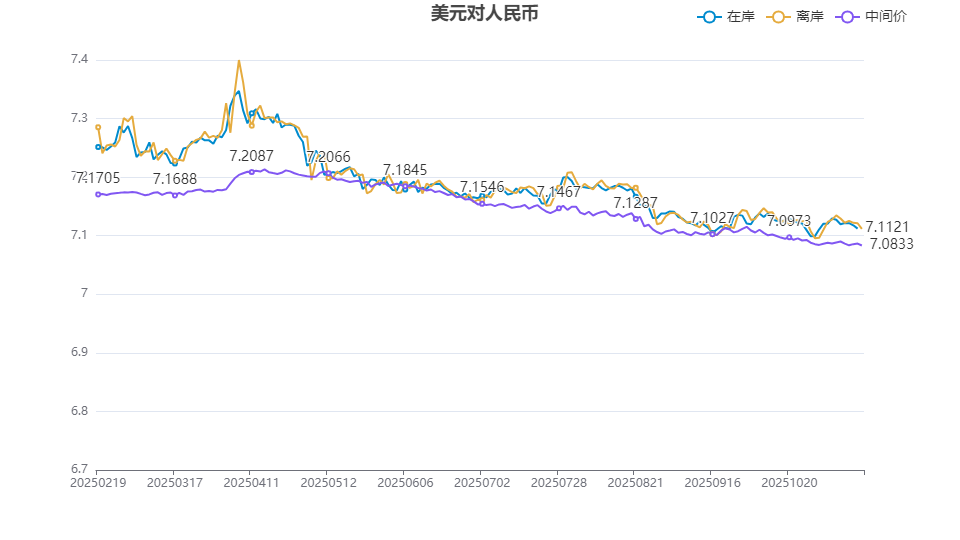
Core Viewpoint - The Chinese yuan has strengthened against the US dollar, reaching its highest level since October 15, 2024, with a central parity rate of 7.0833 on November 12, 2023, indicating a potential for continued strength in the short term [1][6]. Group 1: Currency Market Dynamics - The US dollar index has declined by 6.8% year-to-date, reflecting a challenging environment for the dollar amid expectations of economic data releases that could influence Federal Reserve policy [2][4]. - The recent passing of a temporary funding bill by the US Congress has ended a record 43-day government shutdown, which had cast a shadow over the US economic outlook [4]. - Analysts predict that the combination of a weakening dollar and a strong domestic economic performance in China will support the yuan's resilience [6][7]. Group 2: Economic Indicators and Predictions - The People's Bank of China (PBOC) aims to maintain a stable yuan exchange rate while implementing a moderately loose monetary policy to support economic growth [6][7]. - The PBOC's third-quarter monetary policy report emphasizes the need to prevent excessive fluctuations in the yuan and to keep it at a reasonable and balanced level [7]. - UBS Global Research expresses optimism about the Chinese stock market and the yuan, anticipating improved confidence and credit growth in emerging markets by 2026 [7].

终于对人民币动手了,英国踢掉全部货币,死保美元
Sou Hu Cai Jing· 2025-11-13 02:37
Core Viewpoint - The London Metal Exchange (LME) has abruptly suspended all non-U.S. dollar-denominated metal options trading, forcing global traders to transact in U.S. dollars only, which is seen as a desperate reaction to the rising challenge of the Chinese yuan in the metal trading market [1][3]. Group 1: Impact on Dollar Dominance - The LME's decision is interpreted as a significant blow to the dollar's dominance in global commodity pricing, particularly as the exchange has historically been a key pillar of U.S. dollar hegemony [1][3]. - The dollar's dominance relies on three pillars: settlement, reserve, and pricing, with the LME being central to the pricing pillar [3]. - The LME's operations have allowed U.S. capital to benefit from fluctuations in interest rates, leading to significant profits for Wall Street firms during periods of low interest rates [3][4]. Group 2: Changes in Global Metal Trading - The rise of Chinese manufacturing has shifted the landscape, with China controlling over 70% of rare earth oxide production and significant shares of other metals, establishing itself as the largest metal consumer globally [7]. - Since 2022, the trading volume of metal options denominated in yuan has surged, with a 900% increase in market share, indicating a growing acceptance of the yuan in international metal transactions [7]. - The Shanghai Futures Exchange has reported that yuan-denominated copper futures have the largest open interest globally, surpassing that of the LME [7][8]. Group 3: Market Reactions - Following the LME's announcement, the Shanghai Futures Exchange saw a significant increase in trading volume, while the LME experienced unusual trading halts, highlighting a shift in market dynamics [8][10]. - The Dubai Commodity Exchange plans to launch yuan-denominated copper futures in 2026, further solidifying the yuan's role in the market [8]. - Market participants are increasingly viewing U.S. dollar-denominated metals as less favorable compared to those priced in yuan, indicating a potential shift in trading preferences [10].

信用卡债破万亿美元!人民币逆势崛起:2035年人均GDP翻倍?
Sou Hu Cai Jing· 2025-11-13 02:35
Group 1 - The article discusses the current global economic turmoil, particularly focusing on the challenges faced by the US economy and its implications for Europe and China [1][13] - The US economy is heavily reliant on an AI bubble for growth, with 40% of its growth attributed to this factor, while the remaining 60% is distributed among businesses and citizens, resulting in a meager per capita income increase [8][10] - The article highlights the rising commercial real estate loan default rate in the US, which has reached 11.8%, surpassing levels seen during the 2008 financial crisis, indicating significant distress among businesses [8][10] Group 2 - The article emphasizes the increasing acceptance of the Chinese yuan in international trade, particularly in energy transactions with Russia and Middle Eastern countries, as well as in dealings with resource-rich nations in South America and Africa [3][5] - It points out that as the yuan gains international traction, it could lead to cheaper imports and more favorable exchange rates for Chinese citizens, enhancing the overall economic stability [5][21] - The US is attempting to shift the economic burden onto Europe, particularly Germany, by increasing tariffs on German automobiles and imposing financial restrictions, which could undermine Europe's economic sovereignty [13][17] Group 3 - The article suggests that the US banking sector is tightening credit in response to economic pressures, which may exacerbate the financial struggles of both businesses and consumers, leading to a potential wave of defaults [12][19] - It discusses the strategic moves by the US to compel European companies to adopt US dollar stablecoins for transactions, effectively undermining European monetary sovereignty [17][19] - The article concludes with recommendations for individuals to maintain financial stability by holding cash and investing in safer assets, while also encouraging awareness of opportunities related to the internationalization of the yuan [19][22]

每日投资策略-20251113
Guodu Securities Hongkong· 2025-11-13 02:01
Group 1: Market Overview - The Hang Seng Index continued its upward trend, closing up 226 points or 0.85%, with a total turnover of HKD 2363.95 million [3] - The index reached a high of 27,016 points during the trading session, indicating potential for further gains [3] - Among the blue-chip stocks, 71 out of 88 rose, with notable increases in JD Health (+5.3%) and Galaxy Entertainment (+3.5%) [3] Group 2: Macroeconomic and Industry Dynamics - Hong Kong's Chief Executive, John Lee, emphasized the importance of collaboration between Beijing and Hong Kong to leverage their strengths in the face of global changes [6] - The report highlighted that several representative tech companies from Beijing have listed or established operations in Hong Kong, particularly in sectors like low-altitude economy and AI [6] - Goldman Sachs has delayed its expectations for interest rate cuts in China to early next year, indicating a shift in monetary policy outlook [7] Group 3: Company News - Giant Star Legend announced a partnership with Yushu Technology to create advanced interactive robots, aiming to enhance its market competitiveness and shareholder value [9] - Vipshop is considering a potential secondary listing in Hong Kong as early as next year, reflecting a trend among Chinese companies seeking to list in the Asian financial hub [10] - Li Auto has restructured its human resources management, with CEO Li Xiang taking direct control, indicating a strategic shift in organizational management [11]
中国期货每日简报-20251113
Zhong Xin Qi Huo· 2025-11-13 01:39
1. Report Industry Investment Rating There is no information about the report industry investment rating in the provided content. 2. Core Viewpoints - On November 12, 2025, equity index futures declined while CGB futures rose; commodity futures showed mixed performance, with energy and chemical futures relatively weak [2][9][11]. - The PBOC will strengthen the consistency of macroeconomic policy orientation, conduct counter - cyclical and cross - cyclical adjustments, innovate financial tools, promote RMB internationalization, and raise the level of capital account liberalization. The CSRC will strengthen strategic capacity reserves and stabilization mechanism construction to enhance the intrinsic stability of the capital market [34][35][38]. 3. Summary According to Related Catalogs 3.1 China Futures (期货异动) 3.1.1 Overview (行情概述) - Financial futures: IH gained 0.3%, IC and IM both fell 0.4%; TL rose 0.1%. - Commodity futures: The top three gainers were silver, tin and crude oil. Silver advanced 2.0% with open interest increasing 0.8% month - on - month; tin climbed 1.8% with open interest up 12.1% month - on - month; crude oil rose 1.5% while open interest decreased 4.3% month - on - month. The top three decliners were SCFIS(Europe), eggs and Chinese jujube. SCFIS(Europe)dropped 3.4% with open interest falling 16.1% month - on - month; eggs slid 3.3% as open interest decreased 11.6% month - on - month; Chinese jujube declined 2.0% while open interest increased 1.5% month - on - month [9][10][11]. 3.1.2 Daily Raise (上涨品种) 3.1.2.1 Tin (锡) - On November 12th, tin rose 1.8% to 292,440 yuan/ton. Supply disruptions are continuous. It's expected that Wa State's average monthly output will only increase to around 1,000 metal tons by the end of the year. Tight supply provides strong support for the bottom of tin prices [15][16][17]. 3.1.2.2 Crude Oil (原油) - On November 12th, crude oil rose 1.5% to 466.2 yuan/barrel. Supply pressure persists in the real sector, while OPEC+ has become cautious about increasing production in the expected sector, leading to short - term volatility. Pay attention to the actual output reduction of Russian oil in mid - to - late November [20][21][22]. 3.1.3 Daily Drop (下跌品种) 3.1.3.1 Glass (玻璃) - On November 12th, glass fell 1.2% to 1,049 yuan/ton. There are still expectations of supply disruptions, but midstream and downstream inventories are neutral to high. If there are no more cold repairs before the end of the year, prices may fluctuate weakly; otherwise, prices will rise. In the medium and long term, market - oriented capacity reduction is still needed [28][29][31]. 3.2 China News (中国要闻) 3.2.1 Macro News (宏观要闻) - The PBOC released the Monetary Policy Implementation Report for the Third Quarter of 2025. It will balance multiple relationships, strengthen the consistency of macroeconomic policy orientation, conduct counter - cyclical and cross - cyclical adjustments, and sustain efforts to stabilize growth, employment, and expectations [34][35]. 3.2.2 Industry News (行业要闻) - The PBOC will proactively and steadily prevent and resolve financial risks, expand and enrich the central bank's macro - prudential and financial stability functions, innovate financial tools, and maintain the stable operation of financial markets. It will also accelerate the construction of financial market systems and high - level opening - up, promote RMB internationalization, and raise the level of capital account liberalization. The CSRC will deepen the comprehensive reform of investment and financing, and strive to improve the inclusiveness and adaptability of the capital market system [35][36][38].
美国刚叫停对造华船加税,一场新的较量就开始,人民币被剔出局?
Sou Hu Cai Jing· 2025-11-12 23:51
Core Viewpoint - The recent decision by the London Metal Exchange (LME) to remove the Chinese yuan from its settlement system signals a strategic move by the U.S. to tighten control over the global metal pricing system, despite claims of low usage of non-dollar settlements being seen as misleading [1][3]. Group 1: Market Dynamics - The LME's action is part of a broader strategy by the U.S. and G7 to confine the entire metal supply chain within the dollar system, aiming to control pricing and settlement processes [1][3]. - Despite the LME's decision, China remains the largest consumer of metals globally, with significant purchases of copper, aluminum, zinc, rare earths, nickel, and cobalt, indicating its strong market presence [3][5]. - The trading volume of yuan-denominated contracts on the Shanghai exchange has surged, with aluminum contract trading volume increasing by 18% year-on-year and gold futures trading volume skyrocketing by 25 times compared to the previous year [3][5]. Group 2: Emerging Pricing Systems - The rise of "Shanghai pricing" reflects not only an increase in trading volume but also the establishment of a dual pricing network with both onshore and offshore markets, allowing China to create alternative trading platforms [5][8]. - The potential for a dual pricing system in the global metal market is emerging, with "London pricing" and "Shanghai pricing" coexisting, each catering to different customer bases and settlement systems [7][8]. - The ability of the yuan to establish an independent pricing logic, unaffected by U.S. monetary policy, is crucial for its future role in the global market [8][10]. Group 3: Financial Trust and Market Sentiment - The issuance of Chinese sovereign dollar bonds in Hong Kong, which saw subscriptions exceeding $100 billion for a $4 billion offering, reflects strong market confidence in China's economic stability [5][10]. - The LME's decision may inadvertently accelerate the yuan's movement away from Western platforms, as China's market demand and creditworthiness continue to grow [10][12]. - The evolving financial landscape indicates a shift from a unipolar to a multipolar system, where both the dollar and yuan will compete for influence in global markets [12].
专访香港证监会前主席梁定邦:重构数字金融基础设施是"必答题"
2 1 Shi Ji Jing Ji Bao Dao· 2025-11-12 23:39
Core Insights - Hong Kong's IPO financing has regained the top position globally in the first three quarters of the year, but it faces significant challenges from global financial technology advancements, particularly from the US, India, and Singapore [2] - The future development of Hong Kong's financial sector hinges on three strategic opportunities: the internationalization of the Renminbi, financial technology innovation, and the integration of the Guangdong-Hong Kong-Macao Greater Bay Area [2][17] - The current financial landscape necessitates immediate action, as delays could result in missed opportunities for Hong Kong to maintain its status as an international financial center [2][17] Financial Market Foundations - Hong Kong's financial market success is built on three pillars: the rule of law, high professional standards, and capital freedom [3][4] - The total assets of Hong Kong's banking sector are approximately ten times its GDP, with a GDP of around $400 billion and banking assets reaching $4 trillion [4] - Hong Kong is the largest offshore Renminbi center, handling about 80% of global offshore Renminbi transactions, and has a stable currency system with the Hong Kong dollar pegged to the US dollar [4] Capital Inflows and Economic Structure - Current capital inflows into Hong Kong are primarily concentrated in the stock market, with limited impact on the real estate sector [5] - The service sector constitutes over 93% of Hong Kong's GDP, indicating that capital should ideally flow into this area to benefit the real economy [5][6] - Hong Kong's GDP growth is close to 4% this year, reflecting positive trends in consumption and services, although some sectors like dining still face challenges [6] Commodity Market Development - Hong Kong has the potential to develop a commodities market, particularly in gold, due to changing dynamics in mainland Chinese enterprises and their need for an offshore trading hub [7][8] - The establishment of a gold trading infrastructure, including expanded storage facilities, positions Hong Kong as a key player in the region [7] Renminbi Internationalization - The internationalization of the Renminbi requires integration into payment systems and trade financing, with projects like mBridge facilitating cross-border payments using digital currencies [10][11] - mBridge has demonstrated economic benefits by reducing costs and increasing efficiency in commodity trading, highlighting the need for further development in trade financing systems [11] Asset Tokenization - Asset tokenization aims to streamline financial transactions by merging trading, clearing, and settlement processes into a single system, enhancing efficiency [12][13] - The successful implementation of asset tokenization in Hong Kong could position it as a leader in financial innovation, especially with the support of central bank digital currencies [12][14] Regulatory Framework and Innovation - Hong Kong's regulatory approach is characterized by a "sandbox" model, allowing for controlled experimentation with new financial technologies [15][16] - The need for a flexible regulatory framework is emphasized to balance innovation and risk management, ensuring that Hong Kong remains competitive in the fintech space [15][16] Future Opportunities and Challenges - The primary opportunity for Hong Kong lies in building a new digital capital market infrastructure through asset tokenization and central bank digital currencies [22] - Major challenges include geopolitical risks, talent competition, and the urgency to innovate in response to global advancements in financial technology [22]

中金 | 深度布局“十五五”:宏观篇
中金点睛· 2025-11-12 23:26
Core Viewpoint - The article emphasizes the importance of the "15th Five-Year Plan" in enhancing technological innovation, optimizing internal economic structure, and promoting domestic demand while maintaining a confident approach to external openness [2][3][4]. Group 1: Macroeconomic Context - The "15th Five-Year Plan" is positioned as a critical phase for China's economic development, focusing on higher requirements for technological innovation and the importance of industrialization and scale [2]. - The development environment has changed significantly compared to the "14th Five-Year Plan," with breakthroughs in technological innovation, a downward financial cycle, and a more complex geopolitical landscape [3]. Group 2: Supply-Side Enhancements - The emphasis on building a modern industrial system is crucial, with a focus on enhancing supply capabilities and increasing the demand for technological innovation [4][5]. - The plan outlines specific directions for traditional industries, including strengthening their global competitiveness, while also highlighting strategic emerging industries such as new energy and quantum technology [5][6]. Group 3: Innovation and Technology - The "15th Five-Year Plan" aims to enhance independent innovation capabilities across core technologies, industries, talent, and the digital economy [6]. - Key areas for technological breakthroughs include integrated circuits, advanced materials, and biomanufacturing, with a focus on full-chain support for innovation [6][7]. Group 4: Demand-Side Strategies - The plan recognizes the need to boost domestic demand, with a target to increase the consumer spending rate significantly [9][10]. - Strategies to enhance consumption include improving institutional mechanisms, increasing quality supply, and removing unreasonable restrictions on consumption [10][11][12]. Group 5: Social Welfare and Employment - The plan emphasizes the importance of improving social welfare and employment to support consumer spending, with a focus on high-quality employment and equitable income distribution [12][13]. - Policies aimed at enhancing social security and reducing the financial burden on households are highlighted as essential for stimulating demand [13][14]. Group 6: External Openness - The "15th Five-Year Plan" promotes a more proactive and autonomous approach to external openness, emphasizing the importance of balancing imports and exports [15][16]. - Financial openness is identified as a key area for enhancing China's global financial standing, with a focus on increasing the internationalization of the RMB [17][18].