
货币政策

Search documents
9000亿元!央行连续11个月加量操作MLF
Xin Lang Cai Jing· 2026-01-22 11:57
Core Viewpoint - The People's Bank of China (PBOC) is implementing a significant increase in medium-term lending facility (MLF) operations to maintain ample liquidity in the banking system, with a total of 900 billion yuan MLF operation scheduled for January 23, 2026, marking the 11th consecutive month of increased MLF operations [1][2] Group 1: MLF Operations - The PBOC will conduct a 900 billion yuan MLF operation with a one-year term, which is a substantial increase from the previous operations, resulting in a net injection of 700 billion yuan into the market [1] - This month, the net injection of liquidity through two types of reverse repos reached 300 billion yuan, bringing the total net liquidity injection for January to 1 trillion yuan, significantly larger than previous months [1] Group 2: Reasons for Increased MLF - Analyst Wang Qing identified three main reasons for the PBOC's decision to increase MLF operations: 1. To ensure funding for major projects in key areas and support the economic recovery [1] 2. The completion of 500 billion yuan in new policy financial tools in October 2025 will lead to substantial loan disbursements in January 2026, enhancing the "opening red" effect of credit [1] 3. The approaching Spring Festival will likely result in a seasonal increase in cash withdrawals by residents [1] Group 3: Monetary Policy Stance - The PBOC aims to maintain a moderately accommodative monetary policy in 2026, focusing on stabilizing economic growth and ensuring reasonable price recovery [2] - The central bank plans to flexibly utilize various monetary policy tools, including reserve requirement ratio (RRR) cuts and interest rate reductions, to keep liquidity ample and align social financing and money supply growth with economic growth targets [2] - The average RRR for financial institutions is currently 6.3%, indicating that there is still room for further RRR cuts this year [2]
刚刚,降息100个基点!
中国基金报· 2026-01-22 11:48
【导读】土耳其央行将一周回购利率下调至37%,降息100个基点 回顾来看,2025年7月,土耳其央行重启降息,将政策利率下调300个基点至43% ; 同年9 月,土耳其央行超预期降息250个基点,将政策利率调整至40.5%;10月,土耳其再度降息 100个基点,政策利率降至39.5%;12月,土耳其超预期降息150个基点,政策利率降至 38%。此次再度降息100个基点,政策利率低至37%。 | 一周收回 | | | | | --- | --- | --- | --- | | | | | 共享 X f in 印刷 冒 | | 历史 | 借用 | 借贷 | | | 24.01.2025 | | 45.00 | | | 07.03.2025 | | 42.50 | | | 18.04.2025 | | 46.00 | | | 25.07.2025 | | 43.00 | | | 12.09.2025 | | 40.50 | | | 24.10.2025 | | 39.50 | | | 12.12.2025 | | 38.00 | | | 21.01.2026 | | 37.00 | | 2026年以来,土耳其金融市 ...


美联储主席人选反复生变,特朗普最想要的还是贝森特?
Hua Er Jie Jian Wen· 2026-01-22 10:14
Core Viewpoint - The report from Bank of America highlights the critical phase in the selection of the Federal Reserve Chair, suggesting that while popular candidates like Rieder and Waller are in focus, Treasury Secretary Basant may be the "hidden candidate" who meets the three essential criteria for the position [1][2]. Candidate Analysis - The current landscape shows a shift in market attention towards Rieder and Waller as the shortcomings of popular candidates Hassett and Warsh become apparent [2]. - Rieder has gained significant support, being viewed as a respected market insider with potential bipartisan support in the Senate, while advocating for a loosening of monetary policy [4]. - Waller, as a traditionalist within the Federal Reserve, has demonstrated strong policy judgment and maintains a focus on labor market stability, but his commitment to central bank independence may conflict with Trump's desire to reshape the Fed [6]. Candidate Shortcomings - Hassett's loyalty to Trump raises concerns about his ability to maintain the Fed's independence and continue anti-inflation policies, leading to a decline in his betting market odds [3]. - Warsh, despite attempting to align with the White House, holds a traditional hawkish stance that contradicts Trump's expectations for significant rate cuts [3]. Political Dynamics - The selection process lacks urgency, with the Trump team potentially delaying the final decision until June to ensure the new chair can lead the subsequent rate-cutting cycle [2]. - The gap between current market expectations and political realities is becoming a key variable influencing monetary policy direction [2].
权威访谈·开局“十五五”|营造良好货币金融环境 有力支撑经济高质量发展——访中国人民银行党委书记、行长潘功胜
Xin Hua She· 2026-01-22 09:37
Core Viewpoint - The article emphasizes the importance of creating a favorable monetary and financial environment to support high-quality economic development in China, as outlined in the "14th Five-Year Plan" [1] Group 1: Monetary Policy Implementation - The People's Bank of China (PBOC) will continue to implement a moderately accommodative monetary policy to promote stable economic growth and reasonable price recovery, focusing on integrating both incremental and stock policies [2] - The PBOC plans to maintain ample liquidity by flexibly using various monetary policy tools such as reserve requirement ratio (RRR) cuts and interest rate reductions, with room for further adjustments in 2026 [2][3] - Structural monetary policy tools will be optimized, including a 0.25 percentage point reduction in the interest rates of various structural monetary policy tools and an increase in the quotas for agricultural and small enterprise loans [3] Group 2: Financial System Development - The PBOC aims to construct a scientific and robust monetary policy system and a comprehensive macro-prudential management system as strategic measures for promoting high-quality financial development during the "14th Five-Year Plan" [4] - Key areas of focus include optimizing the monetary policy target system, improving the mechanism for basic currency issuance, and enhancing the market-based interest rate formation and transmission mechanisms [4] Group 3: Support for Real Economy - The PBOC will enhance financial support for key areas such as expanding domestic demand, technological innovation, and small and micro enterprises, which are crucial for high-quality development [6][7] - Specific measures include a dedicated 500 billion yuan for consumer services and elderly care loans, increasing the quotas for agricultural and small enterprise loans, and supporting the issuance of financial bonds by eligible financial institutions [7] Group 4: Global Financial Governance - The PBOC will actively promote global financial governance reform and international financial cooperation, emphasizing multilateralism and the internationalization of the renminbi [8] - Efforts will include deepening institutional openness in the financial sector, enhancing cross-border payment systems, and participating in international financial governance and cooperation [8]
潘功胜:灵活高效运用降准降息等多种货币政策工具 今年降准降息还有一定的空间
Hua Er Jie Jian Wen· 2026-01-22 09:33
Core Viewpoint - The People's Bank of China (PBOC) will continue to implement a moderately accommodative monetary policy in 2026, focusing on promoting stable economic growth and reasonable price recovery as key considerations for monetary policy [1] Summary by Relevant Sections Total Policy - The PBOC plans to flexibly and efficiently utilize various monetary policy tools such as reserve requirement ratio (RRR) cuts and interest rate reductions to maintain ample liquidity, ensuring that the growth of social financing and money supply aligns with economic growth and price level expectations [1] - There is still room for further RRR cuts and interest rate reductions this year [1] Structural Policy - The PBOC has introduced a series of monetary financial policies earlier this year, optimizing the policy elements of structural monetary policy tools [1] - Interest rates for various structural monetary policy tools have been reduced by 0.25 percentage points [1] - A dedicated 1 trillion yuan relending facility for private enterprises has been established, along with a combined risk-sharing tool for technology innovation and private enterprise bonds [1] - The relending quota for supporting agriculture and small enterprises has been increased by 500 billion yuan to 4.35 trillion yuan, and the quota for technology innovation and technological transformation relending has been increased by 400 billion yuan to 1.2 trillion yuan [1] - The support scope has been expanded to include carbon reduction support tools and relending for consumer services and elderly care [1] Financial Market Stability - The PBOC aims to maintain stable financial market operations and manage expectations, keeping the RMB exchange rate stable at a reasonable and balanced level [1] - There will be strengthened supervision and management of the bond market, foreign exchange market, money market, bill market, and gold market [1] - A mechanism will be established to provide liquidity to non-bank institutions under specific scenarios [1]
1月22日白银晚评:美最高法院显现抵御倾向 银价走势大幅上行
Jin Tou Wang· 2026-01-22 09:22
Core Viewpoint - The news highlights the current trading status of silver and the implications of a legal case involving the Federal Reserve's independence, which could impact market confidence and monetary policy effectiveness. Group 1: Silver Price Analysis - As of January 22, the spot silver price is trading at $94.19 per ounce, with a daily range between $90.79 and $94.37 [1] - Technical analysis indicates that silver prices are in an upward channel, suggesting a bullish outlook [3] - The price is above the rising nine-day exponential moving average (EMA), indicating strong short-term momentum [4] Group 2: Market Influences - The U.S. Supreme Court is cautious about President Trump's attempt to dismiss Federal Reserve Governor Lisa Cook, which could undermine the Fed's independence and disrupt markets [3] - A ruling favoring Trump could damage public confidence in the Federal Reserve and jeopardize its ability to formulate effective monetary policy [3] - The court is expected to make a decision by July, which could have significant implications for the U.S. and global economy [3] Group 3: Technical Indicators - The 14-day Relative Strength Index (RSI) is at 70.99, indicating an overbought condition and potential for consolidation [4] - Silver prices may test the historical high of $95.89 set on January 20, 2025, with further resistance around $98.50 [4] - A corrective pullback could occur, potentially down to the nine-day EMA at $90.36, with further support at the lower boundary of the upward channel around $81.10 [4]
债市日报:1月22日
Xin Hua Cai Jing· 2026-01-22 08:04
Core Viewpoint - The bond market showed slight weakness with all government bond futures closing down, while the interbank bond yield exhibited mixed trends, indicating a cautious outlook ahead of the Spring Festival and the Two Sessions [1][2]. Market Performance - Government bond futures closed lower across the board, with the 30-year main contract down 0.07% at 112.17, the 10-year main contract down 0.05% at 108.15, the 5-year main contract down 0.04% at 105.835, and the 2-year main contract down 0.02% at 102.408 [2]. - The interbank bond yield showed slight divergence, with the 30-year government bond yield down 0.45 basis points (bps) to 2.2565%, while the 10-year government bond yield increased by 0.05 bps to 1.834% [2]. Overseas Market Trends - In North America, U.S. Treasury yields collectively fell, with the 10-year yield down 5.16 bps to 4.241% [3]. - In Asia, Japanese government bond yields continued to decline, with the 10-year yield down 2.3 bps to 2.266% [3]. - In the Eurozone, yields on 10-year bonds increased, with French bonds up 1.7 bps to 3.541% [3]. Primary Market - The Export-Import Bank's financial bonds had a bid yield of 1.4226% for the 1.2521-year and 1.7028% for the 5.5041-year, with bid-to-cover ratios of 2.63 and 6.74 respectively [4]. - The China Development Bank's financial bonds had a bid yield of 1.6683% for the 3-year and 1.8772% for the 7-year, with bid-to-cover ratios of 2.85 and 3.83 respectively [4]. Liquidity Conditions - The central bank conducted a 7-day reverse repurchase operation with a total amount of 2102 billion yuan at an interest rate of 1.40%, resulting in a net injection of 309 billion yuan for the day [5]. - The Shibor rates showed mixed performance, with the overnight rate rising by 9.1 bps to 1.413% [5]. Institutional Insights - Huatai Securities suggests maintaining a configuration of medium to short-term credit bonds, with a focus on leveraging opportunities in the ultra-long end and government bonds [6]. - CITIC Securities notes that the central bank's balance sheet has expanded steadily, indicating a potential for government bond trading to influence yields [7]. - Guosheng Fixed Income emphasizes that current inflation is not indicative of a broad price increase, suggesting that monetary policy may remain stable or undergo minor adjustments [7].


2025年12月普惠金融-景气指数:融资精准有力 经营温和回暖
Jing Ji Wang· 2026-01-22 08:03
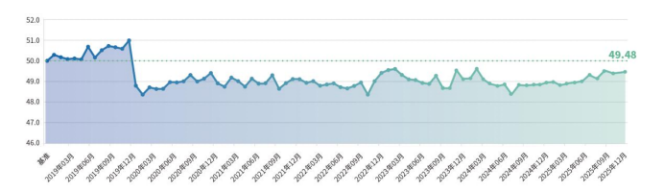
Core Insights - The Inclusive Finance Prosperity Index reached 49.48 points in December 2025, an increase of 0.12 points from November and 0.61 points higher than the same period last year [1] Financing Conditions - The financing prosperity index stood at 54.82 points in December, a slight decrease of 0.01 points from November, with continued growth in credit scale and historically low financing costs [2] - In 2025, new loans totaled 16.27 trillion yuan, reflecting effective monetary policy and sustained demand for credit from enterprises and households [2] - New loans to enterprises amounted to 15.47 trillion yuan, with significant growth in key sectors such as technology, green finance, inclusive finance, elderly care, and digital economy [2] Operational Conditions - The operational prosperity index rose to 48.44 points in December, up 0.16 points from November, indicating improved market activity and increased orders for small and micro enterprises [3] - The Consumer Price Index (CPI) increased by 0.8% year-on-year in December, positively impacting corporate profit expectations and boosting market confidence [3] - The resilience of small and micro enterprises is gradually strengthening due to ongoing policy benefits and recovering market dynamics [3] Industry Performance - Among nine major industries, six showed improvement while three declined in December, with strong demand for agricultural products and logistics boosting the agricultural and transportation sectors [4] - Seasonal increases in demand for community services, maintenance, and housekeeping have enhanced the vitality of the social services sector [4] - The real estate sector also saw some improvement, while the industrial, construction, and wholesale/retail sectors experienced declines [4] Regional Performance - The operational prosperity index across seven regions showed three increases and four declines, with Northeast, South China, and Southwest regions improving, while North China, East China, Central China, and Northwest regions saw declines [5] - The Inclusive Finance Prosperity Index is jointly launched by several financial institutions and reflects the financing and development conditions of small and micro enterprises through both objective and subjective data [5]
高盛首席中国经济学家闪辉:看好2026年中国出口增长
Zhong Guo Jing Ying Bao· 2026-01-22 06:48
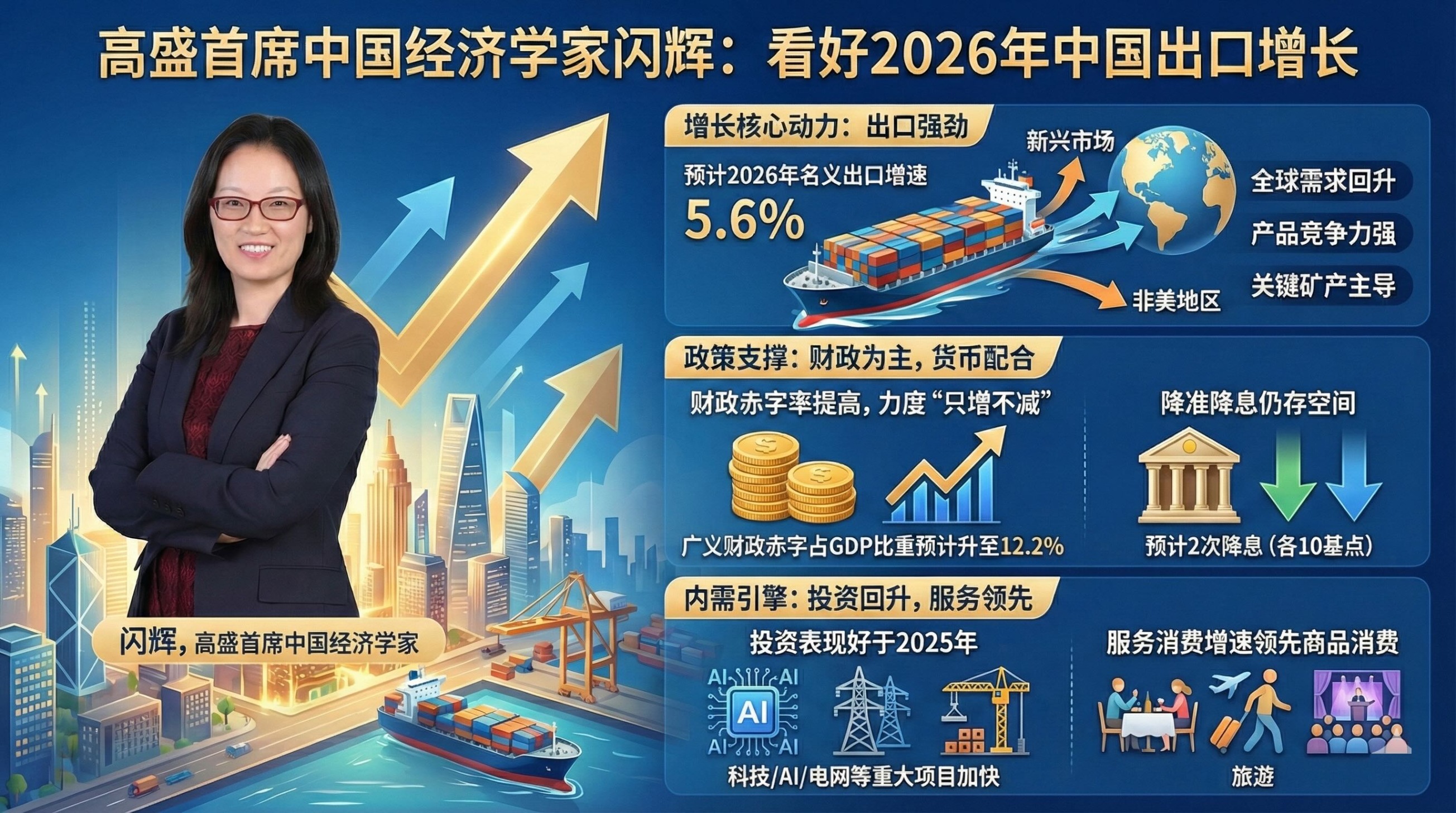
Monetary Policy - The People's Bank of China is expected to implement two interest rate cuts in 2026, each by 10 basis points, with room for further reductions in reserve requirements and interest rates [3][4] - The average reserve requirement ratio for financial institutions is currently 6.3%, indicating potential for a reduction [3] Fiscal Policy - The fiscal deficit rate is projected to increase from 11% of GDP in 2025 to 12.2% in 2026, with overall spending expected to increase in key areas [3][4] - The Ministry of Finance emphasizes that the total scale of fiscal deficits, debt, and expenditures will be maintained at necessary levels to ensure spending does not decrease [4] Economic Growth - China's exports are anticipated to remain strong in 2026, driven by global economic growth, expansion into emerging markets, and China's competitive product strength [5] - In 2025, China's total foreign trade reached 45.47 trillion yuan, a 3.8% increase year-on-year, maintaining its position as the world's largest goods trader [4][5] Investment Outlook - Investment performance in 2026 is expected to improve compared to 2025, with significant projects in technology, AI, and power grids likely to accelerate [5] Consumer Trends - Consumption is expected to show structural differentiation, with service consumption growth outpacing that of goods consumption in 2026 [6]

三菱日联:本周日本央行没有充分理由急于再次加息
Ge Long Hui· 2026-01-22 06:25
1月22日,日本央行预计将在周四开始的为期两天的政策委员会会议上维持利率不变,尽管日本国债价 格仍不稳定,日元也持续走弱。 责任编辑:栎树 美股频道更多独家策划、专家专栏,免费查阅>> 三菱日联首席经济学家Shinichiro Kobayashi表示:"货币政策变化的效果需要一段时间才能显现出来。 我认为在此次会议上没有充分的理由急于再次加息。旨在通过加息来遏制日元贬值的努力可能会助长长 期利率的上升趋势,而这一趋势目前正以相当快的速度发展。日本央行有可能会被迫提高利率以遏制日 元的贬值趋势,不过也不能保证这样的举措会奏效。" ...