
反内卷政策

Search documents
需求支撑不足,猪价延续低位
Zhong Xin Qi Huo· 2025-09-05 05:17
1. Report Industry Investment Ratings - **Oils and Fats**: Expected to be volatile in the short term and likely to strengthen in the medium term [5] - **Protein Meal**: Expected to remain range - bound [5] - **Corn and Starch**: Short - term: Consider closing out short positions and look for short - selling opportunities on rebounds; Long - term: Support for low - buying in far - month contracts [6][7] - **Hogs**: Expected to be volatile. Spot and near - month prices are likely to be weak, while far - month contracts are supported by de - capacity expectations [1][7] - **Natural Rubber**: Expected to be volatile and slightly bullish in the short term [10] - **Synthetic Rubber**: Expected to be volatile and slightly bullish in the short term [11] - **Cotton**: Short - term: Range - bound; After new cotton is on the market: May face downward pressure [11][12] - **Sugar**: Expected to be volatile and slightly bearish in the long term; Short - term: Range - bound between 5500 - 5750 [15] - **Pulp**: Expected to be volatile [16] - **Logs**: Expected to be weak in the near term and stronger in the far term [18] 2. Core Views of the Report - The agricultural market shows a complex pattern with different trends for various products. The hog cycle is still in a downward phase in the short - to - medium term but may turn around in 2026 if de - capacity policies are implemented. Oils and fats are affected by factors such as weather, trade, and demand, with short - term volatility and medium - term upward potential. Protein meal is expected to remain range - bound. Other products like natural rubber, cotton, etc., also have their own supply - demand and market factors influencing their price trends [1][5] 3. Summary by Related Catalogs 3.1 Oils and Fats - **Logic**: Due to concerns about US soybean demand, US soybeans declined on Wednesday, and domestic oils continued to consolidate. The macro environment includes a weaker US dollar and falling crude oil prices. The US soybean growing area is affected by drought, and the export outlook is pessimistic. Domestic soybean imports are expected to decrease seasonally, and palm oil inventory accumulation may be limited. Rapeseed oil inventory is slowly falling but still high year - on - year [5] - **Outlook**: Short - term: Volatile adjustment; Medium - term: Likely to strengthen [5] 3.2 Protein Meal - **Logic**: International soybean prices are affected by weather, with a possible reduction in US soybean yields in the September report. Brazilian soybean premiums have adjusted, and US soybean exports are affected by the trade war. Domestically, the market is range - bound, and demand may improve as the temperature drops [5] - **Outlook**: Range - bound. Hold long positions at 2900 - 2910 and add positions on dips. Oil mills are advised to sell on rallies, and downstream enterprises can buy basis contracts or price at low levels [5] 3.3 Corn and Starch - **Logic**: Corn prices are generally stable, with local declines. Supply is affected by the release of old - crop inventory and the upcoming new - crop supply. Demand is weak as feed enterprises have sufficient inventory. The price difference between corn and wheat is increasing, and wheat substitution may decline [6][7] - **Outlook**: Short - term: Close out short positions and look for short - selling opportunities on rebounds; Long - term: Support for low - buying in far - month contracts [6][7] 3.4 Hogs - **Logic**: Supply is abundant in the short term, with an expected increase in the second half of the year. Demand shows a stable ratio of fat to lean pigs. Inventory weight has decreased slightly. In the long term, de - capacity policies may drive price increases in 2026 if implemented [1][7] - **Outlook**: Volatile. Spot and near - month prices are likely to be weak, while far - month contracts are supported by de - capacity expectations [1][7] 3.5 Natural Rubber - **Logic**: The price is range - bound between 157 - 161. There are many speculation themes, and the short - term supply is limited while demand is stable. The price may rise due to seasonality [10] - **Outlook**: Volatile and slightly bullish in the short term [10] 3.6 Synthetic Rubber - **Logic**: The price is range - bound, following natural rubber and supported by the cost of raw material butadiene. Butadiene supply is under no significant pressure, and demand is stable [11] - **Outlook**: Volatile and slightly bullish in the short term [11] 3.7 Cotton - **Logic**: The current low - inventory and improving - demand situation provides support for cotton prices. The expected increase in purchase prices is limited by the expected large increase in new cotton production. After new cotton is on the market, prices may face downward pressure [11][12] - **Outlook**: Short - term: Range - bound; After new cotton is on the market: May face downward pressure [11][12] 3.8 Sugar - **Logic**: International sugar production is expected to increase, and domestic imports are rising, resulting in downward pressure on prices [15] - **Outlook**: Long - term: Volatile and slightly bearish; Short - term: Range - bound between 5500 - 5750 [15] 3.9 Pulp - **Logic**: The decline is mainly due to the low acceptance of BCTMP pulp. After the 09 contract delivery, the pressure may be alleviated. The market shows a differentiated performance among different types of pulp [16] - **Outlook**: Volatile [16] 3.10 Logs - **Logic**: The price decline is due to lower foreign quotes and weaker domestic spot prices. The market is in a game between weak reality and peak - season expectations. Supply pressure will ease in the coming weeks [17][18] - **Outlook**: Weak in the near term and stronger in the far term [18]
长信改革红利混合:2025年上半年末换手率达823.77%
Sou Hu Cai Jing· 2025-09-05 05:03
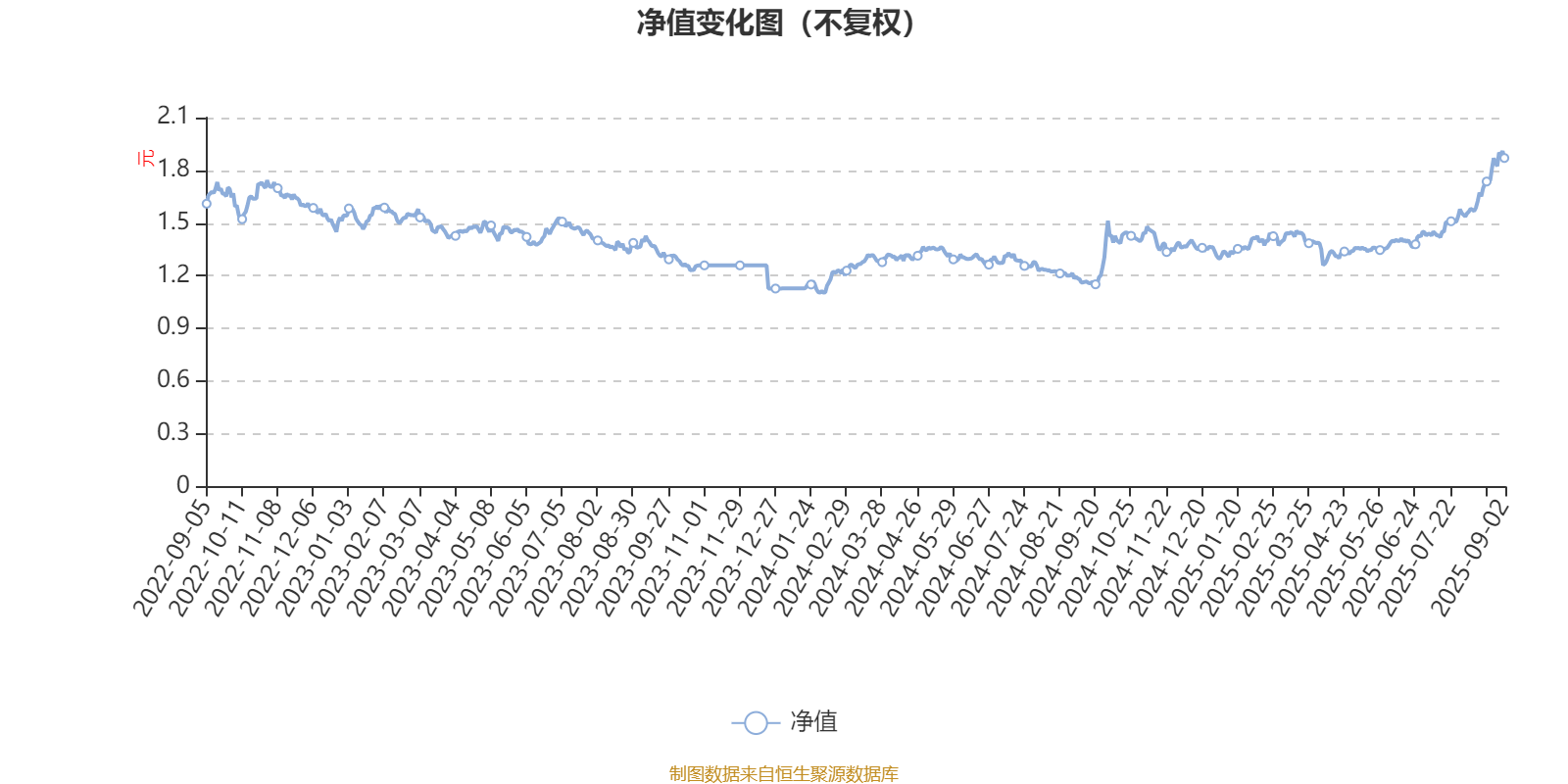
Core Viewpoint - The AI Fund Changxin Reform Dividend Mixed Fund (519971) reported a profit of 781,500 yuan for the first half of 2025, with a weighted average profit per fund share of 0.1123 yuan, and a net value growth rate of 8.21% during the reporting period [3][32]. Fund Performance - As of September 2, the fund's unit net value was 1.87 yuan, with a one-year cumulative net value growth rate of 54.94%, the highest among the three funds managed by the fund manager Zhang Ziqiao [3]. - The fund's performance over different time frames includes a three-month net value growth rate of 37.70%, a six-month growth rate of 36.20%, and a one-year growth rate of 57.80%, ranking 90/880, 81/880, and 194/880 respectively among comparable funds [5]. Fund Management Insights - The fund management indicated a focus on domestic demand and the political bureau's growth stabilization policies, as well as cyclical sectors and technology growth opportunities for the second half of the year [3]. - The management plans to maintain allocations in high-growth sectors such as overseas computing power, military industry, and domestic computing power, while also monitoring supply-side reform opportunities due to anticipated "anti-involution" policies [3]. Valuation Metrics - As of June 30, 2025, the fund's weighted average price-to-earnings (P/E) ratio was approximately 30.16 times, significantly higher than the industry average of 15.75 times [10]. - The fund's weighted average price-to-book (P/B) ratio was about 3.46 times, compared to the industry average of 2.52 times, and the weighted average price-to-sales (P/S) ratio was 2.76 times, against an industry average of 2.16 times [10]. Growth Metrics - For the first half of 2025, the fund's weighted average revenue growth rate was 0.08%, and the weighted average net profit growth rate was 0.4%, with a weighted annualized return on equity of 0.11% [19]. Risk and Return Metrics - The fund's three-year Sharpe ratio was 0.2644, ranking 185/875 among comparable funds [26]. - The maximum drawdown over the past three years was 29.42%, with the highest quarterly drawdown occurring in Q2 2022 at 19.05% [28]. Fund Composition - As of June 30, 2025, the fund had a total of 722 holders, with a total of 6.6512 million shares held, where management employees held 424,000 shares (6.44%), institutions held 37.48%, and individual investors held 62.52% [35]. - The fund's top ten holdings included companies such as Shenghong Technology, Xiaoshangpin City, and Zhimingda [40].

债券市场2025年8月月报:震荡区间上移博弈修复机会-20250905
Nan Jing Yin Hang· 2025-09-05 03:37
Report Industry Investment Rating The provided content does not mention the report industry investment rating. Core Views of the Report - Overseas markets: Since August, the US has raised tariffs, with its economy remaining resilient, inflation rising, and employment slowing unexpectedly. The Fed has hinted at rate cuts, leading to a decline in US Treasury yields and a slight depreciation of the US dollar. The eurozone economy is showing signs of improvement, with inflation remaining moderate, and the euro is expected to appreciate slightly against the US dollar. Japan's economy presents a mixed picture, with tariffs suppressing exports and core inflation cooling, and the yen is expected to fluctuate slightly against the US dollar. The narrowing of the Sino-US yield spread, the release of domestic entities' foreign exchange settlement demand, and the inflow of foreign capital into the domestic stock market have led to a slight appreciation of the RMB against the US dollar, and it is expected to continue to appreciate slightly in the short term [3]. - Macroeconomic fundamentals: In July, both demand and production converged, with the demand side experiencing a larger decline, partly due to falling prices. The production side showed a slight decline, indicating the implementation of anti-involution policies, but overall, it remained resilient. Export data slightly exceeded expectations, but there is downward pressure in the future. The bond market has largely anticipated the weakness in aggregate demand but is sensitive to the upward shift in the price center. As the inflation center rises, the bottom of bond yields will gradually increase [3]. - Monetary policy and liquidity: Since August, the central bank has made net injections, and the short-term capital price center has shifted downward. Looking ahead, the stock market may experience short-term fluctuations, and there are concerns about market overheating and capital idling. The supply of government bonds will remain high, and there will be pressure on the maturity of interbank certificates of deposit, leading to fluctuations in the end-of-quarter capital market. Overall, although there are more disturbances in the capital market, the downward trend in financing costs continues, and liquidity does not have a basis for a trend tightening [4]. - Interest rate bond strategy: Since August, bond yields have first declined and then risen due to fluctuations in industrial product prices under anti-involution policies. Looking ahead, aggregate demand remains weak, but the bond market's reaction to fundamentals is gradually dulling. There are increasing interference factors in the bond market, including the impact of anti-involution policies on prices, the stock market's rise, and the increase in bond interest income tax. However, given the weak demand, the possibility of a significant increase in interest rates is low, and the interest rate center is expected to rise, with the oscillation range also shifting upward. Trading desks can seize repair opportunities when interest rates rise, while allocation desks can intervene when interest rates reach the upper limit of the range, and medium- and long-term bonds are more valuable for allocation [4]. - Credit bond strategy: In August, the "stock-bond seesaw" effect continued to suppress the bond market, and the redemption pressure of funds intensified the volatility of long-term interest rates. As the bond market adjusts, the cost-effectiveness of medium- and high-grade credit bonds with a maturity of three years has increased, but the credit spread is still relatively low. It is recommended to focus on defensive strategies, appropriately reduce duration, and pay attention to coupon opportunities for bonds with a maturity of less than three years. The central bank has taken measures to maintain a balanced and loose liquidity environment, and the pressure on further significant price increases for certificates of deposit may be controllable [5]. Summary by Relevant Catalogs Part I: Overseas Markets - US economic situation: Since August, the US manufacturing and service sectors have expanded significantly. However, the employment market has slowed unexpectedly, and core inflation has continued to rise. The Fed is likely to implement a preventive 25-basis-point rate cut in September. The Fed has been gradually reducing its balance sheet, leading to a marginal convergence of US dollar liquidity. The primary demand for US Treasury bonds has weakened again, and long-term Treasury bond yields face upward pressure. The US dollar is expected to depreciate slightly in the short term [8][10][16]. - Eurozone economic situation: The eurozone economy is showing signs of improvement, with inflation remaining moderate. The euro has appreciated against the US dollar and is expected to continue to appreciate slightly in the short term [31][34]. - Japanese economic situation: Japan's economy presents a mixed picture, with external challenges increasing and core inflation cooling. The yen has appreciated against the US dollar and is expected to fluctuate slightly in the short term [39][44]. - RMB exchange rate situation: Since July, the inversion of the Sino-US Treasury yield spread has gradually decreased, and domestic entities' foreign exchange settlement demand has continued to be released. The RMB has appreciated slightly against the US dollar and is expected to continue to appreciate slightly in the short term [49][55]. - Gold market situation: In August, the price of gold fluctuated upward within a range. Non-commercial net long positions decreased slightly, while gold ETFs continued to flow in. Emerging central banks continued to purchase gold, supporting the medium- and long-term price of gold. It is expected that the price of gold will fluctuate at a high level in the short term [58][65]. Part II: Domestic Macroeconomy - Investment situation: From January to July, the growth rate of fixed asset investment continued to decline, with the growth rates of real estate, infrastructure, and manufacturing investment all falling. Real estate investment is still in the process of bottoming out, and the growth rate of real estate sales has slightly rebounded, while the land transaction premium rate has decreased. The downstream demand for steel is weak, and the price increase is not well supported [71][75][80]. - Consumption situation: In July, the growth rate of consumption continued to decline, mainly due to the diminishing effect of subsidies and the decline in automobile consumption [83]. - Export situation: From January to July, the cumulative year-on-year growth rate of exports was 6.1%, and the growth rate in July was 7.2%, showing strong resilience. However, due to factors such as the increase in tariffs and the overdraft effect of pre-exporting, the export growth rate is expected to decline in the future [86]. - Production situation: From January to July, the cumulative year-on-year growth rate of industrial added value was 6.3%, showing a slight slowdown. The operating rates of the steel and coal industries have generally increased [90][93]. - Employment situation: In July, the urban surveyed unemployment rate increased seasonally, and the employment demand of small and medium-sized enterprises decreased rapidly [96]. - Inflation situation: In July, the year-on-year growth rate of CPI was 0%, and the year-on-year growth rate of core CPI was 0.8%, showing an upward trend. The year-on-year growth rate of PPI stopped falling, and it is expected that the decline will gradually narrow in the future [99][102]. - VAT new policy: Since August 8, 2025, the interest income of newly issued government bonds, local government bonds, and financial bonds will be subject to VAT. This policy will lead to an increase in the spread between new and old bonds, benefit interbank certificates of deposit and credit bonds, and have an impact on financial institutions [103][104][106]. Part III: Liquidity and Monetary Policy - Liquidity review: In August, the central bank made net injections, and the short-term capital price center shifted downward, while the long-term capital price center changed little. The trading volume of pledged repurchase decreased in the middle and late August. The growth rate of M1 and M2 exceeded expectations, and the growth rate of social financing increased [116][121][130]. - Liquidity outlook: In September, the supply of government bonds is expected to remain high, and the maturity pressure of interbank certificates of deposit is large, leading to increased disturbances in the end-of-quarter capital market. However, given the weak demand, the downward trend in financing costs continues, and liquidity does not have a basis for a trend tightening [133]. Part IV: Interest Rate Bond Strategy - Interest rate bond trend: Since August, bond yields have generally shown an upward trend, mainly due to the rise of the stock market and the increase in bond interest income tax. The yield curve has become steeper, and the medium- and long-term spreads are relatively large [137][138][142]. - Investment strategy: Trading desks can seize repair opportunities when interest rates rise, while allocation desks can intervene when interest rates reach the upper limit of the range, and medium- and long-term bonds are more valuable for allocation [4].
黑色金属数据日报-20250905
Guo Mao Qi Huo· 2025-09-05 03:00
Report Industry Investment Rating No relevant content provided. Core Viewpoints - Steel market shows weak supply and demand. After the military parade, production will resume, but demand remains weak, suppressing prices. Steel futures valuation has been restored to a neutral range, and downstream buyers can consider selective hedging [2]. - The short - term fundamentals of ferrosilicon and silicomanganese are poor, with prices under pressure. Although the "anti - involution" policy provides long - term support, current supply is increasing, and demand may be weak, with high inventory and de - stocking pressure [2]. - Coking coal and coke prices are weak. Spot prices are falling, and the futures market is also under pressure. The market expects 2 - 3 rounds of price cuts for coke in September. However, due to factors such as the upcoming National Day and winter storage, and the "anti - involution" policy, the downward space may be limited [4]. - Iron ore prices are in a shock range. Although iron ore supply is expected to increase in the second half of the year, the pre - National Day restocking demand provides some support. The 01 contract still has effective support at the bottom [5]. Summary by Related Catalogs Futures Market - On September 4, for far - month contracts, RB2605 closed at 3167 yuan/ton, down 1 yuan (- 0.03%); HC2605 closed at 3325 yuan/ton, up 9 yuan (0.27%); J2605 closed at 1677.5 yuan/ton, down 18 yuan (- 1.06%); JM2605 closed at 1149.5 yuan/ton, down 15 yuan (- 1.29%). For near - month contracts, RB2601 closed at 3117 yuan/ton, down 2 yuan (- 0.06%); HC2601 closed at 3313 yuan/ton, up 8 yuan (0.24%); J2601 closed at 1581.5 yuan/ton, down 22 yuan (- 1.37%); JM2601 closed at 1094.5 yuan/ton, down 22 yuan (- 1.97%) [1]. - The cross - month spreads on September 4 were: RB2601 - 2605 was - 50 yuan/ton, HC2601 - 2605 was - 12 yuan/ton, J2601 - 2605 was - 96 yuan/ton, JM2601 - 2605 was - 55 yuan/ton [1]. - The spread/ratio/profit on September 4: the coil - to - rebar spread was 196 yuan/ton, the rebar - to - ore ratio was 3.94, the coal - to - coke ratio was 1.44, the rebar futures profit was - 37.48 yuan/ton, and the coking futures profit was 125.82 yuan/ton [1]. Spot Market - On September 4, the spot prices of Shanghai, Tianjin, and Guangzhou rebar were 3210 yuan/ton, 3210 yuan/ton, and 3260 yuan/ton respectively; the price of Tangshan billet was 2960 yuan/ton, and the Platts Index was 105.1 [1]. - The spot prices of Shanghai, Hangzhou, and Guangzhou hot - rolled coils were 3370 yuan/ton, 3420 yuan/ton, and 3360 yuan/ton respectively; the billet - to - product spread was 250 yuan/ton, and the price of PB fines at Rizhao Port was 777 yuan/ton [1]. - The spot prices of Super Special Powder at Qingdao Port, etc. were 670 yuan/ton, 715 yuan/ton, etc.; the price of coking coal at Ganqimaodu was 1180 yuan/ton, the ex - warehouse price of quasi - first - grade coke at Qingdao Port was 1530 yuan/ton, and the price of PB fines at Qingdao Port was 777 yuan/ton [1]. - On September 4, the basis of HC, RB, J, and JM main contracts were 57 yuan/ton, 93 yuan/ton, 98.66 yuan/ton, and 115.5 yuan/ton respectively [1]. Investment Strategies - For steel, adopt a wait - and - see approach on a single - side basis and use futures or options for hedging at appropriate times [2][6]. - For ferrosilicon and silicomanganese, short on rallies [6]. - For coking coal and coke, gradually take profit on previous short positions and consider batch - wise layout of medium - term long positions [6].
大越期货玻璃早报-20250905
Da Yue Qi Huo· 2025-09-05 02:26
交易咨询业务资格:证监许可【2012】1091号 大越期货投资咨询部 胡毓秀 从业资格证号:F03105325 投资咨询证号:Z0021337 联系方式:0575-85226759 影响因素总结 重要提示:本报告非期货交易咨询业务项下服务,其中的观点和信息仅作参考之用,不构成对任何人的投资建议 。 我司不会因为关注、收到或阅读本报告内容而视相关人员为客户;市场有风险,投资需谨慎。 玻璃早报 2025-9-5 每日观点 玻璃: 1、基本面:玻璃生产利润回落,行业冷修放缓,开工率、产量下降至历史同期低位;下游深加工 订单不及往年同期,地产终端需求疲弱;偏空 2、基差:浮法玻璃河北沙河大板现货1056元/吨,FG2601收盘价为1139元/吨,基差为-83元,期 货升水现货;偏空 3、库存:全国浮法玻璃企业库存6305万重量箱,较前一周增加0.77%,库存在5年均值上方运行; 偏空 4、盘面:价格在20日线下方运行,20日线向下;偏空 5、主力持仓:主力持仓净空,空减;偏空 6、预期:玻璃基本面疲弱,短期预计震荡偏弱运行为主。 利多: 1、"反内卷"政策影响下,浮法玻璃行业存产能出清预期。 利空: 1、地产终端需求 ...
建信期货多晶硅日报-20250905
Jian Xin Qi Huo· 2025-09-05 02:20
Report Date - Date: September 5, 2025 [2] Industry Investment Rating - Not provided in the content Core Viewpoints - The polysilicon market continues to show high - level fluctuations. The price of the main contract of polysilicon remains high, and the spot price also rises. However, the terminal demand decline pressure will gradually spread to the upstream of the industrial chain, and the market needs more confirmed policies to break through the high - level resistance [4] Summary by Directory 1. Market Review and Outlook Market Performance - The price of the main polysilicon contract PS2511 closed at 52,195 yuan/ton, up 0.55%. The trading volume was 268,080 lots, and the open interest was 145,950 lots, with a net decrease of 3,260 lots [4] Future Outlook - The transaction price range of polysilicon n - type re - feedstock is 47,000 - 52,000 yuan/ton, with an average transaction price of 49,000 yuan/ton, up 2.30% week - on - week. In September, due to the production limit and sales control policy, the monthly production is expected to be flat compared with the previous month, down from the previous expectation of 145,000 tons, which can meet the downstream demand of 56.8GW, higher than the expected battery production. The terminal demand decline pressure will gradually spread to the upstream of the industrial chain, and the spot price increase has led the industry out of the loss - making situation. The market is mainly in high - level fluctuations and needs more confirmed policies to break through the resistance [4] 2. Market News - On September 3, the number of polysilicon warehouse receipts was 6,870 lots, unchanged from the previous trading day. From January to July 2025, the cumulative photovoltaic installed capacity reached 1,109.6GW, and the newly - added installed capacity was 223.25GW. In July, the newly - added installed capacity was 11GW, a year - on - year decrease of 47.7%, hitting a new low in 2025 [5]
广发早知道:汇总版-20250905
Guang Fa Qi Huo· 2025-09-05 02:13
Report Industry Investment Rating No relevant content provided. Core Viewpoints of the Report - The A-share market experienced a significant correction, with major indices and most sectors declining. The consumer sector bucked the trend, while the TMT sector saw a deep correction. The four major stock index futures also declined, and the basis of the main contracts showed a neutral oscillation. Given the high volatility and the potential for the A-share market to enter a high-level oscillation pattern after a large increase, it is recommended to wait and see. [2][3][4] - The Treasury bond futures mostly closed higher, but short-term trading may remain range-bound. The market should continue to monitor the stock market trend and the release of economic data in August to assess the impact on the bond market. A range trading strategy is suggested, with attention paid to the equity market and fundamental changes. [5][6] - The precious metals market ended its consecutive gains and slightly declined due to the fading of risk aversion and profit-taking by long positions at high levels. With an increased probability of a Fed rate cut in September, the price of gold is expected to rise to over $3,600 in the short term, while silver prices may see increased volatility and are recommended for high-sell and low-buy operations. [7][9][10] - The container shipping futures (EC) showed a weak oscillation. The spot prices continued to decline, and the futures market faced pressure from the weak spot market. There may be a bottom-fishing opportunity for the December contract, and a spread arbitrage strategy between the December and October contracts is recommended. [11][12] - Most non-ferrous metals showed various trends. For example, copper prices had an upward trend but faced constraints; alumina showed a weak oscillation; aluminum prices were expected to remain range-bound; and zinc prices were likely to oscillate. The market conditions and trends of each metal were affected by factors such as supply and demand, macro policies, and inventory changes. [13][16][18] - In the black metal market, steel prices were restricted by production cuts and weak demand during the off-season. Iron ore prices followed the steel price trend, with increased shipments and arrivals. Coking coal prices were weak, and coke prices faced a situation where the seventh round of price increases had been implemented, but the eighth round was blocked. [40][41][46] - In the agricultural product market, the expected high yield of US soybeans suppressed the market, while the domestic market for meal products had a positive outlook. The pig market had limited supply-demand contradictions, and the corn market showed a weak and oscillating trend. [53][54][59] Summary by Directory Financial Derivatives - Financial Futures Stock Index Futures - Market situation: The A-share market continued to correct on Thursday, with major indices significantly declining. The consumer sector rose, while the TMT sector fell sharply. The four major stock index futures also declined, and the basis of the main contracts showed a neutral oscillation. [2][3] - News: The Ministry of Industry and Information Technology and the State Administration for Market Regulation issued a plan to stabilize the growth of the electronic information manufacturing industry from 2025 - 2026. Overseas, the Fed's Beige Book indicated little change in economic activity, and consumer spending was flat or decreased. The number of job openings in the US in July dropped to a 10 - month low. [3][4] - Funds: On September 4, the A-share trading volume increased, and the northbound capital trading volume was 332.562 billion yuan. The central bank conducted a net withdrawal of 15.08 billion yuan through reverse repurchase operations. [4] - Operation suggestion: As the impact of monetary policy in the second half of the year on the equity market is crucial, and the A-share market may enter a high-level oscillation pattern after a large increase, it is recommended to wait and see for the next - stage direction. [4] Treasury Bond Futures - Market performance: Treasury bond futures mostly closed higher, but the yields of some spot bonds rose. The short - term trading of Treasury bond futures may remain range - bound. [5] - Funds: The central bank conducted a net withdrawal of funds through reverse repurchase operations, but the inter - bank funds were still relatively loose. The central bank planned to conduct a 100 - billion - yuan 3 - month outright reverse repurchase operation. [6] - Operation suggestion: Monitor the stock market trend and the release of economic data in August. A range trading strategy is recommended, with attention paid to the equity market and fundamental changes. [6] Financial Derivatives - Precious Metals - Market review: US employment data showed signs of weakness, while the service industry PMI expanded. Fed officials had different views on interest rate cuts. The precious metals market ended its consecutive gains and slightly declined due to the fading of risk aversion and profit - taking by long positions at high levels. [7][8][9] - Future outlook: With an increased probability of a Fed rate cut in September, gold prices are expected to rise to over $3,600 in the short term. Silver prices may see increased volatility, and high - sell and low - buy operations are recommended. [9][10] - Funds: The holdings of gold and silver ETFs increased significantly in August, and the net long speculative positions showed an upward trend. [10] Financial Derivatives - Container Shipping Futures (EC) - Spot quotes: As of September 5, the spot prices of major shipping companies continued to decline slowly. [11] - Shipping indices: As of September 1, the SCFIS European line index and the US West line index declined. As of August 29, the SCFI composite index rose, but the Shanghai - Europe freight rate decreased. [11] - Fundamentals: As of September 2, the global container shipping capacity increased year - on - year. The Eurozone's composite PMI and the US manufacturing PMI showed different trends. [11] - Logic: The futures market declined, and the upward momentum was suppressed by the weak spot market. There may be a bottom - fishing opportunity for the December contract, and a spread arbitrage strategy between the December and October contracts is recommended. [12] - Operation suggestion: Expect a weak oscillation and consider a spread arbitrage strategy between the December and October contracts. [12] Commodity Futures - Non - Ferrous Metals Copper - Spot: As of September 4, copper prices rose, but the spot trading was weak. [13] - Macro: The Fed's stance became more dovish, increasing the probability of a rate cut in September. Key events in September, such as the release of economic data and the FOMC meeting, may cause market fluctuations. [13][14] - Supply: The TC of copper concentrate was at a low level. The domestic electrolytic copper production in August decreased slightly month - on - month and was expected to decline further in September due to factors such as maintenance and supply shortages. [14] - Demand: The operating rates of copper rod production decreased. The domestic demand remained resilient, but there was marginal pressure in Q3. The power and new energy sectors supported the demand. [15] - Inventory: The LME copper inventory decreased, while the domestic social inventory and COMEX copper inventory increased. [15] - Logic: The Fed's dovish stance boosted copper prices, but the upside was limited by concerns about stagflation. The fundamentals showed a "weak reality + stable expectation" state. Copper prices are expected to at least oscillate and may enter a new upward cycle when the commodity and financial attributes resonate. [16] - Operation suggestion: The main contract is expected to operate in the range of 79,000 - 81,000 yuan/ton. [16] - Short - term view: Oscillation. [16] Alumina - Spot: On September 4, the spot prices of alumina in various regions decreased, and the inventory decreased slightly from a high level, causing the spot prices to loosen. [16] - Supply: In August 2025, the production of metallurgical - grade alumina in China increased year - on - year and month - on - month. With the industry still profitable, the operating capacity is expected to continue to increase slightly in September. [17] - Inventory: As of September 4, the port inventory remained unchanged week - on - week, while the registered warehouse receipts increased. [17] - Logic: The alumina futures oscillated, and the market was dominated by fundamentals. The supply was under pressure due to new capacity, while the demand was weak. The inventory continued to accumulate, suppressing the price. The downside is limited, and the upside requires supply disruptions or sentiment catalysts. [18] - Operation suggestion: The main contract is expected to operate in the range of 2,900 - 3,200 yuan/ton. Consider short - selling on rallies in the medium term. [18][19] - View: Weak oscillation, short - selling on rallies in the medium term. [19] Aluminum - Spot: On September 4, the spot price of A00 aluminum decreased, and the premium increased. [19] - Supply: In August 2025, the domestic electrolytic aluminum production increased year - on - year and month - on - month. The proportion of molten aluminum increased, and the ingot casting volume decreased. [19] - Demand: The operating rates of downstream industries showed marginal improvement. [20] - Inventory: On September 4, the domestic electrolytic aluminum social inventory increased week - on - week, and the inventory inflection point was not clear. [20][21] - Logic: The Fed's rate - cut expectation boosted the market sentiment, but the high price suppressed downstream procurement, and the inventory increase pressured the price. Aluminum prices are expected to remain range - bound, and attention should be paid to the actual demand during the peak season, inventory changes, and macro - policy implementation. [21] - Operation suggestion: The main contract is expected to operate in the range of 20,400 - 21,000 yuan/ton. [21] - View: Wide - range oscillation. [21] Aluminum Alloy - Spot: On September 4, the spot price of ADC12 aluminum alloy remained unchanged. [21] - Supply: In July, the production of recycled aluminum alloy ingots increased, and the operating rate increased. In August, the industry was in the off - season, but some enterprises may increase production in anticipation of the peak season. [22] - Demand: In August, the demand was weak, but it showed marginal improvement at the end of the month. The demand is expected to recover moderately in September. [22] - Inventory: The social inventory increased due to the off - season. [22] - Logic: The futures price oscillated with the aluminum price. The supply of scrap aluminum was tight, and the demand was in the off - season. As the peak season approaches, the spot price is expected to remain stable, and the price difference with aluminum may converge. [23][24] - Operation suggestion: The main contract is expected to operate in the range of 20,000 - 20,600 yuan/ton. Consider a spread arbitrage strategy if the price difference is over 500. [24] - View: Strong oscillation. [24] Zinc - Spot: On September 4, the average price of 0 zinc ingots decreased, and the spot trading improved after the futures price declined. [24] - Supply: The TC of zinc concentrate remained high, and the supply of zinc ore was loose. The production of refined zinc in August was higher than expected, and it is expected to continue to increase in 1 - 9 months of 2025. [25] - Demand: The operating rates of primary processing industries were at a seasonal low but had limited room for further decline. The downstream procurement sentiment improved after the zinc price declined. [26] - Inventory: The domestic social inventory increased, while the LME inventory decreased. [26] - Logic: The supply of zinc ore was loose, and the production of refined zinc was high. The demand was about to enter the peak season, and the spot trading improved. The global inventory was low, providing support for the price. Zinc prices are expected to oscillate, and upward or downward breakthroughs require specific conditions. [27] - Operation suggestion: The main contract is expected to operate in the range of 21,500 - 23,000 yuan/ton. [27] - Short - term view: Oscillation. [27] Tin - Spot: On September 4, the price of 1 tin decreased, and the market trading was mixed. [27] - Supply: In July, the domestic tin ore import decreased, and the supply was difficult to improve in the short term. The tin ingot import increased. [28][29] - Demand and inventory: The operating rate of the soldering tin industry decreased, and the demand was weak. The LME inventory and the warehouse receipts of the Shanghai Futures Exchange increased, while the social inventory decreased. [29] - Logic: The supply of tin ore was tight, and the demand was weak. The tin price oscillated at a high level. If the supply recovers smoothly, consider short - selling on rallies; otherwise, the price is expected to continue to oscillate at a high level. [30] - Operation suggestion: The operating range is expected to be 265,000 - 285,000 yuan/ton. [30] - Recent view: Wide - range oscillation. [30] Nickel - Spot: As of September 4, the price of electrolytic nickel decreased, and the premium of imported nickel remained unchanged. [30] - Supply: In July 2025, the production of refined nickel increased year - on - year and month - on - month, and the monthly production plan is expected to increase slightly. [31] - Demand: The demand for electroplating and alloy was stable, while the demand for stainless steel was general. The demand for nickel sulfate was under pressure. [31] - Inventory: The overseas inventory remained high, the domestic social inventory decreased, and the bonded area inventory remained stable. [31] - Logic: The strengthening of the US dollar suppressed the non - ferrous metal market. The nickel price oscillated weakly, and the cost provided some support. The supply is expected to be loose in the medium term, restricting the upside. The price is expected to adjust within a range. [32] - Operation suggestion: The main contract is expected to operate in the range of 118,000 - 126,000 yuan/ton. [32][33] - Short - term view: Range adjustment. [32] Stainless Steel - Spot: As of September 4, the spot price of 304 cold - rolled stainless steel remained unchanged, and the basis increased. [33][34] - Raw materials: The price of nickel ore was stable, and the price of nickel iron was strong. The price of chrome ore was supported by cost, and the supply of chrome iron was tight. [34] - Supply: In August, the domestic stainless steel production increased, and the production is expected to continue to increase in September. [34] - Inventory: The social inventory decreased slowly, and the warehouse receipts decreased. [35] - Logic: The stainless steel futures oscillated slightly lower. The cost was supported by raw material prices, but the demand was weak. The market is cautiously optimistic about the peak season, but the demand is still weak. The price is expected to oscillate within a range. [36] - Operation suggestion: The main contract is expected to operate in the range of 12,600 - 13,400 yuan/ton. [36][37] - Short - term view: Range oscillation. [36] Lithium Carbonate - Spot: As of September 4, the spot prices of battery - grade and industrial - grade lithium carbonate decreased. The salt factories were reluctant to sell, while the traders were more willing to sell. The downstream procurement was mainly for rigid demand. [37] - Supply: In August, the production of lithium carbonate increased. The supply was affected by factors such as mine permit approval, and imports supplemented the supply. [38] - Demand: The demand was robust and optimistic, but the significant driving force was not obvious. The demand in September is expected to increase. [38] - Inventory: The overall inventory decreased last week, with the upstream inventory decreasing and the downstream inventory increasing. [39] - Logic: The lithium carbonate futures opened low and closed high, and the market sentiment improved. The fundamentals remained in a tight - balance state. The price is expected to oscillate widely around 75,000 yuan/ton and then stabilize. [39][40] - Operation suggestion: Wait and see. [40] - Short - term view: Wide - range oscillation. [40] Commodity Futures - Black Metals Steel - Spot: The steel billet price remained stable, and the spot prices of rebar and hot - rolled coil increased slightly. The January contract of rebar had a premium over the spot, while the January contract of hot - rolled coil had a discount. [40] - Cost and profit: The cost support is expected to weaken due to the limited supply recovery of coking coal and the slight increase in iron ore inventory. The steel profit decreased significantly in August. [41] - Supply: From January to August, the iron element production increased year - on - year. In August, the production increased compared with July, mainly due to the increase in scrap steel consumption. This week, the iron water production decreased due to production restrictions, but it is expected to recover next week. The production of finished steel products decreased less than that of iron water. [41] - Demand: The domestic demand and export increased in the first half of the year, but the domestic demand is expected to weaken seasonally. The steel export remained high. The apparent demand decreased seasonally in August but is expected to recover. [41] - Inventory: The inventory of five major steel products increased, mainly due to the increase in rebar inventory. The inventory increase is expected to slow down in the future. [42] - View: This week, the supply and demand
宝城期货动力煤早报-20250905
Bao Cheng Qi Huo· 2025-09-05 02:02
Report Summary 1. Industry Investment Rating - No industry investment rating is provided in the report. 2. Core Viewpoint - The power coal market is expected to maintain a weak operation in the near term, but the callback space of coal prices may be limited due to supply - side support from the "anti - involution" policy [4]. 3. Summary by Relevant Content Price and Market Logic - **Supply**: In late August, safety supervision in major coal - producing areas remained strict. With the approaching of the September 3rd military parade, the frequency and thoroughness of coal mine safety inspections increased, which continued to suppress coal production [4]. - **Demand**: Although the daily consumption of thermal coal remained high in the short term, as the off - season approached, terminal enterprises became more hesitant, putting downward pressure on coal prices [4]. - **Inventory**: As of August 22nd, the total coal inventory at 9 ports in the Bohai Rim was 2.3264 billion tons, with a significant monthly de - stocking of 370.5 million tons. The inventory was 76.6 million tons lower than the same period last year, and the high - inventory advantage in the first half of the year had been basically eliminated [4].
合成橡胶:仍维持震荡格局
Guo Tai Jun An Qi Huo· 2025-09-05 01:51
Report Industry Investment Rating - The report does not explicitly mention an industry investment rating. Core Viewpoints - In the short - term, under a neutral fundamental situation, synthetic rubber is expected to be in an interval - running stage, with pressure above and support below. The upper pressure comes from the high - supply pattern of butadiene rubber and increased inventory pressure, as well as relatively high short - term butadiene arrivals. The lower support is due to the long - term "anti - involution" and supply - side optimization policies, which support the overall valuation of commodities and reduce investors' risk appetite for short - selling. Overall, butadiene rubber is expected to move within an interval, mainly fluctuating with macro - sentiment during the week [3]. Summary by Relevant Catalogs 1. Fundamental Tracking - **Futures Market**: For the butadiene rubber main contract (10 contract), the daily closing price decreased by 75 yuan/ton to 11,810 yuan/ton, the trading volume increased by 25,435 lots to 130,504 lots, the open interest decreased by 2,330 lots to 26,614 lots, and the trading volume increased by 144,632 ten - thousand yuan to 770,146 ten - thousand yuan [1]. - **Spread Data**: The basis of Shandong butadiene - futures main contract increased by 25 to 90, the monthly spread of BR09 - BR10 increased by 20 to 20. The prices of North China and East China butadiene (private) remained unchanged, South China butadiene (private) decreased by 50 yuan/ton to 11,700 yuan/ton, Shandong butadiene market price (delivery product) decreased by 50 yuan/ton to 11,900 yuan/ton. The prices of Qilu styrene - butadiene (model 1502) and (model 1712) decreased by 50 yuan/ton to 12,350 yuan/ton and 11,350 yuan/ton respectively. The mainstream prices of butadiene in Jiangsu and Shandong decreased by 50 yuan/ton and 25 yuan/ton to 9,350 yuan/ton and 9,575 yuan/ton respectively [1]. - **Fundamental Indicators**: The butadiene rubber operating rate remained unchanged at 76.2727%, the theoretical full cost of butadiene rubber remained unchanged at 12,285 yuan/ton, and the butadiene rubber profit remained unchanged at - 185 yuan/ton [1]. 2. Industry News - As of September 3, 2025, the latest inventory of butadiene in East China ports was about 30,950 tons, an increase of 6,950 tons from the previous period. The arrival of imported ships was relatively concentrated during the week, which led to a significant increase in the inventory of sample ports. And some trade volumes were for sale, so inventory changes should be carefully monitored [2]. - As of September 3, 2025, the inventory of Chinese high - cis butadiene rubber sample enterprises was 31,900 tons, an increase of 200 tons from the previous period, a month - on - month increase of 0.60%. The overall supply of domestic butadiene rubber was sufficient this period. Some private enterprises in Shandong and East China were expected to undergo maintenance, and the raw material market was generally strong, so some traders and downstream buyers followed up. However, the continuous volatile trend of the synthetic rubber futures market still affected the upward movement of the trading center. The inventory of sample production enterprises decreased slightly, while the inventory of sample trading enterprises increased [2][3].
美国ADP就业不及预期,中国央行将开展买断式逆回购
Dong Zheng Qi Huo· 2025-09-05 00:43
Report Date - The report date is September 5, 2025 [1] Core Views - The ADP employment in the US in August was lower than expected, but the market reaction was muted, and the US dollar continued to fluctuate [2][20] - The A-share market experienced a significant adjustment, and short - term adjustment thinking is recommended [3][23] - The central bank will conduct a 100 - billion - yuan outright reverse repurchase operation, and the bond market is cautious, with insufficient upward momentum [4][32] - After the military parade, coal mines are gradually resuming production, and the coking coal and coke market will be mainly in a volatile trend in the short term [5][56] - Macro factors strongly support copper prices in the short term, and copper prices are likely to continue to be volatile and relatively strong [6][78] - The fundamentals of US natural gas have marginally improved in the short term, but the medium - term downward trend remains [7][85] Financial News and Comments Macro Strategy (Gold) - The US officially implemented the US - Japan trade agreement, and Japan plans to increase US rice purchases by 75% [14] - The US ISM non - manufacturing PMI in August was 52, higher than expected [15] - The US ADP employment in August increased by 54,000, slightly lower than expected, indicating a cooling employment market. Gold price fluctuations may increase [16] - Investment advice: In the short term, the multi - empty game near the historical high of gold prices intensifies, and the volatility increases [17] Macro Strategy (Foreign Exchange Futures - US Dollar Index) - The New York Fed President predicted that interest rate cuts would be appropriate in the future, and the US Department of Justice launched a criminal investigation into Fed Governor Lisa Cook [18] - The US ADP employment in August was lower than expected, but the market reaction was muted, and the US dollar continued to fluctuate. Short - term investment advice: The US dollar will remain volatile [20][21] Macro Strategy (Stock Index Futures) - The A - share market was significantly adjusted, with the Shanghai Composite Index down 1.25%, the Shenzhen Component Index down 2.83%, and the ChiNext Index down 4.25%. The market volume decreased, and the over - valuation pressure was released. Short - term investment advice: Reduce long positions in stock index futures or increase the hedging ratio [22][23][24] Macro Strategy (US Stock Index Futures) - Stephen Miran emphasized the independence of the Fed, and Fed Williams said that interest rate cuts would be appropriate in the future. The US ADP employment data in August was lower than expected, but the market risk appetite remained high. Investment advice: The US stock market will be volatile and relatively strong under the expectation of interest rate cuts [25][26][30] Macro Strategy (Treasury Bond Futures) - The central bank will conduct a 100 - billion - yuan outright reverse repurchase operation. The bond market is worried about the strength of the stock market, with insufficient upward momentum. Investment advice: Long positions can be held, but do not chase the high [31][32][33] Commodity News and Comments Agricultural Products (Soybean Meal) - Brazil exported 9.34 million tons of soybeans in August, an increase of 16% year - on - year, and is expected to export 6.75 million tons in September. The weekly export sales report of the US will be released on Friday. Investment advice: The futures price will be mainly volatile, and continue to pay attention to the weather in US soybean - producing areas and Sino - US relations [35][36][37] Agricultural Products (Soybean Oil/Rapeseed Oil/Palm Oil) - The estimated production of Malaysian palm oil in August increased by 2.07% month - on - month. The market is waiting for MPOB and USDA data. Investment advice: In the short term, it will continue to be volatile, and the view of going long at low prices in the medium - long term remains unchanged [38] Agricultural Products (Corn Starch) - The consumption of corn and corn starch in starch sugar products decreased this week. The opening rate and inventory of starch enterprises both decreased, but the supply - demand situation remained weak. Investment advice: The difference between futures and spot prices is at a low level, and the further weakening space is expected to be small [39] Agricultural Products (Corn) - The deep - processing demand for corn increased slightly this week, and the inventory continued to decline. The price is expected to be volatile before the production - determination survey and may decline after that. Investment advice: Pay attention to the opportunity of shorting at high prices [40][41][42] Agricultural Products (Cotton) - The cotton planting area in India decreased slightly year - on - year. The export orders of Indian cotton products decreased, and the government may purchase a record amount of cotton. The external market is in a weak pattern. Investment advice: The Zhengzhou cotton futures will be mainly volatile, and the market is not optimistic during the new cotton listing period [43][45][47] Agricultural Products (Red Dates) - The price of red dates in the Hebei Cui'erzhuang market decreased. The futures price decreased significantly, and the short - term downward trend may continue. Investment advice: Be cautious about entering the market and pay attention to the weather in the producing areas [47][48] Black Metals (Steam Coal) - Japan's coal imports in July increased. The coal price continued its seasonal weakness, and the price may decline faster after the military parade, but it is expected to be supported at around 750 yuan [49] Black Metals (Rebar/Hot - Rolled Coil) - Indonesia launched an anti - dumping investigation into Wuhan Iron and Steel Group's hot - rolled coils. The inventory of five major steel products increased this week, and the demand was weak. Investment advice: The steel price will be volatile in the short term, and pay attention to the release of demand [50][51][52] Black Metals (Iron Ore) - The first blasting at the North Pit of the Iron Valley Mine in Australia was successful. The iron ore price is in a volatile market, and it is supported in the short term but may face pressure in the future. Investment advice: Pay attention to the pressure on finished products and molten iron in 2 - 3 weeks [53] Agricultural Products (Pigs) - Tangrenshen expects the sow capacity utilization rate to reach over 90% by the end of the year. The short - term spot price lacks a significant upward driver, and the supply in the second half of the year remains loose. Investment advice: Treat the November contract with an interval thinking, and wait for a good opportunity to go long on the January and May contracts [55] Black Metals (Coking Coal/Coke) - Coal mines are gradually resuming production after the military parade. The supply is stable in the short term, but the demand side is under pressure. Investment advice: The market will be mainly volatile without policy influence in the short term [56][57] Non - Ferrous Metals (Polysilicon) - The government issued a plan for the stable growth of the electronic information manufacturing industry. The production of polysilicon in September may increase, and the downstream inventory is relatively abundant. Investment advice: When the futures price falls below the spot price, the cost - performance of betting on subsequent policies increases. The price is expected to be between 48,000 - 55,000 yuan/ton [58][59][61] Non - Ferrous Metals (Industrial Silicon) - The social inventory of industrial silicon decreased slightly. The resumption of production of large factories in Xinjiang is slower than expected. Investment advice: The price will be between 8,200 - 9,200 yuan/ton in the short term, and pay attention to interval trading opportunities [62][63] Non - Ferrous Metals (Lead) - The LME lead inventory is at a high level seasonally, and the domestic supply may tighten while the demand may improve. Investment advice: It is recommended to wait and see, and pay attention to the opportunity of domestic - foreign anti - arbitrage [64][65] Non - Ferrous Metals (Zinc) - The LME zinc inventory is at a low level, and the domestic social inventory increased. The short - term macro environment is positive for zinc prices. Investment advice: It is recommended to wait and see for unilateral trading, pay attention to the medium - term positive arbitrage opportunity, and maintain the positive arbitrage idea before the overseas inventory bottoms out [67][68] Non - Ferrous Metals (Nickel) - The LME nickel inventory increased. The price of nickel ore is firm, and the price of nickel iron is expected to be strong. Investment advice: The nickel price is likely to be range - bound, and it is more cost - effective to go long at the low end of the range [69][70][71] Non - Ferrous Metals (Lithium Carbonate) - Kodal Minerals obtained an export license for lithium concentrate. The supply may tighten in September, and the fundamentals support the price. Investment advice: Pay attention to the opportunity of going long after the warehouse receipt peaks and the basis strengthens, and also pay attention to the positive arbitrage opportunity [72][73] Non - Ferrous Metals (Copper) - The International Copper Association became an official observer of the Basel Convention. Freeport McMoRan is promoting expansion projects and calling for US incentives. Macro factors support copper prices in the short term. Investment advice: It is recommended to take a long - biased approach for unilateral trading and wait and see for arbitrage [74][75][79] Energy Chemicals (Liquefied Petroleum Gas) - The weekly commodity volume of domestic liquefied petroleum gas decreased, and the inventory increased. Investment advice: The market will be mainly volatile in the short term [80][81][82] Energy Chemicals (Carbon Emissions) - The CEA price in the carbon market decreased slightly, and the trading volume increased. The supply - demand structure is balanced and loose this year. Investment advice: The CEA price will be volatile and weak in the short term [83][84] Energy Chemicals (Natural Gas) - The US natural gas inventory increased by 55 Bcf week - on - week. The short - term fundamentals have improved marginally, but the medium - term downward trend remains. Investment advice: The gas price will be in a volatile adjustment in the short term [85][86][87] Energy Chemicals (PX) - The PX price decreased, and the load of domestic and overseas PX changed little. Investment advice: The unilateral price will be volatile in the short term, and pay attention to the 11 - 1 positive arbitrage opportunity [88][89][90] Energy Chemicals (PTA) - The terminal weaving load did not continue to increase, and the new orders were insufficient. The PTA supply decreased recently, but there is an expectation of new device production in October. Investment advice: It will be in a short - term volatile adjustment [91][92][93] Energy Chemicals (Caustic Soda) - The price of liquid caustic soda in Shandong increased locally. The supply and demand situation is different in different regions. Investment advice: The spot price may stop rising and fall, and the futures price will be volatile and weak [94][95] Energy Chemicals (Pulp) - The import pulp spot market was generally stable. The fundamentals of pulp are not good. Investment advice: The market will be volatile and weak [96][97] Energy Chemicals (PVC) - The PVC powder market price was stable with a slight decline. The fundamentals are under pressure in the short term, but the downward space is limited. Investment advice: The Indian anti - dumping may have a negative impact, but the downward space is limited [98] Energy Chemicals (Styrene) - The capacity utilization rate of styrene downstream industries changed this week. The short - term inventory pressure may slow down, but the Q4 outlook is weak. Investment advice: The short - term inventory pressure may ease marginally, but the Q4 outlook is weak, and pay attention to the policy variables [100] Energy Chemicals (Bottle Chips) - The export price of bottle chips decreased slightly, and the low - price transactions increased. The industry maintains a 20% production reduction target, and the downstream demand is transitioning to the off - season. Investment advice: The absolute price follows the polyester raw materials, and the processing fee is under pressure [101][102] Energy Chemicals (Soda Ash) - The inventory of domestic soda ash manufacturers decreased this week. The supply is relatively loose in the short term. Investment advice: Adopt the idea of shorting at high prices and pay attention to the supply - side disturbances [103][104] Energy Chemicals (Float Glass) - The price of float glass in Hubei remained unchanged. The market lacks a strong driver, and the cost provides weak support. Investment advice: Be cautious about unilateral operations, and focus on arbitrage operations, such as going long on glass and shorting soda ash when the price difference expands [105] Shipping Index (Container Freight Rate) - Maersk announced a suspension plan during the Chinese Golden Week. The current shipping capacity is under pressure, and the freight rate is in a downward trend. Investment advice: Treat the market with a volatile thinking, pay attention to the shorting opportunity after the emotional increase in October and the long - buying value after the increase in December is reversed [106][107][108]

