信用利差

Search documents
信用债周度观察(20251110-20251114):信用债发行量环比增加,各行业信用利差涨跌互现-20251115
EBSCN· 2025-11-15 07:06
Report Industry Investment Rating - Not mentioned in the report Core Viewpoints - From November 10 to November 14, 2025, the issuance volume of credit bonds increased month - on - month, and the industry credit spreads showed mixed trends [1] Summary by Directory 1. Primary Market 1.1 Issuance Statistics - From November 10 to November 14, 2025, 330 credit bonds were issued, with a total issuance scale of 455.379 billion yuan, a month - on - month increase of 25.31% [1][11] - In terms of issuance scale, 161 industrial bonds were issued, with a scale of 169.68 billion yuan, a 4.09% month - on - month decrease, accounting for 37.26% of the total credit bond issuance scale; 122 urban investment bonds were issued, with a scale of 81.729 billion yuan, a 19.25% month - on - month decrease, accounting for 17.95% of the total scale; 47 financial bonds were issued, with a scale of 203.97 billion yuan, a 139.20% month - on - month increase, accounting for 44.79% of the total scale [1][11] - In terms of issuance term, the average issuance term of credit bonds was 2.75 years. The average issuance term of industrial bonds was 2.25 years, urban investment bonds was 3.51 years, and financial bonds was 2.13 years [1][15] - In terms of issuance coupon rate, the average issuance coupon rate of credit bonds was 2.12%. The average issuance coupon rate of industrial bonds was 2.06%, urban investment bonds was 2.26%, and financial bonds was 1.94% [2][19] 1.2 Cancellation of Issuance Statistics - Two credit bonds cancelled issuance this week, namely "25 Huadian Jiangsu SCP027" and "25 Xingmei 01" [3][24] 2. Secondary Market 2.1 Credit Spread Tracking - This week, industry credit spreads showed mixed trends. Among Shenwan primary industries, the largest upward movement in AAA - rated industry credit spreads was in agriculture, forestry, animal husbandry and fishery, up 6.5BP, and the largest downward movement was in steel, down 3.5BP; for AA + - rated industry credit spreads, the largest upward movement was in electronics, up 1.4BP, and the largest downward movement was in the automobile industry, down 16.6BP; for AA - rated industry credit spreads, the largest upward movement was in transportation, up 0.9BP, and the largest downward movement was in mining, down 3.9BP [3][26] - For urban investment bonds by region, among AAA - rated bonds, the largest upward movement in credit spreads was in Zhejiang, up 3BP, and the largest downward movement was in Yunnan, down 10.2BP; for AA + - rated bonds, the largest upward movement was in Fujian, up 2.6BP, and the largest downward movement was in Yunnan, down 10.6BP; for AA - rated bonds, the largest upward movement was in Chongqing, up 3.1BP, and the largest downward movement was in Henan, down 5.7BP [3][29] 2.2 Trading Volume Statistics - The total trading volume of credit bonds was 1219.783 billion yuan, a 5.53% month - on - month decrease. The top three in terms of trading volume were commercial bank bonds, corporate bonds, and medium - term notes. Specifically, the trading volume of commercial bank bonds was 375.608 billion yuan, a 3.93% month - on - month increase, accounting for 30.79% of the total credit bond trading volume; the trading volume of corporate bonds was 414.081 billion yuan, a 7.86% month - on - month decrease, accounting for 33.95% of the total volume; the trading volume of medium - term notes was 243.078 billion yuan, a 16.01% month - on - month decrease, accounting for 19.93% of the total volume [4][30] 2.3 Active Bonds Traded This Week - The report selects the top 20 urban investment bonds, industrial bonds, and financial bonds in terms of trading volume this week for investors' reference, including information such as bond codes, names, trading volumes, average trading yields, and issuers [32][33][34]
美国大型企业破产数量逼近15年新高
第一财经· 2025-11-14 00:18
Core Insights - The pressure on U.S. corporations is becoming increasingly evident, with bankruptcy filings reaching 655 by the end of October 2025, nearing the total of 687 for the entire year of 2024, indicating a potential 15-year high in bankruptcy numbers [3][4] Bankruptcy Trends - In October alone, there were 68 new bankruptcy filings, slightly above the revised figure of 66 in September, and lower than the peak of 76 in August 2020 [4] - The most affected sectors include industrial companies (98 filings) and consumer discretionary (80 filings), highlighting their sensitivity to tightening financial conditions due to trade policy uncertainty, supply chain disruptions, and rising costs [6][8] Market Reactions - High-profile bankruptcies, such as First Brands Group with over $10 billion in liabilities and Tricolor Holdings, have heightened investor sensitivity to potential defaults, despite some analysts viewing these as isolated incidents [7][8] - The bankruptcy of Office Properties Income Trust (OPI), a real estate investment trust with over $1 billion in debt, further illustrates the pressures in the office REIT sector [7] Credit Market Signals - The high-yield credit default swap index (CDX North American High Yield) reached a peak of 343 basis points in mid-October, reflecting increased risk compensation demands from the market [9][10] - The ongoing rise in credit spreads indicates that refinancing difficulties are increasing, with higher funding costs likely impacting cash flow-challenged companies [10] Industry Concentration of Risk - Among the 655 companies that filed for bankruptcy this year, 345 have been categorized by specific industries, with industrial, consumer discretionary, and healthcare sectors accounting for 223 filings [10] - The combination of demand adjustments and tightening financing conditions is leading to a concentration of credit risk, with market observers noting that credit spreads remain elevated, reflecting cautious risk management in the face of slowing profit growth and persistent cost pressures [10]


美国大型企业破产数量逼近15年新高
Di Yi Cai Jing· 2025-11-13 23:32
Group 1 - The core issue of bankruptcy is concentrated in the industrial and consumer discretionary sectors, with recent defaults by First Brands and Tricolor raising concerns about potential credit risks [1][4] - As of October 31, 2023, there have been 655 bankruptcy filings by large U.S. companies, nearing the projected total of 687 for the entire year, which is likely to set a 15-year high [3][4] - In October alone, there were 68 new bankruptcies, slightly above the revised figure of 66 in September, and higher than the 76 in August, marking the highest monthly total since 2020 [3][4] Group 2 - The most affected sectors this year include industrial companies (98 filings) and consumer discretionary (80 filings), which are particularly sensitive to tightening financial conditions due to trade policy uncertainty, supply chain disruptions, and rising costs [4][5] - Notable bankruptcies include First Brands Group, which filed for bankruptcy with over $10 billion in liabilities, and Tricolor Holdings, which led to JPMorgan writing off approximately $170 million in risk exposure [4][5] - The rise in bankruptcy filings corresponds with the Federal Reserve's interest rate hikes, which have increased financing costs since 2022 [5] Group 3 - The U.S. credit market is showing signs of stress, with the high-yield credit default swap index reaching a peak of 343 basis points in mid-October, before settling at 328 basis points by the end of the month, still above September's low of 302 basis points [6][7] - The widening credit spreads indicate an increased risk premium demanded by investors for high-leverage companies, suggesting that refinancing difficulties are rising and funding costs are likely to impact cash-flow-sensitive firms more quickly [7][8] - There is a noticeable concentration of credit risk, with 345 of the 655 bankruptcies categorized by specific industries, primarily in industrial, consumer discretionary, and healthcare sectors, which together account for 223 filings [7][8]
【固收】产业债发行量保持增长,各行业信用利差整体收窄——信用债周度观察(20251103-20251107)(张旭/秦方好)
光大证券研究· 2025-11-09 23:07
Group 1 - The total issuance of credit bonds this week was 334, with a total scale of 363.403 billion yuan, a decrease of 7.66% week-on-week [4] - Industrial bonds accounted for 48.68% of the total issuance, with 162 bonds issued and a scale of 176.92 billion yuan, an increase of 5.36% [4] - City investment bonds saw a decrease of 20.60%, with 145 bonds issued and a scale of 101.213 billion yuan, representing 27.85% of the total issuance [4] - Financial bonds issued 27 bonds with a scale of 85.270 billion yuan, down 13.12%, making up 23.46% of the total issuance [4] - The average issuance term for credit bonds was 3.01 years, with industrial bonds averaging 2.93 years, city investment bonds 3.19 years, and financial bonds 2.55 years [4] - The overall average coupon rate for credit bonds was 2.18%, with industrial bonds at 2.15%, city investment bonds at 2.25%, and financial bonds at 1.96% [4] Group 2 - The total trading volume of credit bonds was 1,291.166 billion yuan, a decrease of 17.33% week-on-week [6] - The top three types of credit bonds by trading volume were corporate bonds, commercial bank bonds, and medium-term notes [6] - Commercial bank bonds had a trading volume of 361.397 billion yuan, down 21.28%, accounting for 27.99% of the total trading volume [7] - Corporate bonds had a trading volume of 449.388 billion yuan, down 6.83%, making up 34.80% of the total trading volume [7] - Medium-term notes had a trading volume of 289.413 billion yuan, down 26.27%, representing 22.41% of the total trading volume [7]

11月信用债行情或仍可保持乐观:信用分析周报(2025/11/3-2025/11/7)-20251109
Hua Yuan Zheng Quan· 2025-11-09 13:57
Report Industry Investment Rating - The report does not explicitly mention the industry investment rating. Core Viewpoints of the Report - The credit strategy in November can remain relatively optimistic. There are three reasons: First, the historical quantiles of medium - and long - term credit bonds are still at relatively high levels since the beginning of the year, especially the 5Y secondary and perpetual bonds still have room to decline. Second, the restart of Treasury bond trading, the overall loose capital interest rates, and the decline in market risk appetite due to the recent adjustment of the equity market are expected to continue the phased upward trend of credit bonds, and there are more positive factors than negative factors in the bond market currently. Third, the rapid decline in bank liability costs supports banks to significantly increase bond investments [4][42]. Summary According to the Directory 1. This Week's Credit Hot Events - Guangxi Jintou's former Party secretary and chairman are under disciplinary review, with the remaining bond balance of the entity being 19.4 billion yuan [1][9]. - Minister of Finance Lan Fuan stated that not increasing implicit debt should be regarded as an "iron - clad discipline" [1][10]. - On November 5, the National Association of Financial Market Institutional Investors warned four institutions including Dongjin Huai Investment and Jintang Xingjin for non - market - based bond issuance [1][11]. - Two bonds, 25 Xiaoshan Airport MTN002B (green) and 25 Jinneng Coal Industry MTN017, cancelled their issuance due to market factors, with a total planned issuance scale of 1.45 billion yuan [1][12]. 2. Primary Market 2.1 Net Financing Scale - The net financing of traditional credit bonds this week increased compared to last week, and the net financing of asset - backed securities increased by 1.17 billion yuan compared to last week. Among different product types, the net financing of urban investment bonds and industrial bonds increased, while that of financial bonds decreased [2][13]. - In terms of the number of issuances and redemptions, the number of urban investment bond issuances and redemptions decreased, the number of industrial bond issuances increased and redemptions decreased, and the number of financial bond issuances decreased and redemptions increased [15]. 2.2 Issuance Cost - Except for a slight increase in the issuance interest rate of AA urban investment bonds, the issuance interest rates of other bonds with different ratings declined to varying degrees. Specifically, the issuance interest rates of industrial and financial bonds with different ratings decreased by 11 - 29BP compared to last week, the AA urban investment bond issuance interest rate increased by 9BP, and the AA + and AAA urban investment bond issuance interest rates decreased by 19BP and 7BP respectively [18]. 3. Secondary Market 3.1 Trading Volume - The trading volume of credit bonds decreased by 53.4 billion yuan compared to last week. Among them, the trading volume of urban investment bonds and industrial bonds decreased, while that of financial bonds increased slightly. The trading volume of asset - backed securities also decreased [19]. - In terms of turnover rate, the turnover rate of most credit bonds decreased compared to last week [20]. 3.2 Yield - The yield of 5Y AA credit bonds decreased by 7BP compared to last week, and the yield of 3Y AAA + credit bonds increased by 4BP. The yield fluctuations of other credit bonds with different ratings and maturities were within 3BP compared to last week [21]. - Taking the 5Y AA + bonds of each variety as an example, the yields of different varieties rose and fell this week [25]. 3.3 Credit Spreads - Overall, except for a slight widening of the credit spread of the AA + non - ferrous metal industry compared to last week, the credit spreads of other industries and ratings compressed to varying degrees. For example, the credit spread of the AA + non - ferrous metal industry widened by 1BP, and the credit spread of the AA non - banking financial industry compressed by 7BP [28]. 3.3.1 Urban Investment Bonds - By maturity, the 3 - 5Y urban investment credit spreads compressed significantly by 8BP, and the compression of other maturities was within the range of 3 - 5BP [31]. - By region, the urban investment credit spreads in different regions compressed to varying degrees, and many regions have reached historical lows since the beginning of 2024 [33]. 3.3.2 Industrial Bonds - Except for a slight widening of the industrial credit spreads of a few maturities and ratings, most industrial credit spreads compressed to varying degrees [35]. 3.3.3 Bank Capital Bonds - Except for a 5BP and 4BP widening of the credit spreads of 5Y AAA - and AA + bank perpetual bonds respectively, the credit spreads of other secondary and perpetual bonds with different maturities and ratings fluctuated slightly within 2BP [37]. 4. This Week's Bond Market Sentiment - "Xiangyiyou" issued by Shanghai Xiangyuan Investment Holding Co., Ltd. defaulted in essence, and the implied ratings of "17 Fucheng A" and "17 Fucheng B" issued by Fujian Fucheng Group Co., Ltd. were downgraded [40]. 5. Investment Suggestions - Overall, except for a slight widening of the credit spread of the AA + non - ferrous metal industry, the credit spreads of other industries and ratings compressed to varying degrees. In terms of urban investment bonds, the 3 - 5Y urban investment credit spreads compressed significantly, and in terms of industrial bonds, most credit spreads compressed. In terms of bank capital bonds, most credit spreads fluctuated slightly [4][42].
净融资额环比回升,信用利差多数收窄
Xiangcai Securities· 2025-11-09 11:05
Group 1: Report Overview - The report is a weekly credit bond research report by Xiangcai Securities, dated November 9, 2025 [1][2] Group 2: Industry Investment Rating - No industry investment rating is provided in the report Group 3: Core Viewpoints - The credit bond market showed a mixed performance this week. The primary market saw an increase in issuance and net financing, while the secondary market experienced slower trading and a narrowing of most credit spreads. Looking ahead, the credit bond market is expected to continue its volatile pattern, and investors could consider moderately extending the duration and focusing on the narrowing spread opportunities of 5 - year credit bonds [3][4][6] Group 4: Primary Market of Credit Bonds - From November 3 - 9, 2025, a total of 337 credit bonds (excluding policy - bank bonds) were issued, with a scale of about 457.667 billion yuan, and 155 bonds matured, with a total repayment of about 250.715 billion yuan, resulting in a net financing of about 206.952 billion yuan. The issuance volume increased, and the total repayment decreased, leading to a significant rise in net financing [3][9] - By category, enterprise bonds issued 1 bond with a scale of about 1.6 billion yuan, a net financing of about - 3.066 billion yuan; corporate bonds issued 131 bonds with a scale of about 103.88 billion yuan, a net financing of about 34.5 billion yuan; medium - term notes issued 94 bonds with a scale of 91.915 billion yuan, a net financing of about 30.254 billion yuan; and short - term financing issued 68 bonds with a scale of about 78.532 billion yuan, a net financing of about 29.684 billion yuan [10] Group 5: Secondary Market of Credit Bonds - From November 3 - 9, 2025, the inter - bank market traded 484.495 billion yuan, and the exchange traded 406.434 billion yuan, with a total trading volume of 890.929 billion yuan, indicating slower trading. Secondary trading was mainly concentrated in corporate bonds and medium - term notes [4][17] - Credit bond yields varied. For medium - and short - term notes, short - end yields generally increased, while 3 - year and 5 - year yields showed different changes. Enterprise bond yields of high - grade bonds mostly increased, while those of medium - and low - grade bonds generally decreased. For urban investment bonds, 1 - year yields increased, and 5 - year yields decreased [21] - Due to the general increase in the risk - free rate, most credit spreads narrowed. The narrowing range of medium - and short - term note credit spreads was between 1 - 12BP; enterprise bond credit spreads narrowed by 2 - 9BP; and urban investment bond credit spreads changed between - 11 - 2BP [4][21] Group 6: Credit Bond Default or Extension - No credit bonds defaulted or were extended from November 3 - 9, 2025 [5][22] Group 7: Investment Recommendations - The central bank maintained a net withdrawal this week, the risk - free rate fluctuated weakly, and the credit bond market showed a mixed performance. In terms of the yield structure, short - end yields of credit bonds generally increased, while long - end yields mostly decreased [6][23] - In October, exports decreased by 1.1% year - on - year, affected by the high base last year and the weakening of the "rush - to - export" effect, while imports increased by 1% year - on - year, showing continuous domestic demand recovery. In terms of capital, the central bank's net investment in open - market treasury bond trading in October was 20 billion yuan, which, although smaller than the same period last year, helps release liquidity in the long run. Coupled with the alleviation of banks' liability - side pressure, most capital interest rates decreased [6][23] - Looking ahead, the credit bond market is expected to continue its volatile pattern. Investors could consider moderately extending the duration and focusing on the narrowing spread opportunities of 5 - year credit bonds [6][23]
11月信用策略:信用利差压缩后半场
GOLDEN SUN SECURITIES· 2025-11-09 07:10
Core Insights - The report indicates that the credit spread compression is entering its second half, with expectations of further declines in the bond market during November and December due to central bank actions and reduced government bond supply [5][8]. - The credit market has shown limited room for further gains, particularly for short to medium-term credit bonds, as many have approached or breached previous lows [2][13]. - The behavior of institutional investors is constrained by upcoming regulatory changes and valuation adjustments, leading to limited incremental funds for credit bonds [3][14]. Credit Market Performance - In October, the bond market experienced fluctuations, with credit spreads narrowing as the 10-year government bond yield decreased from 1.788% to 1.741% by the end of the month [1][8]. - The narrowing of credit spreads was more pronounced in medium to long-term credit bonds compared to short-term ones, indicating a preference for longer durations [1][8]. - The report highlights that the valuation of credit bonds, particularly those rated AAA and AA+, has limited downward space, with most nearing previous lows [2][13]. Institutional Behavior - The anticipated reform of fund fee structures has led to a significant reduction in bond fund volumes, with a cautious approach expected from funds until the formal guidelines are released [3][14]. - Wealth management products are expected to maintain stable incremental funds, but their allocation to bonds may remain conservative due to valuation adjustments required by year-end [3][14]. - The recent performance of the Sci-Tech Innovation Bond ETF has shown limited growth, indicating a lack of substantial incremental demand in the credit market [3][14]. Seasonal Trends - Historically, credit spreads tend to fluctuate towards the end of the year, with limited independent trends observed in the fourth quarter [4][5]. - The report notes that while the credit market may not perform poorly at year-end, it often lags behind interest rate movements, with institutions prioritizing government bonds [4][5]. Future Outlook - The report suggests that the credit spread compression is likely to continue, with a focus on structural opportunities within the credit market as incremental funds remain limited [5][8]. - For investors seeking excess returns, the report recommends exploring lower-rated bonds in the 4-5 year range or focusing on longer-duration bonds with stable liquidity [5][8].
3利率回调 3-7Y 信用利差收窄,3-5Y 二永债表现偏弱
Xinda Securities· 2025-11-08 14:21
1. Report Industry Investment Rating No information about the industry investment rating is provided in the document. 2. Core Viewpoints of the Report - Interest rate bonds adjusted slightly this week, with the yields of 1Y, 3Y, 5Y, 7Y, and 10Y China Development Bank bonds rising by 3BP, 3BP, 5BP, 3BP, and 2BP respectively compared to last week. Credit bonds showed differentiated performance, with the yields of 1Y and 10Y credit bonds rising slightly, while those of 3Y, 5Y, and 7Y falling. Credit spreads of all grades narrowed, with the 3 - 7Y spreads compressing most significantly [2][5]. - The spreads of urban investment bonds mostly declined by 4 - 5BP. The credit spreads of external - rated AAA, AA +, and AA platforms decreased by 4BP, 5BP, and 5BP respectively compared to last week. Provincial - level platform spreads decreased by 4BP, and municipal - and district - level platform spreads decreased by 5BP [2][9]. - The spreads of industrial bonds declined overall, but the spreads of mixed - ownership and private real - estate bonds continued to rise. The spreads of central and state - owned enterprise real - estate bonds decreased by 2 - 4BP, while those of mixed - ownership and private real - estate bonds increased by 42BP and 15BP respectively. The spreads of coal, steel, and chemical bonds of various grades also declined [2][17]. - The yields of secondary - tier and perpetual bonds (two - types of bonds, "two - eternal bonds") rose across the board, performing weaker than ordinary credit bonds. The adjustment amplitude of medium - and high - grade varieties was higher, especially the spreads of 3 - 5Y perpetual bonds widened [2][26]. - The excess spreads of 3Y industrial perpetual bonds rose, and the excess spreads of urban investment bonds continued to differentiate. The excess spreads of industrial AAA 3Y perpetual bonds rose by 4.03BP to 16.17BP, and those of industrial 5Y perpetual bonds remained flat at 12.39BP. The excess spreads of urban investment AAA 3Y perpetual bonds rose by 2.39BP to 7.39BP, while those of urban investment AAA 5Y perpetual bonds decreased by 4.16BP to 9.14BP [2][31]. 3. Summary According to the Table of Contents 3.1 Interest rate bonds adjusted, and credit bonds showed differentiated performance, with the 3 - 7Y credit spreads narrowing significantly - Interest rate bonds adjusted slightly this week. The yields of 1Y, 3Y, 5Y, 7Y, and 10Y China Development Bank bonds rose by 3BP, 3BP, 5BP, 3BP, and 2BP respectively compared to last week [2][5]. - Credit bonds of different maturities showed differentiated performance. The yields of 1Y and 10Y credit bonds rose slightly, while those of 3Y, 5Y, and 7Y fell. The spreads of all grades narrowed, with the 3 - 7Y spreads compressing most significantly. In terms of rating spreads and term spreads, there were also different changes [5]. 3.2 The spreads of urban investment bonds declined by 4 - 5BP - The credit spreads of external - rated AAA, AA +, and AA urban investment platforms decreased by 4BP, 5BP, and 5BP respectively compared to last week. The spreads of most platforms declined by 3 - 7BP, with some exceptions [9]. - In terms of administrative levels, provincial - level platform spreads decreased by 4BP, and municipal - and district - level platform spreads decreased by 5BP. Most provincial - level platform spreads declined by 2 - 6BP, and most municipal - level platform spreads declined by 4 - 7BP, while most district - level platform spreads declined by 3 - 6BP [9][14]. 3.3 The spreads of industrial bonds declined overall, but the spreads of mixed - ownership and private real - estate bonds continued to rise - The spreads of central and state - owned enterprise real - estate bonds decreased by 2 - 4BP, while those of mixed - ownership and private real - estate bonds increased by 42BP and 15BP respectively. For example, the spreads of Longhu decreased by 3BP, and those of Midea Real Estate decreased by 2BP, while those of CIFI rose by 36BP, and those of Vanke rose by 145BP [17]. - The spreads of coal bonds of all grades declined by 4 - 5BP, the spreads of steel bonds of all grades declined by 2 - 4BP, the spreads of AAA - grade chemical bonds declined by 4BP, and those of AA + - grade chemical bonds declined by 5BP. For example, the spreads of Shaanxi Coal Industry decreased by 2BP, those of HBIS decreased by 4BP, and those of Jinkong Coal Industry decreased by 6BP [17]. 3.4 The two - eternal bonds adjusted across the board, performing weaker than ordinary credit bonds - The yields of two - eternal bonds rose across the board, performing weaker than ordinary credit bonds. The adjustment amplitude of medium - and high - grade varieties was higher, especially the spreads of 3 - 5Y perpetual bonds widened [26]. - Specifically, for 1Y bonds, the yields of all - grade secondary - tier capital bonds rose by 2 - 3BP, and the spreads remained flat; the yields of all - grade perpetual bonds rose by 2BP, and the spreads decreased by 1BP. For 3Y bonds, the yields of all - grade secondary - tier capital bonds rose by 3 - 4BP, and the spreads rose by 0 - 1BP; the yields of all - grade perpetual bonds rose by 3 - 5BP, and the spreads rose by 0 - 2BP. For 5Y bonds, the yields of all - grade secondary - tier capital bonds rose by 3 - 4BP, and the spreads decreased by 1 - 2BP; the yields of AA + and above - grade perpetual bonds rose by 6 - 7BP, and the spreads rose by 1 - 2BP, while the yields of AA - grade perpetual bonds rose by 2BP, and the spreads decreased by 3BP [28]. 3.5 The excess spreads of 3Y industrial perpetual bonds rose, and the excess spreads of urban investment bonds continued to differentiate - The excess spreads of industrial AAA 3Y perpetual bonds rose by 4.03BP to 16.17BP, reaching the 46% quantile since 2015, while the excess spreads of industrial 5Y perpetual bonds remained flat at 12.39BP, reaching the 26.93% quantile since 2015 [31]. - The excess spreads of urban investment AAA 3Y perpetual bonds rose by 2.39BP to 7.39BP, reaching the 12.25% quantile, while the excess spreads of urban investment AAA 5Y perpetual bonds decreased by 4.16BP to 9.14BP, reaching the 8.51% quantile [31]. 3.6 Explanation of the compilation of the credit spread database - The overall market credit spreads, the spreads of commercial bank two - eternal bonds, and the credit spreads of urban investment/industrial perpetual bonds are calculated based on the data of ChinaBond medium - and short - term notes and ChinaBond perpetual bonds. The historical quantiles are since the beginning of 2015. The credit spreads related to urban investment and industrial bonds are compiled and statistically analyzed by the R & D Center of Cinda Securities, and the historical quantiles are also since the beginning of 2015 [37]. - The credit spreads of industrial and urban investment individual bonds are calculated as the individual bond's ChinaBond valuation (exercise) minus the yield to maturity of the same - term China Development Bank bonds (calculated by the linear interpolation method), and finally the credit spreads of the industry or regional urban investment are obtained by the arithmetic average method [37]. - The excess spreads of bank secondary - tier capital bonds/perpetual bonds are calculated as the credit spreads of bank secondary - tier capital bonds/perpetual bonds minus the credit spreads of the same - grade and same - term bank ordinary bonds. The excess spreads of industrial/urban investment - type perpetual bonds are calculated as the credit spreads of industrial/urban investment - type perpetual bonds minus the credit spreads of the same - grade and same - term medium - term notes [37]. - Industrial and urban investment bonds both select medium - term notes and public - offering corporate bonds as samples, and guarantee bonds and perpetual bonds are excluded. If the remaining maturity of an individual bond is less than 0.5 years or more than 5 years, it is excluded from the statistical sample. Industrial and urban investment bonds are based on external entity ratings, while commercial banks use ChinaBond implied debt - item ratings [37].
信用债周度观察(20251103-20251107):产业债发行量保持增长,各行业信用利差整体收窄-20251108
EBSCN· 2025-11-08 07:32
1. Report Industry Investment Rating No relevant content provided. 2. Core View of the Report The report focuses on the weekly observation of credit bonds from November 3, 2025, to November 7, 2025. It shows that the issuance volume of industrial bonds increased, while that of urban investment bonds and financial bonds decreased. The overall credit spread of the industry declined, and the total trading volume of credit bonds decreased [1][3]. 3. Summary by Directory 3.1 Primary Market 3.1.1 Issuance Statistics - From November 3 to 7, 2025, a total of 334 credit bonds were issued, with a total issuance scale of 363.403 billion yuan, a week - on - week decrease of 7.66% [1][10]. - Industrial bonds: 162 were issued, with a scale of 176.92 billion yuan, a week - on - week increase of 5.36%, accounting for 48.68% of the total credit bond issuance scale [1][10]. - Urban investment bonds: 145 were issued, with a scale of 101.213 billion yuan, a week - on - week decrease of 20.60%, accounting for 27.85% of the total credit bond issuance scale [1][10]. - Financial bonds: 27 were issued, with a scale of 85.27 billion yuan, a week - on - week decrease of 13.12%, accounting for 23.46% of the total credit bond issuance scale [1][10]. - The average issuance term of credit bonds was 3.01 years. The average issuance terms of industrial bonds, urban investment bonds, and financial bonds were 2.93 years, 3.19 years, and 2.55 years respectively [1][13]. - The average issuance coupon rate of credit bonds was 2.18%. The average issuance coupon rates of industrial bonds, urban investment bonds, and financial bonds were 2.15%, 2.25%, and 1.96% respectively [2][17]. 3.1.2 Cancellation of Issuance Statistics One credit bond was cancelled for issuance during the week [3][22]. 3.2 Secondary Market 3.2.1 Credit Spread Tracking - Overall, the industry credit spread declined this week. Among Shenwan primary industries, the largest decline in AAA - rated industry credit spread was in agriculture, forestry, animal husbandry, and fishery, down 6.1BP; the largest increase in AA + - rated industry credit spread was in steel, up 0.8BP, and the largest decline was in textile and clothing, down 30.4BP; the largest decline in AA - rated industry credit spread was in mining, down 6.6BP [3][23]. - For urban investment bonds by region, the largest decline in AAA - rated credit spread was in Guizhou, down 9.1BP; the largest increase in AA + - rated credit spread was in Tianjin, up 0.9BP, and the largest decline was in Yunnan, down 23.9BP; the largest decline in AA - rated credit spread was in Chongqing, down 11.6BP [3][26]. 3.2.2 Trading Volume Statistics - The total trading volume of credit bonds was 129.1166 billion yuan, a week - on - week decrease of 17.33%. The top three in trading volume were corporate bonds, commercial bank bonds, and medium - term notes [3][27]. - Commercial bank bonds: The trading volume was 36.1397 billion yuan, a week - on - week decrease of 21.28%, accounting for 27.99% of the total credit bond trading volume [3][27]. - Corporate bonds: The trading volume was 44.9388 billion yuan, a week - on - week decrease of 6.83%, accounting for 34.80% of the total credit bond trading volume [3][27]. - Medium - term notes: The trading volume was 28.9413 billion yuan, a week - on - week decrease of 26.27%, accounting for 22.41% of the total credit bond trading volume [3][27]. 3.2.3 Actively Traded Bonds This Week The report selects the top 20 urban investment bonds, industrial bonds, and financial bonds in terms of trading volume this week for investors' reference, providing details such as security codes, abbreviations, trading volumes, yields, and issuers [29][30][31].
【机构观债】10月信用债交易热度下降 信用利差收窄可能性降低
Xin Hua Cai Jing· 2025-11-07 09:51
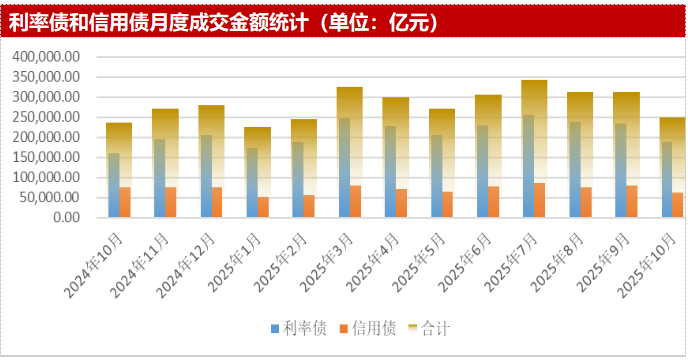
Core Viewpoint - The trading volume of credit bonds decreased in October, influenced by holiday effects and interest rate volatility expectations, while the overall bond market faces increasing adjustment pressure [1][6]. Trading Volume Summary - The total trading volume in the secondary bond market for October was 29,720.106 billion, a year-on-year increase of 3.32% but a month-on-month decrease of 20.21% [1]. - In terms of bond types, the trading volume for interest rate bonds was 18,855.627 billion, a year-on-year increase of 17.22% but a month-on-month decrease of 19.40%. The trading volume for credit bonds was 6,150.889 billion, with year-on-year and month-on-month decreases of 18.70% and 22.69%, respectively [3]. Credit Bond Characteristics - The trading characteristics of industrial bonds showed a shift towards high-grade and medium-short term bonds, while urban investment bonds remained relatively stable. The trading volume of industrial bonds decreased by 26.62% month-on-month, which was greater than the 16.89% decrease in urban investment bonds [3]. - The proportion of AAA-rated bonds in industrial bond transactions increased significantly to 56.18%, indicating a stronger preference for credit quality among investors [3]. Credit Spread Analysis - As of the end of October, the credit spread continued to compress, settling at 36.74 basis points, narrowing by 43.22 basis points year-on-year and slightly by 5.01 basis points month-on-month [4]. - The overall market liquidity remained stable, with the yield on government bonds showing a slight decline. The yield on credit bonds initially maintained the previous month's level but later decreased significantly, leading to an overall narrowing of credit spreads [4]. Urban Investment Bond Trends - Urban investment bonds exhibited a trend of narrowing credit spreads with significant regional differentiation. Most provinces saw a continued decline in credit spreads, while some, such as Xinjiang, Hainan, and Yunnan, experienced increases exceeding 10 basis points [5]. - In regions with notable debt pressure, such as Guizhou, Yunnan, and Gansu, the regional credit risks have been effectively mitigated due to strong policy support [5]. Future Market Outlook - The overall bond market is expected to face increasing adjustment pressure, with the likelihood of further compression in credit spreads diminishing. The central bank's actions, such as restarting government bond trading, may elevate the benchmark interest rate [6]. - After a period of contraction to historically low levels, the credit spreads lack the momentum for significant further compression, with future narrowing dependent on stronger economic recovery or more relaxed liquidity conditions [6].