
债务危机

Search documents
美国将成为下一个日本?美元霸权遭遇最大内患,美经济即将崩溃?
Sou Hu Cai Jing· 2025-09-10 10:05
Core Viewpoint - The article discusses the potential risks stemming from the U.S. non-farm employment data and critiques the Federal Reserve's monetary policy as a root cause of high inflation, wealth disparity, and uncontrollable debt risks, suggesting a need for a policy framework adjustment [1][2]. Group 1: Critique of the Federal Reserve - U.S. Treasury Secretary Becerra criticizes the Federal Reserve for serving political demands, which he believes undermines its independence and credibility [2][4]. - Becerra emphasizes the need for the Federal Reserve to return to its three statutory missions: maximizing employment, stabilizing prices, and maintaining moderate long-term interest rates, highlighting the importance of the third mission [5]. Group 2: Long-term Interest Rates - Becerra's focus on long-term interest rates, particularly U.S. Treasury yields, is crucial as he aims to ensure economic responsibility amid rising debt levels [6]. - The current high-interest environment poses challenges for funding government spending, with 15% of annual U.S. fiscal expenditures allocated to interest payments, which has increased significantly since the onset of the rate hike cycle in 2022 [8]. Group 3: Economic Indicators and Risks - Recent non-farm employment data indicates a significant drop in job creation, with actual figures at 22,000 compared to an expected 75,000, raising concerns about a potential economic recession [8][10]. - The upcoming revision of non-farm employment data is expected to show a downward adjustment of 800,000 jobs, suggesting that the U.S. economy is on the brink of collapse [10]. Group 4: Potential Policy Actions - Becerra expresses urgency for lowering long-term interest rates, as the transmission of Federal Reserve rate cuts primarily affects short-term yields, while long-term rates are influenced by market dynamics and perceptions of U.S. debt stability [11]. - The article discusses the potential for the Federal Reserve to adopt yield curve control strategies similar to Japan's, which could alleviate interest pressure on government debt but may lead to market distortions and reduced foreign investment [13]. Group 5: Global Implications - The article warns that any new round of fiscal expansion in the U.S. could exacerbate debt risks and undermine market trust, potentially leading to a global debt crisis [15]. - The current economic environment in the U.S. differs from Japan's past experience, as the U.S. faces inflation rather than deflation, indicating that high inflation could precede a debt crisis [15].


美国债务的大船很难转向!瑞·达利欧最新对话,给置身当下的年轻人肺腑建议
聪明投资者· 2025-09-10 07:04
Core Viewpoint - Ray Dalio emphasizes the urgency of addressing the U.S. debt crisis, highlighting the unsustainable nature of current fiscal policies and the potential consequences for the economy and the dollar's status as a wealth storage tool [2][4][24]. Group 1: U.S. Debt and Fiscal Policy - The annual interest expenditure on U.S. national debt has reached $1 trillion, with an additional $9 trillion in refinancing and $2 trillion in new debt issuance expected annually, potentially exceeding market absorption capacity [4][24]. - The U.S. government is projected to accumulate an additional $25 trillion in debt over the next decade, starting from a current base of $36 trillion [6][48]. - The current fiscal situation shows that U.S. government spending is approximately $7 trillion, while revenue is only $5 trillion, leading to a 40% deficit [23][24]. Group 2: Political and Economic Implications - Dalio argues that the debt crisis is fundamentally a political issue, as the inability to control fiscal deficits reflects a lack of consensus among political leaders [26][60]. - He suggests that to stabilize the debt level, the fiscal deficit should be kept at around 3% of GDP, which would require a combination of tax increases and spending cuts [27][29]. - The current political climate, characterized by polarization and a lack of effective governance, poses significant risks to addressing the debt crisis [60][73]. Group 3: Historical Context and Future Outlook - Dalio draws parallels between the current U.S. situation and historical precedents, noting that all nations have faced similar debt crises throughout history [19][20]. - He warns that if the current trajectory continues without intervention, it could lead to a devaluation of the dollar and a potential crisis similar to those experienced in the 1970s [40][46]. - The potential for a significant economic downturn is heightened by the interplay of five major forces: debt cycles, internal politics, international geopolitics, natural and climate shocks, and technological changes [4][61]. Group 4: Recommendations for Investors - Investors are advised to prepare for uncertainty by diversifying their portfolios and considering assets like gold as a hedge against systemic risks [82][83]. - Dalio emphasizes the importance of understanding the evolving nature of money and wealth storage in the current economic landscape [85]. - For young professionals entering the job market, aligning with high-performing individuals and leveraging AI tools can enhance opportunities for success [90][94].


刚刚 金价爆了!再创历史新高
Qi Huo Ri Bao· 2025-09-06 02:40
Group 1: Federal Reserve and Economic Data - The U.S. non-farm payrolls increased by 22,000 in August, significantly below the market expectation of 75,000, indicating a cooling labor market [1][2] - The unemployment rate in August reached 4.3%, matching market expectations and marking the highest level since October 2021 [1] - Following the employment data release, the probability of a Federal Reserve rate cut in September surged, with an 88.3% chance of a 25 basis point cut [1][2] Group 2: Gold and Silver Market - Gold prices reached a historical high, with spot gold rising by 1.5% to $3,600.15 per ounce, and a year-to-date increase of 37% [1][6] - The increase in gold prices is driven by strong expectations for a Federal Reserve rate cut, a weakening U.S. dollar, and rising market demand for safe-haven assets [6][7] - The SPDR Gold ETF holdings increased from 953.1 tons at the beginning of August to 981.9 tons by September 4, reflecting heightened investment interest [6][7] Group 3: Oil Market Dynamics - Saudi Arabia is pushing OPEC+ to consider restoring more oil production to regain market share, which has led to a significant drop in international oil prices [4] - Following the announcement, Brent crude fell below $65 per barrel, marking a new low since August 18, while WTI crude dropped to $61.3 per barrel, the lowest since June [4]
刚刚,金价爆了!再创历史新高
Qi Huo Ri Bao· 2025-09-06 02:07
Group 1: Federal Reserve and Economic Data - The U.S. non-farm payrolls increased by 22,000 in August, significantly below the market expectation of 75,000, indicating a cooling labor market [1] - The unemployment rate in August reached 4.3%, matching market expectations and marking the highest level since October 2021 [1] - The probability of a 25 basis point rate cut by the Federal Reserve in September is at 88.3%, with a 0% chance of maintaining the current rate [1][2] Group 2: Gold and Silver Market - Spot gold prices reached a historical high of $3,600.15 per ounce, with a year-to-date increase of 37% [1] - The rise in gold prices is driven by expectations of a rate cut, a weakening dollar, and increased market demand for safe-haven assets [4][5] - The SPDR Gold ETF holdings increased from 953.1 tons at the beginning of August to 981.9 tons by September 4, reflecting strong investment interest [4] Group 3: Oil Market - Saudi Arabia is pushing OPEC+ to consider restoring more oil production to regain market share, leading to a drop in international oil prices [3] - Brent crude oil fell below $65 per barrel, marking a new low since August 18, while WTI crude dropped to $61.3 per barrel, the lowest since June [3]
ETF资金出手!杠杆资金出逃。。
Sou Hu Cai Jing· 2025-09-05 09:18
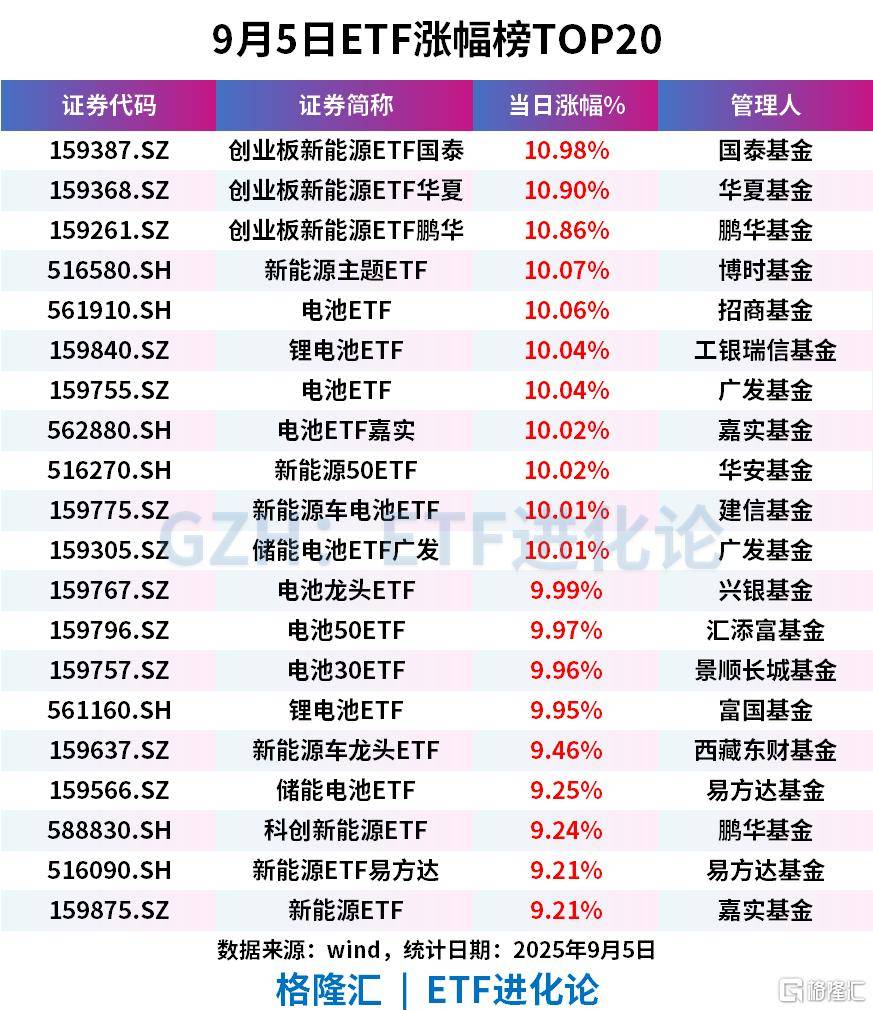
Market Overview - The Shanghai Composite Index rose by 1.24%, ending a three-day decline, while the ChiNext Index surged by 6.55%, reaching a new high since January 2022 [1] - Over 4,800 stocks in the market saw gains, with 105 stocks hitting the daily limit up [1] ETF Performance - Several ETFs related to new energy and batteries showed significant gains, with the top performers being: - ChiNext New Energy ETF by Guotai with a rise of 10.98% - ChiNext New Energy ETF by Huaxia with a rise of 10.90% - ChiNext New Energy ETF by Penghua with a rise of 10.86% [3] - The overall trend indicates a strong interest in new energy and battery sectors, as evidenced by the performance of related ETFs [3] Fund Flows - Leveraged funds saw a net sell-off of 9.703 billion yuan, while stock-type ETFs experienced a net inflow of 7.383 billion yuan [4] - The top three ETFs attracting capital were: - CSI 1000 ETF with a net inflow of 2.656 billion yuan - CSI 300 ETF with a net inflow of 1.718 billion yuan - Chemical ETF with a net inflow of 750 million yuan [5] Market Sentiment - The market is currently experiencing emotional fluctuations, with analysts suggesting that the bull market has entered its second phase [6] - Historical patterns indicate that adjustments in this phase typically last 2-3 trading days with declines of 3-5% [6][7] Global Market Context - The U.S. stock market saw all three major indices rise, with the S&P 500 closing at a record high [8] - Recent employment data showed a lower-than-expected increase in ADP employment numbers, influencing market expectations for a potential interest rate cut by the Federal Reserve [9] Investment Insights - Notable investors, including Ray Dalio, have expressed concerns about the current political and economic climate in the U.S., drawing parallels to historical crises [10] - Dalio predicts a potential debt crisis in the U.S. within three years, prompting some investors to shift from U.S. bonds to gold [11][12] Gold Market Dynamics - Gold prices have surged, with COMEX gold reaching over $3,600 per ounce, marking a year-to-date increase of over 36% [15] - The inflow into gold ETFs in the A-share market has reached 51.8 billion yuan this year, reflecting a strong demand for gold as a hedge against inflation and economic uncertainty [17][20]
贝鲁政府“岌岌可危”,谁能收拾法国债务的烂摊子?
Hua Er Jie Jian Wen· 2025-09-05 08:02
Core Viewpoint - France is facing a political crisis with Prime Minister Borne's government on the brink of collapse, which may lead to a larger economic or debt crisis if a strong fiscal consolidation plan is not implemented [1][6] Political Situation - A confidence vote in parliament is scheduled for September 8, with Borne's government likely to lose due to unpopular austerity measures [1] - Major political parties in France have vowed to overthrow the government unless unexpected abstentions occur [1] - President Macron aims to avoid early elections by seeking a consensus among parties to appoint a new Prime Minister [1] Debt Concerns - Analysts warn that without a robust fiscal plan, France's public debt-to-GDP ratio could rise by 10 percentage points to 125% by 2030 [4] - The current political deadlock is pushing the economy towards a dangerous edge, with market concerns already evident as long-term government bonds face selling pressure [2][5] Economic Outlook - The French economy is described as lacking growth momentum, with domestic demand suppressed by high political uncertainty [5] - Any tightening of financing conditions could jeopardize the anticipated economic recovery expected in 2026 [5] - The immediate economic consequences are currently manageable, but long-term investor concerns about France's fiscal situation are growing [6]
全球长债抛售潮!债务危机警钟敲响
Guo Ji Jin Rong Bao· 2025-09-03 11:43
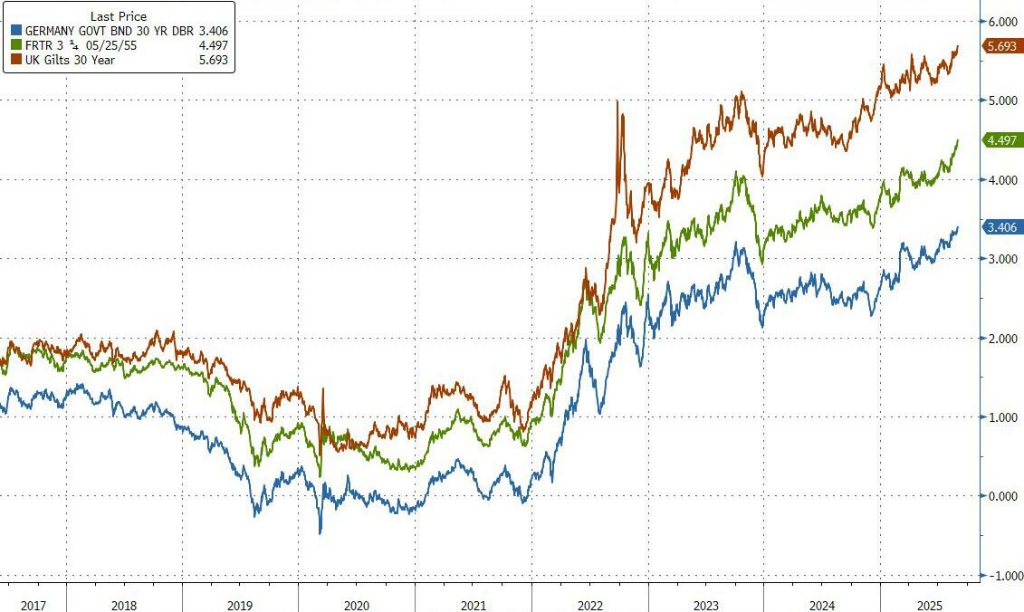
Core Viewpoint - The global bond market is experiencing significant sell-off pressure, leading to a surge in long-term bond yields across multiple countries [1] Group 1: Bond Yield Movements - The yield on the US 30-year Treasury bond has risen to 5%, marking the first increase since July [2] - Japan's 30-year bond yield has reached a historic high, while the 20-year bond yield has climbed to its highest level since 1999 [3] - Germany's 30-year bond yield increased by 2 basis points to 3.4340%, the highest level since July 2011 [4] - The UK 30-year bond yield briefly reached 5.735%, the highest since May 1998, with the 20-year and 10-year yields also hitting their highest levels since 1998 and January 2025, respectively [4] - France's 30-year bond yield is nearing 4.5%, the highest since 2009 [5] Group 2: Underlying Causes of Market Turmoil - The turmoil in the global bond market is attributed to heightened investor concerns regarding national debt levels [6] - In the US, the federal government's deficit for the current fiscal year is projected at $1.7 trillion, slightly down from $1.83 trillion in fiscal 2024, but still at a high level [6] - Concerns about the effectiveness of Trump's tariff policies in reducing the deficit have been raised, with significant uncertainty surrounding future revenue estimates [6] - In France, a no-confidence vote regarding the government's debt reduction plan is expected, with predictions that Prime Minister Borne may not survive the vote [6] - In the UK, recent cabinet reshuffles have failed to alleviate investor concerns about the country's fiscal situation, characterized by high borrowing and sluggish economic growth [6] Group 3: Political Uncertainty and Debt Sustainability - Political uncertainty in Japan, particularly regarding Prime Minister Kishida's leadership, is contributing to investor anxiety [7] - The global sustainability of debt is becoming a deeper concern, with investors demanding higher risk premiums for long-term bonds [7] - Analysts warn of a vicious cycle where rising debt concerns lead to higher yields, which in turn worsen debt dynamics [7] - The International Monetary Fund predicts that global public debt could exceed 95% of GDP by 2025, complicating efforts for fiscal consolidation [7]
铝:震荡偏强氧化铝:区间震荡铸造,铝合金:关注政策落地进展
Guo Tai Jun An Qi Huo· 2025-09-03 03:13
Report Industry Investment Ratings - Aluminum: Oscillating with an upward bias [1] - Alumina: Range-bound oscillation [1] - Cast aluminum alloy: Monitor policy implementation progress [1] Core Viewpoints - The report updates the fundamental data of aluminum, alumina, and cast aluminum alloy, including futures market prices, trading volumes, open interests, spot market prices, import and export profits and losses, and inventory levels [1]. - It also presents some external information such as Dalio's warning about the US economic situation and the US 8 - month ISM manufacturing PMI data [3]. Summary by Relevant Catalogs Futures Market - **Aluminum**: The closing price of the SHFE aluminum main contract was 20,720, with a change of 75 compared to T - 1. The trading volume was 103,466, a decrease of 55,120 from T - 1. The open interest was 213,947, down 7,232 from T - 1 [1]. - **Alumina**: The closing price of the SHFE alumina main contract was 3,022, up 14 from T - 1. The trading volume was 310,480, a decrease of 45,801 from T - 1. The open interest was 242,297, down 5,508 from T - 1 [1]. - **Aluminum Alloy**: The closing price of the aluminum alloy main contract was 20,300, up 25 from T - 1. The trading volume was 1,760, a decrease of 199 from T - 1. The open interest was 8,140, down 81 from T - 1 [1]. Spot Market - **Aluminum**: The domestic aluminum ingot social inventory was 616,000 tons, unchanged from T - 1. The LME aluminum ingot inventory was 479,600 tons, a decrease of 1,400 tons from T - 1. The aluminum spot import loss was 1,236.17 yuan, a loss increase of 52.67 yuan from T - 1 [1]. - **Alumina**: The domestic average alumina price was 3,212 yuan, a decrease of 10 yuan from T - 1. The alumina CIF price at Lianyungang was 386 US dollars per ton, unchanged from T - 1 [1]. - **Aluminum Alloy**: The three - place inventory totaled 34,501 tons, an increase of 786 tons from T - 1 [1]. Other Information - **Trend Intensity**: Aluminum trend intensity was 0; alumina trend intensity was 0; aluminum alloy trend intensity was 0 [3]. - **External News**: Dalio warned that Trump was leading the US towards a 1930s - style governance model, and the US might face a debt crisis in three years. The US 8 - month ISM manufacturing PMI was 48.7, contracting for the sixth consecutive month [3].
达利欧:特朗普正带领美国滑向1930年代,整个华尔街却因恐惧陷入沉默
华尔街见闻· 2025-09-02 10:29
Core Viewpoint - Ray Dalio warns that the current political and social climate in the U.S. resembles that of the 1930s, with Wall Street investors remaining silent due to fear of retaliation for criticizing presidential policies [1][3]. Group 1: Political and Economic Interventions - Dalio highlights Trump's intervention in the private sector, such as acquiring a 10% stake in Intel, as indicative of "strong authoritarian leadership" driven by a desire to control financial and economic situations [2][3]. - The increasing wealth gap, value gap, and erosion of trust are pushing the U.S. towards more extreme policies, weakening democratic institutions and leading to a rise in authoritarian leadership [3]. Group 2: Federal Reserve Independence - Dalio expresses concern over the independence of the Federal Reserve, stating that a politicized central bank will undermine confidence in its ability to protect the value of the currency [2][5]. - International investors are reportedly shifting from U.S. Treasury bonds to gold, reflecting concerns about the stability of the dollar system amid political pressures on the Federal Reserve [6]. Group 3: Debt Crisis Predictions - Dalio predicts that the U.S. will face a debt crisis in about three years, driven by a significant fiscal imbalance where annual spending is approximately $7 trillion against $5 trillion in revenue [7][8]. - Investors are questioning whether U.S. Treasury bonds remain a reliable store of wealth, as the demand for debt is unlikely to keep pace with supply [8].

瑞达期货贵金属产业日报-20250902
Rui Da Qi Huo· 2025-09-02 09:27
Report Industry Investment Rating - Not mentioned in the provided content Core Viewpoints - The recent strong performance of the precious metals market is driven by factors such as the strengthening expectation of the Fed's interest rate cut, Trump's pressure on Fed officials boosting risk - aversion sentiment, and the trading sentiment of the gold - silver ratio returning to the historical average. However, if the economic resilience is significantly stronger than expected, the gold price may have a phased correction, but the probability of a sharp decline is low. Technically, both gold and silver are in the over - bought zone and may need short - term adjustment [2] Summary by Relevant Catalogs Futures Market - **Closing Price**: The closing price of the Shanghai gold main contract was 804.32 yuan/gram, up 3.76; the closing price of the Shanghai silver main contract increased by 49 yuan/kilogram [2] - **Position**: The position of the Shanghai gold main contract was 138,624 hands, down 2,067; the position of the Shanghai silver main contract decreased by 12,097 hands. The net position of the top 20 in the Shanghai gold main contract was 176,304 hands, up 11,434; the net position of the top 20 in the Shanghai silver main contract increased by 3,513 hands [2] - **Warehouse Receipts**: The warehouse receipt quantity of gold was 40,191 kilograms, up 447; the warehouse receipt quantity of silver increased by 8,001 kilograms [2] Spot Market - **Spot Price**: The Shanghai Non - ferrous Metals Network gold spot price was 802 yuan/gram, up 6.62; the silver spot price increased by 165 yuan/kilogram [2] - **Basis**: The basis of the Shanghai gold main contract was - 2.32 yuan/gram, up 2.86; the basis of the Shanghai silver main contract increased by 116 yuan/kilogram [2] Supply - Demand Situation - **ETF Holdings**: The gold ETF holdings were 977.68 tons, up 9.74; the silver ETF holdings decreased by 22.59 tons [2] - **CFTC Non - commercial Net Positions**: The gold CFTC non - commercial net position was 214,311 contracts, up 1,721; the silver CTFC non - commercial net position decreased by 83 contracts [2] - **Supply and Demand Quantities**: The total quarterly supply of gold was 1,313.01 tons, up 54.84; the total annual supply of silver decreased by 21.4 million troy ounces. The total quarterly demand for gold was 1,313.01 tons, up 54.83; the total annual global demand for silver decreased by 47.4 million ounces [2] Option Market - **Historical Volatility**: The 20 - day historical volatility of gold was 9.2%, up 0.98; the 40 - day historical volatility of gold increased by 0.7% [2] - **Implied Volatility**: The implied volatility of at - the - money call options for gold was 20.18%, up 3.9; the implied volatility of at - the - money put options for gold was 20.19%, up 3.91 [2] Industry News - Ray Dalio said that international investors are shifting from US Treasuries to gold, and the US economy is on the verge of a debt crisis. The probability of the Fed keeping interest rates unchanged in September is 10.4%, and the probability of a 25 - basis - point rate cut is 89.6%. The probability of keeping interest rates unchanged in October is 4.9%, the probability of a cumulative 25 - basis - point rate cut is 47.3%, and the probability of a cumulative 50 - basis - point rate cut is 47.9%. Spot gold broke through $3,500, and domestic gold jewelry prices increased significantly [2]