
降息预期

Search documents
美国关税不确定性推升避险需求 贵金属走强
Ge Long Hui· 2026-02-25 07:10
Core Viewpoint - The rejection of multiple tariff measures by the U.S. Supreme Court has led to increased uncertainty in policy, prompting investors to flock to safe-haven metals, resulting in a rise in gold prices [1] Group 1: Market Reactions - Analysts indicate that the return of the Chinese market, combined with increased uncertainty in U.S. policy, is maintaining the attractiveness of gold and silver [1] - Spot gold has risen over 1%, while spot silver and platinum have increased by over 4%, and spot palladium has risen by more than 2% [1] Group 2: Federal Reserve and Interest Rates - Two Federal Reserve officials have suggested that there is no intention to change the central bank's interest rate policy in the short term [1] - The market currently anticipates three rate cuts of 25 basis points each this year [1] Group 3: Geopolitical Factors - The Omani Foreign Minister has announced that the U.S. and Iran will hold the third round of nuclear talks in Geneva on Thursday [1] - Ongoing geopolitical factors, such as U.S. fiscal and trade policies, are expected to continue supporting upward momentum in gold prices [1]
金价遇阻获利了结、利好仍在回撤仍可看涨
Sou Hu Cai Jing· 2026-02-25 03:28
Group 1 - The core viewpoint of the article indicates that international gold prices have faced resistance and declined due to a stronger dollar and profit-taking, alongside warnings from multiple Federal Reserve officials about persistently high inflation, which has significantly cooled interest rate cut expectations [1][2] - The geopolitical tensions in the Middle East have become a significant driving force for the gold market, despite the recent price fluctuations showing a pattern of oscillating upward [1][2] - The outlook for interest rate cuts remains, suggesting that the recent price pullback could present a buying opportunity at support levels [1] Group 2 - On the specific price movements, gold opened at $5227.26 per ounce, reached a daily high of $5249.43, then fell over $100 before stabilizing in the $5160-$5186 range, eventually closing at $5143.70, marking a daily decline of $83.56 or 1.6% [3] - The market is currently supported by moving averages, with the dollar index's early rebound losing momentum, providing some support for gold prices [3] - Federal Reserve officials have expressed caution regarding interest rate cuts, with indications that rates may be maintained for some time, which has pressured gold prices, although the potential for future cuts remains due to the administration's preference for low-rate policies [3]


黄金白银再次突破?麦向带你了解最新咨询
Sou Hu Cai Jing· 2026-02-25 03:11
Market Overview - The domestic and international markets are showing a significant divergence, with domestic markets strengthening post-Spring Festival due to concentrated consumer and investment demand [3] - As of February 25, 2026, the latest prices for gold and silver are as follows: London gold at $5186.11 per ounce (+0.77%), London silver at $88.562 per ounce (+1.54%), and domestic gold and silver prices showing mixed performance [3][4] Core Drivers of Market Trends - The expectation of interest rate cuts by the Federal Reserve in 2026 is igniting market interest, with predictions of a 50-75 basis point reduction, lowering the holding costs for non-yielding precious metals [5] - Continuous net purchases of gold by global central banks for 16 years, with an expected purchase of 755 tons in 2026, provide long-term support for gold prices [8] - Silver is experiencing a structural shortage, with a projected supply gap of 67 million ounces in 2026, driven by industrial demand [7] Investment Strategies - Gold is recommended as a stable asset, suitable for 5%-15% allocation of liquid assets, focusing on preservation of value rather than short-term profits [12] - Preferred investment tools for gold include gold ETFs and bank investment gold, while physical jewelry is advised against due to high premiums [13] - Silver is characterized by high price elasticity, making it suitable for risk-tolerant investors, with a recommended allocation of no more than 5% of total assets [14] Market Behavior and Sentiment - Increased speculative and allocation demand is evident, with rising ETF holdings for silver and gold, reflecting heightened market activity [10] - Geopolitical uncertainties and economic data weaknesses are driving safe-haven investments into precious metals [9]
银河期货每日早盘观察-20260225
Yin He Qi Huo· 2026-02-25 02:51
Report Industry Investment Rating No relevant content provided. Core Viewpoints of the Report - After the Spring Festival, the stock market showed a mixed performance with some sectors rising and others falling. The futures market also had different trends in various products, influenced by factors such as supply - demand, geopolitical situations, and policy changes [20][21][25]. - The bond market sentiment was not weak, but the market might become more cautious as the "Two Sessions" approached. The medium - term outlook for the bond market was relatively optimistic [25][26]. - In the agricultural product market, the supply and price trends of different products varied. For example, the supply of protein meal increased, and the price oscillated; the international sugar price bottomed out and oscillated [30][35]. - In the black metal market, steel faced post - holiday pressure, while the performance of coking coal and iron ore was affected by factors such as production resumption and supply - demand changes [62][65][71]. - In the non - ferrous metal market, precious metals like gold and silver were in high - level oscillations due to macro uncertainties, and other non - ferrous metals also had different price trends influenced by factors such as tariffs and supply - demand [76][79][84]. - In the shipping and carbon emission market, the container shipping market was in short - term oscillations, the dry bulk freight market showed a positive trend after the holiday, and the carbon price in the domestic market oscillated while the EU carbon price was affected by policies and public opinions [122][124][126]. - In the energy and chemical market, the prices of various products were affected by factors such as geopolitical situations, supply - demand, and cost. For example, crude oil was in high - level oscillations, and asphalt was supported by cost but with weak demand [132][136]. Summary by Relevant Catalogs Financial Derivatives Stock Index Futures - After the Spring Festival, the stock index rose across the board, but the trading volume was slightly insufficient. The market showed a clear differentiation, with some sectors rising and others falling. The trading strategy was to be bullish on the trend, buy on dips, and consider arbitrage and option strategies [20][21][23]. Treasury Bond Futures - On Tuesday, the bond futures contracts of various tenors generally strengthened. The central bank's large - scale net withdrawal of short - term liquidity after the holiday and the approaching of the "Two Sessions" affected the bond market sentiment. The trading strategy was to be neutral - bullish and wait and see for arbitrage [25][26][28]. Agricultural Products Protein Meal - The supply increased overall, and the price oscillated. The trading strategy was to short at high levels and wait and see for arbitrage [30][31]. Sugar - The increase in Indian sugar production was revised down, and the international sugar price bottomed out and oscillated. The domestic sugar market was in a bottom - oscillation trend. The trading strategy was to wait and see for arbitrage and sell put options in the short term [32][35][36]. Oilseeds and Oils - The domestic oil market made up for losses and maintained oscillations. The trading strategy was to wait and see for arbitrage and consider reverse arbitrage for some contracts [38][39][40]. Corn/Corn Starch - The spot price in the production area was stable, and the futures price was in high - level oscillations. The trading strategy was to buy on dips for the outer - market corn and short lightly on rallies for domestic corn, and consider expanding the spread between corn and starch [41][43]. Live Pigs - The supply increased gradually, and the price continued to decline. The trading strategy was to buy a small amount of the 05 contract and wait and see for arbitrage [44][46]. Peanuts - The spot price was stable, and the futures price oscillated in a narrow range. The trading strategy was to buy lightly on dips and sell put options [47][48]. Eggs - After the holiday, it entered the off - season, and the egg price was stable with a slight decline. The trading strategy was to short the June contract on rallies and wait and see for arbitrage [50][51][52]. Apples - The market performance varied after the year, with the western region performing slightly better than the eastern region. The trading strategy was to go long on the 5 - month contract on dips and consider a long - 5 short - 10 arbitrage [54][55][56]. Cotton - Cotton Yarn - The fundamentals changed little, and the cotton price was supported. The trading strategy was to go long on dips and wait and see for arbitrage [58][59][60]. Black Metals Steel - There was still pressure on steel after the holiday. The trading strategy was to maintain a weak - oscillation trend, hold short positions, and wait and see for arbitrage [62][63]. Coking Coal and Coke - Coal mines were gradually resuming production. The trading strategy was to consider going long on dips and wait and see for arbitrage [64][65][67]. Iron Ore - The fundamentals continued to weaken, and the ore price was in a weak - running state. The trading strategy was to be bearish and wait and see for arbitrage [70][71]. Ferroalloys - The cost support was strong, and it could be used as a long - position configuration on dips. The trading strategy was to go long on dips and wait and see for arbitrage [72][73][74]. Non - Ferrous Metals Gold and Silver - The macro uncertainties continued, and the prices were in high - level oscillations. The trading strategy was to hold long positions cautiously and consider option strategies [76][79][80]. Platinum and Palladium - Supported by macro and geopolitical factors, platinum could be bought on dips, and palladium could be traded in bands. Consider a long - platinum short - palladium arbitrage [80][81][83]. Copper - Affected by continuous tariff disturbances, the copper price was in a strong - oscillation state. The trading strategy was to be bullish in the long - term and consider option strategies [84][85]. Alumina - After the decline in the supply - side operating rate, the spot price was supported. The trading strategy was to be bullish in the short - term [86][87]. Electrolytic Aluminum - Tariff disturbances did not change the supply - demand support pattern. The trading strategy was to wait and see for both arbitrage and options [89][91][92]. Cast Aluminum Alloy - It oscillated with the aluminum price. The trading strategy was to wait and see for both arbitrage and options [93][95]. Zinc - After the correction stabilized, it could be bought on dips. The trading strategy was to wait and see for both arbitrage and options [96][97]. Lead - It oscillated in a range. The trading strategy was to go long lightly on dips and consider option strategies [99][100]. Nickel - The macro factors dominated the price fluctuations. The trading strategy was to hold long positions at low levels and wait and see for arbitrage [101][103][104]. Stainless Steel - Supported by cost, it followed the nickel price. The trading strategy was to hold long positions at low levels and wait and see for arbitrage [106]. Industrial Silicon - Attention should be paid to the resumption rhythm of large factories. The trading strategy was to rebound in the short - term and short on rallies in the medium - term [107][108]. Polysilicon - Driven by merger news, it might rebound in the short - term, and the spot price should be focused on in the medium - term [110][111]. Lithium Carbonate - The demand was good, and the price was at a high level. The trading strategy was to wait and see [113][115]. Tin - Attention should be paid to macro - policy trends. The trading strategy was to hold long positions at low levels and wait and see for arbitrage [118][120]. Shipping and Carbon Emissions Container Shipping - It was mainly in short - term oscillations, and attention should be paid to Maersk's opening - cabin price. The trading strategy was to wait and see for both single - side trading and arbitrage [121][122][124]. Dry Bulk Freight - After the holiday, the demand recovery drove the spot price to improve. Attention should be paid to the impact of the US Maritime Action Plan. The trading strategy was to wait and see [124][125][126]. Carbon Emissions - The domestic carbon price oscillated, and the EU carbon price was affected by policies and public opinions. The trading strategy was to wait and see [126][127][128]. Energy and Chemicals Crude Oil - The API inventory increased more than expected. The trading strategy was to be bullish on the trend, consider the bullish spread, and buy out - of - the - money call options [132][133]. Asphalt - The cost supported the spot price, but the rigid demand had not recovered. The trading strategy was to go long on the BU2606 contract on dips and wait and see for arbitrage [134][136][137]. Fuel Oil - The high - sulfur supply increased, and the low - sulfur price strengthened in the near - term. The trading strategy was to be bullish on the trend, consider expanding the spread between high - and low - sulfur fuel oil, and wait and see for options [139][140][141]. LPG - It was still dominated by geopolitical factors. The trading strategy was to wait and see for both single - side trading and arbitrage [142]. Natural Gas - It was waiting for geopolitical guidance. The trading strategy was to hold short positions on the HH second - quarter contract and wait and see for both arbitrage and options [145][146][147]. PX & PTA - Driven by cost. The trading strategy was to hold long positions, consider positive arbitrage, and wait and see for options [149][150]. BZ & EB - There was a supply vacuum in the overseas market. The trading strategy was to oscillate and consider reverse arbitrage [151][152]. Ethylene Glycol - There was obvious inventory - accumulation pressure. The trading strategy was to oscillate in a range and wait and see for both arbitrage and options [154][157]. Short - Staple Fiber - The polyester raw materials strengthened. The trading strategy was to be bullish on the price, consider narrowing the processing fee on rallies, and wait and see for options [158]. Bottle Chips - The supply was expected to be tight. The trading strategy was to be bullish on the price and wait and see for both arbitrage and options [160][162]. Propylene - The supply - demand support was acceptable. The trading strategy was to hold long positions and wait and see for both arbitrage and options [163]. Plastic PP - The L plastic was bullish on the trend, and the PP was to wait and see. The trading strategy was to go long on the L 2605 contract on dips and wait and see for both arbitrage and options [165][166]. Caustic Soda - The price was weakening. The trading strategy was to wait and see [168][169]. PVC - It was mainly in oscillations. The trading strategy was to go long on dips and wait and see for both arbitrage and options [170][173]. Soda Ash - The price was bullish on the trend. The trading strategy was to be bullish in the short - term, consider a long - soda - ash short - glass arbitrage, and wait and see for options [174][175]. Glass - The price was bearish on the trend. The trading strategy was to be bearish in the short - term, consider a long - soda - ash short - glass arbitrage, and wait and see for options [176][178]. Methanol - It was in a strong - oscillation state. The trading strategy was to go long on dips, consider a 5 - 9 positive arbitrage, and sell put options on corrections [179][180]. Urea - It was rising strongly. The trading strategy was to go long cautiously and wait and see for both arbitrage and options [182][183]. Pulp - The US dollar quotation increased, but the high inventory suppressed the rebound. The trading strategy was to hold long positions and consider option strategies [184][185][187]. Offset Printing Paper - The inventory was high, and the market rebound was limited. The trading strategy was to short on rallies and consider option strategies [188][189]. Logs - The supply and demand were both weak. The trading strategy was to wait and see and consider a 3 - 5 reverse arbitrage [190][192][193]. Natural Rubber and No. 20 Rubber - The gross profit of concentrated latex decreased for consecutive months. The trading strategy was to go long on the RU 05 contract and consider arbitrage strategies [194][196][197]. Butadiene Rubber - The growth rate of butadiene production slowed down. The trading strategy was to short the BR 04 contract lightly and wait and see for both arbitrage and options [198][200][201].
加元震荡走强 货币政策分化主导走势
Jin Tou Wang· 2026-02-25 02:28
Core Viewpoint - The USD/CAD exchange rate is experiencing a mild upward trend, primarily driven by the divergence in monetary policies between the Federal Reserve and the Bank of Canada, alongside a generally strong USD environment [1][2]. Group 1: Monetary Policy Divergence - The Federal Reserve's interest rate cut expectations are cooling, with the January meeting minutes reinforcing a "wait and see" approach, focusing on bringing inflation back to 2% [1] - The market anticipates a low probability of rate cuts in March, with expectations for rates to remain in the 3.50% to 3.75% range [1] - In contrast, the Bank of Canada has cut rates four times in 2025 by a total of 100 basis points, maintaining the key rate at 2.25% and signaling a long-term hold unless significant changes occur in the economic outlook [1][2] Group 2: Economic Conditions - The overall strength of the USD, reflected in a 0.14% increase in the USD index to 97.844, supports the USD/CAD exchange rate [2] - The Bank of Canada has lowered its GDP growth forecasts, predicting a growth rate of 1.2% for 2025 and 1.1% for 2026, indicating a weak economic outlook that diminishes support for the CAD [2] Group 3: Technical Analysis - The USD/CAD exchange rate is showing a mild upward trend, with recent price action rebounding from mid-February lows and finding support around 1.3690 [2] - If the exchange rate can maintain above the 1.3690 support level, it may test previous highs around 1.3724, with resistance concentrated between 1.3705 and 1.3724 [2] - The future trajectory of the USD/CAD exchange rate will depend on Federal Reserve policy decisions and Canadian economic data performance [2]
天然橡胶日度策略报告-20260225
Fang Zheng Zhong Qi Qi Huo· 2026-02-25 01:53
Group 1: Report Summary - The report is a daily strategy report on natural rubber by the Futures Research Institute of Fangzheng Mid-term [3] - It was written on February 24, 2026 [1] Group 2: Investment Ratings - No investment ratings provided in the report Group 3: Core Views - After the Spring Festival, the chemical industry and the stock market rose sharply, boosting the rubber futures price to challenge the previous high. The overseas spot price of rubber was stable to firm during the holiday, and the suspension of production in rubber-producing areas supported the rubber price [3] - In the US, the GDP growth rate in Q4 2025 was 1.4% quarter-on-quarter annualized, lower than the market expectation of 2.5% and the revised value of 4.4% in Q3. The PCE price index rose 2.9%, higher than the previous value of 2.8%. The core CPI annual rate in January 2026 dropped to 2.5%, a five - year low. The expectation of interest rate cuts has increased [3] - The confrontation between the US and Iran has escalated, and the Russia - Ukraine negotiation has not made substantial progress, causing the crude oil price to gap up, which in turn drove up the synthetic rubber price. However, the potential decline in geopolitical sentiment and the rise in macro - hedging sentiment could lead to a retracement of the crude oil price premium [3] - The US President Trump signed an executive order to impose a 10% global tariff on all countries, increasing market concerns about a new round of trade conflicts [4] - As of February 8, 2026, the social inventory of natural rubber in China was 1.296 million tons, a month - on - month increase of 15,000 tons or 1.2%, which is a major risk factor for the current rise in rubber prices [4] - The rubber - producing areas are gradually entering the off - season, and the raw material price is stable to firm. The downstream is in the seasonal off - season with weak terminal demand, and the finished product inventory is increasing. The supply - demand surplus pattern is expected to gradually improve in the long - term [4] - For rubber trading, take partial profits on long single - sided positions at high levels and avoid chasing the market at high levels due to the volatile macro sentiment [4] Group 4: Section Summaries Part I: Rubber Variety View Summary - For rubber, the recommended strategy is to buy on dips. The main logic is the continuous small increase in domestic spot inventory, stable overseas supply, firm spot price, and the boost from macro sentiment. The support range is 15,500 - 15,800, and the pressure range is 16,300 - 16,500. The market is expected to fluctuate upwards [10] - For 20 - number rubber, the recommended strategy is also to buy on dips. The main logic is that the dark - colored rubber has reached an inventory turning point, the Thai glue price is firm, and the output in Q4 is declining. The support range is 12,700 - 12,800, and the pressure range is 13,420 - 13,805. The market is expected to recover from the bottom [10] Part II: Futures Market Review I. Futures Market Review - The closing price of the rubber continuous contract was 17,030, with a daily increase of 3.90% or 640. The trading volume was 245,962, and the open interest was 162,068 [10] - The closing price of the 20 - number rubber continuous contract was 13,795, with a daily increase of 3.96% or 525. The trading volume was 66,703, and the open interest was 47,522 [10] - The closing price of the Singapore TSR20 continuous contract was 194, with a daily increase of 0.57% or 1. The trading volume was 1,899, and the open interest was 24,490 [10] II. Futures Market Warehouse Receipts - The latest warehouse receipt quantity of 20 - number rubber was 50,601, a year - on - year change of - 4.20%. The warehouse receipts have rebounded from a low level, and the market's expectation of inventory accumulation has resurfaced [14] - The latest warehouse receipt quantity of rubber was 112,570, a year - on - year change of - 40.42%. A large number of warehouse receipts were cancelled today, and the futures inventory has dropped sharply year - on - year, increasing the delivery risk of futures contracts and supporting the RU futures price [14] Part III: Spot Market Trends - The spot price of natural rubber was 16,283 yuan/ton, a month - on - month decrease of 109 yuan/ton and a year - on - year decrease of 853 yuan/ton [19] - The price of Yunnan glue was 14,200 yuan/ton, unchanged month - on - month and a year - on - year decrease of 1,800 yuan/ton [19] - The price of Thai Haie glue was 62 Thai baht/kg, unchanged month - on - month and a year - on - year decrease of 4 Thai baht/kg [19] - The price of Thai Haie cup rubber was 57 Thai baht/kg, a month - on - month increase of 1 Thai baht/kg and a year - on - year decrease of 5 Thai baht/kg [19] - The price of Thai 20 - number standard rubber in Qingdao Free Trade Zone was 1,980 US dollars/ton, unchanged month - on - month and a year - on - year decrease of 170 US dollars/ton [19] Part IV: Basis and Spread Situation - The basis of the RU main contract was - 32, a month - on - month increase of 10 and a year - on - year increase of 437 [24] - The basis of the NR main contract was 1,820, a month - on - month increase of 90 and a year - on - year increase of 115 [24] - The non - standard basis of Thai mixed - RU was - 985, a month - on - month decrease of 55 and a year - on - year increase of 250 [24] - The non - standard basis of SVR3L - RU was 235, a month - on - month decrease of 100 and a year - on - year increase of 570 [24] - The cross - variety spread of RU - NR was 3,235, a month - on - month increase of 100 and a year - on - year increase of 695 [24] - The spread between light and dark - colored rubber (whole milk - Thai mixed) was 720, a month - on - month increase of 55 and a year - on - year decrease of 30 [24] Part V: Inter - month Spread Situation - For rubber, the 5 - 9 spread was 200, a month - on - month increase of 80 and a year - on - year increase of 345. It is expected to fluctuate within a range, and the recommended strategy is to wait and see [26] - For 20 - number rubber, the 3 - 4 spread was - 70, a month - on - month decrease of 10 and a year - on - year decrease of 365. It is expected to fluctuate within a range, and the recommended strategy is to wait and see [26] Part VI: Industrial Supply, Demand and Inventory Situation - No specific data summaries were provided in the text, only the figure descriptions related to supply, demand and inventory were given [30] Part VII: Option - related Data - No specific data summaries were provided in the text, only the figure descriptions related to option data were given [34]
中国人民银行今日早评-20260225
Ning Zheng Qi Huo· 2026-02-25 01:42
Report Industry Investment Rating - Not provided in the report Core Viewpoints - The report provides short - term outlooks for various commodities and long - term government bonds, with most expected to show oscillatory trends, and some with specific directional tendencies such as natural rubber being oscillatory and bullish, and soda ash being oscillatory and bearish in the short - term [2][4][5] Summary by Commodity Precious Metals - **Silver**: Rare metal demand is supported, but silver follows gold's fluctuations. After the holiday, market risk appetite weakened, and the bullish force for silver is less than that of gold. In the medium - term, it is expected to oscillate at a high level [2] - **Gold**: Fed officials' remarks weakened market expectations for interest rate cuts, and the upward momentum of gold is insufficient. Considering US tariffs and geopolitical factors, it may oscillate at a high level in the medium - term [2] Ferrous Metals - **Manganese Silicon**: The manganese silicon market has a situation of strong supply and weak demand, with increasing upstream inventory. The futures price of the main contract is expected to oscillate around the cost [4] - **Iron Ore**: After the holiday, iron - making water production increases while steel enterprises digest inventory. The demand for iron ore is expected to be average. Considering the possible increase in arrivals at ports, there is still pressure for post - holiday inventory accumulation. In the short - term, the price is expected to oscillate [4] - **Rebar**: On the first day after the holiday, most downstream terminals have not started work, and trading volume is scarce. Affected by the decline in iron ore and coking coal futures, rebar futures weakened. In the short - term, steel prices are expected to oscillate [5] Non - ferrous Metals - **Copper**: Supply - side constraints are strengthened, while demand is not fully activated. High prices suppress procurement willingness, and US tariff policies cause market sentiment fluctuations. Copper prices are expected to oscillate at a high level, waiting for inventory inflection points and consumption verification [5] - **Aluminum**: There was a small supply surplus in the global aluminum market at the end of last year due to seasonal consumption decline. Supply has a rigid bottom - support, and the strength of demand recovery will determine the upward space. Aluminum prices are expected to oscillate [8] Energy - **Crude Oil**: The situation between the US and Iran is the short - term market focus. Non - OPEC+ production increases and the release of previously accumulated production by OPEC+ are driving the market into a re - balancing or inventory - accumulation cycle. Short - term trading is recommended [6] Chemicals - **Natural Rubber**: During the Spring Festival, overseas futures and raw material prices rose, and overseas production areas are entering the production - reduction period. Downstream enterprises are gradually resuming work. Natural rubber is expected to oscillate and be bullish [9] - **Asphalt**: Supply decreased, demand decreased, inventory increased, and production profit decreased. Affected by geopolitical factors, asphalt may be supported and run strongly [10] - **PVC**: Supply is abundant, and inventory may continue to accumulate after the holiday. The cost support is weakened. In the short - term, PVC market prices are expected to oscillate [10] - **Soda Ash**: The soda ash market has a situation of strong supply and weak demand, with new production capacity putting pressure on the market. In the short - term, it is expected to oscillate and be bearish [11] - **Methanol**: Domestic methanol production is at a high level, port inventory is high, and downstream demand has declined. After the holiday, some downstream enterprises are resuming work. In the short - term, it is expected to oscillate [12] Bonds - **Long - term Government Bonds**: The central bank's MLF incremental renewal continues, and the capital market is loose, which is beneficial for the bond market. Although the stock market had a good start, its impact on the bond market is limited. In the short - term, the upward momentum of the bond market is insufficient, and it may be bullish in the medium - term [12]
张尧浠:金价遇阻获利了结、利好仍在回撤仍可看涨
Sou Hu Cai Jing· 2026-02-25 01:35
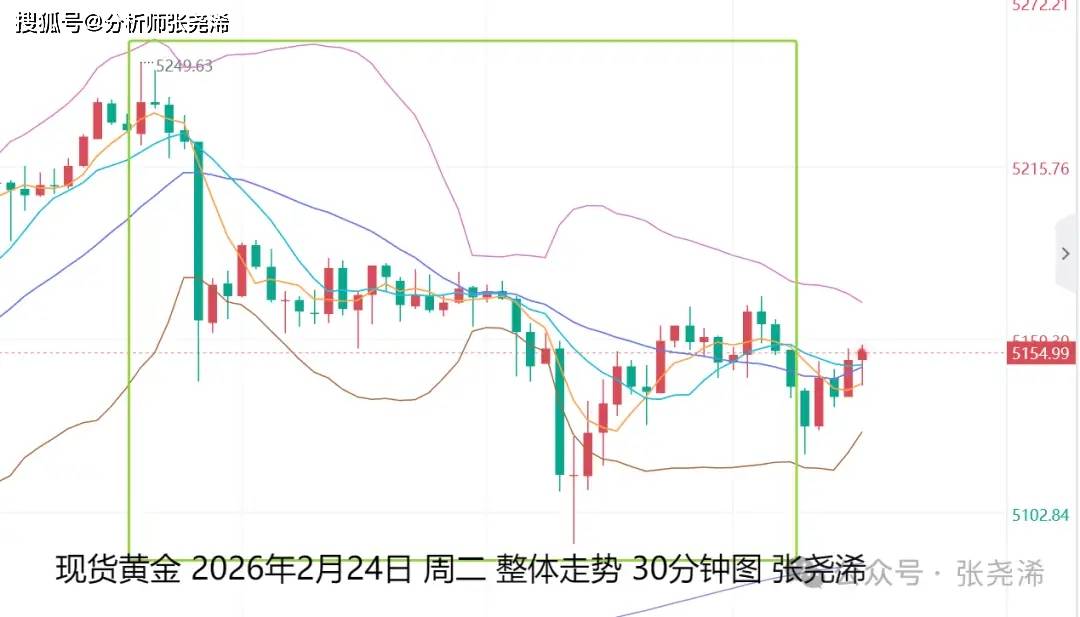
Core Viewpoint - The recent decline in gold prices is attributed to a stronger US dollar and profit-taking, but the long-term outlook remains bullish due to ongoing geopolitical tensions and potential interest rate cuts later in the year [1][5]. Market Performance - On February 24, gold opened at $5,227.26 per ounce, reached a high of $5,249.43, and then fell over $100 before stabilizing in the $5,160-$5,186 range. The lowest point was $5,094.07, closing at $5,143.70, marking a daily drop of $83.56 or 1.6% [3]. - The trading range indicates a volatile market, with a daily fluctuation of $155.36 [3]. Technical Analysis - The monthly chart shows that after a dip in February, gold prices rebounded after hitting a support level, indicating a continuation of the new bull market [6]. - The daily chart suggests that while there was a bearish reversal pattern, gold remains above the upward trend channel, indicating limited downside potential [7]. Geopolitical Factors - Geopolitical tensions have been a long-term driver for the gold market, with fluctuations in these tensions contributing to gold's upward trajectory [5]. - The combination of geopolitical concerns and central bank buying is expected to provide solid support for gold prices in the near term [5]. Future Outlook - The expectation of interest rate cuts later in the year, alongside ongoing geopolitical uncertainties, suggests that gold will maintain a bullish trend, with potential for new highs [5][6]. - Key support levels for gold are identified at $5,130 and $5,060, while resistance levels are at $5,230 and $5,300 [8].
中信建投期货:2月25日工业品早报
Xin Lang Cai Jing· 2026-02-25 01:21
Group 1: Copper Market - The main copper futures in Shanghai closed at 102,220 yuan, while London copper was around 13,200 USD [4][15] - The macroeconomic outlook is neutral to bearish due to the U.S. imposing a 10% global tariff and preparing to increase it to 15%, leading to uncertainty in global trade policies [4][15] - The fundamentals are also neutral to bearish, with an increase in copper warehouse receipts by 80,000 tons to 277,000 tons on the Shanghai Futures Exchange and a rise in LME copper inventory by 1,350 tons to 243,000 tons [4][15] - China's social copper inventory increased by approximately 155,000 tons during the Spring Festival to 508,000 tons [4][15] - Overall, copper prices are expected to remain under pressure in the short term due to tariff policies and geopolitical conflicts, but there is some resilience supported by downstream recovery and domestic policy expectations [4][15] Group 2: Aluminum Market - The overnight aluminum oxide futures saw a slight decline, with spot prices in Shandong quoted at or slightly above institutional prices [16][17] - The decline in production and increased maintenance of aluminum oxide production facilities, along with unexpected policy-driven production cuts in northern regions, have tightened short-term supply [16][17] - The operating capacity of aluminum oxide has decreased to approximately 93.5 million tons, with expectations of continued low operation levels [16][17] - The aluminum market is experiencing a slight improvement in dynamic supply-demand balance, but static balance remains in surplus, leading to a short-term focus on price fluctuations [16][17] Group 3: Zinc Market - The overnight zinc market showed weak fluctuations, with macroeconomic factors including China's response to U.S. tariffs and pressure on the Japanese yen creating mixed signals [18][19] - There is a slight expectation of increased processing fees in February and March, but the recovery pace of smelters and downstream die-casting plants remains slow, leading to subdued spot transactions [18][19] - Zinc ingot inventory increased by 49,000 tons during the Spring Festival, aligning with market expectations, and is at the second-highest level since 2022 [18][19] - Overall, supply-side disturbances are providing price support, but weak short-term spot performance suggests a bottoming out of zinc prices [18][19] Group 4: Lead Market - The lead market showed a strong upward trend overnight, with tight supply of lead concentrate and reduced production at smelters due to pre-holiday shutdowns [19] - The price of recycled lead is under pressure, leading to increased selling by holders, while smelters are also reducing production [19] - The overall supply-demand balance remains weak due to the extended holiday period, leading to low price fluctuations in lead [19] Group 5: Precious Metals Market - Precious metals exhibited mixed trends, with gold, silver, and platinum experiencing slight pullbacks after initial gains, while palladium saw a small increase [21] - The easing of geopolitical risks between the U.S. and Iran and reduced expectations for interest rate cuts have influenced precious metal prices [21] - The Federal Reserve's comments on maintaining current interest rates and better-than-expected consumer confidence index have added pressure on precious metals [21] - Overall, precious metals are expected to remain in a wide fluctuation state, with a focus on short-term volatility risks [21]


黄金早参|美联储官员释放鹰派言论,降息预期降温,金价上行动能受压制
Sou Hu Cai Jing· 2026-02-25 01:15
Group 1 - The core viewpoint of the article highlights the volatility in gold prices influenced by U.S. Federal Reserve officials' statements and Trump's tariff policies, with gold prices initially rising but later experiencing a decline due to profit-taking and a stronger dollar [1] - Gold prices reached a high of $5,269 per ounce before dropping to a low of $5,109 during trading, ultimately closing at $5,160.50, reflecting a 1.25% decrease [1] - The Chicago Fed President Goolsbee indicated that further interest rate cuts are not appropriate until there is more evidence of sustained inflation decline, emphasizing the lessons learned from previous misjudgments regarding inflation [1] Group 2 - The performance of gold-related ETFs was positive, with the Huaxia Gold ETF rising by 3.57%, the Gold Stock ETF increasing by 5.7%, and the Nonferrous Metals ETF gaining 3.22% [1] - The analysis from Huizhong Finance noted that after reaching multi-week highs, some investors opted to lock in profits, leading to increased selling pressure, which is a common phenomenon after rapid price increases [1] - The hawkish statements from Federal Reserve officials provided solid support for the U.S. dollar, further exacerbating the relative weakness of gold prices, as gold typically has an inverse relationship with the dollar index [1]